
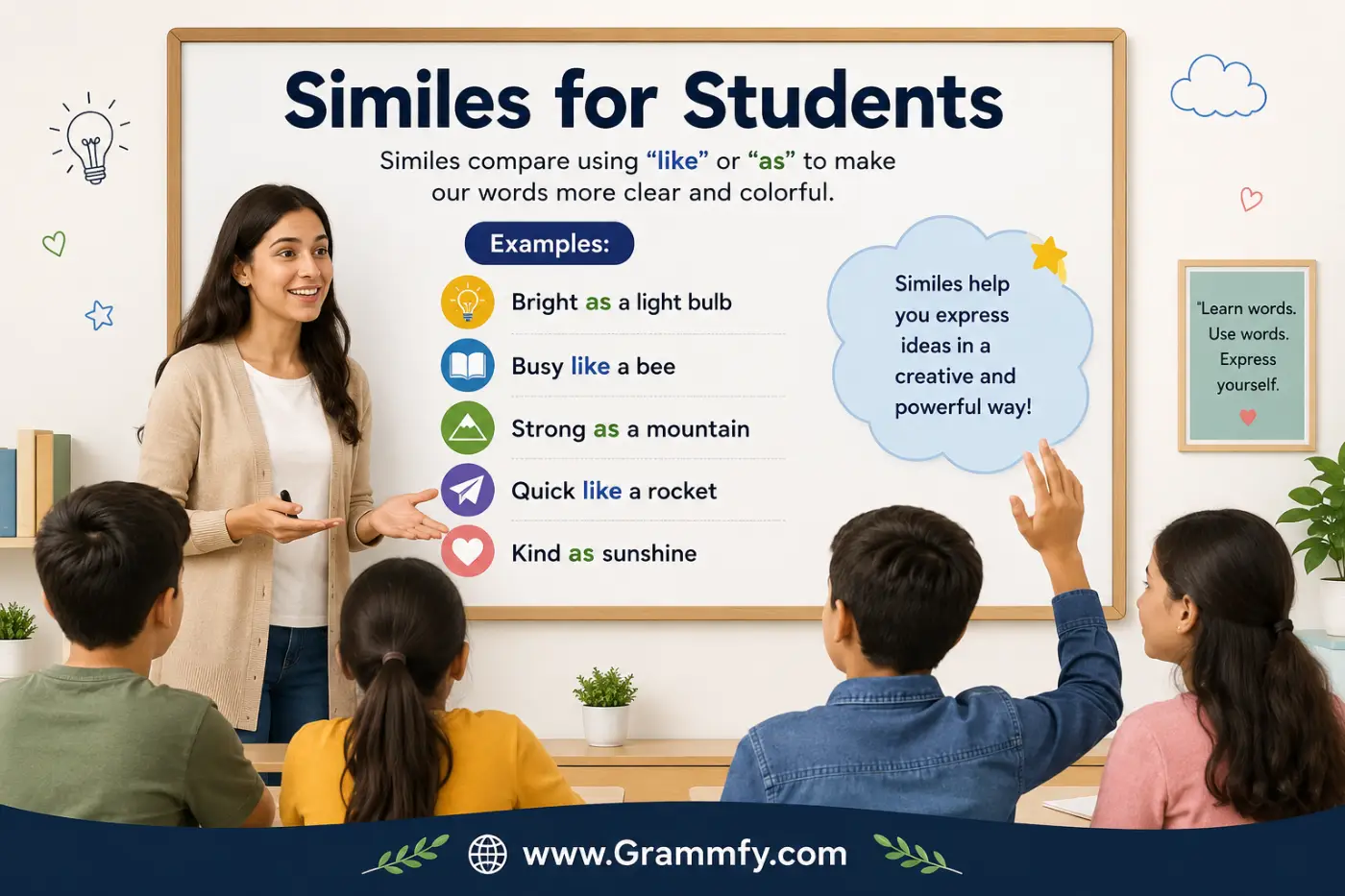
Writing about students can become repetitive when every sentence uses words like “smart,” “busy,” “curious,” or “hardworking.” A well-chosen comparison can bring those qualities to life. Similes for students help writers show what a learner is like instead of simply telling the reader.
Answer box: Similes for students compare learners to familiar people, animals, objects, or natural things to describe qualities such as curiosity, intelligence, energy, kindness, or determination.
Imagine writing a school report, student recommendation, classroom story, essay, or teacher comment. Saying “Maria is hardworking” gives useful information, but “Maria works like a steady little engine” creates a clearer picture. The reader can almost see her staying focused and moving forward.
Not every comparison needs to praise a learner, either. A student can be described as “busy as a bee,” “curious as a cat,” “quiet as a mouse,” or “eager as a puppy.” The best expression depends on the quality you want to highlight.
This guide covers 30+ useful comparisons, the meaning behind them, synonym choices, levels of intensity, examples for school and everyday situations, formal alternatives, common mistakes, and practical tips for choosing the right comparison.
Another helpful guide to figurative language is [similes for stars].
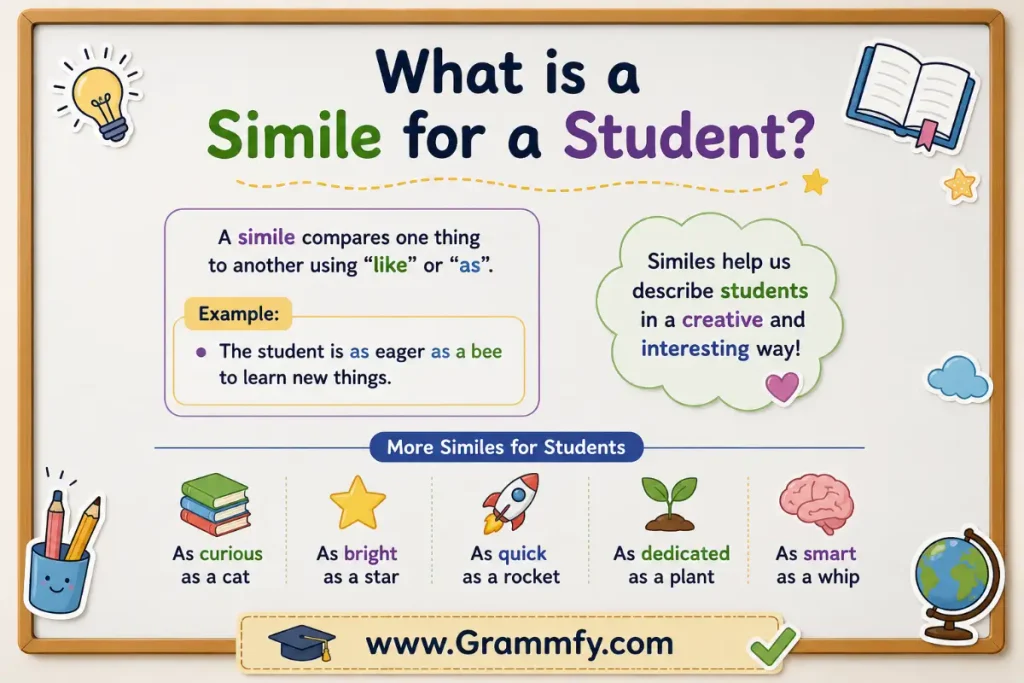
What is a simile for a student?
A simile is a comparison between two different things that usually uses “like” or “as.” Writers use similes to create a mental picture or make an idea easier to understand.
For example:
- “The student was as busy as a bee.”
- “She studied like a determined athlete.”
- “He was as curious as a cat.”
- “The children moved like a flock of excited birds.”
The comparison doesn’t mean the student is literally a bee, athlete, cat, or bird. Instead, the writer borrows a familiar quality from that image.
A bee suggests activity and hard work.
A cat suggests curiosity.
An athlete suggests discipline and effort.
A flock of birds can suggest excitement and movement.
That makes similes useful in creative writing, school assignments, teacher feedback, and descriptions of young learners.
Where does the word “student” come from?
The word student comes from the Latin verb studere, meaning “to be eager,” “to apply oneself,” or “to study.” The word developed through Old French and Middle English before becoming the familiar English noun used today.
In modern English, a student is someone who studies or learns, usually at a school, college, university, or other educational setting.
The word can describe learners of almost any age:
- Elementary school students
- Middle school students
- High school students
- College students
- University students
- Adult students
- Language students
- Online students
- Music students
- Art students
Because students have different personalities and learning styles, one comparison won’t fit everyone.
A thoughtful writer should first identify the quality being described. Is the learner curious? Focused? Energetic? Quiet? Creative? Determined? Once the quality is clear, finding a fitting comparison becomes much easier.
What are the best similes for students?
Here are some of the most useful choices, grouped by the quality they express.
| Simile | Meaning | Tone | Example |
|---|---|---|---|
| As busy as a bee | Very active and hardworking | Positive | She was as busy as a bee during the project. |
| As curious as a cat | Eager to discover things | Positive | The student was as curious as a cat. |
| As quiet as a mouse | Very quiet | Gentle | He was as quiet as a mouse during the test. |
| As bright as a star | Intelligent or talented | Positive | Maya is as bright as a star in math. |
| Like a sponge | Absorbs information quickly | Positive | The new student learned like a sponge. |
| Like a growing tree | Developing steadily | Positive | Her skills grew like a young tree. |
| As steady as a clock | Consistent and reliable | Positive | His study habits were as steady as a clock. |
| Like a busy ant | Hardworking | Positive | The student worked like a busy ant. |
| Like a puzzle solver | Enjoys finding answers | Positive | He approached the problem like a puzzle solver. |
| As determined as a mountain climber | Strongly motivated | Positive | She was as determined as a mountain climber. |
| Like a candle in the dark | Brings hope or insight | Creative | His idea was like a candle in the dark. |
| Like a sponge soaking up knowledge | Learns eagerly | Positive | The class was like sponges soaking up knowledge. |
| Like a young artist | Creative and expressive | Positive | She approached the assignment like a young artist. |
| As brave as a lion | Courageous | Strong | He was as brave as a lion during the speech. |
| As sharp as a tack | Quick-thinking and intelligent | Informal | The new student was as sharp as a tack. |
Which similes describe hardworking students?
Hard work is one of the most common qualities teachers and writers want to describe. Rather than repeating “hardworking,” use a comparison that shows steady effort.
As busy as a bee
This is a familiar expression for someone who is active and productive.
Example:
“Lena was as busy as a bee, finishing her research before the deadline.”
The image works because bees spend their time moving from place to place and completing useful tasks.
Like a busy ant
Ants are often associated with teamwork, persistence, and steady effort.
Example:
“Daniel worked like a busy ant, organizing every part of the group project.”
This choice feels especially natural when the student is working consistently rather than dramatically.
Like a runner near the finish line
This comparison emphasizes determination.
Example:
“Near the end of the semester, she studied like a runner near the finish line.”
The image suggests that the student is tired but motivated to finish.
As steady as a clock
This comparison focuses on consistency.
Example:
“His study routine was as steady as a clock.”
Use this when the student regularly completes work instead of working hard only before deadlines.
What similes describe intelligent students?
Intelligence can mean many things. A learner might solve problems quickly, understand difficult ideas, ask insightful questions, or make creative connections.
As bright as a star
This is a warm and positive way to describe a talented student.
Example:
“Amir is as bright as a star when he works with numbers.”
As sharp as a tack
This is an informal expression for someone who is quick to understand things.
Example:
“Her new classmate is as sharp as a tack.”
The phrase works well in casual writing but isn’t the best choice for a formal academic report.
Like a little scientist
This comparison works when intelligence appears through observation and questioning.
Example:
“She examined every part of the experiment like a little scientist.”
The phrase highlights curiosity as well as intelligence.
Like a puzzle solver
A puzzle solver looks for patterns and connections.
Example:
“He approached every math problem like a puzzle solver.”
This is especially useful when describing analytical thinking.
Which comparisons describe curious learners?
Curiosity is often easier to show through an image than through a simple adjective.
As curious as a cat
This is one of the most recognizable comparisons for curiosity.
Example:
“The students were as curious as cats when the teacher brought in the mystery box.”
The comparison works because cats are commonly associated with exploring unfamiliar objects.
Like a young explorer
This image suggests adventure, discovery, and enthusiasm.
Example:
“Ella entered the science museum like a young explorer.”
Like a little scientist
This works when curiosity involves testing ideas.
Example:
“He asked questions like a little scientist examining a new discovery.”
Like a detective searching for clues
This is useful when a student enjoys finding answers.
Example:
“She read the story like a detective searching for clues.”
The comparison shows active thinking instead of passive reading.
What similes describe focused students?
Focus is important during tests, presentations, reading, and problem-solving.
As focused as an eagle
This comparison creates an image of close attention.
Example:
“During the final exam, Jordan was as focused as an eagle.”
As steady as a clock
The phrase can also describe consistent concentration.
Example:
“She stayed as steady as a clock while working through the difficult questions.”
Like a laser
A laser has a narrow, concentrated beam, so this comparison suggests strong attention.
Example:
“He worked like a laser once he started the research project.”
This is informal and modern, so it fits casual writing better than formal academic prose.
Like a runner near the finish line
This comparison works when focus increases near a goal.
Example:
“By Friday, the class was working like runners near the finish line.”
How do you describe quiet students with similes?
Quietness isn’t automatically a weakness. A quiet learner may be thoughtful, observant, shy, focused, or simply calm.
As quiet as a mouse
This is a common, gentle comparison.
Example:
“The new student was as quiet as a mouse during the first lesson.”
As calm as a lake
This gives a more positive feeling.
Example:
“During the presentation, she remained as calm as a lake.”
Like a shadow
This can suggest someone who stays in the background.
Example:
“He moved through the busy classroom like a quiet shadow.”
Be careful with this one because it may suggest that the person is unnoticed or withdrawn.
Which similes describe energetic students?
Some students bring constant movement and excitement to a classroom.
As energetic as a rabbit
This is playful and easy for younger readers to understand.
Example:
“The children were as energetic as rabbits after recess.”
As lively as a spring morning
This creates a cheerful image.
Example:
“The class was as lively as a spring morning.”
Like a burst of sunshine
This can describe energy that also brings happiness.
Example:
“Her arrival was like a burst of sunshine in the classroom.”
Like a flock of excited birds
This comparison works especially well for groups.
Example:
“The students moved like a flock of excited birds when the bell rang.”
What comparisons describe creative students?
Creativity isn’t limited to art. A creative student may invent solutions, write original stories, design projects, or approach a problem from an unusual angle.
Like a young artist
This comparison suggests imagination and expression.
Example:
“She approached the writing assignment like a young artist.”
Like a painter with a blank canvas
A blank canvas represents unlimited possibilities.
Example:
“He treated the science project like a painter with a blank canvas.”
Like a storyteller opening a new book
This works well for students who create imaginative narratives.
Example:
“She began her story like a storyteller opening a new book.”
Like a gardener planting ideas
This is a more original comparison.
Example:
“He filled the discussion like a gardener planting new ideas.”
The image suggests that creativity can grow over time.
What are 30+ synonyms for “student” and related learner words?
Sometimes you don’t need a simile at all. A precise noun can make a sentence more natural.
| Word | Meaning | Tone | Example |
|---|---|---|---|
| Learner | Person gaining knowledge | Neutral | Every learner progresses differently. |
| Pupil | School student | Formal, UK | Each pupil received a workbook. |
| Classmate | Student in the same class | Everyday | My classmate helped me study. |
| Scholar | Serious or advanced student | Formal | The scholar researched ancient texts. |
| Freshman | First-year college or high school student | US | The freshman joined the club. |
| Sophomore | Second-year US student | US | The sophomore enrolled in biology. |
| Senior | Final-year US high school or college student | US | The senior prepared for graduation. |
| Attendee | Person attending an educational event | Formal | Every attendee received a certificate. |
| Reader | Person studying written material | Neutral | The reader examined the article. |
| Candidate | Person preparing for or seeking a qualification | Formal | The candidate completed the exam. |
| Test-taker | Person taking a test | Informal | Every test-taker received instructions. |
| Schoolchild | Child who attends school | General | The schoolchild carried a backpack. |
| Educand | Person receiving education | Formal, uncommon | The program supports each educand. |
| Apprentice learner | Person developing practical skills | Formal | The apprentice learner practiced daily. |
| Language learner | Person learning a language | Neutral | Every language learner needs regular practice. |
| Lifelong learner | Person who keeps learning throughout life | Positive | A lifelong learner stays curious. |
These words are related but aren’t interchangeable in every sentence.
“Pupil” is more common in British English.
“Student” is standard in both American and British English.
“Scholar” often suggests serious academic work.
“Apprentice” usually involves practical training.
“Trainee” is common in workplace learning.
“Learner” is broad and works well in education discussions.
How do these synonyms change by intensity?
The word you choose can make a description sound gentle, neutral, or very strong.
Mild descriptions
Use these when the learner is still developing:
- Beginner
- Newcomer
- Novice
- Inexperienced learner
- Developing student
- Curious learner
Example:
“She is a curious learner who enjoys trying new activities.”
Neutral descriptions
These work in most school contexts:
- Student
- Learner
- Classmate
- Participant
- Pupil
- Trainee
Example:
“Each student completed the assignment.”
Positive or high-achievement descriptions
Use these when highlighting strong performance:
- Scholar
- Advanced learner
- High-achieving student
- Skilled learner
- Researcher
- Expert-in-training
Example:
“He has developed into a confident and independent learner.”
Informal descriptions
These fit casual conversation:
- Kid
- Classmate
- Freshman
- Study buddy
- Beginner
- New kid
Some of these can sound too casual for formal writing.
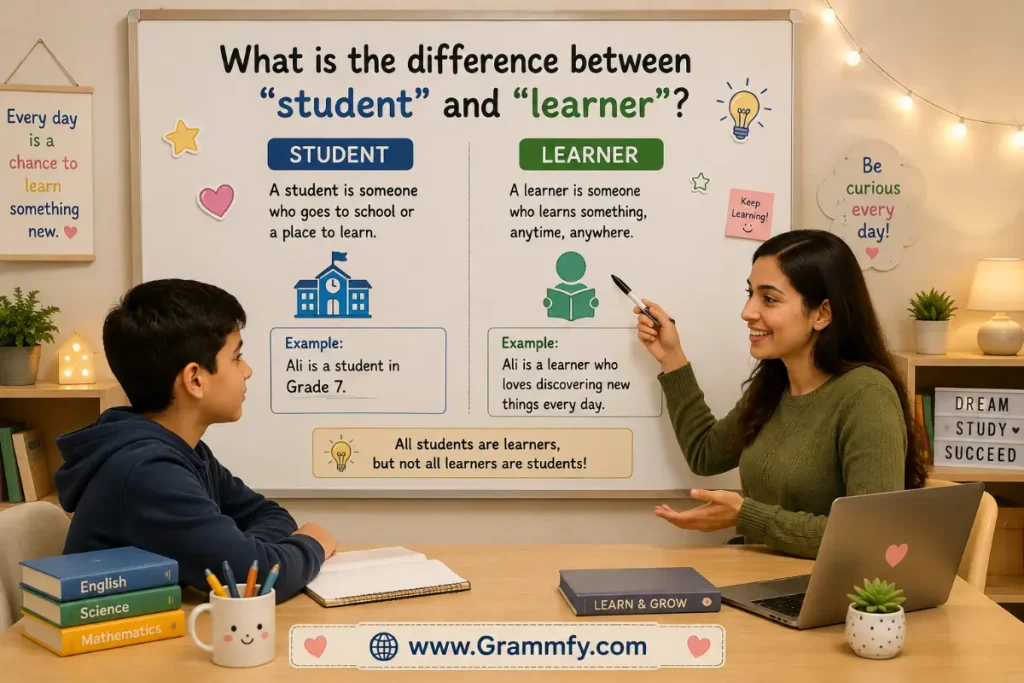
What is the difference between “student” and “learner”?
“Student” usually refers to someone enrolled in a course or educational program. “Learner” has a broader meaning and can describe anyone gaining knowledge or skills.
Compare:
| Student | Learner |
|---|---|
| Often connected to school or college | Broader educational meaning |
| Common in everyday English | Common in education writing |
| Can refer to formal enrollment | Can include informal learning |
| Example: “The student attended class.” | Example: “Every learner develops differently.” |
A person learning to cook at home is a learner, but we wouldn’t normally call them a student unless they’re taking a course.
What is the difference between “pupil” and “student”?
“Pupil” and “student” can both describe someone receiving education, but regional usage differs.
In American English, student is much more common for school-age children.
In British English, pupil is common for children attending school, while student is often used for older learners in colleges and universities.
For example:
US:
“The students returned to class after lunch.”
UK:
“The pupils returned to class after lunch.”
Both are correct within their usual regional contexts.
What is the best word for a student resume?
A resume should sound professional and specific. The word “student” itself is completely acceptable, but your description should focus on skills and achievements.
Instead of:
“I am a smart student.”
Write:
“Motivated student with strong research, communication, and teamwork skills.”
Instead of:
“I am a hardworking student.”
Try:
“Dedicated student with a consistent record of meeting academic deadlines.”
Instead of relying on a colorful comparison, give evidence.
For example:
“Completed a six-month research project while maintaining strong academic performance.”
That sentence proves the quality instead of simply naming it.
Which word works best in an essay?
Academic writing usually benefits from precise nouns and adjectives rather than playful comparisons.
Instead of:
“The student was as busy as a bee.”
Try:
“The student remained highly engaged throughout the research process.”
Creative essays are different. If the assignment asks for descriptive writing, a simile can make the paragraph much stronger.
For example:
“She moved through the library like a young explorer, searching each shelf for another clue.”
The comparison adds personality and imagery.
Which comparisons work best in texting?
Text messages are informal, so playful language works well.
You might write:
“You were as busy as a bee today!”
Or:
“Bro, you studied like a determined athlete 😂”
Another casual option:
“She was as curious as a cat when she saw the surprise.”
Texting gives you more freedom to use humor, emojis, and exaggerated comparisons.
Still, think about the relationship. A joke that sounds friendly between close friends may sound insulting to someone you barely know.
Which words work best in an email?
Professional emails should usually use clear and respectful language.
Instead of:
“Your son is as wild as a rabbit.”
Try:
“Your son is energetic and highly engaged during classroom activities.”
Rather than:
“She is quiet as a mouse.”
You could write:
“She is quiet during group discussions but listens carefully and contributes thoughtful ideas.”
The second version gives useful information without relying on a playful expression.
Which language works best in teacher feedback?
Teacher feedback should be specific. A comparison can make feedback warmer, but it shouldn’t replace evidence.
Weak:
“Tom is like a star.”
Better:
“Tom has shown strong progress in reading and approaches new texts with confidence.”
Creative:
“Tom has become like a bright star in our reading group, growing more confident with every new text.”
The last example works well for a positive classroom note because it combines imagery with a specific achievement.
What are 15 original examples about students?
Here are additional examples across different school situations.
Classroom participation
- “The student was as eager as a puppy when the teacher introduced the new experiment.”
- “She raised her hand like a little explorer who had just discovered a hidden trail.”
- “The class became as lively as a spring morning during the group activity.”
Studying
- “He studied like a determined athlete preparing for an important race.”
- “Her notebook was as organized as a librarian’s shelves.”
- “The new learner absorbed vocabulary like a sponge.”
Problem-solving
- “He attacked the math puzzle like a detective searching for clues.”
- “Her reasoning moved like a careful train, stopping at each important idea.”
- “The student approached the difficult question like a mountain climber facing a steep trail.”
Presentations
- “Before the speech, he was as nervous as a rabbit, but his confidence grew once he began.”
- “She stood in front of the class as calmly as a lake on a windless morning.”
- “His voice became as strong as a drum as he reached the final point.”
Group projects
- “The students worked like a team of busy ants.”
- “Each group member contributed like a different instrument in an orchestra.”
- “The class moved like a well-practiced team when the project deadline arrived.”
These examples show how a comparison can communicate more than one quality at once.
What are two close-synonym comparisons writers often confuse?
Choosing between similar words can be difficult because their meanings overlap.
“Curious” vs. “Inquisitive”
| Curious | Inquisitive |
|---|---|
| Wanting to know or discover something | Actively seeking information |
| Common in everyday English | Slightly more formal |
| Can describe a general interest | Often suggests asking questions |
| “She is curious about space.” | “He is an inquisitive student.” |
Both can describe a learner who asks questions.
“Curious” sounds more natural in everyday conversation.
“Inquisitive” can sound more polished in teacher feedback or formal writing.
“Hardworking” vs. “Diligent”
| Hardworking | Diligent |
|---|---|
| Puts in a lot of effort | Works carefully and consistently |
| Common and direct | More formal |
| Works well in everyday speech | Useful in reports and recommendations |
| “She is hardworking.” | “She is diligent with her assignments.” |
“Diligent” often suggests careful attention as well as effort.
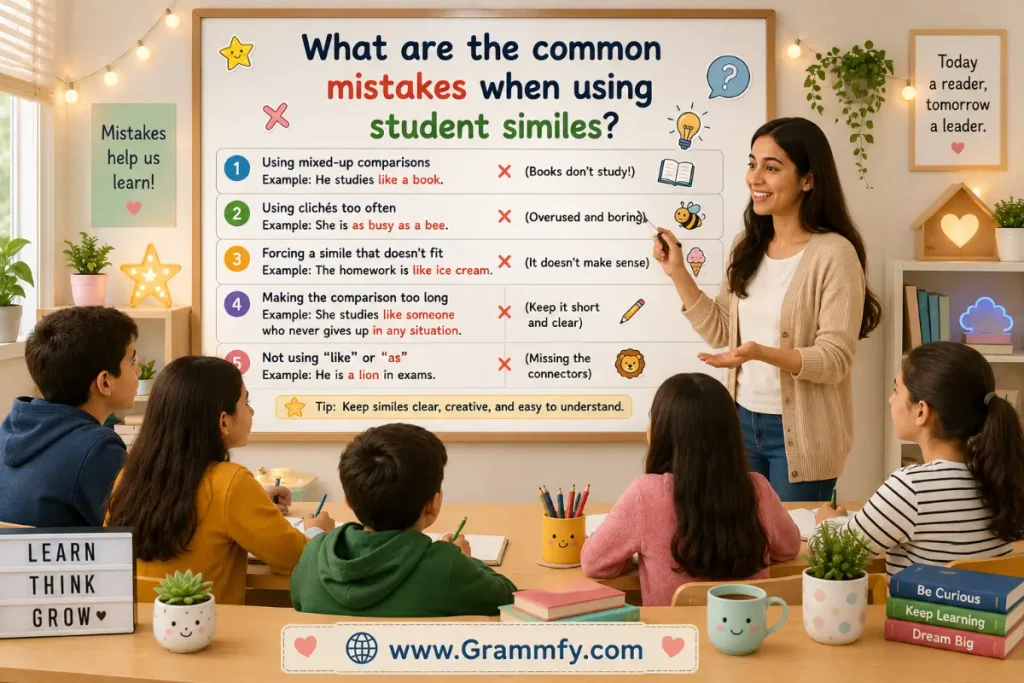
What are the common mistakes when using student similes?
Mistake 1: Using a comparison that doesn’t match the quality
Calling a confused student “as sharp as a tack” creates a contradiction unless you’re being sarcastic.
Make sure the image supports your intended meaning.
Mistake 2: Mixing two similes
Avoid awkward combinations such as:
“She was as busy as a bee like a rocket.”
Choose one clear comparison.
Better:
“She was as busy as a bee.”
Or:
“She moved like a rocket.”
Mistake 3: Using clichés too often
Expressions such as “bright as a star” are easy to understand, but they can become predictable if repeated.
Try creating a fresh comparison:
“Her ideas lit up the discussion like small lanterns.”
Mistake 4: Making the comparison too complicated
A simile should usually make an idea clearer, not harder to understand.
Weak:
“The student’s intellectual curiosity resembled an astronomical body undergoing rapid gravitational expansion.”
Better:
“The student was as curious as a young explorer.”
Mistake 5: Using an animal comparison that sounds insulting
Some animal comparisons can have negative meanings depending on context.
For example, describing a student as “a pig” or “a donkey” can sound insulting. Choose an image that supports the quality you want to praise.
Mistake 6: Using playful language in formal reports
A school report or recommendation letter usually needs professional wording.
Instead of:
“She was as busy as a bee.”
Try:
“She consistently demonstrated strong initiative and commitment.”
Mistake 7: Repeating the same structure
A paragraph filled with “as…as” expressions can feel forced.
Mix structures:
- “as curious as a cat”
- “like a young explorer”
- “her ideas moved like sparks”
- “she worked with the focus of an athlete”
Variation makes writing more natural.
When should you avoid similes?
Similes are useful, but they’re not right for every situation.
Avoid them when precision matters most
Scientific reports, official records, and formal assessments usually need direct statements.
Instead of:
“He was like a rocket in math.”
Write:
“He completed advanced calculations quickly and accurately.”
Avoid them when the comparison could embarrass a student
A humorous description may seem harmless to one person but embarrassing to another.
Avoid comparisons that focus on:
- Appearance
- Weight
- Disability
- Family background
- Personal weaknesses
- Sensitive behavior
Avoid negative labels
A student who struggles with a subject isn’t necessarily “dumb,” “slow,” or “lazy.”
A more accurate description might be:
“The student needs additional practice with fractions.”
This identifies the learning need without attacking the learner.
What are the antonyms of common student qualities?
If you’re describing a student, you may sometimes need the opposite quality.
| Positive quality | Possible opposite |
|---|---|
| Curious | Uninterested |
| Focused | Distracted |
| Hardworking | Unmotivated |
| Energetic | Inactive |
| Organized | Disorganized |
| Patient | Impatient |
| Confident | Uncertain |
| Creative | Unimaginative |
| Careful | Careless |
| Determined | Hesitant |
| Engaged | Disengaged |
| Attentive | Inattentive |
Even here, context matters.
A quiet student isn’t necessarily disengaged.
A slow worker isn’t necessarily lazy.
A beginner isn’t necessarily incapable.
Precise language avoids unfair assumptions.
How can you choose the right simile?
Start by identifying the exact quality you want to show.
For curiosity
Choose:
- As curious as a cat
- Like a young explorer
- Like a little scientist
- Like a detective searching for clues
For hard work
Choose:
- As busy as a bee
- Like a busy ant
- Like a determined athlete
- Like a runner near the finish line
For intelligence
Choose:
- As bright as a star
- As sharp as a tack
- Like a puzzle solver
- Like a little scientist
For calmness
Choose:
- As calm as a lake
- As quiet as a mouse
- Like a still pond
For creativity
Choose:
- Like a young artist
- Like a painter with a blank canvas
- Like a storyteller opening a new book
For courage
Choose:
- As brave as a lion
- Like a mountain climber
- Like an explorer entering unknown territory
The most accurate choice is usually the one that explains the student’s behavior naturally.
How can you make student descriptions more human?
A human-sounding description usually combines a quality, an action, and a specific detail.
Instead of:
“Sarah is hardworking.”
Try:
“Sarah works like a busy ant, quietly completing each part of the project before moving to the next.”
The second sentence shows the behavior.
Instead of:
“Ali is curious.”
Try:
“Ali approaches every experiment like a young scientist, asking questions before touching the equipment.”
The reader now understands what “curious” looks like.
This technique is useful in school essays, teacher comments, recommendation letters, and character descriptions.
How can teachers use similes without sounding exaggerated?
A teacher can use a comparison to make feedback warm, but the statement should remain believable.
Too exaggerated:
“She is the brightest star in the entire universe.”
More natural:
“She has become a bright star in our reading group.”
Even better:
“She has grown into a confident reader and often helps classmates understand new vocabulary.”
A strong description doesn’t need dramatic praise. Specific evidence makes the compliment more convincing.
How can students use similes in creative writing?
Students can improve descriptive writing by connecting a character’s behavior to a familiar image.
Plain:
“The boy was nervous.”
Using a simile:
“The boy was as nervous as a rabbit before the race.”
Plain:
“She studied hard.”
Using a simile:
“She studied like a determined athlete preparing for the final event.”
Plain:
“The classroom was noisy.”
Using a simile:
“The classroom buzzed like a hive after the bell.”
The comparison gives the reader something to imagine.
How can you create original similes instead of using clichés?
Start with the quality you want to show. Then list objects, animals, places, or situations that share that quality.
Suppose you want to describe patience.
Think of:
- A turtle
- A calm lake
- A tree
- A gardener
- A fisherman
Then build a comparison:
“He was as patient as a gardener waiting for spring.”
That sounds more original than simply saying:
“He was very patient.”
For curiosity, think about:
- Detectives
- Explorers
- Scientists
- Cats
- Treasure hunters
Then create:
“Her questions came like clues from a detective searching for a hidden answer.”
The more specific the image, the more memorable the writing becomes.
Why do similes work so well in student descriptions?
A simile turns an abstract quality into a picture.
Words like “determined,” “curious,” and “creative” are useful, but they don’t always give the reader a strong image.
Consider:
“The student was determined.”
Now compare:
“The student climbed through every difficult problem like a mountain climber refusing to turn back.”
The second sentence shows persistence.
The same technique works for many qualities:
- Curiosity becomes an explorer.
- Focus becomes an eagle.
- Hard work becomes a bee.
- Creativity becomes an artist.
- Courage becomes a lion.
- Patience becomes a gardener.
This is why comparisons are especially valuable in descriptive and creative writing.
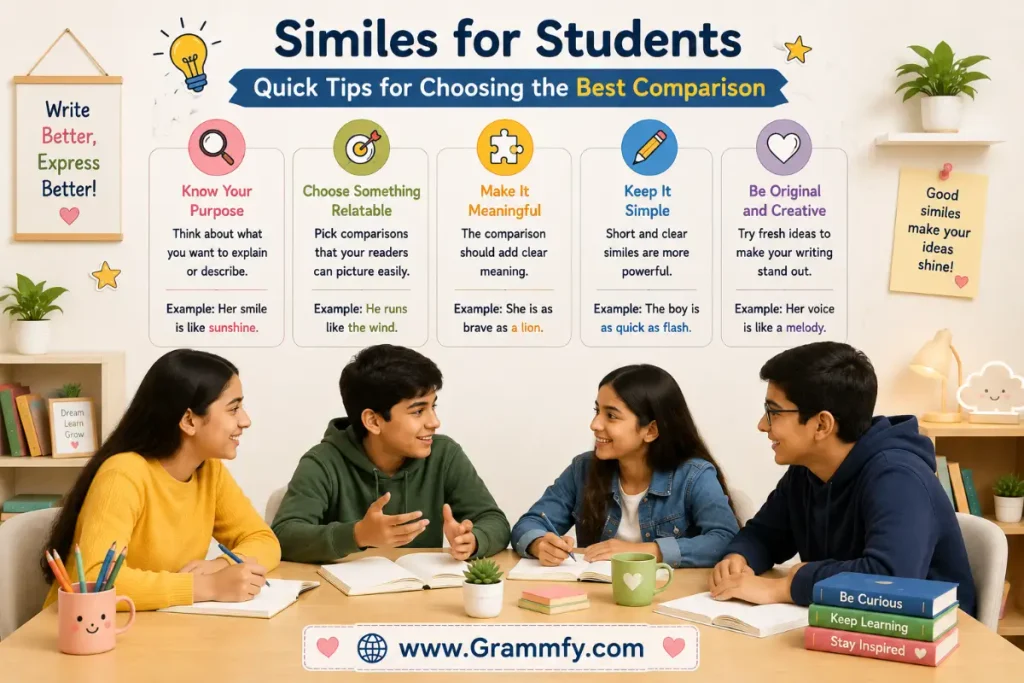
Quick tips for choosing the best comparison
- Identify the quality first. Decide whether you’re describing curiosity, effort, confidence, or another trait.
- Match the tone. A children’s story can use playful comparisons, while a report needs professional language.
- Keep the image clear. Readers should understand the comparison quickly.
- Avoid insulting comparisons. Especially when writing about real students.
- Use evidence. Follow a comparison with a specific behavior when possible.
- Don’t overuse clichés. Familiar phrases are useful, but original comparisons can make writing stand out.
- Vary your sentence openings. Don’t begin every sentence with “The student” or “She.”
- Use “like” and “as” naturally. Both are common structures for similes.
- Think about your audience. Children, teachers, parents, and employers may prefer different language.
- Choose accuracy over exaggeration. A believable compliment is stronger than extreme praise.
- Use direct language in formal contexts. Save playful comparisons for creative or informal writing.
- Respect individual differences. Not every learner behaves in the same way.
- Describe actions when possible. Behavior gives readers evidence.
- Create fresh images. A simple original comparison can be more memorable than a common cliché.
- Read the sentence aloud. If it sounds awkward, simplify the comparison.
Conclusion
A strong comparison can turn an ordinary student description into a memorable one. Similes for students are most effective when they show a clear quality rather than simply adding decoration to a sentence. Choose “as curious as a cat” for curiosity, “as busy as a bee” for active effort, or “as calm as a lake” for a peaceful personality. Formal writing may call for direct words such as “diligent,” “analytical,” or “engaged” instead. Think about your audience, the student’s actual behavior, and the tone you want to create. Most importantly, don’t rely on exaggeration. A simple, accurate comparison can make a school essay, classroom note, or creative description feel more vivid while still sounding natural.
Frequently Asked Questions
What are some good similes for students?
Good choices include “as busy as a bee,” “as curious as a cat,” “as bright as a star,” “like a sponge,” and “as focused as an eagle.” The best option depends on the quality you want to describe.
What is a simile for a hardworking student?
“As busy as a bee” is a simple, familiar choice for a hardworking student. “Like a determined athlete” is another option when you want to emphasize persistence and effort.
What’s another way to describe a smart student?
You can say the student is “as sharp as a tack,” “as bright as a star,” or “like a puzzle solver.” For formal writing, “intelligent,” “analytical,” “quick-thinking,” or “high-achieving” may be better.
Can I use similes for students in an essay?
Yes, especially in creative or descriptive essays. Academic essays usually need more precise language, so use comparisons selectively and support them with specific evidence.
What is a simile for a curious learner?
“As curious as a cat” is a familiar choice, while “like a young explorer” gives the description a more creative feel. Similes for students work best when the image clearly matches the learner’s behavior.
How do I describe a student who works hard?
Try “as busy as a bee,” “like a busy ant,” or “like a determined athlete.” In formal writing, “diligent,” “dedicated,” and “consistent” are stronger choices.
Are student similes appropriate for teacher comments?
Yes, but the tone should match the purpose of the comment. Warm comparisons can work in informal notes, while formal evaluations should focus on specific skills, progress, and behavior.
