
Have you ever stared at the night sky while writing an essay, poem, caption, or text and struggled to describe how beautiful the stars look? Saying “the stars are beautiful” is correct, but it doesn’t create a strong picture in the reader’s mind. A good comparison can make a simple sentence feel vivid and memorable. Using similes for stars can make your writing more vivid by helping readers picture their brightness, beauty, and glow.
The right comparison depends on what you want your reader to imagine. A soft comparison can make the sky feel peaceful, while a powerful one can make it feel magical or dramatic.
This guide explains how star similes work, where the idea comes from, which descriptive words fit different situations, and how to choose the best comparison for essays, stories, poems, texts, and everyday writing.
Another useful figurative-language technique is explained in [similes for dumb].
What are similes for stars?
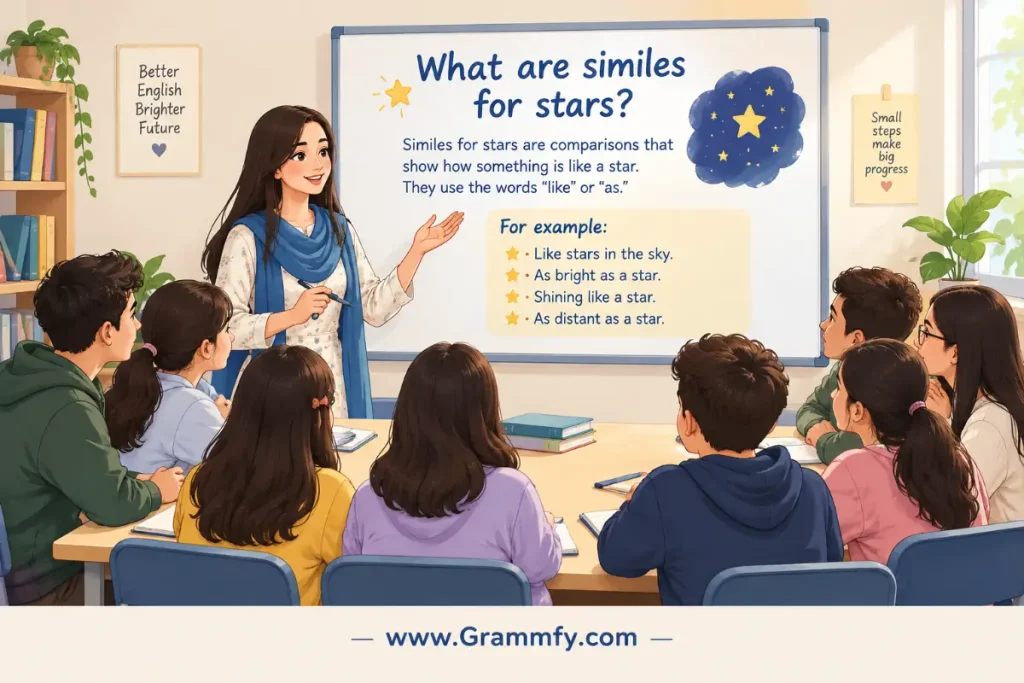
A simile is a figure of speech that compares two different things using words such as like or as. Writers use similes to help readers picture something more clearly.
For example:
- The stars sparkled like diamonds.
- The stars were as bright as tiny lanterns.
- The stars looked like scattered jewels.
- The stars shone like candles in the darkness.
The stars are not actually diamonds, jewels, or candles. The comparisons simply highlight a shared quality, such as brightness, beauty, shape, or color.
A strong comparison does more than tell readers what something looks like. It can also create a mood.
Compare these two sentences:
The stars were bright.
The stars glittered like a thousand diamonds scattered across black velvet.
The first sentence gives information. The second creates an image.
That’s why comparisons are useful in creative writing, descriptive essays, poetry, speeches, social media captions, and storytelling.
Where did the idea of star similes come from?
Similes have been used in literature for thousands of years. Ancient writers often compared natural objects with familiar things because comparisons helped audiences understand ideas quickly.
Stars have always attracted comparisons because people see them as bright points against a dark sky. Writers naturally connect them with objects that sparkle, glow, shine, or appear in groups.
The exact phrase “similes for stars” isn’t the name of a special literary technique. It simply describes a collection of similes that use stars as the subject of comparison.
Common comparison ideas include:
- diamonds
- jewels
- candles
- lanterns
- fireflies
- glitter
- pearls
- tiny lamps
- silver dust
- distant lights
These images work because they connect something enormous and distant—the night sky—to objects people can easily recognize.
How do you make a good star simile?
A good simile should have a clear reason for the comparison. Don’t choose an image only because it sounds fancy.
Think about the quality you want to show.
To show brightness
Use comparisons with:
- diamonds
- lamps
- candles
- lanterns
- crystals
Example:
The stars shone like diamonds against the dark sky.
To show beauty
Use comparisons with:
- jewels
- pearls
- gems
- glitter
- ornaments
Example:
The stars looked like jewels sewn into the night.
To show movement
Use comparisons with:
- fireflies
- sparks
- floating lights
- drifting embers
Example:
The stars flickered like fireflies over a quiet field.
To show a peaceful mood
Use softer images:
- candles
- pearls
- tiny lamps
- silver beads
- distant lanterns
Example:
The stars glowed like tiny candles in a silent room.
To create a dramatic image
Use stronger images:
- blazing sparks
- burning embers
- fireworks
- flashes of silver
- scattered flames
Example:
The stars burned like sparks from a giant fire.
Master list of words for describing stars
There isn’t one perfect synonym for a star simile. Instead, writers can choose words that describe brightness, appearance, movement, mood, or intensity.
Here are 28 useful descriptive and comparison words grouped by tone.
| Word | Meaning | Tone | Example |
| Shiny | Reflecting or giving light | Everyday | The stars looked shiny like beads. |
| Twinkling | Shining with changing brightness | Everyday | The stars twinkled like fireflies. |
| Brilliant | Very bright or impressive | Formal | Brilliant stars filled the sky. |
| Dazzling | Extremely bright and impressive | Formal | The stars were dazzling like crystals. |
| Fiery | Suggesting flames or intense heat | Dramatic | The stars looked fiery like sparks. |
| Blazing | Burning or shining intensely | Dramatic | The stars blazed like tiny flames. |
| Jewel | A valuable, shining object | Poetic | Each star looked like a jewel. |
| Diamond | A clear, sparkling gemstone | Poetic | The stars shone like diamonds. |
| Pearl | A smooth, pale gem | Poetic | The stars looked like pearls. |
| Lantern | A portable source of light | Warm | The stars glowed like lanterns. |
| Firefly | A small glowing insect | Magical | The stars twinkled like fireflies. |
| Spark | A tiny flash of fire or light | Energetic | The stars flashed like sparks. |
These words give you more choices than repeatedly using bright, beautiful, or shiny.
Star comparisons by intensity: mild to strong
Not every scene needs an intense image. Your word choice should match the mood.
Mild
Use mild comparisons when the scene is calm or peaceful.
- The stars glowed like tiny candles.
- The stars looked like distant pearls.
- The stars shimmered like silver beads.
- The stars rested in the sky like little lamps.
These comparisons create a quiet feeling.
Medium
For a more vivid description, try:
- The stars sparkled like diamonds.
- The stars twinkled like fireflies.
- The stars glittered like scattered jewels.
- The stars shone like polished crystals.
These images are noticeable without feeling dramatic.
Strong
For an exciting or powerful scene, use:
- The stars blazed like sparks from a fire.
- The stars flashed like tiny fireworks.
- The stars burned like embers in a dark sky.
- The stars shone like a thousand lamps.
Strong comparisons work well in dramatic poetry and descriptive stories.
Similes by part of speech
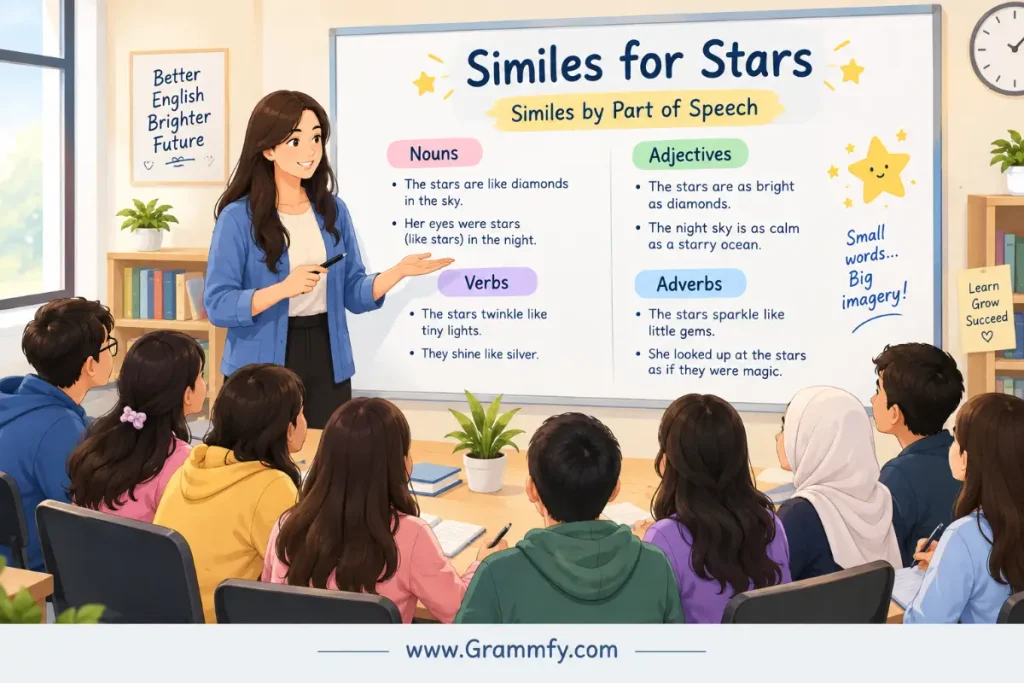
Understanding the grammar behind a comparison can help you build better sentences.
Adjective-based descriptions
Adjectives describe the stars directly.
Examples:
- bright
- radiant
- dazzling
- luminous
- sparkling
- fiery
Sentence:
The dazzling stars looked like diamonds scattered across the sky.
Verb-based descriptions
Verbs show what the stars are doing.
Examples:
- sparkle
- twinkle
- glow
- shimmer
- gleam
- flicker
- blaze
Sentence:
The stars shimmered like silver dust above the mountains.
Noun-based comparisons
Nouns provide the image being compared.
Examples:
- diamonds
- jewels
- candles
- pearls
- fireflies
- lanterns
- sparks
Sentence:
The stars were like tiny lanterns floating above the town.
Best star simile for an essay
For an essay, choose a clear comparison rather than one that sounds overly dramatic.
Good examples include:
The stars looked like scattered diamonds across the night sky.
The stars twinkled like tiny lights against the darkness.
The stars shone like distant lanterns above the quiet landscape.
These sentences are descriptive but easy to understand.
Avoid stuffing several comparisons into one sentence:
The stars were like diamonds, pearls, jewels, candles, fireflies, and fireworks.
That makes the writing feel crowded.
One strong comparison is usually enough.
Best star simile for a poem
Poetry gives you more freedom. You can use unusual images if they fit the mood.
Try:
The stars were silver beads sewn into the night.
Or:
The stars drifted like sparks across a sea of darkness.
Or:
Above the sleeping town, stars glimmered like forgotten candles.
Poetry doesn’t always need a literal comparison. The goal is to create a feeling or image.
Best star simile for texting
Text messages usually need short, natural language.
Try:
The stars look like tiny diamonds tonight.
Or:
The sky is glowing like a blanket of glitter.
Or:
Those stars are sparkling like little lights.
These sound more natural than a long poetic sentence.
Best star simile for an email
In a professional email, keep the comparison simple and appropriate.
For example:
The evening sky was as clear as glass, with stars shining like tiny lights.
If you’re writing a formal message, don’t force a poetic comparison into every paragraph. Use one only when it adds something useful.
Best star simile for speaking
When speaking, choose a comparison that people can understand immediately.
You could say:
The stars looked like little lanterns in the sky.
Or:
They were sparkling like diamonds.
Simple comparisons are often more effective in conversation because listeners don’t have time to reread the sentence.
29 original similes for stars
Here are original examples you can use for stories, essays, poems, captions, and creative writing.
- The stars sparkled like diamonds scattered across black velvet.
- The stars twinkled like fireflies dancing over a field.
- The stars glowed like tiny candles in a dark room.
- The stars looked like silver beads sewn into the night.
- The stars glittered like jewels spilled across the sky.
- The stars shone like lanterns hanging above a sleeping village.
- The stars flickered like sparks from a distant fire.
- The stars appeared like pearls floating on a sea of darkness.
- The stars shimmered like crystals beneath a soft light.
- The stars looked like golden pins scattered across a midnight blanket.
- The stars burned like tiny embers in the endless sky.
- The stars glimmered like distant lamps on a lonely road.
- The stars danced like fireflies around an invisible garden.
- The stars were like scattered pieces of silver.
- The stars shone like polished gems in a dark crown.
- The stars flickered like candles in a gentle breeze.
- The stars appeared like tiny windows opening into another world.
- The stars sparkled like glitter sprinkled over black paper.
- The stars looked like glowing seeds planted across the heavens.
- The stars twinkled like tiny eyes watching from above.
- The stars shimmered like drops of light on dark water.
- The stars gleamed like fresh snow under moonlight.
- The stars scattered across the sky like grains of sparkling sand.
- The stars glowed like warm lamps in a distant town.
- The stars flashed like miniature fireworks in the darkness.
- The stars looked like diamonds resting on a velvet cloth.
- The stars flickered like little flames beyond the clouds.
- The stars shone like silver buttons on a dark coat.
- The stars glimmered like coins beneath clear water.
“Stars like diamonds” vs. “stars like jewels”
Both comparisons suggest beauty and brightness, but they create slightly different images.
| Comparison | Main feeling | Best use |
|---|---|---|
| Stars like diamonds | Bright, sharp, sparkling | Descriptive essays |
| Stars like jewels | Beautiful, valuable, magical | Poetry and stories |
“Diamonds” usually emphasizes sparkle. “Jewels” focuses more on beauty and value.
Compare:
The stars sparkled like diamonds.
This creates a crisp, bright image.
The stars looked like jewels scattered across the sky.
This feels softer and more magical.
“Stars like candles” vs. “stars like lanterns”
These comparisons are also close, but they are not identical.
| Comparison | Image | Mood |
|---|---|---|
| Stars like candles | Small flames | Quiet and gentle |
| Stars like lanterns | Larger lights | Warm and comforting |
Use candles when you want a delicate image:
The stars flickered like candles in the darkness.
Use lanterns when you want warmth:
The stars glowed like lanterns above the sleeping town.
“Stars like fireflies” vs. “stars like sparks”
These comparisons can both suggest small points of light, but they create different moods.
Fireflies feel natural, gentle, and magical:
The stars twinkled like fireflies over a summer field.
Sparks feel energetic and dramatic:
The stars flashed like sparks from a giant fire.
Choose the comparison based on the action and mood of your scene.
US vs. UK usage
The word star has the same basic meaning in American and British English. The main difference is usually not the vocabulary but the surrounding style.
For example, these sentences work in both varieties:
The stars sparkled like diamonds.
The stars looked like tiny lanterns.
The stars twinkled like fireflies.
Words such as sparkling, glittering, glowing, and shimmering are also widely understood in both American and British English.
The important thing is to keep your spelling and overall style consistent if you’re writing a longer piece.
Common mistakes when writing star similes
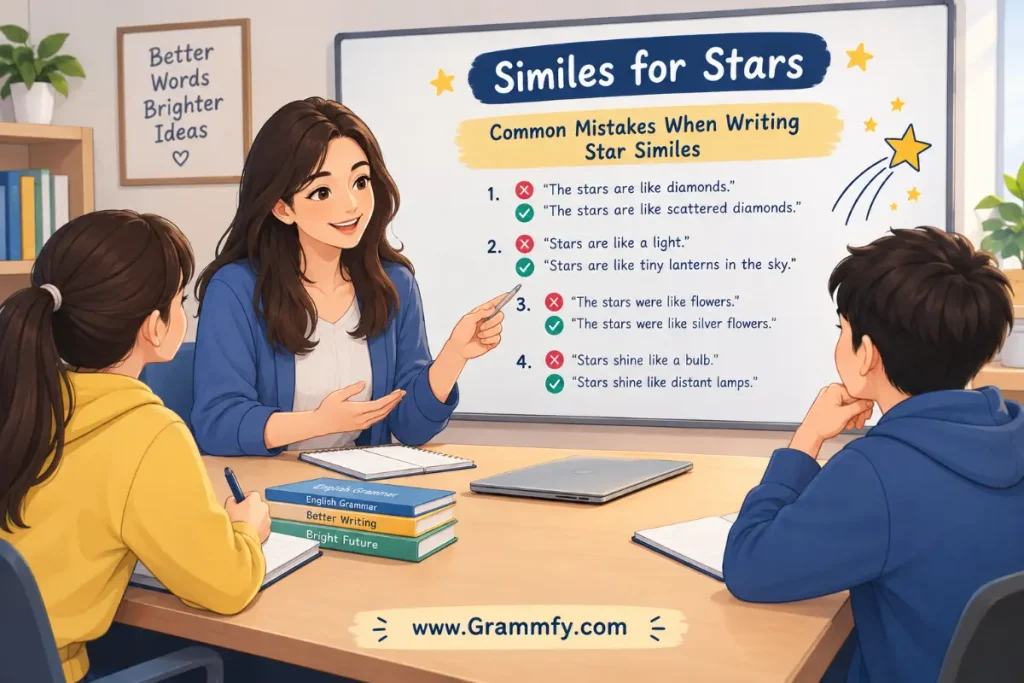
Good comparisons can become weak when the grammar or image doesn’t make sense.
Mistake 1: Forgetting the comparison word
A basic simile normally uses like or an as…as structure.
Incorrect:
The stars diamonds in the sky.
Better:
The stars were like diamonds in the sky.
Mistake 2: Mixing too many images
Avoid piling up comparisons.
Weak:
The stars were like diamonds, candles, pearls, jewels, fireflies, and fireworks.
Better:
The stars glittered like diamonds scattered across the sky.
Mistake 3: Using the same comparison repeatedly
If every sentence says the stars are “like diamonds,” the writing becomes predictable.
Instead, vary the imagery:
The stars sparkled like diamonds.
Some twinkled like fireflies.
Others glowed like distant lanterns.
Mistake 4: Choosing an image that doesn’t fit the mood
A peaceful scene may not need a comparison involving explosions or flames.
For a quiet night:
The stars glowed like tiny candles.
For a dramatic night:
The stars flashed like sparks.
Mistake 5: Confusing a simile with a metaphor
A simile usually makes the comparison explicit:
The stars are like diamonds.
A metaphor makes the comparison directly:
The stars are diamonds scattered across the sky.
Both can be effective, but they are different figures of speech.
When should you NOT use a star simile?
You don’t need a simile in every sentence.
Avoid one when:
- the sentence is already clear without it
- you’re writing a technical explanation
- the comparison distracts from the main point
- you’ve already used several comparisons nearby
- the image feels forced
- the comparison doesn’t match the mood
For example, in a science report, this is usually better:
Stars produce and release energy through nuclear reactions.
Adding:
Stars produce energy like glowing diamonds in the sky.
would make the scientific statement less precise.
Creative comparisons belong most naturally in descriptive and imaginative writing.
Antonyms and contrasting ideas
A simile doesn’t have a direct antonym because simile is a literary device, not a quality such as “hot” or “cold.”
However, writers can contrast star imagery with ideas such as:
- darkness
- dullness
- emptiness
- shadow
- silence
- fading
- dimness
- obscurity
For example:
The stars shone like diamonds against the deep darkness.
The contrast between light and darkness makes the image stronger.
You can also contrast different levels of brightness:
Some stars glowed like candles, while others barely showed through the clouds.
How to choose the right comparison
Choosing the best comparison becomes easier when you ask five questions.
1. What do the stars look like?
Are they:
- bright?
- tiny?
- colorful?
- scattered?
- clustered?
- distant?
Choose an image that shares that feature.
2. What mood do you want?
To create a peaceful mood, try:
- candles
- pearls
- lanterns
For a magical mood, try:
- fireflies
- jewels
- crystals
For a dramatic mood, try:
- sparks
- embers
- flames
3. Who is reading it?
A children’s story may benefit from:
The stars twinkled like fireflies.
A formal essay might work better with:
The stars appeared like scattered diamonds.
4. Is the sentence too long?
If your comparison takes half the paragraph, simplify it.
Strong writing doesn’t need complicated language.
5. Does the comparison create a picture?
Ask yourself:
Can the reader see the image in their mind?
If the answer is yes, the comparison is probably doing its job.
Quick tips for better star descriptions
- Use diamonds for sparkle.
- Use jewels for beauty.
- Use candles for a gentle glow.
- Use lanterns for warmth.
- Use fireflies for movement and magic.
- Use sparks for energy.
- Use pearls for a soft, elegant image.
- Use crystals for a sharp, brilliant image.
- Match your comparison to the mood.
- Don’t use several comparisons when one strong image will work.
- Mix verbs such as glow, twinkle, shimmer, and sparkle.
- Read your sentence aloud to check whether it sounds natural.
- Avoid comparisons that readers cannot easily picture.
- Keep academic writing clearer than creative writing.
- Let the comparison support the scene instead of taking over the scene.
How can you make a star simile sound less predictable?
The easiest way is to move beyond the most common comparisons.
“Stars like diamonds” is clear, but it is also familiar. You can create a fresher image by focusing on an unexpected detail.
Instead of:
The stars were like diamonds.
Try:
The stars looked like silver buttons stitched onto the night.
Or:
The stars floated like tiny lanterns above the sleeping town.
Or:
The stars appeared like bright crumbs scattered across a dark table.
These comparisons still use familiar objects, but they create a more personal image.
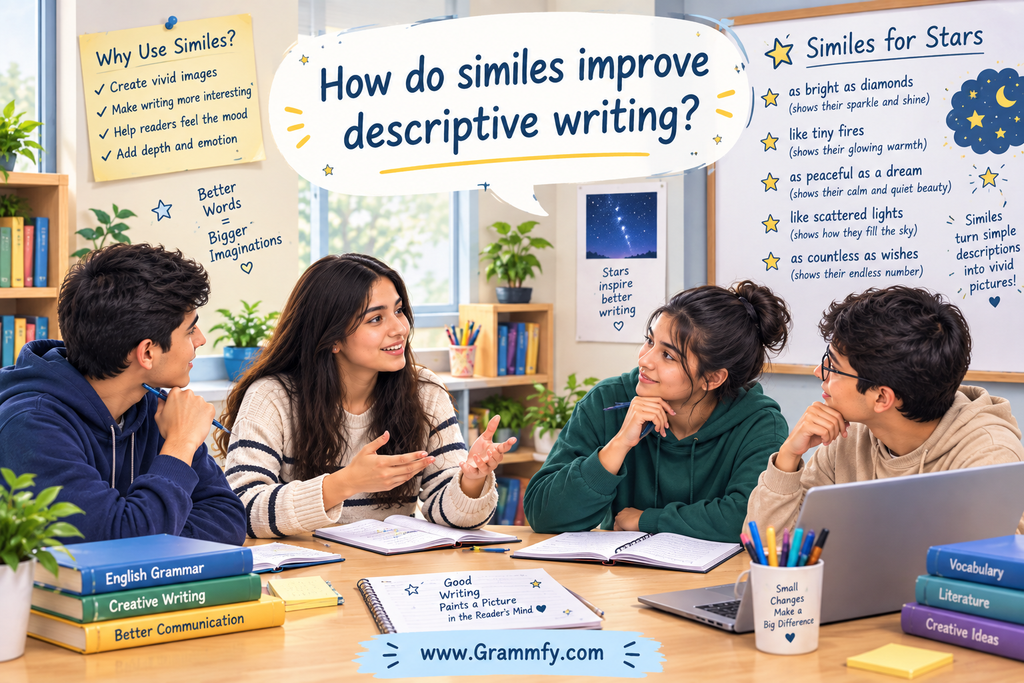
How do similes improve descriptive writing?
Similes help readers experience a scene instead of simply receiving information.
Consider:
The sky was full of stars.
This tells the reader what was there.
Now compare it with:
The sky was full of stars that glittered like jewels scattered across black velvet.
The second sentence gives the reader color, texture, brightness, and space.
A good simile can also slow down an important moment. If a character walks outside after a difficult day, describing the sky with a gentle comparison can show a change in mood without directly saying, “The character felt peaceful.”
For example:
She stepped onto the porch and looked up. The stars glowed like tiny candles above the quiet trees.
The comparison helps establish the atmosphere.
How to avoid cliché star descriptions
Some comparisons appear so often that they can lose their impact.
Common examples include:
- stars like diamonds
- stars like jewels
- stars like glitter
- stars like fireflies
These aren’t wrong. They’re useful because readers understand them immediately. But if you’re writing a poem, story, or creative essay and want a more original voice, try changing the object.
Think about things that:
- sparkle
- glow
- hang in groups
- move gently
- appear against darkness
- have small points of light
Then build a comparison from that idea.
For example:
The stars were like tiny windows in the roof of the night.
That’s different from the usual gemstone comparison while remaining easy to understand.
Conclusion
The best Similes for stars are clear, vivid, and suited to the situation. You can compare stars with diamonds when you want to show sparkle, candles when you want a soft glow, fireflies when you want movement, or lanterns when you want warmth. The strongest choice isn’t always the fanciest one. It should help readers picture the sky and feel the mood of the scene.
When writing an essay, keep the comparison simple. For poetry or stories, you can experiment with unusual images. Most importantly, avoid using several comparisons just to make a sentence sound impressive. One fresh, well-chosen image can do more than a paragraph of crowded description.
Frequently Asked Questions
What is a simile for stars?
A simile for stars compares stars to another object using like or as, such as “The stars sparkled like diamonds.”
What’s another way to describe stars?
You can describe stars as sparkling, twinkling, glowing, shimmering, glittering, radiant, or luminous, depending on the image you want.
What are some beautiful similes for stars?
Beautiful comparisons include stars like diamonds, jewels, pearls, candles, crystals, and tiny lanterns.
What is a good simile for stars in an essay?
“The stars shone like scattered diamonds across the night sky” is a clear and effective choice for an essay.
Can I use star similes in a poem?
Yes, star similes work especially well in poems because they create vivid images and help establish mood.
Are “stars are diamonds” and “stars are like diamonds” the same?
No. “Stars are like diamonds” is a simile, while “stars are diamonds” is a metaphor because it makes the comparison directly.
How can I make my star descriptions more creative?
Choose an image that matches the stars’ brightness, movement, or mood, then use a familiar object in an unexpected way.
