
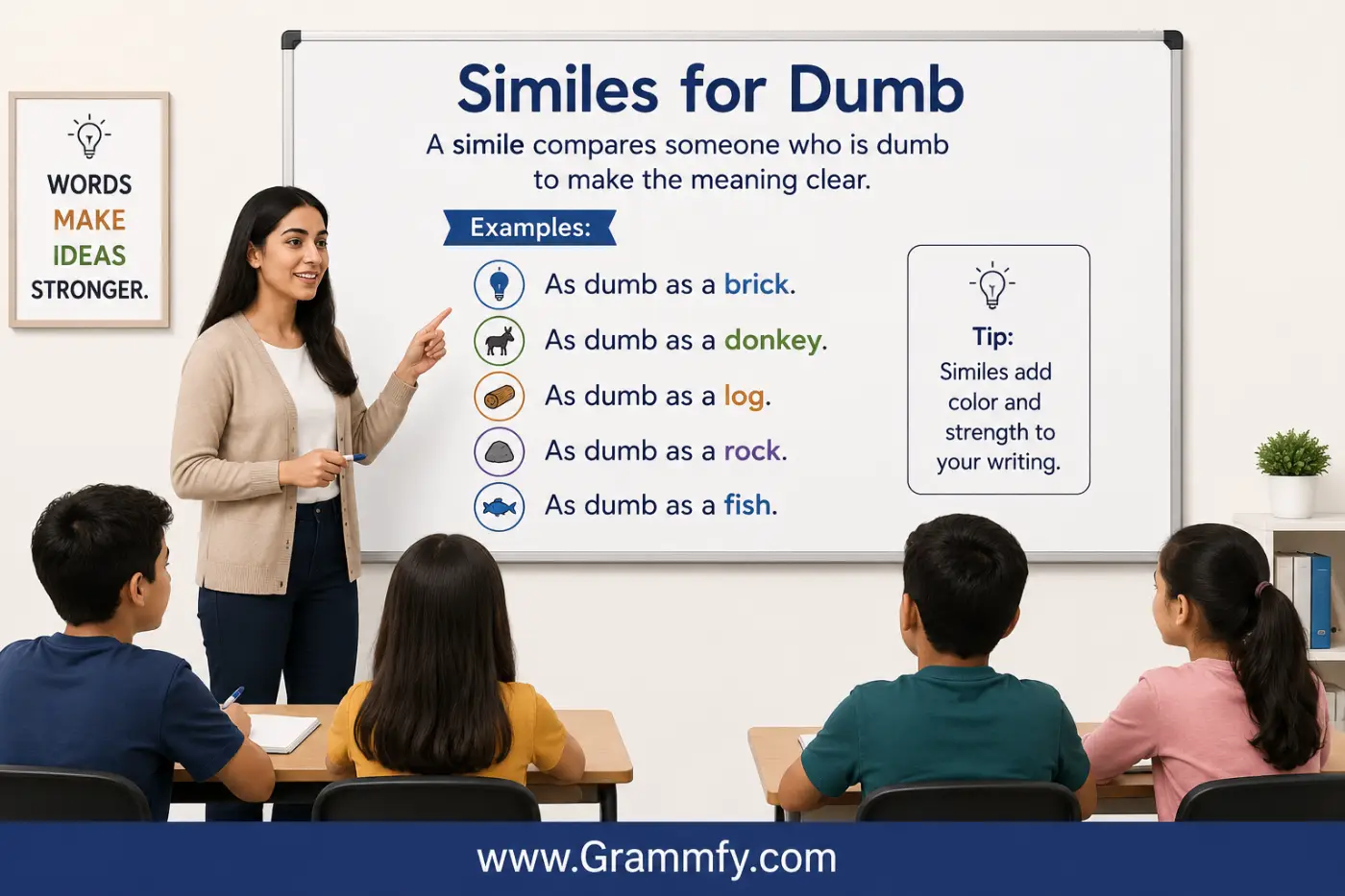
Have you ever been writing a text, essay, or funny message and wanted a better way to describe a foolish choice? You might reach for the word “dumb,” but a simile can make the idea clearer, funnier, or more vivid. Similes for dumb use comparisons to show poor judgment, lack of common sense, or an obviously foolish action.
Answer box: The best similes for “dumb” compare a person, idea, or action to something known for being foolish, useless, confused, or unable to understand. Examples include “as dumb as a box of rocks” and “as dumb as a doorknob.”
The word “dumb” can sound playful among friends, but it can also sound rude or harsh. The right comparison depends on your audience and purpose. A funny text may allow a light expression, while an essay, workplace email, or professional conversation usually needs a more respectful choice.
This guide explains the meaning and history of “dumb,” gives you more than 25 useful comparisons, and organizes related words by tone and intensity. You’ll also see examples for essays, resumes, emails, texting, and everyday speech, plus tips for choosing language that fits the situation.
For more examples that bring writing to life, check out [Similes for silent].
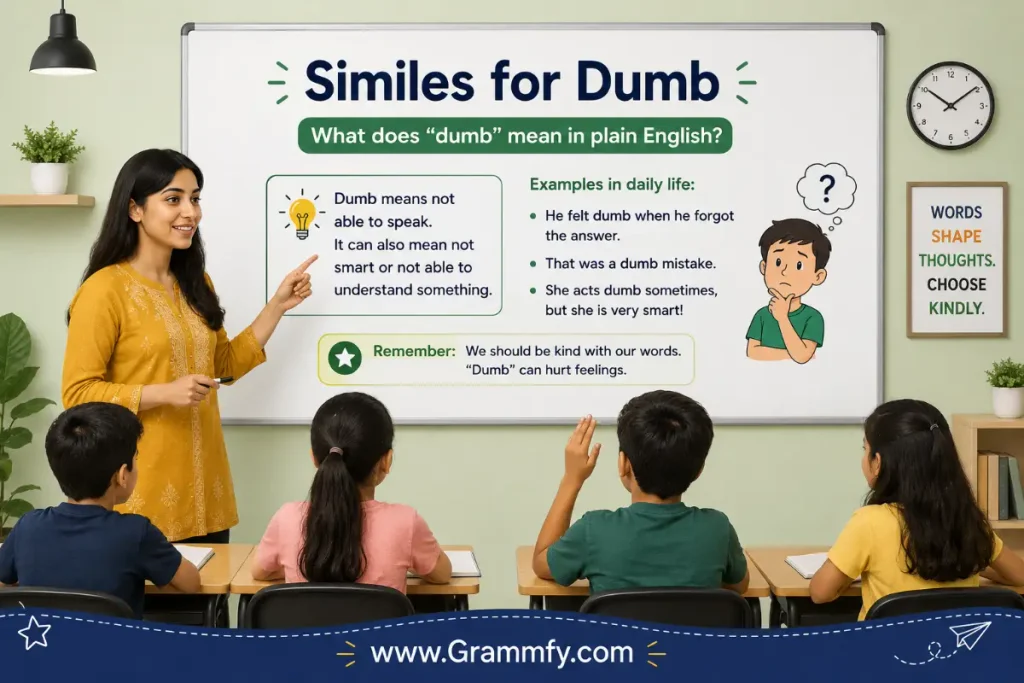
What Does “Dumb” Actually Mean?
“Dumb” commonly means not intelligent, showing poor judgment, or lacking common sense. It can describe a person, decision, question, mistake, idea, or action.
For example:
- That was a dumb decision.
- It was dumb to leave the door unlocked.
- He made a dumb mistake.
- That idea sounds dumb.
- I felt dumb after forgetting my keys.
The word can have different levels of force. Sometimes people use it casually to mean “silly.” In other situations, it can be a strong insult.
A useful distinction is that calling an action dumb is often less personal than calling a person dumb.
Compare:
- “That was a dumb mistake.” — Criticizes an action.
- “You’re dumb.” — Attacks the person.
For respectful communication, focus on the choice or behavior instead of labeling someone.
Where did the word “dumb” come from?
The history of “dumb” is more interesting than its modern meaning suggests.
The word comes from Old English dumb, which originally referred to someone who could not speak. Related forms appeared in other Germanic languages. Over time, English developed additional meanings connected with silence and an inability to communicate.
Eventually, “dumb” also developed the meaning of lacking intelligence or good judgment. That meaning is now common in informal English.
Because of its older meaning, “dumb” can be sensitive when used to describe people who cannot speak. Modern English generally uses nonverbal or more specific language instead of “dumb” in that context.
So, when you use Similes for dumb, it’s important to understand the meaning you intend. If you’re describing a foolish decision, you can use a playful comparison. If you’re discussing a person respectfully, another word may be better.
What are some common similes for dumb?
Here are some popular comparisons that express foolishness, poor judgment, or a lack of common sense:
| Simile | Meaning | Tone | Example |
|---|---|---|---|
| As dumb as a box of rocks | Very unintelligent | Humorous, harsh | He was acting as dumb as a box of rocks. |
| As dumb as a doorknob | Not very smart | Playful | I felt as dumb as a doorknob after that mistake. |
| As dumb as a brick | Extremely foolish | Casual, harsh | That plan was as dumb as a brick. |
| Like a fish out of water | Uncomfortable or confused | Mild | I felt like a fish out of water. |
| As sharp as a marble | Not clever | Sarcastic | He isn’t exactly as sharp as a marble. |
| Like a GPS with no signal | Lost or confused | Modern, casual | I was like a GPS with no signal. |
| As wise as a broken clock | Poor judgment | Sarcastic | His advice was as wise as a broken clock. |
| Like a hammer looking for a nail | Using the wrong approach | Figurative | He attacked every problem like a hammer looking for a nail. |
| As practical as a paper umbrella | Not useful | Humorous | That plan is as practical as a paper umbrella. |
| Like a phone with a dead battery | Unable to respond or work | Modern | My brain was like a phone with a dead battery. |
| As organized as a tornado | Extremely disorganized | Humorous | His notes were as organized as a tornado. |
| Like a sheep following traffic | Following without thinking | Figurative | They acted like sheep following traffic. |
| As prepared as a swimmer with no water | Poorly prepared | Humorous | He was as prepared as a swimmer with no water. |
Some of these expressions are direct insults, while others describe confusion, poor planning, or uselessness. That difference matters.
What are the best Similes for dumb for everyday English?
For everyday conversations, the best comparisons are usually short, familiar, and easy to understand.
1. As dumb as a box of rocks
This is one of the most recognizable humorous expressions for describing someone as lacking intelligence.
Example:
“He was acting as dumb as a box of rocks when he tried to charge his phone with a banana.”
It’s funny because rocks are associated with having no thoughts or understanding.
Still, it can be insulting when directed at a person. It works better in joking conversations where everyone understands the tone.
2. As dumb as a doorknob
This expression uses an ordinary object that doesn’t think or reason.
Example:
“I felt as dumb as a doorknob when I realized the answer was right in front of me.”
This version can be useful when making fun of your own mistake. Self-directed humor often sounds less aggressive.
3. As dumb as a brick
A brick doesn’t think, reason, or respond. The comparison is simple and easy to understand.
Example:
“That plan was as dumb as a brick.”
This works especially well when criticizing an idea rather than a person.
4. As sharp as a marble
This is sarcastic because a marble isn’t normally associated with intelligence.
Example:
“He’s as sharp as a marble when it comes to reading instructions.”
This expression is humorous, but the sarcasm makes it less suitable for formal writing.
5. Like a deer in headlights
This comparison is slightly different. It doesn’t necessarily mean someone is unintelligent. It usually means they are shocked, confused, or unable to react.
Example:
“When the manager asked about the missing report, I stood there like a deer in headlights.”
That distinction makes it a safer choice when you want to describe confusion rather than stupidity.
How do Similes for dumb change from mild to strong?
Not every comparison has the same emotional effect. Choosing the right intensity can make your writing sound natural instead of unnecessarily harsh.
Mild comparisons
Use mild expressions when someone is confused, inexperienced, or uncertain.
- Like a lost puppy
- Like a GPS with no signal
- Like a fish out of water
- Like a computer with no power
- Like a puzzle missing half its pieces
- Like a deer in headlights
These don’t directly say that someone is unintelligent.
Example:
“During my first day at the new office, I felt like a GPS with no signal.”
The sentence communicates confusion without attacking intelligence.
Medium-strength comparisons
These suggest poor judgment or weak reasoning.
- As dumb as a doorknob
- As dumb as a brick
- Like a broken compass
- Like a hammer looking for a nail
- As organized as a tornado
- As practical as a paper umbrella
Example:
“Choosing that route was as practical as a paper umbrella.”
The focus is on the decision rather than the person.
Strong comparisons
These directly suggest extreme foolishness.
- As dumb as a box of rocks
- As dumb as a sack of hammers
- As sharp as a marble
- As clueless as a tourist without a map
These are better for informal conversations, comedy, fiction, or self-deprecating humor.
Avoid them in situations where respect and professionalism matter.
Which words can replace “dumb”?
If you need a synonym instead of a simile, English offers many choices. The best one depends on what you actually mean.
Master synonym list for “dumb”
| Word | Meaning | Tone | Example |
|---|---|---|---|
| Silly | Lacking good sense in a harmless way | Mild | That was a silly mistake. |
| Foolish | Showing poor judgment | Neutral | It was foolish to ignore the warning. |
| Careless | Failing to pay attention | Neutral | A careless error caused the problem. |
| Thoughtless | Not considering others or results | Neutral | That was a thoughtless comment. |
| Clueless | Having little understanding | Informal | He was clueless about the rules. |
| Naive | Lacking experience or awareness | Mild | She was naive about the risks. |
| Absurd | Extremely unreasonable | Formal | The argument was absurd. |
| Senseless | Having no reasonable purpose | Strong | It was a senseless decision. |
| Foolhardy | Recklessly brave or careless | Formal | It was a foolhardy attempt. |
| Brainless | Showing very little thought | Informal, harsh | That was a brainless move. |
| Mindless | Done without thought | Neutral to harsh | It was a mindless mistake. |
| Dense | Slow to understand | Informal, harsh | He was being dense. |
| Thick | Slow to understand | Informal, regional | Don’t be thick. |
| Witless | Lacking intelligence | Literary, strong | The witless decision caused trouble. |
| Foolish-minded | Showing poor reasoning | Uncommon | The argument seemed foolish-minded. |
| Inane | Silly or pointless | Formal | The discussion became inane. |
| Vacuous | Lacking ideas or intelligence | Formal | The speech contained vacuous claims. |
| Impractical | Not likely to work | Neutral | The proposal was impractical. |
| Unreasonable | Not based on good sense | Neutral | His demand was unreasonable. |
| Short-sighted | Failing to consider future results | Neutral | The policy was short-sighted. |
| Reckless | Acting without considering danger | Strong | It was reckless to drive that fast. |
Notice that these words aren’t perfect replacements for one another.
“Careless” means someone failed to pay attention.
“Clueless” means someone doesn’t understand.
“Naive” suggests inexperience.
“Irrational” means the reasoning isn’t logical.
“Reckless” means someone ignores danger.
Using the precise word makes your writing stronger.
What are the synonyms for “dumb” by tone?
Grouping related words by tone makes it easier to choose the right expression.
Simple and mild
Use these when you don’t want to sound aggressive:
- Silly
- Foolish
- Unwise
- Naive
- Careless
- Confused
- Thoughtless
Example:
“It was a silly mistake, but I learned from it.”
Everyday and informal
These fit casual conversations:
- Clueless
- Dense
- Brainless
- Mindless
- Ridiculous
- Absurd
- Thick
Example:
“I was completely clueless about how the new system worked.”
Formal alternatives
These work better in essays, reports, and professional writing:
- Unwise
- Irrational
- Illogical
- Unreasonable
- Uninformed
- Impractical
- Short-sighted
- Senseless
- Obtuse
- Inane
Example:
“The proposal was impractical because it ignored the project’s budget.”
Slang and strongly informal choices
These can sound insulting:
- Dumb
- Brainless
- Thick
- Dense
- Witless
- Airheaded
- Boneheaded
- Knuckleheaded
These are best avoided in professional communication unless you’re deliberately writing dialogue or humor.
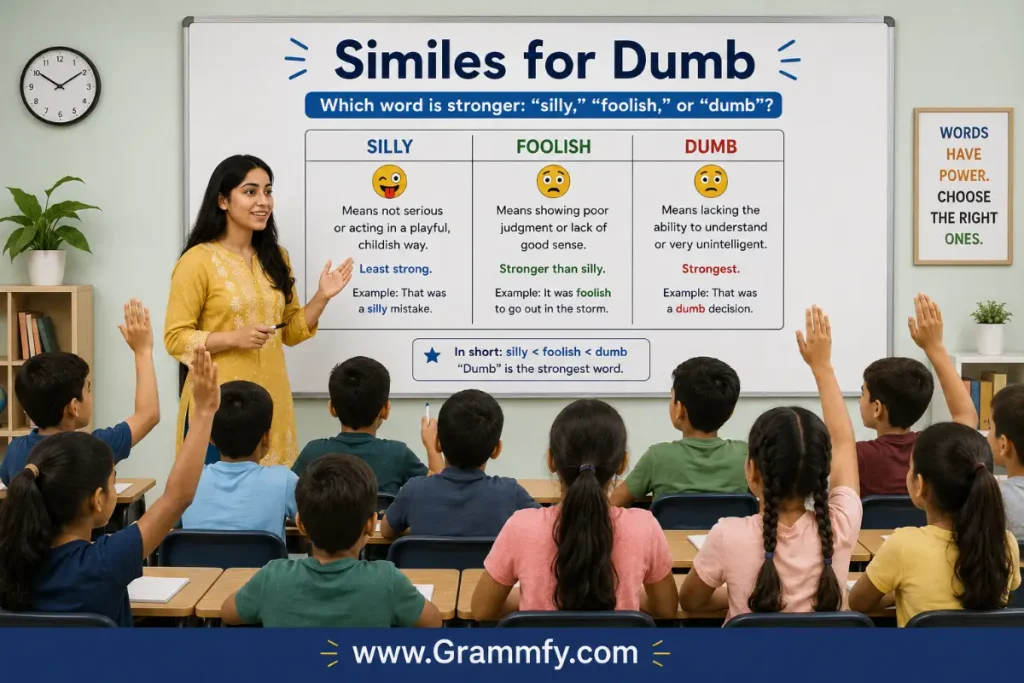
Which word is stronger: “silly,” “foolish,” or “dumb”?
These words overlap, but they don’t have exactly the same meaning.
| Word | Strength | Main idea | Example |
|---|---|---|---|
| Silly | Mild | Childish or harmlessly foolish | That was a silly mistake. |
| Foolish | Medium | Poor judgment | It was foolish to ignore the advice. |
| Dumb | Medium to strong | Lack of intelligence or common sense | That was a dumb decision. |
Silly is usually the friendliest.
Foolish often focuses on judgment.
Dumb can focus more directly on intelligence or common sense.
For example:
“I made a silly mistake.”
This sounds forgiving.
“I made a foolish decision.”
This suggests poor judgment.
“I made a dumb decision.”
This sounds more casual and self-critical.
“Clueless” vs. “dumb” — what’s the difference?
“Clueless” means lacking knowledge or understanding about a particular situation. It doesn’t necessarily mean a person has low intelligence.
For example:
- “I’m clueless about car repairs.”
- “She’s clueless about investing.”
These sentences don’t say that the person is generally unintelligent. They only identify a gap in knowledge.
“Dumb” is broader and can suggest poor intelligence, poor judgment, or a foolish action.
Compare:
| Clueless | Dumb |
|---|---|
| Lack of knowledge | Lack of good sense or intelligence |
| Often situation-specific | Can be broader |
| Usually less insulting | Can sound harsh |
| Common in casual speech | Common in casual speech |
If someone doesn’t know how to fix a car, clueless is probably more accurate than dumb.
“Foolish” vs. “dumb” — what’s the difference?
“Foolish” usually focuses on poor judgment. “Dumb” can focus on intelligence, judgment, or an action.
Compare:
Foolish:
“It was foolish to spend all the money before payday.”
Dumb:
“It was dumb to spend all the money before payday.”
Both sentences work, but “foolish” sounds more polished and less insulting.
For formal writing, foolish, unwise, or short-sighted is often a better choice.
What are the best Similes for dumb in a resume?
A resume is not the place for insults or jokes about intelligence. Instead of using a direct comparison, describe the actual problem.
For example, don’t write:
“I was as dumb as a box of rocks when I started.”
A professional version would be:
“I initially lacked experience with the software but quickly developed proficiency.”
Another option:
“My early approach was inefficient, but I improved the process through training and practice.”
A resume should highlight learning, improvement, judgment, and skills.
Better resume vocabulary
Use:
- Inexperienced
- Unfamiliar
- Still developing
- Initially untrained
- Learning curve
- Needed additional training
- Improved through practice
- Developed stronger judgment
Example:
“Initially unfamiliar with the reporting system, I learned the software within two weeks.”
This sounds much stronger than calling yourself dumb.
Which word works best in an essay?
In an academic essay, choose precise and neutral language.
Instead of:
“The government’s decision was dumb.”
Write:
“The decision was poorly considered.”
Or:
“The policy was unwise because it failed to address the main problem.”
Other useful choices include:
- Illogical
- Unreasonable
- Unwise
- Poorly planned
- Short-sighted
- Unsupported
- Misguided
- Ineffective
These words explain why something is flawed.
That’s important in academic writing. A strong essay doesn’t just label an idea as foolish. It explains the evidence behind the judgment.
What should you use in a text message?
Texting allows more freedom. If you’re talking to a close friend, playful comparisons can work well.
For example:
“That was as dumb as a doorknob 😂”
Or:
“That plan is like a screen door on a submarine.”
Or:
“My brain is like a phone with a dead battery today.”
Self-directed humor is often safer than insulting someone else.
If you’re texting someone you don’t know well, choose a milder expression:
“That probably wasn’t the best idea.”
This communicates the same basic point without sounding hostile.
What should you use in an email?
Professional emails should avoid insulting language.
Instead of:
“That was a dumb mistake.”
Try:
“That appears to have been an oversight.”
Instead of:
“This plan is dumb.”
Try:
“I don’t think this approach will work as intended.”
Instead of:
“You made a dumb decision.”
Try:
“I have some concerns about the decision and its possible results.”
These alternatives sound calm and professional.
What should you say when speaking?
In everyday speech, your relationship with the listener matters.
When talking to close friends, you might say:
“You were as dumb as a doorknob for checking the locked door ten times.”
With a coworker, try:
“That approach may not be the most practical.”
With a child, you could say:
“That wasn’t a good choice.”
The goal isn’t always to find a softer synonym. Sometimes the best choice is to describe the exact behavior.
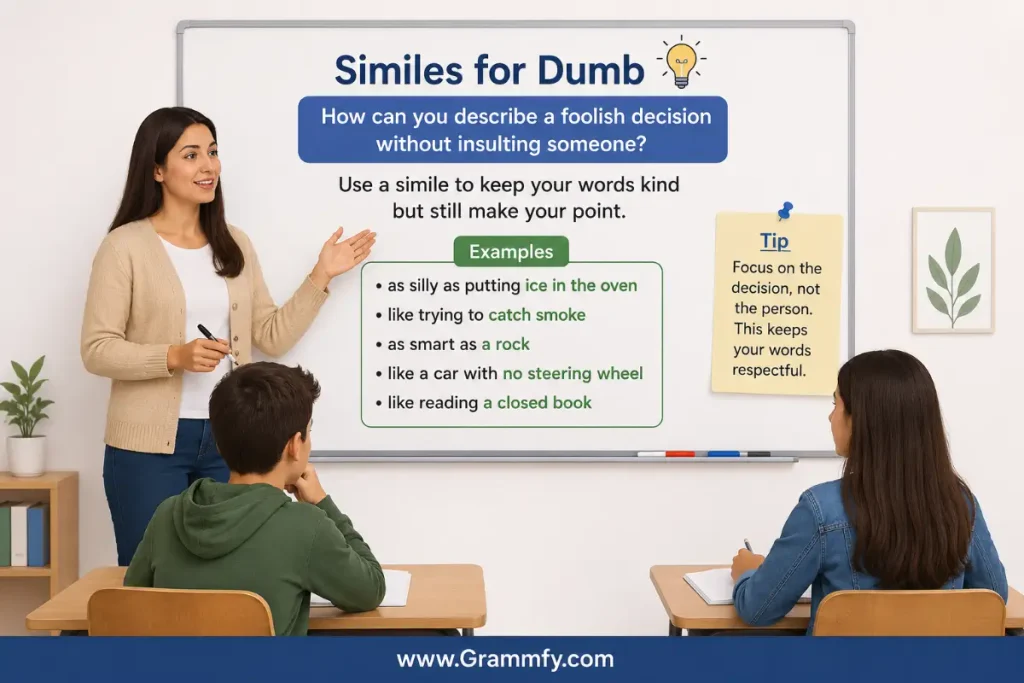
How can you describe a foolish decision without insulting someone?
One of the best writing techniques is to criticize the decision, not the person.
Instead of:
“You’re dumb for doing that.”
Try:
“That decision wasn’t well thought out.”
Instead of:
“He’s dumb.”
Try:
“He misunderstood the situation.”
Instead of:
“That’s a dumb idea.”
Try:
“That idea has a few serious problems.”
This approach is especially useful in workplace, academic, and family conversations.
What are 10+ original examples using these comparisons?
Here are examples across different real-life situations.
1. A forgotten deadline
“I felt as dumb as a doorknob when I realized the deadline had been written on my calendar all week.”
2. A bad plan
“Bringing an umbrella made of paper was as practical as a paper umbrella.”
3. A confusing meeting
“During the technical discussion, I felt like a fish out of water because I didn’t understand the software terms.”
4. A missed clue
“She looked as confused as a cat in a bathtub when everyone started laughing.”
5. A poor route
“My navigation was like a broken compass, sending me in the wrong direction twice.”
6. A bad business idea
“Selling winter coats at a beach resort was about as practical as a chocolate teapot.”
7. A first-day mistake
“I was like a lost puppy on my first day at the new office.”
8. A repeated mistake
“He kept making the same error like a bird flying into a window.”
9. A technical problem
“My brain felt like a computer with no power after three hours of studying.”
10. A poor decision
“Skipping the safety check was a foolish choice that could have caused a serious problem.”
11. A funny self-description
“After forgetting my own password, I felt as sharp as a marble.”
12. An unsuitable solution
“Using a bicycle to move the entire piano was like bringing a spoon to a construction site.”
13. An unclear explanation
“His explanation was like a puzzle missing half its pieces.”
14. A confusing question
“I stared at the math problem like a deer in headlights.”
15. Poor preparation
“He arrived at the camping trip as prepared as a swimmer with no water.”
These examples show an important point: comparisons don’t always need to use the word “dumb.” A strong simile can communicate foolishness without directly calling someone unintelligent.
What are the best Similes for dumb when you want humor?
Humor works best when the comparison is unexpected.
Consider:
- As dumb as a box of rocks
- As sharp as a marble
- As useful as a chocolate teapot
- Like a screen door on a submarine
- Like a GPS with no signal
- Like a phone with a dead battery
- Like a fish out of water
- As organized as a tornado
The humor comes from the mismatch.
For example, a screen door on a submarine is funny because a screen door has no practical use underwater. The comparison therefore suggests that an idea is badly suited to its purpose.
Likewise, a chocolate teapot sounds useful at first, but hot water would quickly destroy it. The comparison suggests that something looks like a solution but cannot actually perform its job.
Can similes describe an idea instead of a person?
Yes. In fact, this is often the better choice.
Instead of saying:
“John is dumb.”
You can say:
“John’s plan was like a screen door on a submarine.”
The second sentence focuses on the plan.
Other examples include:
- “The strategy was like a broken compass.”
- “The proposal was as practical as a paper umbrella.”
- “The argument was like a puzzle missing half its pieces.”
- “The explanation was as clear as a foggy window.”
This technique creates vivid writing while reducing the personal attack.
What are some synonyms for “dumb” based on part of speech?
“Dumb” can function as an adjective, so most direct replacements are adjectives. But related nouns and adverbs can also help you express the idea more precisely.
Adjectives
- Silly
- Foolish
- Unwise
- Clueless
- Irrational
- Illogical
- Careless
- Naive
- Reckless
- Thoughtless
- Impractical
- Absurd
- Ridiculous
- Senseless
- Short-sighted
Example:
“That was an unwise decision.”
Nouns
If you’re describing the problem rather than the person, nouns can be useful:
- Mistake
- Error
- Oversight
- Misjudgment
- Misunderstanding
- Miscalculation
- Blunder
- Misstep
- Foolishness
- Poor judgment
Example:
“The decision was a serious misjudgment.”
Adverbs
Adverbs can describe how an action was performed:
- Carelessly
- Foolishly
- Recklessly
- Thoughtlessly
- Irrationally
- Unwisely
Example:
“He acted recklessly without considering the consequences.”
What are the antonyms of “dumb”?
The opposite depends on which meaning of “dumb” you have in mind.
| Antonym | Meaning |
|---|---|
| Intelligent | Having strong mental ability |
| Smart | Showing good thinking or judgment |
| Wise | Showing good judgment |
| Sensible | Practical and reasonable |
| Clever | Quick to understand or solve problems |
| Thoughtful | Showing careful consideration |
| Rational | Based on sound reasoning |
| Logical | Following clear reasoning |
| Insightful | Showing deep understanding |
| Knowledgeable | Having useful information or expertise |
For example:
- Dumb decision → wise decision
- Dumb idea → sensible idea
- Dumb argument → logical argument
- Dumb approach → practical approach
- Dumb mistake → thoughtful choice
Choosing an exact antonym is better than automatically using “smart.”
When should you avoid the word “dumb”?
Avoid “dumb” when it can create unnecessary offense or when you need precise professional language.
Avoid it in formal reports
Use:
- Unwise
- Illogical
- Ineffective
- Poorly considered
- Unsupported
Avoid it in professional feedback
Instead of:
“That was dumb.”
Say:
“That approach may create problems.”
Avoid it when discussing disabilities
Because “dumb” historically referred to someone who could not speak, it can be offensive in this context.
Use accurate terms such as:
- Nonverbal
- Unable to speak
- Speech-impaired, when appropriate and accurate
Always follow the terminology preferred by the person or community being discussed.
Avoid it when you don’t know the audience
A joke that works with a close friend may sound rude to a new coworker, teacher, client, or manager.
What are common mistakes when using these expressions?
Mistake 1: Using a strong insult in a formal setting
“As dumb as a box of rocks” is not suitable for a formal business report.
Use:
“The decision was poorly considered.”
Mistake 2: Confusing “clueless” with “unintelligent”
Someone can be highly intelligent and still be clueless about a new topic.
For example:
“She’s clueless about car engines.”
This doesn’t mean she lacks intelligence.
Mistake 3: Using a simile that changes the meaning
“Like a deer in headlights” means shocked or unable to react. It doesn’t directly mean unintelligent.
Use it when confusion or hesitation is the main idea.
Mistake 4: Overusing insults
Repeated comparisons can make writing sound childish.
One strong simile is often enough.
Mistake 5: Attacking the person instead of the action
A sentence such as “You’re dumb” is personal.
A better sentence is:
“That decision wasn’t well thought out.”
Mistake 6: Ignoring cultural differences
Some expressions are strongly associated with certain regions or speech communities. A phrase that sounds funny to one group may sound strange or overly harsh to another.
How do US and UK English differ with these expressions?
Most common comparisons are understood in both American and British English, but some vocabulary has different levels of popularity.
In American English, expressions such as these are common:
- As dumb as a box of rocks
- As dumb as a doorknob
- As dumb as a sack of hammers
- Clueless
- Boneheaded
British English commonly uses words such as:
- Thick
- Daft
- Foolish
- Silly
“Daft” often means silly or foolish and can sound less severe than “dumb.”
“Thick” can mean slow to understand in British English, but this usage may sound unusual to many American speakers.
Regional meaning matters, so writers should consider their audience.
How do you choose the right word?
Use these quick questions before choosing a synonym or simile.
Are you describing intelligence?
Try:
- Intelligent
- Unintelligent
- Clever
- Dense
- Sharp
- Clueless
Are you describing poor judgment?
Try:
- Foolish
- Unwise
- Reckless
- Thoughtless
- Short-sighted
Are you describing confusion?
Try:
- Clueless
- Confused
- Lost
- Like a deer in headlights
- Like a GPS with no signal
Are you describing something impractical?
Try:
- Impractical
- Useless
- Ineffective
- Like a screen door on a submarine
- As useful as a chocolate teapot
Are you trying to be funny?
Choose an unexpected comparison:
- As dumb as a box of rocks
- As sharp as a marble
- Like a phone with a dead battery
- Like a puzzle missing half its pieces
Are you writing formally?
Skip the insult and explain the problem:
- Poorly considered
- Illogical
- Unreasonable
- Unsupported
- Ineffective
- Misguided
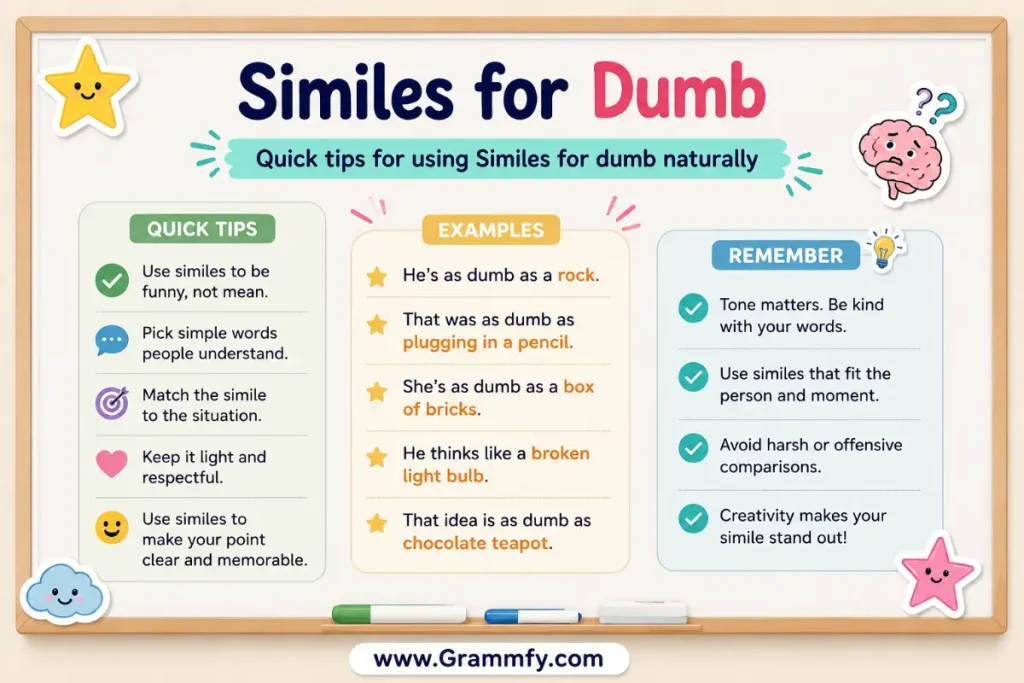
Quick tips for using Similes for dumb naturally
- Match the tone to the audience. A joke with a friend isn’t the same as workplace feedback.
- Focus on actions when possible. Criticizing a decision is usually less offensive than criticizing a person.
- Use precise synonyms. “Careless” is better than “dumb” when the problem was lack of attention.
- Use a simile for imagery. Comparisons work especially well in creative writing, stories, and informal conversations.
- Don’t explain every joke. A familiar comparison should usually speak for itself.
- Avoid repetition. One strong comparison is more effective than several weak ones.
- Consider regional vocabulary. Expressions like “thick” and “daft” may have different levels of familiarity depending on the audience.
- Remember the historical meaning of “dumb.” Don’t use the term carelessly when discussing someone’s ability to speak.
- Choose humor carefully. Self-deprecating comparisons are often safer than insulting someone else.
- Say what you really mean. If you mean “inexperienced,” use “inexperienced.” If you mean “poorly planned,” say that.
How can you make these comparisons sound better in creative writing?
A simile becomes stronger when it supports the scene instead of simply replacing the word “dumb.”
Weak:
“Tom was dumb.”
More vivid:
“Tom stared at the instructions like a GPS with no signal.”
Even better:
“Tom stared at the instructions like a GPS with no signal, turning the page upside down before finally asking for help.”
The final version gives the reader an image and shows the behavior.
You can also create original comparisons:
“Her plan was like bringing a snow shovel to the beach.”
“His explanation was like a map with every road erased.”
“My brain was like an unplugged computer before the first cup of coffee.”
Original similes can be more memorable than familiar ones.
What makes a good simile for foolishness?
A strong simile usually has three qualities.
It creates a clear image
“As dumb as a box of rocks” is easy to picture.
It matches the intended meaning
“Like a deer in headlights” works for confusion, not necessarily low intelligence.
It fits the tone
A funny comparison may work in dialogue but fail in a formal essay.
The strongest comparisons don’t simply say that something is foolish. They show why it seems foolish.
Conclusion
Good comparisons make writing more vivid, but the best choice depends on what you really want to say. Similes for dumb can describe foolish behavior, poor judgment, confusion, or an impractical idea, and each situation calls for a different expression. “As dumb as a box of rocks” is humorous and strong, while “like a deer in headlights” is better for confusion. In formal writing, precise words such as “unwise,” “illogical,” “careless,” or “poorly considered” are usually better. Always think about your audience before using a harsh comparison. When you choose a phrase that matches both the meaning and the tone, your writing becomes clearer, more natural, and much more memorable.
Frequently Asked Questions
What’s another way to say “dumb”?
Good alternatives include “foolish,” “silly,” “unwise,” “clueless,” “illogical,” and “thoughtless.” The best choice depends on whether you mean poor judgment, lack of knowledge, confusion, or low intelligence.
What are some funny Similes for dumb?
Funny choices include “as dumb as a box of rocks,” “as dumb as a doorknob,” “as sharp as a marble,” and “as dumb as a sack of hammers.” These are informal and can sound insulting when aimed directly at another person.
Is “dumb” a rude word?
“Dumb” can be rude because it may directly attack someone’s intelligence. It is often acceptable in casual speech, but more respectful alternatives such as “foolish,” “unwise,” or “poorly considered” work better in formal settings.
What is a polite way to say someone made a dumb mistake?
A polite option is “That wasn’t the best decision” or “That was an oversight.” These phrases focus on the mistake rather than labeling the person.
What is the difference between “dumb” and “clueless”?
“Dumb” can suggest low intelligence or poor judgment, while “clueless” usually means someone lacks knowledge or understanding about a particular situation. A knowledgeable person can be clueless about a subject they haven’t studied.
Can I use “dumb” in an essay?
You can use “dumb” when discussing dialogue, informal language, or a character’s speech, but it is usually too casual for academic analysis. In formal writing, words such as “unwise,” “illogical,” “misguided,” or “poorly considered” are usually stronger choices.
What is a strong simile for someone who lacks common sense?
“As dumb as a box of rocks” is a strong, humorous comparison, while “as dumb as a doorknob” is somewhat lighter. Both are informal, so avoid them in professional or academic writing.
