
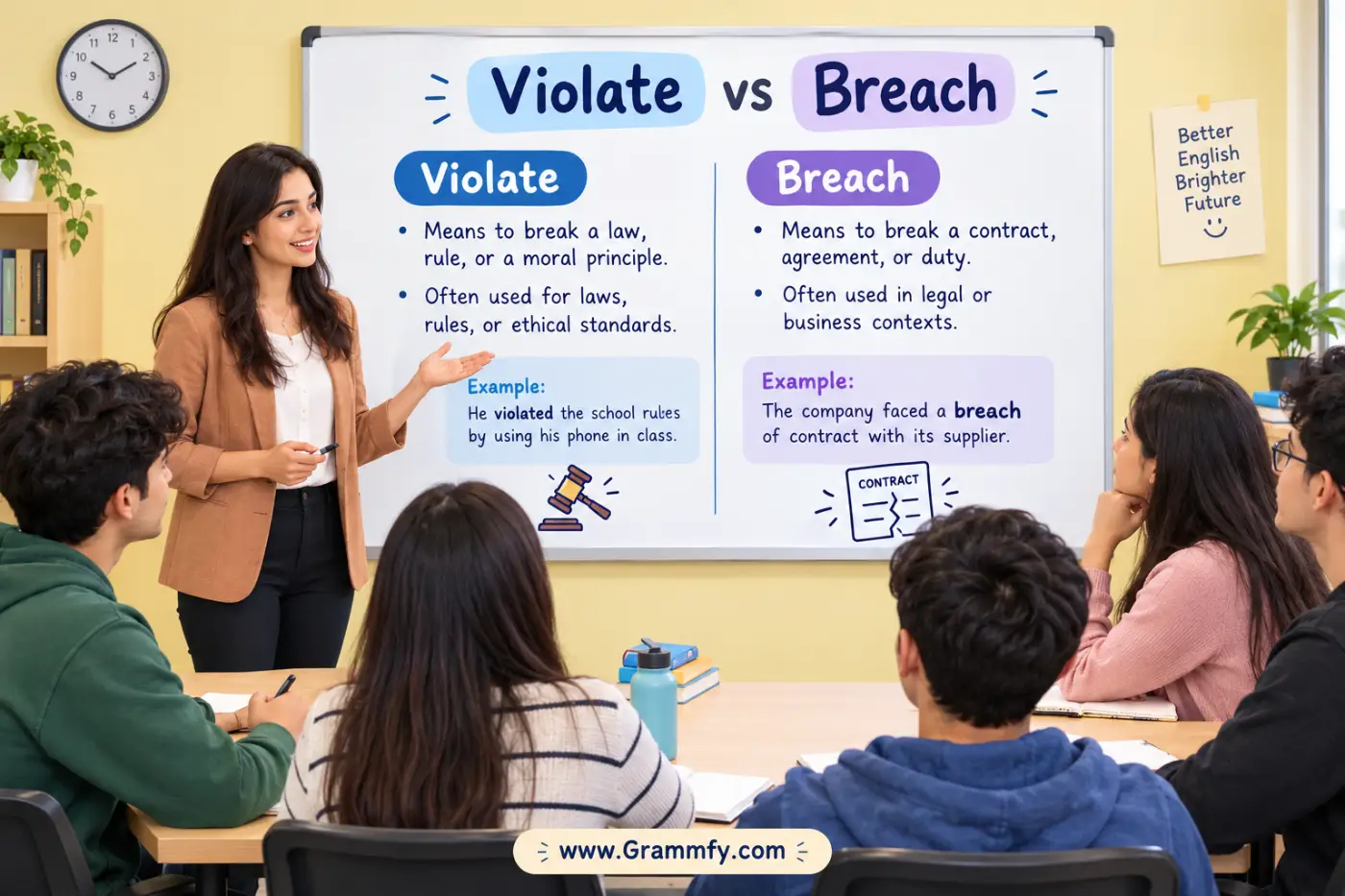
When you’re writing an email, essay, resume, or text, you may stop at a word choice and wonder whether violate vs breach sounds right. Both words can describe breaking a rule, agreement, law, or duty, but they aren’t always interchangeable.
Violate is a broad word for breaking or failing to respect a rule, law, agreement, principle, or someone’s rights. Breach usually means breaking a formal duty, agreement, legal obligation, security measure, or relationship of trust.
Answer box: Use violate for breaking a rule, law, right, principle, or agreement. Use breach when something formal, protected, or trusted has been broken, especially a contract, duty, confidentiality, or security.
The difference becomes easier when you look at the situation around the word. This guide explains their meanings, origins, strength, synonyms, grammar, common mistakes, and the best choice for emails, essays, resumes, texts, and everyday speech.
If you’re working on choosing the right word, explore [See vs Sea].
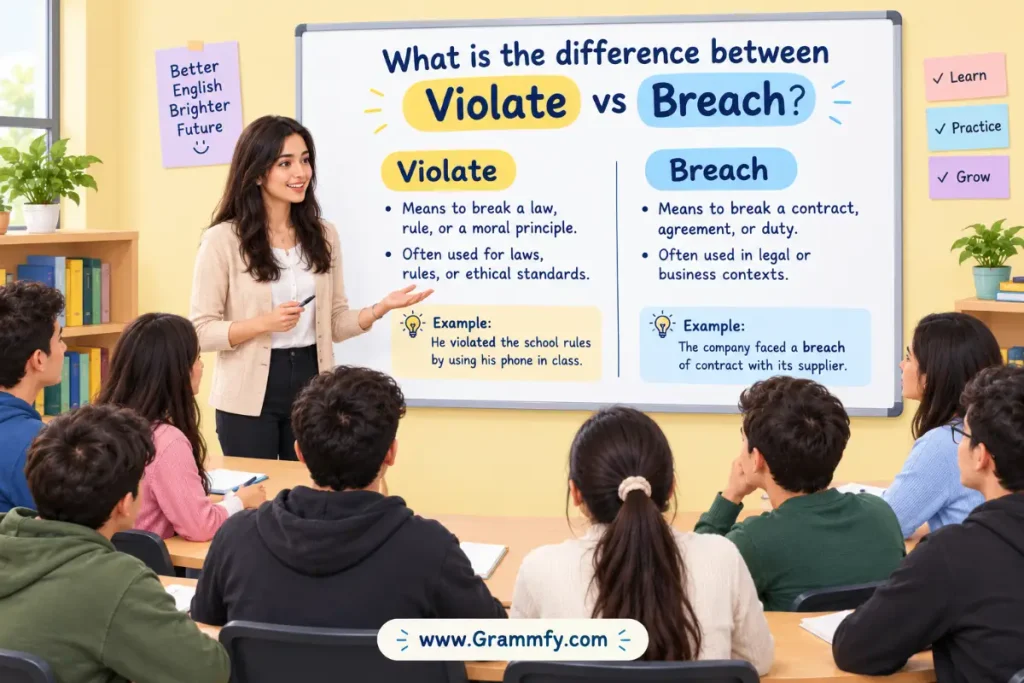
What is the difference between Violate vs Breach?
The main difference is what has been broken and how formal the situation is.
Violate has a wide range of uses. You can violate a law, rule, agreement, principle, right, privacy, or someone’s personal space. The word often focuses on the act of failing to respect a boundary or requirement.
Breach is more specific. It often describes breaking a formal agreement, legal duty, promise, confidentiality, security system, or relationship of trust. The noun breach is also extremely common.
Compare these examples:
- The driver violated the traffic law.
- The company breached the contract.
- The employee violated company policy.
- The hacker breached the company’s security.
- The journalist was accused of violating someone’s privacy.
- The lawyer warned that sharing the document could breach confidentiality.
A useful shortcut is:
Rule or right → violate
Contract, duty, trust, confidentiality, or security → breach
That isn’t an absolute rule. In some contexts, both words work, but one usually sounds more natural or precise.
Where do Violate vs Breach come from?
Understanding their origins can make the difference easier to remember.
Where does violate come from?
Violate comes from the Latin word violāre, meaning to treat with violence, dishonor, or disrespect. English later developed the word with the sense of breaking a rule, law, agreement, or principle.
That history helps explain why violate can involve more than a physical action. Something can be violated when it isn’t respected properly.
For example:
- violate a law
- violate a rule
- violate someone’s rights
- violate privacy
- violate a principle
- violate an agreement
The central idea is disrespecting or breaking something that should be respected.
Where does breach come from?
Breach comes from Old English and is related to the idea of a break or opening. Historically, a breach could refer to a gap made in a wall or defensive barrier.
That physical meaning still appears today:
- The soldiers found a breach in the wall.
- Water entered through a breach in the dam.
The word later developed figurative meanings. A person can create a breach of contract, breach of trust, or breach of confidentiality.
The basic image is still useful:
A breach creates a break in something that was supposed to hold, protect, or connect.
How do Violate vs Breach work in plain English?
The easiest way to understand these words is to imagine different kinds of boundaries.
Violate means breaking a rule or boundary
Use violate when something has been broken, ignored, or disrespected.
Examples include:
- a law
- a rule
- a policy
- a right
- privacy
- a principle
- an agreement
- personal space
The word doesn’t always require a formal contract.
Example:
“Please don’t violate the school’s dress code.”
Here, violate simply means “break.”
Breach means breaking a formal obligation or protection
Use breach when there is a formal duty, agreement, protected information, security system, or relationship of trust.
Common combinations include:
- breach a contract
- breach an agreement
- breach confidentiality
- breach a duty
- breach security
- breach a promise
- breach trust
The word often sounds more legal, professional, or technical than violate.
Example:
“The company breached its contract with the supplier.”
The focus is on failing to follow a formal contractual obligation.
Violate vs Breach: what’s the difference in everyday use?
| Situation | More natural word | Example |
|---|---|---|
| Breaking a school rule | Violate | He violated the school rule. |
| Breaking a traffic law | Violate | She violated the speed limit. |
| Breaking someone’s rights | Violate | The policy may violate workers’ rights. |
| Invading privacy | Violate | The app could violate your privacy. |
| Breaking a contract | Breach | The company breached the contract. |
| Breaking confidentiality | Breach | Sharing the file breached confidentiality. |
| Breaking a legal duty | Breach | The manager breached his duty. |
| Breaking computer security | Breach | Hackers breached the system. |
| Breaking trust | Breach | His actions breached their trust. |
| Breaking a general principle | Violate | The decision violated the principle of fairness. |
The table isn’t a strict grammar law. English speakers sometimes use violate and breach in overlapping situations. Context determines the most natural choice.
What are the main synonyms for Violate vs Breach?
Both words have many related terms, but each synonym carries a slightly different tone or level of seriousness.
Simple synonyms
These are useful when you want clear, everyday English.
| Word | Meaning | Tone | Example |
|---|---|---|---|
| Break | Fail to follow a rule | Simple | He broke the rule. |
| Ignore | Fail to pay attention to a rule | Neutral | She ignored the warning. |
| Disobey | Refuse to follow an instruction | Everyday | The child disobeyed the order. |
| Cross | Go beyond an accepted boundary | Everyday | He crossed the line. |
| Overstep | Go beyond an acceptable limit | Neutral | She overstepped her authority. |
| Hurt | Cause harm to someone or something | Simple | The decision hurt their rights. |
Everyday synonyms
These work well in normal conversation and general writing.
| Word | Meaning | Tone | Example |
|---|---|---|---|
| Go against | Act contrary to something | Conversational | That goes against our policy. |
| Disregard | Pay little or no attention to something | Neutral | He disregarded the instructions. |
| Invade | Enter someone’s private space or rights improperly | Strong | The questions invaded her privacy. |
| Intrude | Enter where you aren’t welcome | Neutral | I don’t want to intrude. |
| Overstep | Pass an acceptable boundary | Neutral | The manager overstepped his role. |
| Defy | Refuse to obey openly | Strong | They defied the order. |
| Violate | Break or disrespect a rule, right, or boundary | Neutral-formal | The action violated the law. |
Formal and legal synonyms
These are more common in business, law, policy, and official writing.
| Word | Meaning | Tone | Example |
|---|---|---|---|
| Breach | Break a formal duty, agreement, or protection | Formal | The supplier breached the contract. |
| Contravene | Act against a law or rule | Very formal | The action contravenes federal law. |
| Infringe | Limit or break a right or legal protection | Formal | The rule infringes on free expression. |
| Transgress | Go beyond a moral or legal limit | Formal | The official transgressed ethical standards. |
| Default | Fail to meet a legal or financial obligation | Legal | The borrower defaulted on the loan. |
| Noncomply | Fail to comply with a requirement | Formal | The company did not comply with the standard. |
| Disobey | Fail to follow an order or command | Formal-neutral | The employee disobeyed the instruction. |
| Encroach | Gradually move into another’s rights or space | Formal | The policy encroaches on privacy rights. |
Informal and slang-like alternatives
These aren’t direct replacements in every situation, but they can work in casual speech.
| Word | Meaning | Tone | Example |
|---|---|---|---|
| Mess with | Interfere with something or someone | Informal | Don’t mess with the settings. |
| Step over the line | Go beyond an acceptable limit | Informal | You stepped over the line. |
| Cross the line | Behave in an unacceptable way | Informal | That joke crossed the line. |
| Go too far | Become more serious or extreme than acceptable | Informal | His comments went too far. |
| Screw up | Make a serious mistake | Very informal | I screwed up the paperwork. |
| Break | Fail to follow something | Casual | He broke the agreement. |
Not every casual expression has the legal precision of violate or breach. Use informal alternatives carefully in professional documents.
Which synonyms are mild or strong?
Word choice can change how serious your sentence sounds.
Mild terms
These suggest a problem without necessarily implying serious wrongdoing:
- overlook
- ignore
- neglect
- disregard
- go against
- overstep
Example:
“She disregarded the instructions.”
This doesn’t automatically suggest a serious legal offense.
Medium-strength terms
These clearly suggest that a rule or boundary was broken:
- break
- violate
- infringe
- disobey
- cross the line
Example:
“The company violated the safety rules.”
Strong terms
These can suggest serious misconduct, legal consequences, or major damage:
- breach
- defy
- transgress
- infringe upon
- invade
- sabotage
Example:
“The attack breached the hospital’s security system.”
The right strength depends on what actually happened. Don’t choose a stronger word just to make a sentence sound impressive.
What part of speech are Violate vs Breach?
Understanding their grammar can prevent awkward sentences.
Violate as a verb
Violate is primarily a verb.
Common structure:
subject + violate + object
Examples:
- The company violated the law.
- He violated the agreement.
- The policy violates their rights.
- They violated the safety rules.
The past form is violated, and the -ing form is violating.
Breach as a verb
Breach can also work as a verb.
Examples:
- The company breached the contract.
- The employee breached confidentiality.
- Hackers breached the database.
- He breached his duty to the client.
Breach as a noun
Breach is especially common as a noun.
Examples:
- It was a breach of contract.
- The incident was a serious breach of security.
- The lawyer discussed a breach of confidentiality.
- The employee committed a breach of trust.
This noun use is one reason breach appears frequently in legal and business writing.
Related nouns for violate
The noun related to violate is violation.
Examples:
- a violation of the law
- a violation of company policy
- a privacy violation
- a traffic violation
- a violation of human rights
This gives you a useful pair:
violate → violation
breach → breach
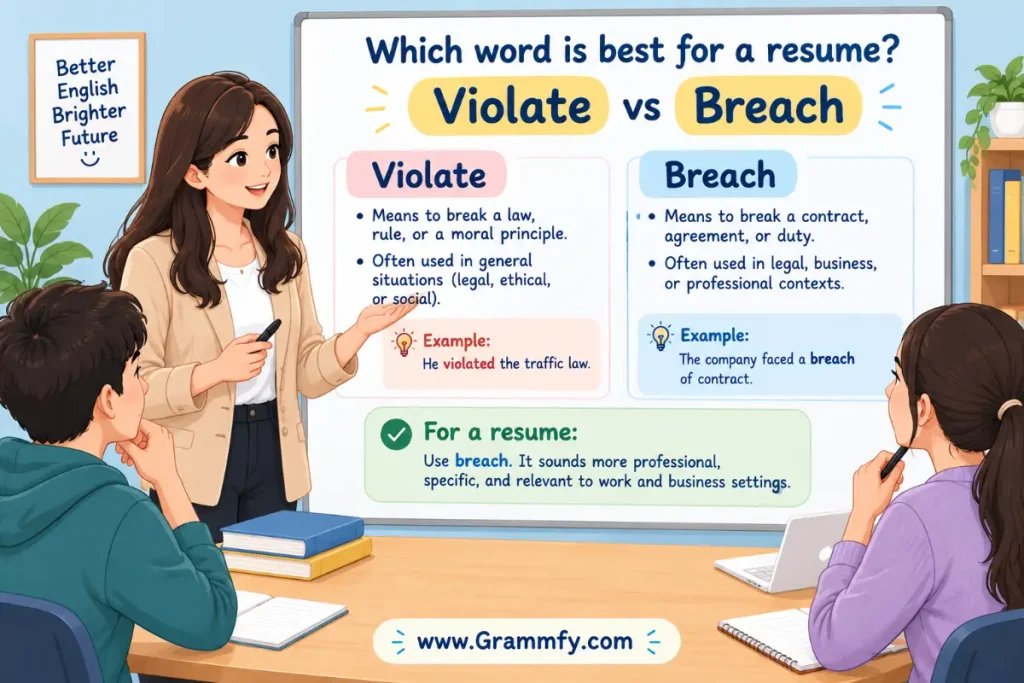
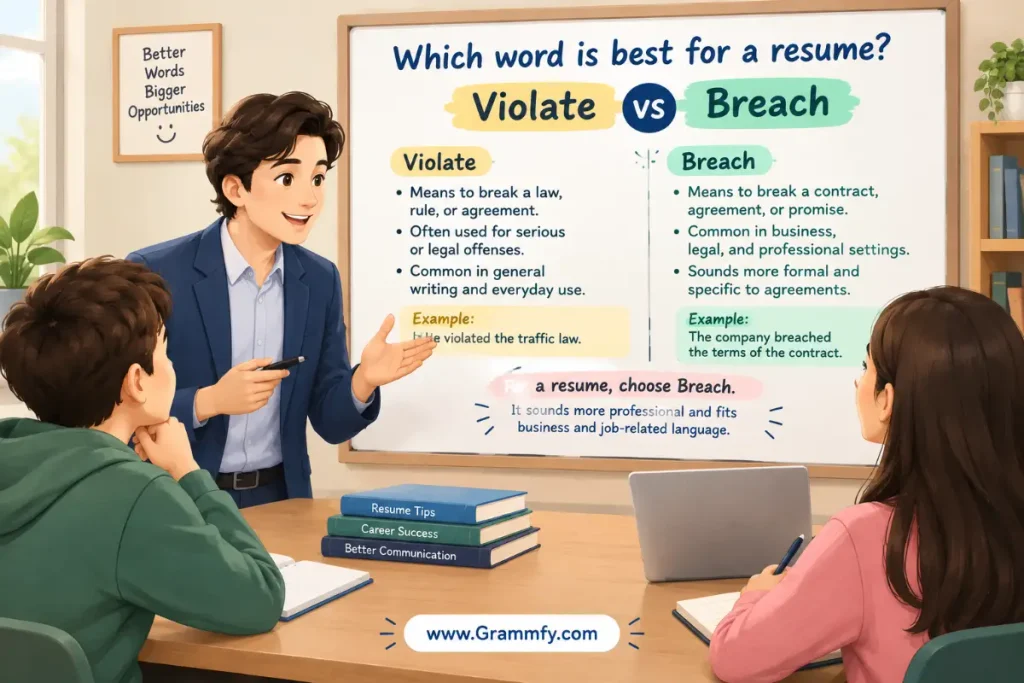
Which word is best for a resume Violate vs Breach?
Should you use violate or breach on a resume?
For a resume, neither word is normally useful unless you’re describing compliance, legal work, cybersecurity, risk, or a similar professional area.
A resume usually benefits from precise action verbs.
Instead of:
“Worked on issues involving companies that violated regulations.”
You might write:
“Reviewed regulatory violations and supported compliance investigations.”
For cybersecurity:
“Investigated security breaches and helped strengthen network protection.”
For legal work:
“Reviewed potential contract breaches and prepared case summaries.”
A resume should show what you did, not simply state that someone broke a rule.
Resume example
“Analyzed compliance reports and identified potential regulatory violations.”
Here, violations is natural because the work concerns rules and regulations.
Another example:
“Investigated data breaches and documented security risks.”
In cybersecurity, breaches is the standard professional term for unauthorized access or exposure.
Which word is best for an essay Violate vs Breach?
Should you use violate or breach in an essay?
Violate is often the better choice in a general academic essay because it works with laws, rights, principles, rules, and social norms.
For example:
“The new policy may violate citizens’ privacy rights.”
A more formal essay might say:
“The policy could violate established principles of equal treatment.”
Use breach when your topic involves contracts, duties, confidentiality, security, or formal obligations.
“The organization may have breached its legal duty to protect customer information.”
Academic writing rewards accuracy more than complicated vocabulary. If break is clear but violate is more precise, choose violate. Don’t replace every “break” with a formal word.
Which word is best in a professional email Violate vs Breach?
Should you use violate or breach in an email?
Choose the word based on what you’re discussing.
- For a general policy:
“This action may violate our company policy.”
- For a contract:
“This change could constitute a breach of the agreement.”
- For confidentiality:
“Sharing this information outside the team may breach our confidentiality requirements.”
A professional email should avoid accusations unless you have enough evidence.
Instead of:
“You violated the contract.”
- A careful version may be:
“This action may constitute a breach of the contract.”
The second sentence sounds more measured and professional.
Which word is better for texting Violate vs Breach?
Should you use violate or breach in a text?
Break is usually more natural in casual texting.
You might write:
“You broke the rules.”
Rather than:
“You violated the rules.”
The second sentence isn’t wrong, but it sounds more formal.
Breach is even more formal in many everyday conversations:
“You breached our agreement.”
This sounds serious and possibly legal.
If you’re texting a friend about a simple rule, say:
“You broke the rule.”
If you’re discussing a serious agreement or privacy issue, breach may be appropriate.
Which word sounds natural in everyday speaking Violate vs Breach?
Is violate or breach better when speaking?
Violate is more common in ordinary speech than breach, but break is often the simplest option.
Compare:
“He violated the rules.”
“He broke the rules.”
Both are correct. The second sounds more conversational.
Now compare:
“They breached the contract.”
“They broke the contract.”
Both can work, but breached the contract sounds more professional and legal.
When speaking, think about your audience. A lawyer, manager, or cybersecurity specialist may naturally use breach. Friends usually choose simpler words.
What are common examples of violate?
Here are examples from different situations:
- The driver violated the speed limit.
- The company violated environmental regulations.
- The new policy could violate employees’ privacy rights.
- Students who violate the exam rules may receive a penalty.
- The landlord cannot violate a tenant’s legal rights.
- The advertisement violated the platform’s content policy.
- The decision appears to violate the principle of equal treatment.
- Entering the building without permission may violate security rules.
- The referee ruled that the player had violated the league’s rules.
- The government was accused of violating constitutional rights.
These examples show how flexible violate can be. It works with laws, policies, rules, rights, principles, and boundaries.
What are common examples of breach?
Here are examples from business, law, technology, and relationships:
- The supplier breached the contract by missing the deadline.
- Sharing the document could breach confidentiality.
- The employee was accused of breaching a professional duty.
- Hackers breached the company’s computer network.
- The incident was reported as a serious data breach.
- The manager apologized after breaching the team’s trust.
- Failure to provide the required service may constitute a breach of contract.
- The lawyer investigated an alleged breach of agreement.
- The company introduced new controls after a security breach.
- The employee’s actions could be considered a breach of policy.
Notice that breach frequently appears with formal relationships and protections.
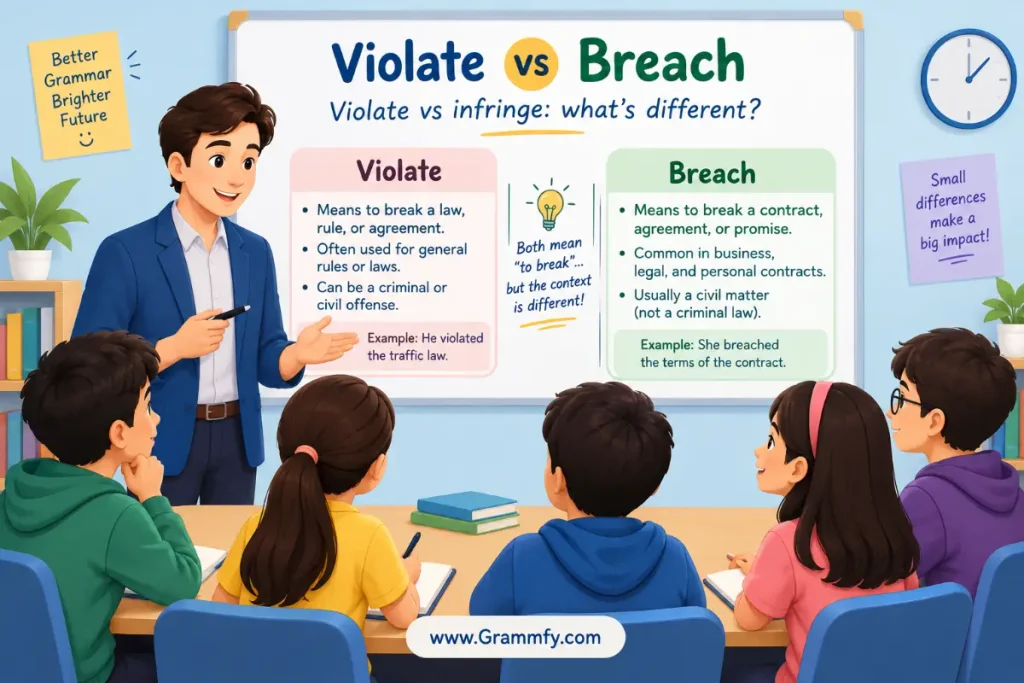
Violate vs infringe: what’s different?
Violate and infringe can overlap, but infringe is especially common when talking about rights, freedoms, patents, copyrights, or legal protections.
| Violate | Infringe |
|---|---|
| Broad meaning | More specific |
| Break or disrespect a rule, law, right, or principle | Encroach on a right, freedom, or legal protection |
| Common in general and formal English | Common in legal and intellectual-property contexts |
| “The law violates privacy rights.” | “The product infringes a patent.” |
Consider these examples:
“The policy violates workers’ rights.”
“The company infringed the patent.”
The first focuses broadly on a violation of rights. The second points to a specific legal protection.
Breach vs break: what’s different?
Break is much broader and more conversational.
Breach adds a sense of formality or a broken obligation, protection, or trust.
| Break | Breach |
|---|---|
| Very broad | More specific |
| Casual and everyday | Formal or professional |
| Break a rule | Breach a contract |
| Break a promise | Breach confidentiality |
| Break the law | Breach a duty |
| Break a relationship | Breach trust |
For example:
“He broke the agreement.”
This is understandable and natural.
“He breached the agreement.”
This sounds more formal and may fit legal or business writing better.
Neither is automatically more correct. The context determines the best choice.
Violate vs breach: when can both work?
Some nouns can naturally follow either word.
Agreements
You can say:
“They violated the agreement.”
You can also say:
“They breached the agreement.”
The difference is subtle. Violated emphasizes failure to follow the terms. Breached emphasizes the formal obligation created by the agreement.
Rules
You can say:
“The employee violated the rules.”
Using breach here is less common in ordinary English:
“The employee breached the rules.”
It isn’t always impossible, but violated the rules is usually more natural.
Laws
The natural choice is usually:
“They violated the law.”
Breached the law is not the normal everyday expression.
Contracts
The strongest standard choice is often:
“They breached the contract.”
You may also hear violated the contract, but breach of contract is an established legal phrase.
Privacy
Violated privacy is common:
“The app violated users’ privacy.”
For formal legal contexts, you may also encounter:
“The company breached its privacy obligations.”
The second sentence focuses on a formal duty rather than privacy as a personal boundary.
What are the most common mistakes with these words?
Mistake 1: Using breach for every broken rule
A learner might write:
“I breached the school rule.”
A more natural sentence is:
“I violated the school rule.”
Breach is strongly associated with formal obligations, contracts, security, confidentiality, and trust.
Mistake 2: Thinking violate always means physical harm
It doesn’t.
You can violate:
- a law
- a rule
- a principle
- a right
- privacy
- an agreement
The word can describe a legal, moral, social, or personal boundary.
Mistake 3: Assuming breach is always legal
Breach is common in legal language, but it isn’t limited to law.
You can have:
- a breach of trust
- a breach of confidentiality
- a security breach
- a breach in a wall
- a breach in a relationship
The idea of a “break” remains important.
Mistake 4: Using formal words when a simple word is better
Writing:
“You have transgressed the rules.”
may sound unnatural in a casual text.
Writing:
“You broke the rules.”
is clearer.
Good writing isn’t about choosing the most complicated synonym. It’s about choosing the word that communicates the idea naturally.
Mistake 5: Treating all synonyms as interchangeable
Words such as infringe, encroach, breach, and violate have different patterns.
For example:
- infringe a patent
- breach a contract
- violate a law
- encroach on someone’s rights
Changing one word for another can make a sentence sound unnatural even if the general meaning remains understandable.
When should you NOT use violate?
Avoid violate when a simpler or more specific verb gives the reader a clearer picture.
Instead of:
“He violated the door.”
Say:
“He damaged the door.”
Instead of:
“She violated the computer.”
Say:
“She accessed the computer without permission.”
Instead of:
“He violated his deadline.”
Say:
“He missed his deadline.”
The problem is not grammar alone. Violate needs an object that can logically be violated.
When should you NOT use breach?
Avoid breach when you’re simply talking about an ordinary mistake or failure.
Instead of:
“I breached my homework deadline.”
Say:
“I missed my homework deadline.”
Instead of:
“She breached the classroom rule.”
Say:
“She broke the classroom rule” or “She violated the classroom rule.”
Use breach when the idea of a broken obligation, protection, trust, agreement, or security boundary makes sense.
What are the antonyms of Violate vs Breach?
The opposite of breaking a rule is generally follow, obey, or respect.
Useful antonyms include:
| Word | Opposite idea | Example |
|---|---|---|
| Obey | Follow an order or law | She obeyed the law. |
| Follow | Act according to a rule | He followed the instructions. |
| Respect | Treat a right or boundary properly | They respected her privacy. |
| Honor | Keep a promise or agreement | He honored his commitment. |
| Comply | Act according to a requirement | The company complied with the rules. |
| Protect | Keep something safe | The system protects user data. |
| Maintain | Keep something in proper condition | They maintained confidentiality. |
The best antonym depends on the object.
Violate a law → obey the law
Violate someone’s rights → respect their rights
Breach a contract → honor the contract
Breach a security system → protect the system
What is the best way to choose between Violate vs Breach?
Use these quick questions before choosing.
Is it a general rule or law?
Choose violate.
“The company violated the safety law.”
Is it a formal contract?
Choose breach in most formal contexts.
“The company breached the contract.”
Is it someone’s right or privacy?
Choose violate.
“The policy violates users’ privacy.”
Is it confidentiality?
Choose breach.
“Sharing the information breached confidentiality.”
Is it computer security?
Choose breach.
“Attackers breached the network.”
Is it a moral principle?
Choose violate.
“The decision violated basic ethical principles.”
Is it trust?
Choose breach when using the established expression.
“His actions were a breach of trust.”
Are you writing casually?
Consider break instead.
“They broke the rules.”
Are you writing a legal document?
Use the established legal term for the specific situation.
“breach of contract”
“violation of law”
“infringement of copyright”
Specific phrases are often more important than simply choosing the most formal word.
Are there US and UK differences?
There is no major US-versus-UK meaning difference between these two words. Both varieties of English use violate for breaking laws, rules, rights, and principles, and both use breach for contracts, duties, confidentiality, trust, and security.
Spelling also remains the same:
- violate
- violated
- violation
- breach
- breached
Legal systems and terminology can differ between countries, however. A phrase that is standard in one country’s legal system may have a different technical meaning elsewhere.
For ordinary English, the same basic distinction works well in both American and British English.
How do you use Violate vs Breach in formal writing?
Formal writing requires precision.
Consider this sentence:
“The company did something bad with customer information.”
It’s vague.
A more precise version is:
“The company violated customers’ privacy.”
If a formal confidentiality obligation existed, you might write:
“The company breached its confidentiality obligations.”
The second version tells the reader that a specific duty was involved.
Strong professional writing usually answers three questions:
- What was broken?
- Who was responsible?
- What kind of obligation or boundary was involved?
That information helps you select the correct verb.
How do you remember the difference between Violate vs Breach?
Try this simple memory trick:
Violate = break a rule or right.
Breach = break a formal bond, duty, contract, trust, or protection.
Picture a red line around a rule. Crossing it can violate the rule.
Now picture a wall protecting something valuable. Creating a gap in that wall is a breach.
That mental image can help you remember why security systems, confidentiality, contracts, and trust are so often connected with breach.
Quick comparison chart
| Feature | Violate | Breach |
|---|---|---|
| Main idea | Break or disrespect | Break or open |
| Common objects | Laws, rules, rights, privacy, principles | Contracts, duties, confidentiality, security, trust |
| Part of speech | Mainly verb | Verb and noun |
| Formality | Neutral to formal | Often formal |
| Common noun | Violation | Breach |
| Casual alternative | Break | Break |
| Legal use | Very common | Very common |
| Security use | Possible | Very common |
| Contract use | Possible | Especially common |
| Privacy use | Very common | Possible when a duty is involved |
| Trust use | Possible | Very common |
Quick tips for choosing the right word
- Choose violate for laws and rules.
- Choose violate for rights and privacy.
- Choose violate for principles and standards.
- Choose breach for contracts.
- Choose breach for confidentiality.
- Choose breach for formal duties.
- Choose breach for security incidents.
- Choose breach for trust.
- Use break when the situation is casual.
- Use infringe when a specific legal right or intellectual-property protection is involved.
- Don’t use a formal word just because it sounds more professional.
- Check the noun that normally follows the verb.
- In legal writing, use established phrases such as breach of contract and violation of law.
- When accusing someone of wrongdoing, use careful wording if the facts aren’t confirmed.
Conclusion
The easiest way to remember Violate vs Breach is to focus on what has been broken. Violate is the broader choice for laws, rules, rights, privacy, principles, and boundaries. Breach is especially useful for contracts, formal duties, confidentiality, security, and trust. In casual conversation, break may be the clearest alternative to either word.
Good word choice depends on context rather than formality alone. If you’re discussing a traffic law, “violate” fits naturally. If a company fails to follow a contract, “breach” is usually more precise. Once you learn these common word patterns, choosing between them becomes much easier. When you’re unsure, identify the object first, then select the verb that normally goes with it.
Frequently Asked Questions
What is the difference between violate and breach?
Violate generally means breaking or disrespecting a rule, law, right, principle, or boundary, while breach often refers to breaking a formal agreement, duty, trust, confidentiality, or security protection. The two can overlap in some contexts.
Can I say breach a law?
Usually, violate a law is the natural expression. “Breach a law” is not the standard choice in ordinary American English.
Is it a breach or violation of a contract?
Breach of contract is the standard formal expression, especially in legal and business writing. “Violation of a contract” can be understood, but it isn’t usually the preferred legal phrase.
What’s another way to say violate?
Other choices include break, disobey, disregard, infringe, overstep, contravene, and go against. The best alternative depends on what is being broken and how formal the writing needs to be.
What’s another way to say breach?
Depending on the context, you can use break, violate, infringe, fail to comply with, or break an obligation. For contracts and confidentiality, breach is often the clearest formal term.
Is breach more serious than violate?
Not necessarily, because seriousness depends on the situation. Breach often sounds more formal or legal, while violate can describe anything from breaking a simple rule to violating fundamental rights.
Can I use violate and breach in the same sentence?
Yes, when they describe different things. For example, “The company violated privacy rules and breached its contractual duty to protect customer data” uses each word for a slightly different type of obligation.
