
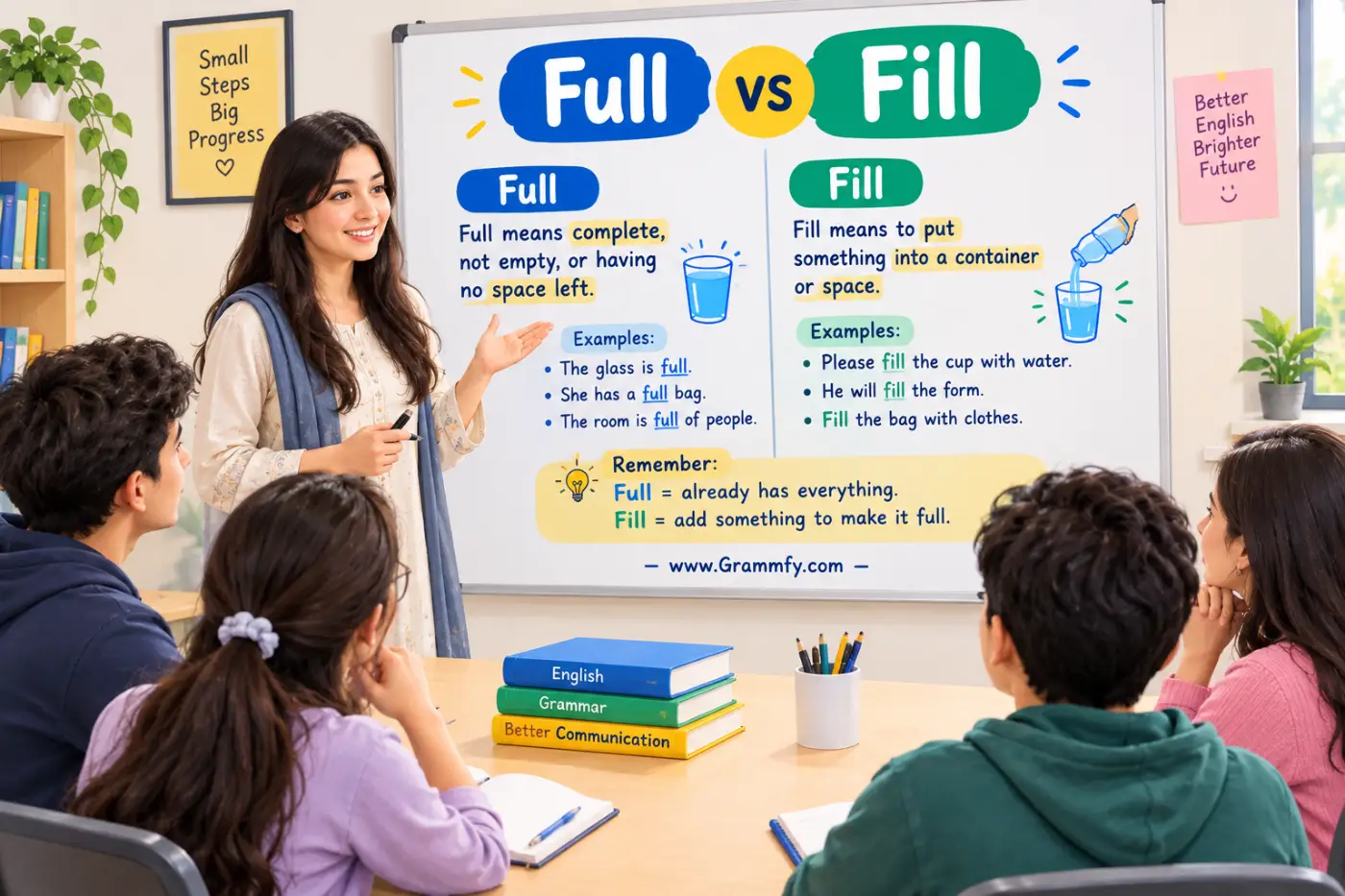
You’re writing an email, essay, resume, or text, and you pause over two words that sound almost identical: full vs fill. They look and sound similar, but they have different meanings and grammatical jobs.
Answer Box: Full describes something that contains as much as it can hold, while fill means to put something into a space or container until it is occupied. For example, “The glass is full” but “Please fill the glass.”
Understanding Full vs Fill becomes much easier when you focus on whether you’re describing a condition or an action. Full is usually an adjective, while fill is most often a verb. Their related forms also appear in many everyday expressions, such as “full of,” “fill out,” and “fill in.”
For another common word-choice problem, see [Similes for Loneliness].
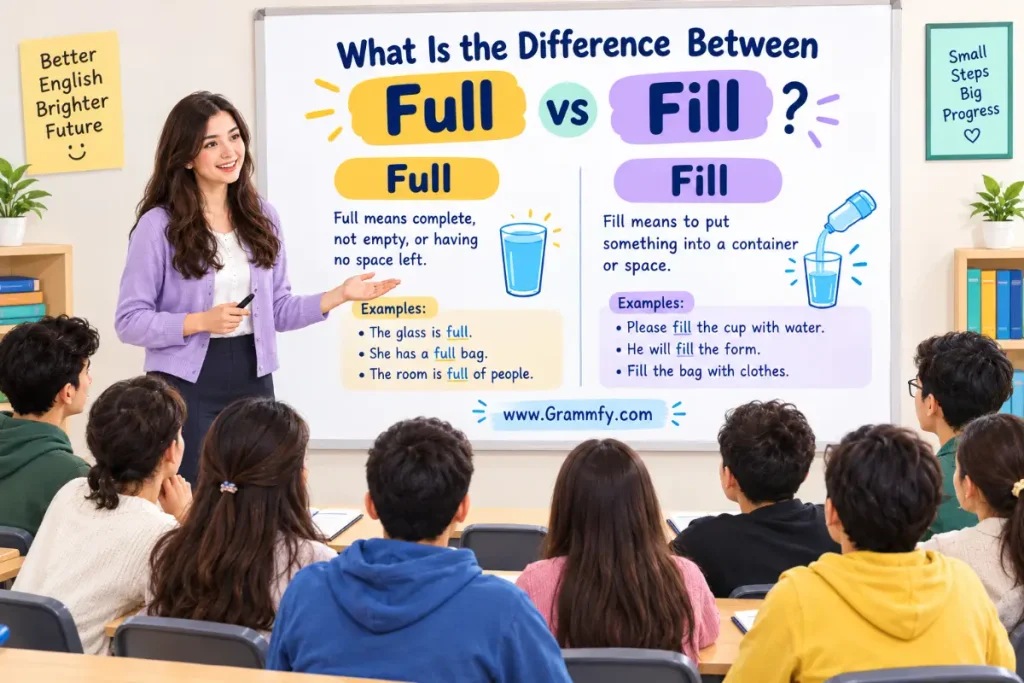
What Is the Difference Between Full vs Fill?
The simplest difference is this:
- Full = containing as much as something can hold or having no available space.
- Fill = to put something into a container, space, or area.
- Full usually describes a state or condition.
- Fill usually describes an action or process.
Compare:
The bottle is full.
Here, full describes the bottle’s condition.
Fill the bottle with water.
Here, fill describes the action of putting water into the bottle.
Another easy pair is:
My schedule is full.
Please fill my schedule with useful activities.
The first sentence describes a condition. The second describes an action.
How Do You Remember Full vs Fill?
Use this quick trick:
Full = finished state.
Fill = action.
Think about a cup:
You fill the cup.
After you add enough water:
The cup is full.
You can remember the relationship as:
Fill → Full
The action of filling something can result in it becoming full.
This doesn’t mean that every use follows this exact pattern. For example, “fill out a form” doesn’t make the form “full.” Still, the basic distinction is useful for beginners.
What Does “Full” Mean?
Full has several meanings, but the central idea is having no more room available.
Full as an Adjective
The most common use is as an adjective.
Examples:
- The glass is full.
- The room is full.
- The box is full.
- My calendar is full.
- The bus was full.
- The bottle is full of juice.
In these examples, full describes the noun.
Full Can Describe Amount
“Full” can also mean containing a complete amount.
Examples:
- I drank a full glass of water.
- She worked a full day.
- We waited for a full hour.
- He received a full refund.
- They completed a full course.
Here, full doesn’t always mean that something is physically packed. It can mean complete or entire.
Full Can Describe Someone Who Has Eaten
In everyday English, full can describe a person who has eaten enough.
“I’m full.”
This means:
“I don’t want to eat more because I’ve eaten enough.”
You wouldn’t normally say:
“I’m fill.”
That’s incorrect.
What Does “Fill” Mean?
Fill is most commonly a verb. It means to put something into a space, container, or area.
Examples:
- Fill the glass with water.
- Fill the bottle.
- Fill the box with books.
- Fill out this form.
- Fill in the missing word.
- The room filled with smoke.
The subject can also be the thing entering the space:
“Water filled the glass.”
Here, water is the subject, and filled is the verb.
Fill Can Mean “Complete”
“Fill” doesn’t always involve a physical container.
It can mean completing a space, form, position, or requirement.
Examples:
- Please fill out the application.
- She filled in the missing information.
- The company needs someone to fill the position.
- He filled the page with drawings.
- The students filled the seats.
So, the basic meaning expands from putting something into a space to making something complete or occupied.
Where Do Full vs Fill Come From?
Full and fill are related English words, but their histories are not identical in every detail.
Full comes from Old English full, meaning complete, filled, or having all that is possible. It is related to similar words in other Germanic languages.
Fill comes from Old English fyllan, meaning to make full or put something into a space. The two words have been closely connected in English for a very long time.
Their relationship makes sense:
Fill means to make something full.
This connection is still visible in modern English.
For example:
“Fill the cup until it is full.”
The two words work together, but they don’t perform the same grammatical job.
Is Full an Adjective or a Verb?
Full is mainly an adjective in modern standard English.
It describes a person, place, object, amount, or condition.
Examples:
- The tank is full.
- The room is full.
- I’m full.
- The report is full of useful information.
- We had a full day.
There are some less common or specialized uses of full as a verb or adverb, but learners usually need to focus on its common adjective use.
For everyday writing, remember:
Full describes.
Is Fill a Verb or a Noun?
Fill is most commonly a verb, but it can also be a noun.
- Fill as a Verb
Please fill the cup.
She filled out the form.
The audience filled the theater.
- Fill as a Noun
In some contexts, fill means something used to fill a space.
For example:
“The pillow has a soft fill.”
You may also hear “fill” in technical, manufacturing, construction, food, or textile contexts.
For everyday grammar, however, fill is much more commonly used as a verb.
Full vs Fill in a Quick Comparison
| Feature | Full | Fill |
|---|---|---|
| Common part of speech | Adjective | Verb |
| Basic idea | Having no space left | Put something into a space |
| Describes a condition? | Yes | Usually no |
| Describes an action? | Usually no | Yes |
| Example | The cup is full. | Fill the cup. |
| Common phrase | Full of | Fill with |
| Past form | — | Filled |
| -ing form | — | Filling |
| Comparative | Fuller | — |
| Superlative | Fullest | — |
What Are the Main Uses of Full?
Understanding its different uses helps prevent confusion.
- Full Means “Containing as Much as Possible”
The glass is full.
The parking lot is full.
The theater was full.
- Full Means “Complete”
We watched the full movie.
She gave me the full story.
He worked a full shift.
- Full Means “Entire”
I spent the full day studying.
Read the full report before the meeting.
- Full of Means “Containing a Lot of”
The garden is full of flowers.
The book is full of useful examples.
Her speech was full of energy.
- Full Can Describe a Busy Schedule
My calendar is full this week.
His day is full of meetings.
This doesn’t necessarily mean there is literally no physical space. It means there is little or no time available.
What Are the Main Uses of Fill?
- Fill a Container
Fill the bottle with water.
Fill the bowl with rice.
Fill the tank with fuel.
- Fill a Space
The children filled the room.
Smoke filled the kitchen.
The crowd filled the stadium.
- Fill Out a Form
Please fill out this application.
- Fill In a Blank
Fill in the missing word.
- Fill a Position
She was hired to fill the vacant position.
- Fill Time
I read books to fill my free time.
What Is the Difference Between Full vs Fill in a Sentence?
Look at these pairs carefully.
| With Full | With Fill |
|---|---|
| The cup is full. | Fill the cup. |
| The room is full. | People filled the room. |
| The box is full of toys. | She filled the box with toys. |
| My schedule is full. | I filled my schedule with meetings. |
| The page is full of notes. | He filled the page with notes. |
| The tank is full. | They filled the tank. |
| The theater was full. | The audience filled the theater. |
A useful pattern is:
Full + of
The box is full of books.
Fill + with
She filled the box with books.
This is one of the most useful grammar patterns to remember.
What Is the Difference Between “Full of” and “Fill With”?
These phrases are closely related, but their structures differ.
Full of
Full of describes what something contains.
The basket is full of apples.
The basket already has apples in it.
Fill with
Fill with describes the action of putting something into a space.
She filled the basket with apples.
The action is happening.
Compare:
The room was full of people.
The workers filled the room with chairs.
The first describes the room. The second describes an action.
What Are 30 Synonyms and Related Words for Full and Fill?
Because full and fill can have different meanings, their related words also depend on context.
Simple Alternatives
| Word | Meaning | Tone | Example |
|---|---|---|---|
| Complete | Having all parts | Neutral | The form is complete. |
| Packed | Very full | Everyday | The bus was packed. |
| Filled | Containing something | Neutral | The jar was filled with rice. |
| Entire | Whole or complete | Neutral | I read the entire book. |
| Enough | As much as needed | Simple | We have enough food. |
| Loaded | Holding a lot | Everyday | The truck was loaded with boxes. |
| Occupied | Being used | Neutral | Every seat was occupied. |
| Crowded | Full of people | Everyday | The store was crowded. |
Everyday Alternatives
| Word | Meaning | Tone | Example |
|---|---|---|---|
| Stuffed | Completely filled | Informal | The bag is stuffed with clothes. |
| Jam-packed | Extremely crowded | Informal | The train was jam-packed. |
| Packed full | Filled almost completely | Everyday | The drawer was packed full. |
| Overflowing | Too full to contain everything | Everyday | The basket was overflowing. |
| Busy | Having little free time | Everyday | My schedule is busy. |
| Loaded with | Containing a lot | Casual | The article is loaded with examples. |
| Filled up | Made completely full | Casual | I filled up the tank. |
| Used up | Completely consumed | Everyday | We used up the milk. |
Formal Alternatives
| Word | Meaning | Tone | Example |
|---|---|---|---|
| Complete | Having every required part | Formal/neutral | Submit the complete report. |
| Comprehensive | Covering many or all details | Formal | The guide is comprehensive. |
| Occupied | Taken or in use | Formal | All seats are occupied. |
| Saturated | Completely soaked or filled | Technical/formal | The material was saturated with water. |
| Abundant | Available in large amounts | Formal | The region has abundant resources. |
| Extensive | Large in size or scope | Formal | She has extensive experience. |
| Exhaustive | Covering everything possible | Formal | The study provides an exhaustive review. |
| Replete | Filled or well supplied | Formal/literary | The book is replete with examples. |
Informal or Slang-Style Alternatives
| Word | Meaning | Tone | Example |
|---|---|---|---|
| Stuffed | Very full, especially after eating | Informal | I’m stuffed after dinner. |
| Packed | Very crowded or full | Informal | The concert was packed. |
| Slammed | Extremely busy | Slang/informal | I’m slammed with work. |
| Swamped | Overloaded with work | Informal | We’re swamped today. |
| Loaded | Containing a lot | Informal | The page is loaded with details. |
| Chock-full | Completely full | Informal | The box was chock-full of toys. |
| Crammed | Filled tightly | Informal | The suitcase was crammed with clothes. |
| Jammed | Crowded or blocked | Informal | The hallway was jammed with people. |
These aren’t perfect replacements in every sentence. Full, complete, packed, crowded, and filled overlap in some situations, but each has its own usual context.
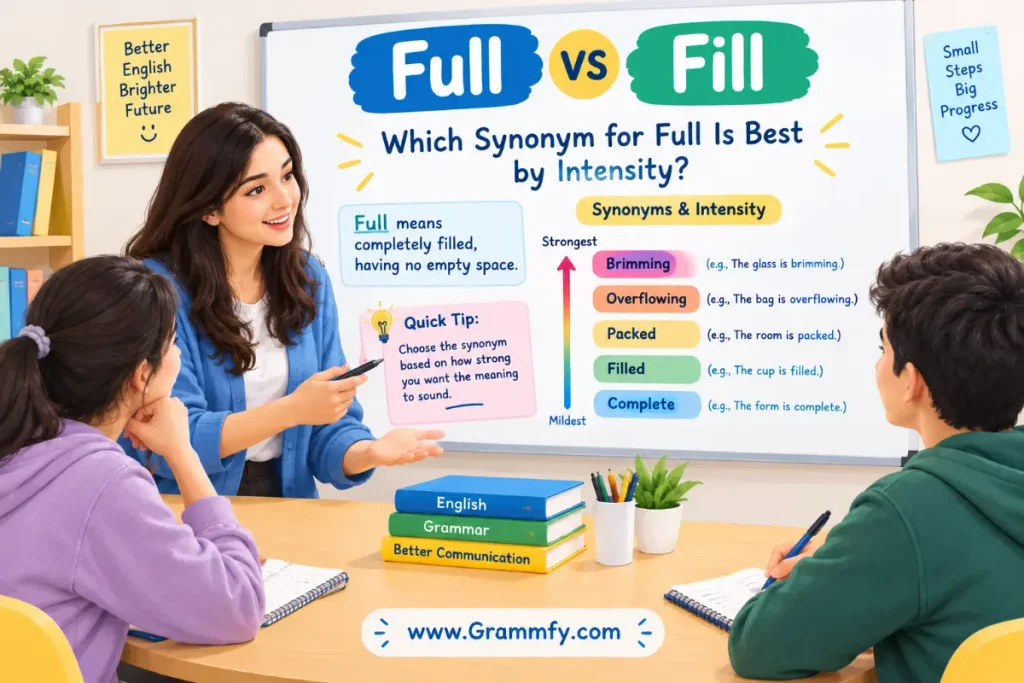
Which Synonym for Full Is Best by Intensity?
The right word depends on how much is present.
Mild
Use:
- occupied
- containing
- complete
- supplied
- filled
Example:
“The shelf is filled with books.”
Strong
Use:
- packed
- crowded
- loaded
- crammed
- stuffed
Example:
“The suitcase was crammed with clothes.”
Very Strong
Use:
- jam-packed
- overflowing
- bursting
- chock-full
Example:
“The small room was jam-packed with people.”
Be careful with these stronger words. If a room has plenty of space, calling it “jam-packed” would be inaccurate.
Which Synonym for Fill Is Best by Meaning?
To Put Something Inside
Use:
- fill
- load
- pack
- place
- put
“Fill the container with water.”
To Complete a Form
Use:
- complete
- enter
- provide
- supply
- submit
“Please complete the application.”
To Occupy a Position
Use:
- take
- occupy
- assume
- hold
- cover
“She will fill the vacant position.”
To Occupy Time
Use:
- occupy
- spend
- use
- pass
“He read a book to fill the waiting time.”
The context determines which alternative sounds natural.
What Are the Different Forms of Fill?
Because fill is a verb, it changes form.
| Form | Example |
|---|---|
| Base | Fill the glass. |
| Third person | She fills the glass. |
| Past | She filled the glass. |
| Past participle | The glass was filled. |
| -ing form | She is filling the glass. |
Notice the spelling:
fill → filled → filling
Not:
fill → filld
And not:
fill → fillling
The correct forms are filled and filling.
What Are the Different Forms of Full?
Full is normally used as an adjective.
It can take comparative forms:
- full
- fuller
- fullest
Examples:
This box is full.
That box is fuller.
This is the fullest box.
You can also use related forms:
- fully
- fullness
- fulfill
- fulfilled
- fulfilling
These words are related in form or history, but they don’t all mean the same thing.
Is “Fully” Related to Full?
Yes. Fully is the adverb form of full.
It means completely or entirely.
Examples:
- The system is fully operational.
- I fully understand the instructions.
- The building is fully occupied.
- The project is fully funded.
Compare:
The room is full.
The room is fully occupied.
Full describes a noun or subject. Fully modifies an adjective, verb, or participle.
Is “Fulfill” the Same as Fill?
No. Fulfill has a different meaning from ordinary fill.
Fulfill often means to complete something, satisfy a requirement, or achieve a promise or expectation.
Examples:
- She fulfilled her promise.
- The company fulfilled the order.
- He fulfilled the requirements.
- The job fulfilled his ambitions.
Notice that fulfill can be related to the idea of making something complete, but it isn’t simply another spelling of “fill.”
What Are Common Mistakes With Full vs Fill?
Mistake 1: “The Cup Is Fill”
Incorrect:
The cup is fill.
Correct:
The cup is full.
Why? Full describes the condition of the cup.
Mistake 2: “Please Full the Cup”
Incorrect:
Please full the cup.
Correct:
Please fill the cup.
Why? Fill is the verb that describes the action.
Mistake 3: “The Box Is Fill With Books”
Incorrect:
The box is fill with books.
Correct:
The box is full of books.
Or:
The box is filled with books.
There are two correct patterns:
full of + noun
The box is full of books.
filled with + noun
The box is filled with books.
Mistake 4: “I Am Fill”
Incorrect:
I am fill.
Correct:
I am full.
When talking about having eaten enough, use full.
Mistake 5: “Fill of”
Incorrect:
The bag is fill of clothes.
Correct:
The bag is full of clothes.
Mistake 6: “Full With”
This isn’t normally the standard pattern when describing contents.
Instead of:
The room is full with people.
Use:
The room is full of people.
Or:
The room is filled with people.
When Should You Use “Full” Instead of “Fill”?
Choose full when you are describing the condition or amount of something.
Use full for:
- full bottles
- full rooms
- full schedules
- full meals
- full reports
- full days
- full containers
- complete amounts
Examples:
My calendar is full.
The bottle is full.
We need the full report.
I’m full after dinner.
When Should You Use “Fill” Instead of “Full”?
Choose fill when you’re talking about an action.
Use fill for:
- filling a bottle
- filling a form
- filling a position
- filling a room
- filling a blank
- filling a tank
- filling a bag
- filling time
Examples:
Please fill the bottle.
Fill out the form.
She filled the position.
They filled the seats.
Is “Fill Up” Different From “Fill”?
Yes, but they are closely related.
Fill means to put something into a container or space.
Fill up often emphasizes making something completely full.
Compare:
Please fill the bottle.
Please fill up the bottle.
Both can be correct. Fill up often emphasizes reaching the full level.
Another common example is fuel:
“I need to fill up the car.”
More precisely, you are filling the car’s fuel tank.
In everyday American English, fill up is very common.
Is “Fill In” Different From “Fill Out”?
Yes. Both can be used with forms, but regional preferences differ.
Fill Out
In American English, fill out a form is very common.
Please fill out this application.
Fill In
Fill in can mean providing missing information.
Please fill in your address.
It can also refer to a blank:
Fill in the missing answer.
In British English, fill in a form is particularly common.
In American English, fill out a form is often preferred for completing the entire document.
Both expressions are useful, but context and regional usage matter.
US vs UK: Is There a Difference?
The basic meanings of full and fill are the same in American and British English.
The biggest regional difference appears in related expressions such as fill in and fill out.
| Meaning | US English | UK English |
|---|---|---|
| Complete a form | Fill out a form | Fill in a form |
| Provide missing information | Fill in | Fill in |
| Make a container full | Fill it | Fill it |
| Containing no more space | Full | Full |
You can safely use full and fill in both varieties of English. Just be aware of regional preferences for some phrasal verbs.

What Is the Best Word for a Resume Full vs Fill?
For a resume, full is useful when describing complete information or a complete schedule, while fill can describe occupying a role or completing a requirement.
Examples:
“Full-time project coordinator with five years of experience.”
“Filled a key leadership position during a major company transition.”
However, avoid using “full” as vague praise.
Weak:
“I have a full set of skills.”
Better:
“I have experience in project management, data analysis, and customer support.”
A resume should give specific information instead of relying on broad words.
What Is the Best Word for an Essay Full vs Fill?
Both words can be useful in an essay.
Use full when describing completeness or contents:
“The novel is full of examples of social conflict.”
Use fill when describing an action:
“The author fills the scene with vivid details.”
For academic writing, related words such as complete, comprehensive, occupied, or contained may sometimes sound more precise.
Example:
“The report provides a comprehensive analysis of the problem.”
This is stronger than simply saying:
“The report is full of information.”
What Is the Best Word for Texting Full vs Fill?
In texting, both are common.
Examples:
“I’m full 😂”
“Can you fill my bottle?”
“The place is full.”
“I need to fill out this form.”
Texting usually doesn’t require formal alternatives. Use the ordinary word that matches the meaning.
A useful casual distinction is:
“I’m full.” = I ate enough.
“Fill it up.” = Put more into it.
What Is the Best Word for an Email Full vs Fill?
Use full when describing a complete amount or lack of availability.
“My schedule is full on Monday, but I’m available Tuesday.”
Use fill when asking someone to complete something.
“Please fill out the attached form before Friday.”
This distinction is especially important in professional emails because using the wrong word can make the sentence sound grammatically incorrect.
What Is the Best Word When Speaking Full vs Fill?
In conversation, the easiest test is to ask:
Am I describing something, or am I asking someone to do something?
If you’re describing:
“The room is full.”
When you’re giving an instruction:
“Fill the room with chairs.”
If you’re talking about food:
“I’m full.”
When you’re asking someone to complete a document:
“Fill out this form.”
This simple test works in most everyday conversations.
15 More Real-Life Examples of Full vs Fill
Example 1: Restaurant
“I’m full, so I don’t want dessert.”
Here, full describes how the speaker feels after eating.
Example 2: Water Bottle
“Please fill my water bottle before we leave.”
Here, fill describes the action.
Example 3: Classroom
“The classroom was full before the teacher arrived.”
Here, full describes the room.
Example 4: Classroom Action
“The students filled every seat.”
Here, filled describes what the students did.
Example 5: Work Schedule
“My schedule is full tomorrow.”
The schedule has no convenient space available.
Example 6: Adding Work
“I don’t want to fill my schedule with unnecessary meetings.”
Here, fill describes adding meetings.
Example 7: Application
“Please fill out the application carefully.”
The action is completing the form.
Example 8: Application Status
“The application contains a full record of your work history.”
Here, full means complete.
Example 9: Storage
“The drawer is full of old papers.”
The drawer contains many papers.
Example 10: Storage Action
“She filled the drawer with old papers.”
The sentence focuses on the action.
Example 11: Stadium
“The stadium was full by the time the game started.”
The stadium had little or no available space.
Example 12: Stadium Action
“Fans quickly filled the stadium.”
The fans occupied the available space.
Example 13: Tank
“The fuel tank is full.”
This describes its condition.
Example 14: Fuel Action
“I need to fill the tank before the trip.”
This describes what needs to happen.
Example 15: Free Time
“He watched a movie to fill the empty hour.”
The activity occupied available time.
Can Full and Filled Be Used Together?
Yes.
Full and filled can sometimes appear in the same sentence because one can describe a final state and the other can describe an action.
For example:
“She filled the glass until it was full.”
The sequence is clear:
- She filled the glass.
- The glass became full.
Another example:
“The workers filled the boxes until they were full.”
This structure clearly shows action followed by a condition.
Full vs Filled: What’s the Difference?
Full describes a state. Filled often describes something that has been made full or contains something as a result of an action.
Compare:
“The bottle is full.”
“The bottle is filled with water.”
The first is shorter and focuses on the condition.
The second emphasizes what is inside the bottle and can suggest the result of an action.
Another pair:
“The room was full of guests.”
“The room was filled with guests.”
Both are grammatical. The first is very natural for describing a crowded room. The second puts more emphasis on the room becoming occupied.
Full vs Complete: What’s the Difference?
Full and complete overlap, but they aren’t always interchangeable.
The glass is full.
You can’t naturally replace it with:
The glass is complete.
Complete means having all necessary parts.
The report is complete.
You could sometimes say:
The report is full.
But that would usually mean the report contains a lot of information, not necessarily that every required part has been finished.
So:
- Full → amount, capacity, contents
- Complete → all required parts
Fill vs Complete: What’s the Difference?
Fill and complete can overlap when talking about forms.
Fill out the form.
Complete the form.
Both can mean providing the required information.
However, fill focuses on entering information into spaces, while complete focuses on finishing the task.
For example:
“Fill in your address.”
This points to a particular blank.
“Complete the application.”
This refers to finishing the entire application.
What Are the Antonyms of Full?
The most common opposite of full is empty.
Other contrasting words include:
- empty
- vacant
- available
- incomplete
- partial
- lacking
- depleted
- bare
Examples:
The bottle is full. → The bottle is empty.
The room is full. → The room is vacant.
The schedule is full. → The schedule is open.
The best antonym depends on the meaning.
What Are the Antonyms of Fill?
Because fill is an action, its opposites can include:
- empty
- drain
- remove
- clear
- evacuate
- drain out
- empty out
- leave vacant
Examples:
Fill the bottle. → Empty the bottle.
Fill the tank. → Drain the tank.
Fill the seats. → Leave the seats vacant.
Again, context determines the most natural opposite.
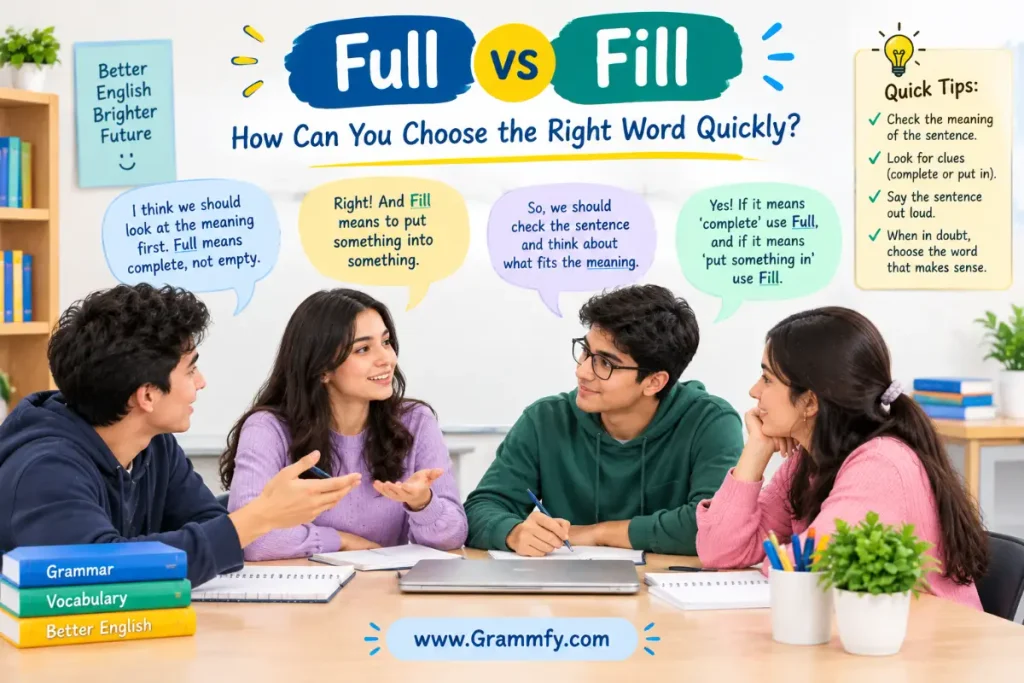
How Can You Choose the Right Word Quickly?
Use this three-question test.
Question 1: Am I Describing a Condition?
If yes, try full.
“The box is full.”
Question 2: Am I Describing an Action?
If yes, try fill.
“Fill the box.”
Question 3: Am I Talking About Completing Information?
Use fill in or fill out, depending on the context.
“Fill in the blank.”
“Fill out the application.”
This quick test solves most everyday Full vs Fill problems.
Quick Grammar Patterns to Remember
- Pattern 1: Be + Full
The room is full.
The bottle was full.
I’m full.
- Pattern 2: Full + Of
The box is full of books.
The garden is full of flowers.
The article is full of useful information.
- Pattern 3: Fill + Object
Fill the bottle.
Fill the tank.
Fill the box.
- Pattern 4: Fill + Object + With
Fill the bottle with water.
Fill the box with books.
Fill the room with chairs.
- Pattern 5: Fill Out + Form
Fill out the application.
- Pattern 6: Fill In + Blank
Fill in the blank.
Learning these patterns is often more useful than memorizing isolated definitions.
Why Do Full and Fill Cause Confusion?
There are several reasons.
First, they are closely related in meaning. Fill can cause something to become full.
Second, they look similar.
Third, their pronunciation can be confusing for some learners, especially when spoken quickly.
Fourth, English has many expressions built from these words:
- full of
- full-time
- full-length
- fill in
- fill out
- fill up
- fill in for
- filled with
- filling station
Because the words appear in so many combinations, learning them through sentence patterns is more effective than learning only a dictionary definition.
A Simple Memory Trick for Students
Imagine a glass.
Before you add water:
The glass is empty.
While you’re adding water:
You fill the glass.
After enough water is added:
The glass is full.
So remember:
Fill is the action. Full is the result.
This isn’t a rule for every figurative use, but it is an excellent starting point for everyday English.
Final Quick Reference: Full or Fill?
| If You Mean… | Use | Example |
|---|---|---|
| No more space | Full | The box is full. |
| Complete amount | Full | We need the full amount. |
| Ate enough | Full | I’m full. |
| Put something inside | Fill | Fill the box. |
| Add information | Fill | Fill in the blank. |
| Complete a form | Fill out | Fill out the application. |
| Occupy a position | Fill | She filled the position. |
| Occupy time | Fill | Read to fill the time. |
| Contains many things | Full of | The room is full of books. |
| Put something inside | Filled with | The box was filled with books. |
Conclusion
The key to Full vs Fill is recognizing whether you’re describing a state or an action. Full usually describes something that has no more room, contains a complete amount, or has reached a certain condition. Fill usually describes putting something into a container, space, form, position, or period of time.
Remember the basic pattern: you fill something, and it can become full. You fill a glass with water, then the glass is full. You fill out a form, but the form isn’t “full” in the same grammatical sense.
Once you learn common patterns such as full of, filled with, fill in, fill out, and fill up, the difference becomes much easier to use naturally. When you’re unsure, ask yourself whether you’re describing the condition or the action. That simple question will help you choose the right word in most everyday situations.
Frequently Asked Questions
What is the simple difference between full and fill?
Full describes a condition, while fill describes an action. For example, “The cup is full” describes the cup, while “Fill the cup” tells someone what to do.
Is it correct to say “the bottle is fill”?
No, the correct sentence is “the bottle is full.” Use fill when describing the action of putting something into the bottle.
What’s another way to remember full vs fill?
Think “fill is the action, full is the result.” You fill a glass, and afterward the glass can be full.
Should I say “full of” or “filled with”?
Both can be correct, but they emphasize different things. “The room is full of people” describes its condition, while “The room was filled with people” can emphasize how it became occupied.
Is “fill out” or “fill in” correct for a form?
Both are used, but “fill out a form” is especially common in American English, while “fill in a form” is especially common in British English. “Fill in” is also commonly used for individual blanks.
Can I say “I am fill” after eating?
No. Say “I am full” when you mean that you’ve eaten enough. “Fill” is a verb, while “full” is the adjective used for this feeling.
Is full an adjective and fill a verb?
Yes, in their most common everyday uses. Full is mainly an adjective, while fill is mainly a verb, although “fill” can also function as a noun in some specialized contexts.

1 thought on “Full vs Fill: Simple Guide to the Difference”