
Writing a work email, checking an essay, or answering a question can make you pause over one small choice: should you say accurate or correct? The two words often seem interchangeable, but they don’t always mean exactly the same thing. Knowing the difference can make your English clearer and more natural.
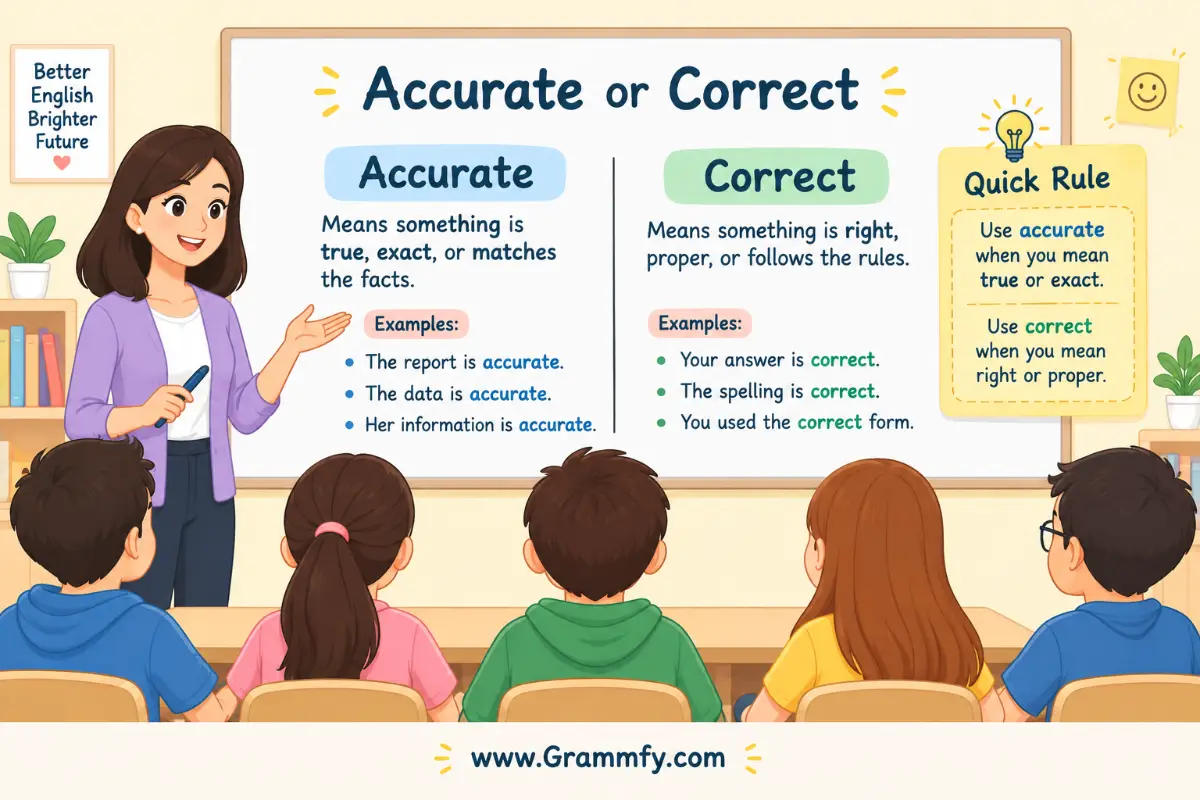
Accurate or Correct is a common word-choice question because both terms can describe something that is free from mistakes. Still, they focus on different ideas. Accurate usually means something matches the facts, measurements, or details. Correct is broader and can mean right according to facts, rules, instructions, or accepted standards.
Answer box: Accurate usually means factually or precisely right, while correct means right or free from error. They overlap, but “accurate” often focuses on precision and “correct” often focuses on whether something is right.
Picture a student checking a math answer before submitting homework. You might call the answer correct. If you’re checking whether a measurement exactly matches the real value, accurate is often the better choice. The context decides which word sounds most natural.
This guide explains the meaning, origins, differences, synonyms, intensity, grammar, regional usage, examples, common mistakes, and best choices for emails, resumes, essays, texts, and everyday speech.
If you enjoy figurative language, you’ll also like our guide to [similes for students].
What do accurate and correct mean in plain English?
Both accurate and correct describe something that is right, but they don’t emphasize the same quality.
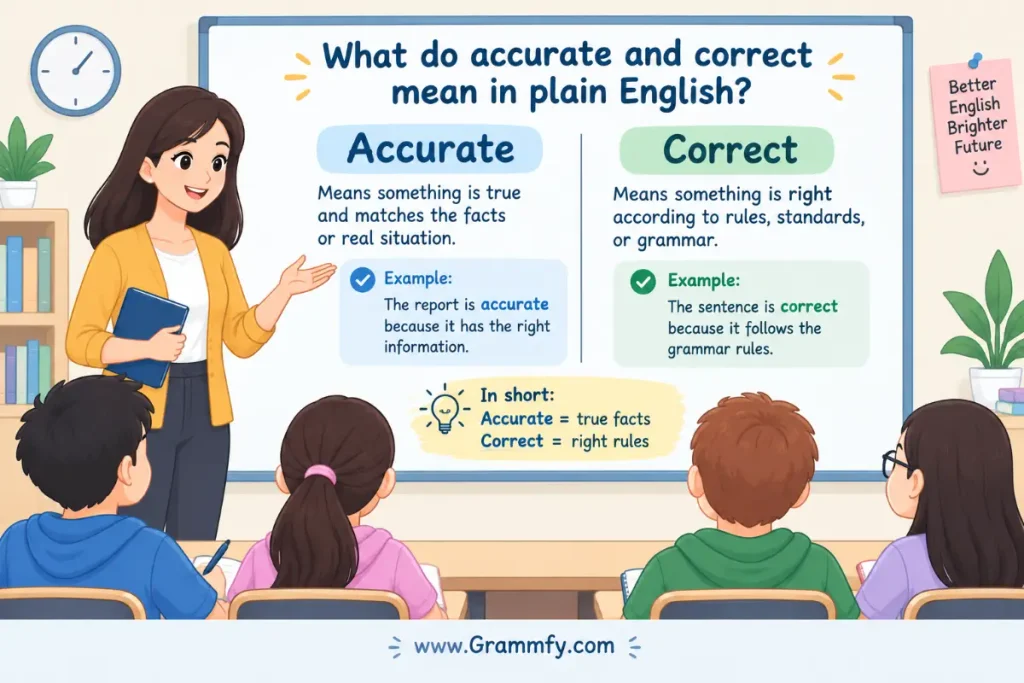
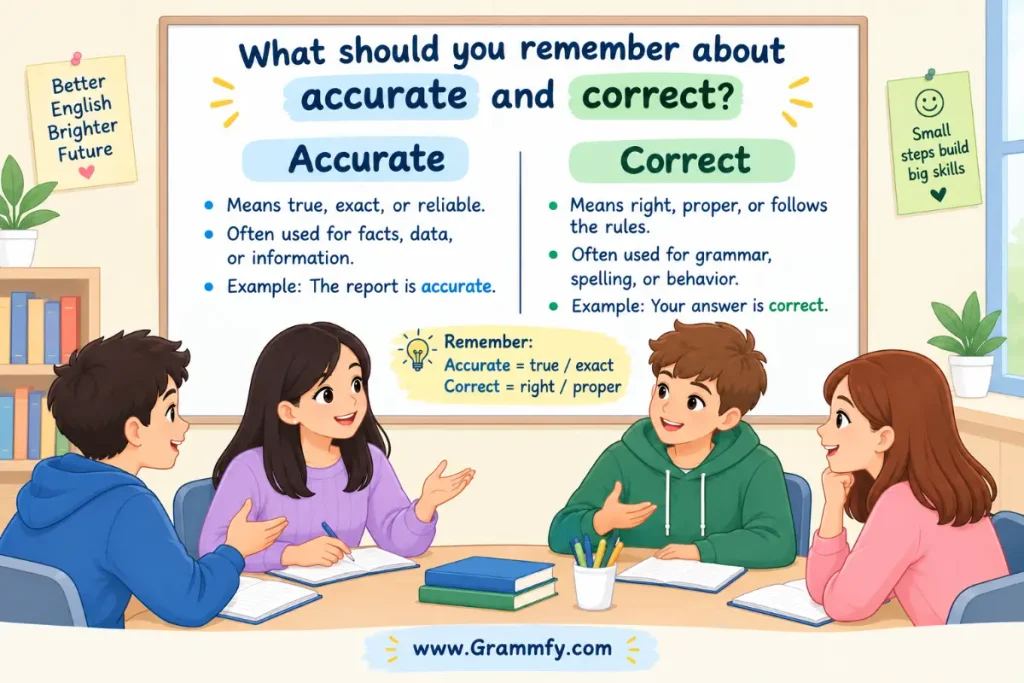
Accurate means something is true, precise, or closely matches the real facts or value.
Examples:
- “The report contains accurate information.”
- “The scale gave an accurate measurement.”
- “Her description of the event was accurate.”
- “The map is accurate.”
Correct means something is right and does not contain an error.
Examples:
- “Your answer is correct.”
- “That is the correct spelling.”
- “Please enter the correct password.”
- “He chose the correct option.”
A useful shortcut is:
Accurate = matches reality or the facts closely.
Correct = right according to facts, rules, instructions, or standards.
The distinction becomes clearer when you compare different situations.
| Situation | Natural choice | Why |
|---|---|---|
| A math answer | Correct | It agrees with the expected answer |
| A measurement | Accurate | It closely matches the true value |
| A spelling | Correct | It follows the accepted spelling |
| A historical statement | Accurate | It matches historical facts |
| An answer to a test question | Correct | It is the right answer |
| A weather forecast | Accurate | It closely matches actual conditions |
| A procedure | Correct | It follows the required method |
| A description | Accurate | It matches the thing being described |
| An address | Correct | It is the right address |
| A clock reading | Accurate | It closely matches the actual time |
These are tendencies rather than absolute rules. Either word may work in some situations depending on what you want to emphasize.
Where do the words accurate and correct come from?
Understanding word origins can make the distinction easier to remember.
Accurate comes from the Latin accuratus, meaning “done carefully” or “prepared with care.” It is related to the Latin verb accurare, meaning “to take care of” or “to perform carefully.”
That history connects naturally with the modern idea of precision. Something accurate is carefully matched to facts, measurements, or reality.
Correct comes from the Latin correctus, meaning “made straight,” “put right,” or “corrected.” It comes from corrigere, meaning “to make straight” or “to set right.”
That history fits the modern meaning. When something is correct, it is right rather than wrong.
The words developed different shades of meaning in English:
- Accurate → careful, precise, factually reliable
- Correct → right, free from error, proper, acceptable
Their meanings overlap, which is why English speakers sometimes use them in the same sentence.
When should you use accurate?
Use accurate when you want to emphasize factual precision, measurement, detail, or closeness to reality.
Accurate information
Information is accurate when it matches the facts.
“The article provides accurate information about the topic.”
This doesn’t simply mean the information sounds good. It means the claims can be supported by reliable facts.
Accurate measurement
Measurements are often described as accurate when they are close to the true value.
“The scientist needs an accurate measurement.”
A measurement can be precise but still inaccurate if it is consistently far from the true value.
Accurate description
A description is accurate when it gives a truthful picture of something.
“Her description of the house was accurate.”
The description may not include every detail, but the details it includes match reality.
Accurate prediction
Predictions can be called accurate when they closely match what actually happens.
“The forecast was accurate.”
The forecast doesn’t need to be perfect in every tiny detail. It needs to correspond closely to the actual outcome.
When should you use correct?
Use correct when you mean right, free from an error, or in agreement with a rule, instruction, answer, or accepted standard.
Correct answer
This is one of the most common uses.
“Your answer is correct.”
The focus is on whether the response is right.
Correct spelling
Use correct for accepted spelling.
“Which spelling is correct?”
You aren’t usually talking about how precisely the spelling matches reality. You’re asking whether it follows the accepted form.
Correct procedure
A process can be correct when it follows the required instructions.
“Make sure you use the correct procedure.”
The emphasis is on following the appropriate method.
Correct information
“Correct information” is also perfectly natural.
“Please provide the correct information.”
Here, the meaning is that the information isn’t wrong. It doesn’t necessarily emphasize fine precision.
Accurate or Correct: what is the main difference?
The easiest way to understand Accurate or Correct is to ask what you’re measuring.
Accurate often answers:
“Does this match the facts or reality?”
Correct often answers:
“Is this right or free from error?”
Consider a temperature reading.
Suppose the actual temperature is 20°C.
A thermometer showing 20.1°C may be accurate because it is very close to the actual temperature.
If a worksheet asks, “What is 10 + 10?” and you write 20, your answer is correct.
The concepts overlap, but the focus changes.
| Accurate | Correct |
|---|---|
| Focuses on factual precision | Focuses on being right |
| Often relates to measurements | Often relates to answers |
| Common with data and facts | Common with rules and standards |
| Can mean close to reality | Can mean free from error |
| “An accurate estimate” | “The correct answer” |
| “An accurate description” | “The correct spelling” |
| “An accurate measurement” | “The correct procedure” |
A helpful memory trick is:
Accuracy points toward reality. Correctness points toward rightness.
What are the best synonyms for accurate and correct?
The right synonym depends on your sentence and level of formality.
| Word | Meaning | Tone | Example |
|---|---|---|---|
| Right | Not wrong | Simple | Your answer is right. |
| Exact | Completely precise | Neutral | Give me the exact number. |
| True | Matches reality | Neutral | The statement is true. |
| Correct | Free from error | Neutral | That answer is correct. |
| Accurate | Factually precise | Neutral | The report is accurate. |
| Reliable | Can be trusted | Neutral | The data is reliable. |
| Valid | Logically or officially acceptable | Formal | The argument is valid. |
| Factual | Based on facts | Formal | The article is factual. |
| Truthful | Honest and true | Neutral | Her account was truthful. |
| Authentic | Genuine or real | Formal | The document is authentic. |
| Sound | Reasonable or well-founded | Formal | That is a sound conclusion. |
| Legitimate | Valid or genuine | Formal | The request is legitimate. |
| Proper | Suitable or right | Neutral | Use the proper format. |
| Appropriate | Suitable for the situation | Neutral | Choose the appropriate response. |
| Exacting | Very demanding about accuracy | Formal | The scientist followed exacting standards. |
| Error-free | Without mistakes | Neutral | The final document was error-free. |
| Dependable | Consistently trustworthy | Everyday | The source is dependable. |
| Trustworthy | Worth believing | Neutral | We need a trustworthy source. |
| Spot-on | Completely right | Informal | Your prediction was spot-on. |
| Dead-on | Extremely accurate | Informal | His estimate was dead-on. |
| Right on | Exactly right | Informal | Your guess was right on. |
| Bang-on | Very accurate | Informal, more common in UK | Her estimate was bang-on. |
| On target | Very close to the desired result | Everyday | The estimate was on target. |
| Precise | Exact and carefully stated | Formal | Use precise language. |
| Verifiable | Able to be checked | Formal | Use verifiable facts. |
| Consistent | Showing reliable agreement | Neutral | The results were consistent. |
| Sound | Correct or well-supported | Formal | The reasoning is sound. |
Not every synonym can replace accurate or correct in every sentence. “Spot-on,” for example, works well in casual conversation but may sound too informal in a research report.
How do accurate synonyms differ by intensity?
Some words suggest basic correctness, while others suggest a very high level of precision.
Mild or general
These are useful when you simply want to say something isn’t wrong:
- Right
- Proper
- True
- Correct
Example:
“That is the right answer.”
Moderate precision
These suggest a dependable or fact-based result:
- Accurate
- Reliable
- Factual
- Trustworthy
- Sound
Example:
“The report contains reliable data.”
Strong precision
These suggest a very high level of exactness:
- Exact
- Precise
- Spot-on
- Dead-on
- Error-free
Example:
“The calculation was extremely precise.”
Be careful with absolute language. Calling something “perfectly accurate” suggests there is no meaningful error at all. In technical writing, that claim may require strong evidence.
What parts of speech are accurate and correct?
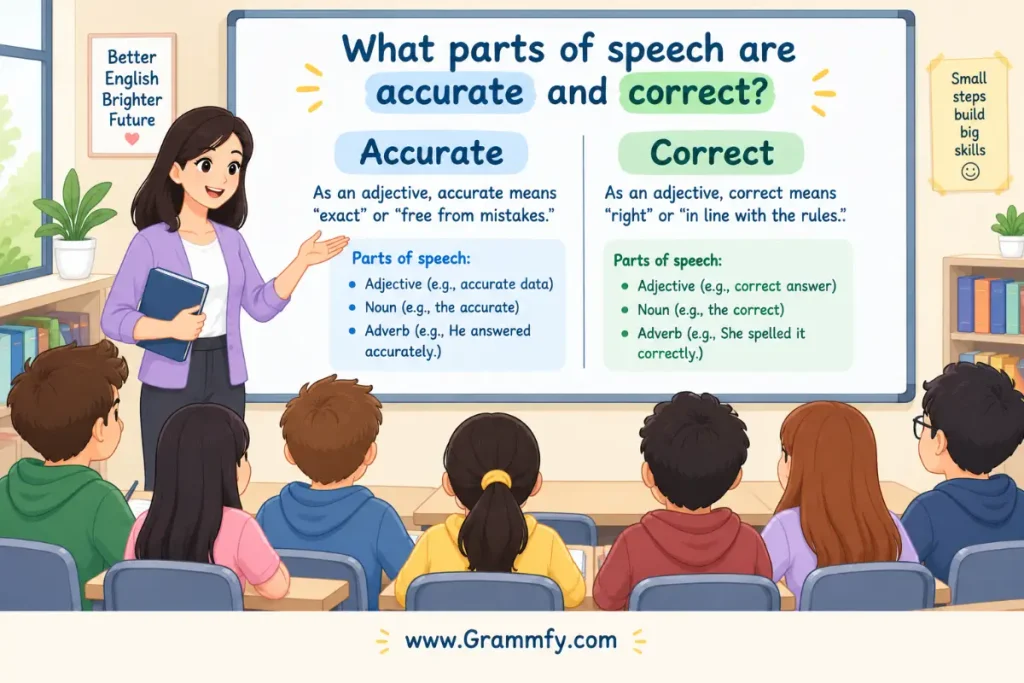
Both accurate and correct are primarily adjectives.
Accurate as an adjective
“The information is accurate.”
Related forms include:
- Accurately — adverb
- Accuracy — noun
- Accurate — adjective
Examples:
“She described the event accurately.”
“The accuracy of the report was impressive.”
Correct as an adjective
“The answer is correct.”
Related forms include:
- Correctly — adverb
- Correctness — noun
- Correction — noun
- Correct — adjective and verb
Examples:
“He answered the question correctly.”
“The teacher made a correction.”
“Please correct the spelling.”
This difference matters when building sentences because you may need a noun or adverb rather than an adjective.
Which word is better for a resume?
For a resume, accurate often works well when describing data, records, reports, or attention to detail.
Examples:
“Maintained accurate customer records.”
“Prepared accurate financial reports.”
“Entered data accurately and efficiently.”
Correct can work too, but it often sounds less professional when describing workplace skills.
For example:
“Entered correct data.”
This is grammatical, but:
“Entered accurate data.”
usually sounds more natural because data quality is connected to factual precision.
If you’re describing an employee who follows procedures, correct can be useful:
“Followed correct safety procedures.”
Even better in many professional contexts:
“Followed established safety procedures.”
The most effective resume writing usually describes the skill and result rather than simply saying something was accurate or correct.
Which word is better for an essay?
The choice depends on what you’re discussing.
Use accurate for facts, descriptions, statistics, historical details, and information.
“The author provides an accurate description of life during the period.”
Use correct for answers, grammar, spelling, rules, and interpretations that are judged right or wrong.
“The second interpretation is correct.”
Academic writing often benefits from more specific alternatives:
- Accurate data
- Reliable evidence
- Precise measurements
- Valid argument
- Factual statement
- Correct interpretation
Specific vocabulary tells the reader exactly what you mean.
Which word is better in texting?
In casual texting, correct and right are usually more natural.
For example:
“Yep, that’s correct.”
Or:
“You’re right!”
Accurate can sound more technical:
“Your guess was accurate.”
That’s still perfectly natural, especially when talking about a prediction, estimate, or factual detail.
A friend might say:
“Your guess was spot-on!”
rather than:
“Your guess was accurate.”
The informal option depends on the relationship and situation.
Which word is better in an email?
Both can work in professional emails.
Use correct when checking information, details, forms, or instructions.
“Could you confirm that this is the correct address?”
Use accurate when discussing data, records, figures, or factual details.
“Please make sure the figures are accurate before sending the report.”
A useful distinction is:
- Correct address
- Accurate figures
- Correct spelling
- Accurate description
- Correct procedure
- Accurate records
Which word sounds best in speaking?
Everyday speech often favors correct or right.
You might say:
“That’s correct.”
“You’re right.”
“That’s the correct answer.”
For technical subjects, accurate becomes more common:
“Is this measurement accurate?”
“How accurate is the estimate?”
“The information isn’t very accurate.”
If you’re unsure, “right” is often the easiest conversational choice. For more precise writing, choose between accurate and correct based on the context.
What are examples of accurate and correct in real situations?
Here are original examples showing how the words work naturally.
School
- “The teacher marked her answer correct.”
- “His description of the experiment was accurate.”
- “Check that you’ve selected the correct answer.”
- “The student recorded an accurate measurement.”
Work
- “Our team needs accurate sales figures before the meeting.”
- “Please use the correct form when submitting your request.”
- “The assistant kept accurate customer records.”
- “She followed the correct procedure for handling the document.”
Writing
- “The writer included accurate historical details.”
- “The editor corrected the incorrect spelling.”
- “His summary was accurate but could have included more detail.”
- “She chose the correct word for the sentence.”
Science
- “Scientists need accurate measurements to support their conclusions.”
- “The researcher used the correct formula.”
- “The instrument isn’t accurate enough for this experiment.”
- “The calculation is correct, but the measurement may not be accurate.”
Everyday life
- “Is this the correct address?”
- “The map gave us an accurate idea of where the trail began.”
- “Your estimate was surprisingly accurate.”
- “That’s the correct way to assemble the chair.”
Technology
- “Enter the correct password.”
- “The location shown by the device wasn’t completely accurate.”
- “Make sure the software has the correct settings.”
- “The sensor needs to provide accurate readings.”
These examples show why the two words shouldn’t always be treated as exact substitutes.
Can something be correct but not accurate?
Yes. A statement or answer can be technically correct without being highly accurate in its level of detail or precision.
For example, imagine someone asks:
“How far is the city?”
You answer:
“About 100 miles.”
If the actual distance is 100.2 miles, the general answer may be considered correct in an everyday context. However, it isn’t highly precise.
In another situation, a measurement might be called correct because the right method was used, but its result could still be inaccurate because the equipment was faulty.
This distinction becomes especially important in science, engineering, statistics, and data analysis.
Can something be accurate but not correct?
Yes, depending on what “correct” means in the context.
Suppose a teacher asks:
“What is the answer to this question?”
A student gives an answer that accurately describes one part of the issue but doesn’t answer the question being asked.
The information may be factually accurate, yet the response isn’t the correct answer.
Another example involves instructions. A student may accurately copy a set of outdated instructions, but following them may not produce the correct result under the current rules.
Accuracy is about correspondence with facts or reality. Correctness can depend on the question, rule, purpose, or standard being applied.
Accurate vs exact: what’s the difference?
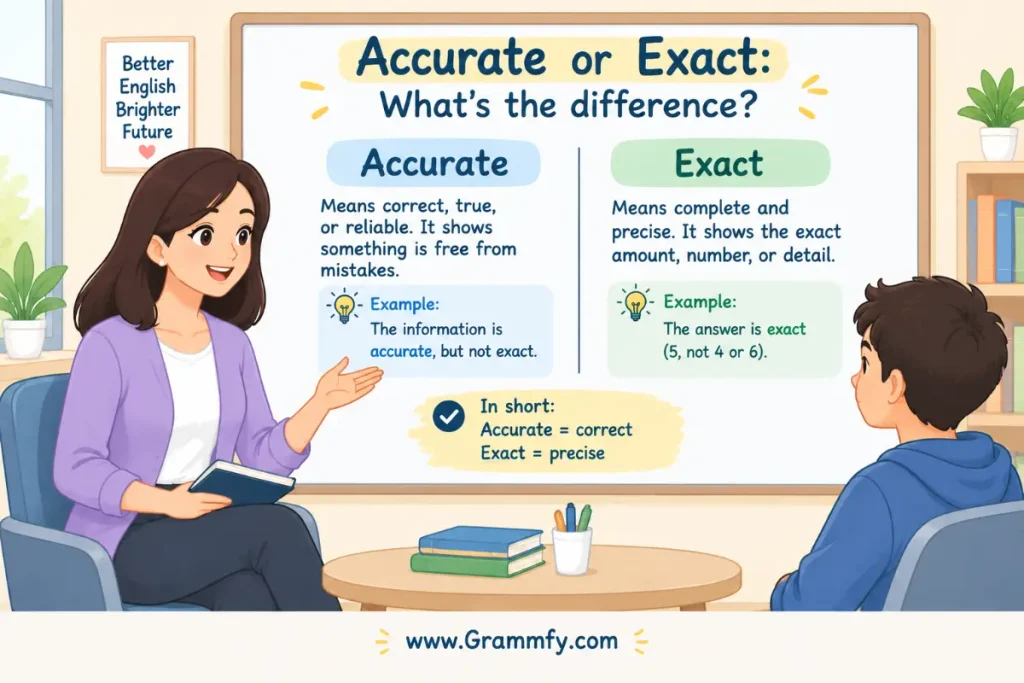
Accurate means close to the true value or facts. Exact means completely precise or without approximation.
Compare:
| Accurate | Exact |
|---|---|
| Can allow a small degree of error | Usually suggests no approximation |
| Focuses on closeness to truth | Focuses on precise identity or value |
| “An accurate estimate” | “The exact amount” |
| “An accurate measurement” | “The exact measurement” |
For example:
“The estimate was accurate.”
This means the estimate was close to the actual value.
“Tell me the exact amount.”
This asks for the precise number, not an approximation.
An estimate can be accurate without being exact.
Correct vs right: what’s the difference?
Correct and right often mean the same thing, especially when talking about answers.
“Your answer is correct.”
“Your answer is right.”
Both are natural.
However, right has many additional meanings. It can refer to direction, morality, entitlement, or suitability.
Examples:
- “Turn right.”
- “You have the right to speak.”
- “That isn’t right.”
- “Choose the right tool.”
Correct is narrower and often sounds more formal.
In professional and academic writing, “correct” may be preferable when discussing answers, spelling, procedures, or facts.
Accurate vs precise: what’s the difference?
These words are closely related but not identical.
Accurate means close to the true value.
Precise means consistent or exact in the level of detail.
Imagine a target with arrows.
If the arrows land close to the bullseye, they are accurate.
If the arrows land very close to each other, they are precise.
The arrows can be:
- Accurate and precise
- Accurate but not very precise
- Precise but inaccurate
- Neither accurate nor precise
This distinction is especially important in science and measurement.
For example, a scale might repeatedly show 75.0 kg when the actual weight is 77.0 kg. The readings are precise because they are consistent, but they’re not accurate because they are far from the true value.
What are common mistakes when using these words?
Mistake 1: Treating them as perfect synonyms
The words overlap, but they aren’t identical.
“The thermometer gave a correct reading.”
This can be understood, but “accurate reading” is often more natural because you’re discussing closeness to the actual temperature.
Mistake 2: Using accurate for rules
You might hear:
“Use the accurate procedure.”
Usually, correct procedure or proper procedure is more natural.
The issue is not whether the procedure matches a measurable fact. The issue is whether it is the appropriate or required procedure.
Mistake 3: Using correct for measurements
“We need a correct measurement.”
This isn’t always wrong, but accurate measurement is usually the better choice when you mean closeness to the true value.
Mistake 4: Confusing accurate with exact
An accurate estimate can still be approximate.
“The estimate was accurate.”
This doesn’t mean the estimate was exact.
Mistake 5: Using formal vocabulary where simple English works better
Sometimes “right” is better than either word.
Instead of:
“Your response is accurate.”
You might simply say:
“You’re right.”
Choose the word that fits the audience rather than making every sentence sound technical.
Mistake 6: Assuming accurate always means perfect
Accuracy can involve a degree of closeness.
A measurement can be very accurate without being absolutely exact.
When should you avoid accurate or correct?
There are situations where a more specific word communicates your meaning better.
Instead of:
“The information is correct.”
Consider:
“The information is verified.”
If you’ve actually checked it against a reliable source, “verified” gives the reader more information.
Instead of:
“The data is accurate.”
You might say:
“The data is consistent.”
If you’re talking about repeated results, consistency may be the real point.
Instead of:
“The argument is correct.”
You might say:
“The argument is well-supported.”
That is often stronger in academic writing because it explains why the argument is convincing.
Other useful alternatives include:
- Verified
- Precise
- Reliable
- Valid
- Appropriate
- Suitable
- Factual
- Consistent
- Exact
- Well-supported
What are the antonyms of accurate and correct?
The most direct opposites are:
| Word | Antonym |
|---|---|
| Accurate | Inaccurate |
| Correct | Incorrect |
| Exact | Approximate |
| Precise | Imprecise |
| True | False |
| Reliable | Unreliable |
| Valid | Invalid |
| Factual | Unfactual / false |
| Right | Wrong |
| Appropriate | Inappropriate |
The best antonym depends on the original word.
For example:
“The information is inaccurate.”
sounds natural when discussing factual reliability.
“The answer is incorrect.”
sounds natural when discussing a test answer.
“The measurement is imprecise.”
works when the measurement lacks precision.
How can you choose between accurate and correct quickly?
Ask yourself one simple question:
Are you talking about closeness to reality?
Choose accurate.
Examples:
- Accurate measurement
- Accurate data
- Accurate forecast
- Accurate description
- Accurate estimate
- Accurate information
Are you talking about whether something is right?
Choose correct.
Examples:
- Correct answer
- Correct spelling
- Correct address
- Correct procedure
- Correct choice
- Correct form
Are you talking casually?
Consider right.
“You’re right.”
Are you discussing extreme precision?
Consider exact or precise.
“Give me the exact number.”
“We need a precise measurement.”
This quick test handles most everyday situations.
How can you improve word choice in professional writing?
Professional writing becomes clearer when you choose words based on the specific quality you want to communicate.
Compare:
“We need correct data.”
with:
“We need accurate data.”
The second sentence is stronger because data is generally evaluated for factual accuracy.
Now compare:
“Please use accurate form.”
with:
“Please use the correct form.”
The second sentence is natural because the form needs to be the appropriate one.
Another example:
“The report has correct details.”
This can work, but:
“The report contains accurate details.”
better emphasizes whether those details match the facts.
Good writing isn’t about choosing the more complicated word. It’s about choosing the word that communicates the intended meaning most clearly.
What should you remember about accurate and correct?
Keep these simple patterns in mind:
Accurate information
The information matches the facts.
Correct information
The information is not wrong.
Accurate measurement
The measurement is close to the true value.
Correct answer
The answer is the right one.
Accurate description
The description matches reality.
Correct procedure
The procedure follows the required or accepted method.
Accurate estimate
The estimate is close to the actual result.
Correct choice
The selected option is the right one.
These combinations aren’t rigid grammar rules, but they are useful natural patterns in English.
Conclusion
Choosing between these two words becomes easier once you focus on the idea behind the sentence. Accurate or Correct isn’t simply a matter of picking whichever word sounds more formal. Use accurate when you mean that information, measurements, descriptions, estimates, or predictions closely match reality. Choose correct when something is right according to a question, rule, instruction, spelling standard, or accepted choice. In casual speech, right may be even more natural. For technical situations, precise or exact might express the intended meaning better. The key is to think about what you’re judging: factual precision or whether something is right. Once you notice that difference, your word choice becomes clearer, more natural, and more confident.
Frequently Asked Questions
Is accurate or correct better for information?
Accurate is often better when you want to emphasize that information matches the facts. “Correct information” is also natural when you simply mean the information isn’t wrong.
Is it correct to say “accurate answer”?
Yes, but correct answer is usually more natural when referring to a test or question. “Accurate answer” can work when the focus is on how faithfully the answer reflects facts.
What’s another way to say accurate?
Common alternatives include precise, exact, factual, reliable, truthful, valid, and spot-on. The best choice depends on the context and level of formality.
What is the difference between accurate and precise?
Accurate means close to the true value, while precise means highly exact or consistent. Something can be precise without being accurate.
Is “correct information” grammatically correct?
Yes, correct information is completely grammatical and common. It means information that is right or free from error.
Should I use accurate or correct in a resume?
Accurate is often better for describing data, records, reports, and attention to detail. Correct works well when discussing procedures, forms, answers, or compliance with requirements.
Can accurate and correct be used interchangeably?
Sometimes, but not always. Accurate usually emphasizes factual precision, while correct more broadly means right or free from error.
