
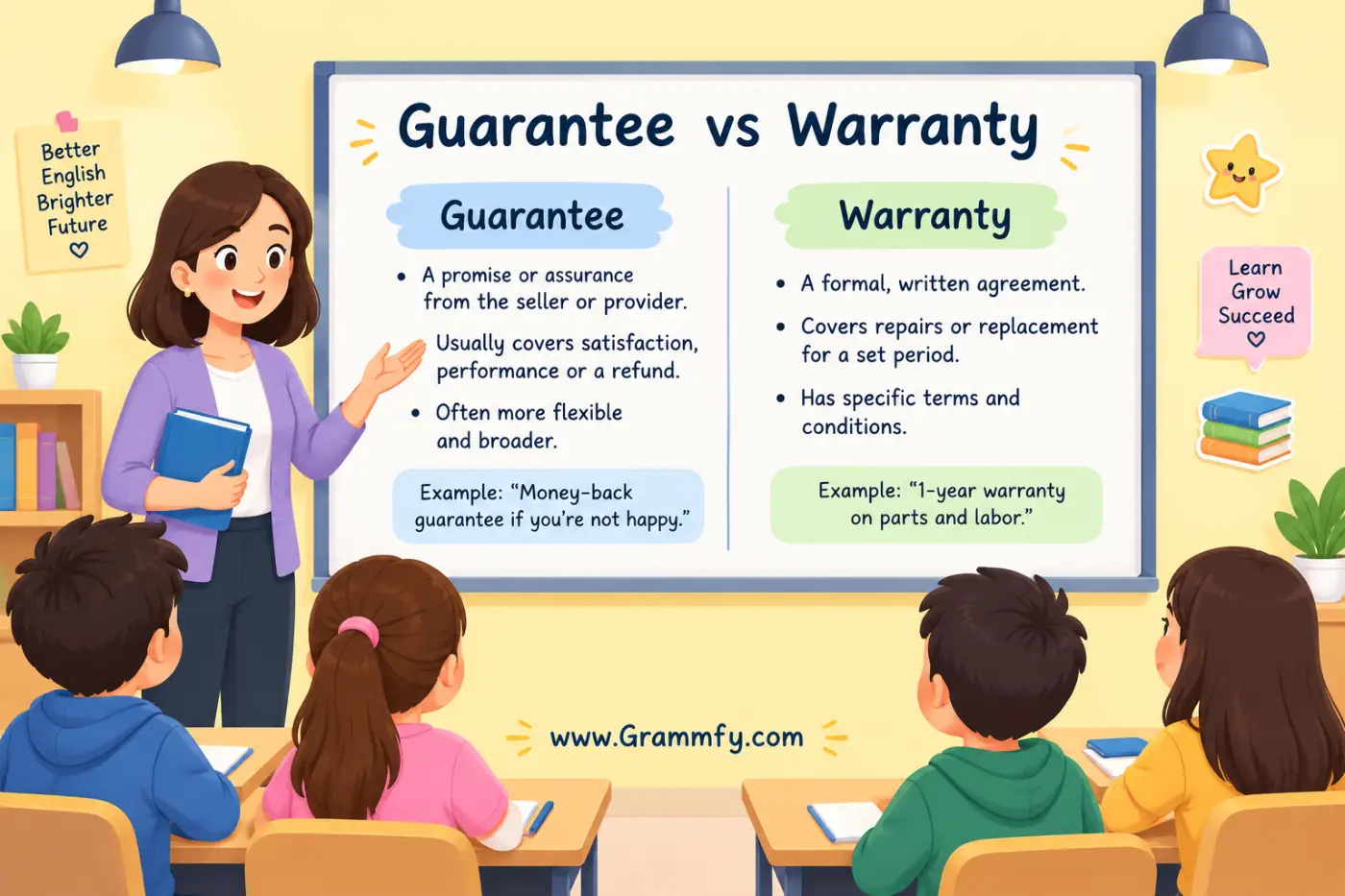
When you’re writing an email, buying a product, or explaining a return policy, you may wonder whether Guarantee vs Warranty means the same thing. The two words are closely related, but they aren’t always interchangeable. A guarantee usually gives a promise about quality, performance, or satisfaction, while a warranty is typically a formal promise about a product’s condition and repairs or replacement.
The difference can matter when you’re deciding whether a product is protected after purchase. A store might offer a satisfaction guarantee, while the manufacturer provides a one-year warranty. Both give customers some form of protection, but the terms, coverage, and remedies can be very different.
Answer box: A guarantee is a promise that something will meet a certain standard or that a customer will receive a particular result. A warranty is a formal assurance that a product will be repaired, replaced, or otherwise covered if a stated problem occurs within specific terms.
Understanding these words can help you choose the right one in an essay, email, resume, conversation, or product description. This guide explains their meanings, origins, differences, related words, examples, common mistakes, regional usage, and the best choice for different situations.
Want to avoid similar spelling mistakes? See [Analyze or Analyse].
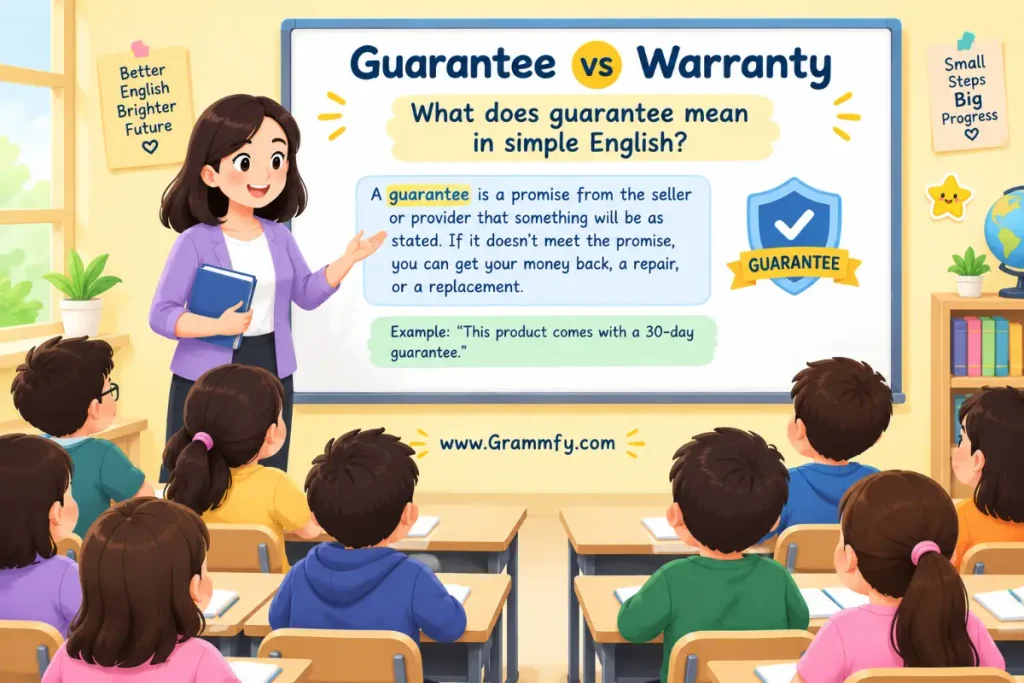
What does guarantee mean in simple English?
A guarantee is a promise that something will happen, work, or meet a certain standard.
The word often focuses on confidence or a promised result. A company may guarantee that a service will be completed on time. A seller may guarantee customer satisfaction. A person can also guarantee something in everyday conversation.
For example:
- “We guarantee your satisfaction.”
- “I guarantee that you’ll enjoy this book.”
- “The company guarantees delivery within three days.”
The promise doesn’t always concern a physical product. It can relate to a service, experience, outcome, quality level, or personal commitment.
A guarantee may also come with a remedy if the promise isn’t met. Depending on the situation, that remedy could be a refund, replacement, correction, or another solution.
What does warranty mean in simple English?
A warranty is a formal promise about the condition, quality, or performance of a product or service.
Warranties are especially common with physical goods such as:
- Cars
- Phones
- Laptops
- Appliances
- Electronics
- Furniture
- Tools
- Home equipment
A warranty usually explains what is covered, how long the coverage lasts, and what the manufacturer or seller will do if a covered problem appears.
For example:
“This laptop includes a two-year warranty against manufacturing defects.”
That statement doesn’t mean every problem will automatically be fixed. The warranty may exclude accidental damage, misuse, unauthorized repairs, or normal wear.
Guarantee vs Warranty — what’s the main difference?
The simplest distinction is this:
| Guarantee | Warranty |
|---|---|
| Usually a promise about quality, satisfaction, performance, or a result | Usually a formal promise about a product’s condition or defects |
| Can be broad or specific | Usually has detailed terms and conditions |
| Often focuses on the customer’s confidence or expected result | Often focuses on repair, replacement, or covered defects |
| Can apply to services and products | Most commonly associated with products |
| May offer a refund or replacement | Often provides repair, replacement, or specified service |
| Can be informal or formal | Usually formal and documented |
There is some overlap. A company may use guarantee and warranty as marketing terms, and legal meanings can vary by country and contract.
The safest approach is to look at the actual terms instead of relying only on the label.
Where did guarantee come from?
The history of guarantee helps explain why the word is connected with promises.
The English word developed through French influence and is related to older forms meaning to protect, assure, or warrant something. Its history is connected to the idea of giving someone confidence that a promise will be kept.
Over time, guarantee became common in English as both a noun and a verb.
As a noun:
“The store offers a money-back guarantee.”
As a verb:
“We guarantee excellent service.”
Modern English uses the word in both commercial and everyday settings.
Where did warranty come from?
Warranty has a different but related history.
The word comes from older legal language connected with the idea of a formal promise, assurance, or protection. It shares historical roots with words such as warrant, warranted, and guarantee.
That connection explains why the two terms can sometimes seem confusing.
Modern usage, however, has developed a clearer practical distinction. Warranty is strongly associated with formal product protection, while guarantee is often broader and can describe a promise about an expected result.
Why do guarantee and warranty sound so similar?
The words are related because both developed around the idea of assurance and protection.
Their modern uses overlap, especially in business and consumer language. A company might call something a “lifetime guarantee,” while another company might call similar protection a “lifetime warranty.”
The important point is that the label alone doesn’t always tell you exactly what you’re entitled to receive.
Reading the terms is more reliable than assuming two policies work in the same way.
What words can you use instead of guarantee or warranty?
Not every related word is a perfect synonym. Some words describe a promise, while others describe protection, confidence, certainty, or a legal obligation.
The following master list gives you useful alternatives and related expressions.
Simple words for guarantee and warranty
| Word | Meaning | Tone | Example |
|---|---|---|---|
| Promise | A statement that something will happen | Simple | “She made a promise to help.” |
| Assurance | A statement that gives confidence | Simple | “The company gave assurance that the issue would be fixed.” |
| Protection | Help against loss, damage, or problems | Simple | “The plan offers protection against defects.” |
| Coverage | What a policy or agreement protects | Simple | “The warranty provides coverage for parts.” |
| Safety net | Something that provides support when things go wrong | Casual | “The return policy is a safety net for buyers.” |
| Security | Protection from risk or loss | Simple | “The policy gives customers extra security.” |
| Backup | Something available if the first option fails | Casual | “Keep the receipt as a backup.” |
Everyday words related to guarantee and warranty
| Word | Meaning | Tone | Example |
|---|---|---|---|
| Commitment | A firm promise to do something | Everyday | “The company made a commitment to its customers.” |
| Pledge | A serious promise | Everyday | “The business pledged to improve its service.” |
| Word | Someone’s spoken promise | Informal | “You have my word that I’ll help.” |
| Promise | A commitment that something will happen | Everyday | “He promised to replace the item.” |
| Refund promise | A commitment to return money | Everyday | “The seller made a refund promise.” |
| Return policy | Rules explaining when an item can be returned | Everyday | “Check the return policy before buying.” |
| Customer protection | Measures designed to protect buyers | Everyday | “Customer protection varies by seller.” |
| Service promise | A commitment about service | Everyday | “The service promise covers late delivery.” |
Formal words related to guarantee and warranty
| Word | Meaning | Tone | Example |
|---|---|---|---|
| Assurance | A formal statement of confidence | Formal | “The company provided assurance of compliance.” |
| Undertaking | A formal commitment to do something | Formal | “The contractor gave an undertaking to complete the work.” |
| Covenant | A formal agreement or promise | Legal | “The contract contains a restrictive covenant.” |
| Indemnity | Protection against certain losses or liabilities | Legal | “The agreement includes an indemnity clause.” |
| Obligation | A duty created by an agreement or rule | Formal | “The seller has an obligation to provide the stated service.” |
| Warranty | A formal assurance concerning quality or condition | Formal | “The product is covered by a limited warranty.” |
| Representation | A statement presented as true | Formal | “The agreement contains representations about the product.” |
| Certification | Official confirmation that something meets a standard | Formal | “The equipment received safety certification.” |
| Compliance assurance | Confidence that requirements are being met | Formal | “The report provides compliance assurance.” |
Slang and informal expressions related to guarantee
True slang synonyms for guarantee or warranty are limited. Informal English usually replaces the formal word with a phrase.
| Word or phrase | Meaning | Tone | Example |
|---|---|---|---|
| Sure thing | Something considered certain | Informal | “A refund? Sure thing.” |
| For sure | Certainly | Informal | “I’ll be there for sure.” |
| No doubt | Strong confidence | Informal | “No doubt, this phone is fast.” |
| You have my word | A strong personal promise | Informal | “You have my word I’ll finish it.” |
| Covered | Protected under an agreement | Casual | “Don’t worry; you’re covered.” |
| Backed | Supported by a promise or policy | Casual | “The product is backed by a solid return policy.” |
| Good for it | Likely to honor a promise | Informal | “The seller is good for it.” |
These expressions aren’t legal substitutes for warranty. They’re useful when you’re speaking casually rather than describing an actual contract.
Are guarantee and warranty true synonyms?
No. Guarantee and warranty are related terms, but they aren’t perfect synonyms.
A guarantee generally emphasizes a promise. A warranty generally emphasizes formal protection under defined conditions.
Consider these examples:
“The restaurant guarantees satisfaction.”
This focuses on the customer’s experience.
“The refrigerator has a five-year warranty.”
This focuses on formal product coverage.
The distinction isn’t absolute. Businesses sometimes use the words differently for marketing or legal reasons.
Guarantee vs Warranty — promise or product protection?
A useful way to remember the difference is:
Guarantee = “We promise this result or standard.”
Warranty = “We provide specified protection if a covered problem occurs.”
Imagine buying a new washing machine.
The manufacturer might provide a warranty covering certain mechanical defects for two years. The retailer might separately offer a 30-day satisfaction guarantee.
Those protections may cover different problems and provide different remedies.
Guarantee vs Warranty — refund or repair?
Another important difference involves the remedy.
A guarantee often sounds like it may lead to a refund, replacement, or satisfaction-based remedy. A warranty frequently explains a repair or replacement process.
For example:
| Situation | More likely wording |
|---|---|
| Money returned if you’re unhappy | Satisfaction guarantee |
| Product repaired after a covered defect | Warranty |
| Service completed by a promised date | Guarantee |
| Replacement for a manufacturing defect | Warranty |
| Customer satisfaction promise | Guarantee |
| Protection for a specific component | Warranty |
This is a general language distinction, not a universal legal rule.
How do guarantee and warranty differ in business?
Businesses use both terms because they communicate different kinds of confidence.
A guarantee can make a customer feel that the seller stands behind a promised result. It can be especially effective for services where performance is more important than physical durability.
A warranty can show that a manufacturer is willing to provide protection if a defined product problem appears.
For example:
“We guarantee same-day delivery.”
This makes a performance promise.
“The printer includes a one-year warranty.”
This describes product protection.
Both statements can increase buyer confidence, but they make different promises.
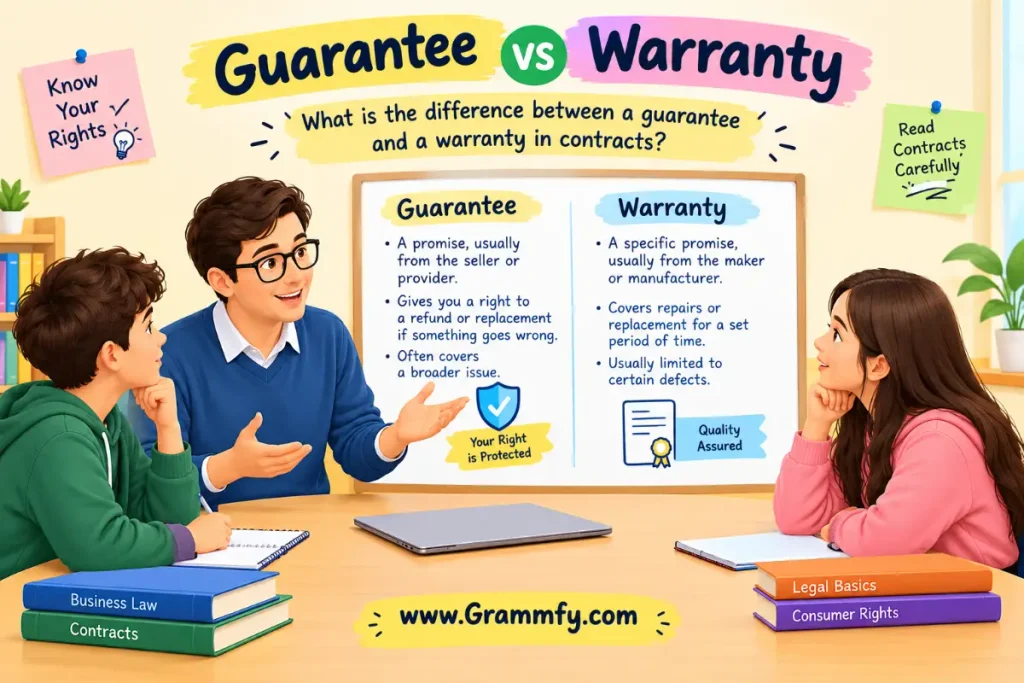
What is the difference between a guarantee and a warranty in contracts?
In contracts, the exact meaning depends on the agreement and applicable law.
A document may define what a guarantee or warranty covers, when it applies, how long it lasts, and what happens if a problem occurs.
That’s why it’s risky to assume that a word has one universal legal meaning everywhere.
Look for details such as:
- Coverage period
- Covered defects
- Exclusions
- Required maintenance
- Repair terms
- Replacement terms
- Refund conditions
- Claim procedure
- Proof of purchase
- Geographic limits
- Transferability
The contract’s wording matters more than a simple dictionary definition.
What are synonyms for guarantee by intensity?
Related words can also be organized by how strong they sound.
Mild: confidence and support
These words express a lower level of commitment:
- Suggestion
- Expectation
- Indication
- Confidence
- Reassurance
Example:
“The results give us confidence that the plan will work.”
This doesn’t create the same strong promise as “guarantee.”
Medium: clear commitment
These terms communicate a stronger promise:
- Assurance
- Commitment
- Pledge
- Promise
- Undertaking
Example:
“The company gave a written assurance that the problem would be investigated.”
Strong: certainty or formal protection
These expressions can sound very strong:
- Guarantee
- Absolute assurance
- Binding commitment
- Contractual obligation
- Warranty
Example:
“The agreement creates a contractual obligation to provide the service.”
Choose intensity carefully. A strong word can create expectations that a weaker word doesn’t.
What part of speech is guarantee?
Guarantee can function as both a noun and a verb.
Guarantee as a noun
It refers to the promise itself.
“The product comes with a money-back guarantee.”
Guarantee as a verb
It means to promise or assure something.
“We guarantee fast delivery.”
The grammatical form changes depending on how you use the word.
What part of speech is warranty?
Warranty is primarily a noun.
“The phone has a two-year warranty.”
You wouldn’t normally use warranty as a verb in standard everyday English.
Instead, use verbs such as:
- Guarantee
- Warrant
- Cover
- Protect
- Assure
For example:
“The manufacturer warrants that the product meets the stated requirements.”
That sentence is formal and legal in tone.
Is guarantee or warranty more common in American English?
Both words are common in American English, but they often appear in different contexts.
Warranty is strongly associated with consumer products and manufacturers.
Guarantee is common in advertising, customer service, personal promises, and satisfaction policies.
Examples include:
- Money-back guarantee
- Satisfaction guarantee
- Limited warranty
- Manufacturer’s warranty
- Extended warranty
- Lifetime guarantee
American businesses may use the terms in overlapping ways, so context matters.
Is guarantee or warranty different in British English?
British English also uses both words, with similar broad distinctions.
Guarantee is widely used for promises and satisfaction policies. Warranty is commonly associated with formal product protection.
Some product and service terms may differ by industry or legal system, though.
Regional wording can also depend on whether you’re discussing consumer law, insurance, contracts, or ordinary conversation.
When writing for an international audience, define the protection clearly instead of relying on the word alone.
Which word is best for a resume?
A resume usually needs precise action words rather than either “guarantee” or “warranty.”
If you’re describing a skill, use language that shows what you can actually do.
Instead of:
“I guarantee excellent SEO results.”
Try:
“Improved website visibility through keyword research and on-page SEO.”
The second sentence is stronger because it describes an action and result without making an unrealistic promise.
If your job involved customer protection or product policies, warranty may be appropriate:
“Processed warranty claims and coordinated product replacements.”
For a resume, avoid promising results you can’t control.
Which word is best for an essay?
In an essay, choose guarantee when you’re discussing a promise, certainty, or expected result.
Example:
“Education does not guarantee financial success, but it can create more opportunities.”
Use warranty when the essay concerns consumer products, contracts, law, or business practices.
Example:
“The warranty protects consumers against certain manufacturing defects.”
Academic writing benefits from precise wording. Don’t use one word simply because it sounds more formal.
Which word is best for texting?
In casual texting, guarantee is much more natural.
Examples:
“I guarantee you’ll love it.”
“Can you guarantee you’ll be there?”
“That’s a guarantee.”
Warranty sounds unusual unless you’re talking about a product.
For example:
“Does this laptop still have a warranty?”
That sounds completely natural because the subject is product protection.
Which word is best for email?
Your choice depends on the topic.
For a customer-service email:
“Could you please confirm whether the item is still covered by warranty?”
For a service promise:
“Can you guarantee delivery by Friday?”
And, For a formal business message:
“Please confirm the warranty period and the conditions for replacement.”
Clear nouns such as coverage, terms, and protection can also make the email easier to understand.
Which word is best for speaking?
Use guarantee when you’re talking about a promise or certainty.
“I guarantee this will make the process easier.”
Use warranty when you’re discussing formal product coverage.
“The computer is still under warranty.”
In conversation, context usually makes the meaning obvious.
What are real-life examples of guarantee and warranty?
Here are original examples from common situations.
- Online shopping:
“The store offers a 30-day money-back guarantee if customers aren’t satisfied.” - Electronics:
“My headphones stopped working, so I’m checking whether they’re still under warranty.” - Car purchase:
“The dealer offered a three-year warranty on certain parts.” - Food service:
“The restaurant guarantees that every order will be prepared fresh.” - Delivery service:
“The company guarantees delivery by Friday.” - Software service:
“The provider guarantees a response to support requests within 24 hours.” - Home appliance:
“The refrigerator warranty covers manufacturing defects but excludes accidental damage.” - Personal promise:
“I guarantee that I’ll return your book tomorrow.” - Business email:
“Please confirm whether the replacement is covered by the original warranty.” - School essay:
“Hard work can improve your chances of success, but it cannot guarantee a particular outcome.” - Repair shop:
“The technician provided a 90-day guarantee on the repair.” - Phone purchase:
“Before buying the phone, I asked how long the manufacturer’s warranty lasts.” - Online course:
“The provider offers a satisfaction guarantee for eligible students.” - Furniture:
“The warranty covers defects in the frame but not normal wear.” - Freelance service:
“I can’t guarantee a specific ranking position, but I can follow an agreed SEO process.”
Guarantee vs Assurance — what’s different?
Guarantee usually makes a stronger promise than assurance.
| Guarantee | Assurance |
|---|---|
| Strong promise | Confidence or reassurance |
| Often creates a clear expectation | Often reduces doubt |
| Can involve a remedy | Doesn’t necessarily include a remedy |
| “We guarantee a refund.” | “We assure you that we’ll investigate.” |
Consider this pair:
“We assure you that your complaint is being reviewed.”
The company is reassuring the customer.
“We guarantee a refund if the stated conditions are met.”
The company is making a specific promise.
The second statement is more definite.
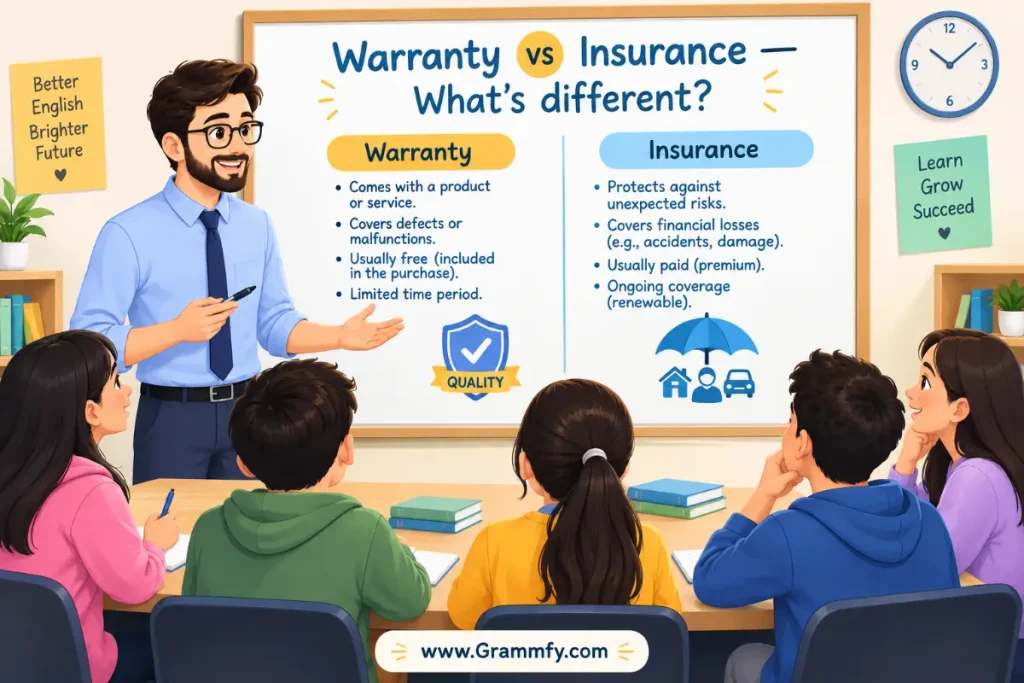
Warranty vs Insurance — what’s different?
A warranty and insurance both provide protection, but they aren’t the same.
A warranty generally relates to defined product or service issues covered by the warranty provider.
Insurance is designed to protect against specified risks or losses and normally involves a policy and premium.
For example:
“The laptop warranty covers certain manufacturing defects.”
Insurance might cover risks such as theft or accidental damage, depending on the policy.
Never assume that a warranty automatically covers every kind of damage.
Guarantee vs Promise — what’s different?
A promise is the broader everyday word.
You can promise to call someone, finish a task, or help a friend. A guarantee is often a stronger assurance that something will happen or meet a specific standard.
Compare:
“I promise I’ll call tonight.”
with:
“I guarantee the service will be completed by Friday.”
The first is personal and conversational. The second sounds more definite and specific.
Warranty vs Coverage — what’s different?
Coverage refers to what is protected.
A warranty is the formal protection or assurance itself.
For example:
“The warranty provides coverage for manufacturing defects.”
Here, warranty identifies the protection agreement, while coverage describes what the agreement includes.
This distinction is especially useful when reading product documentation.
What are common mistakes with guarantee and warranty?
Several mistakes appear often because the words overlap.
Mistake 1: Treating them as exact synonyms
It’s tempting to think they always mean the same thing.
Better approach: check whether you’re discussing a promise, satisfaction policy, or formal product protection.
Mistake 2: Assuming every warranty covers damage
A warranty doesn’t automatically cover every problem.
Accidental damage, misuse, normal wear, or unauthorized modifications may be excluded.
Mistake 3: Using warranty for every promise
You wouldn’t normally say:
“I warranty I’ll call you tonight.”
Use:
“I guarantee I’ll call you tonight.”
Or, more naturally:
“I promise I’ll call you tonight.”
Mistake 4: Using guarantee for a formal product document
You can use guarantee in product contexts, but if you’re specifically discussing formal manufacturer coverage, warranty is usually clearer.
Mistake 5: Assuming “lifetime” means unlimited protection
A “lifetime warranty” or “lifetime guarantee” still has terms.
The word lifetime may refer to a particular period, owner, product life, or set of conditions depending on the agreement.
Mistake 6: Making promises you can’t control
A business should be careful with statements such as:
“We guarantee you’ll reach the top of Google.”
Search rankings depend on many factors, so a specific ranking guarantee can be misleading.
A better statement is:
“We use an SEO strategy designed to improve search visibility.”
When should you not use guarantee?
Avoid guarantee when you’re only expressing a possibility.
Don’t write:
“This method guarantees better results.”
if you don’t have a reliable basis for that claim.
Depending on your meaning, better choices may include:
- May improve
- Can help
- Is designed to
- Is expected to
- Often leads to
- Increases the chance of
These phrases are more accurate when the outcome isn’t certain.
When should you not use warranty?
Don’t use warranty simply to mean “promise” in casual English.
For example:
“I warranty I’ll finish my homework.”
That’s incorrect in normal usage.
Use:
“I promise I’ll finish my homework.”
or:
“I guarantee I’ll finish my homework.”
Warranty is generally used as a noun for a formal assurance, especially one connected to goods, services, or agreements.
What are the antonyms of guarantee?
There isn’t one perfect antonym for guarantee, but several words express uncertainty or lack of assurance.
Useful opposites include:
- Uncertainty
- Doubt
- Risk
- Possibility
- Insecurity
- Unreliability
- Question
- Unpredictability
For example:
“There is no guarantee of success.”
This sentence communicates uncertainty without needing a direct antonym.
What are the antonyms of warranty?
Because warranty refers to formal protection, its practical opposites include:
- No coverage
- Exclusion
- Unprotected
- Uncovered
- Liability
- Risk
- Disclaimer
For example:
“Accidental damage is excluded from the warranty.”
Here, excluded communicates the opposite of being covered.
How can you choose the right word quickly?
Use these simple questions.
Are you talking about a promise?
Choose guarantee or promise.
“I guarantee the work will be finished tomorrow.”
Are you talking about product protection?
Choose warranty.
“The camera has a two-year warranty.”
Are you talking about what a policy protects?
Choose coverage.
“The coverage includes replacement parts.”
Are you reassuring someone?
Choose assurance.
“We assure customers that their concerns are being reviewed.”
Are you writing casually?
Choose promise, sure thing, or you have my word, depending on the situation.
Are you writing a legal or business document?
Use the exact term defined in the contract and describe the conditions clearly.
What should you check before relying on a warranty?
Don’t stop at the word “warranty.” Read the details.
Check:
- Length: How long does protection last?
- Coverage: Which parts or problems are included?
- Exclusions: What isn’t covered?
- Claim process: How do you request service?
- Proof: Do you need a receipt or registration?
- Repair: Will the company repair the product?
- Replacement: Can the company replace it?
- Refund: Is a refund available?
- Maintenance: Are maintenance requirements included?
- Transfer: Does protection follow the product or the original buyer?
A short warranty can be more useful than a long one if its coverage is broader.
What should you check before trusting a guarantee?
A guarantee also deserves careful attention.
Look for:
- What exactly is promised?
- Who qualifies?
- How long does the promise last?
- What conditions apply?
- What happens if the promise isn’t met?
- Is a refund available?
- Is replacement available?
- Are there exclusions?
- Is registration required?
- Does the promise appear in writing?
A phrase such as “100% guaranteed” sounds powerful, but the details determine what it actually means.
Quick comparison: guarantee, warranty, promise, and assurance
| Term | Main idea | Common setting | Example |
|---|---|---|---|
| Guarantee | Strong promise about an outcome or standard | Business, services, products, everyday speech | “We guarantee satisfaction.” |
| Warranty | Formal protection under stated terms | Products and contracts | “The phone has a one-year warranty.” |
| Promise | Commitment to do something | Everyday speech | “I promise I’ll call.” |
| Assurance | Reassurance or confidence | Business, formal communication | “We assure you the issue is being reviewed.” |
| Coverage | What is protected | Policies and warranties | “The coverage includes parts.” |
| Protection | General defense against loss or problems | Consumer and business contexts | “The plan offers protection.” |
| Commitment | Firm intention or obligation | Business and personal contexts | “We made a commitment to customers.” |
| Pledge | Serious promise | Formal or public contexts | “The company pledged to improve service.” |
What does “money-back guarantee” mean?
A money-back guarantee usually means a seller promises to return your money if specific conditions are met.
The conditions matter.
For example, a policy might require:
- A return within 30 days
- Proof of purchase
- The product to be returned
- A specific reason for the refund
- Compliance with the seller’s terms
Therefore, “money-back” doesn’t necessarily mean you can request a refund at any time for any reason.
Read the policy before assuming what you’re entitled to receive.
What does “limited warranty” mean?
A limited warranty provides protection with restrictions.
The limits may concern:
- Time
- Parts
- Types of defects
- Types of damage
- Who can claim coverage
- Available remedies
For instance, a limited warranty might cover manufacturing defects for one year but exclude accidental damage.
The word limited is important because it tells you that the protection has boundaries.
What does “extended warranty” mean?
An extended warranty provides additional protection beyond an original warranty period or coverage arrangement.
For example, a product might include one year of standard coverage, with an optional plan extending certain protection for another two years.
Before paying for an extended plan, compare its cost and coverage with the product’s original protection.
An extended warranty isn’t automatically a good value for every purchase.
What does “lifetime guarantee” mean?
A lifetime guarantee sounds like unlimited protection, but its actual meaning depends on the terms.
The word lifetime might refer to:
- The original buyer’s ownership
- The product’s expected life
- The company’s definition of the product’s lifetime
- A specific period stated in the policy
Always check the written terms.
Why does precise wording matter?
Words such as guarantee, warranty, assurance, and coverage create different expectations.
Clear wording helps readers understand what is actually being promised.
Compare:
“Your purchase is fully protected.”
with:
“The product has a two-year warranty covering manufacturing defects.”
The second statement is more useful because it tells the reader what the protection is and how long it lasts.
Precision is especially important in:
- Product descriptions
- Customer-service emails
- Contracts
- Websites
- Advertising
- Business proposals
- Resumes
- Academic writing
Quick tips for choosing the right word
- Use guarantee for a strong promise.
- Use warranty for formal product protection.
- Use promise for everyday personal commitments.
- Use assurance when you’re reassuring someone.
- Use coverage when describing what a policy protects.
- Use protection as a broad, general term.
- Read the actual terms before assuming what a guarantee or warranty provides.
- Avoid absolute claims when the result depends on factors outside your control.
- Choose precise wording instead of using a stronger word just because it sounds impressive.
- In legal or commercial situations, follow the defined terms in the agreement.
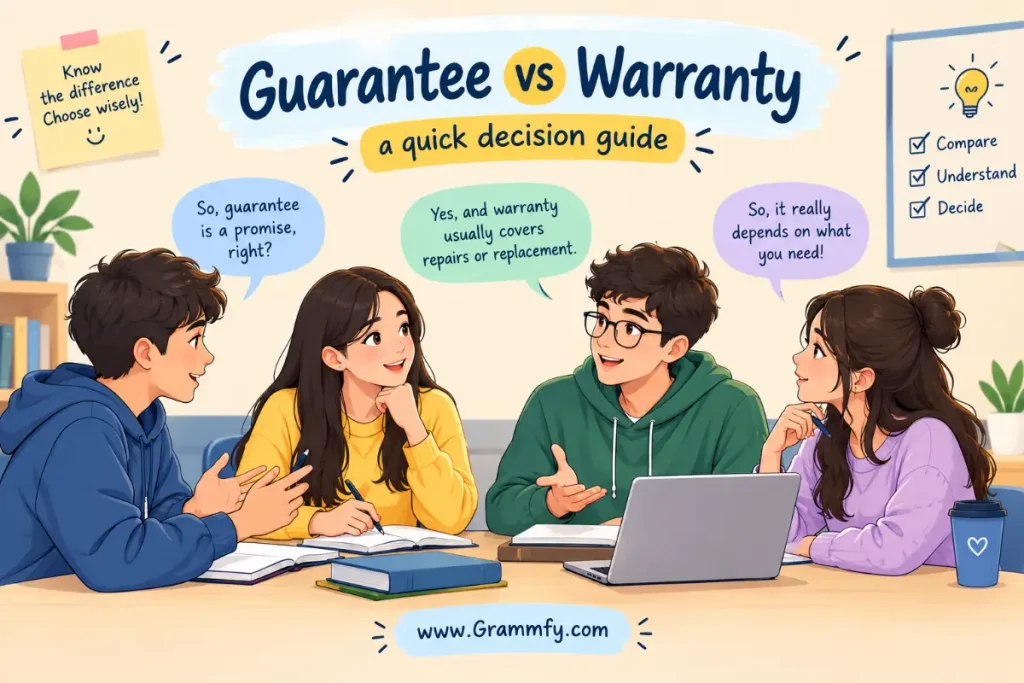
Guarantee vs Warranty: a quick decision guide
When you’re unsure, use this mini-guide:
Is it a promise about a result?
→ Guarantee
Is it formal protection for a product?
→ Warranty
Is it a personal commitment?
→ Promise
Is it reassurance?
→ Assurance
Are you describing what a policy protects?
→ Coverage
Are you talking about general help against risk?
→ Protection
This simple test works for most everyday situations.
Conclusion
The key difference in Guarantee vs Warranty is the type of protection or promise being described. A guarantee usually focuses on an assurance that something will meet a standard, provide satisfaction, or produce a stated result. A warranty is more often a formal promise connected to a product’s condition, defects, repair, or replacement.
Neither word is automatically better than the other. The right choice depends on what you’re trying to communicate. Use guarantee for promises and expected results, and choose warranty when discussing defined product protection. When the distinction matters, don’t rely only on the label. Check the actual terms, conditions, exclusions, and remedies.
Once you understand that basic difference, choosing between these related words becomes much easier.
Frequently Asked Questions
What’s the difference between a guarantee and a warranty?
A guarantee is generally a promise about quality, performance, satisfaction, or an expected result, while a warranty usually provides formal protection for a product under stated conditions.
Is a warranty the same as a guarantee?
No, not always. The terms overlap, but a warranty commonly refers to formal product protection, while a guarantee often describes a broader promise.
Can I use guarantee and warranty interchangeably?
Sometimes businesses use them in similar ways, but you shouldn’t assume they have identical terms. Check the specific agreement or policy to understand the protection provided.
What’s another way to say guarantee?
Common alternatives include promise, assurance, commitment, pledge, and undertaking, although each has a slightly different tone and meaning.
Is a warranty only for products?
No. Warranties can appear in other formal agreements, but the word is especially common when discussing products, manufacturers, repairs, and defects.
Which word should I use in an email about a broken product?
Use warranty when you’re asking about formal product coverage, such as: “Could you confirm whether this item is still under warranty?”
Does a money-back guarantee mean I can always get a refund?
No. A money-back guarantee normally has conditions, such as a deadline, return requirements, or eligibility rules. Read the policy before requesting a refund.
Conclusion
The key difference in Guarantee vs Warranty is the type of protection or promise being described. A guarantee usually focuses on an assurance that something will meet a standard, provide satisfaction, or produce a stated result. A warranty is more often a formal promise connected to a product’s condition, defects, repair, or replacement.
Neither word is automatically better than the other. The right choice depends on what you’re trying to communicate. Use guarantee for promises and expected results, and choose warranty when discussing defined product protection. When the distinction matters, don’t rely only on the label. Check the actual terms, conditions, exclusions, and remedies.
Once you understand that basic difference, choosing between these related words becomes much easier.
