
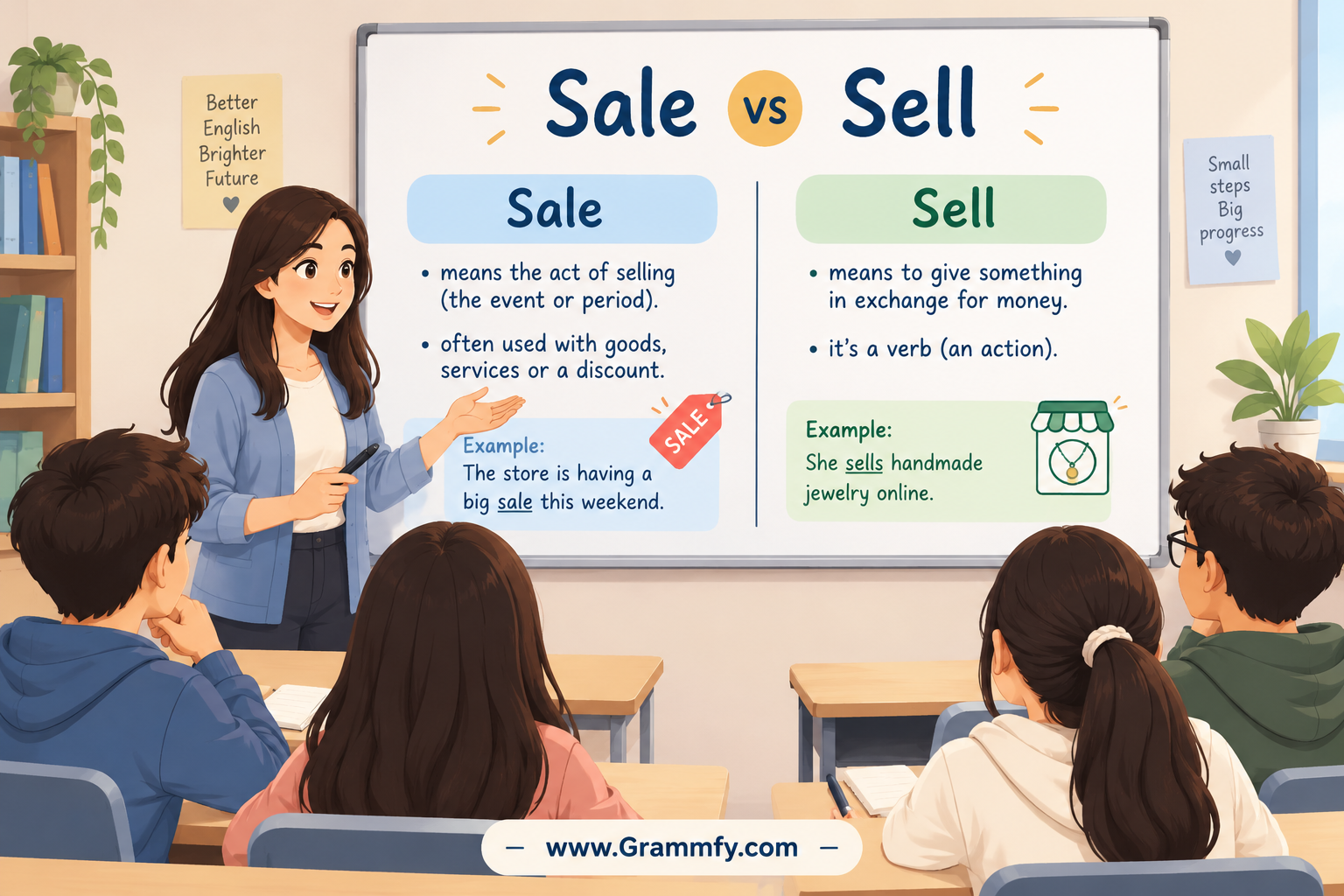
Have you ever stopped while writing an email, essay, resume, or text and wondered whether you should use sale vs sell? These two words look and sound related because they come from the same word family, but they play different roles in a sentence. Choosing the wrong one can make even a simple sentence sound awkward.
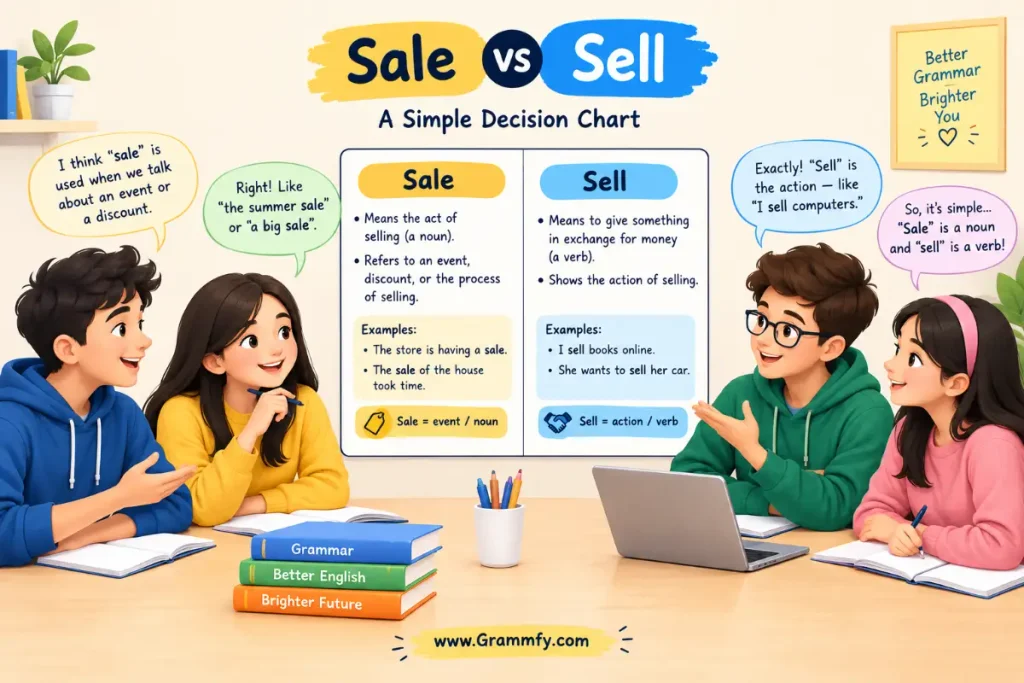
The easiest way to remember the difference is this: sale is usually a noun, while sell is a verb. If you are talking about an event, offer, or act of selling something, you will often need sale. If you are talking about the action of giving something to a buyer in exchange for money, you need sell.
Answer: Sale is a noun that refers to an act or event of selling, while sell is a verb that means to give something to someone in exchange for money.
This guide explains the difference between sale and sell, where the words came from, how their meanings developed, which synonyms fit different situations, and how to avoid common mistakes. You’ll also see examples for resumes, essays, emails, texts, conversations, advertising, and everyday writing.
To sharpen your word-choice skills, take a look at [Guarantee vs Warranty].
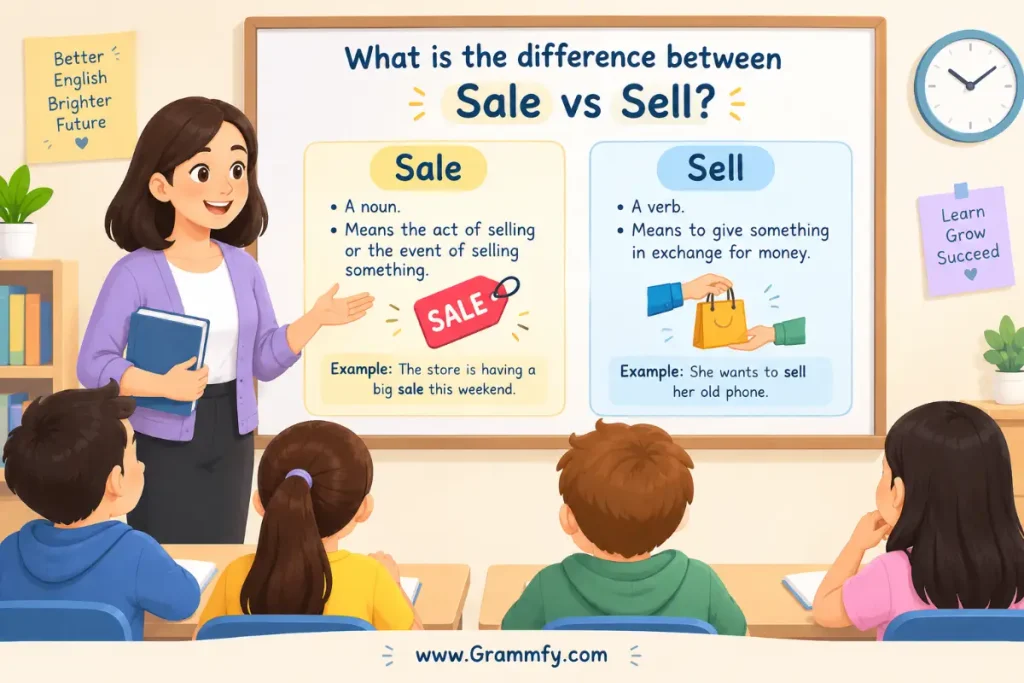
What is the difference between “Sale vs Sell”?
The basic difference between sale and sell is their grammatical role.
- Sale is mainly a noun.
- Sell is mainly a verb.
- Sale names an event, transaction, or opportunity to buy something at a reduced price.
- Sell describes the action of offering or exchanging something for money.
Compare these examples:
| Word | Part of speech | Meaning | Example |
|---|---|---|---|
| Sale | Noun | An event or transaction involving selling | The store is having a big sale. |
| Sell | Verb | To give something to a buyer for money | They sell handmade furniture. |
A useful test is to ask what the sentence is doing.
If the sentence describes an action, use sell.
- I want to sell my old laptop.
- They sell fresh bread.
- She plans to sell her car.
If the sentence describes an event, transaction, or discounted shopping period, use sale.
- The store is having a sale.
- I bought these shoes during a sale.
- The house was sold in a private sale.
Is sale a noun or a verb?
Sale is a noun. It normally names something rather than showing an action.
For example:
- The sale starts Friday.
- The company reported a successful sale.
- This jacket is on sale.
- The property is for sale.
You generally cannot use sale where a verb is required.
Incorrect:
- I want to sale my car.
Correct:
- I want to sell my car.
Is sell a noun or a verb?
Sell is primarily a verb. It describes the act of selling something.
Examples:
- We sell books online.
- She wants to sell her bicycle.
- The company sells software.
- He sold his old phone yesterday.
The word also has related forms such as seller, selling, and sold.
Where did “Sale vs Sell” come from?
The connection between sale and sell is not accidental. Both words belong to the same old Germanic and English word family connected with the idea of exchanging goods.
Sell comes from an Old English verb related to the act of giving something in exchange for money. Over centuries, its spelling and pronunciation developed into the modern English sell.
Sale developed as a noun connected to the act or event of selling. English has many word pairs like this, where a noun and verb share a historical root but have different forms.
You can see a similar pattern in pairs such as:
- advise → advice
- choose → choice
- speak → speech
- prove → proof
- sell → sale
The important point for modern English learners is that you don’t need to memorize the entire history. You only need to remember their jobs in a sentence.
Sell = action.
Sale = thing, event, or transaction.
What does sale mean in plain English?
Sale has several closely related meanings.
1. A period when products are sold at lower prices
This is probably the meaning you see most often in stores and advertisements.
- The shoes are on sale.
- The store is having a summer sale.
- I bought the jacket during the weekend sale.
Here, sale refers to a special shopping period or promotion.
2. The act or process of selling something
In business, sale can refer to a transaction.
- The sale of the building was completed yesterday.
- The company announced the sale of its smaller division.
- The car’s sale was delayed.
3. An opportunity to buy something
In phrases such as for sale, the word means that something is available for purchase.
- My old desk is for sale.
- Is this house for sale?
- They have several used computers for sale.
What does sell mean in plain English?
Sell means to give something to a person or organization in exchange for money.
Examples:
- I want to sell my old books.
- They sell coffee and pastries.
- She sold her car last month.
- The company sells products worldwide.
Sell can also have a broader meaning.
Sell an idea
You can sell an idea when you persuade someone that the idea is valuable.
- She sold the team on her plan.
- The presentation helped sell the idea to investors.
Sell yourself
In professional situations, sell yourself means to present your skills and strengths in a convincing way.
- A good resume should help you sell yourself to employers.
Sell out
Sell out can mean that all available items or tickets have been purchased.
- The concert tickets sold out in one hour.
It can also have a negative meaning when someone gives up principles for money or personal benefit.
Sale vs Sell: a simple memory trick
If you keep mixing up these words, use this shortcut:
You sell something, but a sale happens.
Think about these two sentences:
- I want to sell my bike.
- My bike is for sale.
The first sentence focuses on the action. The second focuses on the availability or transaction.
Another easy trick is to look for common phrases.
Common phrases with sale
- on sale
- for sale
- sale price
- sales tax
- sales team
- garage sale
- yard sale
- clearance sale
- online sale
- public sale
- private sale
Common phrases with sell
- sell a product
- sell a service
- sell a car
- sell a house
- sell online
- sell directly
- sell quickly
- sell well
- sell out
- sell yourself
- sell an idea
What are the best synonyms for “Sale vs Sell”?
There isn’t one perfect synonym for either word. The best choice depends on the context, tone, and exact meaning.
Some alternatives are very casual, while others sound better in business or formal writing.
Master synonym list
| Word | Meaning | Tone | Example |
|---|---|---|---|
| Sale | An act or event of selling | Neutral | The store announced a sale. |
| Purchase | The act of buying | Formal/neutral | The purchase was recorded. |
| Deal | An agreed business arrangement | Everyday/business | We made a good deal. |
| Bargain | Something bought at a good price | Everyday | This coat was a bargain. |
| Discount | A reduction in price | Neutral | The store offers a discount. |
| Promotion | A sales offer or campaign | Business | The promotion ends Friday. |
| Clearance | A sale to move remaining stock | Retail | The shoes are part of a clearance. |
| Marketplace | A place where goods are exchanged | Neutral | The marketplace has many sellers. |
| Sell | Exchange something for money | Neutral | They sell handmade goods. |
| Market | Promote or sell something | Business | The company markets its products online. |
| Trade | Exchange goods or services | Neutral | They trade used equipment. |
| Retail | Sell directly to consumers | Business | The company retails clothing. |
| Distribute | Supply products to sellers or users | Formal/business | They distribute products nationwide. |
| Advertise | Publicize something to attract buyers | Neutral/business | They advertise online. |
| Broker | Arrange a deal between parties | Formal/business | She brokers property deals. |
| Retailer | A person or company that sells to consumers | Business | The retailer sells home goods. |
| Vendor | A person or business selling goods | Neutral/business | The vendor sells fresh produce. |
| Seller | A person or business that sells | Neutral | The seller answered my question. |
| Merchant | A person or business involved in trade | Formal/traditional | The merchant sold imported goods. |
| Dealer | Someone who buys and sells particular products | Business | The car dealer offered a discount. |
| Move | Sell something, especially in business | Informal/business | The store needs to move old stock. |
Simple synonyms
For everyday English, these are usually easiest:
- offer
- trade
- exchange
- deal
- discount
- bargain
- buy and sell
- transaction
Example:
The store is offering a discount this weekend.
This sounds natural and clear.
Everyday synonyms
In casual conversation, people may use:
- deal
- bargain
- trade
- move
- offer
- buy and sell
Example:
I got a great deal on this phone.
Formal synonyms
For business reports, academic writing, and professional documents, consider:
- transaction
- distribute
- promote
- market
- retail
- exchange
- commercialize
- negotiate
Example:
The company completed the transaction in June.
Slang and informal alternatives
Informal English may use:
- move
- flip
- cash in
- unload
- peddle
Be careful with these. Some have extra meanings or can sound negative.
For example:
He flips old furniture for profit.
This is casual and specific. It doesn’t simply mean sell in every situation.
Which synonyms are mild and which are strong?
Words related to selling can have different levels of force or persuasion.
| Intensity | Word | Typical feeling |
|---|---|---|
| Mild | Offer | Simply make something available |
| Mild | Provide | Supply something |
| Neutral | Sell | Exchange for money |
| Neutral | Market | Promote to buyers |
| Moderate | Promote | Actively encourage interest |
| Moderate | Pitch | Persuade someone to accept an idea |
| Strong | Persuade | Try to change someone’s mind |
| Strong | Convince | Successfully cause someone to agree |
| Strong | Pressure | Push someone toward a decision |
| Very strong | Push | Aggressively encourage a purchase |
For example, a salesperson might offer a product without pressure. If the salesperson keeps trying to make you buy it, you might say they are pushing the product.
This difference matters because synonyms aren’t always interchangeable.
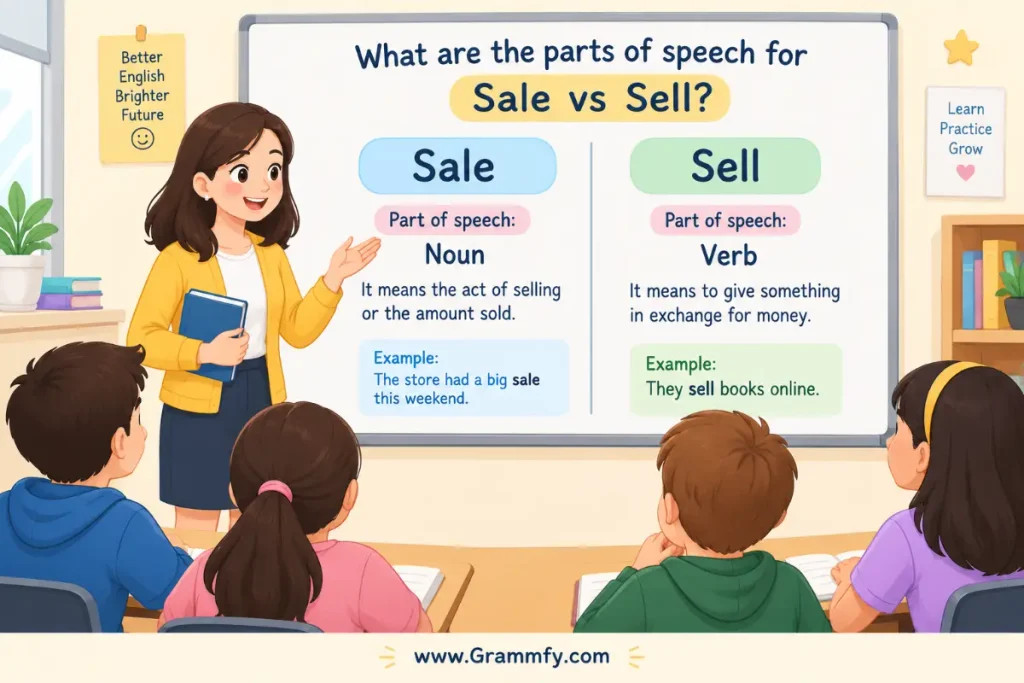
What are the parts of speech for “Sale vs Sell”?
Understanding grammar makes this word pair much easier.
Sale as a noun
Sale can be singular or plural.
- The sale begins tomorrow.
- The sales increased this year.
Notice that sales has an important business meaning.
Examples:
- Our sales increased by 15%.
- She works in sales.
- The sales team called the customer.
Sell as a verb
Sell changes form depending on tense and subject.
| Form | Example |
|---|---|
| Sell | I sell books. |
| Sells | She sells books. |
| Sold | She sold the books. |
| Selling | She is selling the books. |
A common mistake is using sale as though it were a verb.
Incorrect:
They sale computers online.
Correct:
They sell computers online.
Sale vs Sell: which word should you use in a resume?
For a resume, sell is usually the correct word when describing an action or skill.
For example:
I helped sell software to small businesses.
You can also use stronger professional verbs instead of repeating sell:
- generated
- promoted
- marketed
- negotiated
- closed
- increased
- developed
- secured
- converted
Instead of:
Sold products to customers.
Try:
Increased product sales by building strong customer relationships.
Or:
Generated new sales through targeted outreach.
These versions can sound more professional because they focus on results.
Resume examples
- Managed a team responsible for sales growth.
- Sold more than 500 products during the holiday season.
- Increased monthly sales by 20%.
- Developed strategies to improve online sales.
- Sold services to new business clients.
- Worked with the sales team to reach monthly targets.
How should you use “Sale vs Sell” in an essay?
In an essay, choose the word based on the sentence’s grammar and meaning.
Use sell when discussing the action:
Small businesses often sell products through social media.
Use sale when discussing a transaction or event:
The sale of products through online platforms has changed consumer behavior.
For formal essays, related words such as trade, commerce, marketing, distribution, and transaction may sometimes be more precise.
Essay example
Online platforms allow small businesses to sell products without opening a physical store. This type of sale can reduce operating costs and help businesses reach customers in other regions.
Here, both words are correct because they perform different grammatical jobs.
How do you use “Sale vs Sell” in a text message?
Texting is more casual, but grammar still matters.
You might write:
Are you trying to sell your laptop?
Or:
Is your laptop still for sale?
For a short text:
Is this for sale?
That is natural and common.
Don’t write:
Is this for sell?
That is incorrect.
Remember the fixed phrase:
for sale
not:
for sell
How do you use “Sale vs Sell” in an email?
In an email, choose the word based on your purpose.
Business email
We sell office equipment to small businesses.
Customer email
This item is currently on sale.
Professional announcement
We are offering a special sale this weekend.
Asking about an item
Is the property still for sale?
These phrases are short, natural, and professional.
How do you use sale and sell when speaking?
In conversation, both words appear constantly.
Someone might say:
What are you doing with your old car?
You could answer:
I’m going to sell it.
Or:
It’s for sale if you know anyone who wants it.
The choice depends on whether you’re describing the action or the item’s availability.
What are some real-life examples of “Sale vs Sell”?
Here are examples from common situations.
- Shopping:
The store is having a big sale this weekend. - Selling a car:
I’m planning to sell my car next month. - Online shopping:
These headphones are on sale today. - Small business:
We sell handmade candles online. - Real estate:
The house is for sale. - Business:
The company completed the sale of its old office. - Advertising:
The campaign helped sell the new product. - Conversation:
Are you really going to sell your bike? - Professional writing:
The company reported strong sales during the final quarter. - School essay:
Online stores sell products to customers around the world. - Text message:
Is that old phone still for sale? - Workplace:
Our sales team reached its monthly target. - Garage sale:
We found some useful books at a garage sale. - Persuasion:
She did a great job selling her idea to the committee. - Retail:
The store plans to sell the remaining stock at a lower price.
Sale vs Sell: what’s the difference in “for sale” and “for sell”?
For sale is correct.
For sell is incorrect in standard English.
Examples:
- The house is for sale.
- My bicycle is for sale.
- These books are for sale.
Why?
The phrase for sale means available to be bought. English has established this phrase over time.
You don’t replace sale with sell just because the meaning involves selling.
Think of for sale as a fixed expression.
Sale vs Sell: what’s different between “on sale” and “sell”?
On sale describes an item that is being offered at a reduced price or, depending on context, is being offered for purchase.
Examples:
These shoes are on sale.
But sell describes an action:
The store sells these shoes.
Compare:
| Expression | Meaning |
|---|---|
| On sale | Available at a special/reduced price |
| Sell | The action of exchanging something for money |
| For sale | Available for someone to buy |
| Sales | Money or business generated through selling |
These expressions may appear together:
The store sells shoes that are often on sale.
Sale vs Sell: what’s the difference between sales and selling?
Sales and selling are closely related, but they aren’t always interchangeable.
Sales often refers to the business activity or the amount of money earned from selling.
She works in sales.
Selling refers to the activity of trying to sell something.
He is good at selling cars.
Compare:
Our sales increased this year.
with:
Our team is selling more products this year.
The first focuses on business results. The second focuses on the activity.
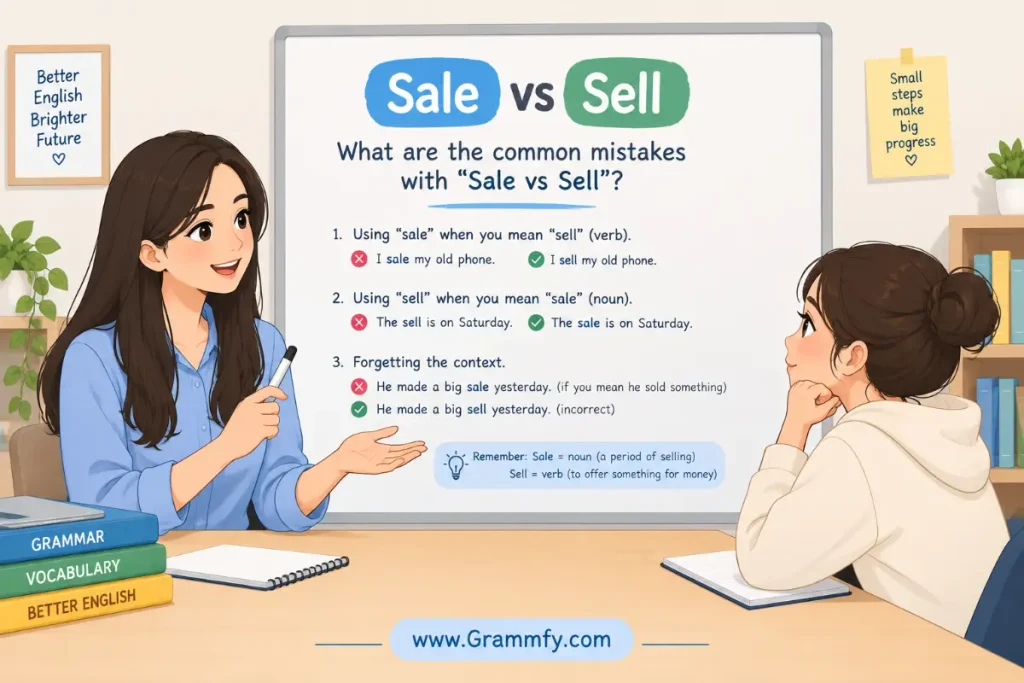
What are the common mistakes with “Sale vs Sell”?
Mistake 1: “I want to sale my car.”
Incorrect:
I want to sale my car.
Correct:
I want to sell my car.
Why? The sentence needs a verb after “want to.”
Mistake 2: “The car is for sell.”
Incorrect:
The car is for sell.
Correct:
The car is for sale.
Why? For sale is the standard expression meaning available to buy.
Mistake 3: “They sale clothes online.”
Incorrect:
They sale clothes online.
Correct:
They sell clothes online.
The sentence needs a verb.
Mistake 4: “There is a sell at the store.”
Incorrect:
There is a big sell at the store.
Correct:
There is a big sale at the store.
Here, you are naming an event, so the noun sale is needed.
Mistake 5: Confusing “sales” with “sale”
These are not always the same.
The company had one major sale.
This can refer to one transaction or event.
The company’s sales increased.
This refers to overall selling activity or revenue generated through sales.
When should you NOT use sale?
Don’t use sale when the sentence requires an ordinary action verb.
Incorrect:
I will sale my old computer.
Use:
I will sell my old computer.
You should also avoid using sale as a general replacement for selling.
Incorrect:
She is good at sale products.
Correct:
She is good at selling products.
Or:
She works in sales.
When should you NOT use sell?
Don’t use sell when you need the noun in a fixed phrase such as for sale or on sale.
Incorrect:
This car is for sell.
Correct:
This car is for sale.
Also:
Incorrect:
The store has a huge sell this week.
Correct:
The store has a huge sale this week.
What are the antonyms of “Sale vs Sell”?
The best antonym depends on the meaning.
For sell, common opposites include:
- buy
- purchase
- keep
- retain
- acquire
Example:
I want to sell my old phone.
Opposite:
I want to buy a new phone.
For sale, there isn’t always one exact opposite. Depending on context, you might use:
- purchase
- buying
- retention
- withdrawal from the market
If something is for sale, the person interested in it may buy it.
How does American English use “Sale vs Sell”?
In American English, the standard distinction is the same:
- sale = noun
- sell = verb
American English commonly uses expressions such as:
- garage sale
- yard sale
- on sale
- for sale
- sales tax
- sales representative
- sales department
For example:
I found this table at a garage sale.
And:
I’m going to sell my old table.
Are sale and sell different in British English?
The basic distinction is also the same in British English.
British speakers use sale as a noun and sell as a verb.
Some retail terms and regional expressions can differ between American and British English, but you do not need a different grammar rule for this word pair.
The safest rule is the same in both varieties:
Sell = verb. Sale = noun.
Which word is best for business writing “Sale vs Sell”?
In business writing, sales is extremely common.
You may see phrases such as:
- sales growth
- sales revenue
- sales target
- sales report
- sales representative
- sales department
- sales strategy
- sales forecast
- sales performance
Examples:
Our sales increased by 12% this quarter.
The company hired two new sales representatives.
Use sell when you describe what a company or person does:
We sell software to small businesses.
Use sale when referring to a specific transaction or promotional event:
The sale of the company was finalized last week.
Which word is best for advertising “Sale vs Sell”?
Advertising often uses sale, especially when promoting discounts.
Examples:
- Summer Sale
- Back-to-School Sale
- Holiday Sale
- Clearance Sale
- Weekend Sale
You may also see:
Everything is on sale.
The verb sell appears when describing the business action:
We sell high-quality furniture at affordable prices.
Which word is best for real estate “Sale vs Sell”?
Real estate uses both words frequently.
Use for sale when a property is available for purchase:
The house is for sale.
Use sell when describing the action:
They plan to sell their house.
Choose “sale” when describing the transaction:
The sale was completed last week.
You may also see:
The property sold quickly.
Notice that sold is the past tense of sell.
Which word is best for online stores “Sale vs Sell”?
Online stores use both words depending on the sentence.
We sell clothing online.
Our winter sale starts Monday.
These jackets are on sale.
The item is for sale on our website.
Online sales increased this year.
All five forms are correct because they have different grammatical functions.
Quick comparison: sale, sell, sold, selling, sales
| Form | Role | Example |
|---|---|---|
| Sale | Noun | The sale starts tomorrow. |
| Sell | Base verb | We sell books. |
| Sells | Present verb | She sells books. |
| Sold | Past/past participle | She sold the book. |
| Selling | -ing form | She is selling the book. |
| Sales | Plural noun | Our sales increased. |
Learning all six forms can prevent many mistakes.
What are some close word comparisons?
Sale vs bargain
A sale is an event or period when products are offered, often at lower prices.
A bargain is something you believe is a very good deal.
The store is having a sale.
This jacket was a bargain.
A sale doesn’t guarantee that every item is a bargain.
Sell vs market
Sell means to exchange something for money.
Market means to promote or position a product to attract buyers.
The company sells laptops.
The company markets laptops to college students.
A business can market something without making a sale immediately.
Sale vs discount
A sale can include discounts, but the words aren’t identical.
A discount is a reduction in the original price.
A sale is often a promotional event where discounts may be offered.
The store is having a sale.
The store is offering a 30% discount.
Sell vs persuade
To sell something can involve persuasion, but persuade is broader.
The salesperson tried to sell me a phone.
She persuaded me to choose the cheaper model.
You can persuade someone about an idea, decision, or action without selling anything.
15+ useful example sentences
Here are more examples that show how the words work naturally.
- I want to sell my old desk before moving.
- The bookstore is having a weekend sale.
- Is this apartment still for sale?
- They sell handmade products through their website.
- These shoes are currently on sale.
- The company increased its sales this year.
- She sold her car to a neighbor.
- The sale of the property took several weeks.
- We found a great bargain at the garage sale.
- The business plans to sell its products overseas.
- He works in sales for a technology company.
- The advertisement helped sell the new product.
- The tickets sold out within a few hours.
- My old laptop is for sale.
- The store will sell the remaining stock at a discount.
- Their biggest sale of the year begins tomorrow.
- She gave a strong presentation and sold the idea to the team.
- Online sales have become an important part of the business.
- The retailer wants to sell more products through its mobile app.
- We bought the sofa during a holiday sale.
How can you choose the right word quickly?
Use these questions when you’re unsure.
Are you describing an action?
Use sell.
I want to sell my bike.
Are you describing an event or transaction?
Use sale.
The sale begins tomorrow.
Is something available to buy?
Use for sale.
The house is for sale.
Is something offered at a lower price?
Use on sale.
The jacket is on sale.
Are you talking about business results?
Use sales.
Our sales increased last month.
Are you talking about the past action?
Use sold.
She sold her car yesterday.
A simple decision chart for sale and sell
| If you mean… | Choose | Example |
|---|---|---|
| The action of exchanging something for money | Sell | I want to sell it. |
| A shopping promotion | Sale | The store has a sale. |
| Something available to buy | For sale | The house is for sale. |
| A reduced price | On sale | The shoes are on sale. |
| Past action | Sold | He sold his car. |
| Current action | Selling | She is selling her car. |
| Business activity/results | Sales | Sales increased. |
Quick tips for choosing the right word
Keep these five rules in mind:
- Use sell for the action.
- They sell books.
- Use sale for the event or transaction.
- The book sale starts Friday.
- Use for sale for something available to buy.
- The books are for sale.
- Use on sale for a reduced-price offer.
- The books are on sale.
- Use sales for business activity or results.
- Book sales increased.
If you remember these patterns, most mistakes disappear quickly.
Why do people confuse sale and sell?
The confusion is understandable because the words are related in meaning and spelling. They also sound somewhat similar, especially for English learners.
Another reason is that English often uses word families where a noun and verb have different forms.
For example:
- speak → speech
- choose → choice
- advise → advice
- sell → sale
The key is not to translate each word separately from another language. Instead, learn the common sentence patterns.
For example, memorize:
I want to sell it.
It is for sale.
It is on sale.
The sale starts tomorrow.
These patterns are more useful than memorizing a single definition.
Conclusion
The easiest way to remember Sale vs Sell is to focus on grammar. Sell is a verb, so it describes the action of exchanging something for money. Sale is a noun, so it can describe a selling event, transaction, or special shopping period. You can sell a car, but the car can be for sale. A store can sell shoes, while those shoes may be on sale. In business, sales often refers to selling activity or revenue.
Once you learn these common patterns, the difference becomes much easier. When you’re writing, stop for a second and ask: “Am I describing an action or naming an event?” If it’s an action, choose sell. If it’s an event or thing, choose sale. A few simple examples will help the distinction stick.
Frequently Asked Questions
Is sale a noun or a verb?
Sale is a noun. It usually refers to an event, transaction, or period when goods are offered, often at a reduced price.
Is sell a noun or a verb?
Sell is primarily a verb. It means to give something to a buyer in exchange for money.
What is the difference between sale and sell?
Sale is a noun, while sell is a verb. In simple terms, you sell something, but a sale is the event or transaction.
Is it correct to say “for sell”?
No, the correct phrase is for sale. For example, “My old phone is for sale.”
What’s another way to say “sell”?
Depending on the context, you can say offer, market, trade, exchange, retail, distribute, promote, or vend. The best synonym depends on what kind of selling you mean.
Should I use sale or sell in a resume?
Use sell when describing the action of selling, and use sales when discussing business performance or a sales role. For example, “Increased sales by 20%” is natural resume language.
Is “on sale” the same as “for sale”?
No. For sale means something is available to buy, while on sale often means it is being offered at a reduced or special price.

1 thought on “Sale vs Sell: The Ultimate Easy Guide”