
You’re writing an essay, preparing a resume, or sending an email, and you pause over one small spelling question: should you write Analyze or Analyse? Both forms are correct, but the right choice depends on the type of English you’re using.
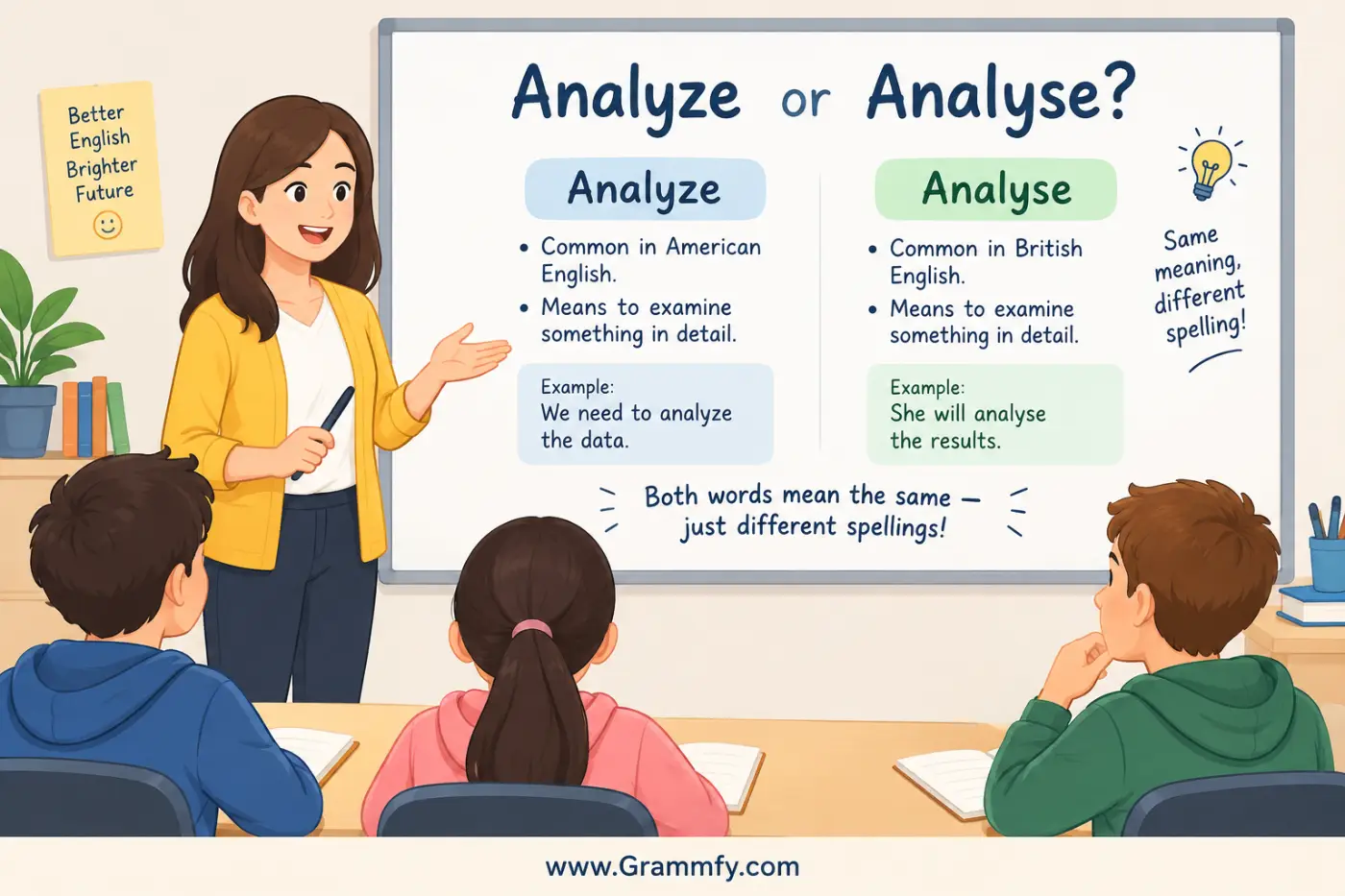
The main difference is regional. Analyze is the standard spelling in American English, while analyse is the standard spelling in British English and several other varieties of English. They have the same meaning and pronunciation.
Answer box: Analyze is the American English spelling, while analyse is the British English spelling. Both mean to examine something carefully and understand its parts or meaning.
Knowing the difference can help you keep your writing consistent. It matters especially in school assignments, professional documents, websites, resumes, and international communication. This guide explains the meaning, origin, spelling rule, synonyms, examples, regional usage, common mistakes, and the best choice for different types of writing.
If you’re working on choosing the right word, explore [Puns or Jokes].

What does analyze mean in plain English?
Analyze means to examine something carefully so you can understand it better. You might break information into smaller parts, look for patterns, compare details, or study causes and effects.
For example:
“Students need to analyze the poem before writing their answers.”
Here, students aren’t simply reading the poem. They are looking closely at its words, ideas, structure, and meaning.
The word can describe many kinds of careful examination:
- Analyzing a research study
- Analyzing a business report
- Analyzing a poem
- Analyzing a problem
- Analyzing customer data
- Analyzing a movie
- Analyzing a financial statement
- Analyzing someone’s argument
The basic idea stays the same: look closely, break information down, and understand what it shows.
What does analyse mean in plain English?
Analyse has exactly the same meaning as analyze. The difference is spelling, not meaning.
British English normally uses analyse:
“The students need to analyse the results.”
American English normally uses analyze:
“The students need to analyze the results.”
Both sentences communicate the same idea.
The choice depends on the English variety you’re following. If you’re writing for an American audience, use analyze. When following British English conventions, use analyse.
Where do analyze and analyse come from?
Both spellings trace back to the Greek word analyein, which means to break up or loosen.
The Greek roots are connected to the idea of taking something apart so its parts can be understood. That meaning fits the modern sense of analyzing information.
The word entered English through forms influenced by French and Latin. Over time, different English-speaking regions developed different spelling conventions.
American English later became more comfortable with certain -ize endings. British English often retained or developed -ise spellings in words such as:
- analyse / analyze
- organise / organize
- recognise / recognize
- realise / realize
The history is useful, but remember that spelling conventions aren’t perfectly identical across every English-speaking country.
Why are analyze and analyse spelled differently?
The difference comes mainly from regional spelling conventions.
American English generally prefers -ize in words such as:
- analyze
- organize
- realize
- recognize
- apologize
British English commonly uses -ise in these words:
- analyse
- organise
- realise
- recognise
- apologise
Therefore:
| American English | British English |
|---|---|
| analyze | analyse |
| organize | organise |
| realize | realise |
| recognize | recognise |
| apologize | apologise |
The pronunciation usually stays essentially the same.
This is a spelling difference, not a difference in definition.
Analyze or Analyse — which spelling is correct?
Both spellings are correct.
Analyze is correct in American English.
Analyse is correct in British English and is also common in several other English varieties.
The important rule is to match your spelling to your target audience.
For a US school assignment:
“We will analyze the results.”
For a British English assignment:
“We will analyse the results.”
Neither sentence is grammatically wrong.
Is analyze American or British English?
Analyze is the standard American English spelling.
It is widely used in the United States in:
- Schools
- Universities
- Newspapers
- Business writing
- Government documents
- Websites
- Technical writing
- Professional reports
American dictionaries use analyze as the main spelling.
For example:
“The researcher will analyze the survey data.”
If your entire document follows American English, keeping the -ize spelling is the safest choice.
Is analyse American or British English?
Analyse is the standard spelling in British English.
It is commonly used in the United Kingdom and in writing that follows British spelling conventions.
Example:
“The researcher will analyse the survey data.”
British English often uses -ise in words that American English spells with -ize.
However, British spelling has an important detail: -ize spellings can also be accepted in some British style systems. This means British usage isn’t as simple as saying that every British writer must use -ise.
For general learners, though, analyse is a familiar and widely accepted British spelling.
Do analyze and analyse mean the same thing?
Yes. Analyze and analyse have the same meaning.
They are not different verbs.
| Word | Meaning | Main usage |
|---|---|---|
| Analyze | Examine something carefully | American English |
| Analyse | Examine something carefully | British English |
For example:
“Scientists analyze the data.”
and
“Scientists analyse the data.”
Both mean that scientists examine the data carefully.
The difference is simply the spelling convention.
What are the different forms of analyze?
The verb has several related forms.
Analyze / analyse
This is the base verb.
“We need to analyze the information.”
Analyzes / analyses
This is the third-person singular form.
American English:
“She analyzes the results.”
British English:
“She analyses the results.”
Notice something important here: analyses can look confusing because it is also the plural of the noun analysis.
Analyzed / analysed
This is the past tense and past participle.
American English:
“The team analyzed the report.”
British English:
“The team analysed the report.”
Analyzing / analysing
This is the present participle or gerund.
American English:
“He is analyzing the data.”
British English:
“He is analysing the data.”
The spelling changes slightly when -ing is added.
What is the noun form of analyze?
The noun is analysis.
It means a detailed examination of something.
Example:
“Her analysis of the poem was clear.”
The plural is analyses, pronounced differently from the singular.
- Analysis → one detailed examination
- Analyses → more than one detailed examination
Example:
“The report includes three analyses of the survey results.”
This distinction is important because learners sometimes confuse analyse, analysis, and analyses.
What is the adjective form?
A common adjective is analytical.
It describes someone or something connected with careful examination or logical thinking.
Example:
“She has strong analytical skills.”
Another related adjective is analytic, which is also correct in certain contexts.
For example:
“The company uses analytic tools to study customer behavior.”
In many everyday situations, analytical sounds more natural when describing a person’s ability or approach.
What is the adverb form?
The common adverb is analytically.
Example:
“The problem should be approached analytically.”
This means the problem should be considered carefully and logically.
The word is more common in academic or professional writing than in casual conversation.
What are the best synonyms for analyze and analyse?
The best synonym depends on what kind of examination you’re describing. Some words are simple and conversational, while others are more formal or technical.
Simple synonyms
| Word | Meaning | Tone | Example |
|---|---|---|---|
| Examine | Look at something carefully | Neutral | “Let’s examine the results.” |
| Study | Look at something closely to learn | Simple | “We studied the report.” |
| Check | Look at something to find information or errors | Casual | “Check the figures again.” |
| Review | Look over something carefully | Neutral | “Please review the document.” |
| Look at | Consider something | Simple | “Let’s look at the evidence.” |
| Understand | Figure out meaning | Simple | “We need to understand the problem.” |
| Explore | Investigate an idea or subject | Neutral | “The article explores the issue.” |
| Consider | Think carefully about something | Neutral | “We should consider the evidence.” |
Everyday synonyms
| Word | Meaning | Tone | Example |
|---|---|---|---|
| Break down | Divide something into parts | Everyday | “Let’s break down the problem.” |
| Look into | Investigate something | Casual | “I’ll look into the complaint.” |
| Go over | Review something | Casual | “We went over the report.” |
| Dig into | Examine deeply | Informal | “The team dug into the numbers.” |
| Figure out | Understand something | Casual | “We’re trying to figure out the cause.” |
| Compare | Look at similarities and differences | Neutral | “Compare the two reports.” |
| Investigate | Search for facts or causes | Neutral | “Police investigated the incident.” |
| Assess | Judge something carefully | Neutral | “The doctor assessed the situation.” |
Formal synonyms
| Word | Meaning | Tone | Example |
|---|---|---|---|
| Evaluate | Judge quality, value, or effectiveness | Formal | “Researchers evaluated the results.” |
| Assess | Examine and judge | Formal | “The committee assessed the proposal.” |
| Examine | Study carefully | Formal | “The paper examines social change.” |
| Investigate | Search for facts or causes | Formal | “The study investigated the problem.” |
| Interpret | Explain meaning | Formal | “The researcher interpreted the findings.” |
| Scrutinize | Examine very carefully | Formal | “The auditors scrutinized the records.” |
| Deconstruct | Break something into parts to understand it | Academic | “The essay deconstructs the argument.” |
| Review | Examine information or work | Professional | “The board reviewed the proposal.” |
Informal synonyms
| Word | Meaning | Tone | Example |
|---|---|---|---|
| Dig into | Examine deeply | Informal | “Let’s dig into the numbers.” |
| Look over | Review quickly or generally | Informal | “Can you look over my essay?” |
| Check out | Examine or explore | Very casual | “Check out these results.” |
| Break down | Explain or divide into parts | Casual | “Let’s break down the question.” |
| Look into | Investigate | Casual | “I’ll look into the issue.” |
| Pick apart | Examine every detail, often critically | Informal | “Critics picked apart the proposal.” |
| Get into | Examine or discuss deeply | Casual | “The lesson gets into the details.” |
| Figure out | Understand or solve | Casual | “We need to figure out what went wrong.” |
These alternatives aren’t perfect substitutes in every sentence. Scrutinize, for example, suggests especially close or critical examination, while review can mean simply looking over information.
Which synonyms are closest to analyze?
Some alternatives are especially close in meaning.
Examine
Examine is one of the closest general synonyms.
“The scientist analyzed the sample.”
can become:
“The scientist examined the sample.”
Both suggest careful study.
Assess
Assess focuses more on judging a situation, quality, value, or risk.
“The manager assessed the team’s performance.”
This means the manager examined the performance and made a judgment.
Evaluate
Evaluate also involves judgment.
“The committee evaluated the proposal.”
The focus is on deciding how good, useful, effective, or suitable something is.
Investigate
Investigate emphasizes finding facts, causes, or explanations.
“The police investigated the accident.”
You wouldn’t always replace “investigate” with “analyze” because investigation can involve collecting evidence, interviewing people, and conducting research.
Interpret
Interpret focuses on explaining meaning.
“The student interpreted the poem.”
The student is trying to explain what the poem means.
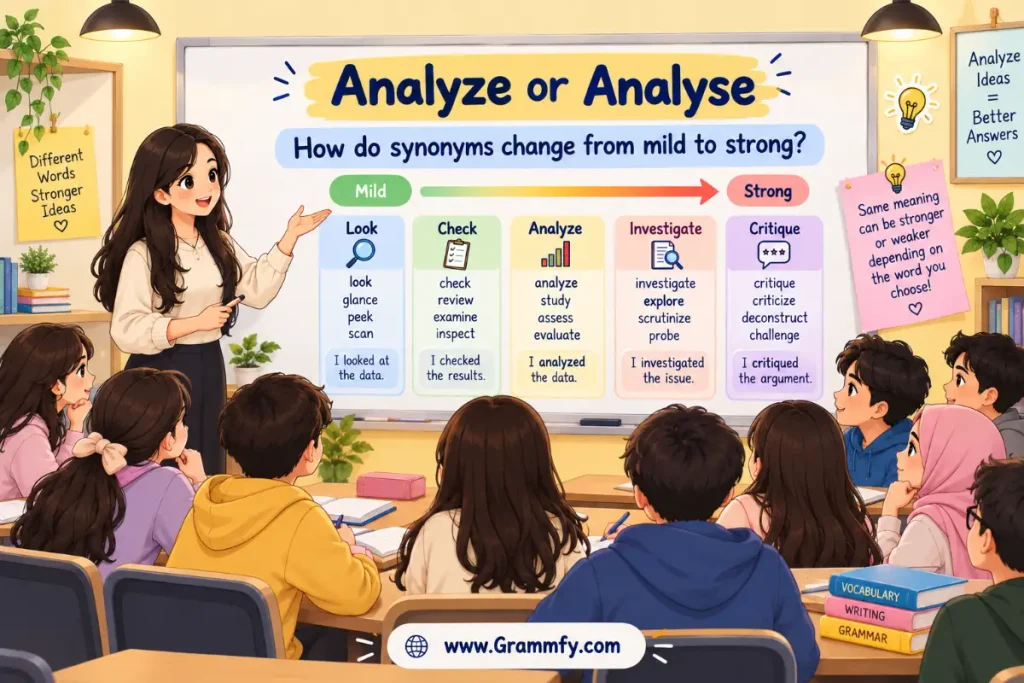
How do synonyms change from mild to strong?
The intensity of examination can vary.
Mild examination
These words suggest a basic review:
- Check
- Look at
- Review
- Consider
- Study
Example:
“Please review the document before the meeting.”
Moderate examination
These suggest a deeper look:
- Examine
- Assess
- Compare
- Explore
- Investigate
Example:
“The researchers examined the survey responses.”
Strong examination
These imply very detailed or critical study:
- Analyze
- Scrutinize
- Deconstruct
- Investigate deeply
- Break down
Example:
“The researchers analyzed every stage of the process.”
Which word sounds strongest?
Scrutinize often sounds stronger than review because it suggests close attention to detail.
For example:
“The manager reviewed the contract.”
The manager looked through it.
“The manager scrutinized the contract.”
The manager examined it very carefully, probably looking for problems.
Analyze vs examine — what’s the difference?
Both words describe careful study, but analyze often suggests breaking something into parts to understand how it works.
| Analyze | Examine |
|---|---|
| Breaks information into parts | Looks at something carefully |
| Often involves deeper interpretation | Can be broad or detailed |
| Common in academic work | Common in everyday and formal English |
| Focuses on relationships and meaning | Focuses on observation and inspection |
For example:
“The doctor examined the patient.”
This describes a physical or medical inspection.
“The researcher analyzed the patient’s test results.”
This suggests studying the information and looking for patterns or meaning.
The words can overlap, but the focus is slightly different.
Analyze vs evaluate — what’s the difference?
Analyze means to examine something carefully.
Evaluate means to examine something and judge its quality, value, success, or effectiveness.
Compare:
“The team analyzed the survey data.”
They studied the data.
“The team evaluated the survey method.”
They judged whether the method was effective or appropriate.
Analysis often comes before evaluation.
You might:
- Analyze the information.
- Identify patterns.
- Evaluate what those patterns mean.
- Make a recommendation.
Analyze vs investigate — what’s the difference?
Investigate usually focuses on finding facts or discovering a cause.
Analyze focuses more on examining information that has already been collected.
For example:
“The company investigated the customer complaint.”
The company searched for information about what happened.
“The company analyzed the customer data.”
The company studied the collected data to find patterns or useful information.
An investigation can include analysis, but the two processes aren’t identical.
Analyze vs interpret — what’s the difference?
Analyze means examining parts and relationships.
Interpret means explaining what something means.
A literature student may first analyze a poem’s imagery, structure, and word choice. Then the student may interpret what those features suggest about the poem’s main theme.
| Analyze | Interpret |
|---|---|
| Examines details | Explains meaning |
| Breaks information down | Gives meaning or understanding |
| Identifies patterns | Explains what patterns suggest |
Both skills are useful in academic writing.
What should you use in an American resume?
Use analyze if your resume follows American English.
For example:
“Analyze customer data to identify trends and improve performance.”
You can also use the noun analysis:
“Performed detailed analysis of customer behavior.”
A resume should focus on clear action verbs.
Good choices include:
- Analyze
- Evaluate
- Assess
- Examine
- Investigate
- Review
- Interpret
- Compare
If you’re applying for a data-related role, analyze can clearly describe an important skill.
What should you use in a British resume?
Use analyse when following British English spelling.
Example:
“Analyse customer data to identify trends and improve performance.”
The meaning doesn’t change.
British-style resumes may also use:
“Performed detailed analysis of customer behavior.”
Notice that analysis keeps the same spelling in both American and British English.
That makes it useful when you want a word that doesn’t change between the two spelling systems.
Which spelling is better for an essay?
The answer depends on the required English variety.
For an American school or college essay:
“The author analyzes the character’s behavior.”
For a British English essay:
“The author analyses the character’s behavior.”
If your teacher or school has a style guide, follow it.
Consistency is more important than choosing one form because it “looks better.”
Which spelling should you use in texting?
Texting is informal, so either spelling may be understood easily.
Still, your usual English variety should guide your choice.
American texter:
“Can you analyze this for me?”
British texter:
“Can you analyse this for me?”
You don’t need to explain the difference in a casual message.
The reader will usually understand both forms.
Which spelling works best in a professional email?
Match the spelling to your organization’s style.
An American company might write:
“We will analyze the customer feedback.”
A British company might write:
“We will analyse the customer feedback.”
International companies may have a specific style guide. If one exists, follow it throughout the document.
Mixing spelling systems isn’t always a serious error, but consistency makes professional writing look more polished.
Which spelling should you use when speaking?
There is no spelling difference when speaking.
Both words are pronounced essentially the same way.
That means you don’t have to worry about whether you are saying analyze or analyse correctly based on spelling. The distinction appears in written English.
In conversation, the listener normally understands the word from its pronunciation and context.
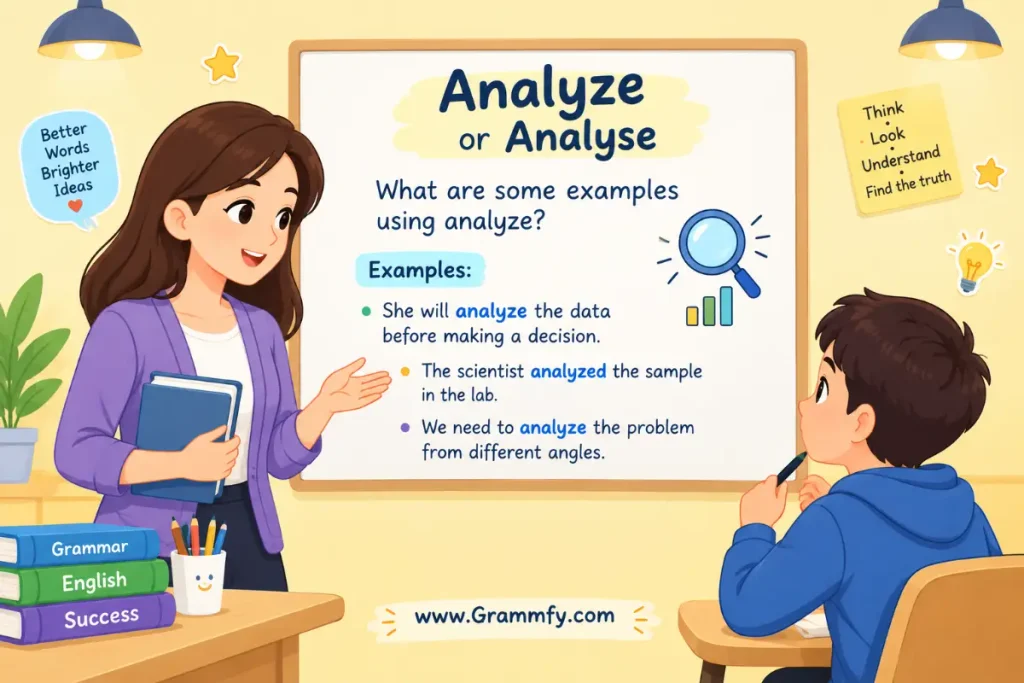
What are some examples using analyze?
Here are examples from different real-life situations.
School
“Students should analyze the main character’s decisions.”
Science
“Scientists analyze the samples to identify chemical changes.”
Business
“The marketing team analyzes customer behavior.”
Technology
“The software analyzes large amounts of data.”
Literature
“The class will analyze the poem’s central theme.”
News
“Experts analyzed the economic report.”
Sports
“Coaches analyze game footage before important matches.”
Personal decision-making
“I need time to analyze my options.”
Research
“The researchers analyzed the survey responses.”
Workplace
“Her job requires her to analyze financial reports.”
Problem-solving
“Let’s analyze the problem before deciding what to do.”
Social media
“The company analyzes engagement data to improve its content.”
Each example uses analyze naturally in American English. British English would generally use analyse in the same sentences.
What are examples using analyse?
The following sentences use the British spelling.
“The students will analyse the novel in class.”
“Researchers analyse data to identify patterns.”
“The manager analysed the report before the meeting.”
“She is analysing the results carefully.”
“The article analyses the causes of the problem.”
“Experts analysed the economic figures.”
“The team will analyse the evidence.”
“He analysed the situation before responding.”
The meaning remains identical to the American versions.
What are common mistakes with analyze and analyse?
The biggest mistake is usually mixing spelling conventions without realizing it.
Mistake 1: Using analyse in an American document
If your document follows American English, analyze is normally the preferred spelling.
For example:
“The researcher will analyze the data.”
is the standard American form.
Mistake 2: Using analyze in a British-style document
In British English, analyse is a common standard spelling.
A British-style document may therefore use:
“The researcher will analyse the data.”
Mistake 3: Changing the meaning
Some learners think the two spellings have different meanings.
They don’t.
The difference is regional spelling.
Mistake 4: Confusing analysis with analyze
These words are related but have different grammatical roles.
“We need to analyze the data.”
Here, analyze is a verb.
“We need an analysis of the data.”
Here, analysis is a noun.
Mistake 5: Confusing analyses with analyse
This is a common spelling trap.
Analyses can be the plural of analysis.
Example:
“The report contains several analyses.”
It can also be the British English third-person singular form of analyse.
Example:
“She analyses the data every week.”
Context tells you which meaning is intended.
When should you not use analyze?
Don’t use analyze when you simply mean “look at” in every situation.
For example:
“Analyze the picture and tell me what color it is.”
This can be correct if you want a detailed examination, but it may sound too formal for a simple task.
If you only want someone to look at something, look at or check may be better.
Similarly, use evaluate when you specifically mean judging quality or effectiveness.
Choose investigate when you mean searching for facts or causes.
Use interpret when the main task is explaining meaning.
Precise word choice makes writing clearer.
What are the antonyms of analyze?
There is no single perfect opposite of analyze, but several words can express the opposite idea depending on context.
Possible contrasts include:
- Ignore
- Overlook
- Neglect
- Guess
- Assume
- Accept without examination
- Skim
- Generalize
For example:
“Instead of analyzing the evidence, he simply guessed.”
Here, guessed contrasts with careful examination.
Another example:
“She ignored the warning signs.”
Ignoring something is very different from analyzing it.
What are the related words for analytical thinking?
If you’re discussing the skill rather than the action, several terms can help.
- Analytical
- Logical
- Critical
- Reasoned
- Evidence-based
- Systematic
- Detailed
- Observant
- Methodical
- Objective
For example:
“The position requires strong analytical thinking.”
Or:
“She uses a systematic approach to solve complex problems.”
These terms are useful in resumes, interviews, essays, and professional profiles.
How do you choose the right synonym?
Start by asking what you actually mean.
If you mean “look carefully”
Use examine.
“The doctor examined the patient.”
If you mean “study information”
Use analyze or analyse.
“The team analyzed the results.”
If you mean “judge quality”
Use evaluate.
“The committee evaluated the proposal.”
If you mean “judge a situation”
Use assess.
“The manager assessed the risks.”
If you mean “find facts”
Use investigate.
“The police investigated the incident.”
If you mean “explain meaning”
Use interpret.
“The student interpreted the poem.”
If you mean “look over something”
Use review.
“Please review the document.”
Choosing the exact verb prevents vague writing.
What are quick tips for remembering the spelling?
A simple memory trick is to connect analyze with American English and analyse with British English.
American English
Think:
Analyze = Z
American English often uses -ize.
Examples:
- Analyze
- Organize
- Realize
- Recognize
British English
Think:
Analyse = S
British English commonly uses -ise.
Examples:
- Analyse
- Organise
- Realise
- Recognise
This isn’t a rule for every word or every English-speaking region, but it is a useful guide for these common verbs.
Does Australian English use analyze or analyse?
Australian English commonly follows British-style spelling and generally uses analyse.
For example:
“Researchers analyse the results.”
However, English spelling conventions can vary by publication, organization, and style guide.
If you’re writing for an Australian school, employer, or publication, check its preferred style if you’re unsure.
Does Canadian English use analyze or analyse?
Canadian English can use both -ize and -ise spellings, depending on the word and style guide.
Analyze is widely used in Canadian English.
Because Canadian spelling has influences from both British and American English, it doesn’t always fit neatly into a simple US-versus-UK rule.
For formal Canadian writing, follow the style guide required by your school, employer, or publication.
Does Indian English use analyze or analyse?
Indian English commonly follows British spelling conventions, so analyse is widely used.
For example:
“Students should analyse the data carefully.”
Educational and professional writing in India may follow British-influenced spelling, although American English is also widely encountered online and in technology-related fields.
When writing for a specific institution, its style guide should take priority.
Does the pronunciation change?
Usually, no.
Analyze and analyse are pronounced the same way in standard English varieties.
The final -ze or -se spelling doesn’t normally create a different pronunciation.
This is why the distinction matters mostly in writing.
You can pronounce the word naturally without thinking about which spelling you’ll type later.
Why is consistency important?
Mixing spelling conventions can make a document look less polished.
Imagine an essay that uses:
“The author analyzes the poem.”
Later, it says:
“The writer organised the ideas.”
This combines American analyzes with British organised.
The reader can still understand it, but a consistent style is usually better.
A US document might use:
- Analyze
- Organize
- Realize
- Recognize
A British-style document might use:
- Analyse
- Organise
- Realise
- Recognise
Pick the appropriate style and stay consistent.
How does style matter in SEO writing?
SEO content should use the spelling expected by its target audience.
A website aimed mainly at US readers should generally use analyze.
A site targeting UK readers can use analyse.
Search engines can understand both forms, especially because they are recognized variants. Still, matching the audience’s natural spelling can improve readability and make the content feel more local.
For an international website, you can mention both forms when the spelling difference is itself the topic.
That approach helps readers understand why they may see both versions online.
Which spelling should students use?
Students should follow the English variety required by their school, teacher, or assignment.
If you’re studying American English:
“Analyze the author’s argument.”
If you’re studying British English:
“Analyse the author’s argument.”
Don’t change the spelling simply because one version looks more familiar.
The required style should determine the choice.
How can you avoid spelling mistakes?
A few habits make the choice easier.
- Check whether your audience uses US or UK English.
- Look at your school’s style guide.
- Follow your employer’s preferred spelling.
- Keep the same spelling throughout one document.
- Remember -ize for common American forms.
- Remember -ise for common British forms.
- Don’t confuse the verb with the noun analysis.
- Use a dictionary when a regional spelling is unclear.
Grammar and spell-check tools can also help, but they may follow a particular language setting. Make sure your word processor is set to the correct English variety.
Which form is better for a website?
Neither form is universally better.
The better choice depends on your audience.
| Audience | Recommended form |
|---|---|
| United States | Analyze |
| United Kingdom | Analyse |
| Australia | Analyse |
| India | Analyse is common |
| International | Follow your site’s main style |
| Canadian | Check your style guide |
A website should normally maintain one consistent spelling style.
If your site primarily serves US readers, analyze will feel natural. A UK-focused website will generally sound more natural with analyse.
Analyze or Analyse — what should you remember?
The key point is simple: both spellings are correct.
Use analyze for American English.
Use analyse for British English and other varieties that follow that spelling convention.
Both words mean to examine something carefully in order to understand it.
The related forms also follow regional patterns:
| American English | British English |
|---|---|
| analyze | analyse |
| analyzes | analyses |
| analyzed | analysed |
| analyzing | analysing |
| analysis | analysis |
| analyses | analyses |
Notice that analysis doesn’t change between the two varieties.
That can make the noun an easy word to remember.

Conclusion
The spelling choice is straightforward once you know which English variety you’re using. Analyze is the preferred American English form, while analyse is commonly used in British English and several other varieties. Neither spelling changes the meaning of the word. Both describe the process of examining information carefully to understand its parts, patterns, causes, or meaning.
For schoolwork, resumes, emails, and professional documents, follow the spelling style expected by your audience or organization. Keep related forms consistent, too, especially when using words such as analyzes, analyzed, analyzing, and their British equivalents. When you understand the regional rule, the choice becomes much easier. Pick the form that matches your audience, stay consistent throughout your writing, and you’ll avoid one of the most common spelling questions in English.
Frequently Asked Questions
Is analyze or analyse correct?
Both are correct spellings. Analyze is standard American English, while analyse is standard British English and common in several other varieties.
What is the difference between analyze and analyse?
The difference between Analyze or Analyse is spelling, not meaning. Both verbs mean to examine something carefully and understand its parts, patterns, or meaning.
Should I use analyze in American English?
Yes, analyze is the standard American English spelling. Use it in US-focused academic, professional, and general writing.
Should I use analyse in British English?
Yes, analyse is a common standard British English spelling. It is widely used in British academic, professional, and everyday writing.
What’s another word for analyze?
Common alternatives include examine, study, assess, evaluate, investigate, review, interpret, and scrutinize. The best option depends on exactly what kind of examination you mean.
Is analyse a spelling mistake in American English?
In standard American English, analyse is generally treated as a British spelling variant rather than the preferred American form. American writing normally uses analyze.
Does analyze mean the same as analysis?
No. Analyze is a verb, while analysis is a noun. For example, “We analyze the data” uses the verb, while “We wrote an analysis of the data” uses the noun.
