
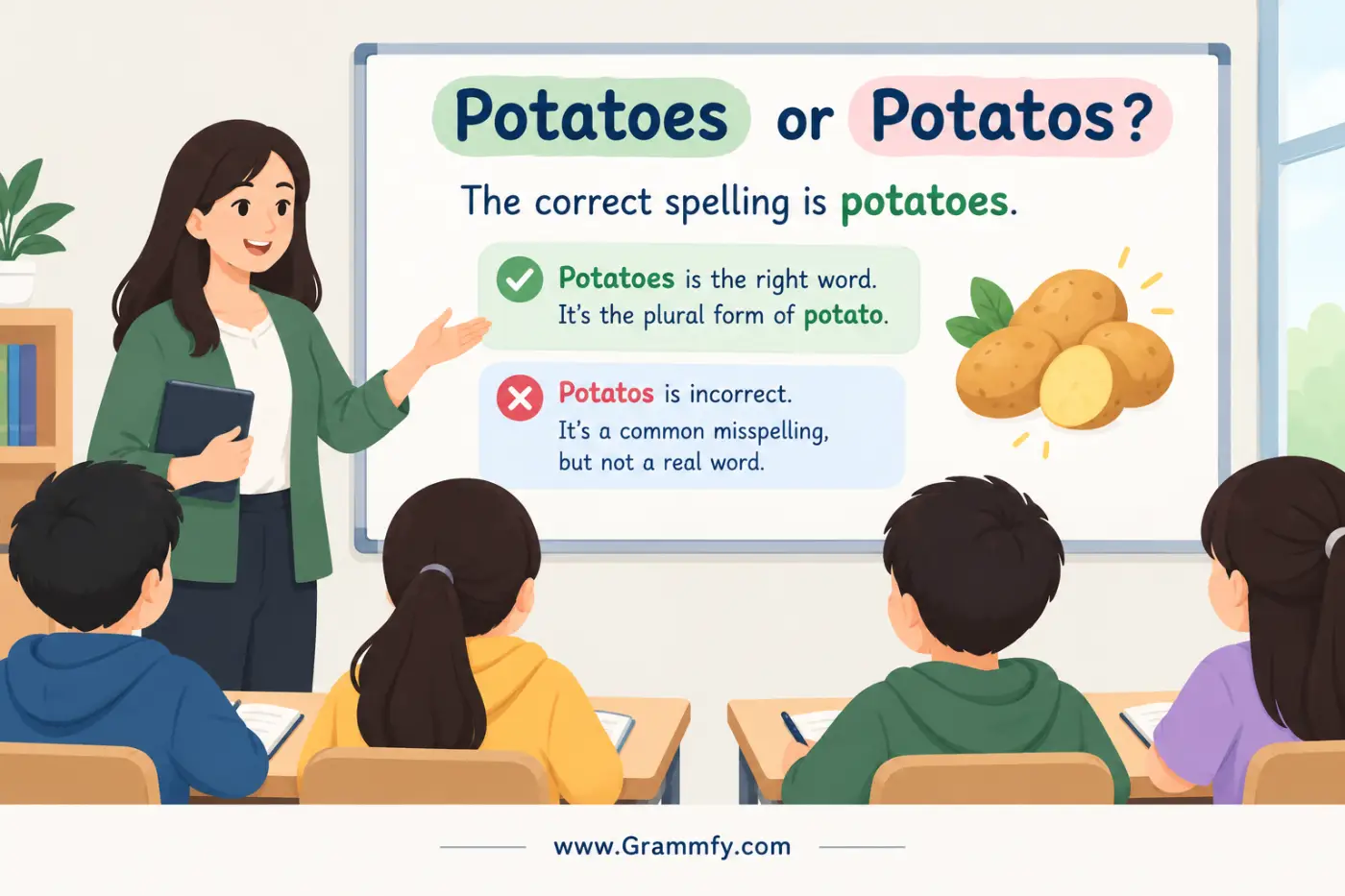
You’re typing a grocery list, school assignment, recipe, email, or text when you pause over one simple question: is it potatoes or potatos? The two spellings look almost identical, but only one is correct in standard English.
Answer: “Potatoes” is the correct plural spelling of “potato.” “Potatos” is a common misspelling and should not be used in standard writing.
The confusion makes sense because many English nouns form their plurals by simply adding -s. For example, tomato becomes tomatoes, but other words ending in -o can take only -s, which makes the rule feel inconsistent.
This guide explains why the correct plural is potatoes, where the word comes from, how its plural form developed, useful related words, regional differences, common mistakes, and examples for school, work, recipes, texting, and everyday conversation.
Another useful spelling guide is [shiny or shiney].
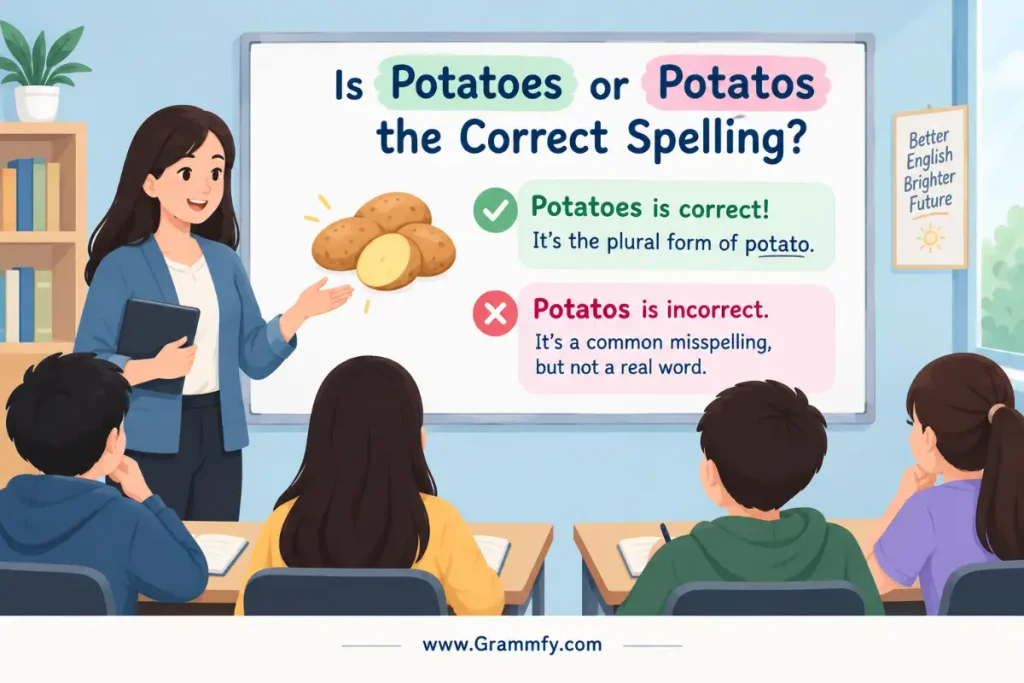
Is Potatoes or Potatos the correct spelling?
Potatoes is the correct standard plural spelling.
The singular form is:
potato
The plural form is:
potatoes
The spelling potatos is incorrect in standard English.
Here is the basic pattern:
| Singular | Correct plural |
|---|---|
| potato | potatoes |
| tomato | tomatoes |
| hero | heroes |
| echo | echoes |
Some nouns ending in -o, however, simply add -s:
| Singular | Plural |
|---|---|
| photo | photos |
| piano | pianos |
| radio | radios |
| video | videos |
That difference is one reason English plural spelling can be confusing.
Why do we add -es to potato?
The standard plural form developed as potatoes, not potatos.
The word ends in -o, and traditional English spelling uses -es in several common nouns ending in a consonant followed by o.
So:
potato + es = potatoes
The extra e isn’t optional in standard spelling.
What does potato mean?
A potato is an edible underground tuber that comes from a plant in the nightshade family.
Potatoes are widely eaten around the world. They can be:
- boiled
- baked
- roasted
- mashed
- fried
- grilled
- steamed
- sautéed
- stuffed
- turned into chips
- used in soups and stews
The word can refer to one potato or, depending on context, the plant and crop itself.
Singular vs. plural
Use potato when you’re talking about one.
I baked a potato for lunch.
Use potatoes when you’re talking about more than one.
I bought five potatoes.
The distinction is straightforward once the spelling is familiar.
Where did the word potato come from?
The English word potato has a fascinating history.
It ultimately comes from languages spoken in the Americas. The plant was cultivated in the Andes long before Europeans encountered it. Spanish speakers adopted a related word, and English later borrowed potato through Spanish usage.
The crop became increasingly important in Europe after its introduction from the Americas. Over time, potatoes became a major food in many countries.
The word’s history also explains why its spelling doesn’t follow a simple modern English pattern. English contains thousands of borrowed words whose spelling and plural forms developed over centuries.
Potato and its plural form
The modern spelling is:
- one potato
- two potatoes
- many potatoes
The plural ending -es has become part of the standard spelling.
You shouldn’t remove the final e simply because the singular ends in -o.
Why is potatos a common mistake?
The spelling potatos feels natural because English often forms plurals by adding -s.
Consider these words:
- book → books
- chair → chairs
- apple → apples
- banana → bananas
- photo → photos
- radio → radios
A writer may apply the same pattern to potato and produce potatos.
The problem is that standard English uses potatoes.
Another reason is pronunciation. In normal speech, the difference between the endings may not feel important. When you’re writing quickly, it’s easy to leave out the e.
The best way to avoid the mistake is to memorize the complete pair:
potato → potatoes
How do you remember the spelling of potatoes?
A useful memory trick is to connect potato with tomato.
Both words follow the same common plural pattern:
tomato → tomatoes
potato → potatoes
You can also remember the phrase:
One potato, two potatoes.
This familiar phrase appears in children’s counting games and makes the spelling easier to recall.
Another trick is to focus on the ending:
-to → -toes
So:
potato → potatoes
The word toes appears at the end of potatoes, which can help you remember the letters.
Potato plural spelling rules explained simply
English plural rules have patterns, but they aren’t completely consistent.
Most regular nouns
Many nouns simply add -s:
- apple → apples
- car → cars
- book → books
- table → tables
Some nouns ending in -o
Several common words use -es:
- potato → potatoes
- tomato → tomatoes
- hero → heroes
- echo → echoes
Other -o words use -s
Some words take only -s:
- photo → photos
- piano → pianos
- radio → radios
- video → videos
Because both patterns exist, it’s better not to rely on one universal rule. Learn common words as complete singular-plural pairs.
What are some synonyms or related words for potato?
A potato doesn’t have many perfect synonyms because it names a specific plant and food. However, depending on context, you can use related terms and descriptive expressions.
The following table gives useful vocabulary associated with potatoes.
| Word | Meaning | Tone | Example |
|---|---|---|---|
| Tuber | Swollen underground plant stem used as food | Formal | The potato is an edible tuber. |
| Spud | Informal word for potato | Casual | He baked a spud for dinner. |
| Tater | Informal American word for potato | Casual | The kids wanted tater tots. |
| Crop | Plants grown for food or sale | Formal | Potato is an important crop. |
| Produce | Farm-grown food | Everyday | The store has fresh produce. |
| Starch | Carbohydrate-rich food component | Technical | Potato is a starchy food. |
| Spud | Informal potato | Slang/Casual | Toss the spuds into the oven. |
| Tater | Informal potato | Slang/Casual | The recipe calls for three taters. |
| Potato tuber | Underground edible part | Scientific | The potato tuber stores nutrients. |
| Fresh potato | Recently harvested potato | Everyday | The recipe uses fresh potatoes. |
| New potato | Young potato harvested early | Culinary | New potatoes taste great roasted. |
| Russet | A common potato variety | Culinary | Russets are excellent for baking. |
| Yukon Gold | A yellow-fleshed potato variety | Culinary | Yukon Gold potatoes work well in mash. |
| Red potato | Potato with red skin | Culinary | Red potatoes are good for roasting. |
| Fingerling | Small, narrow potato variety | Culinary | Fingerling potatoes roast quickly. |
| Mash | Mashed potato dish or preparation | Culinary | The mash was creamy and smooth. |
| Fries | Potato strips cooked in oil | Casual | We ordered fries with lunch. |
| Chips | Thin fried potato slices in US usage | Everyday | She opened a bag of potato chips. |
| Crisps | Thin fried potato slices in UK usage | Everyday/UK | He bought a packet of crisps. |
| Tater tots | Small grated potato pieces shaped into cylinders | Casual/US | The children love tater tots. |
| Baked potato | Whole potato cooked in an oven | Everyday | I had a baked potato for lunch. |
Simple potato-related words
For basic conversation, these are easy choices:
- potato
- vegetable
- spud
- tater
- tuber
- crop
- fries
- wedges
- chips
- mash
The best option depends on what you actually mean.
Everyday potato vocabulary
Common cooking terms include:
- mashed potatoes
- baked potato
- roasted potatoes
- boiled potatoes
- fried potatoes
- potato salad
- potato soup
- potato wedges
- hash browns
- potato chips
These terms are especially useful in recipes and food writing.
Formal or technical terms
Scientific and agricultural writing may use:
- tuber
- potato crop
- potato plant
- edible tuber
- starch-rich tuber
- cultivated crop
- potato variety
A biology textbook, for example, may call the potato an edible tuber rather than simply a vegetable.
Slang and casual terms
In informal American English, you may hear:
- spud
- tater
- taters
Examples:
Grab some spuds from the kitchen.
We’re having taters with dinner.
These forms are casual and shouldn’t replace potatoes in formal writing.
What are potato words by intensity?
Unlike adjectives such as happy or angry, potato-related nouns don’t have a natural mild-to-strong scale. However, descriptions can vary from general to highly specific.
General
- vegetable
- produce
- potato
- crop
More specific
- tuber
- potato variety
- new potato
- red potato
- russet
- fingerling
Dish-specific
- mashed potatoes
- potato wedges
- fries
- hash browns
- potato salad
- baked potato
Choosing a specific term gives your reader more information.
Compare:
We ate potatoes.
with:
We ate roasted fingerling potatoes.
The second sentence tells the reader exactly what kind of potatoes and how they were prepared.
Potato-related words by part of speech
The word potato itself is mainly a noun. Other related forms can appear in different grammatical roles.
Nouns
- potato
- potatoes
- tuber
- crop
- spud
- tater
- starch
- fries
- mash
Examples:
The potatoes are ready.
The tubers were harvested.
Adjectives and compound modifiers
English commonly uses potato as part of a compound noun or modifier:
- potato salad
- potato soup
- potato chips
- potato skin
- potato plant
- potato crop
- potato farmer
- potato field
- potato starch
Examples:
She made potato soup.
The farmer inspected the potato crop.
Verbs
There isn’t a common standard verb meaning “to potato” in ordinary English. Instead, cooking verbs describe what happens to the food:
- bake
- boil
- roast
- fry
- mash
- peel
- chop
- slice
- dice
- steam
These words make food writing more precise.
Are potatoes vegetables?
In everyday cooking and nutrition discussions, potatoes are commonly treated as vegetables.
Botanically, however, the potato is a tuber, which is a modified underground stem of the plant.
This difference matters because food categories and botanical categories don’t always match.
For example, people commonly call tomatoes vegetables in cooking, even though botanically they are fruits.
So if you’re writing a casual recipe, vegetable is a normal term. In scientific writing, tuber is more precise.
Potatoes or Potatos: Which form should you use in school?
Always use potatoes in school assignments.
Correct:
Potatoes are one of the world’s important food crops.
Incorrect:
Potatos are one of the world’s important food crops.
Teachers may mark potatos as a spelling error because it isn’t the standard plural.
Academic writing rewards accuracy, so don’t rely on spell-check alone. Learning common irregular or less predictable plural forms will help you avoid similar errors.
Which spelling is best in a resume “Potatoes or Potatos”?
A resume usually won’t need the word potatoes unless you’re applying for work related to food, farming, restaurants, agriculture, or food production.
If you do need it, use potatoes.
For example:
Managed inventory of fresh potatoes and other produce.
A more professional resume may also use specific terms:
Coordinated daily inventory for potato and produce shipments.
The second version focuses on the work rather than the food itself.
Which word should you use in an essay Potatoes or Potatos?
Use potatoes when you mean more than one potato.
For example:
Potatoes became an important food crop in many parts of the world.
Academic writing can also use more specific terms when necessary:
The potato crop played an important role in regional agriculture.
If the essay is about biology, tuber may be more accurate:
Each potato tuber stores nutrients that support the plant’s growth.
Which spelling should you use in texting Potatoes or Potatos?
Use potatoes even in casual texts.
For example:
Can you buy some potatoes on your way home?
Texting often contains abbreviations and informal spellings, but potatos is still an incorrect standard spelling.
If you’re joking around, you might use playful forms such as taters, but that’s a style choice rather than the standard plural.
Which word should you use in an email Potatoes or Potatos?
Use potatoes in professional and personal emails.
For example:
Could you please add five bags of potatoes to the order?
For business communication, accuracy matters even when the subject is simple.
If you’re discussing agricultural products, you may need more specific terms such as:
- potato crop
- potato shipment
- potato inventory
- potato varieties
- fresh potatoes
- processed potatoes
Which word should you use when speaking Potatoes or Potatos?
When speaking, say potatoes when referring to more than one potato.
For example:
I bought some potatoes.
Casual speech may include spuds or taters, but potatoes is the neutral choice.
The standard word works in almost every situation, so there’s usually no reason to replace it unless you’re intentionally using a casual expression.
US vs. UK spelling: Is there a difference?
The spelling potatoes is standard in both American and British English.
Unlike some words that have different US and UK spellings, this plural form doesn’t change.
| Meaning | US English | UK English |
|---|---|---|
| Plural of potato | potatoes | potatoes |
| Fried potato strips | fries | chips |
| Thin fried potato slices | potato chips | crisps |
| Informal potato | spud | spud |
The biggest regional difference is often vocabulary surrounding potato dishes.
Fries vs. chips
In American English:
We ordered French fries.
In British English:
We ordered chips.
Chips vs. crisps
In American English:
I bought a bag of potato chips.
In British English:
I bought a packet of crisps.
The spelling potatoes remains the same in both varieties.
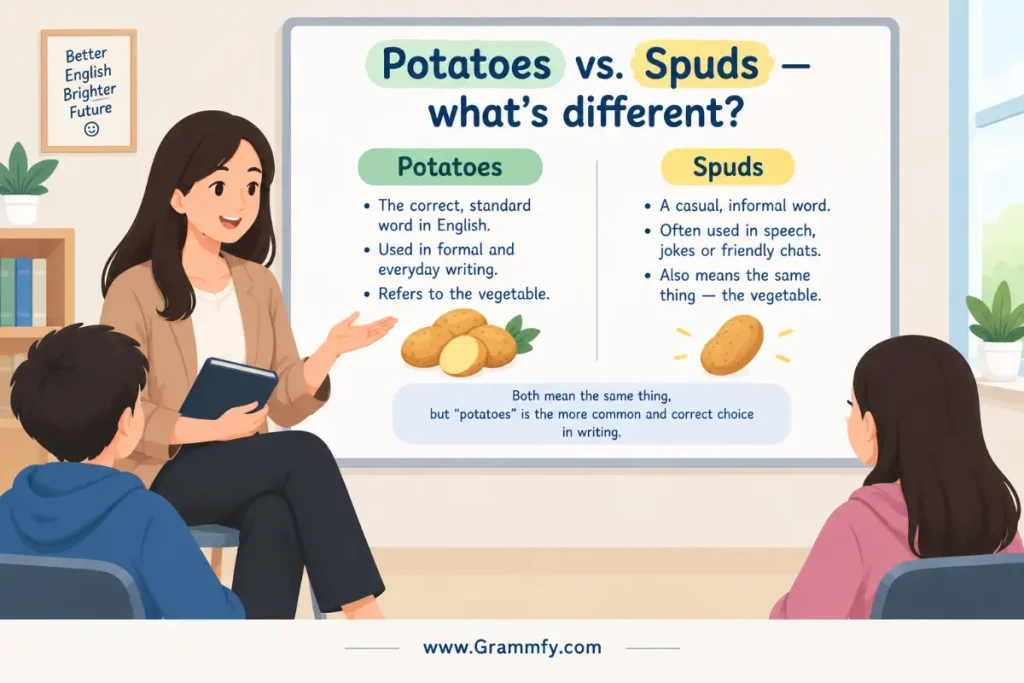
Potatoes vs. spuds — what’s different?
Potatoes is the standard neutral term. Spuds is an informal alternative.
| Potatoes | Spuds |
|---|---|
| Standard English | Informal English |
| Suitable for formal writing | Better for casual speech |
| Neutral tone | Friendly or playful tone |
| Used in school and business | Common in informal conversation |
Compare:
The restaurant ordered 50 kilograms of potatoes.
This sounds professional.
The restaurant ordered 50 kilos of spuds.
This sounds casual.
Both can refer to the same food, but they create different tones.
Potatoes vs. taters — what’s different?
Taters is another informal term, especially familiar in American English.
We’re having potatoes for dinner.
sounds neutral.
We’re having taters for dinner.
sounds casual and playful.
You may also see tater tots, which is the name of a particular potato-based food.
Using taters in a school essay would usually be unnecessary. Potatoes is the safer choice.
Potatoes vs. tubers — what’s different?
These words aren’t exact synonyms.
Potatoes refers specifically to the edible crop.
Tubers describes a broader biological structure found in certain plants.
For example:
Potatoes are edible tubers.
This sentence shows the relationship clearly.
Every potato is a tuber, but not every tuber is a potato.
The word tuber is therefore more scientific and broader in meaning.
Potatoes vs. sweet potatoes — what’s different?
Despite sharing the word potato, sweet potatoes belong to a different plant family from ordinary potatoes.
When a recipe calls for:
potatoes
it normally means regular potatoes unless the recipe specifically says:
sweet potatoes
The two foods differ in taste, color, texture, and botanical classification.
Examples:
The recipe uses white potatoes.
The dessert uses sweet potatoes.
Being specific helps prevent confusion.
20+ Original example sentences with potatoes
- I bought six potatoes for dinner.
- The farmer harvested the potatoes in late autumn.
- She peeled the potatoes before boiling them.
- We roasted the potatoes with garlic and herbs.
- The recipe calls for three medium potatoes.
- He planted potatoes in the garden.
- Fresh potatoes can be stored in a cool, dark place.
- The children helped wash the potatoes.
- Mashed potatoes are a popular side dish.
- She added chopped potatoes to the soup.
- The restaurant serves crispy potatoes with breakfast.
- We need more potatoes for the family dinner.
- The potato crop was damaged by bad weather.
- He sliced the potatoes into thin pieces.
- The chef used small potatoes for the roasted dish.
- Potato farmers often monitor soil conditions carefully.
- The bag of potatoes was heavier than I expected.
- She made a warm potato salad for the picnic.
- The potatoes became soft after twenty minutes of boiling.
- We stored the potatoes in a cool cupboard.
- The recipe works well with red potatoes.
- He added baked potatoes to the dinner menu.
- The market sells several varieties of potatoes.
- They served potato wedges with the sandwiches.
Common mistakes with “Potatoes or Potatos”
Several errors appear when people use this word.
Mistake 1: Writing potatos
Incorrect:
I bought three potatos.
Correct:
I bought three potatoes.
The plural requires -es.
Mistake 2: Using potato for multiple items
Incorrect:
I bought five potato.
Correct:
I bought five potatoes.
The noun needs its plural form because the number is greater than one.
Mistake 3: Adding an unnecessary apostrophe
Incorrect:
I bought potato’s.
Correct:
I bought potatoes.
An apostrophe does not normally create a plural.
Mistake 4: Confusing potatoes with potato’s
Potato’s is possessive, not plural.
For example:
The potato’s skin was damaged.
This means the skin belonging to one potato.
By contrast:
The potatoes were washed.
This means more than one potato.
Mistake 5: Using potatoes when referring to one
Incorrect:
I baked potatoes for one meal.
This sentence can be grammatically correct if more than one potato was baked, but if you mean exactly one, use:
I baked a potato for one meal.
The number and noun form should agree.
When should you not use the word potatoes?
The word potatoes is useful, but it isn’t always the most precise option.
Use a variety name when possible
Instead of:
The recipe needs potatoes.
You might write:
The recipe needs Yukon Gold potatoes.
The second version tells the reader exactly which type is preferred.
Use a cooking term for a prepared dish
Instead of:
We ate potatoes.
You could say:
We ate mashed potatoes.
or:
We ate roasted potato wedges.
The specific term gives more information.
Use tuber in scientific writing
A biology paper may benefit from:
The potato tuber stores nutrients.
rather than simply:
The potato stores nutrients.
Both can be understandable, but the first is more precise.
What are the antonyms of potato?
A food noun doesn’t have true antonyms in the same way that adjectives do.
You wouldn’t normally have a direct opposite of potato.
However, depending on the sentence, you might contrast potatoes with:
- meat
- fruit
- grains
- legumes
- leafy vegetables
- other crops
For example:
The meal contains potatoes rather than rice.
This is a contrast, not an antonym.
The distinction is important because not every different word is an opposite.
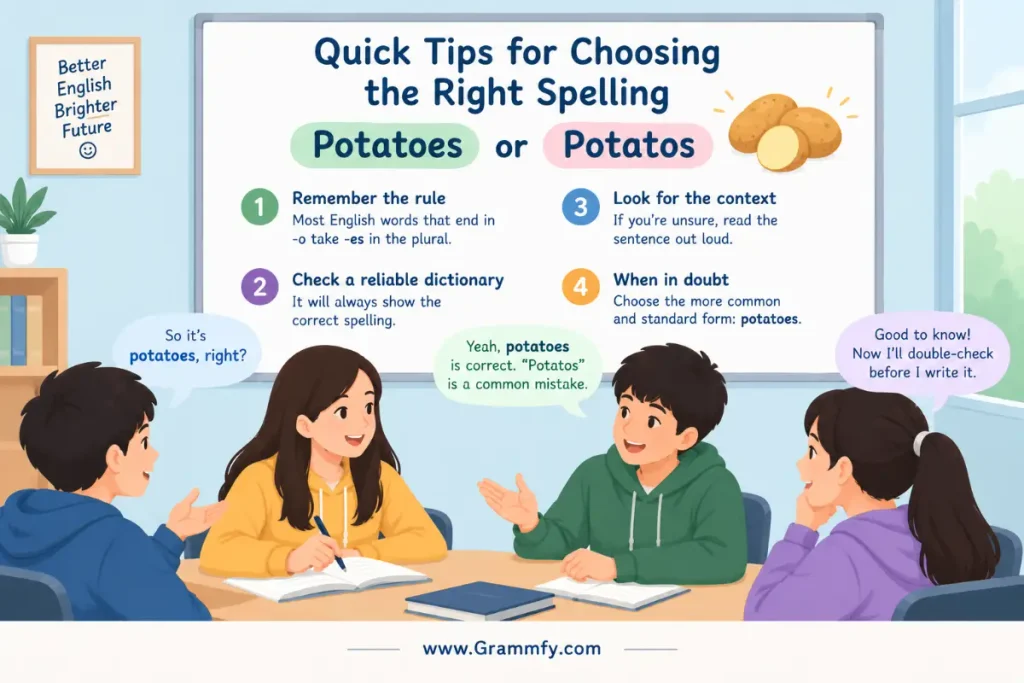
Quick tips for choosing the right spelling
Remember the singular
Start with:
potato
Then add the standard plural ending:
potatoes
Think of tomato
The pair tomato → tomatoes can remind you of potato → potatoes.
Remember “one potato, two potatoes”
This familiar phrase is one of the easiest memory aids.
Don’t add an apostrophe
Plural:
potatoes
Possessive:
potato’s
Those forms have different meanings.
Watch for the missing e
If you write potatos, stop and check the ending.
The correct form contains:
-oes
So:
potatoes
Learn common -o plurals individually
English has both patterns:
- potato → potatoes
- photo → photos
- tomato → tomatoes
- piano → pianos
There’s no single shortcut that works perfectly for every noun ending in -o.
A quick potato spelling checklist
Before publishing or submitting your writing, check:
- Is the singular form potato?
- Am I talking about more than one?
- If yes, did I write potatoes?
- Did I accidentally write potatos?
- Did I add an unnecessary apostrophe?
- Am I using a more specific word if the context requires one?
- Is my writing formal enough for the audience?
- Have I used the correct regional food terms?
- Does the sentence clearly show whether I mean one or more than one?
- Have I checked other words ending in -o separately rather than assuming they follow the same rule?
What should you remember about potatoes?
The most important point is simple: potatoes is the standard plural of potato.
The spelling potatos leaves out the e and is considered incorrect in standard English. Although the plural rule can feel confusing because some words ending in -o take only -s, common words such as potato and tomato use -es.
Knowing the difference helps in everything from school assignments to recipes and professional writing. You can also choose more specific words such as russets, fingerlings, spuds, or tubers when the context calls for them. For neutral writing, though, potatoes is the reliable choice.
Conclusion
When deciding between potatoes or potatos, choose potatoes every time in standard English. The plural form keeps the e before the final s, giving us potatoes. Although English has many nouns ending in -o that simply take -s, common words such as potato and tomato use -es. A simple way to remember the spelling is to connect potato with tomato or repeat the familiar phrase “one potato, two potatoes.” For casual speech, terms like spuds or taters can add personality, while tuber works better in scientific contexts. Once the spelling becomes familiar, this small grammar question becomes much easier to handle confidently.
Frequently Asked Questions
Is potatoes or potatos correct?
Potatoes is correct, while potatos is a common spelling mistake.
Why is the plural of potato potatoes?
The standard English plural adds -es, producing potatoes rather than potatos.
How do you spell the plural of potato?
The plural is spelled potatoes, with an e before the final s.
What’s another way to say potatoes?
Informal alternatives include spuds and taters, while tubers is a broader scientific term.
Are potatoes and tubers the same thing?
A potato is a type of edible tuber, but tuber is a broader biological term that applies to other plants as well.
Is potatoes spelled differently in British English?
No. Potatoes is the standard spelling in both American and British English.
Can I write potatos in a text message?
You can encounter informal misspellings in texts, but potatoes is still the correct spelling and is the best choice for clear writing.
