
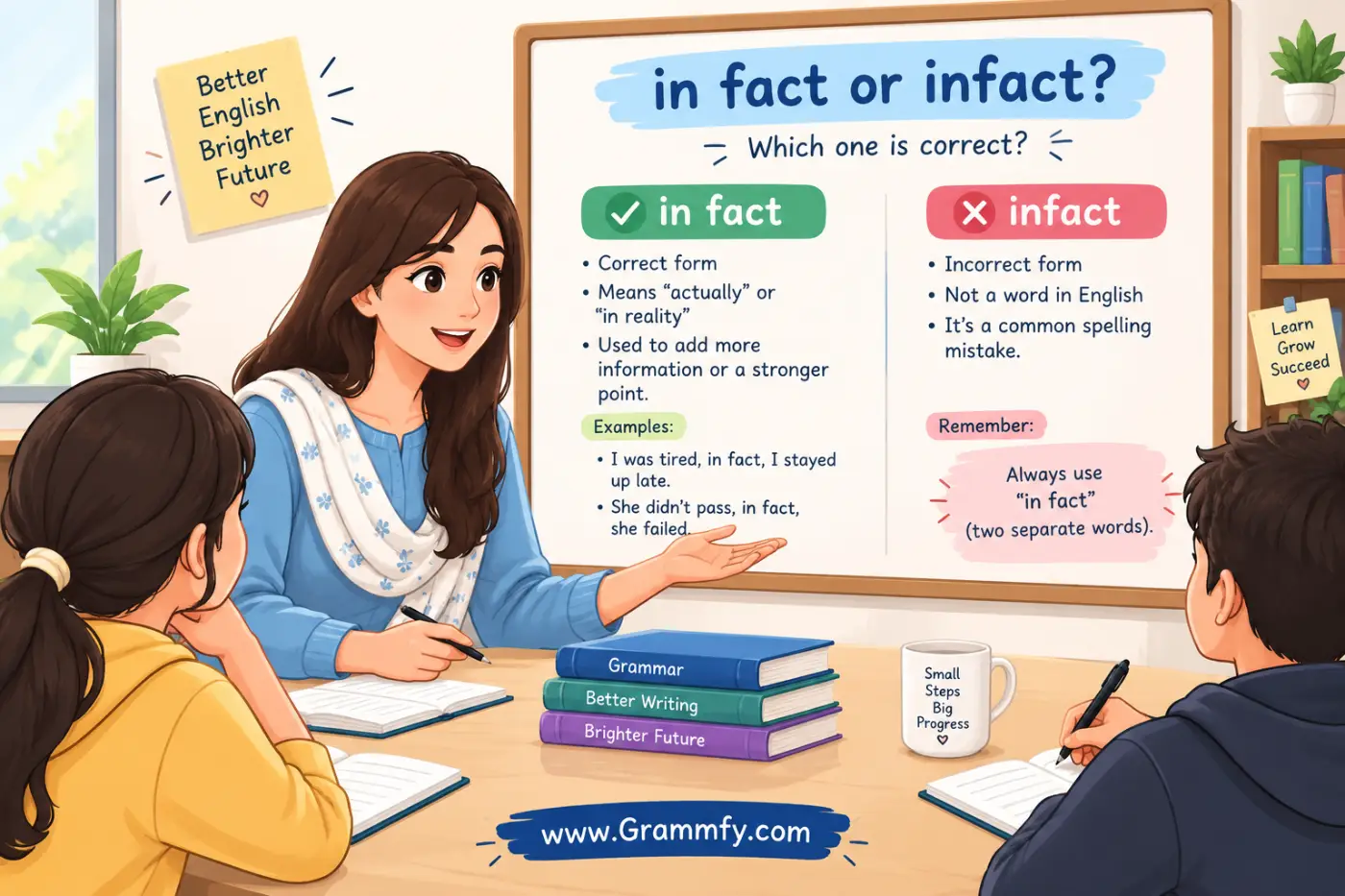
You’re writing an email, essay, resume, or text and suddenly pause over a small spelling question: should you write In fact or Infact? Both forms may look familiar, but only one is standard English.
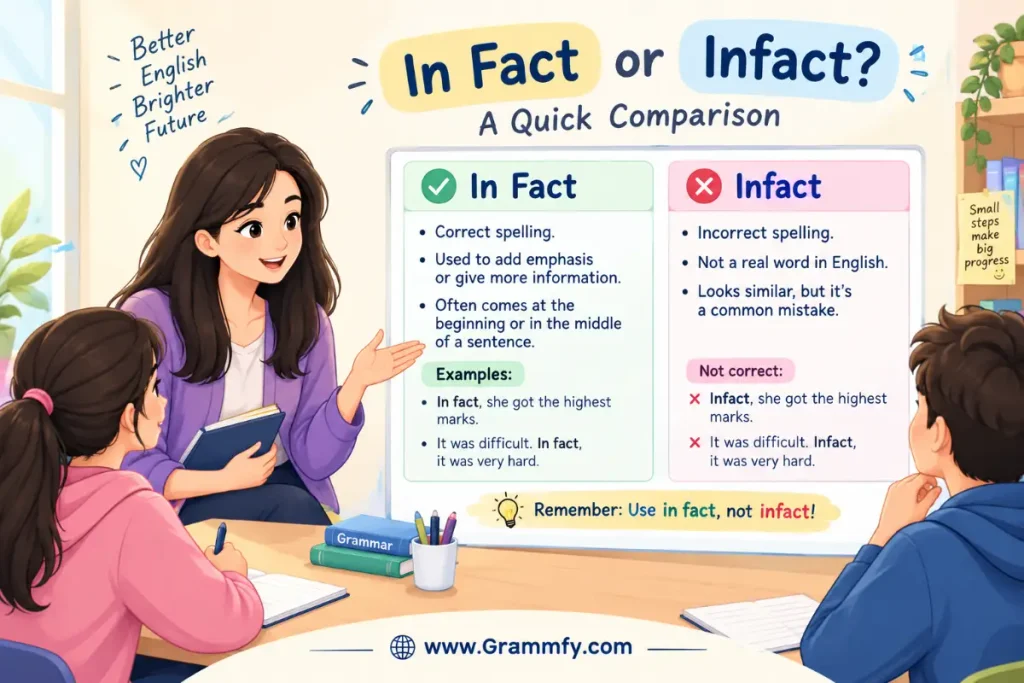
Answer: “In fact” is the correct form. It is always written as two separate words. “Infact” is a common spelling mistake and should be avoided in standard writing.
The phrase in fact is used to emphasize that something is true, correct, or supported by real information. It can also introduce a fact that strengthens, corrects, or adds detail to something just mentioned.
Knowing how to use this phrase well can make your writing clearer and more natural. This guide covers its meaning, origin, grammar, synonyms, punctuation, examples, formal and informal uses, common mistakes, and better alternatives for different situations.
Another useful spelling guide is [potatoes or potatos].
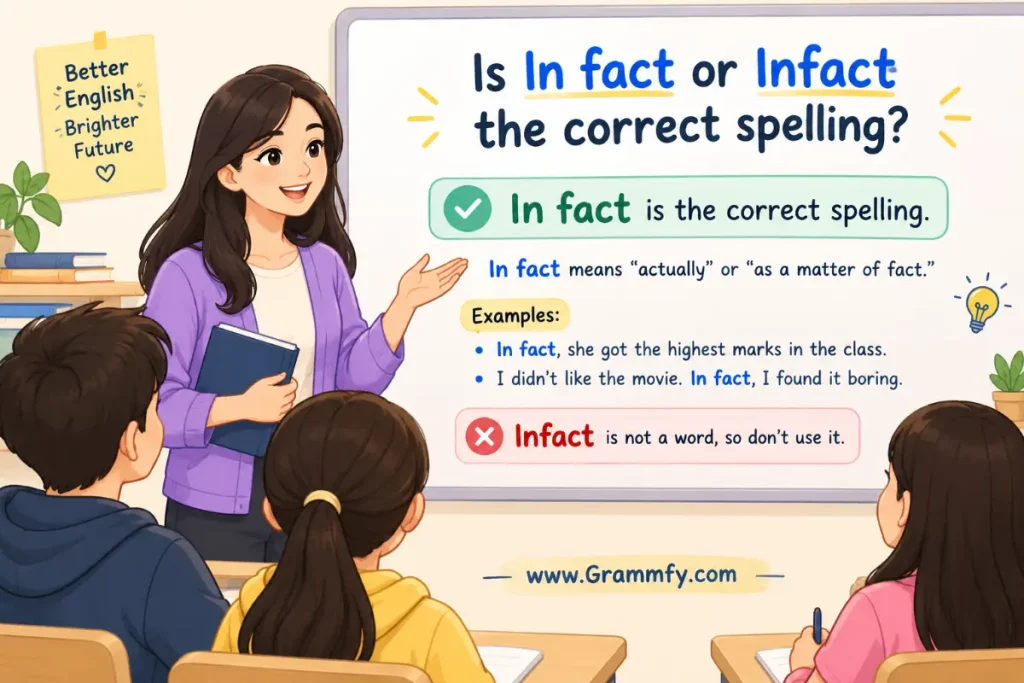
Is In fact or Infact the correct spelling?
In fact is the correct spelling.
The phrase contains two separate words:
in + fact = in fact
The form infact is not standard English.
Here are some examples:
- In fact, I already finished the assignment.
- She wasn’t tired. In fact, she wanted to keep working.
- The plan sounds difficult, but in fact, it’s quite simple.
- He said he was busy. In fact, he had already left.
Notice that in and fact remain separate every time.
Why do people write infact?
The mistake usually happens because in fact is pronounced as a connected phrase in normal speech.
When people speak quickly, the words can sound almost like one unit. That makes it tempting to write infact as one word.
English has many expressions that sound connected when spoken but remain separate in writing. The same issue appears with phrases such as:
- a lot
- at least
- each other
- of course
- in spite
- as well
Learning the written form is the best way to avoid the mistake.
What does in fact mean?
In fact is an adverbial phrase that means something like:
- actually
- really
- truthfully
- as a matter of fact
- to tell the truth
- indeed
- in reality
It is commonly used to emphasize a statement or provide information that confirms or corrects an earlier idea.
For example:
I thought the test would be difficult. In fact, it was quite easy.
The phrase tells the reader that the second statement is important and true.
Another example:
She isn’t new to the company. In fact, she’s worked here for ten years.
Here, in fact introduces information that makes the previous statement clearer.
What is the plain-English meaning of in fact?
In simple English, in fact means “actually” or “the truth is.”
Consider this example:
He looks young, but in fact, he’s 35.
You could replace in fact with actually:
He looks young, but actually, he’s 35.
The meaning remains similar.
Another example:
I thought Sarah was from Canada. In fact, she’s from the United States.
The phrase signals that the writer is giving the real or correct information.
Where did the phrase in fact come from?
The expression combines two ordinary English words: in and fact.
The noun fact comes through Old French from Latin factum, meaning something done or something that has happened. Over time, English speakers used fact for something known or accepted as true.
The preposition in has an even older history and developed from Germanic roots.
Together, in fact became an established English expression used to introduce or emphasize information that is true.
Its meaning has remained closely connected to the idea of reality and truth.
Why isn’t infact a word?
English does create many compound words over time, but not every frequently used phrase becomes one word.
The expression in fact developed as a phrase, not as a single compound word.
Therefore, standard English keeps the words separate:
in fact
rather than:
infact
This is similar to other common phrases that contain separate words even when they are frequently used together.
Is in fact one word or two words?
In fact is always written as two words in standard English.
The first word is the preposition in.
The second word is the noun fact.
Together, they form an adverbial phrase.
| Form | Correct? | Example |
|---|---|---|
| in fact | Yes | In fact, I agree with you. |
| infact | No | Infact, I agree with you. |
| In Fact | Usually unnecessary capitalization | In Fact, I agree with you. |
| IN FACT | Correct when used for emphasis | IN FACT, I agree. |
Normal sentences should use lowercase:
In fact, the answer is quite simple.
How is in fact used in a sentence?
The phrase has several common uses.
To emphasize a fact
The movie was in fact better than I expected.
The phrase adds emphasis to the statement.
To correct an assumption
I thought he was angry. In fact, he was just tired.
The second statement corrects the first impression.
To add supporting information
The restaurant is popular. In fact, it won an award last year.
The second sentence provides evidence that supports the first.
To strengthen a statement
She is a talented writer. In fact, she has published three books.
Should you use a comma after in fact?
Often, yes, especially when in fact appears at the beginning of a sentence or is used as an interrupting phrase.
For example:
In fact, I already knew the answer.
The comma helps separate the introductory phrase from the main statement.
When in fact appears in the middle of a sentence, commas are often used around it when it functions as an interrupting expression:
The answer is, in fact, quite simple.
At the end of a sentence, punctuation depends on its role:
She was telling the truth, in fact.
In many cases, the phrase can be moved or rewritten to make the sentence smoother.
Do you always need commas?
Not necessarily.
When in fact is closely integrated into a sentence, punctuation can vary depending on style and sentence structure.
For example:
The results in fact support our original conclusion.
This is grammatically possible, although many writers would use commas for readability:
The results, in fact, support our original conclusion.
When you’re writing for school or professional purposes, punctuation should help the reader understand the phrase’s role.
In fact vs actually — what’s the difference?
In fact and actually are close in meaning, but they don’t always sound the same.
| In fact | Actually |
|---|---|
| Often emphasizes a fact | Often corrects or contrasts an idea |
| Can introduce supporting information | Common in conversation |
| Can sound slightly more formal | Often sounds natural and conversational |
| Frequently works at the start of a sentence | Can appear in many positions |
Compare:
I thought the store was closed. In fact, it was still open.
I thought the store was closed. Actually, it was still open.
Both work.
However, actually is often more natural in casual speech, while in fact can give writing a more deliberate tone.
In fact vs indeed — what’s the difference?
Indeed and in fact can overlap, but indeed often sounds more formal or literary.
| In fact | Indeed |
|---|---|
| Common in everyday writing | More formal |
| Means actually or in reality | Can mean certainly or truly |
| Often introduces evidence | Can strongly confirm a statement |
| Natural in conversation | More common in formal prose |
Example:
The task was difficult. In fact, it took three hours.
You could write:
The task was difficult. Indeed, it took three hours.
The second version sounds more formal.
For most everyday writing, in fact is easier and more natural.
In fact vs as a matter of fact — what’s the difference?
Both expressions can emphasize truth.
In fact is shorter and more flexible.
In fact, I agree with you.
As a matter of fact is longer and can sound more conversational or emphatic.
As a matter of fact, I agree with you.
The longer expression can sometimes sound defensive or overly emphatic depending on the context.
For clean, direct writing, in fact is usually the better choice.
In fact vs actually in formal writing
Both can appear in formal writing, but context matters.
Consider:
The results were surprising. Actually, they were much better than expected.
This is correct, but actually can sometimes sound conversational.
A more formal alternative is:
The results were surprising. In fact, they were much better than expected.
Neither is automatically wrong. The choice depends on the tone you want.
What are the best synonyms for in fact?
There isn’t one perfect replacement for every sentence. Different alternatives create different tones.
| Word or phrase | Meaning | Tone | Example |
|---|---|---|---|
| Actually | In reality | Everyday | Actually, I agree. |
| Indeed | Truly; certainly | Formal | Indeed, the results were impressive. |
| Really | Truly | Casual | It really was difficult. |
| In reality | In the real situation | Neutral/Formal | In reality, the process takes longer. |
| As a matter of fact | Emphatically true | Conversational | As a matter of fact, I was there. |
| Truly | Genuinely | Formal | She truly understood the issue. |
| Certainly | Without doubt | Formal | The plan certainly has value. |
| Clearly | In an obvious way | Neutral | Clearly, the evidence supports this. |
| In truth | In reality | Formal/Literary | In truth, the decision was difficult. |
| To tell the truth | Honestly | Conversational | To tell the truth, I was nervous. |
| Truthfully | Honestly | Neutral | Truthfully, I didn’t expect that. |
| Really and truly | Genuinely | Casual | She really and truly helped me. |
| In reality | As things actually are | Formal | In reality, the problem was smaller. |
| In actuality | In reality | Formal | In actuality, the process is simpler. |
| As it happens | As the situation turns out | Neutral | As it happens, I know her. |
| In point of fact | In reality | Very formal | In point of fact, the records disagree. |
| To be precise | More exactly | Formal | To be precise, the meeting starts at nine. |
| Specifically | In exact terms | Formal | Specifically, the rule applies here. |
| Frankly | Honestly | Direct | Frankly, the plan needs work. |
| Honestly | Truthfully | Everyday | Honestly, I expected more. |
| Certainly | Definitely | Formal | The policy certainly applies. |
| Undeniably | Impossible to deny | Strong/Formal | The evidence is undeniably important. |
| Veritably | Truly | Literary | The room was veritably transformed. |
| In truth | Truthfully | Literary | In truth, he had no choice. |
| As the facts show | Based on evidence | Formal | As the facts show, the policy worked. |
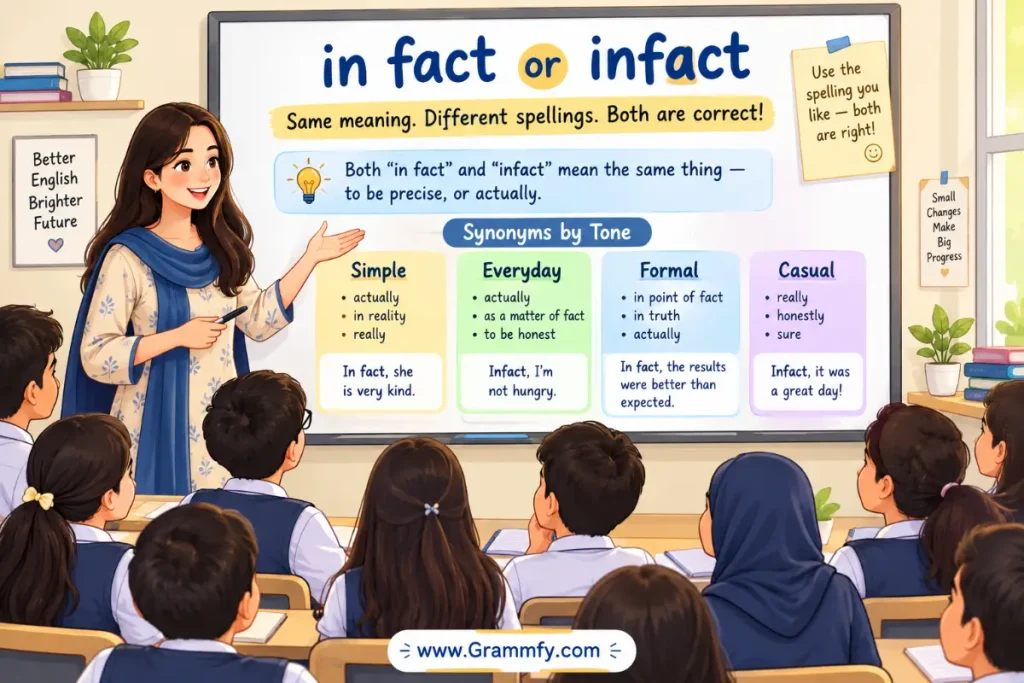
Synonyms by tone: simple, everyday, formal, and casual
Different situations call for different alternatives.
Simple alternatives
Use these when you want easy, clear English:
- actually
- really
- clearly
- truly
- in reality
Example:
Actually, I don’t need any help.
Everyday alternatives
These sound natural in normal conversation and writing:
- actually
- really
- honestly
- as a matter of fact
- to tell the truth
Example:
Honestly, I wasn’t expecting that result.
Formal alternatives
Academic and professional writing may use:
- indeed
- in reality
- in actuality
- in truth
- certainly
- specifically
- as the facts show
Example:
Indeed, the evidence supports the original conclusion.
Casual alternatives
Informal speech may use:
- actually
- really
- honestly
- seriously
- to be honest
Example:
Seriously, I thought you already knew.
These aren’t exact replacements in every context, but they can communicate a similar idea.
Synonyms by intensity: mild to strong
The phrase in fact can be neutral or emphatic depending on the sentence.
Mild emphasis
These alternatives usually add a small amount of emphasis:
- actually
- really
- in reality
- indeed
Example:
The test was actually easier than expected.
Medium emphasis
These can make the truth feel more noticeable:
- as a matter of fact
- truly
- certainly
- in truth
Example:
As a matter of fact, we had already discussed this issue.
Strong emphasis
These expressions can sound forceful:
- undeniably
- without a doubt
- unquestionably
- beyond doubt
- the facts show
Example:
The evidence undeniably supports the conclusion.
Strong wording should be used carefully. Don’t describe something as undeniable unless the evidence really supports that level of certainty.
What part of speech is in fact?
In fact is an adverbial phrase.
It doesn’t function as a single noun or verb. Instead, it modifies a statement by adding information about its truth, reality, or emphasis.
For example:
In fact, the report was finished yesterday.
The phrase comments on the statement that follows.
You can also place it inside a sentence:
The report was, in fact, finished yesterday.
Here, it works as an interrupting adverbial phrase.
Is in fact formal or informal?
In fact is neutral and can work in both formal and informal writing.
It is suitable for:
- school essays
- emails
- reports
- articles
- presentations
- conversations
- text messages
- business writing
The surrounding sentence determines how formal the overall expression sounds.
Formal example
The findings were significant. In fact, they changed the direction of the study.
Casual example
I thought you were busy. In fact, you’re already done!
The phrase itself doesn’t require a formal setting.
Is in fact good for a resume?
In fact can appear on a resume, but it usually isn’t necessary.
Resumes benefit from direct, concise statements.
Instead of:
In fact, I managed a team of ten employees.
Write:
Managed a team of ten employees.
The second version is stronger because it removes unnecessary wording.
If the phrase is needed for a cover letter or personal statement, it can work naturally:
In fact, this experience prepared me for the leadership responsibilities of the role.
A resume should prioritize achievements and evidence rather than conversational transitions.
Is in fact good for an essay?
Yes. In fact can be useful in essays when you want to introduce evidence, clarify a point, or correct an assumption.
For example:
Many people believe that the process is expensive. In fact, several low-cost options are available.
The phrase creates a clear connection between the common belief and the information that follows.
Don’t overuse it
Repeating in fact in every paragraph can make an essay sound repetitive.
Instead, vary your transitions:
- however
- for example
- in reality
- actually
- therefore
- specifically
- indeed
- as a result
- in contrast
Each transition has a different function, so choose one that fits the relationship between ideas.
Is in fact good for texting?
Yes, but it can sound slightly more deliberate than actually or really.
For example:
I thought you didn’t like coffee.
In fact, I love it 😂
This is perfectly understandable.
A more casual version would be:
Actually, I love it 😂
Both are correct. The second sounds more conversational.
Is in fact good for an email?
Yes. It works well in personal and professional emails.
For example:
I reviewed the document. In fact, I found three areas that need correction.
The phrase makes the second point sound important.
In a short business email, don’t add it simply because it sounds professional. Use it when you’re emphasizing or clarifying information.
Is in fact natural in speaking?
Yes. Native speakers use in fact in conversation.
For example:
I don’t dislike the idea. In fact, I think it’s great.
Another natural example is:
I was going to call you. In fact, I called you earlier.
The phrase is especially useful when a speaker wants to correct an assumption or add an unexpected fact.
20+ original example sentences using in fact
- In fact, I finished the project before the deadline.
- She thought the trip would be expensive, but in fact, it was affordable.
- The book looks short. In fact, it has more than 400 pages.
- He wasn’t upset. In fact, he was laughing.
- In fact, the opposite is true.
- We expected rain. In fact, the entire day was sunny.
- The restaurant seemed empty. In fact, every table had been reserved.
- I thought the instructions were confusing. In fact, they were quite simple.
- She isn’t a beginner. In fact, she’s been teaching for years.
- The phone isn’t broken. In fact, it works perfectly.
- In fact, the evidence supports your argument.
- He said he had never visited the city. In fact, he had lived there for five years.
- The task didn’t take long. In fact, I completed it in twenty minutes.
- In fact, several students had already submitted their work.
- The new method may look unusual. In fact, it has been tested many times.
- I wasn’t disappointed. In fact, I was pleasantly surprised.
- The weather wasn’t cold. In fact, it was warmer than expected.
- She thought the answer was wrong. In fact, it was completely correct.
- The store isn’t far away. In fact, it’s only two blocks from here.
- In fact, this is one of the easiest parts of the assignment.
- He didn’t ignore the message. In fact, he replied within minutes.
- The movie wasn’t boring. In fact, I wanted it to continue.
- In fact, we had already made the same decision.
- The problem seems complicated, but in fact, the solution is simple.
How does in fact change a sentence?
Adding in fact can change the emphasis without changing the basic information.
Compare:
The test was difficult.
This gives a straightforward statement.
The test was, in fact, difficult.
The second sentence emphasizes that the statement is genuinely true.
Now compare:
I thought the test was difficult. In fact, it was easy.
Here, the phrase signals a correction.
The words themselves are simple, but their position can influence how the reader understands the relationship between ideas.
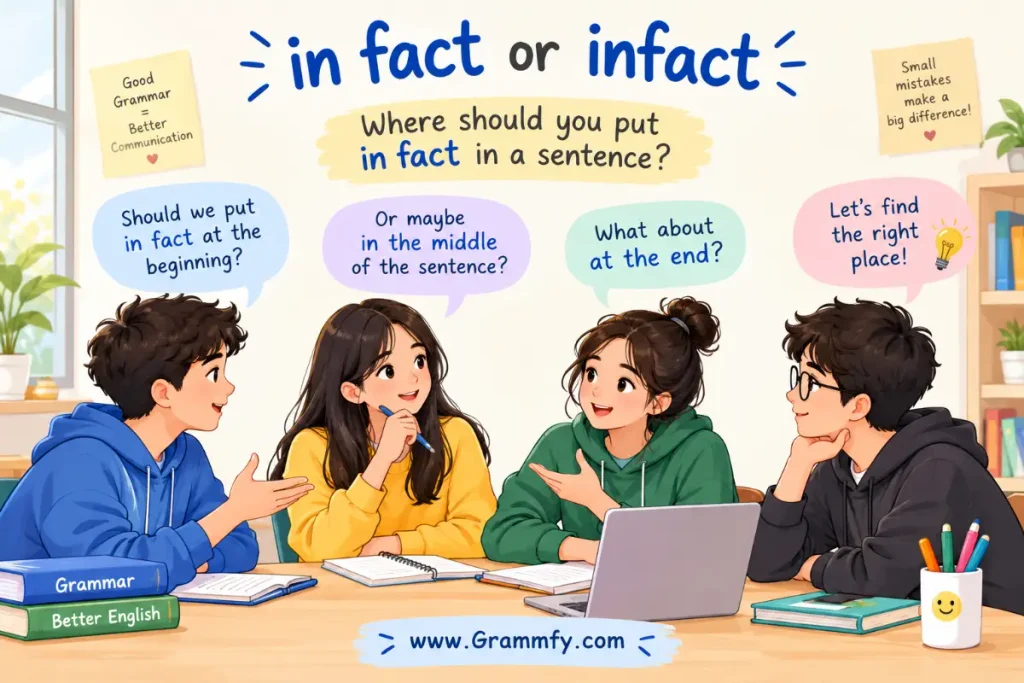
Where should you put in fact in a sentence?
There are three common positions.
At the beginning
In fact, I agree with your point.
This is common when introducing a new sentence.
In the middle
The answer is, in fact, quite simple.
This gives extra emphasis to the statement.
At the end
She knew the answer, in fact.
This position is possible, but it can sound less natural in many sentences. Writers often prefer placing the phrase at the beginning or middle.
Can you start a sentence with in fact?
Yes.
Starting a sentence with in fact is completely grammatical.
In fact, the evidence suggests a different conclusion.
This is especially useful when the second sentence adds stronger information to the first.
A good writer should still avoid beginning every paragraph with the same transition.
Can you use in fact after a comma?
Yes, depending on the sentence.
For example:
The plan seemed risky, but, in fact, it was quite safe.
However, the sentence can often be made cleaner:
The plan seemed risky, but in fact, it was quite safe.
Punctuation depends on how the phrase connects to the surrounding grammar.
When in doubt, read the sentence aloud and check whether the phrase is acting as an interruption or as part of the sentence’s normal flow.
Common mistakes with in fact
Mistake 1: Writing infact
Incorrect:
Infact, I already knew.
Correct:
In fact, I already knew.
The two words must remain separate.
Mistake 2: Writing in-fact
Incorrect:
In-fact, the result was different.
Correct:
In fact, the result was different.
A hyphen isn’t needed.
Mistake 3: Capitalizing both words unnecessarily
Incorrect in normal sentence style:
In Fact, the answer is correct.
Correct:
In fact, the answer is correct.
Both words don’t need initial capitals unless the phrase appears in a title using title case.
Mistake 4: Using it without a reason
Weak:
I went to the store. In fact, I bought milk.
The phrase isn’t necessarily wrong, but the connection may be weak.
Better:
I didn’t forget to buy groceries. In fact, I bought everything on the list.
Now the phrase introduces information that reinforces the previous statement.
Mistake 5: Repeating it too often
Example of repetitive writing:
In fact, the plan is useful. In fact, it is affordable. In fact, it is easy to follow.
This sounds mechanical.
Better:
The plan is useful, affordable, and easy to follow. In addition, it can be adapted to different situations.
Varying transitions makes writing smoother.
When should you not use in fact?
There are several situations where another word or no transition at all may be better.
Don’t use it just to sound formal
Adding in fact doesn’t automatically improve writing.
Weak:
In fact, I submitted the assignment on Tuesday.
Better:
I submitted the assignment on Tuesday.
If there is no contrast, correction, or emphasis, the phrase may be unnecessary.
Don’t use it when you mean “for example”
These expressions aren’t interchangeable.
Incorrect meaning:
Many fruits are nutritious. In fact, apples are one example.
If you’re introducing an example, use:
Many fruits are nutritious. For example, apples contain important nutrients.
Don’t use it when you mean “therefore”
In fact doesn’t mean “as a result.”
Incorrect:
It rained heavily. In fact, the game was canceled.
If the cancellation happened because of the rain, a better transition is:
It rained heavily. As a result, the game was canceled.
Don’t use it when you mean “however”
However shows contrast.
The task was difficult. However, we completed it.
In fact doesn’t communicate the same relationship.
The task was difficult. In fact, we completed it.
This suggests emphasis rather than contrast.
What are the antonyms of in fact?
Because in fact is an expression about reality or truth, it doesn’t have one direct antonym.
Depending on context, contrasting expressions can include:
- supposedly
- allegedly
- apparently
- reportedly
- theoretically
- in theory
- supposedly true
These don’t always mean the exact opposite. Instead, they can signal uncertainty, appearance, or a claim that has not necessarily been confirmed.
Compare:
In fact, the report is accurate.
with:
Apparently, the report is accurate.
The first presents the information as fact. The second suggests that the speaker has reason to believe it but may not be completely certain.
In fact vs apparently — what’s the difference?
These phrases communicate different levels of certainty.
| In fact | Apparently |
|---|---|
| Presents information as true | Indicates something seems true |
| Stronger certainty | Less certain |
| Based on known facts or correction | Often based on what you’ve heard or observed |
| Direct | More cautious |
Example:
In fact, the meeting starts at nine.
The speaker presents this as confirmed.
Apparently, the meeting starts at nine.
The speaker isn’t necessarily claiming personal confirmation.
Choosing the right expression helps you avoid overstating information.
In fact vs however — what’s the difference?
These phrases serve different purposes.
However introduces contrast.
The task was difficult. However, we completed it.
In fact emphasizes or adds factual information.
The task was difficult. In fact, it took three hours.
The first transition says, “Here is a contrast.”
The second says, “Here is a fact that strengthens or clarifies the point.”
In fact vs therefore — what’s the difference?
Therefore introduces a result or conclusion.
The roads were icy. Therefore, the school closed.
In fact doesn’t show cause and effect.
The roads were icy. In fact, the school closed.
This sentence adds information but doesn’t explicitly say that the icy roads caused the closure.
Use transitions according to the logical relationship between your ideas.
Quick tips for using in fact correctly
1. Keep it as two words
Always write:
in fact
Never:
infact
2. Use it to emphasize truth
Ask yourself whether you’re stressing that something is actually true.
3. Use it to correct an assumption
I thought she was new. In fact, she’s been here for years.
4. Use it to add supporting information
The project was successful. In fact, it exceeded its target.
5. Don’t use it when you mean “for example”
Choose for example when introducing an example.
6. Don’t use it when you mean “therefore”
Use therefore, so, or as a result for conclusions.
7. Don’t overuse it
One well-placed transition is stronger than several repeated ones.
8. Consider “actually” in casual speech
Actually may sound more natural in relaxed conversation.
9. Consider “indeed” in formal writing
Indeed can work when you want a more formal tone.
10. Read the sentence without it
If removing in fact makes the sentence clearer and doesn’t change the meaning, you may not need it.
A quick comparison chart
| Phrase | Main purpose | Example |
|---|---|---|
| In fact | Emphasize truth | In fact, I already knew. |
| Actually | Correct or clarify | Actually, I already knew. |
| Indeed | Strongly confirm | Indeed, the results were significant. |
| However | Show contrast | However, we continued. |
| Therefore | Show result | Therefore, we changed the plan. |
| For example | Give an example | For example, apples are nutritious. |
| In addition | Add information | In addition, the plan is affordable. |
| As a result | Show consequence | As a result, the event was canceled. |
| Apparently | Show uncertainty | Apparently, the store is closed. |
| Honestly | Express sincerity | Honestly, I expected more. |
How to choose the right transition
Before using in fact, ask one simple question:
What relationship does this sentence have with the sentence before it?
If you’re emphasizing a truth, in fact may work.
If you’re correcting an assumption, actually may work.
When you’re showing contrast, choose however.
For a result, use therefore or as a result.
To introduce evidence or an example, use for example or specifically.
This approach makes your writing more logical and prevents transition words from becoming filler.
Examples for school assignments
History
Many people assume the invention was recent. In fact, it dates back several centuries.
Science
Water appears simple. In fact, its chemical properties make it unusual.
Literature
The character seems selfish at first. In fact, later events reveal a more complicated personality.
Geography
The region receives little rainfall. In fact, some areas are among the driest in the country.
Mathematics
The problem looks complicated. In fact, it can be solved using a simple formula.
These examples show how the phrase can introduce information that strengthens or changes the reader’s understanding.
Examples for professional emails
I reviewed the proposal. In fact, I found several points that could strengthen it.
The client has already approved the design. In fact, we received confirmation this morning.
The deadline hasn’t changed. In fact, we still have two additional days.
The document is ready. In fact, I attached the final version to this email.
The phrase works best when the second part provides useful information rather than merely repeating what was already said.
Examples for conversations
I thought you lived nearby. In fact, I live just around the corner.
I wasn’t nervous. In fact, I was excited.
You think this is expensive? In fact, it’s cheaper than the other option.
I thought the movie was over. In fact, there was another scene.
Conversation often favors actually, but in fact remains natural.
Examples for persuasive writing
The phrase can help highlight evidence in an argument.
Some people believe the change will be expensive. In fact, the new system could reduce long-term costs.
Another example:
The proposal may seem ambitious. In fact, similar programs have already succeeded elsewhere.
This structure works because the phrase introduces information that challenges or strengthens the reader’s expectations.
How can in fact improve clarity?
A transition should help readers understand why one idea follows another.
Compare:
The product looks expensive. It costs less than the older model.
The relationship is understandable, but the second sentence could use emphasis:
The product looks expensive. In fact, it costs less than the older model.
Now the reader knows that the second statement is meant to correct the first impression.
Good transitions don’t just make writing sound smoother. They help explain the logic between ideas.
Is infact ever acceptable?
In standard English, infact is not the accepted spelling of the phrase.
You may occasionally see it online in:
- social media posts
- comments
- informal messages
- usernames
- unedited websites
- learner writing
Those examples don’t make it standard.
For schoolwork, professional writing, published articles, applications, and formal communication, use in fact.
What should you remember about in fact?
The main rule is simple:
In fact = two words.
Use the phrase when you want to emphasize that something is true, correct an assumption, or add factual information.
Remember these examples:
In fact, I agree.
She isn’t new. In fact, she’s been here for years.
The task looked difficult. In fact, it was easy.
If you see infact, treat it as a spelling error unless it is intentionally being used as a name or stylistic creation.
Conclusion
When choosing between In fact or Infact, always use in fact in standard English. The expression is made up of two separate words and is commonly used to emphasize truth, correct an assumption, or introduce information that strengthens a point. It works naturally in school essays, emails, reports, conversations, and many other forms of writing. Alternatives such as actually, indeed, in reality, and as a matter of fact can be useful when you want a different tone or level of emphasis. Just remember that transitions should have a purpose. If the phrase doesn’t add clarity, you can often remove it. Keeping in fact as two words is the key spelling rule, and using it thoughtfully will make your writing clearer and more precise.
Frequently Asked Questions
Is in fact one word or two?
In fact is two words. The spelling infact is not standard English.
What does in fact mean?
In fact means actually, really, or in reality. It often emphasizes a statement or introduces information that corrects an assumption.
What’s another way to say in fact?
Common alternatives include actually, indeed, in reality, truly, and as a matter of fact. The best option depends on the sentence and tone.
Can I start a sentence with in fact?
Yes, you can start a sentence with in fact. A comma commonly follows the phrase when it introduces the sentence: In fact, I already knew the answer.
Is in fact formal English?
In fact is standard neutral English and works in both formal and informal contexts. It is suitable for essays, emails, reports, conversations, and everyday writing.
Should I use in fact or actually?
Both can be correct, but actually often sounds more conversational, while in fact can provide stronger emphasis or introduce supporting information.
Why is infact wrong?
Infact is wrong because the standard English expression is written as two separate words: in fact.
