
You’re writing an email, finishing an essay, or sending a quick text when you suddenly stop and wonder: latter or ladder? These two words sound almost the same, but they have completely different meanings. Using the wrong one can change your sentence or make your writing look careless.
The confusion is understandable. Latter and ladder are both common English words, and their pronunciations can be difficult to distinguish in fast speech. The good news is that you can learn the difference with one simple idea: latter is about the second of two things, while ladder is something you climb.
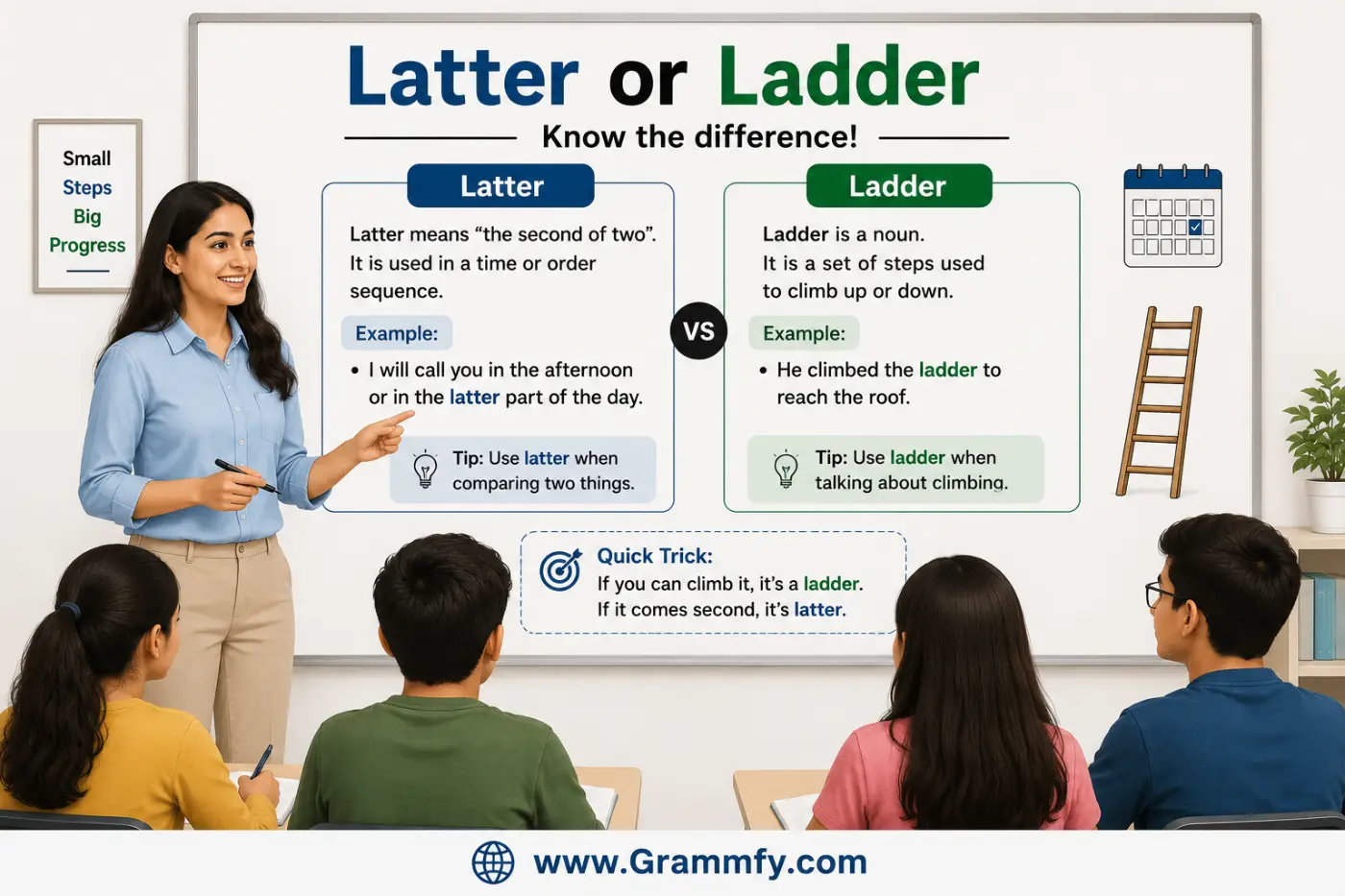
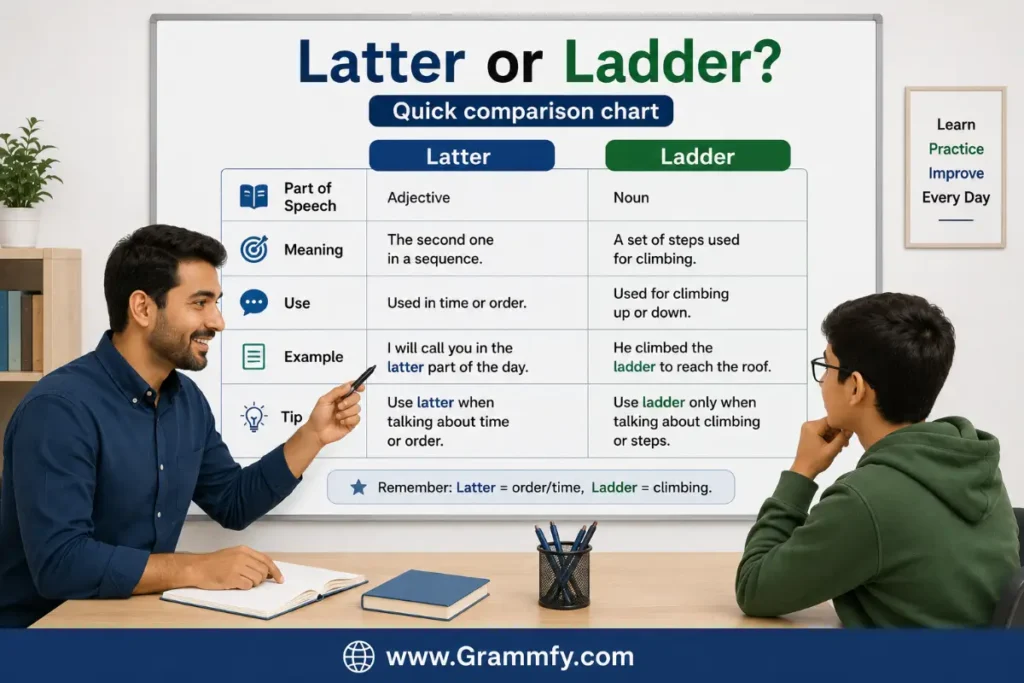
Latter means the second of two things mentioned; ladder is a tool with steps or rungs that you climb.
Knowing this difference will help you in school essays, professional emails, resumes, conversations, and everyday writing. This guide explains their meanings, origins, pronunciation, synonyms, examples, common mistakes, and easy memory tricks so you can choose the right word every time.
You can also learn about common plural forms in [ballon or balloon].
What is the difference between “Latter or Ladder”?
The easiest way to understand latter and ladder is to look at their meanings.
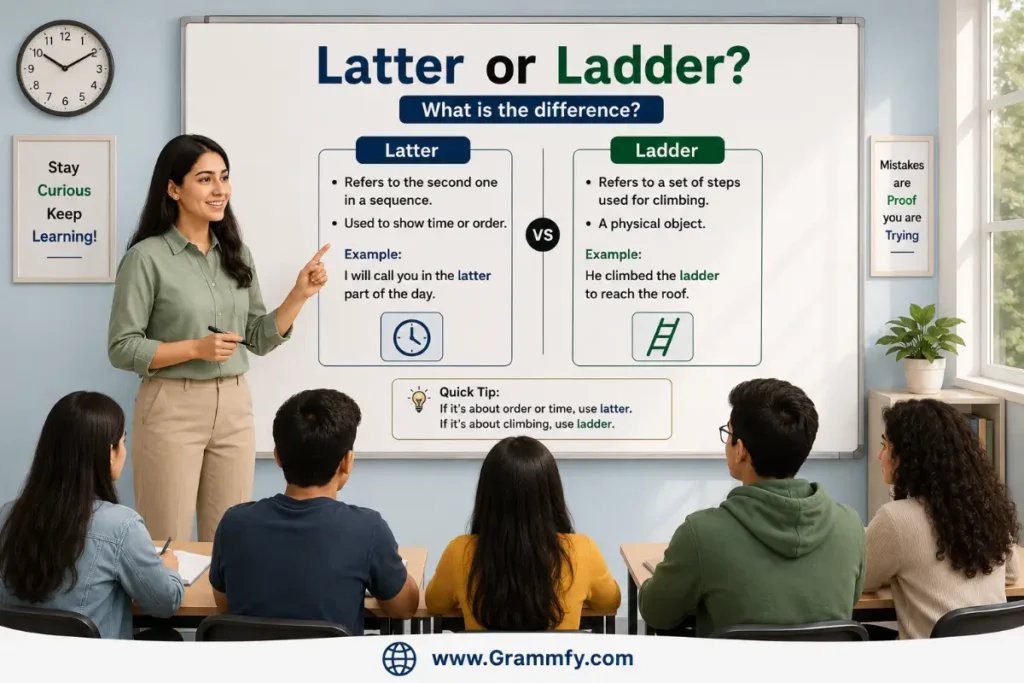
Latter refers to the second of two people or things that have already been mentioned.
Ladder is a structure with steps or rungs that allows someone to climb up or down.
Compare these sentences:
I can study at home or at the library. I prefer the latter.
Here, latter means the library, because the library was the second option mentioned.
Now look at this sentence:
He climbed the ladder to reach the roof.
Here, ladder means a physical object used for climbing.
| Word | Meaning | Example |
|---|---|---|
| Latter | The second of two things mentioned | I chose the latter option. |
| Ladder | A structure used for climbing | She climbed the ladder. |
The fastest rule to remember
Think:
Latter = last of two
Ladder = climb
The word latter contains “later” in a similar sense. It points to something that comes later in a pair.
A ladder, on the other hand, has rungs.
What does latter mean in plain English?
Latter means the second of two people, things, choices, or ideas that were just mentioned.
For example:
We could travel by train or bus. I prefer the latter.
There are two choices:
- train
- bus
The second choice is bus, so latter refers to bus.
Another example
Sarah and Emma applied for the position. The latter was selected.
The two people are:
- Sarah
- Emma
The latter refers to Emma.
Why does latter refer to the second one?
The word is connected to the idea of something coming later in a sequence.
When you mention two things, the first is called the former, and the second is called the latter.
For example:
Dogs and cats are popular pets. The former are often more active, while the latter are often more independent.
Here:
- former = dogs
- latter = cats
This pair is especially useful in formal writing.
What does ladder mean in plain English?
A ladder is a structure made for climbing. It usually has two long sides connected by horizontal steps called rungs.
For example:
He put the ladder against the wall.
She climbed the ladder to reach the window.
The painter carried a ladder into the room.
A ladder can be made from:
- wood
- aluminum
- steel
- fiberglass
- other strong materials
Ladders come in different types and sizes.
Common types of ladders
You may hear these terms:
- step ladder
- extension ladder
- folding ladder
- platform ladder
- telescoping ladder
- rope ladder
- attic ladder
- straight ladder
The basic meaning remains the same: a ladder is used to help someone reach a higher or lower place.
Where did the word latter come from?
Latter has Old English and Germanic roots connected with the idea of something later or coming after something else.
Over time, the word developed a special use in English. Instead of simply meaning “later,” it came to identify the second of two things previously mentioned.
This meaning is still common today, especially in formal and academic writing.
The related word former works as its natural partner:
- former = first
- latter = second
This is why you often see them together.
For example:
The company offers online and in-person courses. The former is more flexible, while the latter allows students to interact directly with teachers.
Where did the word ladder come from?
Ladder also has an Old English history. It comes from an old Germanic word related to climbing.
The word has stayed closely connected to its physical meaning for centuries.
A ladder has a very simple design: two longer supports with rungs between them. People use those rungs to move upward or downward.
The physical meaning is much easier to picture than the abstract meaning of latter, which is one reason visual memory tricks can help.
Why are Latter or Ladder confused?
The main reason is pronunciation.
In many varieties of English, latter and ladder can sound extremely similar. In some accents, they may sound almost identical.
Their spellings are also similar:
- latter
- ladder
Both begin with la and contain repeated consonants.
But their meanings are completely different.
This is a classic example of words that can cause confusion because of sound rather than meaning.
How do you pronounce Latter or Ladder?
Pronunciation varies by accent.
In many American accents, latter and ladder may have very similar pronunciations. The middle consonant can sound like a quick tap, making the words difficult to distinguish when spoken.
That’s why context is important.
If someone says:
I climbed the latter.
You may need to look at the surrounding sentence to know whether they meant ladder.
In writing, the spelling makes the distinction clear.
A pronunciation memory trick
When you hear the word, ask:
Is the person talking about a choice between two things?
If yes, they probably mean latter.
If they’re talking about climbing, rungs, a wall, a roof, or reaching a high place, they probably mean ladder.
What are synonyms for latter?
Latter has fewer direct synonyms than ladder because its meaning is quite specific. It usually identifies the second of two previously mentioned things.
Still, depending on the sentence, you can use related expressions.
Simple alternatives
| Word or phrase | Meaning | Tone | Example |
|---|---|---|---|
| Second | Coming after the first | Simple | I prefer the second option. |
| Second one | The second item mentioned | Everyday | I’ll take the second one. |
| Last of the two | The second of two | Simple | She chose the last of the two. |
| Other | The other item in a pair | Everyday | I prefer the other choice. |
| One mentioned second | The second item | Clear | The one mentioned second was cheaper. |
| Second choice | Choice listed second | Neutral | The second choice is better. |
| Second option | Option listed second | Neutral | I’ll take the second option. |
| Second person | Person mentioned second | Neutral | The second person won. |
Formal alternatives
| Word or phrase | Meaning | Tone | Example |
|---|---|---|---|
| The second | The second of two items | Formal/neutral | The second was more effective. |
| The latter-mentioned | The item mentioned later | Formal | The latter-mentioned proposal was accepted. |
| The second-mentioned | The second item discussed | Formal | The second-mentioned issue needs attention. |
| The subsequent one | The one that follows | Formal | The subsequent one received approval. |
| The final of the two | The last of two | Formal | The final of the two options was selected. |
| The latter option | The second option | Formal | The latter option costs less. |
| The latter choice | The second choice | Formal | The latter choice is more practical. |
| The second alternative | The second possible choice | Formal | The second alternative is cheaper. |
Everyday alternatives
| Word or phrase | Meaning | Tone | Example |
|---|---|---|---|
| The second one | Second item mentioned | Everyday | I like the second one. |
| The other one | Other item in a pair | Casual | Let’s choose the other one. |
| The one after it | Item that follows | Casual | Pick the one after it. |
| Number two | Second item | Casual | I’ll take number two. |
| The second choice | Second option | Everyday | The second choice looks better. |
| The other option | Alternative choice | Everyday | Let’s try the other option. |
There isn’t a perfect synonym in every sentence. Often, simply saying the second one is the clearest alternative.
What are synonyms for ladder?
The word ladder has several related terms, but they aren’t all exact synonyms.
| Word | Meaning | Tone | Example |
|---|---|---|---|
| Steps | Surfaces used to climb | Everyday | She walked up the steps. |
| Stairway | A series of steps | Neutral | We took the stairway upstairs. |
| Stairs | Fixed steps between levels | Everyday | He ran up the stairs. |
| Staircase | A complete set of stairs | Neutral | The staircase was wooden. |
| Step ladder | Short self-supporting ladder | Everyday | He used a step ladder. |
| Extension ladder | Ladder that can be made longer | Technical | The worker opened the extension ladder. |
| Rope ladder | Ladder made with rope and rungs | Specific | The boat had a rope ladder. |
| Climbing frame | Structure designed for climbing | Everyday | Children played on the climbing frame. |
| Access ladder | Ladder used to reach a location | Technical | The roof has an access ladder. |
| Fire escape | Emergency exit structure | Safety-related | They used the fire escape. |
Be careful: stairs and ladder are not interchangeable.
You climb a ladder, but you normally walk up stairs.
Synonyms by intensity: mild to strong
Because latter has a very specific grammatical meaning, it doesn’t have an intensity scale like words describing emotions or size.
For ladder, the alternatives can vary according to the type or purpose rather than intensity.
For example:
| Basic | More specific | Purpose |
|---|---|---|
| Ladder | Step ladder | Short tasks |
| Ladder | Extension ladder | Greater height |
| Ladder | Rope ladder | Flexible climbing |
| Ladder | Access ladder | Reaching a specific area |
| Ladder | Emergency ladder | Escape or emergency access |
| Ladder | Industrial ladder | Workplace use |
If you’re writing instructions, choosing the exact type is better than simply repeating ladder.
What part of speech is latter?
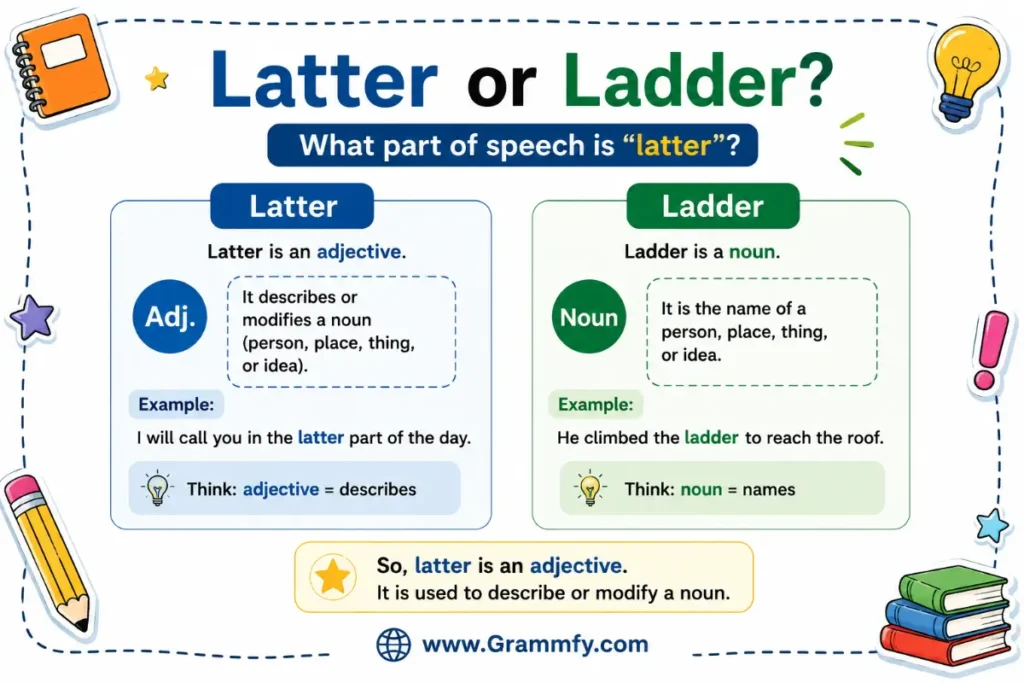
Latter is usually an adjective or a noun-like pronoun in modern usage.
Latter as an adjective
The latter option is cheaper.
Here, latter modifies option.
Latter used independently
I prefer the latter.
Here, latter stands for the second option.
This is common in formal writing.
Latter should refer to two things
Traditionally, former and latter are used when there are two items.
For example:
Tea and coffee are available. I prefer the latter.
This is clear.
If you have three, four, or ten items, it is usually better to say the second, the third, the final, or name the item directly.
What part of speech is ladder?
Ladder is primarily a noun.
For example:
The ladder is leaning against the house.
You can also use it in compound nouns and expressions.
Examples include:
- ladder rung
- ladder safety
- ladder climb
- ladder truck
- extension ladder
- step ladder
English also uses ladder metaphorically.
For example:
She is climbing the corporate ladder.
Here, the person isn’t necessarily climbing a physical ladder. The phrase means advancing through levels of a career or organization.
What does “climb the ladder” mean?
Climb the ladder can have a literal or figurative meaning.
Literal meaning
He climbed the ladder to clean the window.
He physically moved upward using a ladder.
Figurative meaning
She worked hard to climb the corporate ladder.
Here, climb the corporate ladder means to advance professionally and take on higher positions.
Other examples include:
- climb the career ladder
- climb the social ladder
- climb the professional ladder
These expressions use the physical idea of moving upward as a metaphor for progress.
What is the difference between latter and former?
Former and latter work as a pair.
- Former = first of two
- Latter = second of two
Example:
I considered a laptop and a tablet. The former is better for typing, while the latter is easier to carry.
Here:
- former = laptop
- latter = tablet
Easy memory rule
Think:
Former = first
Latter = later/second
The first word starts with f, which can remind you of first.
The second word starts with l, which can remind you of later.
This is one of the easiest ways to remember their difference.
Latter vs second: What’s the difference?
Second is more general.
Latter specifically refers back to two things already mentioned.
Compare:
I prefer the second option.
This can work when options have been clearly numbered or listed.
I prefer the latter option.
This usually refers to the second of two options that were just mentioned.
For example:
We could take the train or the bus. I prefer the latter.
Here, latter is natural because there are exactly two choices.
If you have four options, saying the latter can become unclear.
Instead:
I prefer the second option.
Or:
I prefer option four.
What’s different?:Latter vs last
Latter and last are not always interchangeable.
Latter normally refers to the second of two.
Last can refer to the final item in a longer sequence.
For example:
John and Mark attended. The latter arrived late.
There are two people, so latter means Mark.
But:
John, Mark, Sarah, and Lisa attended. Lisa was the last to arrive.
There are four people, and Lisa is the final one.
Quick comparison
| Word | Main use |
|---|---|
| Latter | Second of two |
| Last | Final item in a sequence |
| Second | Item in position two |
| Former | First of two |
Latter vs later: What’s different?
This is another common spelling and meaning confusion.
Later means at a time after now or after another time.
I’ll call you later.
Latter refers to the second of two things previously mentioned.
I considered tea and coffee. I chose the latter.
A simple way to remember them:
Later = time
Latter = second of two
Compare:
I’ll finish the work later.
and:
I prefer the latter option.
They look similar but perform different jobs.
Latter vs later vs ladder
These three words can be confusing because their spelling and pronunciation are similar.
| Word | Meaning | Example |
|---|---|---|
| Latter | Second of two | I chose the latter. |
| Later | At a future time | I’ll do it later. |
| Ladder | Tool for climbing | He climbed the ladder. |
Memory trick
Later → time
Latter → two choices
Ladder → climb
If you remember those three words, many spelling mistakes disappear.
What word should you use in a resume Latter or Ladder?
On a resume, latter is useful when you are comparing exactly two things, but it can sometimes make a sentence less direct.
For example:
I have experience in content writing and editing, with greater expertise in the latter.
This means the writer has greater expertise in editing, the second item mentioned.
However, a resume is usually stronger when it states the skill directly:
I have greater expertise in editing.
This removes any possible confusion.
Resume tip
Use latter when the comparison is useful and obvious. Otherwise, name the skill or role directly.
What word should you use in an essay Latter or Ladder?
Latter can be very useful in essays because it helps you avoid repeating a noun.
For example:
Online learning and classroom learning both have advantages. The latter provides more direct interaction with teachers.
The reader knows that the latter means classroom learning.
This can make formal writing more concise.
However, don’t overuse it. If a paragraph contains several choices or comparisons, repeatedly using former and latter can force readers to look backward to remember what you mean.
When clarity matters more than repetition, simply name the subject again.
What word should you use in texting Latter or Ladder?
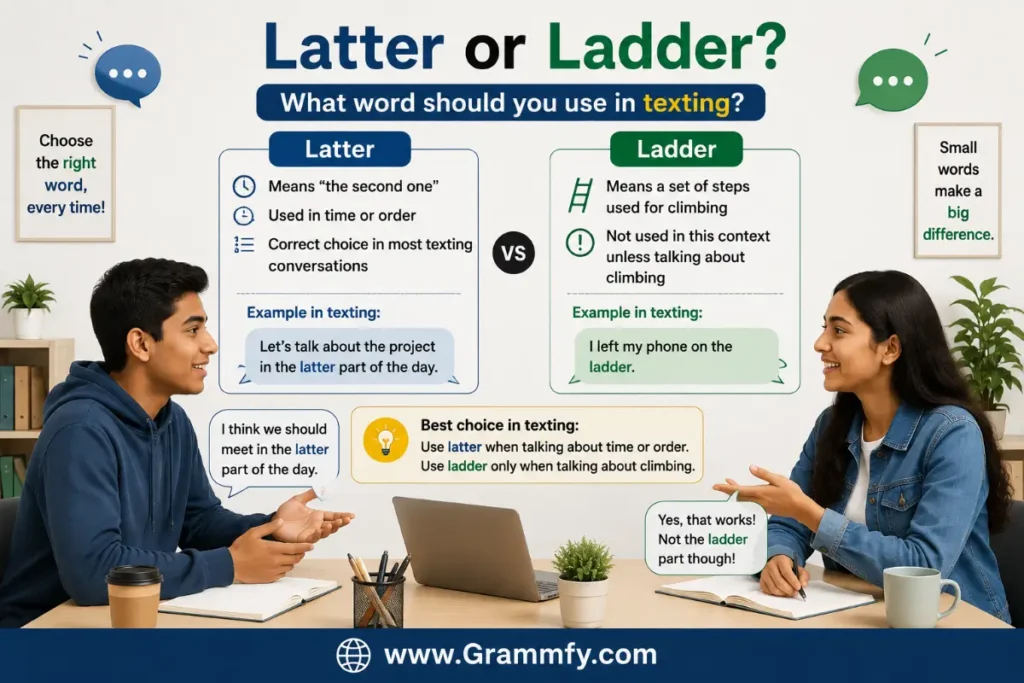
In texting, latter is less common than simple phrases such as:
- the second one
- the other one
- the second option
For example:
Do you want pizza or burgers?
A natural text reply might be:
The second one.
You could say:
I prefer the latter.
But that sounds more formal.
For a physical object, use ladder normally:
Can you bring the ladder?
What word should you use in an email Latter or Ladder?
In professional emails, latter can be useful when discussing two options.
For example:
We can schedule the meeting on Tuesday or Wednesday. I prefer the latter.
This means Wednesday.
You can also avoid possible confusion by being direct:
I prefer Wednesday.
Both are correct. The second version is often easier to understand.
If you’re talking about a physical climbing tool, use ladder:
The maintenance team needs a ladder to reach the ceiling.
What word should you use when speaking Latter or Ladder ?
In conversation, context usually determines the correct word.
When you’re talking about two choices:
I prefer the latter.
If you’re talking about climbing:
Bring the ladder.
If you’re talking about time:
I’ll do it later.
Because these words can sound similar, listeners rely heavily on context.
15+ examples of latter in real situations
1. Choosing between two drinks
I can have tea or coffee, but I prefer the latter.
The latter = coffee.
2. Comparing two jobs
The first job pays more, but the latter offers better benefits.
The latter = the second job.
3. Comparing two schools
I visited City School and Green Valley School. I liked the latter more.
The latter = Green Valley School.
4. Comparing two study methods
Students can study alone or in groups. The latter can provide more social interaction.
The latter = studying in groups.
5. Comparing two transportation methods
We could travel by train or plane. The latter is faster.
The latter = plane.
6. Comparing two products
The company sells basic and premium plans. The latter includes more features.
The latter = premium plan.
7. Comparing two careers
Teaching and writing are both rewarding careers, but I prefer the latter.
The latter = writing.
8. Comparing two books
I read both books, but I enjoyed the latter more.
The latter = the second book.
9. Comparing two options
We can repair the device or replace it. The latter may be cheaper.
The latter = replacing it.
10. Comparing two ideas
The author discusses tradition and innovation. The latter receives more attention.
The latter = innovation.
11. Comparing two locations
We considered Lahore and Islamabad. The latter seemed quieter.
The latter = Islamabad.
12. Comparing two plans
Plan A is cheaper, while the latter provides more features.
This sentence would only be correct if exactly two plans had been mentioned and the latter referred clearly to the second.
13. Comparing two learning styles
Reading and listening can both help, but the latter is useful for improving pronunciation.
The latter = listening.
14. Comparing two hobbies
She enjoys painting and photography. The latter is her favorite.
The latter = photography.
15. Comparing two solutions
We could update the software or replace the computer. The latter would cost more.
The latter = replacing the computer.
15+ examples of ladder in real situations
1. Cleaning a window
He used a ladder to reach the second-floor window.
2. Painting a wall
The painter placed the ladder carefully before starting work.
3. Reaching the roof
They climbed the ladder to inspect the roof.
4. Picking fruit
She used a ladder to reach the apples at the top of the tree.
5. Emergency equipment
The building has an emergency ladder.
6. Attic access
We installed a folding ladder to reach the attic.
7. Library maintenance
The worker brought a ladder to reach the top shelf.
8. Construction work
The worker checked the ladder before climbing it.
9. Garden work
He carried a ladder into the backyard.
10. Decorating
We needed a ladder to hang the lights.
11. Changing a light bulb
She stood on a ladder to replace the bulb.
12. Cleaning gutters
The homeowner used a ladder to clean the gutters.
13. A fire escape
The building has an exterior ladder for emergency access.
14. A boat
The swimmer climbed the ladder back onto the boat.
15. A metaphor
She hopes to climb the corporate ladder.
Common mistakes with latter and ladder
Mistake 1: Using ladder when you mean second
Incorrect:
I prefer the ladder option.
Correct:
I prefer the latter option.
Here, you are discussing a choice, not something used for climbing.
Mistake 2: Using latter when you mean a climbing tool
Incorrect:
He climbed the latter to reach the roof.
Correct:
He climbed the ladder to reach the roof.
The physical object is a ladder.
Mistake 3: Confusing latter with later
Incorrect:
I’ll finish my homework latter.
Correct:
I’ll finish my homework later.
Later refers to time.
Mistake 4: Using latter for more than two things
If you list several things, latter can become confusing.
For example:
We considered tea, coffee, juice, and water. I prefer the latter.
Which one does latter mean?
The reader may interpret it as water, but the traditional use of latter is the second of two items. It is better to say:
I prefer water.
Or:
I prefer the last option.
Mistake 5: Using former and latter without clear references
Consider:
The new policy is more flexible than the old policy, and the former is easier to understand.
The reader has to stop and determine what former refers to.
A clearer version may be:
The new policy is more flexible than the old policy, and the new policy is easier to understand.
Avoiding repetition is useful, but clarity comes first.
When should you NOT use latter?
Don’t use latter when the reader may not know which two things you’re referring to.
For example:
The latter is better.
This sentence is incomplete if the previous sentence didn’t clearly mention two things.
Instead:
The second option is better.
Or name the specific choice.
Avoid latter when the list is long
If you’ve mentioned several items, direct naming is usually clearer.
Instead of:
The latter was the most useful.
Write:
The final method was the most useful.
Or:
The survey method was the most useful.
When should you NOT use ladder?
Don’t use ladder when you simply mean stairs.
A ladder and a staircase both help people move vertically, but they’re different structures.
Incorrect:
I walked up the ladder to the second floor.
If you mean a permanent set of steps, say:
I walked up the stairs to the second floor.
Use ladder when the object has rungs and is designed for climbing.
What are the antonyms of latter?
Latter doesn’t have a direct opposite in every context, but former is its standard contrasting term when referring to two things.
Example:
Cats and dogs are popular pets. The former are often more independent, while the latter are often more social.
Here:
- former = cats
- latter = dogs
So the most useful pair to remember is:
former ↔ latter
What are the antonyms of ladder?
A ladder doesn’t have a simple opposite because it’s an object rather than a quality.
If you’re thinking about movement, possible contrasting concepts include:
- ground
- floor
- descent
- elevator
- lift
But these aren’t true dictionary antonyms.
If you’re describing movement, climb down or descend can contrast with climb up.
A simple memory trick for latter
Use this:
Latter = later = second
When you see latter, think about something that comes later in a pair.
Example:
Tea or coffee? I want the latter.
Coffee came second.
Another trick:
Former = first
Latter = last of two
Although latter technically means the second rather than the final item in every possible list, this memory phrase works well when you’re comparing exactly two things.
A simple memory trick for ladder
Picture a ladder.
It has:
- two sides
- several rungs
- a person climbing upward
The spelling ladder has a double d.
You can remember:
Ladder has rungs and a double D.
That visual connection makes the spelling easier to remember.
A three-word memory trick
When you’re unsure, ask what the sentence is about:
Latter → choice
Later → time
Ladder → climbing
Examples:
I prefer the latter. → choice
I’ll call you later. → time
Get the ladder. → climbing
This is one of the fastest ways to separate the three words.
How to choose the right word quickly
Use this five-second test.
Step 1: Look at the meaning
Are you talking about the second of two things?
Choose latter.
Step 2: Think about physical climbing
Are you talking about a tool with rungs?
Choose ladder.
Step 3: Think about time
Are you talking about something happening after now?
Choose later.
Step 4: Check the surrounding sentence
If you’re using latter, make sure two things have already been mentioned.
Step 5: Choose clarity over fancy wording
If the reader might be confused, simply say the second one or name the item directly.
Quick comparison chart about “Latter or Ladder”
| Word | Meaning | Memory clue | Example |
|---|---|---|---|
| Latter | Second of two | Later/second | I chose the latter. |
| Ladder | Climbing structure | Rungs | He climbed the ladder. |
| Later | At a future time | Time | I’ll call later. |
| Former | First of two | First | I prefer the former. |
Final checklist before using the word
Before you submit your essay, email, or post, ask:
- Am I referring to the second of two things?
- If yes, use latter.
- Am I talking about something used for climbing?
- If yes, use ladder.
- Am I talking about a future time?
- If yes, use later.
- Have I clearly mentioned two things before using latter?
- Would naming the second item make the sentence clearer?
- Am I using former and latter correctly as a pair?
- Am I avoiding latter when there are many possible items?
- Have I checked the spelling before publishing?
Conclusion
Understanding latter and ladder becomes easy once you connect each word with its main meaning. Latter belongs to comparisons and means the second of two things already mentioned. Ladder is a physical structure with rungs that people climb. The related word later refers to time, while former is the natural partner of latter and means the first of two.
When you’re writing, don’t rely only on how these words sound. Look at the meaning of the sentence first. When you’re comparing two choices, think former and latter. If you’re talking about climbing, think of the rungs on a ladder. If you’re talking about a future time, choose later. With these simple connections, you’ll be able to spot the correct spelling quickly and write with confidence.
Frequently Asked Questions
What is the difference between latter and ladder?
Latter means the second of two things mentioned, while ladder is a structure used for climbing. They sound similar in many accents but have completely different meanings.
Is latter the second or the first?
Latter means the second of two things. The first is called the former.
How do I remember latter vs ladder?
Remember latter = second and ladder = climb. A ladder has rungs, while latter points to the item that came later in a pair.
What’s another way to say latter?
You can say the second, the second one, the other option, or the second-mentioned item, depending on the sentence.
Is latter the same as later?
No, latter and later have different meanings. Later refers to time, while latter refers to the second of two things already mentioned.
Can I use latter for three or more things?
It’s better to avoid latter when referring to more than two items. Use words such as second, third, final, or the specific name of the item to keep your meaning clear.
Is latter or ladder correct for climbing?
Ladder is correct for climbing. A ladder is a structure with rungs that helps people reach higher or lower places.
