
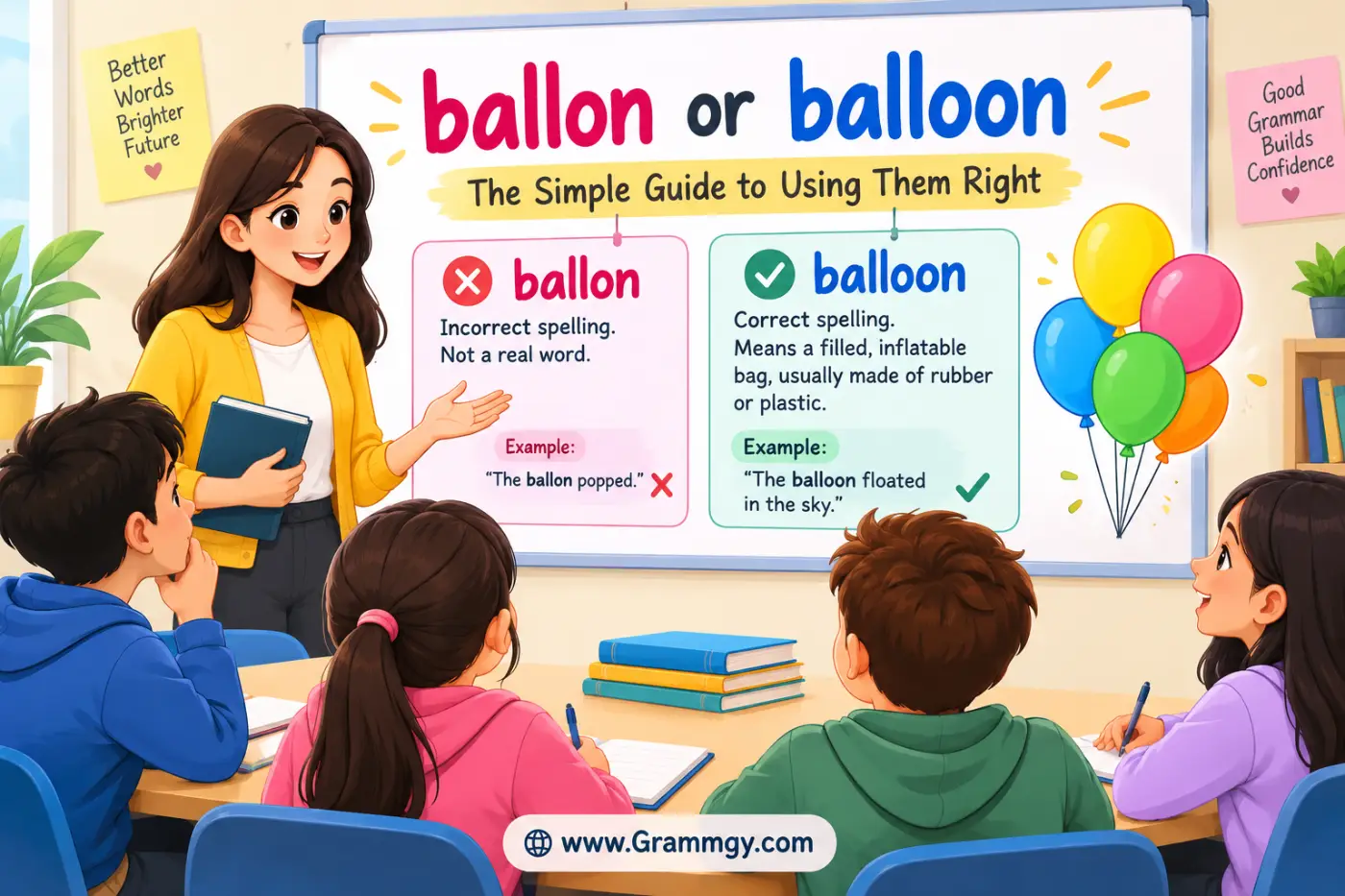
Writing an email, finishing an essay, or sending a quick text can sometimes stop you over one tiny spelling question: Is it ballon or balloon? The two forms look almost identical, so it’s easy to type the wrong one, especially when you’re writing quickly.
If you’ve ever searched for ballon or balloon while checking your spelling, you’re not alone. One extra letter can make the difference between a standard English word and a spelling error.
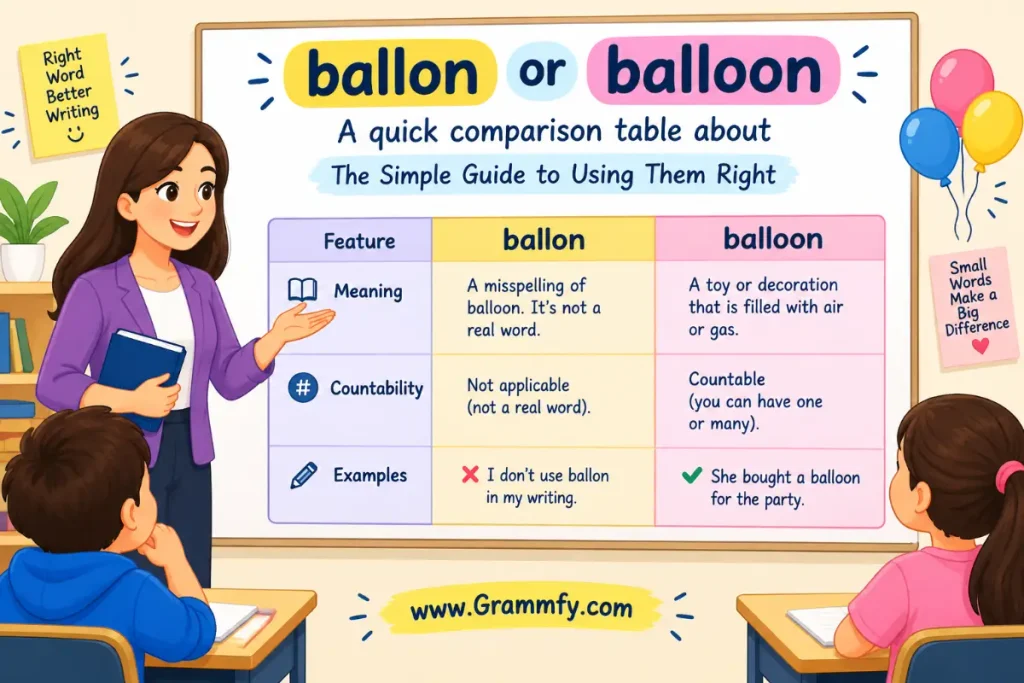
The correct English spelling is “balloon.” “Ballon” is usually a misspelling when you mean the inflatable object.
In this guide, you’ll learn why balloon is correct, where the word came from, how it works as a noun and verb, and which related words you can use in different situations. You’ll also see examples for school, work, texting, and everyday speech.
To improve your spelling accuracy, take a look at [skillset or skill set].
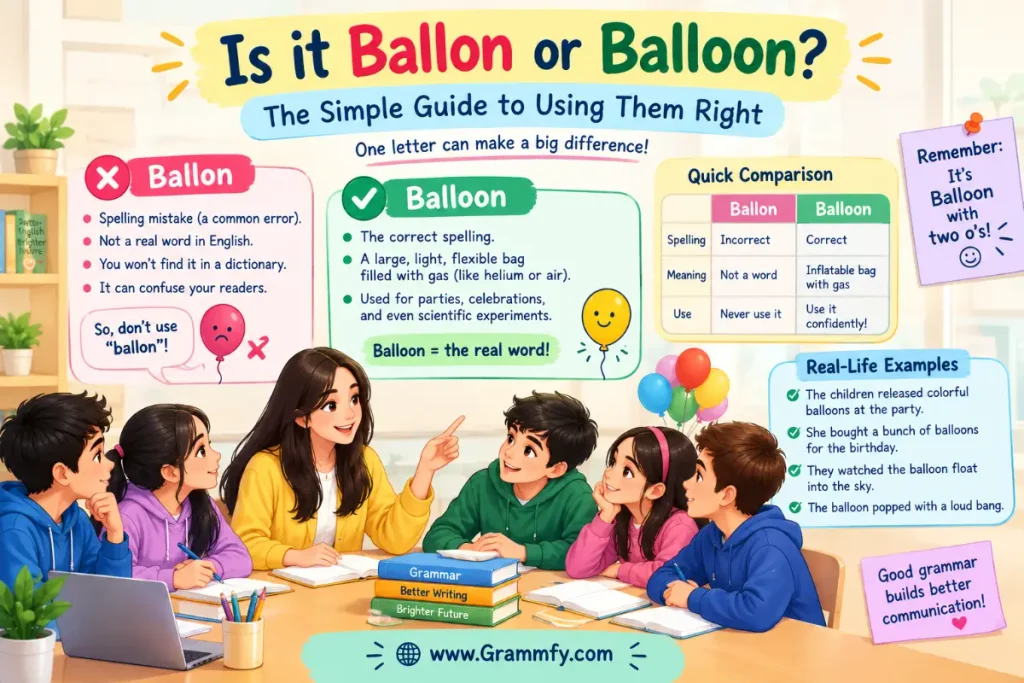
Is it Ballon or Balloon?
Balloon is the correct spelling in standard English when you mean an inflatable object filled with air or gas.
Ballon is generally a spelling mistake in English. If you are writing about a birthday party, a hot-air balloon, a balloon animal, or something that expands like a balloon, use balloon.
| Spelling | Correct in standard English? | Meaning |
|---|---|---|
| balloon | Yes | An inflatable object; also a verb meaning to expand or increase |
| ballon | No, in most English contexts | Usually a misspelling of “balloon” |
Why is balloon spelled with two o’s?
The word balloon contains two consecutive o’s before the final n:
B-A-L-L-O-O-N
A useful way to remember it is:
ball + oo + n = balloon
You can picture the two o’s as two round balloons.
The double o is important because changing the spelling to ballon removes one letter and creates a nonstandard spelling in ordinary English.
Is ballon ever a real word?
Yes, but there is an important distinction. Ballon can appear as a word or name in other languages or in specialized names, places, surnames, or historical contexts. That does not make it the normal English spelling for the inflatable object.
For everyday English, school writing, websites, business communication, and general conversation, choose balloon.
What does balloon mean?
The noun balloon usually means a flexible object that expands when filled with air, helium, or another gas.
For example:
- The children played with colorful balloons.
- She tied a red balloon to the chair.
- We released a helium balloon into the air.
The word can also describe a hot-air balloon, which is a large aircraft that rises because heated air inside it is less dense than the surrounding air.
The word has another useful meaning as a verb. To balloon means to become larger, increase quickly, or expand.
For example:
- The balloon ballooned as more air entered it.
- The project cost ballooned beyond the original budget.
- His workload ballooned after two coworkers left.
So, depending on the sentence, balloon can be a noun or a verb.
Where did the word balloon come from?
The English word balloon has a long history connected to the idea of something round, swollen, or inflated.
It entered English from French ballon, which was associated with a large ball or inflated object. The French form itself has roots connected with words for a ball. Over time, English developed the spelling balloon.
The history explains something that can confuse learners: ballon is not simply a random spelling. It resembles an older French form. However, modern standard English uses balloon for the common word.
This is why you may occasionally see ballon in foreign-language material or names while still needing balloon in an English sentence.
Does balloon come from ball?
The history of balloon is related to the idea of a ball or rounded object. The shape connection makes sense because an inflated balloon is usually round or oval.
That connection also gives you a helpful memory trick:
ball → balloon
Think of a small ball becoming larger as it fills with air.
Balloon as a noun: What does it describe?
As a noun, balloon can describe several things.
1. An inflatable party object
This is the meaning most people think of first.
We decorated the room with blue and yellow balloons.
2. A hot-air balloon
A hot-air balloon is a large aircraft that rises through the air.
We watched a hot-air balloon drift over the hills.
3. A gas-filled object
A balloon can be filled with helium or another gas.
The helium balloon floated toward the ceiling.
4. A balloon used for decoration
Balloons are common at birthdays, weddings, graduations, and other events.
She bought twenty balloons for the graduation party.
5. A rounded or swollen shape
The word can also describe something that looks inflated or expanded.
The fabric ballooned around the edges.
Balloon as a verb: What does it mean?
Many learners know balloon only as a noun. But it can also function as a verb.
When something balloons, it becomes much larger, often quickly.
Example 1: Costs
The cost of the repairs ballooned after the mechanic found another problem.
The cost did not literally become a balloon. It increased sharply.
Example 2: A workload
My workload ballooned during the final week of the project.
This means the amount of work increased a lot.
Example 3: A population
The city’s population ballooned over the next decade.
Here, ballooned means grew rapidly.
Example 4: A physical shape
The fabric ballooned in the strong wind.
In this sentence, the word describes something physically expanding or swelling.
What are synonyms for balloon?
There isn’t one perfect synonym for balloon because the word has several meanings. A party balloon, a hot-air balloon, and the verb to balloon need different alternatives.
The following list gives you more than 20 related words and expressions. Some are direct synonyms, while others are close alternatives that work in particular contexts.
Simple and everyday alternatives
| Word | Meaning | Tone | Example |
|---|---|---|---|
| Ball | A round object | Simple | The child threw the ball. |
| Bubble | A thin, round pocket of air or gas | Everyday | A bubble floated across the room. |
| Inflatable | Something designed to be filled with air | Everyday | We bought an inflatable toy. |
| Toy | An object used for play | Simple | The balloon was the child’s favorite toy. |
| Decoration | Something used to make a place attractive | Everyday | The balloons were party decorations. |
| Party decoration | An item used for a celebration | Casual | We need more party decorations. |
| Air-filled toy | A toy filled with air | Simple | The children played with an air-filled toy. |
| Helium balloon | A balloon filled with helium | Everyday | The helium balloon rose quickly. |
Formal and technical alternatives
| Word | Meaning | Tone | Example |
|---|---|---|---|
| Inflatable object | An object that expands when filled with air or gas | Formal | The inflatable object was stored safely. |
| Aerostat | An aircraft supported by a gas lighter than air | Technical | The aerostat remained above the field. |
| Airship | A powered aircraft that uses buoyant gas | Formal | The airship traveled slowly across the sky. |
| Blimp | A nonrigid airship | Technical/everyday | The blimp passed over the stadium. |
| Gas balloon | A balloon lifted by a lighter-than-air gas | Technical | The gas balloon climbed steadily. |
| Hot-air balloon | An aircraft lifted by heated air | Standard | The hot-air balloon landed safely. |
| Envelope | The fabric container holding lifting gas in an aerostat | Technical | The balloon’s envelope was inspected. |
| Inflatable vessel | A flexible structure filled with gas or air | Technical | The inflatable vessel expanded under pressure. |
Informal and descriptive alternatives
| Word | Meaning | Tone | Example |
|---|---|---|---|
| Floaty | Something light that floats | Casual | The room was filled with colorful floaties. |
| Party balloon | A balloon used for celebrations | Casual | She bought party balloons. |
| Inflatable | Something that can be inflated | Casual | The kids played with an inflatable. |
| Blow-up | Something inflated with air | Informal | He bought a blow-up decoration. |
| Floating decoration | A decoration that hangs or floats | Descriptive | A floating decoration was above the table. |
| Sky balloon | A general descriptive term | Informal | We watched a sky balloon rise. |
| Air-filled decoration | Decoration containing air | Descriptive | Each air-filled decoration was tied down. |
| Balloon animal | A balloon shaped like an animal | Everyday | The performer made a balloon animal. |
Alternatives for the verb balloon
| Word | Meaning | Tone | Example |
|---|---|---|---|
| Expand | Become larger | Neutral | The material expanded in the heat. |
| Grow | Become larger or greater | Neutral | The business grew quickly. |
| Increase | Become greater in amount | Formal | Expenses increased sharply. |
| Rise | Move or become higher | Neutral | Prices rose during the summer. |
| Swell | Become larger or fuller | Descriptive | The river swelled after the storm. |
| Inflate | Fill with air or increase in size | Neutral | The tire began to inflate. |
| Escalate | Increase quickly, often in seriousness | Formal | The conflict escalated. |
| Surge | Increase suddenly and strongly | Strong | Demand surged after the announcement. |
| Soar | Rise very quickly or reach a high level | Strong | Housing costs soared. |
| Mushroom | Grow or spread very quickly | Informal | The number of complaints mushroomed. |
Which synonym should you use?
The best alternative depends on what you mean.
If you’re talking about a birthday decoration, inflatable object, party balloon, or helium balloon may work.
If you’re describing a business cost that rises quickly, surge, soar, increase, or escalate may be better.
For example:
The cost ballooned after the company changed suppliers.
You could write:
The cost soared after the company changed suppliers.
But you wouldn’t normally replace balloon with soar when talking about a birthday decoration.
That is why synonyms should be chosen by meaning rather than by dictionary matching alone.
Balloon synonyms by intensity: Mild to strong
When balloon is used as a verb, it often suggests noticeable or rapid growth. Different words communicate different levels of change.
| Intensity | Word | Example |
|---|---|---|
| Mild | Grow | The company grew slowly. |
| Mild | Increase | Prices increased slightly. |
| Moderate | Expand | The business expanded into new areas. |
| Moderate | Rise | Costs rose during the year. |
| Strong | Swell | The crowd swelled after the concert. |
| Strong | Surge | Online orders surged overnight. |
| Strong | Soar | Energy prices soared. |
| Very strong | Skyrocket | The price skyrocketed after demand increased. |
| Very strong | Balloon | The budget ballooned far beyond expectations. |
Balloon vs increase
Increase is neutral. It simply tells the reader that something became larger or greater.
Balloon often suggests that the increase was large, unexpected, or difficult to control.
Compare:
The budget increased.
This is neutral.
The budget ballooned.
This suggests a much bigger or more noticeable increase.
Balloon vs soar
Soar often emphasizes reaching a high level.
Prices soared.
Balloon emphasizes expansion in size or amount.
Expenses ballooned.
Both can describe rapid growth, but their tone is slightly different.
What part of speech is balloon?
Balloon can be both a noun and a verb.
Noun
A noun names the object.
The balloon popped.
Verb
A verb describes an action or change.
The costs ballooned.
Here are common forms:
| Form | Example |
|---|---|
| balloon | The balloon is red. |
| balloons | The balloons are red. |
| ballooned | The costs ballooned. |
| ballooning | Ballooning expenses caused concern. |
This flexibility makes balloon useful in both everyday and formal writing.
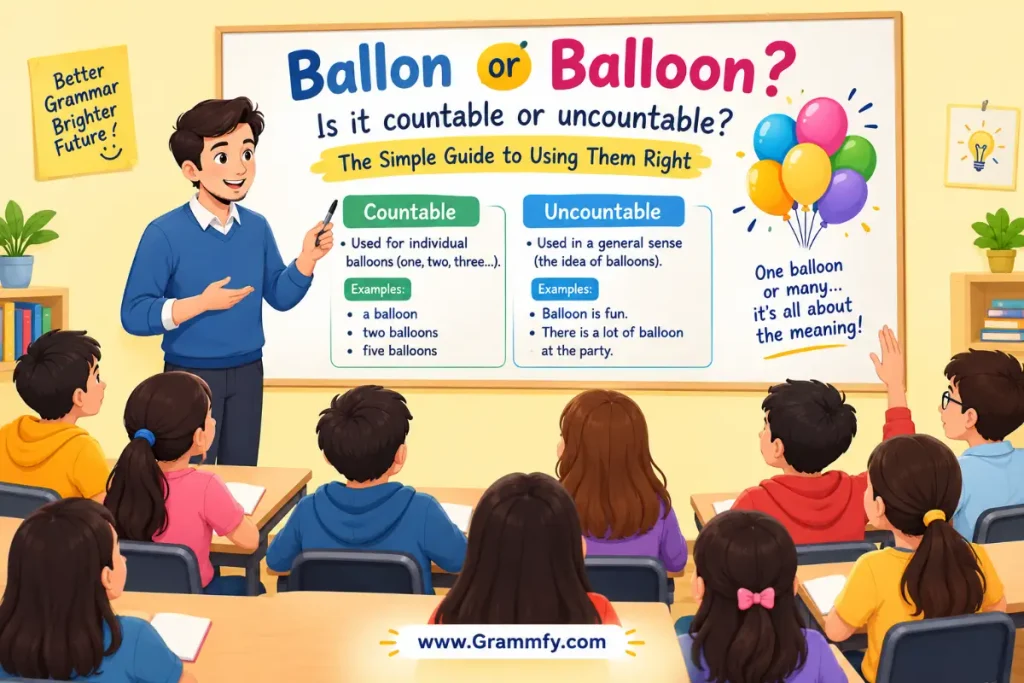
Is balloon countable or uncountable?
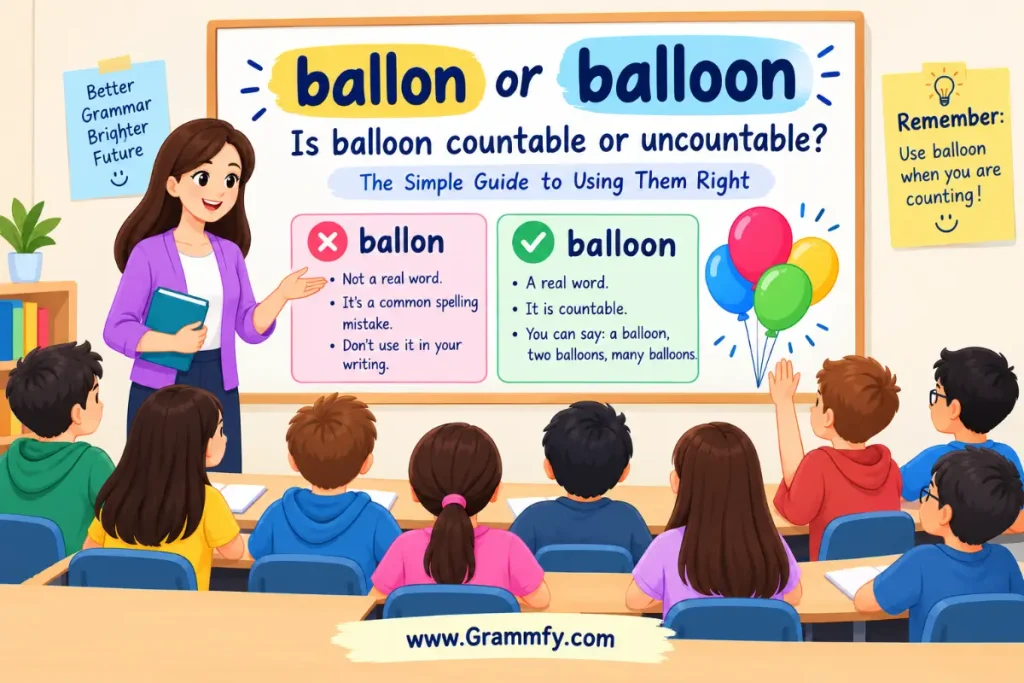
When referring to the physical objects, balloon is normally a countable noun.
You can say:
- one balloon
- two balloons
- five balloons
- many balloons
- several balloons
For example:
We bought six balloons.
You generally wouldn’t say:
We bought six balloon.
The plural form is balloons.
What is the plural of balloon?
The plural is balloons.
The spelling is:
balloon → balloons
The double o stays in the plural.
Examples:
The room was filled with balloons.
We need three more balloons.
The children carried colorful balloons.
What is the past tense of balloon?
The simple past tense is ballooned.
Examples:
The ballooned budget caused problems.
Our expenses ballooned during the trip.
The workload ballooned after the deadline changed.
The present participle is ballooning:
Ballooning costs forced the company to reconsider the plan.
Is balloon correct in American English?
Yes. Balloon is the standard spelling in American English.
Examples include:
- balloon
- balloons
- ballooning
- ballooned
- balloon ride
- balloon animal
- hot-air balloon
- balloon payment
The same spelling is also standard in British English.
Is there a US vs UK spelling difference?
There is no major US-versus-UK spelling difference for balloon.
Both American and British English use:
balloon
You may encounter ballon in French or in other contexts, but that does not change the normal English spelling.
This is different from words such as color/colour or center/centre, where American and British spelling can differ.
With balloon, you can use the same spelling in both varieties of English.
What word is best for a resume Ballon or Balloon?
For a resume, balloon is usually relevant only when you’re describing something that increased rapidly.
For example:
Managed a growing budget that ballooned from $50,000 to $90,000.
However, a professional resume may benefit from a more precise word.
Instead of:
Helped control ballooning expenses.
You might write:
Reduced rapidly increasing expenses by 15%.
The second version gives the reader a measurable result.
Best resume choices
Use:
- increased
- expanded
- grew
- reduced
- controlled
- managed
- accelerated
- scaled
Choose the word that explains the actual result.
What word is best for an essay Ballon or Balloon?
In an essay, balloon can be useful when you want to describe rapid growth.
For example:
The city’s population ballooned after new industries arrived.
If your essay is formal, expanded, increased, or grew rapidly may sometimes sound more neutral.
Use ballooned when you want the increase to feel unusually large or sudden.
Essay example
After the new highway opened, the town’s population ballooned, creating pressure on schools and public transportation.
This sentence works because ballooned communicates fast, substantial growth.
What word is best for texting Ballon or Balloon?
In texting, balloon is perfectly normal when you’re talking about an actual balloon.
Don’t forget to bring the balloons!
The balloon popped 😂
I need pink balloons for the party.
You don’t need a more formal synonym in casual messages.
If you’re talking about an increase, you can also use informal words such as:
- grew
- shot up
- went up
- blew up
For example:
The price shot up overnight.
That sounds more casual than:
The price ballooned overnight.
What word is best for an email Ballon or Balloon?
In professional email, choose based on your meaning.
For an actual object:
Please bring the balloons for Friday’s event.
For an increase:
Our project costs have increased significantly.
If the increase was unusually large:
Project costs have ballooned because of the additional materials.
The last sentence is stronger and suggests that the increase is concerning.
What word is best for speaking Ballon or Balloon?
In everyday speech, balloon is easy and natural.
You can say:
Look at that balloon!
Or:
The price of gas has ballooned.
When speaking, the context usually makes the meaning clear.
12+ examples of balloon in real situations
Here are practical examples from school, work, parties, travel, and everyday life.
1. Birthday party
We filled the living room with colorful balloons before the guests arrived.
2. School event
Each student received a balloon at the end of the school festival.
3. Hot-air balloon ride
They booked a hot-air balloon ride during their vacation.
4. Balloon animal
The entertainer made a balloon dog for the children.
5. Helium balloon
The helium balloon floated near the ceiling.
6. Decorating a room
She tied a balloon to every chair.
7. A balloon popping
The balloon popped when it touched the sharp corner.
8. Business expenses
The company’s expenses ballooned after the expansion.
9. A growing workload
My workload ballooned when three new projects started.
10. A growing population
The population ballooned as more families moved into the area.
11. Increasing demand
Demand for the product ballooned after the company launched its new campaign.
12. Rising costs
Construction costs ballooned because of supply shortages.
13. A physical shape
The curtain ballooned in the wind.
14. A science lesson
The teacher used a balloon to demonstrate how air takes up space.
15. A children’s game
The children tried to keep the balloon from touching the floor.
Balloon vs inflatable: What’s different?
Balloon and inflatable are related, but they aren’t always interchangeable.
A balloon is a particular type of flexible object that is usually filled with air or gas.
Inflatable is a broader term. It can describe many objects that expand when filled with air.
For example:
We bought an inflatable pool.
You wouldn’t normally call it a balloon.
Likewise:
She held a red balloon.
You could describe the balloon as an inflatable object, but balloon is much more specific.
| Balloon | Inflatable |
|---|---|
| Specific type of object | Broad category |
| Usually small or designed to float | Can be very large |
| Common at parties | Used for pools, boats, toys, decorations, and more |
| Filled with air or gas | Usually filled with air |
Balloon vs bubble: What’s different?
A bubble is a thin layer of liquid surrounding air or gas. A balloon is a flexible container that holds air or another gas.
Compare:
The child blew a bubble.
The child inflated a balloon.
A bubble usually disappears when its thin surface breaks. A balloon can remain inflated because its material holds the air inside.
These words are related to round, inflated shapes, but they describe different things.
Balloon vs blimp: What’s different?
A balloon is a broad term for a gas- or air-filled object.
A blimp is a specific type of airship. It is powered and designed to travel through the air.
For example:
We saw a balloon floating above the field.
This could refer to a recreational or hot-air balloon.
We saw a blimp above the stadium.
A blimp is a large airship, often seen at sporting events.
So blimp can be related to balloon, but the words are not interchangeable in every sentence.
Balloon vs airship: What’s different?
An airship is a powered aircraft that stays aloft using buoyant gas.
A balloon generally relies on buoyancy and isn’t necessarily powered in the same way.
A hot-air balloon, for example, is controlled mainly by heating the air and adjusting its altitude. An airship can use engines for controlled movement.
For everyday writing, use the more specific term when you know exactly what you’re describing.
Common spelling mistakes with balloon
Because balloon contains repeated letters, it can be easy to misspell.
Mistake 1: Writing ballon
Incorrect:
I bought a red ballon.
Correct:
I bought a red balloon.
Mistake 2: Writing baloon
Incorrect:
The baloon popped.
Correct:
The balloon popped.
Mistake 3: Writing ballooon
Incorrect:
The ballooon floated away.
Correct:
The balloon floated away.
The standard spelling has:
two l’s + two o’s
Think:
ba + ll + oo + n
Why do people spell balloon incorrectly?
Several factors can cause this mistake.
First, English spelling isn’t always predictable. Learners can’t always know how many repeated letters a word needs.
Second, people often type quickly. When a word contains repeated letters, one may be skipped.
Third, ballon looks believable because it resembles the French word ballon.
Finally, pronunciation doesn’t clearly tell you that there are two o’s. The spelling has to be learned.
When should you NOT use balloon?
Don’t use balloon simply because something is large or round.
For example, if you mean that a business expanded, you can say:
The company expanded.
You don’t need balloon unless you want to emphasize rapid or excessive growth.
Also, don’t call every inflatable object a balloon.
A swimming pool, inflatable mattress, and inflatable boat are not normally called balloons.
Avoid balloon when precision matters
In technical writing, choose the exact term.
For example, instead of:
The flying balloon carried passengers.
You might write:
The hot-air balloon carried passengers.
The second sentence gives the reader more information.
Common mistakes beyond spelling
Mistake: Using balloon as a synonym for every type of growth
Not every increase is a ballooning increase.
The temperature increased by one degree.
This doesn’t necessarily need ballooned.
But:
The project’s cost ballooned from $20,000 to $80,000.
Here, the stronger word fits.
Mistake: Using balloon when the increase is positive
Balloon often carries a negative or concerning feeling when used for costs, debts, or problems.
Compare:
Our savings grew.
This sounds positive.
Our savings ballooned.
This may sound unusual because balloon isn’t the natural choice for every kind of positive growth.
Mistake: Confusing balloon with ballooning
Choose balloon as the base verb:
Costs balloon quickly.
Use ballooned for the past:
Costs ballooned last year.
Use ballooning for an ongoing or descriptive form:
Ballooning costs are affecting the project.
Antonyms of balloon
The opposite of balloon depends on how you’re using the word.
If balloon means “increase quickly,” possible opposites include:
- decrease
- shrink
- decline
- fall
- contract
- reduce
- diminish
- drop
- lessen
- stabilize
Examples:
Expenses ballooned.
Opposite idea:
Expenses decreased.
Or:
The market ballooned.
Opposite:
The market contracted.
If you’re talking about an actual balloon, the opposite process might be:
- deflate
- collapse
- shrink
- flatten
For example:
The balloon inflated.
Opposite:
The balloon deflated.
Quick tips for remembering the spelling “Ballon or Balloon”
Here are simple ways to remember balloon.
Tip 1: Remember “two O’s”
The easiest trick is:
ball + oo + n
The two o’s look like two small balloons.
Tip 2: Break the word into parts
Say it mentally as:
bal-loon
Then remember the spelling:
balloon
Tip 3: Connect it with “ball”
A balloon is related in shape to a ball.
Think:
ball → balloon
Both start with ball.
Tip 4: Picture two balloons
Imagine two round balloons side by side.
Those two round shapes can remind you of the two o’s in:
balloon
Tip 5: Check the word before publishing
If you’re unsure while writing, look at the word carefully:
balloon
Not:
ballon
Not:
baloon
A simple memory trick for students
Try this sentence:
A balloon has two round O’s.
The two O’s can represent two small balloons.
So when you’re unsure, remember:
ball + OO + n = balloon
This works well for school assignments, spelling tests, and quick writing.
How to check your sentence
When you’re deciding whether balloon fits your sentence, ask three questions:
- Am I talking about an inflatable object?
- Am I describing something that expanded or increased quickly?
- Have I spelled it with two o’s?
When the answer to the first question is yes, balloon is probably the word you need.
If you’re describing rapid growth, balloon may work as a verb.
If you’re describing a different object or a simple increase, another word may be more precise.
Balloon in common expressions
The word appears in several common English expressions and combinations.
Hot-air balloon
A large aircraft lifted by heated air.
We watched a hot-air balloon rise at sunrise.
Balloon animal
A balloon twisted into a shape such as a dog, flower, or sword.
The clown made a balloon animal for the child.
Balloon ride
A trip in a balloon, usually a hot-air balloon.
They went on a balloon ride during their vacation.
Balloon payment
A large final payment that can be part of certain loan arrangements.
The agreement included a balloon payment at the end of the term.
Balloon effect
A term used in different fields for a situation where pressure or activity shifts from one area to another rather than disappearing.
The researchers described the change as a balloon effect.
These expressions show why learning the correct spelling matters. One small spelling error can affect many related phrases.
How balloon works in formal writing
Balloon is not automatically informal.
The noun is completely normal in formal writing when you’re discussing actual balloons, aircraft, science, or related subjects.
The verb is also acceptable in formal writing when it accurately describes rapid growth.
For example:
Government spending ballooned during the emergency.
This is grammatically correct and natural.
However, formal writing sometimes benefits from more precise language.
Instead of:
The number of users ballooned.
You could write:
The number of users increased by 45%.
If you have exact data, the number gives the reader more useful information.
Balloon in science and education
Teachers often use balloons to explain basic scientific ideas.
A balloon can demonstrate that air takes up space. It can also help students understand pressure, volume, and the behavior of gases.
For example:
The teacher stretched a balloon over the mouth of a bottle to demonstrate how air occupies space.
Balloons can also be used in simple experiments involving temperature and gas expansion.
This makes balloon a common word in educational materials.
Balloon in technology and design
The idea of a balloon has also influenced visual design.
Speech bubbles in comics and digital interfaces are sometimes called speech balloons or speech bubbles.
A speech balloon contains words spoken by a character.
For example:
The comic artist placed the character’s words inside a speech balloon.
In many modern contexts, speech bubble is more common, but speech balloon is still a recognized term.
Balloon in finance and business
The verb balloon is especially useful when describing costs, debt, or expenses that grow much more than expected.
Examples:
The project’s budget ballooned after several delays.
Medical expenses ballooned during the year.
The company’s debt ballooned after the acquisition.
In these examples, ballooned communicates more than simple growth. It suggests that the increase became unusually large.
For professional writing, however, consider whether the word matches your intended tone.
If you want neutral language, use:
increased significantly
If you want to emphasize an alarming increase, use:
ballooned
A quick comparison table about “Ballon or Balloon”
| Word | Main meaning | Example |
|---|---|---|
| Balloon | Inflatable object | The balloon popped. |
| Inflatable | Object filled with air | The inflatable pool was large. |
| Bubble | Thin liquid film around gas | The bubble burst. |
| Blimp | Nonrigid airship | The blimp flew over the stadium. |
| Airship | Powered buoyant aircraft | The airship traveled across the region. |
| Expand | Become larger | The company expanded. |
| Increase | Become greater | Costs increased. |
| Surge | Rise suddenly | Demand surged. |
| Soar | Rise very high or quickly | Prices soared. |
| Inflate | Fill with air or expand | She inflated the tire. |
| Shrink | Become smaller | The material shrank. |
| Deflate | Release air from something | The balloon deflated. |
Final checklist before you use the word
Before submitting an essay, sending an email, or publishing a page, check these points:
- Balloon is the standard English spelling.
- It contains two l’s.
- It contains two o’s.
- Ballon is usually incorrect when you mean the inflatable object.
- Balloon can be a noun.
- Balloon can also be a verb.
- Ballooned is the past tense.
- Ballooning describes an ongoing increase.
- Use increase, expand, or grow when you want a neutral description.
- Use surge, soar, or skyrocket when you want to emphasize a strong increase.
- Use deflate when describing a balloon losing air.
- Use a specific term such as hot-air balloon, blimp, or airship when precision matters.
Conclusion
The correct spelling is balloon, with two l’s and two o’s. Ballon is usually a spelling mistake when you’re writing standard English about an inflatable object. The word can be used as both a noun and a verb: you can hold a balloon, or you can say that costs ballooned when they increased quickly.
Remember the simple pattern ball + oo + n. The two o’s can remind you of two round balloons. When choosing a related word, focus on your meaning. Use inflatable for a broader category, blimp for a specific type of airship, and words such as expand, surge, or soar when describing growth.
Once you remember the double o’s, this spelling becomes much easier.
Frequently Asked Questions
Is ballon or balloon the correct spelling?
Balloon is the correct standard English spelling for the inflatable object. Ballon is generally a misspelling in English.
Why does balloon have two o’s?
The spelling balloon developed through its history in English and French, and the standard English form uses two o’s. A simple memory trick is to think of the two o’s as two round balloons.
What’s another way to say balloon?
Another word depends on the meaning. For an inflatable object, you can use terms such as inflatable object or helium balloon; for rapid growth, words such as expand, surge, and soar may work.
Is balloon the same in American and British English?
Yes. Balloon is the standard spelling in both American and British English. There is no major US/UK spelling difference for this word.
Can balloon be used as a verb?
Yes, balloon can be a verb meaning to expand or increase rapidly. For example, “The project’s costs ballooned after the delay.”
What is the plural of balloon?
The plural is balloons. For example, “The children carried colorful balloons.”
What is the opposite of balloon?
When balloon means to increase rapidly, possible opposites include shrink, decrease, decline, and contract. When talking about an inflated object, deflate is a natural opposite.
