
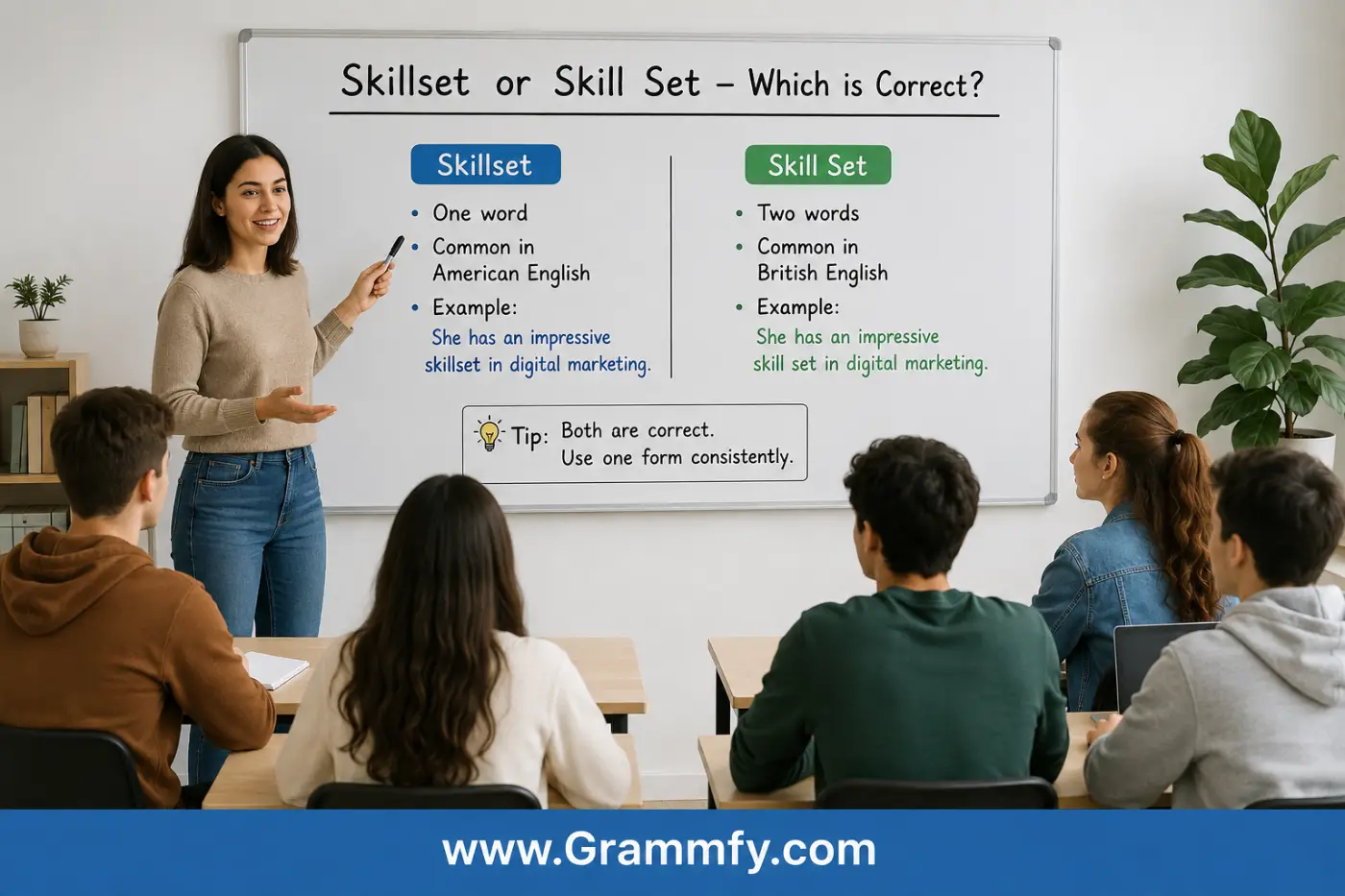
You’re writing a resume, updating your LinkedIn profile, or finishing an essay, and you stop at one small question: skillset or skill set? Both forms appear online, so it can be hard to know which one belongs in polished English.
The good news is that the answer is fairly simple. Skill set is the traditional and widely accepted two-word form in standard English. Skillset is also used, especially in modern business and workplace writing, but many style guides and editors still prefer the two-word version.
“Skill set” is the safest choice in formal English. “Skillset” is also used as a closed compound noun, especially in business and professional writing.
This guide explains the difference, the history of the expression, how each form works in a sentence, and which choice makes the most sense for resumes, essays, emails, texting, and everyday speech. You’ll also find examples, related terms, common mistakes, and quick rules you can remember.
If you’re learning how to use comparisons effectively, take a look at [similes for complex ideas].
Is Skillset or Skill Set correct?
Both skill set and skillset can be found in English, but skill set is the safer and more established choice, especially in formal writing.
The expression skill set is made from two familiar words:
- skill = an ability or learned talent
- set = a group or collection
Together, skill set means a group of skills that a person has.
For example:
She has a strong skill set in digital marketing.
You may also see:
She has a strong skillset in digital marketing.
The second version is increasingly common, particularly in workplace and business language. However, if you’re writing a school essay, formal application, academic document, or professional material and you want the least controversial spelling, skill set is a good choice.
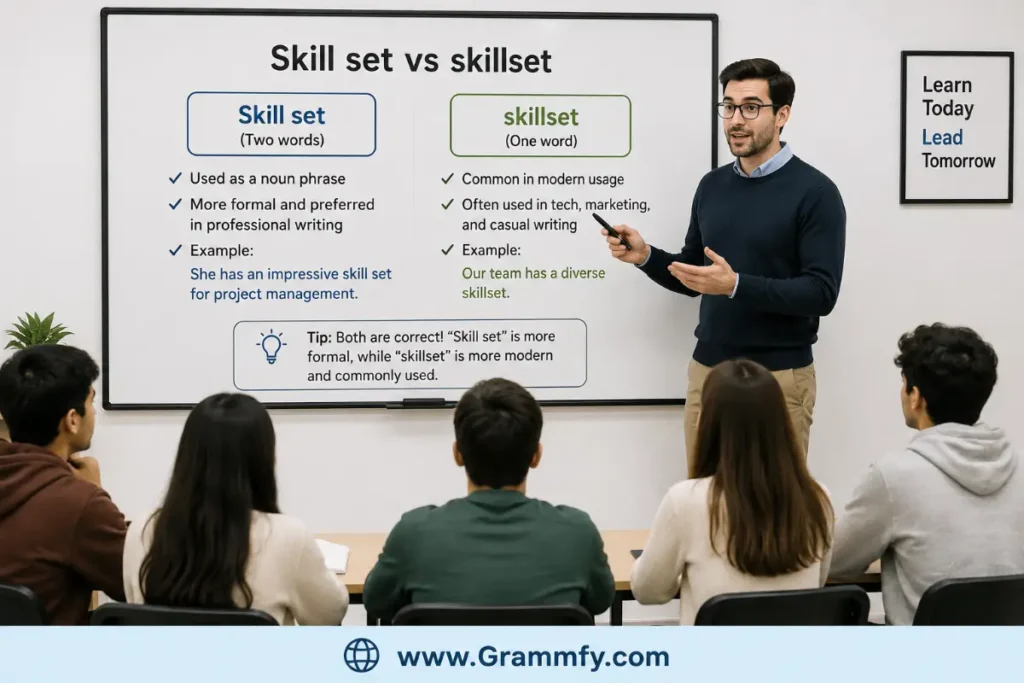
Skill set vs skillset at a glance
| Form | Status | Best use |
|---|---|---|
| skill set | Traditional, widely accepted | Formal, academic, professional writing |
| skillset | Common modern compound form | Business, workplace, informal professional writing |
| skills set | Usually incorrect for the intended meaning | Avoid |
| skill- set | Incorrect spacing | Avoid |
The important point is that skill set is not a different concept from skillset. They usually refer to the same idea.
What does skill set mean in plain English?
A skill set is a group of abilities that someone has developed.
For example, a web designer might have a skill set that includes:
- graphic design
- HTML
- CSS
- user experience design
- image editing
- communication
A teacher might have a different skill set:
- classroom management
- lesson planning
- public speaking
- assessment
- communication
- organization
So, a skill set isn’t one individual ability. It refers to several related abilities considered together.
Simple definition
Skill set = a collection or group of skills that a person has.
For example:
Her skill set includes writing, editing, and research.
This tells us that she has several abilities rather than just one.
What is the difference between a skill and a skill set?
A skill is one ability.
A skill set is a collection of abilities.
| Term | Meaning | Example |
|---|---|---|
| Skill | One learned ability | Writing |
| Skill set | A group of abilities | Writing, editing, and research |
| Talent | Natural or developed ability | Strong musical ability |
| Expertise | Advanced knowledge or ability | Expertise in accounting |
| Competency | Ability to perform a task effectively | Project management competency |
Compare these sentences:
Editing is one of her strongest skills.
This focuses on one ability.
Editing, writing, and research are part of her skill set.
This focuses on several abilities together.
That distinction is useful when you’re writing a resume or describing someone’s professional background.
Where did the phrase skill set come from?
The expression skill set is a compound noun formed from the words skill and set.
The word skill has a long history in English. It developed from older Germanic language forms associated with knowledge, discernment, and the ability to do something well.
The word set also has a very long history and has many meanings. One of those meanings involves a collection or group of related things. We see the same idea in expressions such as:
- a set of tools
- a set of rules
- a set of instructions
- a set of skills
When the two words are combined, skill set naturally means a collection of skills.
Over time, compound nouns in English often change from two words to hyphenated forms and then sometimes to one word. This is why you may see both skill set and skillset in modern writing.
The spelling hasn’t changed the basic meaning.
Why do people write skillset as one word?
English frequently turns common word combinations into compound words.
For example:
- data base → database
- web site → website
- work place → workplace
- team work → teamwork
Some combinations remain open:
- school bus
- high school
- coffee table
Others can appear in more than one form depending on usage and style.
Skillset has become increasingly common because people often treat it as a single business term. Professional writing, job descriptions, marketing pages, and workplace conversations frequently use the closed form.
However, frequency doesn’t always mean that every style guide treats a form as equally preferred.
That’s why skill set remains the safest choice when you’re unsure.
Is skillset one word or two words?
In careful standard writing, skill set is traditionally written as two words.
However, skillset is also widely used as a closed compound in modern English.
If you’re asking which form to choose for a formal document, use:
skill set
If you’re writing casually or following a workplace’s preferred terminology, skillset may be acceptable.
The key is consistency. Don’t switch randomly between the two forms in the same document.
Is skillset or skill set more common?
Usage varies by source, industry, and writing style.
Skill set has a long-established presence in English and remains common in edited writing. Skillset has become popular in modern workplace, technology, recruitment, and business language.
You may notice skillset frequently in:
- job advertisements
- career websites
- business blogs
- professional profiles
- technology articles
- recruitment content
This doesn’t mean the two-word form is outdated. In many formal contexts, skill set remains the preferred choice.
Should I write skill set on a resume?
For a resume, skill set is a safe and professional choice.
However, you don’t always need the phrase itself. A resume is usually stronger when it names the actual skills.
Instead of:
Strong skill set in digital marketing.
You could write:
Digital Marketing Skills: SEO, content writing, keyword research, analytics, and social media.
The second version gives the employer specific information.
When skill set works on a resume
You can use it in a summary:
Marketing professional with a diverse skill set in SEO, content strategy, and analytics.
You can also use it in a cover letter:
My skill set combines technical writing with digital marketing experience.
When specific skills are better
Instead of:
I have an excellent skill set.
Write:
I have strong skills in SEO, WordPress, and content writing.
The second sentence is more informative because it tells the reader exactly what you can do.
Should I write skill set in an essay?
Skill set works well in essays when you’re discussing education, employment, training, or professional development.
For example:
Higher education can help students develop a broad skill set for future careers.
Another example:
Volunteer work helped him build a useful skill set that included leadership and communication.
For academic writing, you can sometimes choose more precise terms such as skills, competencies, or abilities.
The best choice depends on your subject.
What is the best form for texting “Skill set or skillset”?
In a text message, either form is understandable.
For example:
You have a great skill set!
Or:
You have a great skillset!
Because texting is informal, most readers won’t focus on the spacing.
Still, if you’re trying to develop strong English habits, skill set is a useful form to remember.
What is the best form for email “Skill set or skillset”?
For a professional email, skill set is a safe choice.
For example:
My skill set matches the requirements of the position.
Or:
I believe my skill set would be useful for this project.
If you’re writing to a friend or coworker in a casual conversation, skillset is unlikely to cause confusion.
The bigger issue in professional email isn’t usually the spacing. It’s whether the sentence clearly communicates what you can do.
What is the best form for speaking “Skill set or skillset”?
When speaking, you don’t need to worry about whether the phrase is written as one word or two.
Both forms sound the same when spoken.
You might say:
She has a strong skill set.
Or:
He has the right skill set for the job.
Because pronunciation doesn’t reveal the spelling, this question mainly matters when you’re writing.
What are synonyms for skill set?
There are many ways to describe a group of abilities. The best alternative depends on your audience and the type of writing.
Simple and everyday alternatives
| Word or phrase | Meaning | Tone | Example |
|---|---|---|---|
| Skills | Abilities someone has | Simple | She has strong writing skills. |
| Abilities | Things someone can do | Neutral | His abilities include problem-solving. |
| Strengths | Areas where someone performs well | Everyday | Communication is one of her strengths. |
| Talents | Natural or developed abilities | Positive | Music is one of his talents. |
| Know-how | Practical knowledge | Casual | She has the technical know-how. |
| Capabilities | Things someone is able to do | Neutral | The team has strong capabilities. |
| Experience | Knowledge gained through doing something | Everyday | He has experience in sales. |
| Knowledge | Information someone understands | Neutral | She has strong technical knowledge. |
Formal and professional alternatives
| Word or phrase | Meaning | Tone | Example |
|---|---|---|---|
| Competencies | Abilities needed to perform effectively | Formal | Leadership is a key competency. |
| Expertise | Advanced knowledge or skill | Formal | She has expertise in cybersecurity. |
| Qualifications | Skills, education, or credentials that make someone suitable | Formal | His qualifications match the role. |
| Proficiencies | Areas in which someone is skilled | Formal | Her proficiencies include Excel and SQL. |
| Capabilities | Skills or abilities that allow action | Professional | The team has strong technical capabilities. |
| Core competencies | Main professional strengths | Formal | Communication is a core competency. |
| Professional strengths | Important abilities in a career | Professional | Writing is one of her professional strengths. |
| Technical abilities | Skills involving technology or technical work | Professional | His technical abilities are impressive. |
Workplace and business alternatives
| Word or phrase | Meaning | Tone | Example |
|---|---|---|---|
| Core skills | Most important abilities | Professional | Leadership is one of her core skills. |
| Transferable skills | Skills useful across different jobs | Professional | Communication is a transferable skill. |
| Technical skills | Job-specific technical abilities | Professional | Coding is a technical skill. |
| Soft skills | Interpersonal and personal-work abilities | Professional | Teamwork is an important soft skill. |
| Professional skills | Abilities used at work | Professional | She developed strong professional skills. |
| Job skills | Abilities needed for employment | Everyday | The course teaches job skills. |
| Career skills | Abilities useful for career growth | Professional | The program builds career skills. |
| Work skills | Abilities used in the workplace | Simple | The workshop improves work skills. |
Informal alternatives
| Word or phrase | Meaning | Tone | Example |
|---|---|---|---|
| Know-how | Practical understanding | Informal | He has the know-how to fix it. |
| Strengths | Things someone does well | Casual | Writing is one of my strengths. |
| What you can do | A person’s abilities | Very casual | Show employers what you can do. |
| Abilities | Things a person can do | Neutral | Her abilities are impressive. |
| Toolkit | A collection of useful abilities or methods | Informal/metaphorical | Communication is part of his toolkit. |
| Bag of tricks | A collection of useful methods | Casual | She has a great bag of tricks for teaching. |
Which synonym is strongest?
Not every synonym has the same meaning.
For example, skills is broad and simple.
Expertise suggests a high level of knowledge or ability.
Competencies sounds more formal and is common in human resources.
Qualifications can include more than skills. They may include education, certifications, training, and experience.
Strengths focuses on areas where a person performs particularly well.
Choosing the right term makes your writing more accurate.
Synonyms by intensity: mild to strong
Different words can suggest different levels of ability.
| Level | Term | What it suggests |
|---|---|---|
| Mild | Skills | General ability |
| Mild | Abilities | General capacity |
| Moderate | Capabilities | Ability to perform tasks |
| Moderate | Proficiency | Good working ability |
| Strong | Competency | Effective performance |
| Strong | Expertise | Advanced knowledge |
| Very strong | Mastery | Very high level of ability |
| Very strong | Specialization | Deep focus in one area |
| Very strong | Expert knowledge | Advanced understanding |
For example:
She has skills in graphic design.
This is neutral.
She has proficiency in graphic design.
This suggests a stronger level of ability.
She has expertise in graphic design.
This suggests advanced knowledge and experience.
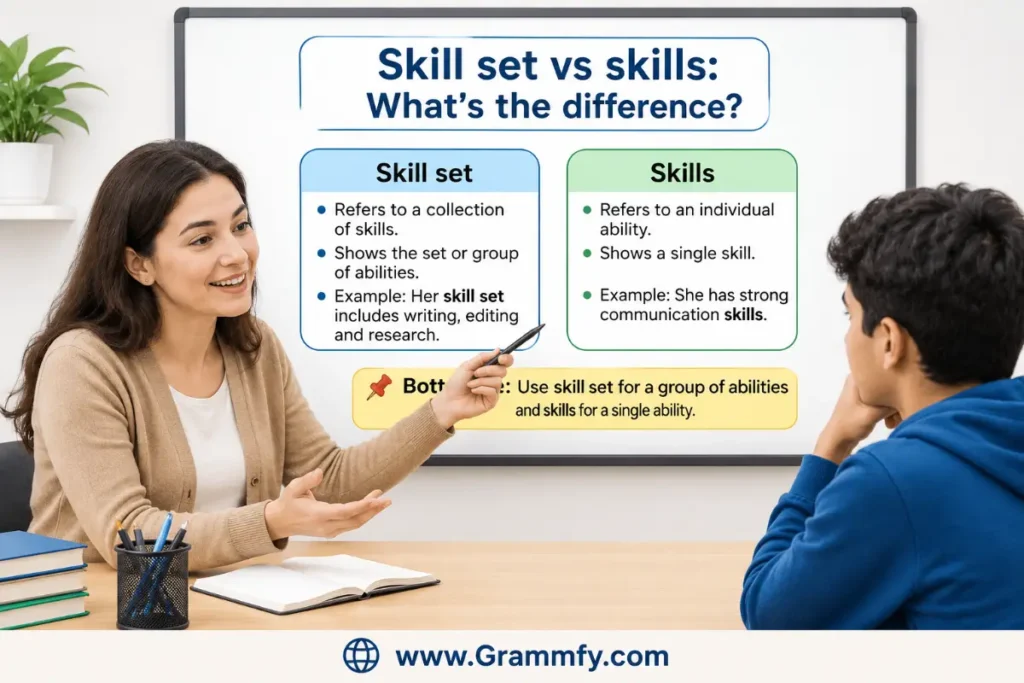
Skill set vs skills: What’s the difference?
Skills can refer to individual abilities or a general collection of abilities.
Skill set specifically emphasizes a group of related abilities considered together.
Compare:
She has excellent communication skills.
This can focus on several forms of communication ability.
Her skill set includes communication, leadership, and project management.
The second sentence gives a broader picture of several abilities.
Which one should you choose?
Use skills when you want a simple, direct term.
Use skill set when you want to describe a collection of abilities as a package.
Skill set vs expertise: What’s different?
Skill set doesn’t necessarily mean advanced ability.
Someone can have a skill set that includes beginner-level skills.
Expertise usually suggests deep knowledge or advanced ability.
Compare:
His skill set includes Python and data analysis.
This tells us what he can do.
His expertise is in machine learning.
This suggests a high level of knowledge.
Don’t call something expertise unless the person’s experience supports that level.
Skill set vs competency: What’s different?
Competency often refers to the ability to perform a task effectively, especially in professional or organizational settings.
A skill set is broader.
For example:
Her skill set includes writing, editing, research, and communication.
A competency might be:
Her communication competency helps her manage client relationships.
Competency is especially common in:
- human resources
- training
- education
- management
- performance reviews
For simple writing, skills is often easier for readers to understand.
Skill set vs qualifications: What’s different?
These terms are related but not interchangeable.
Qualifications can include:
- degrees
- certifications
- training
- work experience
- professional licenses
- relevant skills
A skill set focuses mainly on abilities.
For example:
His qualifications include a degree in accounting and five years of experience.
His skill set might include:
financial analysis, budgeting, auditing, and spreadsheet management.
Qualifications explain why someone is suitable. A skill set describes what the person can do.
Skill set vs talent: What’s different?
A talent often suggests a natural ability or an ability developed to a high level.
A skill is usually learned or developed through practice.
For example:
She has a talent for music.
But:
She developed a skill set in audio production.
The words can overlap, but they emphasize different ideas.
Skill set by part of speech
The phrase skill set is a noun phrase.
It normally acts as a noun in a sentence.
Subject
Her skill set is impressive.
Here, skill set is the subject.
Object
The company values his skill set.
Here, skill set is the object of the verb values.
After a preposition
The position requires a strong skill set.
The phrase follows the adjective strong.
Possessive form
My skill set includes writing and editing.
You can also say:
Her skill set is different from mine.
How do you pluralize skill set?
The standard plural is:
skill sets
For example:
Different careers require different skill sets.
You pluralize set, not skill.
Correct:
The course helps students develop useful skill sets.
Incorrect:
The course helps students develop useful skills sets.
The second version changes the structure and doesn’t express the intended compound noun correctly.
15+ real examples of skill set
Here are examples from different situations.
Education
The course helps students develop a practical skill set.
Job application
My skill set matches the requirements listed in the job description.
Marketing
Her skill set includes SEO, content writing, and social media management.
Technology
The developer has a strong skill set in Python and database design.
Management
Good managers need a skill set that includes communication and decision-making.
Healthcare
The position requires a specialized skill set.
Customer service
His skill set makes him well suited to customer support.
Career change
She is building a new skill set for a career in technology.
Freelancing
Freelancers often need a broad skill set to handle different clients.
Teamwork
Each team member brings a different skill set to the project.
Leadership
Leadership requires a skill set that goes beyond technical knowledge.
Education technology
Teachers need a modern skill set to work effectively with digital tools.
Writing
A strong writer’s skill set may include research, editing, and communication.
Business
The company is looking for candidates with a flexible skill set.
Personal development
Learning a new language can add a valuable skill to your overall skill set.
Career planning
Identify the skill set you need before choosing a training program.
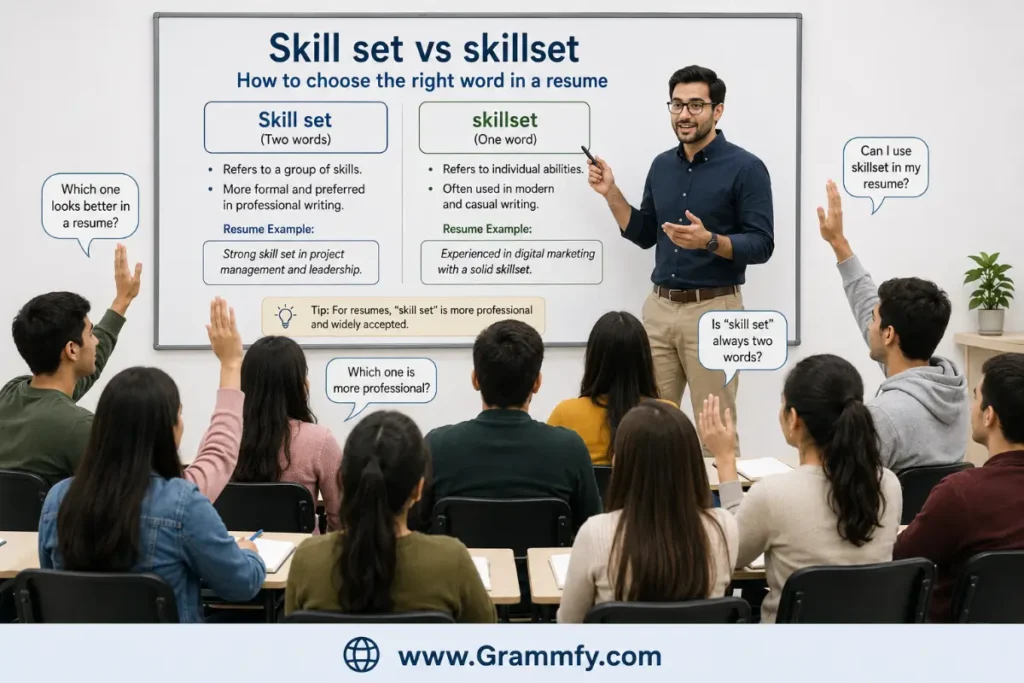
How to choose the right word in a resume
A resume should be clear and specific.
Instead of repeating:
Strong skill set
throughout the document, name the abilities.
For example:
Skills
- SEO
- Keyword research
- Content writing
- WordPress
- On-page optimization
- Google Analytics
This is much more useful than:
I have a great skill set.
Better resume wording
Weak:
I have a strong skill set.
Better:
I have strong skills in SEO, content writing, and WordPress.
Even better:
Developed SEO content that improved organic visibility through keyword research, on-page optimization, and content planning.
The final version demonstrates the skills instead of simply claiming them.
How to choose the right word in an essay
For an essay, think about your audience.
If you’re writing for younger readers, skills or abilities may be easiest.
If you’re writing an academic paper, competencies, abilities, or professional skills may fit depending on the subject.
For example:
Students need a broad set of skills to succeed in modern workplaces.
This is simple and direct.
You could also write:
Students need a diverse skill set to prepare for different career paths.
Both are correct, but the second emphasizes the group of abilities as one package.
How to choose the right word in texting
Texting doesn’t require formal vocabulary.
You can write:
You’ve got a great skill set!
Or:
You’re really good at this stuff.
The second is more casual.
If you’re talking to a friend, there’s no need to replace every simple word with a formal synonym.
Natural communication is usually better than unnecessarily complicated wording.
How to choose the right word in an email
Professional email should be clear rather than overly impressive.
Instead of:
I possess a comprehensive and highly developed skill set.
Try:
I have strong skills in project management and communication.
The second sentence sounds more natural.
If you’re applying for a position, you can connect your skills directly to the role:
My skills in SEO and content writing align well with the responsibilities of this position.
That’s more specific than simply saying:
My skill set is perfect for the job.
How to choose the right word when speaking
In conversation, skills is often the easiest option.
For example:
What skills do you need for this job?
You can also say:
What kind of skill set does the job require?
Both sound natural.
The second question emphasizes the combination of abilities required.
Common mistakes with skill set
Mistake 1: Treating skillset as the only correct form
Some writers assume that because they often see skillset, it must always be the preferred spelling.
That’s not true.
Skill set remains a well-established form and is the safer choice in formal writing.
Mistake 2: Assuming skillset is always wrong
The opposite claim is also too strict.
Skillset is widely used as a closed compound in modern English. Many professional writers and organizations use it.
The better approach is to consider your audience and style guide.
Mistake 3: Writing skills set
Incorrect:
Her skills set is impressive.
If you mean a collection of skills, write:
Her skill set is impressive.
Or:
Her skills are impressive.
Mistake 4: Overusing the phrase
Repeating skill set several times in a resume or article can make the writing sound vague.
Instead of:
My skill set includes writing. My skill set includes editing. My skill set includes research.
Write:
My skills include writing, editing, and research.
This is shorter and more natural.
Mistake 5: Using expertise for every skill
Don’t describe basic familiarity as expertise.
For example:
I have expertise in Microsoft Word.
If you only know basic functions, this may overstate your ability.
A more accurate sentence would be:
I have experience using Microsoft Word.
When should you avoid the phrase skill set?
Sometimes a simpler word is better.
Instead of:
She has a diverse skill set.
You could say:
She has many useful skills.
Instead of:
This course will improve your skill set.
You could say:
This course will help you develop new skills.
Instead of:
The job requires a specialized skill set.
You could say:
The job requires specialized skills.
The simpler versions often sound more natural.
Is skill set overused in business writing?
It can be.
Business writing sometimes relies heavily on phrases such as:
- skill set
- leverage
- synergy
- capabilities
- expertise
- solutions
- competencies
These words aren’t wrong, but too many can make writing sound vague.
For example:
We are seeking a candidate with a diverse skill set and strong capabilities.
This doesn’t tell the reader much.
A clearer version is:
We are seeking a candidate with experience in customer service, data analysis, and project management.
Specific skills are more useful than broad business language.
How can you make your writing more specific?
Whenever you write skill set, ask:
Which skills?
Then name them.
Instead of:
She has a strong skill set.
Write:
She has strong skills in research, writing, and data analysis.
Instead of:
The role requires a technical skill set.
Write:
The role requires experience with Python, SQL, and cloud platforms.
Specific language makes your writing easier to understand.
What are the antonyms of skill set?
There isn’t one exact antonym for skill set because it describes a collection rather than a quality.
Depending on the context, possible contrasting ideas include:
- lack of skills
- inexperience
- inability
- limited ability
- lack of training
- weakness
- incompetence
For example:
His skill set is limited.
The opposite idea could be:
He has limited experience in this area.
In professional writing, it’s usually better to describe the missing ability directly rather than label someone negatively.
Quick tips for choosing the right form
Use these simple rules:
Rule 1: Choose skill set when you’re unsure
For formal English, skill set is the safest option.
Rule 2: Skillset is common in modern business language
Don’t be surprised if you see skillset in job ads, business websites, or professional profiles.
Rule 3: Be consistent
If your document uses skill set, don’t randomly change it to skillset later.
Rule 4: Name the actual skills
Specific skills are more useful than vague claims.
Rule 5: Don’t confuse skills with qualifications
A degree or certification isn’t necessarily a skill.
Rule 6: Don’t overuse the phrase
Sometimes skills is shorter and clearer.
Rule 7: Match your tone
Use simple language for general readers and more technical terms when your audience expects them.
A quick decision guide
| Situation | Best choice |
|---|---|
| Formal essay | skill set |
| Academic writing | skill set |
| Resume | skill set or specific skills |
| Cover letter | skill set |
| Professional email | skill set |
| Business article | Either, depending on style |
| Job advertisement | Either, depending on house style |
| Text message | Either |
| Casual conversation | Either |
| When following a style guide | Follow the guide |
| When unsure | skill set |
A simple memory trick
Think of skill set as a set containing several skills.
Imagine a box labeled:
SKILL SET
Inside the box are:
- writing
- communication
- research
- teamwork
- leadership
The word set tells you that you’re grouping several skills together.
If you remember this idea, you’ll also remember why skill set is naturally written as two words in the traditional form.
Why exact wording matters on a resume
Recruiters often scan resumes quickly. They want to see specific abilities, tools, and results.
Compare:
Strong skill set in marketing.
with:
SEO, keyword research, content strategy, Google Analytics, and email marketing.
The second version gives the reader much more useful information.
This doesn’t mean you can never write skill set on a resume. It simply means that the phrase works best when it introduces or summarizes specific abilities.
For example:
My skill set combines technical SEO with content strategy.
That’s useful because the sentence explains what the skill set contains.
How to improve a sentence with skill set
Consider this sentence:
She has a great skill set for the position.
It’s grammatically fine, but it’s vague.
A stronger version is:
She has a strong skill set in customer service, scheduling, and communication.
An even more direct version is:
She has strong customer service, scheduling, and communication skills.
The best version depends on your purpose.
If you’re emphasizing the combination, skill set works well.
If you’re simply listing abilities, skills is usually better.
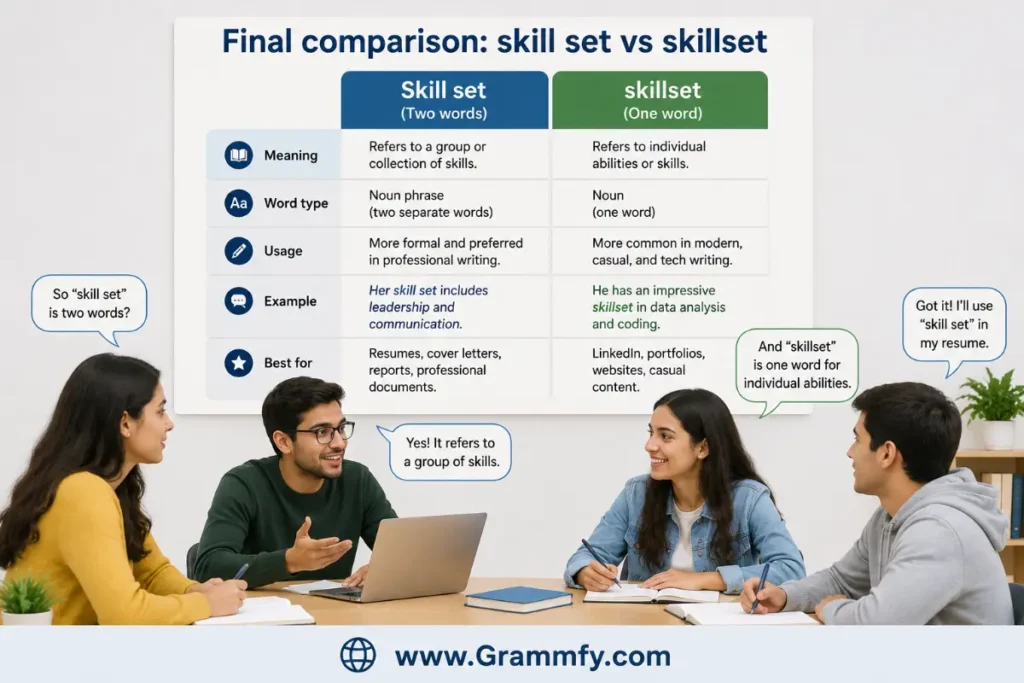
Final comparison: skill set vs skillset
| Feature | Skill set | Skillset |
|---|---|---|
| Number of words | Two | One |
| Meaning | Group of skills | Group of skills |
| Traditional form | Yes | No |
| Modern usage | Very common | Increasingly common |
| Formal writing | Safe choice | May depend on style |
| Business writing | Common | Common |
| Resume | Safe choice | Often seen |
| Academic writing | Preferred safe choice | Less conservative |
| Meaning difference | Usually none | Usually none |
The main difference is spelling and style, not meaning.
Conclusion
The safest answer is simple: skill set is the traditional two-word form, while skillset is a common modern one-word variant. Both generally refer to the same collection of abilities, so the main issue is style rather than meaning. For essays, academic work, resumes, and formal documents, skill set is a reliable choice when you don’t have a specific style guide telling you otherwise.
When possible, make your writing more specific by naming the actual abilities instead of relying on broad phrases. Saying “SEO, writing, and research skills” tells readers much more than “a strong skill set.” Choose the form that fits your audience, stay consistent, and focus on clear wording. Once you understand the difference, you’ll be able to make the right choice with confidence.
Frequently Asked Questions
Is skillset or skill set the correct spelling?
Skill set is the traditional and safest spelling in formal English, while skillset is also widely used as a modern compound noun.
Is skillset one word or two words?
Both forms appear in modern English, but skill set is the established two-word form and is a safe choice when you’re unsure.
Can I write skillset on my resume?
Yes, you can find skillset on many modern resumes, but skill set is a conservative and professional choice. Naming your specific skills is often even better.
What’s another way to say skill set?
You can say skills, abilities, competencies, capabilities, expertise, strengths, or professional skills, depending on the exact meaning.
Is skill set formal or informal?
Skill set is neutral and can be used in both professional and general writing. More formal alternatives include competencies, proficiencies, and expertise.
What is the plural of skill set?
The plural is skill sets. For example, “Different careers require different skill sets.”
Is skillset acceptable in American English?
Yes, skillset is widely used in American English, especially in business and workplace contexts. However, skill set remains a safe choice for formal writing.

1 thought on “Skillset or Skill Set: The Simple Spelling Guide”