
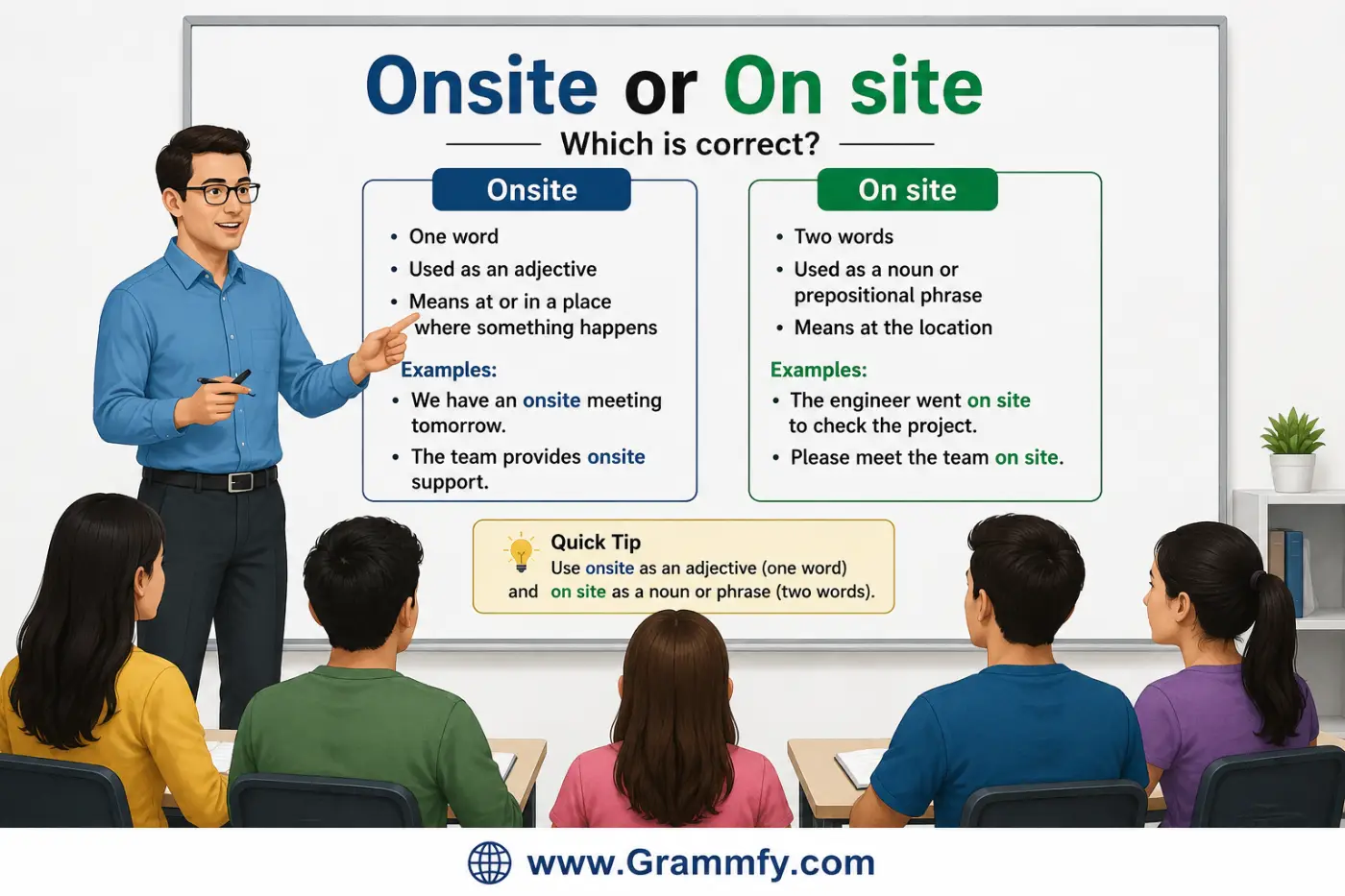
You’re writing a resume, sending an email, or finishing an essay when you suddenly pause over a small spelling question: Onsite or On site? Both forms appear in English, so it can be difficult to know which one is correct.
The confusion comes from the fact that English uses both on-site and on site, while onsite has also become common, especially in American business writing. The right choice depends partly on how the phrase works in your sentence.
“On site” is the traditional two-word form, while “onsite” is a widely accepted modern form, especially when it works as an adjective before a noun.
This guide explains the difference between the forms, their meanings, origins, grammar, common examples, regional preferences, and the best choice for resumes, essays, emails, texting, and professional writing. You’ll also learn when on-site is useful and how to avoid common mistakes.
You may also want to learn the difference between [latter or ladder].
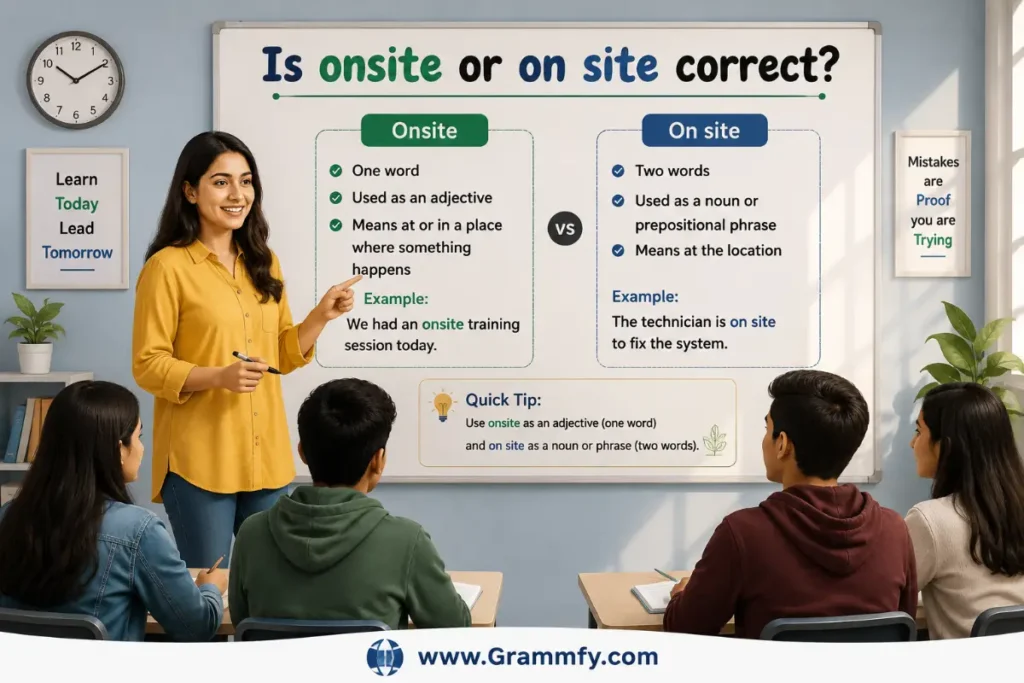
Is onsite or on site correct?
Both onsite and on site are used in modern English, but they don’t always work in exactly the same way.
The traditional expression is on site, written as two words.
For example:
The technician is on site.
Here, the phrase describes where the technician is.
The closed form onsite is increasingly common when it acts as an adjective before a noun:
The company provides onsite training.
You may also see on-site with a hyphen:
The company provides on-site training.
All three forms appear in real-world English, but style preferences vary.
Quick comparison
| Form | Common use | Example |
|---|---|---|
| on site | Adverbial phrase; location | The engineer is on site. |
| onsite | Adjective, especially in modern US English | We offer onsite training. |
| on-site | Hyphenated adjective, especially in edited writing | We offer on-site training. |
A useful basic rule is:
Use “on site” when you’re describing where something happens. Use “onsite” or “on-site” before a noun when it functions as an adjective.
However, house styles differ, so consistency matters.
What does on site mean in plain English?
On site means at the actual location where an activity, job, service, or event is taking place.
For example:
The construction manager is on site.
This means the manager is physically at the construction location.
Another example:
A technician will be on site tomorrow.
The technician will physically visit the location where the equipment is located.
The phrase can apply to many situations:
- construction
- repairs
- education
- business
- healthcare
- events
- manufacturing
- technology
- security
- customer service
Simple definition
On site = at the place where the work or activity is happening.
This meaning stays the same even when the context changes.
What does onsite mean?
Onsite generally has the same basic meaning as on site, especially when it describes something provided or located at a particular workplace or location.
For example:
The company offers onsite childcare.
Here, onsite means the childcare is available at the company’s location.
Another example:
Employees receive onsite training.
The training happens at the workplace rather than at a separate location.
The closed form is especially common in:
- job descriptions
- business websites
- HR documents
- service descriptions
- workplace policies
- marketing copy
- technology documentation
What does on-site mean?
On-site is the hyphenated form.
A hyphen can connect two words when they work together as an adjective before a noun.
For example:
We provide on-site support.
Here, on-site describes support.
The phrase means support provided at the customer’s location.
The hyphen helps readers see that on-site works together as one adjective.
Compare the structures
The technician is on site.
Here, the phrase tells us where the technician is.
The technician provides on-site support.
Here, on-site describes the type of support.
This distinction is useful when you’re editing professional writing.
Why does English have three forms?
English often develops different spellings for common phrases.
A phrase may begin as separate words. Over time, writers may start hyphenating it when it functions as a compound adjective. Eventually, the hyphen may disappear as the compound becomes familiar.
You can see similar patterns in other English expressions.
For example:
- on line → online
- web site → website
- health care → healthcare
- work place → workplace
Not every word follows the same path, and different dictionaries and style guides may make different recommendations.
That’s why on site, on-site, and onsite can all be encountered.
Where did the phrase on site come from?
The phrase is built from two ordinary English words:
- on — indicating position or location
- site — a particular place or location
The word site comes through French from Latin situs, meaning position or location.
When English speakers combine on with site, the literal idea is simple: something is located at a particular place.
Over time, the phrase became especially useful in professional fields where people need to distinguish between work performed at a customer’s location and work performed somewhere else.
For example:
- onsite repair
- onsite inspection
- onsite training
- onsite service
- onsite support
The modern workplace helped make the expression especially common.
What is the difference between “Onsite or On site”?
The biggest difference is usually grammar and style, not meaning.
On site as a location phrase
The technician is on site.
The phrase tells us the technician’s location.
Onsite as an adjective
The company offers onsite repairs.
The word describes the repairs.
On-site as a compound adjective
The company offers on-site repairs.
This serves the same basic grammatical purpose as onsite.
| Sentence | Function |
|---|---|
| The worker is on site. | Location phrase |
| We provide onsite training. | Adjective |
| We provide on-site training. | Hyphenated adjective |
Should I write onsite or on site?
If you’re unsure, look at what the phrase is doing in your sentence.
Use on site for location
The manager is on site.
Our engineer is currently on site.
The team arrived on site at 8 a.m.
In these examples, the phrase answers the question Where?
Use onsite or on-site before a noun
We provide onsite training.
We provide on-site training.
The company has an onsite clinic.
In these examples, the expression describes a noun.
What if my style guide prefers on-site?
Use on-site consistently.
Some organizations and editors prefer the hyphenated form because it clearly marks the compound adjective.
Others use onsite because the closed form has become common.
If you’re writing for a company, publication, or academic institution, follow its style guide when one exists.
Is onsite one word in American English?
Onsite is widely used as a one-word adjective in American English, especially in business and workplace contexts.
Examples include:
onsite training
onsite support
onsite services
onsite staff
onsite parking
However, on site remains common when the phrase functions as a location expression.
For example:
Our technician is on site.
So American English commonly uses both forms depending on sentence structure and style.
Is Onsite or On site British English?
British English also uses on site, on-site, and increasingly onsite, although preferences can vary by publication and context.
In careful British writing, you may frequently see:
The engineer is on site.
And:
The company provides on-site support.
The important point is that regional preferences don’t create a simple rule such as “American English always uses onsite” and “British English always uses on site.”
Actual usage is more flexible.
Is there a US vs UK spelling difference?
There isn’t a simple US-versus-UK spelling rule for this expression.
Both varieties use:
- on site
- on-site
- onsite
The main difference is often editorial preference.
If you’re writing for a US audience, onsite is a very common professional form.
If you’re writing for a British audience, on-site may be especially familiar in formal or edited writing.
When in doubt, follow the style used by the organization or publication you’re writing for.
When should I use a hyphen?
A hyphen can make a compound adjective easier to understand.
For example:
We offer on-site training.
The words on-site work together to describe training.
Compare that with:
The instructor is on site.
Here, no hyphen is needed because the phrase simply tells us where the instructor is.
A useful editing rule
When two or more words work together before a noun as a single adjective, a hyphen can help show their relationship.
Examples:
- on-site training
- on-site repair
- on-site inspection
- on-site support
- on-site services
But if your preferred style uses onsite as a closed compound, you don’t need the hyphen.
Is onsite formal or informal?
Onsite is common in professional writing and isn’t inherently informal.
You can find it in contexts such as:
- corporate websites
- job descriptions
- technical documents
- employee handbooks
- service agreements
- educational programs
- business reports
For example:
The company provides onsite technical support.
That’s perfectly understandable professional English.
However, if you’re writing for an organization with a specific style guide, use its preferred form.
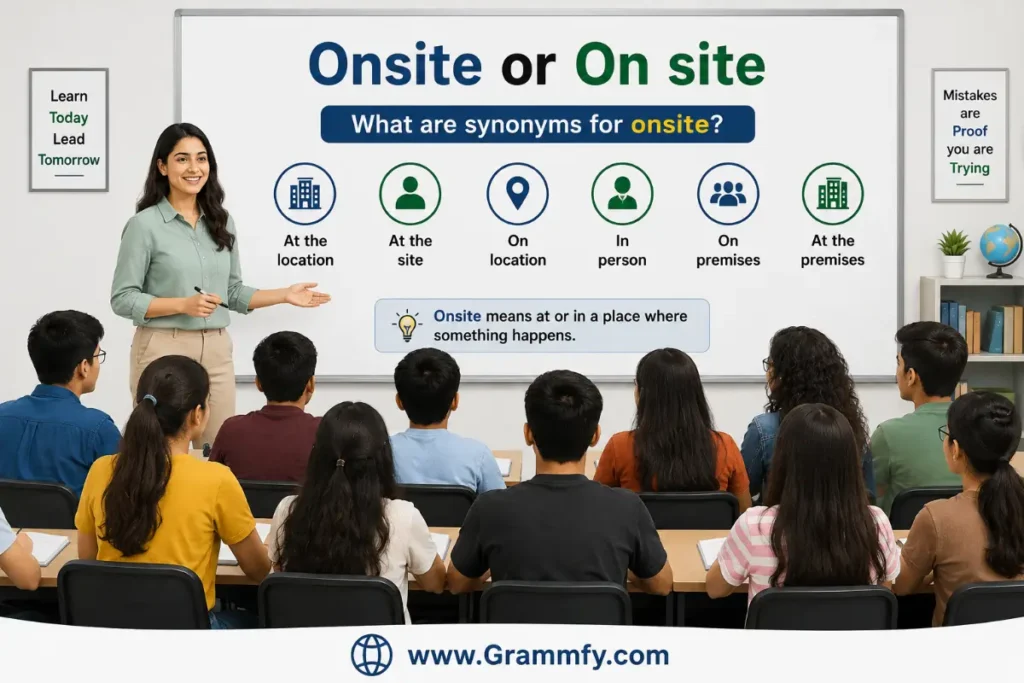
What are synonyms for onsite?
The best synonym depends on what you mean. Some alternatives describe location, while others describe services provided at a particular place.
Simple alternatives
| Word or phrase | Meaning | Tone | Example |
|---|---|---|---|
| At the location | At the specific place | Simple | The worker is at the location. |
| At the site | At the work location | Neutral | The engineer is at the site. |
| There | At that place | Very simple | The technician is there. |
| In person | Physically present | Everyday | The consultant met us in person. |
| At the workplace | At the place of work | Neutral | Training happens at the workplace. |
| At the facility | At a specific building or operation | Neutral | Staff work at the facility. |
| At the premises | At the property or building | Formal | The service is provided at the premises. |
Everyday alternatives
| Word or phrase | Meaning | Tone | Example |
|---|---|---|---|
| In person | Physically present | Everyday | The interview will happen in person. |
| At work | At the workplace | Casual | She’s at work today. |
| At the office | Physically at the office | Everyday | I’ll be at the office tomorrow. |
| At the location | At the relevant place | Neutral | A specialist will be at the location. |
| In-house | Within the organization | Business | We provide in-house training. |
| On location | At the place where something occurs | Everyday | The crew filmed on location. |
| At the venue | At the event location | Everyday | Staff will be at the venue early. |
Formal and professional alternatives
| Word or phrase | Meaning | Tone | Example |
|---|---|---|---|
| At the site | At the specified location | Formal | Engineers were at the site. |
| At the premises | At a property or business location | Formal | Services are available at the premises. |
| At the facility | At an operational location | Professional | Staff work at the facility. |
| In-house | Provided within an organization | Professional | We provide in-house training. |
| Field-based | Performed in the field rather than an office | Professional | The role involves field-based work. |
| Location-based | Connected to a specific place | Technical | The service is location-based. |
| On location | At the place where an activity occurs | Professional | The team worked on location. |
| Face-to-face | Directly in person | Professional | The consultation was face-to-face. |
Informal alternatives
| Word or phrase | Meaning | Tone | Example |
|---|---|---|---|
| Here | At this place | Casual | The technician is here. |
| There | At that place | Casual | The team is there now. |
| In person | Physically present | Casual | Let’s discuss it in person. |
| At the place | At the relevant location | Casual | I’ll meet you at the place. |
| At work | At one’s workplace | Casual | He’s at work today. |
| Right there | At a nearby location | Very casual | The equipment is right there. |
Which synonym should you choose?
The context matters.
When you’re talking about a technician physically visiting a customer, at the location or on location may work.
If you’re talking about training inside a company, in-house may be better.
If you’re contrasting physical attendance with virtual attendance, in person is often clearer.
For example:
The interview will be conducted onsite.
could become:
The interview will be conducted in person.
The second sentence focuses more clearly on physical attendance.
Synonyms by intensity: mild to strong
Location words don’t usually have a true “mild to strong” scale. Instead, they differ in specificity.
| General | More specific |
|---|---|
| There | At the location |
| At the location | At the site |
| At the site | At the facility |
| At the facility | At the customer’s premises |
| In person | Face-to-face |
| At work | At the company’s workplace |
For professional writing, the most useful word is often the one that tells the reader exactly where the activity occurs.
Onsite vs in-house: What’s the difference?
In-house and onsite may seem similar, but they have different meanings.
Onsite usually means something happens at a particular physical site.
In-house usually means something is handled within an organization rather than outsourced.
Compare:
The company provides onsite training.
This means the training happens at the relevant location.
The company provides in-house training.
This often means the company handles the training internally.
An outside trainer can provide onsite training, so the two terms aren’t interchangeable.
Side-by-side comparison
| Onsite | In-house |
|---|---|
| Focuses on physical location | Focuses on who provides or handles something |
| At a particular site | Within an organization |
| Can involve an outside provider | Usually internal |
| Example: onsite repair | Example: in-house training |
Onsite vs in person: What’s different?
In person focuses on physical presence.
Onsite focuses on a specific location.
For example:
The interview will be held in person.
This means it won’t be virtual.
The technician will provide onsite support.
This means the technician will provide support at the relevant location.
You can sometimes use both:
The consultant will meet the team in person onsite.
But this may be unnecessarily repetitive. Usually one precise phrase is enough.
Onsite vs on location: What’s different?
On location is especially common when people work at a particular place temporarily.
For example:
The film crew worked on location in Chicago.
Onsite is more common in workplace services:
We provide onsite technical support.
The terms can overlap, but they have different common uses.
Onsite vs remote: What’s different?
These words are often opposites in workplace contexts.
Onsite means physically working at a specified location.
Remote means working away from that location, often from home or another place.
Compare:
The company offers onsite and remote positions.
Here, employees can either work at the workplace or from another location.
Workplace comparison
| Onsite | Remote |
|---|---|
| Physically at the workplace | Away from the workplace |
| In-person interaction | Often online |
| Uses workplace facilities | May use home or another location |
| Example: onsite employee | Example: remote employee |
Onsite vs virtual: What’s different?
Onsite describes physical attendance.
Virtual describes participation through digital technology.
For example:
The workshop is available onsite or virtually.
This is common for modern training programs and events.
If your audience might not know what onsite means, saying in person can sometimes be even clearer.
What word is best for a resume Onsite or On site?
For a resume, onsite, on-site, and on site can appear depending on sentence structure.
Use the form that fits your sentence and keep your wording consistent.
For example:
Provided onsite technical support to more than 100 clients.
This is common professional wording.
You can also write:
Provided on-site technical support to more than 100 clients.
If you want to avoid the spelling question entirely, you can rewrite the sentence:
Provided technical support directly at client locations.
This is especially clear because it tells the reader exactly what you did.
Resume examples
Managed onsite customer support for major accounts.
Conducted on-site equipment inspections.
Delivered training at client locations.
The third version avoids the variation entirely.
What word is best for an essay Onsite or On site?
In an essay, choose based on your subject and audience.
For example:
Students can receive onsite support from academic advisers.
This works well.
But you could write:
Students can receive support directly on campus.
The second version may be more specific.
Academic writing often benefits from precise language, so don’t choose onsite simply because it sounds professional.
Ask what location you actually mean.
What word is best for texting Onsite or On site?
In texting, simplicity wins.
You might write:
Are you onsite?
Or:
Are you on site?
Both are understandable.
For a casual conversation, you could simply say:
Are you there?
If the location is already obvious, there’s no reason to use a more formal term.
What word is best for email Onsite or On site?
In professional email, all of these can work depending on sentence structure.
The technician is on site.
We offer onsite support.
We offer on-site support.
If you’re writing to customers, on-site support may be especially easy to understand because the hyphen clearly connects the words.
If your company consistently uses onsite, follow that style.
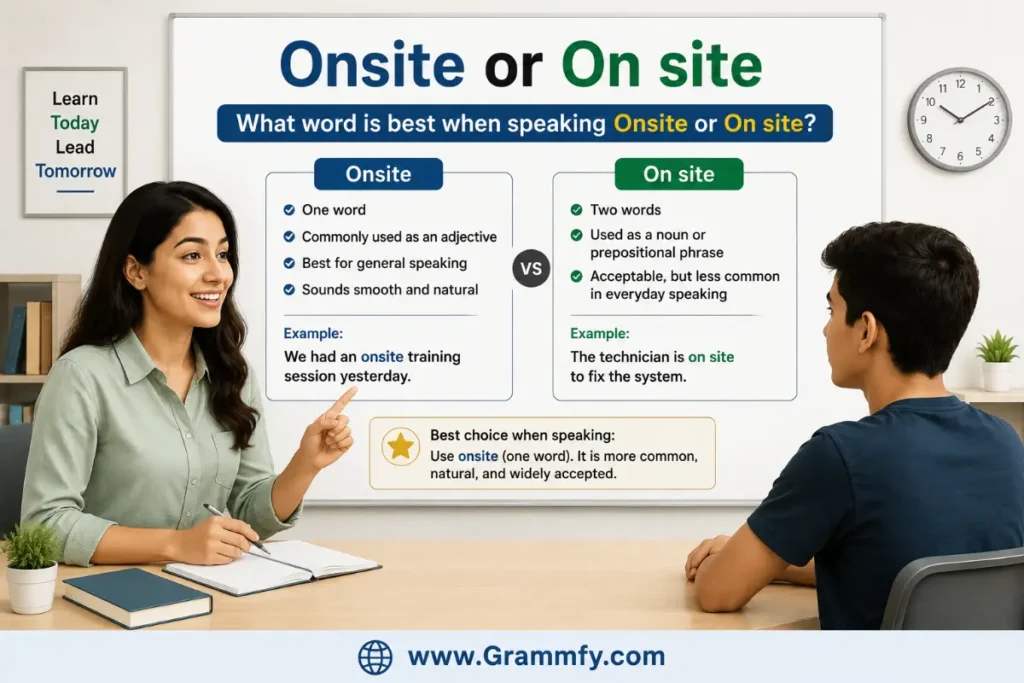
What word is best when speaking Onsite or On site?
When speaking, the spelling doesn’t matter because onsite and on site sound the same.
You can say:
The technician is on site.
Or:
We offer onsite training.
The listener understands the meaning from context.
If you’re speaking casually, at the location or in person may sometimes sound more natural.
15+ original examples of Onsite or On site
1. Technical support
Our team provides onsite technical support for business customers.
2. Construction
The project manager is on site every morning.
3. Training
Employees receive onsite training during their first week.
4. Repairs
A technician will be on site to repair the equipment.
5. Healthcare
The company has an onsite medical clinic.
6. Parking
The building offers onsite parking for visitors.
7. Security
Security staff remain on site throughout the event.
8. Education
The program includes onsite workshops for new teachers.
9. Manufacturing
Engineers were on site during the equipment installation.
10. Customer service
Customers can request onsite assistance.
11. Events
All staff members must be on site by 7 a.m.
12. Interviews
The company is conducting onsite interviews next week.
13. Childcare
The employer provides onsite childcare.
14. Maintenance
The maintenance team will be onsite tomorrow.
15. Film production
The director chose to film on location rather than in a studio.
16. Software support
Clients can request onsite software installation.
17. School services
Students can receive onsite counseling at the school.
18. Equipment inspection
An engineer will conduct an on-site inspection.
Common mistakes with “Onsite or On site”
Mistake 1: Treating on site as always one word
Some writers assume that onsite must always be written as one word because it’s common online.
That’s too broad.
The technician is on site.
is completely natural.
Mistake 2: Treating onsite as always wrong
The opposite claim is also too strict.
Onsite is widely used, especially as an adjective in American business English.
onsite training
onsite support
onsite services
Mistake 3: Using a hyphen everywhere
Don’t automatically write:
The technician is on-site.
If you’re using the phrase as a location expression, on site is generally the cleaner form.
Compare:
The technician is on site.
with:
We provide on-site support.
Mistake 4: Mixing forms randomly
Avoid writing:
We offer onsite training and on-site support.
This isn’t necessarily grammatically wrong, but if the two expressions have the same function and your style guide has a preference, consistency is better.
Choose one preferred adjective form and stick with it.
Mistake 5: Using onsite when you mean remote
Incorrect:
She works onsite from home.
If she works from home, she’s normally working remotely, not onsite at the company location.
You could say:
She works remotely from home.
When should you NOT use onsite?
Don’t use onsite when the exact meaning is unclear.
When you mean a physical location, you can often write:
at the location
If you mean physical attendance:
in person
If you mean internal company services:
in-house
When you mean working away from the office:
remotely
Choosing the precise phrase can make your writing much clearer.
When is “at the site” better?
At the site can be useful when you want to emphasize a specific physical location.
For example:
Engineers discovered the problem at the site.
This sounds natural in construction, engineering, environmental work, and similar fields.
Compare:
Engineers provided onsite support.
This focuses on the type of support.
Engineers worked at the site.
This focuses on where they worked.
When is “in person” better?
Use in person when your main contrast is between physical and virtual interaction.
For example:
The meeting will be held in person.
This is clearer than:
The meeting will be held onsite.
Why?
Because onsite tells us that the meeting is at a particular site, but it doesn’t necessarily emphasize the contrast with video participation.
If the real question is “Will I have to attend physically?”, in person is usually the better phrase.
When is “in-house” better?
Use in-house when you’re talking about something handled internally by an organization.
For example:
We have an in-house design team.
This means the design team belongs to or works directly for the organization.
It does not necessarily mean that the team is physically at a particular site.
So:
in-house = internally provided
onsite = physically at the location
These are different ideas.
What are the antonyms of onsite?
There isn’t one exact opposite in every context.
Depending on what you mean, possible contrasts include:
- remote
- off-site
- online
- virtual
- away from the location
- off premises
- external
Onsite vs off-site
These are often direct opposites in workplace contexts.
The technician is onsite.
The technician is working off-site.
Here, off-site means away from the usual or specified location.
Onsite vs remote
onsite employee
remote employee
These terms are common in workplace discussions.
Onsite vs virtual
onsite meeting
virtual meeting
These describe physical and digital participation.
What is the opposite of on site?
Off site or off-site is often the closest opposite.
For example:
The equipment is stored off site.
This means it is stored away from the main or specified location.
As with on site, the spelling can depend on grammatical function and style.
How do you pluralize onsite?
Onsite is normally an adjective, so it doesn’t have a plural form.
For example:
onsite services
The noun services is plural, while onsite stays unchanged.
Similarly:
onsite employees
onsite facilities
onsite programs
The adjective doesn’t change.
Can onsite be used as a noun?
In standard professional writing, onsite is mainly used as an adjective.
For example:
We provide onsite support.
You may occasionally encounter noun-like uses in workplace jargon, such as:
The onsite will begin at 9.
But this is less standard and may sound like industry shorthand.
For clear writing, use a noun such as:
The onsite session will begin at 9.
or:
The on-site training will begin at 9.
Better yet, name the event:
The training session will begin at 9.
Can on site be used as an adjective?
The traditional phrase on site can sometimes appear in compound expressions, but when it directly modifies a noun, writers often use on-site to make the compound relationship clear.
For example:
on-site training
on-site repair
on-site inspection
This is why the hyphenated form remains useful.
How do dictionaries handle onsite?
Dictionaries and style resources can differ in how they treat compound forms, especially as English usage changes.
A word may move through stages such as:
on site → on-site → onsite
But these stages don’t happen uniformly across every publication or region.
That’s why you should not assume that seeing one form online makes every other form incorrect.
For practical writing, consider:
- grammar
- audience
- region
- publication style
- consistency
How should you write it in website content?
For website content, consistency is more important than obsessing over a tiny spelling variation.
If your website uses American English and your content repeatedly uses the adjective form, onsite is a common choice.
For example:
We provide onsite computer repair.
But if your site’s style guide uses hyphens for compound adjectives:
We provide on-site computer repair.
Both can be understood clearly.
When possible, define your preferred style and use it throughout the website.
How should you write it in SEO content?
For SEO content, don’t force one spelling into every sentence.
Search engines can understand closely related forms and context, but readers still need natural writing.
Instead of repeating:
onsite service
onsite support
onsite service
onsite support
vary your language naturally:
- on-site support
- support at your location
- in-person service
- local technical assistance
- service at the customer’s premises
This gives readers useful variation without making the page sound repetitive.
How should you write it in a job description?
Job descriptions commonly use onsite when describing workplace arrangements.
For example:
This is an onsite position based in our Chicago office.
You may also see:
This is an on-site position.
Or:
This position requires employees to work on site.
The meaning is clear in all three.
A particularly clear version is:
This position requires employees to work from the office five days a week.
That’s more specific than simply saying onsite.
How should you write it in a job application?
If you’re applying for a position, match the terminology used by the employer when appropriate.
For example, if a listing says:
onsite position
you can write:
I am comfortable working in an onsite environment.
But you can also use plain language:
I am comfortable working from the office and collaborating with the team in person.
The second version sounds more personal and specific.
How can you avoid the spelling issue?
Sometimes the easiest solution is to rewrite the sentence.
Instead of:
The technician will provide onsite support.
Write:
The technician will provide support at your location.
Instead of:
We offer onsite training.
Write:
We provide training at your workplace.
Instead of:
Employees must work onsite.
Write:
Employees must work from the office.
These alternatives remove ambiguity and often make the writing easier for readers.
Quick tips for choosing the right form
Tip 1: Ask “Where?”
If the phrase answers where?, use on site.
The engineer is on site.
Tip 2: Ask “What kind?”
If the phrase describes a noun, onsite or on-site may work.
onsite training
on-site training
Tip 3: Follow your style guide
If your organization prefers on-site, use it consistently.
Tip 4: Consider your audience
For general readers, at your location can sometimes be clearer than onsite.
Tip 5: Don’t confuse onsite with in-house
Onsite focuses on location. In-house focuses on internal provision.
Tip 6: Don’t confuse onsite with remote
Onsite means physically at the location. Remote generally means away from it.
Tip 7: Use in person when physical attendance is the main point
The meeting will be held in person.
This is often clearer than onsite.
Tip 8: Keep your document consistent
Choose a preferred style and don’t switch forms without a reason.
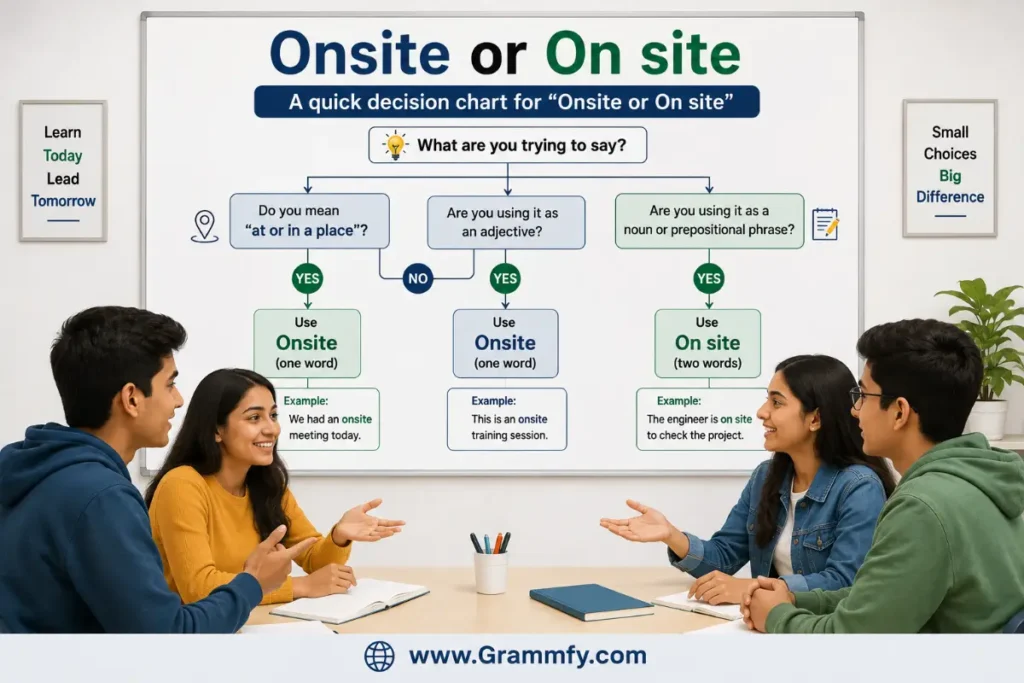
A quick decision chart for “Onsite or On site”
| If you mean… | Use |
|---|---|
| At the physical location | on site |
| Provided at the location | onsite / on-site |
| Physically present | in person |
| Provided internally | in-house |
| Away from the location | off-site |
| Working away from the office | remote |
| At a particular filming/event location | on location |
| At a property | at the premises |
| At a workplace | at the workplace |
Final comparison examples
Let’s compare the forms in real sentences.
Location
The technician is on site.
This is a location phrase.
Adjective
The technician provides onsite support.
This describes the type of support.
Hyphenated adjective
The technician provides on-site support.
This has the same basic meaning as the previous sentence.
Clear alternative
The technician provides support at the customer’s location.
This avoids the spelling variation entirely.
Conclusion
Choosing between onsite, on-site, and on site is mostly a matter of grammar, style, and context rather than a simple right-or-wrong spelling rule. When you’re describing where someone or something is located, on site is a clear and traditional choice. When the expression describes a noun, onsite and on-site are both widely used, with the preferred form depending on the style of your organization or publication.
For resumes, emails, websites, and professional documents, consistency matters. If your company uses onsite, keep that form throughout your content. If its style guide prefers on-site, follow that instead. And when clarity is more important than terminology, phrases such as at your location, in person, or from the office can make your meaning even clearer.
Frequently Asked Questions
Is onsite or on site correct?
Both are used in modern English, but “on site” is the traditional form for describing location. The closed form onsite is widely used as an adjective, especially in professional American English.
Should I write onsite or on-site?
Either can work when the word acts as an adjective, depending on your style guide. If your organization prefers hyphenated compound adjectives, choose on-site; otherwise, onsite is widely accepted.
What’s another way to say onsite?
You can say at the location, at the site, in person, at the workplace, on location, or at the premises, depending on the context.
Is onsite one word in American English?
Yes, “onsite” is widely used as a one-word adjective in American English. You will often see it in business, HR, technology, and workplace writing.
Is on site two words?
Yes, “on site” is a standard two-word phrase when it describes a location. For example, “The engineer is on site.”
Is onsite the same as in-house?
No, onsite describes a physical location, while in-house usually describes something handled within an organization. An outside company can provide onsite services.
What is the opposite of onsite?
Off-site, remote, virtual, or away from the location can serve as opposites depending on the context. For workplace arrangements, remote is especially common.
