
You’re writing a text to a friend, adding a funny line to an email, or trying to make your essay more interesting. Then you wonder whether the funny line is Puns or Jokes. Both can make people laugh, but they work in different ways.
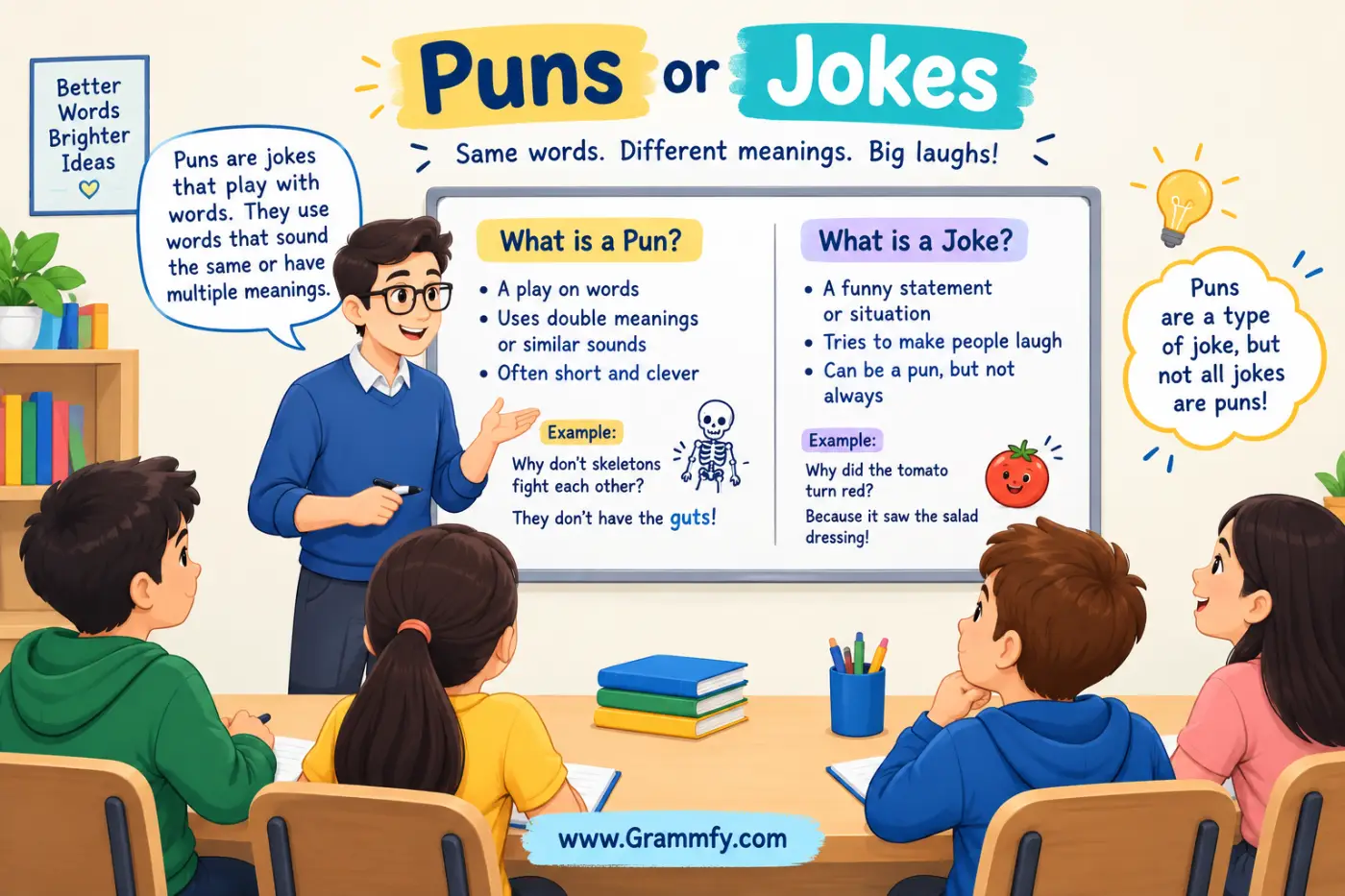
A pun plays with words, sounds, or meanings. A joke is a broader type of humor that usually has a setup and a funny ending. A pun can actually be part of a joke, which is why the two terms are sometimes confused.
Answer box: A pun is a type of wordplay that uses similar sounds or multiple meanings, while a joke is a humorous story, statement, or situation designed to make people laugh.
Understanding Puns or Jokes can help you choose the right term when talking about humor. It can also make your writing more creative and precise. This guide covers the meaning, origins, types, examples, synonyms, differences, common mistakes, and the best choices for different situations.
Want to avoid another common word-choice mistake? Read [Urgency vs Emergency].
What is a pun in plain English?
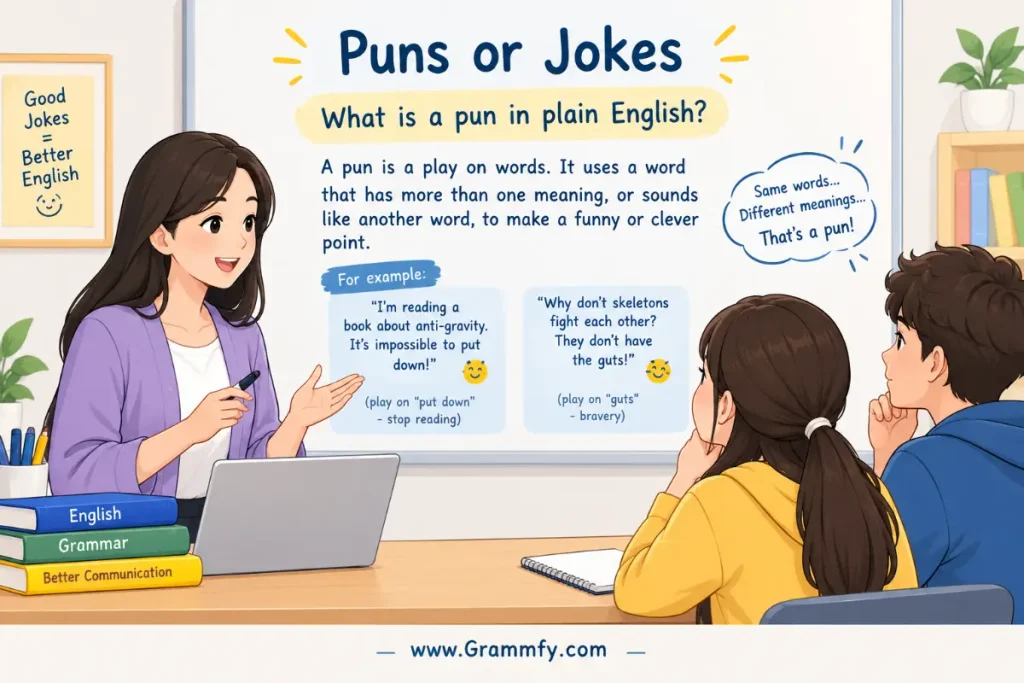
A pun is a form of wordplay. It uses a word or phrase that has more than one meaning, or it uses words that sound alike or almost alike.
The humor comes from the connection between those meanings or sounds.
For example:
“I used to be a baker, but I couldn’t make enough dough.”
The word dough means money in informal English, but it also means the mixture used to make bread. The sentence works because of those two meanings.
Another example is:
“I wondered why the baseball was getting bigger. Then it hit me.”
The phrase “hit me” can mean that something suddenly became clear. It can also describe a baseball physically hitting someone.
Puns are often short. They can appear in advertisements, headlines, captions, conversations, books, and social media posts.
How does a pun work?
Most puns depend on one of these techniques:
- Two meanings of the same word
- Similar-sounding words
- Homophones
- Words with related meanings
- A surprising change in interpretation
- A literal interpretation of a familiar phrase
For example:
“The bicycle couldn’t stand on its own because it was two-tired.”
Here, two-tired sounds like too tired. The bicycle has two tires, while “too tired” normally describes a person who needs rest.
That’s classic wordplay.
What is a joke in plain English?
A joke is something said, written, or done to create humor.
Jokes can take many forms. Some are short one-liners, while others are stories with several parts.
A basic joke might have:
- A setup
- An expectation
- A punchline
For example:
“Why don’t scientists trust atoms? Because they make up everything.”
The question creates an expectation, while the answer provides the humorous twist.
A joke doesn’t have to depend on wordplay. It can use:
- Surprise
- Exaggeration
- Situational humor
- Irony
- Observations
- Stories
- Characters
- Physical comedy
- Wordplay
That makes joke the broader term.
What is the difference between a pun and a joke?
The easiest distinction is this:
A pun depends mainly on wordplay. A joke can use many different forms of humor.
| Feature | Pun | Joke |
|---|---|---|
| Main purpose | Creates humor through words | Creates humor in many ways |
| Wordplay required | Usually | No |
| Can have a punchline | Yes | Usually |
| Can be a story | Rarely | Often |
| Can involve multiple meanings | Common | Sometimes |
| Can involve a situation | Sometimes | Common |
| Can be very short | Yes | Yes |
| Can include a pun | Yes | Yes |
Think of the relationship like this:
Pun → a specific form of humor
Joke → a broad category of humorous expression
A pun can therefore be a joke, but not every joke is a pun.
Where did the word pun come from?
The exact history of pun is uncertain.
The word appeared in English in the 1600s. One possible connection is the older word pundigrion, which referred to a play on words. Another theory connects it with the idea of a punning expression or a phrase that uses clever wordplay.
Because the origin isn’t completely certain, dictionaries and language historians don’t all give the same explanation.
What is clear is that wordplay itself is much older than the modern English word pun. Writers and speakers have used double meanings, sound similarities, and clever language for centuries.
William Shakespeare, for example, was famous for using wordplay in his plays.
Where did the word joke come from?
Joke entered English from earlier words connected with play, amusement, and humorous behavior.
The modern noun became common in English around the 17th century. The related verb developed later.
Today, the word has a wide meaning. It can refer to a short humorous statement, a funny story, a playful remark, or even something that isn’t serious.
For example:
“I was only joking.”
In that sentence, joking means the speaker wasn’t being serious.
The history of the word also explains why “joke” can cover so many forms of humor.
What are the main types of puns?
Puns come in several forms. You don’t need to memorize every category, but knowing the common types makes wordplay easier to recognize.
Homophone puns
A homophone is a word that sounds like another word but has a different meaning or spelling.
Example:
“The musician got arrested because he broke the law.”
The humor can come from interpreting broke the law in a literal or playful way, although not every example of wordplay is a strict homophone pun.
A clearer example is:
“I need some peace and quiet.”
A humorous version might play with peace and piece, two words that sound alike.
Multiple-meaning puns
These use one word with more than one meaning.
Example:
“The fisherman was hooked on his new hobby.”
Hooked can mean physically caught with a hook or strongly interested in something.
Visual puns
A visual pun uses an image rather than words alone.
Imagine a picture of a tired-looking bicycle next to the caption:
“I’m two-tired.”
The joke depends on seeing the two tires and understanding “too tired.”
Compound puns
These combine several words or meanings to create a humorous phrase.
Example:
“The math teacher has too many problems.”
A problem can be a math question or a difficult situation.
Context-based puns
These depend heavily on the surrounding situation.
A sign outside a bakery might say:
“We’re on a roll!”
The phrase refers both to success and to bread rolls.
What are the main types of jokes?
Jokes have much more variety than puns.
One-liners
A one-liner delivers the humor in one short sentence.
Example:
“I told my computer I needed a break, and now it won’t stop sending me vacation ads.”
The humor comes from treating a computer as if it understands a human request.
Knock-knock jokes
These follow a familiar question-and-answer pattern.
Example:
“Knock, knock.”
“Who’s there?”
“Lettuce.”
“Lettuce who?”
“Lettuce in; it’s cold out here!”
Observational jokes
These focus on ordinary experiences.
A comedian might joke about school lunches, traffic, shopping, or trying to remember passwords.
The humor comes from recognizing something familiar in an unexpected way.
Story jokes
These take longer to develop. The speaker gives details before reaching the punchline.
Story jokes often use characters, situations, misunderstandings, and unexpected endings.
Situational jokes
These get humor from what happens rather than from a clever phrase.
A character might walk into a room expecting a quiet meeting and discover that everyone is wearing costumes.
Self-deprecating jokes
These make light of the speaker’s own mistakes or weaknesses.
Example:
“I’m excellent at multitasking. I can waste time in several ways at once.”
The humor comes from exaggerating a personal weakness.
Absurd jokes
These use something impossible, strange, or illogical.
Example:
“My dog started a bakery, but his specialty is just rolling over.”
The situation is funny because it combines unrelated ideas.
What are the best synonyms for pun or joke?
Synonyms aren’t always exact replacements. Some describe humor generally, while others describe a specific style.
Simple synonyms
| Word | Meaning | Tone | Example |
|---|---|---|---|
| Humor | Something that creates amusement | Neutral | “The book has gentle humor.” |
| Funny line | A short humorous statement | Simple | “She added a funny line.” |
| Wordplay | Clever use of language | Neutral | “The headline uses wordplay.” |
| Quip | A short clever remark | Neutral | “He made a quick quip.” |
| Wit | Clever humor or intelligence in expression | Neutral | “Her wit impressed everyone.” |
| Gag | A humorous idea or action | Casual | “The movie includes a visual gag.” |
| Tease | A playful remark | Casual | “He made a light tease.” |
| Laugh | Something that causes amusement | Informal | “That story was a real laugh.” |
Everyday synonyms
| Word | Meaning | Tone | Example |
|---|---|---|---|
| One-liner | A short funny statement | Casual | “He told a great one-liner.” |
| Wisecrack | A clever or sarcastic remark | Informal | “She answered with a wisecrack.” |
| Crack | A quick humorous remark | Informal | “He made a crack about the weather.” |
| Banter | Playful conversation | Casual | “Their friendly banter was funny.” |
| Prank | A playful trick | Casual | “The students planned a harmless prank.” |
| Teasing | Playful humor directed at someone | Casual | “Their teasing wasn’t serious.” |
| Punchline | The funny ending of a joke | Neutral | “The punchline surprised everyone.” |
| Story | A humorous account of events | Everyday | “He told a funny story.” |
Formal synonyms
| Word | Meaning | Tone | Example |
|---|---|---|---|
| Wit | Clever verbal humor | Formal/neutral | “The novel is known for its wit.” |
| Wordplay | Creative use of language | Formal/neutral | “The author uses wordplay effectively.” |
| Satire | Humor used to criticize people or ideas | Formal | “The article uses satire.” |
| Irony | Contrast between expectation and reality | Formal | “The story contains irony.” |
| Parody | Humorous imitation of something | Formal | “The show is a parody.” |
| Comic remark | A humorous statement | Formal | “He added a comic remark.” |
| Amusement | Entertainment or enjoyment | Formal | “The performance provided amusement.” |
| Farce | Exaggerated comedy based on absurd situations | Formal | “The play is a farce.” |
Casual and slang-like terms
| Word | Meaning | Tone | Example |
|---|---|---|---|
| LOL | Written expression of laughter | Very casual | “LOL, that’s funny.” |
| Roast | Humorous criticism of someone | Informal | “They roasted their friend.” |
| Burn | A sharp humorous insult | Informal | “That was a good burn.” |
| Zinger | A sharp, surprising remark | Casual | “She delivered a clever zinger.” |
| Crack-up | Something very funny | Informal | “That video was a crack-up.” |
| Goof | A silly joke or action | Informal | “It was just a little goof.” |
| Wisecrack | A smart or sarcastic joke | Informal | “He made another wisecrack.” |
| Gag | A funny trick or bit | Informal | “The movie’s best gag was unexpected.” |
These words overlap, but they shouldn’t be treated as identical. Satire, for example, usually has a social or political target, while a simple quip may have no deeper message.
How do humor words differ in intensity?
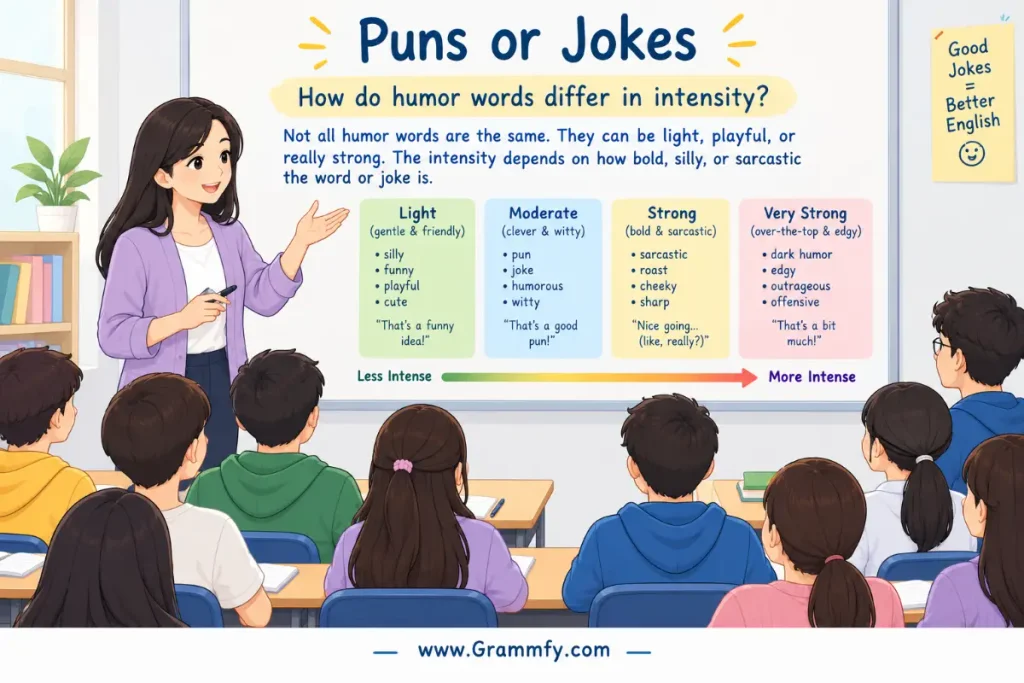
Not every humorous expression feels equally strong.
Mild humor
Use these for light amusement:
- Amusement
- Smile
- Playfulness
- Wit
- Quip
- Funny remark
Example:
“Her playful comment brought a smile to the group.”
Moderate humor
These suggest clearer comedy:
- Joke
- Gag
- Banter
- Wordplay
- One-liner
- Wisecrack
Example:
“The speaker added a joke to keep the audience engaged.”
Strong or memorable humor
These can describe humor that gets a big reaction:
- Hilarious joke
- Great punchline
- Zinger
- Roast
- Comic performance
- Satire
Example:
“The comedian finished with a sharp zinger.”
Humor with a specific purpose
Some forms of humor aren’t simply meant to make people laugh.
- Satire → criticizes people, systems, or ideas
- Parody → imitates something for comic effect
- Sarcasm → often says the opposite of what is literally meant
- Irony → creates contrast between expectation and reality
Understanding the purpose helps you select a more accurate word.
Which words are nouns, verbs, adjectives, and adverbs?
Knowing the parts of speech can help you write about humor correctly.
Pun
Pun is mainly a noun.
“That was a clever pun.”
The related verb pun exists but is uncommon in ordinary conversation.
“The writer punned on the word.”
Joke
Joke works as both a noun and a verb.
Noun:
“He told a joke.”
Verb:
“She was joking.”
Funny
Funny is an adjective.
“That was a funny comment.”
Humor
Humor is a noun.
“The article uses humor.”
The verb humor has a different meaning in some contexts: to accommodate or indulge someone.
Humorous
Humorous is an adjective.
“The story has a humorous tone.”
Comically
Comically is an adverb.
“The character behaved comically.”
Witty
Witty is an adjective.
“She gave a witty response.”
Puns or Jokes — which should you use in a resume?
A resume usually isn’t the place for jokes or puns unless you’re applying for a role where humor is directly relevant.
For most professional resumes, words such as wit, creative communication, engaging content, or humorous writing may be more useful.
For example:
“Created engaging social media content using concise, audience-focused writing.”
That’s more professional than:
“Made lots of funny jokes for customers.”
If you’re applying for a comedy writing position, however, humor can be part of your professional experience.
A comedy writer might write:
“Developed original comedic scripts, sketches, and short-form digital content.”
That statement communicates the skill without sounding casual.
What is the best word for an essay Puns or Jokes?
Wordplay is often the best choice when discussing a pun in an essay.
You could write:
“The author uses wordplay to create humor.”
If you’re discussing a humorous story more generally, joke, humor, satire, irony, or parody may be more appropriate.
Consider the subject carefully.
A literary analysis might say:
“The repeated wordplay creates a playful tone.”
A discussion of political criticism might say:
“The writer uses satire to criticize the policy.”
A discussion of a comedian’s performance could say:
“The comedian builds each joke around an unexpected punchline.”
What is the best word for texting Puns or Jokes?
Texting is informal, so simple terms usually sound natural.
You can say:
- “That’s a good joke.”
- “Nice pun!”
- “That was funny.”
- “LOL, I didn’t expect that.”
- “That joke was terrible 😂”
- “Okay, that was actually clever.”
Pun is especially common when someone makes a word-based joke.
For example, if a friend says:
“I’m reading a book about anti-gravity. It’s impossible to put down.”
You might reply:
“Nice pun!”
A text doesn’t need formal vocabulary. Natural language usually works best.
What is the best word for an email?
The right word depends on why you’re mentioning humor.
A professional email might use humor, lighthearted comment, or wordplay.
Example:
“The campaign uses light humor to make the message more memorable.”
If you’re writing to a friend, you can simply say:
“That joke made my day.”
Avoid overly casual slang when the email is formal.
What is the best word when speaking?
In everyday conversation, joke, pun, funny comment, and joking are the most natural choices.
You might say:
“Was that a joke?”
Or:
“That’s a great pun.”
When discussing a comedian, joke is usually the broader and safer term.
For a specific clever use of language, pun gives more detail.
What are some original examples of puns?
Here are examples that show how wordplay works.
Example 1: Gardening
“I wondered why the gardener got promoted. He really rose to the occasion.”
Rose can refer to a flower and to the idea of rising to a challenge.
Example 2: Electricity
“The electrician was shocked by the news.”
Shocked can describe an emotional reaction or an electrical experience.
Example 3: School
“The math teacher has too many problems.”
Problems can mean math questions or difficulties.
Example 4: Music
“The musician had a lot of good notes.”
Notes can refer to musical sounds or written pieces of information.
Example 5: Food
“The chef kept making jokes because he wanted to spice things up.”
Spice things up can mean adding flavor or making something more exciting.
Example 6: Books
“The librarian was booked all day.”
Booked can mean busy or reserved, while books are central to a library.
What are some original examples of jokes?
A joke doesn’t need a pun.
Example 1
“I started exercising every morning. So far, my alarm clock is getting the best workout.”
The humor comes from the difference between the speaker’s intention and reality.
Example 2
“My phone battery lasts longer when I don’t use my phone. I think it has finally understood my priorities.”
This uses personification and an unexpected observation.
Example 3
“I tried to organize my desk, but I couldn’t find the motivation under all the papers.”
The humor comes from treating motivation as if it were physically buried.
Example 4
“My teacher said I should think outside the box. Unfortunately, the box was the only place where I could find my homework.”
The joke uses a familiar phrase in a literal way.
Example 5
“I made a to-do list today. It looks very productive sitting next to me.”
The humor comes from the contrast between planning and actually doing the work.
Example 6
“I told my friend I was going to bed early. The internet disagreed.”
This uses a familiar experience as the punchline.
What is the difference between a pun and wordplay?
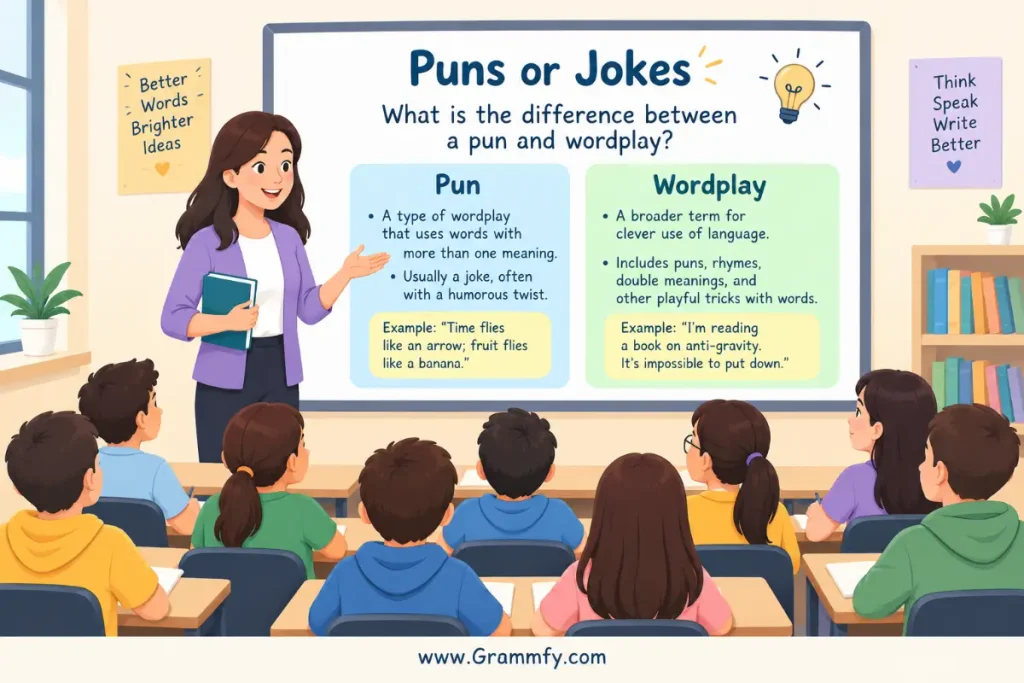
Wordplay is the broader category.
A pun is a type of wordplay, but wordplay can include many other techniques.
| Term | Meaning |
|---|---|
| Wordplay | Creative or clever use of language |
| Pun | Wordplay based on meanings or sounds |
| Rhyme | Similar ending sounds |
| Alliteration | Repeated beginning sounds |
| Double entendre | Phrase with two meanings, often with a humorous or suggestive effect |
| Spoonerism | Accidental or intentional switching of sounds |
| Malapropism | Using an incorrect word that sounds similar to the intended one |
For example, a clever rhyme may be wordplay without being a pun.
That distinction matters when you’re writing about language techniques.
Joke vs quip — what’s different?
A joke can be a complete humorous story or statement.
A quip is usually a short, clever remark made quickly.
Compare:
| Joke | Quip |
|---|---|
| Can be long or short | Usually short |
| Often has a setup and punchline | Often delivered in one sentence |
| Can tell a story | Usually a quick remark |
| Broad category | More specific style |
Example joke:
“I tried to write a joke about gardening, but it wasn’t growing on anyone.”
Example quip:
“That meeting could’ve been an email.”
The second is short and sharp, so quip fits well.
Joke vs gag — what’s different?
A gag is often a simple comic idea, trick, or action.
In comedy, a gag might be a repeated visual bit or a funny situation.
For example, a character repeatedly tries to sit in a chair that keeps moving away. That’s a visual gag.
A joke is more often a humorous statement or story with a punchline.
The terms can overlap, especially in movies and television.
Pun vs one-liner — what’s different?
A one-liner describes the length or format of a humorous statement.
A pun describes how the humor works.
That means one line can be both.
For example:
“I used to be a banker, but I lost interest.”
This is a one-liner because it’s short.
It’s also a pun because interest can refer to money earned from banking and to curiosity or attention.
That’s why categories of humor can overlap.
Common mistakes when using pun and joke
Understanding the difference is useful, but several common mistakes are worth avoiding.
Calling every joke a pun
Not every funny statement uses wordplay.
If a comedian tells a story about getting lost at an airport, that may be a joke without being a pun.
Use pun when the humor depends on language.
Calling every pun a joke
This isn’t always wrong, but it can be less specific.
If someone asks:
“What kind of wordplay is this?”
and the answer is clearly a pun, saying only “joke” doesn’t explain how the humor works.
Confusing a pun with sarcasm
Sarcasm often involves saying something different from what you really mean.
A pun, by contrast, depends on word meanings or sounds.
For example:
“Great job!” said after someone makes a huge mistake.
That can be sarcasm.
A sentence such as:
“The bicycle was tired because it was two-tired.”
is wordplay.
Assuming puns must always be funny
A pun can be clever without being genuinely funny to everyone.
Humor is subjective. Some people love wordplay, while others find it predictable or cheesy.
Using slang in formal writing
Words such as roast, burn, and LOL are common online but may not belong in academic or professional writing.
Choose vocabulary that matches your audience.
When should you not use a pun?
Puns aren’t suitable for every situation.
Avoid playful wordplay when discussing:
- Serious accidents
- Death
- Tragedy
- Sensitive personal issues
- Formal complaints
- Medical emergencies
- Professional disciplinary matters
- Grief
The problem isn’t that puns are always inappropriate. Context matters.
A clever line that works in a social media post may be completely unsuitable in a serious workplace message.
When should you not use a joke?
Jokes can also be inappropriate when the audience expects serious information.
Avoid unnecessary humor when:
- Giving safety instructions
- Discussing an emergency
- Writing a formal legal document
- Communicating serious bad news
- Addressing a sensitive conflict
- Giving important medical information
Clear communication should come before entertainment.
What are the antonyms of pun and joke?
These words don’t have perfect opposites because they’re categories of communication rather than qualities.
Still, useful contrasts include:
- Serious statement
- Literal statement
- Fact
- Formal explanation
- Straightforward comment
- Sincere statement
- Serious discussion
For example:
“The first sentence is meant as a joke, while the second is a serious statement.”
Literal language vs wordplay
Literal language communicates the direct meaning of the words.
Wordplay invites the reader to notice another meaning, sound, or interpretation.
That difference is especially useful when analyzing literature or advertising.
How are puns and jokes used in advertising?
Businesses often use wordplay because short phrases are easy to remember.
A bakery might use:
“We’re on a roll.”
The phrase works because it connects success with bread rolls.
A cleaning company might use:
“We make dirt disappear.”
That’s humorous or catchy without necessarily being a pun.
Advertising can combine both techniques.
A campaign may use a pun as the headline and then build a larger joke or playful message around it.
How are puns and jokes used in headlines?
Newspapers, magazines, websites, and social media accounts sometimes use wordplay to attract attention.
For example, a gardening article could have a playful title such as:
“Growing the Right Way”
A food article might use:
“A Recipe for Success”
These expressions may use familiar phrases in a new context.
Good headlines should still be clear. A clever headline isn’t useful if readers can’t tell what the article is about.
How do writers use humor effectively?
Good humor usually depends on context.
A writer should consider:
- Who will read it?
- What is the purpose?
- Is the topic appropriate for humor?
- Will the wording be understood?
- Does the humor distract from the main point?
- Could the joke be misunderstood?
Short wordplay works well in captions and headlines. Longer jokes may work better in stories, scripts, and comedy writing.
Professional writing usually benefits from light humor rather than constant jokes.
How can you choose the right humor word?
Use this quick guide.
Choose “pun” when:
- The humor depends on a word.
- Two meanings are involved.
- Similar sounds create the humor.
- You’re analyzing wordplay.
- A clever phrase is the main point.
Choose “joke” when:
- You’re talking about humor generally.
- There’s a punchline.
- The humor comes from a story.
- The situation creates the comedy.
- You don’t need to explain the exact technique.
Select “quip” when:
- The remark is short.
- It’s clever or witty.
- It sounds like a quick response.
Choose “wordplay” when:
- You’re discussing language techniques generally.
- Several types of verbal humor are involved.
- You don’t want to limit the description to puns.
Use “satire” when:
- The humor criticizes society, politics, people, or institutions.
Use “parody” when:
- The humor imitates a recognizable person, style, work, or format.
A quick guide to humor vocabulary
| If you mean… | Best word |
|---|---|
| Humor based on two meanings | Pun |
| General funny statement | Joke |
| Short clever comment | Quip |
| Clever use of language | Wordplay |
| Social criticism through humor | Satire |
| Funny imitation | Parody |
| Sharp humorous remark | Wisecrack |
| Funny trick or action | Gag |
| Playful conversation | Banter |
| Funny ending | Punchline |
| Humor based on contradiction | Irony |
| Sarcastic humorous criticism | Sarcasm |
Why does word choice matter when describing humor?
Precise vocabulary helps readers understand exactly what happened.
Imagine writing:
“The author uses jokes.”
That statement is very broad.
A more precise sentence would be:
“The author uses puns to create a playful tone.”
The second sentence tells readers how the humor works.
Similarly:
“The comedian tells jokes.”
is accurate but general.
A stronger description might be:
“The comedian combines observational humor with short one-liners.”
Specific language gives your writing more information without making it complicated.
How can you make a pun effective?
A strong pun should usually be easy enough to understand.
Try these tips:
- Use familiar words.
- Keep the sentence short.
- Make the double meaning clear from context.
- Avoid explaining the pun immediately.
- Match the humor to the audience.
- Don’t force wordplay into every sentence.
- Use a surprising interpretation when possible.
The best puns often feel natural.
A weak pun can sound like you’re searching for a word that happens to have two meanings.
How can you make a joke effective?
Good jokes often depend on timing and surprise.
Helpful techniques include:
- Start with a clear setup.
- Create an expectation.
- Give the audience enough information.
- Use an unexpected ending.
- Keep unnecessary details out.
- Match the joke to your audience.
- Avoid explaining the punchline.
A joke becomes less effective when the audience has to work too hard to understand it.
Are puns and jokes the same thing?
No. Puns or Jokes aren’t two names for exactly the same thing.
A pun is a specific type of wordplay. A joke is a broader form of humor.
Consider this:
“I wondered why the baseball was getting bigger. Then it hit me.”
This can work as a joke because it has a setup and punchline. It also uses the double meaning of “hit me,” giving it a pun-like element.
Now consider:
“My dog thinks I’m a great singer because he always howls along.”
That’s a joke based on a funny observation. It doesn’t depend on a pun.
The categories can overlap, but they aren’t identical.
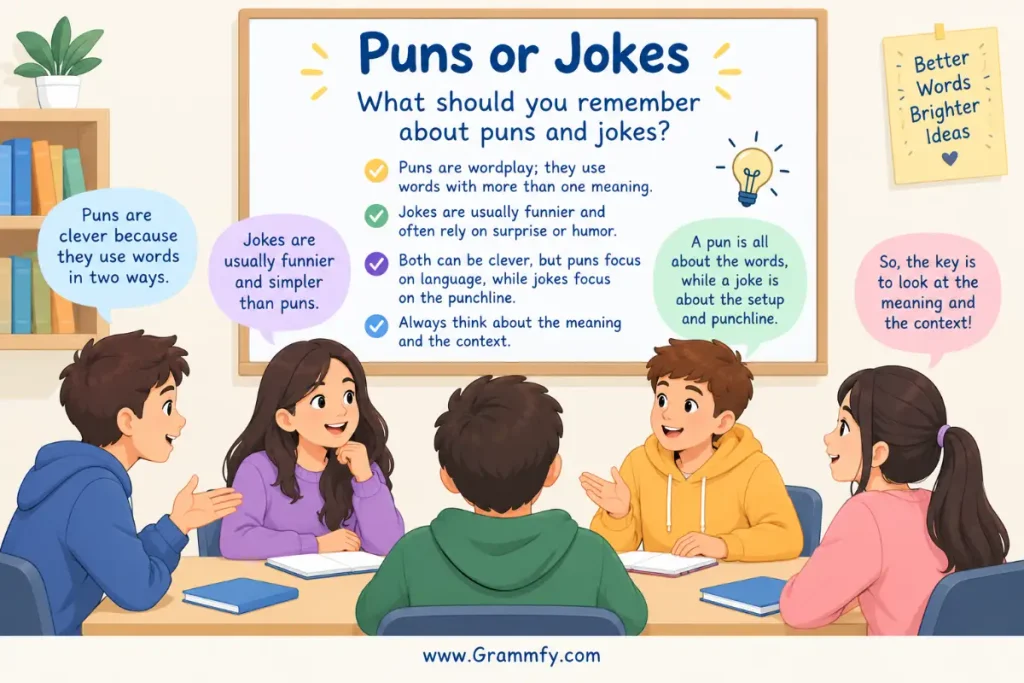
What should you remember about puns and jokes?
The most useful rule is simple:
If the humor depends on words, meanings, or sounds, think “pun.”
If you’re talking about humor more generally, think “joke.”
A few additional points make the distinction even clearer:
- A pun is a type of wordplay.
- A joke is a broad category of humor.
- Some jokes contain puns.
- A pun can be a joke.
- Not every joke contains wordplay.
- Not every example of wordplay is necessarily a joke.
- Context determines which word sounds most accurate.
Conclusion
The choice between Puns or Jokes depends on what creates the humor. A pun focuses on words, sounds, or multiple meanings, while a joke is a wider category that can include stories, observations, situations, surprise, and wordplay. This means a pun can be part of a joke, but a joke doesn’t have to contain a pun.
When you’re describing language techniques, “pun” or “wordplay” is usually more precise. In casual conversation, “joke” is often the natural choice for humor in general. Other terms, such as quip, gag, satire, parody, and banter, describe more specific forms. Once you understand these small differences, you’ll be able to describe humor more accurately and choose words that fit your audience, purpose, and tone.
Frequently Asked Questions
What is the difference between a pun and a joke?
A pun uses wordplay, while a joke can use many forms of humor, including stories, surprise, situations, or wordplay. A pun can be part of a joke, but not every joke is a pun.
Is a pun considered a joke?
Yes, a pun can be considered a joke when it is used to create a humorous effect. The important difference is that a pun specifically depends on language, sounds, or multiple meanings.
What’s another way to say a pun?
Another way to describe a pun is wordplay, although wordplay is a broader term. Depending on the context, you could also use “play on words” or “word joke.”
Are puns and jokes the same thing?
No, Puns or Jokes have a related but different meaning. A pun is a specific form of wordplay, while a joke can include many different kinds of humor.
What is a simple example of a pun?
“I used to be a baker, but I couldn’t make enough dough” is a simple pun because “dough” can mean both bread mixture and money.
What is the difference between a pun and a one-liner?
A pun describes the type of wordplay, while a one-liner describes the short format of a humorous statement. One sentence can be both a pun and a one-liner.
Why do people use puns?
People use puns to make language more playful, memorable, clever, or humorous. They’re common in conversations, advertising, headlines, captions, books, and entertainment.
