
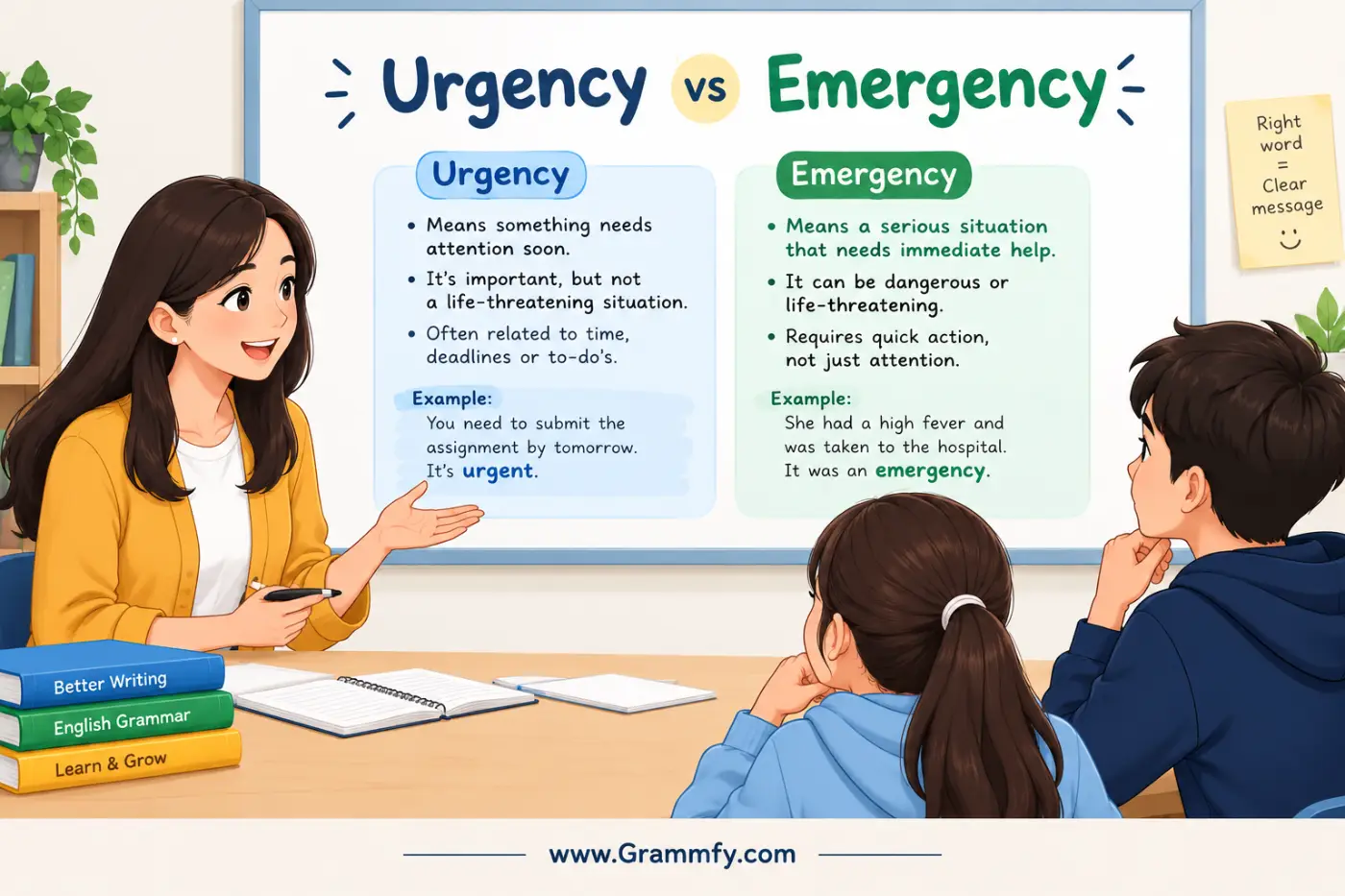
You’re writing an email to your teacher, preparing a resume, or sending a quick text when you stop and wonder: should you say something is urgent, or should you call it an emergency? The two words are close, but they don’t mean exactly the same thing. Urgency vs Emergency describes the difference between a situation that needs quick attention and one that requires immediate action because of serious danger or risk.
The key difference is the level of danger and the need for immediate action. Urgency means something needs attention soon, while an emergency usually involves serious or immediate danger that requires action right away.
Answer box: Urgency means a situation needs quick attention, while an emergency is a serious situation that requires immediate action, often because of danger, injury, or major risk.
Want to strengthen your grammar skills? Explore [My vs Mine].
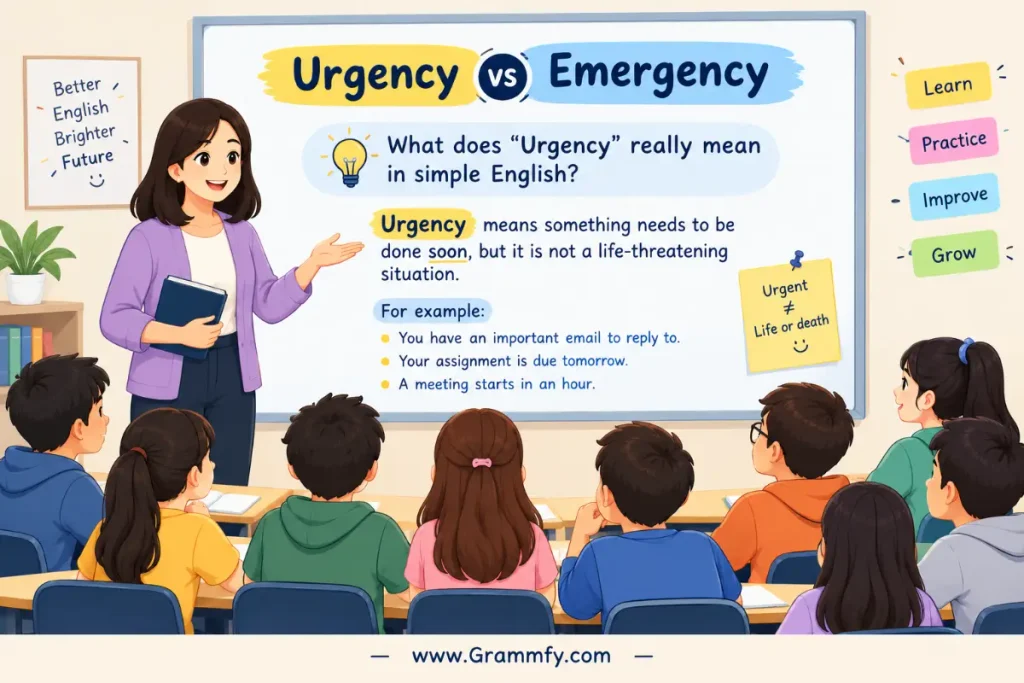
What does “Urgency” really mean in simple English?
Urgency is the quality of needing quick attention or action. Something can be urgent without being dangerous.
For example, imagine your teacher asks you to submit an assignment by 5 p.m. You may need to finish it quickly, so the deadline has urgency. However, missing the deadline isn’t normally a life-threatening situation.
The word focuses on time and speed. An urgent matter should not be ignored for too long.
Consider these examples:
- “There is urgency in completing the application.”
- “The manager stressed the urgency of the deadline.”
- “I need an urgent reply before noon.”
- “The repair has some urgency because the machine may stop working.”
Urgency can exist at different levels. A work email may be urgent because someone needs information within an hour. A medical problem can also be urgent when treatment should happen quickly, even if the person isn’t in immediate danger.
What does Emergency mean in plain English?
An emergency is a serious and unexpected situation that requires immediate action.
The word is often connected with danger, injury, health problems, accidents, fires, natural disasters, or situations where waiting could cause serious harm.
Examples include:
- A person suddenly has trouble breathing.
- A building catches fire.
- A serious car accident occurs.
- A major gas leak is discovered.
- Someone is in immediate danger.
An emergency isn’t simply something you want handled quickly. It usually has a much higher level of risk.
For instance:
“Please fix the broken office printer urgently.”
This is urgent, but it’s probably not an emergency.
Now compare it with:
“Call emergency services. Someone has been seriously injured.”
That’s an emergency because immediate action is needed to protect someone’s safety or life.
Where do the words Urgency vs Emergency come from?
Understanding word origins can make the difference easier to remember.
Urgency comes from the Latin root urgere, meaning “to press” or “to drive.” The idea is that something is pressing you to act.
The related word urgent entered English through French and Latin forms. Its meaning developed around something that demands immediate attention.
Emergency comes from the Latin emergere, meaning “to arise” or “to come out.” The word later developed the sense of an unexpected situation that arises and requires action.
These origins give you a useful memory trick:
- Urgency → something is pressing you to act.
- Emergency → a serious situation has arisen and needs immediate action.
The history doesn’t tell you every modern use, but it helps explain why the words have different shades of meaning.
What is the difference between Urgency vs Emergency?
The simplest distinction is quick action versus immediate action because of serious danger or risk.
| Word | Main idea | Typical level |
|---|---|---|
| Urgency | Something needs attention quickly | Moderate to high |
| Emergency | A serious situation needs immediate action | Very high |
An urgent situation may become an emergency if the risk gets worse.
Imagine a water pipe begins leaking in a building. At first, the leak may be an urgent maintenance problem. If the pipe bursts and floods the building, damages electrical systems, or threatens people’s safety, the situation may become an emergency.
Another useful test is to ask:
“What happens if we wait?”
If waiting is inconvenient, costly, or harmful to a project, the issue may be urgent.
If waiting could cause serious injury, death, major damage, or immediate danger, it may be an emergency.
Urgency vs Emergency — what’s the real difference?
| Feature | Urgency | Emergency |
|---|---|---|
| Needs quick action | Yes | Yes |
| Usually involves danger | Not necessarily | Often |
| Waiting can cause problems | Yes | Often serious problems |
| Can be planned | Sometimes | Usually unexpected |
| Used in workplaces | Very common | Common for serious incidents |
| Used for medical situations | Yes | Yes |
| Usually life-threatening | No | Sometimes |
| Level of seriousness | Varies | Usually very high |
The words can overlap, but they aren’t interchangeable in every sentence.
Calling every small problem an emergency can make your communication less accurate. If you describe every deadline as an emergency, people may eventually stop recognizing your truly serious warnings.
What are the best synonyms for Urgency vs Emergency?
There isn’t one perfect synonym for either word. The best choice depends on the situation, tone, and level of seriousness.
Here is a larger synonym list to help you choose accurately.
Simple and easy synonyms
| Word | Meaning | Tone | Example |
|---|---|---|---|
| Need | Something that must be handled | Simple | “There’s a need to act quickly.” |
| Hurry | Need to move or act quickly | Casual | “We need to hurry.” |
| Speed | Fast action or movement | Neutral | “The project needs more speed.” |
| Promptness | Acting without delay | Neutral | “Promptness is important here.” |
| Quickness | Doing something fast | Simple | “Quickness matters in this situation.” |
| Pressure | Force that makes action necessary | Neutral | “The deadline created pressure.” |
| Demand | A strong requirement for action | Neutral | “The situation demands attention.” |
Everyday synonyms
| Word | Meaning | Tone | Example |
|---|---|---|---|
| Immediate need | Something needed right away | Everyday | “This is an immediate need.” |
| Time pressure | Limited time to act | Everyday | “We’re under time pressure.” |
| Rush | A need to act quickly | Casual | “There’s a rush to finish the order.” |
| Priority | Something more important than other tasks | Neutral | “This should be our top priority.” |
| Fast response | A quick reaction | Everyday | “We need a fast response.” |
| Quick action | Action taken without much delay | Everyday | “Quick action can prevent further damage.” |
| Short notice | Little time to prepare | Everyday | “Thanks for helping on short notice.” |
| Pressing need | A need that requires attention soon | Neutral | “Housing is a pressing need.” |
Formal synonyms
| Word | Meaning | Tone | Example |
|---|---|---|---|
| Immediacy | The quality of requiring immediate attention | Formal | “The issue requires a sense of immediacy.” |
| Necessity | Something that must be done | Formal | “The necessity of action is clear.” |
| Expediency | Suitability of quick action | Formal | “The matter should be handled with expediency.” |
| Prompt attention | Attention given quickly | Formal | “The complaint requires prompt attention.” |
| Critical need | A highly important requirement | Formal | “The clinic has a critical need for supplies.” |
| Priority | A matter given special importance | Formal/neutral | “Safety remains our highest priority.” |
| Immediate intervention | Action taken without delay | Formal | “Immediate intervention may be required.” |
| Critical situation | A situation requiring serious attention | Formal | “The team is monitoring a critical situation.” |
Casual and slang-like expressions
| Word or phrase | Meaning | Tone | Example |
|---|---|---|---|
| ASAP | As soon as possible | Casual | “Please send it ASAP.” |
| Right away | Immediately | Casual | “I’ll handle it right away.” |
| Pronto | Quickly or immediately | Informal | “Send the details pronto.” |
| In a rush | Having very little time | Casual | “I’m in a rush today.” |
| Drop everything | Stop other activities to act | Informal | “We had to drop everything.” |
| Act fast | Take action quickly | Casual | “Act fast before the offer ends.” |
| Now | At this exact time | Very direct | “We need help now.” |
Not every casual expression works in professional writing. “ASAP” can be acceptable in some workplace emails, but “prompt attention” may sound more professional in a formal letter.
What are synonyms for urgency from mild to strong?
Synonyms aren’t all equal. Some communicate a small need for speed, while others suggest serious danger.
Mild urgency
Use these when something needs attention but isn’t a crisis:
- Soon
- Timely
- Prompt
- Priority
- Important
- Pressing
Example:
“Please give this request prompt attention.”
Moderate urgency
These suggest that waiting isn’t a good idea:
- Urgent
- Immediate
- Time-sensitive
- High-priority
- Pressing need
- Fast response
Example:
“This is a time-sensitive request because the application closes tomorrow.”
Strong urgency
These expressions suggest that action must happen immediately:
- Critical
- Immediate intervention
- Critical need
- Act now
- Immediate action required
- Life-threatening
Example:
“The patient needs immediate medical attention.”
Emergency-level language
Use these only when the situation genuinely deserves it:
- Emergency
- Crisis
- Disaster
- Life-threatening situation
- Serious incident
- Critical incident
- Imminent danger
Example:
“The fire created an emergency that required everyone to leave the building.”
What are the parts of speech for Urgency vs Emergency?
Knowing how these words work grammatically can help you use them correctly.
Urgency as a noun
Urgency is a noun.
- “The urgency of the situation is increasing.”
- “She spoke with urgency.”
- “The manager understood the urgency.”
Urgent as an adjective
Urgent describes something that needs quick action.
- “This is an urgent request.”
- “I received an urgent email.”
- “The patient needs urgent care.”
Urgently as an adverb
Urgently explains how something is done.
- “Please respond urgently.”
- “The team urgently needs additional information.”
Emergency as a noun
An emergency is normally used as a noun.
- “This is an emergency.”
- “The hospital received several emergency cases.”
- “She called for help during the emergency.”
Emergency as an adjective
Emergency can also modify a noun.
- “Emergency services arrived quickly.”
- “The building has an emergency exit.”
- “He needed emergency treatment.”
Emergent as an adjective
Emergent is a related word, but it doesn’t always mean exactly the same thing as “emergency.”
It can describe something that is newly developing or becoming important. In some professional settings, especially medicine, it may also describe a situation requiring immediate attention.
For everyday English, urgent and emergency are usually clearer.
Is urgency stronger than importance?
Usually, yes, but they measure different things.
Importance tells you how valuable or significant something is. Urgency tells you how quickly something needs attention.
An annual report may be extremely important but not urgent today.
A broken website payment system may be urgent because customers can’t pay, even if fixing the issue isn’t as important as a major long-term company project.
Compare these:
“The meeting is important.”
This tells us the meeting matters.
“The meeting is urgent.”
This suggests the meeting needs attention quickly.
A task can be:
- Important but not urgent.
- Urgent but not very important.
- Both important and urgent.
- Neither important nor urgent.
That distinction is especially useful when organizing work.
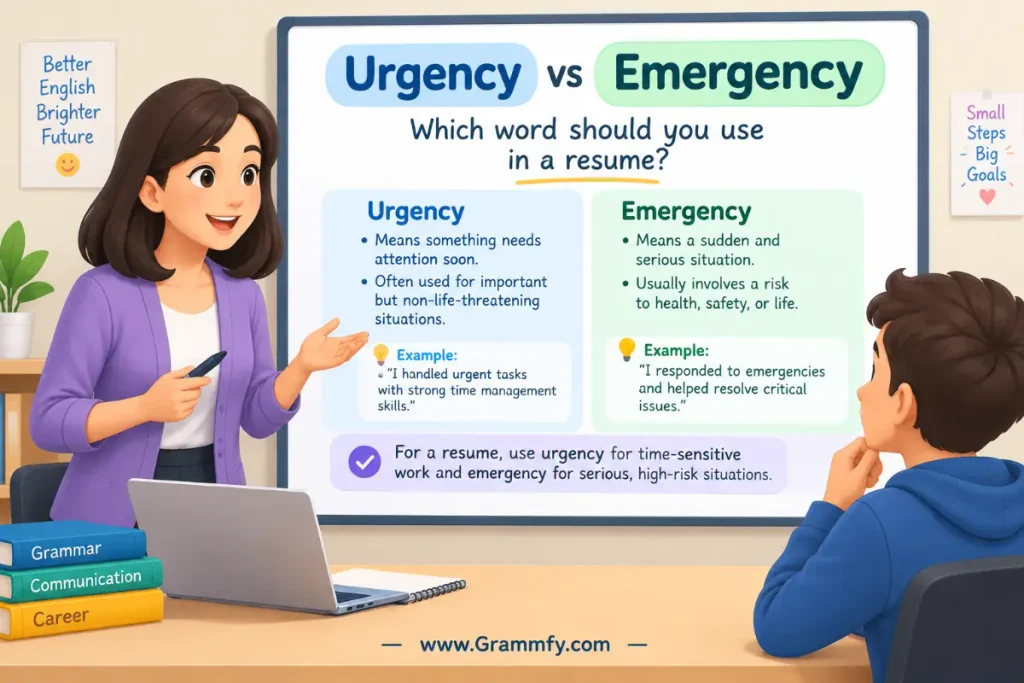
Urgency vs Emergency — which word should you use in a resume?
For a resume, use professional terms such as time-sensitive, high-priority, critical, prompt, or urgent when they accurately describe your experience.
Avoid calling ordinary workplace tasks “emergencies” just to make your experience sound more impressive.
A stronger resume example is:
“Managed time-sensitive customer requests while meeting strict deadlines.”
You could also write:
“Handled high-priority support requests and resolved issues within tight deadlines.”
These statements show useful skills without exaggerating.
What should you write in a resume?
Good resume language includes:
- Managed high-priority tasks.
- Responded to time-sensitive requests.
- Worked effectively under pressure.
- Resolved urgent customer issues.
- Prioritized critical tasks.
- Coordinated responses to unexpected problems.
The goal is to show that you can manage pressure and priorities.
What is the best word for an essay?
In an essay, choose the word based on your argument.
Urgency works well when discussing social problems, deadlines, environmental concerns, policy, or public action.
Example:
“The growing urgency of climate action has influenced public policy.”
Emergency is better when the subject involves a serious crisis or immediate danger.
Example:
“The earthquake created a national emergency.”
Academic writing benefits from precision. Don’t use “emergency” simply because it sounds stronger.
How do you use urgency in an essay?
You can use phrases such as:
- “the urgency of the issue”
- “a growing sense of urgency”
- “the urgent need for change”
- “the increasing urgency of reform”
- “an urgent public concern”
Example:
“The growing urgency of affordable housing requires policymakers to consider practical solutions.”
That sentence sounds stronger than simply saying:
“Affordable housing is important.”
What is the best word for texting?
Texting is more flexible, so simple expressions usually work best.
Use:
- ASAP
- Right away
- Quickly
- Urgent
- Need help now
- Please call me
- This can’t wait
For example:
“Can you call me ASAP?”
If someone is in immediate danger, be direct:
“Call emergency services now.”
Text messages don’t need complicated vocabulary. Clear language matters more than formal language.
What is the best word for an email?
For professional emails, urgent, time-sensitive, high-priority, or immediate attention can work well.
Compare these subject lines:
- Question
- Important Question
- Urgent: Approval Needed Today
- Time-Sensitive: Contract Review
- Immediate Action Required
The best choice depends on the actual situation.
If you need a response by the end of the day, “Time-Sensitive” may be more accurate than “Emergency.”
Example professional email sentences
“Could you please review this request as soon as possible?”
“This is a time-sensitive matter because the deadline is tomorrow.”
“Your prompt attention would be appreciated.”
Reserve “emergency” for genuinely serious situations.
What is the best word for speaking?
In everyday speech, choose simple words that your listener can understand immediately.
Say:
“We need to act quickly.”
Instead of:
“We require immediate intervention.”
The formal version isn’t wrong, but it may sound unnatural in a casual conversation.
For a serious situation, say:
“This is an emergency.”
That direct sentence is often better than using a complicated synonym.
What are real examples of Urgency vs Emergency?
Real-life examples make the distinction easier to remember.
Example 1: A work deadline
Your manager needs a report in two hours.
“The report is urgent.”
This is an urgent work task. It isn’t necessarily an emergency.
Example 2: A medical crisis
Someone becomes unconscious and isn’t breathing normally.
“This is an emergency.”
Immediate help is needed because there may be a serious threat to the person’s life.
Example 3: A broken computer
Your computer crashes shortly before an important presentation.
“The problem is urgent.”
You need it fixed quickly, but it isn’t automatically an emergency.
Example 4: A building fire
Smoke fills a crowded building.
“This is an emergency.”
People may need to leave immediately and emergency services may need to respond.
Example 5: A school assignment
Your essay is due tonight.
“I have an urgent deadline.”
Calling your homework an “emergency” would usually be an exaggeration.
Example 6: A leaking roof
A small leak appears during light rain.
“The repair is urgent.”
If the roof collapses and people are at risk, the situation could become an emergency.
Example 7: A website problem
An online store stops accepting payments.
“The payment issue is urgent.”
The company may lose sales, but that doesn’t necessarily make it an emergency.
Example 8: A dangerous gas leak
A strong gas smell is detected inside a building.
“This may be an emergency.”
The potential danger makes immediate action important.
Example 9: A delayed package
A package is late by one day.
“I need an update soon.”
Calling the delay an emergency would normally sound excessive.
Example 10: A hospital situation
A patient suddenly develops severe symptoms.
“The patient needs immediate attention.”
Depending on the circumstances, medical professionals may classify it as an emergency.
Example 11: A job application
An employer asks for your documents before a deadline.
“This is a time-sensitive request.”
That’s more accurate than calling it an emergency.
Example 12: A natural disaster
A severe storm causes flooding and threatens homes.
“The community is facing an emergency.”
The word fits because there is a serious and immediate risk.
Urgent vs critical — what’s the difference?
Urgent means something needs quick attention.
Critical suggests something is extremely important or potentially serious.
An urgent issue doesn’t always have severe consequences. A critical issue usually carries greater risk.
Compare:
| Urgent | Critical |
|---|---|
| Needs quick attention | May involve severe consequences |
| Can be routine | Usually more serious |
| Focuses on time | Focuses on importance or risk |
| “Please reply today.” | “The system has failed.” |
For example:
“Please approve this urgent request.”
The request needs quick action.
“The patient is in critical condition.”
The second sentence describes a much more serious condition.
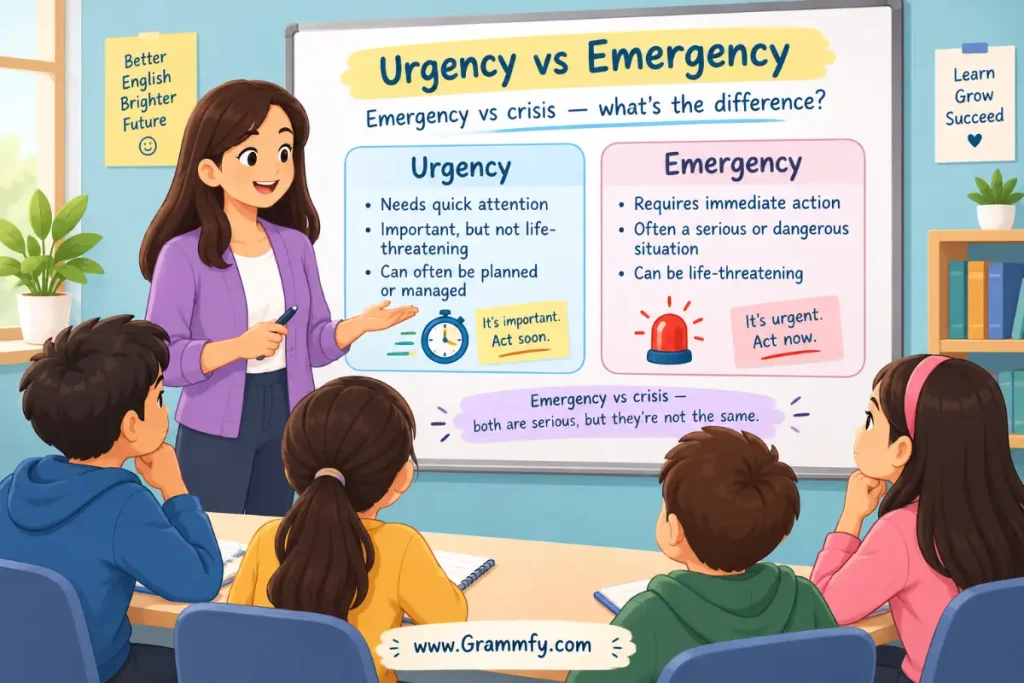
Emergency vs crisis — what’s the difference?
An emergency is usually a serious situation requiring immediate action.
A crisis is a period of severe difficulty, danger, or instability. A crisis can continue for a longer period.
For example:
“The hospital declared an emergency after the accident.”
This emphasizes immediate response.
“The company is experiencing a financial crisis.”
This suggests a serious problem that may develop over weeks, months, or longer.
A crisis can create emergencies, and an emergency can occur during a crisis, but the words are not identical.
Urgent vs immediate — what’s the difference?
Urgent means something needs attention very soon.
Immediate means without delay or happening right now.
That makes immediate stronger in many situations.
Compare:
“Please give this urgent request your attention.”
You should act quickly.
“Please take immediate action.”
You should act now.
The exact strength can depend on context, but “immediate” generally leaves less room for waiting.
Can an emergency be planned?
Yes. An emergency can be unexpected, but people and organizations can prepare for possible emergencies.
For example, a school may have:
- Fire evacuation plans
- Emergency exits
- First-aid supplies
- Emergency contact information
- Severe-weather procedures
The emergency itself may be unexpected, while the response is carefully planned.
This is why businesses often use phrases such as emergency plan, emergency procedure, and emergency response.
Can something be urgent without being an emergency?
Absolutely.
This is one of the most important points to remember.
A deadline can be urgent. A customer complaint can be urgent. A repair can be urgent. A work request can be urgent.
None of these automatically involves an emergency.
For example:
“The application deadline is tomorrow, so I need to finish this urgently.”
There is time pressure, but no immediate threat to safety.
That is why urgent is a broader word than emergency.
Can something be an emergency without being called urgent?
Yes, although emergency situations usually require urgent action.
The word emergency already carries a strong sense of immediacy. Saying “emergency” tells people that the situation needs immediate attention.
You might say:
“The building has an emergency.”
You don’t necessarily need to add:
“The building has an urgent emergency.”
In fact, that phrase can sound repetitive.
Better:
“The building has an emergency.”
Or:
“There is an urgent safety issue.”
Common mistakes with Urgency vs Emergency
Several mistakes happen because people treat these words as exact synonyms.
Mistake 1: Calling every urgent task an emergency
Incorrect or exaggerated:
“My homework is an emergency.”
Better:
“My homework is urgent because it’s due tonight.”
Unless there is an unusual serious circumstance, homework isn’t an emergency.
Mistake 2: Using “urgent” when you mean dangerous
Suppose someone is seriously injured.
Saying:
“This is urgent.”
isn’t necessarily wrong, but it may not communicate enough seriousness.
Better:
“This is an emergency.”
The stronger word clearly signals immediate danger.
Mistake 3: Overusing “emergency” at work
If every small request is labeled an emergency, coworkers may start ignoring the label.
Use “emergency” for genuinely serious situations.
For normal deadlines, choose:
- Urgent
- High-priority
- Time-sensitive
- Important
- Prompt
Mistake 4: Confusing urgency with importance
Something can be important without needing immediate action.
For example:
“Learning a new language is important.”
It doesn’t mean:
“Learning a new language is an emergency.”
Importance and urgency aren’t the same thing.
Mistake 5: Using emergency as a dramatic synonym
Some speakers use “emergency” to make a message sound stronger.
That can reduce clarity. Professional communication is usually more effective when the level of seriousness matches the facts.
When should you NOT use the word emergency?
Don’t use emergency when you simply mean:
- Important
- Inconvenient
- Annoying
- Time-sensitive
- Expensive
- Difficult
- Stressful
- High-priority
For example, a lost password may be frustrating and urgent if you need access for work, but it isn’t normally an emergency.
Similarly, a missed appointment can be important without being an emergency.
The word should be saved for situations where immediate action is genuinely necessary.
What are the antonyms of Urgency vs Emergency?
Knowing opposites can also clarify meaning.
Antonyms of urgency
Possible opposites include:
- Delay
- Patience
- Slowness
- Leisure
- Calm
- Lack of pressure
- Non-urgent
- Routine
Example:
“This request is non-urgent and can wait until next week.”
Antonyms of emergency
There isn’t one perfect opposite, but useful choices include:
- Normal situation
- Routine situation
- Stability
- Safety
- Calm
- Ordinary circumstances
- Non-critical situation
Example:
“The hospital returned to normal operations after the emergency ended.”
Are Urgency vs Emergency used differently in US and UK English?
The basic distinction is the same in both US and UK English.
American and British speakers generally understand urgent, urgency, and emergency in similar ways.
Some related terms can vary by region or institution.
For example, the phrase emergency room is very common in American English. In British English, A&E, meaning “Accident and Emergency,” is commonly used for a hospital emergency department.
You may also hear ER in the United States and A&E in the UK.
The core distinction remains:
- Urgent → needs quick attention.
- Emergency → serious situation requiring immediate response.
What words can replace urgency in different situations?
The best replacement depends on what you actually want to communicate.
| Situation | Better word or phrase |
|---|---|
| Need a fast reply | Prompt response |
| Deadline is close | Time-sensitive |
| Task has high priority | High-priority |
| Serious workplace issue | Critical issue |
| Need action today | Urgent |
| Need action right now | Immediate action |
| Serious danger | Emergency |
| Long period of serious difficulty | Crisis |
| Casual conversation | Need to hurry |
| Formal report | Immediacy / pressing need |
A good synonym doesn’t just replace a word. It preserves the intended meaning.
How do you choose the right word quickly?
Use this simple decision process.
Step 1: Ask whether there is danger
If people, property, health, or safety are in immediate danger, emergency may be appropriate.
Step 2: Ask whether the main issue is time
If the problem simply needs to be handled soon, use urgent, time-sensitive, or pressing.
Step 3: Consider the audience
A text message can be direct:
“I need this ASAP.”
A formal email might say:
“This is a time-sensitive request.”
An academic essay may use:
“The urgency of the issue is increasing.”
Step 4: Don’t exaggerate
Choose the strongest word that is still accurate.
Calling something an emergency when it’s merely inconvenient can create confusion.
Step 5: Look at the consequences of waiting
Ask yourself:
“What could happen if we wait?”
Minor inconvenience → probably not an emergency.
Missed deadline → possibly urgent.
Serious damage or danger → potentially an emergency.
A quick comparison chart
| If you mean… | Use… |
|---|---|
| Needs attention soon | Urgent |
| Needs attention quickly because of a deadline | Time-sensitive |
| Needs special priority | High-priority |
| Needs action without delay | Immediate |
| Has serious consequences | Critical |
| Involves immediate danger | Emergency |
| Involves prolonged severe difficulty | Crisis |
| Needs a quick response | Prompt |
| Is important but can wait | Important |
| Is routine | Normal / non-urgent |
How can you remember the difference?
Think of a traffic-light style scale:
Normal → Urgent → Emergency
A normal task can wait.
An urgent task should be handled soon.
An emergency needs immediate attention because the consequences of waiting may be serious.
Here’s another memory trick:
Urgency = “Act soon.”
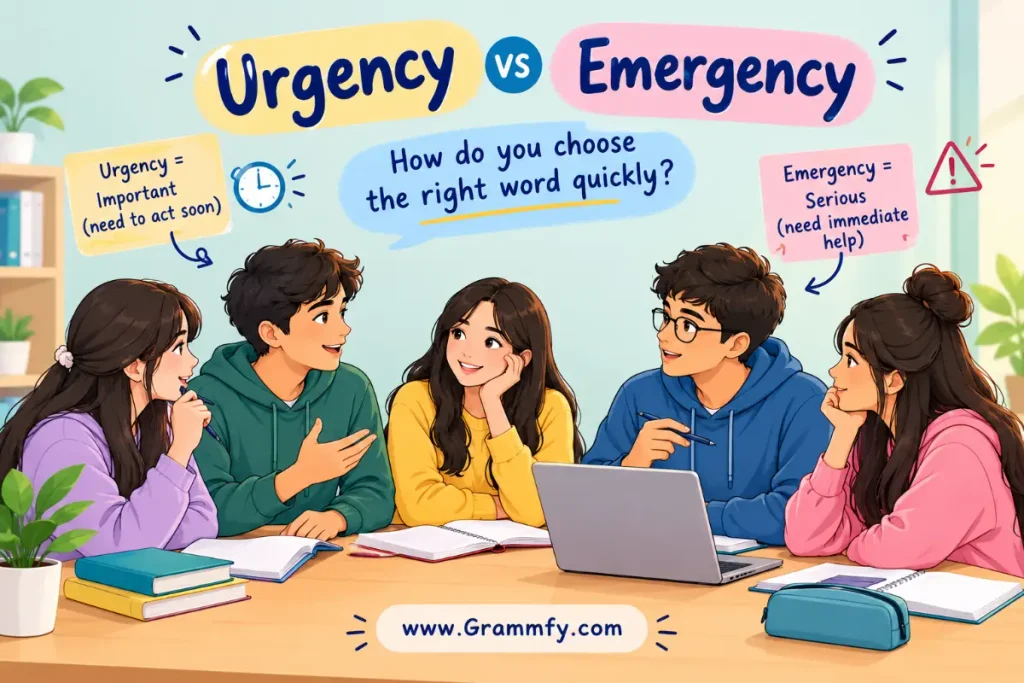
Emergency = “Act now because something serious is happening.”
That simple distinction works in most everyday situations.
Conclusion
Choosing between Urgency vs Emergency becomes much easier when you focus on what the situation actually requires. Urgency is about the need for quick attention, often because of a deadline, priority, or time-sensitive problem. An emergency is more serious and usually involves immediate danger, significant risk, or a situation that can’t safely wait.
Use “urgent” for a report that must be finished today, a quick business response, or a problem that needs prompt attention. Save “emergency” for serious situations such as accidents, fires, sudden medical crises, or immediate safety threats. The strongest word isn’t always the best word. Accurate wording makes your communication clearer, more professional, and easier to trust.
Frequently Asked Questions
What’s another way to say urgency?
Another way to say urgency is immediacy, promptness, pressing need, time pressure, or a need for quick action. The best choice depends on the situation and tone.
Is urgency more serious than emergency?
No, an emergency is generally more serious than ordinary urgency. Urgency vs Emergency is mainly a difference between needing quick attention and facing a serious situation that requires immediate action.
What is the difference between urgent and emergency?
Urgent describes something that needs attention quickly, while emergency describes a serious situation requiring immediate action. An urgent issue doesn’t always involve danger.
Can I use urgent in a professional email?
Yes, urgent is appropriate in a professional email when something genuinely needs quick attention. For a softer tone, you can use “time-sensitive,” “high-priority,” or “prompt attention.”
Is an emergency always life-threatening?
No, an emergency isn’t always life-threatening, but it generally involves serious risk or a situation that requires immediate action. The exact meaning depends on the context.
Should I say urgency or emergency in an essay?
Use urgency when discussing the need for quick action and emergency when describing a serious crisis or dangerous situation. Urgency vs Emergency depends on whether your main point is time pressure or serious immediate risk.
What’s the easiest way to remember urgency vs emergency?
Remember urgency = act soon and emergency = act now because of serious danger or risk. This quick rule works for most everyday examples.
