
Have you ever been writing an essay, story, text, or poem and wanted to describe a moment when everything suddenly became quiet? You might write, “The room was silent,” but that sentence doesn’t always show how the silence actually felt. A well-chosen comparison can make that quiet moment easier to imagine. Similes for silent
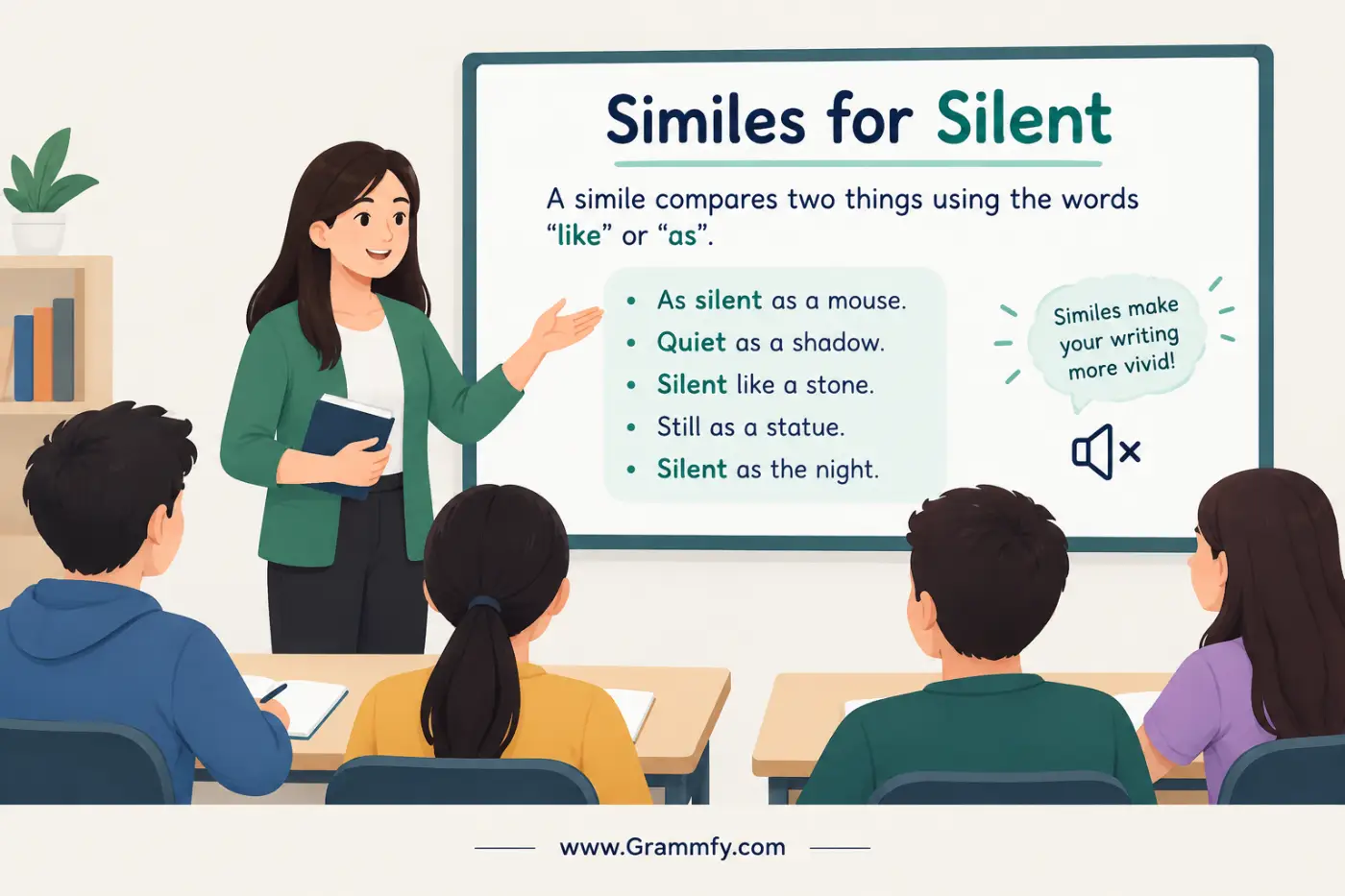
Similes for silent describe quietness by comparing it to something familiar, such as a sleeping town, a closed book, a frozen lake, or a whisperless room.
The right comparison can make silence feel peaceful, lonely, tense, mysterious, or even frightening. A quiet library and an abandoned house may both be silent, but they don’t create the same feeling.
This guide explains the meaning and origin of silent, gives you a large collection of related words, compares close synonyms, and shows how to choose the right description for essays, stories, poems, emails, texts, and everyday speech.
You can also explore related examples in [sun similes].
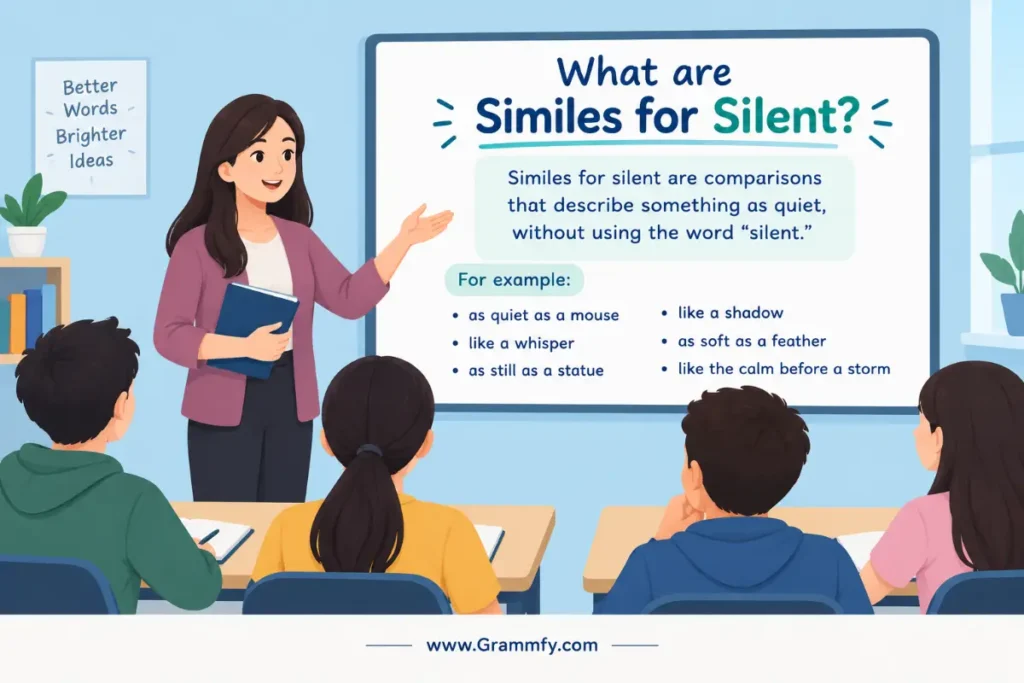
What are Similes for silent?
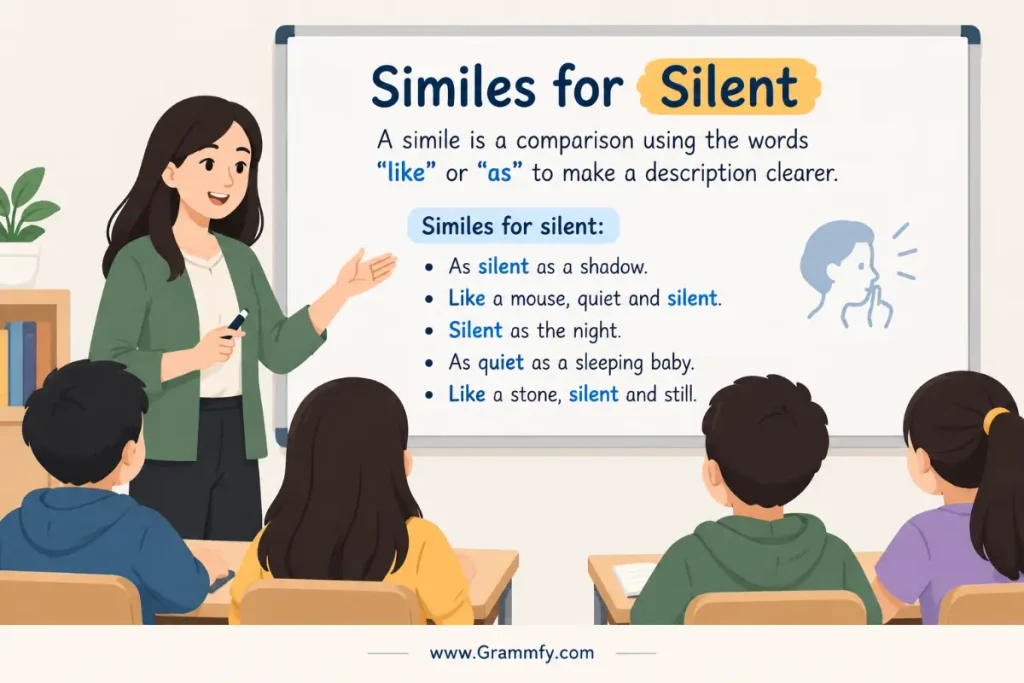
A simile is a comparison between two different things, usually using like or as.
When describing silence, a writer can compare quietness with something that has little or no sound.
For example:
- The room was as silent as a sleeping baby.
- The forest was quiet like an empty church.
- The house stood as still as a closed book.
- The classroom became silent like a frozen lake.
- The street was as quiet as a deserted village.
These comparisons don’t mean that a room is literally a sleeping baby or that silence is literally a frozen lake. They help readers imagine the level and feeling of the quietness.
Consider the difference:
The hallway was silent.
This tells us that there was no sound.
Now consider:
The hallway was as silent as an empty church.
The second sentence gives the reader a stronger mental picture. It suggests a deep, almost noticeable quiet.
What does “silent” mean in plain English?
Silent means having little or no sound.
It can describe a person, place, object, action, or situation.
Examples:
- The students became silent.
- The room was silent.
- The machine went silent.
- She remained silent.
- The forest was silent at midnight.
The word can also describe someone who chooses not to speak.
For example:
He stayed silent during the meeting.
Here, silent means that he did not talk.
Silence can also be intentional. A person may remain quiet because they are thinking, upset, nervous, respectful, or simply uninterested in talking.
That makes silent different from some related words. Quiet usually means there isn’t much noise, while silent often suggests an almost complete absence of sound.
Where did the word “silent” come from?
The word silent comes from Latin silens, meaning “being still” or “quiet.” It is related to the Latin verb silere, meaning “to be quiet.”
The word later entered English through French and developed into the form we use today.
Its history connects it with the basic idea of stopping sound or remaining quiet. That’s why the word can describe both physical quietness and a person’s lack of speech.
Over time, writers have used silence to express much more than the absence of noise. Silence can suggest:
- peace
- sadness
- fear
- secrecy
- loneliness
- respect
- concentration
- mystery
- tension
- surprise
This is why descriptions of silence can be powerful in creative writing.
Why do writers compare silence with other things?
Silence is difficult to “see.” You can see a tree, a house, or a mountain, but you can’t directly see silence.
A comparison gives that invisible feeling a shape.
For example:
The room was silent like a locked vault.
A locked vault suggests isolation and secrecy.
Compare that with:
The room was silent like a sleeping garden.
This creates a much softer feeling.
The silence hasn’t changed, but the comparison changes the reader’s emotional response.
When choosing a comparison, ask:
- How quiet is the scene?
- What mood do I want?
- Is the silence peaceful or uncomfortable?
- What familiar image could show that feeling?
- Does the comparison fit the situation?
Master synonym list for “silent”
There are many words related to silence, but they aren’t all interchangeable. Some describe a complete lack of sound, while others suggest only a small amount of noise.
| Word | Meaning | Tone | Example |
|---|---|---|---|
| Quiet | Making little noise | Simple | The room was quiet. |
| Silent | Making no or almost no sound | Neutral | The room was silent. |
| Still | Without movement or noise | Everyday | The lake was still. |
| Calm | Peaceful and without disturbance | Everyday | The morning was calm. |
| Mute | Not producing sound | Neutral | The television was mute. |
| Soundless | Without sound | Formal | The movement was soundless. |
| Noiseless | Making no noise | Formal | The machine operated noiselessly. |
| Serene | Very calm and peaceful | Formal | The garden felt serene. |
| Tranquil | Extremely calm | Formal | The lake was tranquil. |
| Hushed | Made unusually quiet | Descriptive | The crowd grew hushed. |
| Whisper-quiet | Extremely quiet | Informal | The room was whisper-quiet. |
| Wordless | Without spoken words | Literary | They shared a wordless moment. |
| Reticent | Unwilling to speak openly | Formal | She was reticent about the event. |
| Reserved | Not openly expressing thoughts | Neutral | He was reserved during the meeting. |
| Inaudible | Impossible to hear | Formal | His reply was inaudible. |
| Subdued | Quiet and restrained | Formal | The celebration was subdued. |
| Dormant | Temporarily inactive | Formal | The town seemed dormant at night. |
| Unvoiced | Not spoken aloud | Formal | Her concerns remained unvoiced. |
| Unspoken | Not expressed in words | Everyday | There was an unspoken agreement. |
| Soundless | Completely lacking sound | Literary | They moved through the room soundlessly. |
| Calm | Free from excitement or noise | Simple | The sea was calm. |
| Motionless | Not moving | Descriptive | The room felt motionless. |
| Peaceable | Free from conflict or disturbance | Formal | It was a peaceable evening. |
| Secretive | Keeping information hidden | Descriptive | His silence seemed secretive. |
| Silent | Not speaking or making sound | Neutral | Everyone became silent. |
| Quietude | A state of quietness | Literary | The forest had a deep quietude. |
Simple words for everyday writing
If you’re writing for younger readers or want clear English, choose:
- quiet
- silent
- still
- calm
- peaceful
- hushed
These words are easy to understand.
Example:
The classroom became silent after the teacher entered.
Everyday descriptive words
For stories, texts, and casual writing, try:
- hushed
- muted
- wordless
- whisper-quiet
- still
- speechless
Example:
The children grew hushed as the lights went out.
Formal words
Academic and professional writing may use:
- tranquil
- serene
- subdued
- inaudible
- reticent
- taciturn
- soundless
Example:
The normally busy laboratory became unusually subdued.
Informal or expressive choices
Casual writing can use expressions such as:
- whisper-quiet
- dead quiet
- totally quiet
- not a sound
- quiet as a mouse
These can sound natural in conversation but may not fit formal academic writing.
How strong are different words for silence?
Not every synonym has the same intensity.
Mild silence
These suggest a small amount of sound:
- calm
- peaceful
- quiet
- subdued
Example:
The café was quiet after lunch.
There may still be soft conversations or background noise.
Moderate silence
These suggest a deeper level of quiet:
- hushed
- still
- muted
- wordless
Example:
The audience became hushed before the performance began.
Strong silence
These suggest almost complete absence of sound:
- silent
- soundless
- noiseless
- dead quiet
Example:
The hallway was completely silent.
Extreme or dramatic silence
For creative writing, you might use:
- deathly silent
- eerily quiet
- unnaturally still
- completely soundless
These expressions often create tension or mystery.
Example:
The abandoned house was eerily quiet.
What are the different forms of “silent”?
The word silent is mainly used as an adjective.
Silent as an adjective
It describes something or someone that is not making a sound or not speaking.
The audience was silent.
She remained silent.
Silently as an adverb
Silently describes an action performed without sound.
He walked silently through the hallway.
The snow fell silently overnight.
Silence as a noun
The state or condition of being quiet is called silence.
The silence in the room felt strange.
Silence as a verb
To silence someone or something means to make them quiet.
The teacher silenced the noisy class.
This distinction matters because you can’t always replace one form with another.
Best words for a resume
A resume usually doesn’t need creative descriptions of silence. Instead, use precise professional language.
If you need to describe someone who speaks carefully, words such as reserved, thoughtful, or measured may work better.
Example:
She maintained a calm and measured communication style during difficult discussions.
Avoid writing:
She was as silent as a sleeping forest.
That sounds creative rather than professional.
Best words for an essay
For an essay, choose clear language that supports your point.
Good options include:
- quiet
- silent
- subdued
- peaceful
- hushed
- tranquil
Example:
After the announcement, the classroom became completely silent.
For a descriptive essay:
The village was as quiet as a sleeping child beneath the moonlight.
The first example is more factual. The second is more imaginative.
Best words for texting
Texting usually calls for short and natural expressions.
Try:
It was so quiet.
The place was dead quiet.
Everyone went silent.
Not a sound anywhere.
A poetic sentence can work if you’re texting a friend who enjoys creative language:
The street was quiet like the whole city had fallen asleep.
Best words for an email
Professional emails usually need direct language.
Instead of:
The office was as silent as a deserted forest.
Use:
The office was unusually quiet this morning.
Or:
The meeting became quiet after the announcement.
Creative comparisons can sound strange in business communication unless you’re intentionally writing in a personal or literary style.
Best words for speaking
In everyday conversation, simple expressions are strongest.
You might say:
It was completely quiet.
Everyone went silent.
The room was dead quiet.
You couldn’t hear a sound.
These phrases are natural and easy to understand.
30+ original Similes for silent
Here are original comparisons for different moods and situations.
Peaceful silence
- The garden was as silent as a sleeping child.
- The lake was quiet like a closed book.
- The village was as still as a painting.
- The forest rested like a sleeping giant.
- The room was quiet like a candlelit chapel.
- The morning was as peaceful as a snow-covered field.
- The house was silent like a library after closing time.
- The beach was as quiet as an empty shell.
- The meadow was still like a photograph.
- The night was as quiet as a sleeping town.
Mysterious silence
- The hallway was as silent as a locked vault.
- The old house was quiet like a forgotten graveyard.
- The forest stood silent like a secret waiting to be discovered.
- The room was as still as a paused movie.
- The empty street was quiet like a hidden tunnel.
- The building became silent like a room after everyone leaves.
- The darkness was as quiet as a sealed door.
Uncomfortable silence
- The classroom became as silent as a courtroom.
- The dinner table was quiet like a storm before it breaks.
- The room fell silent like someone had pressed a pause button.
- Everyone became as still as statues.
- The crowd was quiet like a field after a sudden snowfall.
- The hallway felt as silent as an abandoned station.
Dramatic silence
- The battlefield was silent like a stage after the final scene.
- The city became as quiet as a sleeping machine.
- The street was silent like the world had stopped breathing.
- The forest was as still as a frozen photograph.
- The house stood silent like a forgotten monument.
- The night was quiet like a giant curtain covering the world.
- The crowd fell silent like a switch had suddenly been turned off.
- The room became as silent as the moment before a storm.
- The empty theater was quiet like a sleeping giant.
“Quiet like a sleeping town” vs. “silent like a locked room”
These two comparisons both describe a lack of noise, but the mood is different.
| Comparison | Feeling | Best for |
|---|---|---|
| Quiet like a sleeping town | Peaceful and calm | Stories, poems |
| Silent like a locked room | Closed and mysterious | Suspense, mystery |
For example:
The village was quiet like a sleeping town.
This feels safe and peaceful.
But:
The hallway was silent like a locked room.
This feels more tense.
The lesson is simple: the object you choose controls the mood of the comparison.
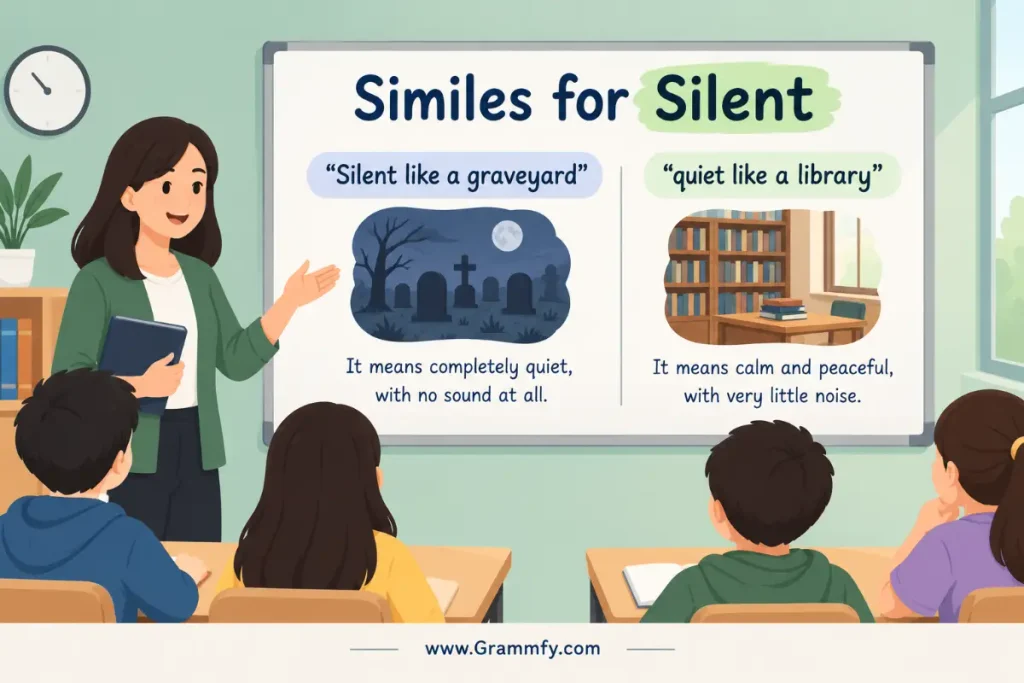
“Silent like a graveyard” vs. “quiet like a library”
These are both common ideas, but they have different emotional effects.
| Comparison | Main idea | Mood |
|---|---|---|
| Silent like a graveyard | Deep, eerie quiet | Dark |
| Quiet like a library | Controlled, peaceful quiet | Calm |
Use the library image when you want peaceful concentration.
Use the graveyard image when you want mystery or fear.
“Silent” vs. “quiet” — what’s different?
Silent usually suggests no sound or almost no sound, while quiet means there is little sound.
| Silent | Quiet |
|---|---|
| Little or no sound | Low level of sound |
| Stronger | Softer |
| Can mean not speaking | Usually describes noise |
| Often dramatic | Usually neutral |
Compare:
The library was quiet.
There may still be whispers, footsteps, or pages turning.
The library was silent.
This suggests that you can’t hear much, if anything.
That’s why choosing between these words changes the strength of your description.
“Silent” vs. “still” — what’s different?
Silent focuses on sound. Still focuses mainly on movement.
The room was silent.
There was no sound.
The lake was still.
The water wasn’t moving.
You can combine them:
The lake was silent and still beneath the moon.
This creates a stronger visual and auditory image.
“Hushed” vs. “silent” — what’s different?
Hushed often suggests that something has deliberately become quieter.
The audience grew hushed before the announcement.
The people were probably talking before, but then they became quiet.
Silent is stronger:
The audience was silent during the announcement.
No speech or noticeable sound is suggested.
“Peaceful” vs. “silent” — what’s different?
Peaceful describes a feeling or atmosphere. Silent describes sound.
A place can be peaceful without being silent.
For example:
The park was peaceful, with birds singing in the trees.
The park isn’t silent, but it still feels calm.
This distinction is useful when describing nature.
How do you describe silence in different moods?
Peaceful
Use:
- peaceful
- tranquil
- serene
- gentle
- calm
Example:
The lake was as quiet as a sleeping child.
Sad
Use:
- empty
- lonely
- muted
- subdued
- hollow
Example:
The empty house was silent like a forgotten room.
Scary
Use:
- eerie
- deathly
- unnaturally still
- soundless
- ominously quiet
Example:
The forest was as silent as a graveyard.
Mysterious
Use:
- hushed
- secretive
- still
- hidden
- soundless
Example:
The hallway was silent like a locked door.
Comfortable
Use:
- calm
- peaceful
- gentle
- quiet
- restful
Example:
The bedroom was quiet like a cozy winter evening.
Common mistakes when using silence similes
Using “silent” for something that is obviously making noise
Don’t write:
The thunder was silent like a drum.
Thunder creates sound, so the comparison doesn’t make sense unless you’re describing a sudden absence of thunder.
Making the comparison too complicated
Weak:
The room was silent like the mysterious, forgotten, ancient, empty castle at the edge of a mountain.
Better:
The room was silent like an abandoned castle.
Shorter doesn’t mean less creative.
Choosing an image with the wrong mood
A graveyard may create an eerie mood. A sleeping baby suggests peace.
Make sure your image matches the feeling.
Repeating “like” too many times
For example:
The room was like a library, like a church, like a graveyard, and like a sleeping house.
Choose one.
The room was as silent as an empty church.
That’s stronger.
Using a simile where direct language is better
In a scientific or professional sentence, clarity should come first.
Instead of:
The device became as silent as a sleeping forest.
Write:
The device stopped producing sound.
Creative language has a place, but precision matters in factual writing.
When should you avoid a silence simile?
Don’t force a comparison simply because you’re trying to make every sentence interesting.
A direct sentence may be better when:
- giving instructions
- writing a business email
- explaining a scientific process
- reporting a fact
- writing a resume
- describing a simple action
- the comparison adds no useful meaning
For example:
Please remain silent during the examination.
This is much better than:
Please remain as silent as a sleeping forest during the examination.
The first sentence is clear and professional.
Antonyms of “silent”
Common opposites include:
- noisy
- loud
- loudness
- talkative
- vocal
- bustling
- lively
- busy
- boisterous
- deafening
The correct opposite depends on what silent means in your sentence.
When describing a place:
silent ↔ noisy
For a person:
silent ↔ talkative
When describing a machine:
silent ↔ loud
For an atmosphere:
silent ↔ bustling
How can you make silence feel powerful?
Silence becomes powerful when you describe what is missing.
Instead of simply writing:
The room was silent.
Try:
Not a single voice broke the silence.
Or:
No footsteps echoed through the hallway.
Or:
Even the old clock seemed to have stopped ticking.
These descriptions let the reader notice the absence of sound.
You can also contrast silence with an earlier noisy scene.
For example:
Moments earlier, the children had been shouting and laughing. Now the classroom was as silent as a sleeping library.
The change makes the silence feel stronger.
How can you use silence to create suspense?
Silence can make readers expect something.
For example:
The door creaked open. Then everything became silent.
The sudden quiet suggests that something might happen.
A comparison can increase that tension:
The hallway was as silent as a locked vault.
The reader may wonder why it is so quiet.
Another technique is to mention a sound that should be there but isn’t:
The old house was silent. There were no footsteps, no voices, not even the usual ticking of the clock.
This makes the silence feel unusual.
How can you use silence to show peace?
Not all silence needs to be scary.
A quiet environment can show relaxation.
For example:
The cabin was as quiet as a snow-covered field.
The comparison creates a soft, peaceful picture.
You can combine quietness with natural imagery:
The forest was silent beneath the moon, like a sleeping animal resting after a long day.
The reader can imagine a calm setting rather than a frightening one.
How can you use silence to show sadness?
Silence can also represent loneliness.
For example:
After everyone left, the house was as silent as an empty theater.
The empty theater suggests that something lively has ended.
Another example:
Her room felt quiet like a place where a happy song had stopped.
This type of comparison focuses on emotional emptiness rather than simply the lack of sound.
Quick tips for choosing the right word
- Use quiet when there is little noise.
- Use silent when there is almost no sound.
- Use still when movement has stopped.
- Use hushed when something has become quieter.
- Use peaceful when the atmosphere feels calm.
- Use serene for a polished, calm description.
- Use tranquil for deep peacefulness.
- Use soundless when you want to stress the absence of sound.
- Use inaudible when something cannot be heard.
- Use speechless when a person cannot or does not speak.
- Use wordless when communication happens without spoken words.
- Use reserved for someone who doesn’t openly express much.
- Use taciturn for someone who habitually speaks very little.
- Match the comparison to the mood.
- Don’t use a poetic simile in a factual sentence unless it adds value.
- Read the sentence aloud before using it.
- Prefer one strong comparison over several weak ones.
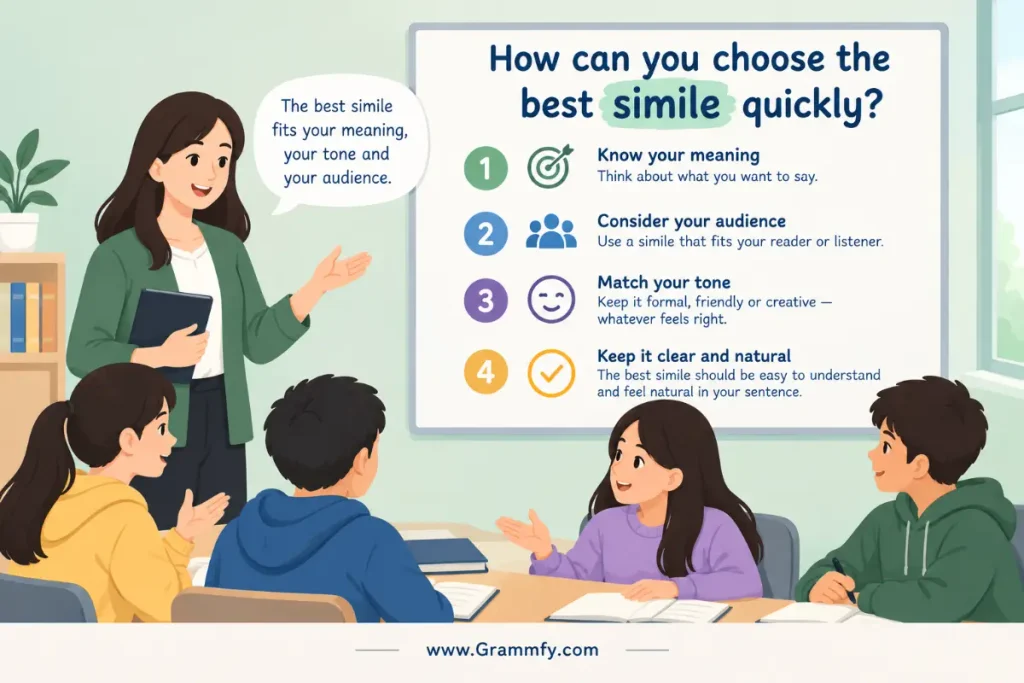
How can you choose the best simile quickly?
Use this simple formula:
Level of quietness + mood + familiar image = strong comparison
For example:
Deep quiet + peaceful mood + sleeping town
The village was as silent as a sleeping town.
Or:
Deep quiet + mystery + locked room
The hallway was as silent as a locked room.
Or:
Soft quiet + comfort + candle
The room was quiet like a candlelit corner.
This method helps you create original comparisons instead of copying the same phrase every time.
Conclusion
The best Similes for silent don’t just tell readers that a place or person makes no sound. They show what that quietness feels like. A sleeping town can suggest peace, a locked room can create mystery, and a graveyard can create an eerie mood. The comparison you choose should match the scene.
For school essays and everyday writing, simple images are often the strongest. For poems and stories, you can experiment with less common comparisons. Remember to focus on the feeling behind the silence rather than adding a comparison just to sound creative. When your image fits the scene, even a short sentence can create a strong picture in the reader’s mind.
Frequently Asked Questions
What is a simile for silent?
A simile for silent compares quietness to something familiar, such as a sleeping town, closed book, or locked room, usually with like or as.
What’s another way to say “silent”?
Another way to say “silent” is quiet, soundless, noiseless, hushed, still, tranquil, or mute, depending on the context.
What are some good similes for silent?
Good comparisons include “as silent as a sleeping town,” “quiet like a closed book,” and “as still as a painting.”
Is “silent as a graveyard” a simile?
Yes. “Silent as a graveyard” is a simile because it compares one type of silence with another using as.
What is the difference between silent and quiet?
Silent usually suggests little or no sound, while quiet generally means that there is only a small amount of noise.
Can I use similes for silent in an essay?
Yes, especially in descriptive or creative essays. Keep the comparison clear and make sure it supports the point you’re trying to make.
What is the best word for complete silence?
Silent or soundless usually works best when you want to suggest that there is no noticeable sound at all.
