
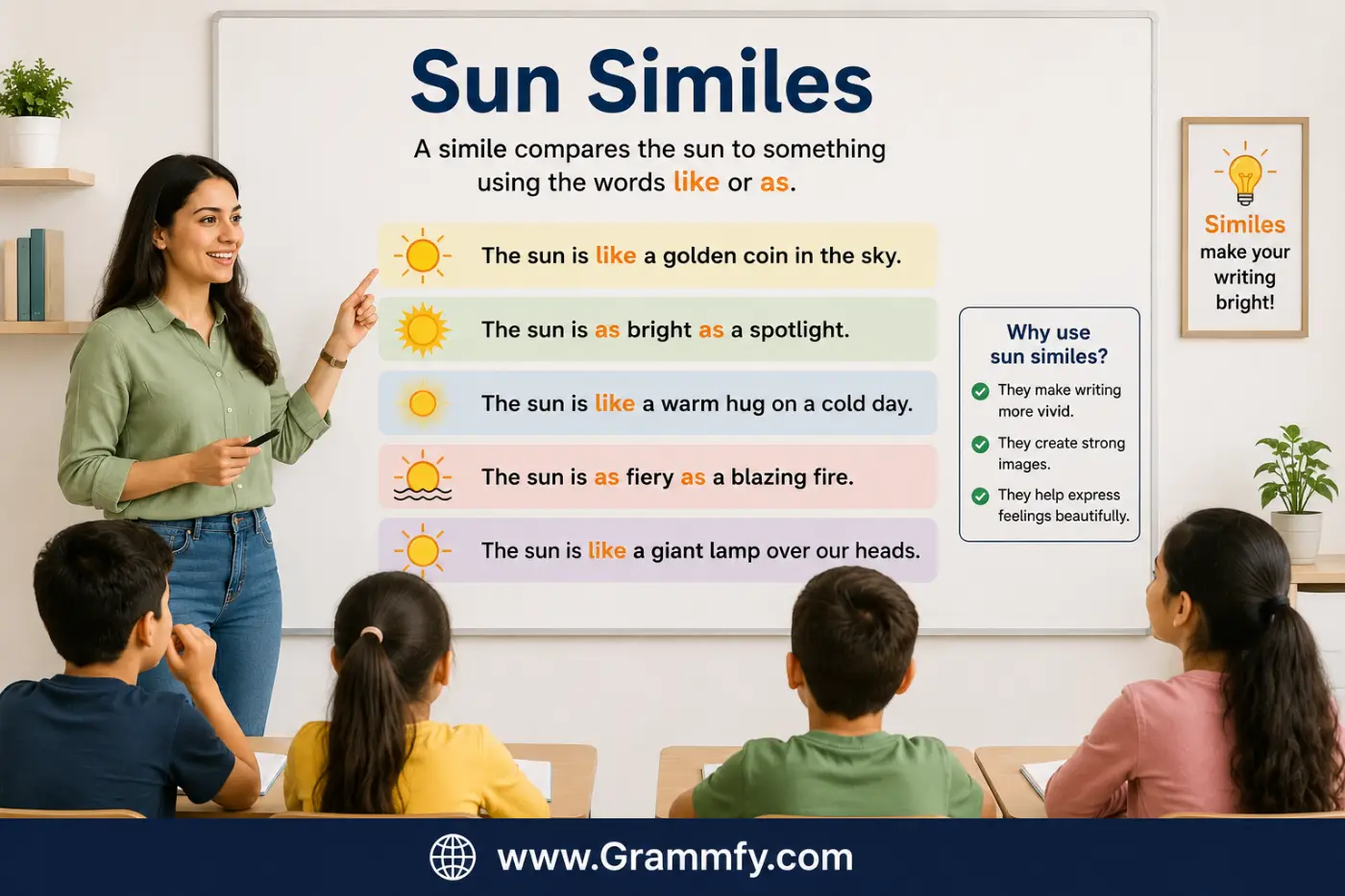
You’re writing an essay, poem, story, caption, or social media post, and you want to describe the sun without simply saying “the sun was bright.” That sentence works, but it doesn’t create a strong picture in the reader’s mind. A good comparison can make the scene feel warm, bright, peaceful, dramatic, or even magical. Sun similes compare the sun or its qualities to something familiar by using words such as like or as. They help readers picture sunlight, warmth, brightness, color, movement, and mood in a more creative way.
Answer box: A sun simile compares the sun, its light, heat, color, or effect to something else using like or as, such as “The sun was like a golden coin in the sky.”
You can use these comparisons in creative writing, school assignments, poems, stories, captions, speeches, and everyday descriptions. This guide covers simple and creative examples, different moods, useful alternatives, common mistakes, and tips for choosing a comparison that fits your writing.
If you’re working on your grammar, you may also find [here is or here are] helpful.
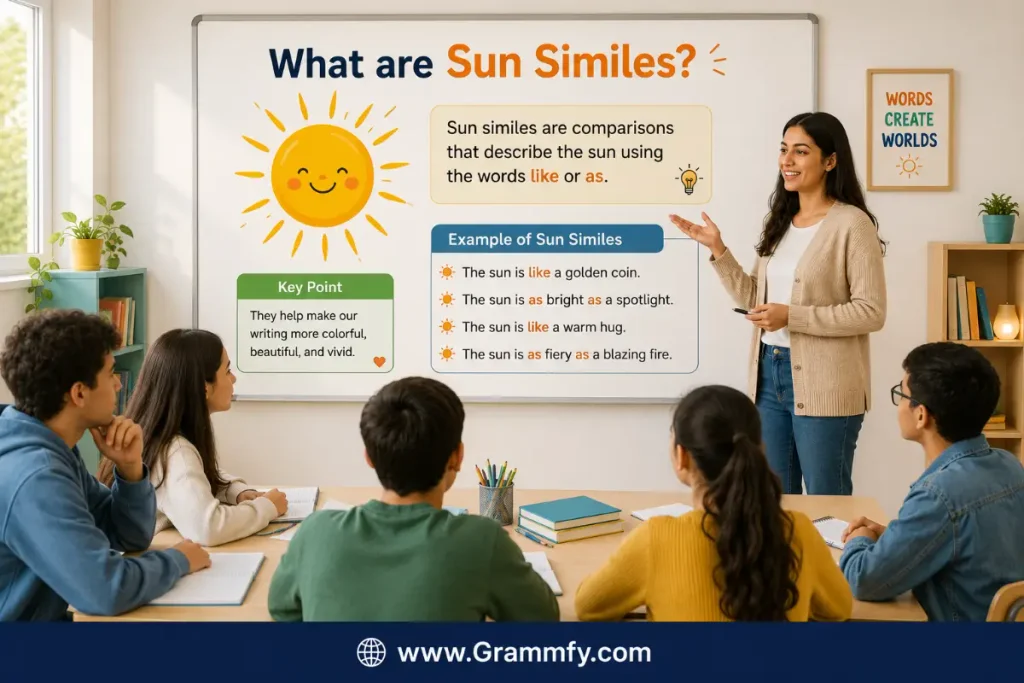
What are Sun Similes?
A simile is a figure of speech that compares two different things using like or as.
For example:
The sun was like a golden ball above the trees.
The sun isn’t literally a golden ball. The writer compares it to one because both are round and golden.
Another example is:
The morning sun was as gentle as a warm blanket.
The sun isn’t actually a blanket. The comparison emphasizes how comforting and warm the sunlight feels.
A strong simile doesn’t just make a sentence longer. It gives the reader a clearer image or feeling.
What can you compare the sun to?
You can compare the sun to things connected with:
- Gold
- Fire
- Diamonds
- A lamp
- A candle
- A coin
- A ball
- A jewel
- Honey
- A spotlight
- A torch
- A smile
- A warm blanket
- A glowing ember
- A crown
- A lantern
- A pearl
- A painted brush
- A glowing eye
- A bright star
The best comparison depends on what you want the reader to feel.
Where did the idea of comparing the sun come from?
People have compared natural objects to familiar things for thousands of years. Before modern science and photography, writers relied heavily on observation and imagery to describe the world around them.
The sun was an especially natural subject for comparisons. It is bright, warm, round, powerful, and constantly changing in appearance. At sunrise, the sun may look red or orange. Around noon, it can appear intensely white or yellow. By sunset, it may look like a glowing fireball.
That variety gives writers many ways to describe it.
The word simile comes from the Latin word similis, meaning “like” or “similar.” The basic idea is simple: show that one thing resembles another.
When you write:
The sun was like a fireball.
you help the reader connect the sun with the familiar image of a ball of fire.
The comparison becomes even stronger when you explain the shared quality:
The setting sun looked like a giant fireball sinking behind the hills.
Now the reader can imagine the round shape, fiery color, and movement.
Why do writers use similes for the sun?
A plain sentence gives information:
The sun was bright.
A simile gives information and imagery:
The sun shone like a diamond above the quiet lake.
The second sentence creates a stronger visual image.
Similes can help you:
- Make descriptions more vivid
- Show emotions
- Create atmosphere
- Improve creative writing
- Make poems more memorable
- Describe light and color
- Show warmth or heat
- Make stories easier to visualize
- Add personality to captions
- Avoid repetitive descriptions
The goal isn’t to use the fanciest comparison possible. The goal is to choose a comparison that fits the scene.
30 words and phrases related to sun descriptions
There isn’t a perfect synonym for a simile because a simile is a type of comparison rather than a single word. However, you can use related descriptive words and expressions to build stronger imagery.
| Word or phrase | Meaning | Tone | Example |
|---|---|---|---|
| Sunshine | Light from the sun | Simple | Sunshine filled the room. |
| Sunbeam | A narrow ray of sunlight | Everyday | A sunbeam entered the window. |
| Ray | A line or beam of light | Everyday | A ray of sunlight crossed the floor. |
| Glow | Soft, steady light | Everyday | The sunset had a warm glow. |
| Shine | Give off or reflect light | Simple | The sun began to shine. |
| Warmth | Pleasant heat | Everyday | The sun’s warmth felt comforting. |
| Heat | High temperature | Simple | The afternoon heat was strong. |
| Golden | Rich yellow or gold-like | Everyday | Golden light covered the hills. |
| Fiery | Resembling fire | Descriptive | A fiery sun sank below the horizon. |
| Blazing | Burning or shining intensely | Strong | The blazing sun heated the road. |
| Brilliant | Extremely bright | Everyday | A brilliant sun rose over the ocean. |
| Radiant | Shining brightly | Formal | The radiant sun warmed the valley. |
| Scorching | Extremely hot | Strong | The scorching sun dried the field. |
| Gleaming | Shining smoothly or brightly | Descriptive | The gleaming sunlight touched the windows. |
| Warm | Pleasantly hot | Simple | Warm sunlight entered the room. |
| Gentle | Soft and mild | Soft | Gentle sunlight touched her face. |
| Harsh | Strong and unpleasant | Negative | Harsh sunlight covered the empty street. |
| Golden hour | Time of soft golden light | Everyday | We photographed the landscape during golden hour. |
| Daylight | Natural light during the day | Simple | Daylight filled the kitchen. |
| Sunrise | Sun appearing in the morning | Simple | We watched the sunrise. |
| Sunset | Sun disappearing in the evening | Simple | The sunset turned the sky orange. |
These words are especially useful when creating your own comparisons.
What are some simple Sun Similes?
If you’re a student or a beginner writer, you don’t need complicated imagery. Simple comparisons can be powerful.
Here are easy examples:
- The sun was like a golden ball in the sky.
- The sun shone like a bright lamp.
- The sun was as round as a coin.
- The sunlight was like warm honey.
- The sun glowed like a fireball.
- The morning sun was like a soft blanket.
- The sun was as bright as a diamond.
- The sunset looked like a painting.
- The sun was like a giant orange.
- The sunlight spread like golden paint across the field.
These comparisons work well in elementary and middle-school creative writing because the images are easy to understand.
What are some beautiful similes for the sun?
For poetry, stories, and descriptive writing, you may want softer or more artistic comparisons.
Try these:
- The sun was like a golden jewel hanging in the sky.
- The morning sun was like a warm smile.
- The sunset was like fire painted across the clouds.
- The sun glowed like a lantern floating above the hills.
- Sunlight spilled across the valley like liquid gold.
- The sun looked like a golden crown above the mountains.
- The evening sky was like a canvas brushed with fire.
- The sun was like a bright pearl in a blue sea.
- Golden rays stretched across the field like ribbons.
- The setting sun looked like a burning ember on the horizon.
These comparisons focus more on beauty than heat.
What are some sun similes for heat?
Sometimes the important quality isn’t brightness. It’s temperature.
Use comparisons that make the reader feel the heat.
- The sun was as hot as a furnace.
- The afternoon sun felt like a blazing oven.
- The sunlight burned like fire on my skin.
- The pavement felt like a frying pan under the sun.
- The sun hung overhead like a giant heater.
- The air felt as hot as a desert.
- The sun pressed down like a heavy blanket of heat.
- The afternoon was like standing beside an open furnace.
Notice that these comparisons create a very different mood from a gentle morning-sun comparison.
Compare:
The morning sun was like a warm blanket.
with:
The afternoon sun was like a blazing oven.
Both describe warmth, but the first feels comforting while the second feels uncomfortable.
What are some sun similes for brightness?
When you want to show intense light, compare the sun to something that shines strongly.
Examples:
- The sun was as bright as a diamond.
- The sunlight flashed like polished silver.
- The sun shone like a giant spotlight.
- Its light was like a million tiny mirrors.
- The sun glared like a bright torch.
- The morning light sparkled like diamonds on water.
- The sun was as dazzling as a newly polished jewel.
- The sunlight spread like golden sparks across the lake.
Avoid using “bright” repeatedly. A good comparison can show the brightness instead.
What are some sun similes for sunrise?
Sunrise often creates a calm, hopeful, or magical mood.
Try comparisons such as:
- The sunrise was like a golden curtain opening.
- The sun rose like a golden balloon.
- Morning light spread like honey across the hills.
- The sun appeared like a fireball climbing into the sky.
- Dawn glowed like a lantern being lit.
- The sun rose as gently as a flower opening.
- The horizon looked like a canvas brushed with gold.
- The morning sun was like a new beginning.
For a peaceful story, choose soft comparisons. For an exciting scene, choose stronger ones.
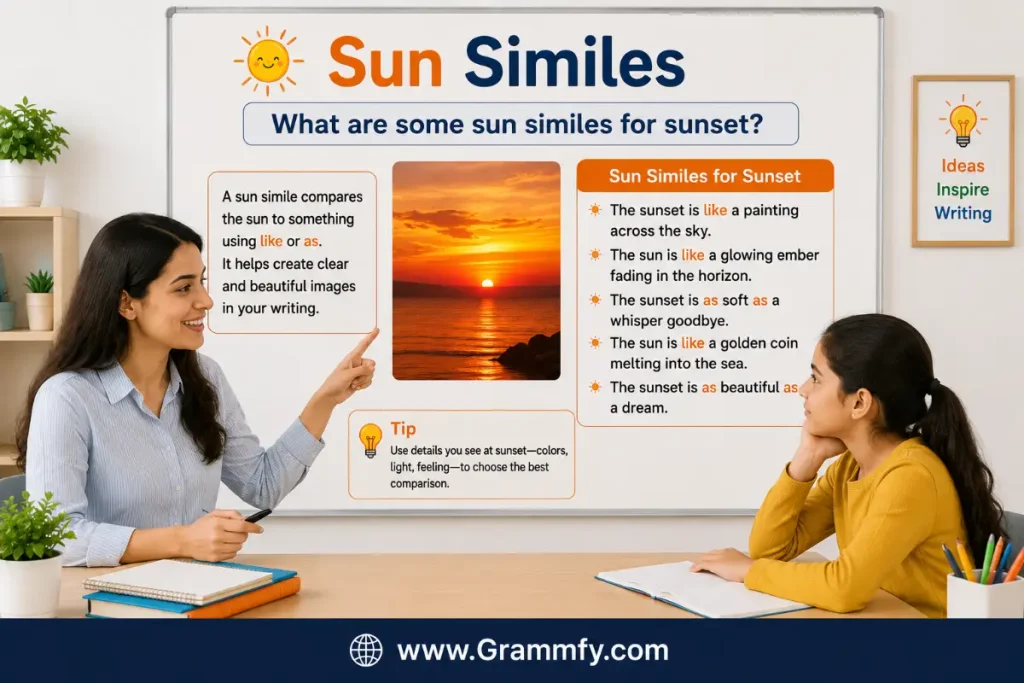
What are some sun similes for sunset?
Sunset gives writers some of the richest imagery because the colors and position of the sun change quickly.
Examples:
- The setting sun was like a giant orange sinking into the sea.
- The sky looked like a painting dipped in fire.
- The sun glowed like a red ember.
- Sunset spread across the sky like molten gold.
- The sun was like a burning coin near the horizon.
- The clouds looked like pink cotton candy around the setting sun.
- The evening sky was like a canvas covered in orange and purple paint.
- The sun disappeared like a glowing candle being slowly covered.
These comparisons can make a sunset scene feel cinematic without requiring complicated vocabulary.
What are some funny sun similes?
Not every comparison needs to sound poetic. Humor can make a description memorable.
Try:
- The sun was like a giant fried egg in the sky.
- The afternoon heat felt like someone left an oven door open.
- The sun followed me like a nosy spotlight.
- The sun was like a giant flashlight pointed directly at my face.
- The pavement was as hot as a pan on a stove.
- The sun felt like a friend who doesn’t understand personal space.
- The sky looked like someone spilled orange juice everywhere.
Funny comparisons work especially well in casual writing, captions, children’s stories, and humorous essays.
What are some romantic sun comparisons?
For romantic writing, choose comparisons connected with warmth, beauty, comfort, and affection.
Examples:
- Her smile was like sunrise after a long night.
- His presence felt like warm sunlight on a cold morning.
- Their love was like the sun lighting up a quiet field.
- Her face glowed like morning sunlight.
- His voice was as comforting as sunshine through a window.
- Their happiness spread like golden light across the room.
Here, the sun doesn’t just describe appearance. It represents warmth and positive emotion.
What are some powerful sun comparisons?
For dramatic scenes, use images connected with fire, power, force, or intensity.
Examples:
- The sun was like a giant furnace above the battlefield.
- Its heat struck like a wave of fire.
- The sun hung overhead like a burning crown.
- Its rays were like spears of light.
- The sky glowed like a furnace door opened to the world.
- The blazing sun was like an angry eye staring down from the sky.
Strong comparisons should match strong scenes. Don’t use an aggressive image for a peaceful morning unless you want a deliberate contrast.
Sun similes by mood
The same sun can create completely different feelings.
| Mood | Useful comparison | Effect |
|---|---|---|
| Happy | Like a warm smile | Cheerful |
| Peaceful | Like a soft blanket | Calm |
| Hopeful | Like a new beginning | Positive |
| Romantic | Like warm sunlight | Loving |
| Magical | Like a glowing jewel | Dreamy |
| Dramatic | Like a ball of fire | Powerful |
| Dangerous | Like a burning furnace | Threatening |
| Sad | Like a fading candle | Melancholy |
| Funny | Like a giant fried egg | Humorous |
| Energetic | Like a spotlight | Lively |
| Lonely | Like a distant lamp | Quiet |
| Comforting | Like a warm hug | Safe |
Before choosing a comparison, decide what emotion you want the reader to experience.
How do you choose the best sun simile?
Start with the quality you want to describe.
If you want to show color
Think about:
- Gold
- Orange
- Red
- Amber
- Yellow
- Fire
- Honey
Example:
The setting sun was like a pool of amber above the horizon.
If you want to show shape
Think about:
- Ball
- Coin
- Orange
- Pearl
- Jewel
- Globe
Example:
The sun hung in the sky like a golden coin.
If you want to show heat
Think about:
- Furnace
- Oven
- Fire
- Heater
- Flame
Example:
The afternoon sun was like an open furnace.
If you want to show brightness
Think about:
- Diamond
- Spotlight
- Torch
- Lamp
- Mirror
- Jewel
Example:
The sun shone like a spotlight over the stadium.
If you want to show comfort
Think about:
- Blanket
- Hug
- Smile
- Warm cup
- Fireplace
Example:
The morning sunlight felt like a warm blanket.
What is the difference between a simile and a metaphor?
A simile uses comparison words such as like or as.
The sun was like a golden ball.
A metaphor directly says one thing is another.
The sun was a golden ball in the sky.
The two devices can create similar imagery, but their grammatical structures are different.
| Simile | Metaphor |
|---|---|
| Uses like or as | Makes a direct comparison |
| The sun is like gold. | The sun is gold. |
| The sun shone like fire. | The sun was fire. |
| Sunlight was like honey. | Sunlight was honey. |
If your teacher specifically asks for a simile, make sure your comparison uses like or as.
“Like a diamond” vs. “as bright as a diamond”
These two patterns are both similes, but they emphasize different things.
Like + noun
The sun was like a diamond.
This compares the overall appearance.
As + adjective + as
The sun was as bright as a diamond.
This focuses specifically on brightness.
Other examples:
The sun was like a fireball.
The sun was as hot as a fire.
The first compares the object itself. The second compares a specific quality.
“Like gold” vs. “golden” — what’s different?
These descriptions aren’t exactly the same.
The sunlight was like gold.
This is a simile. It creates a comparison.
The sunlight was golden.
This is a direct descriptive adjective.
The simile usually feels more imaginative because the reader actively connects sunlight with gold.
You can also combine them:
Golden sunlight spread across the field like liquid gold.
This creates strong visual imagery, but avoid overloading every sentence with comparisons.
“Like fire” vs. “like a furnace” — what’s different?
Both can describe heat, but they suggest different experiences.
| Comparison | Main idea | Mood |
|---|---|---|
| Like fire | Burning, glowing, powerful | Dramatic |
| Like a furnace | Extreme heat | Uncomfortable |
| Like an oven | Trapped heat | Casual |
| Like a warm blanket | Comfort | Peaceful |
| Like a fireplace | Cozy warmth | Comforting |
Choose the image that matches the scene.
Common mistakes when writing sun similes
Mistake 1: Using a comparison that doesn’t fit
Example:
The peaceful morning sun was like an angry dragon.
This isn’t grammatically wrong, but it creates a strange mood unless the writer deliberately wants contrast.
A better peaceful comparison might be:
The morning sun was like a warm smile.
Mistake 2: Mixing too many comparisons
Avoid:
The sun was like a diamond, a fireball, a golden coin, a lamp, and a dragon.
The reader doesn’t know which image to focus on.
Choose one strong comparison.
Mistake 3: Using clichés without purpose
Some expressions are familiar:
The sun was like a ball of fire.
This is understandable, but it is common. You can make your writing more original by adding a specific detail:
The setting sun looked like a glowing fireball sinking behind the pine trees.
Mistake 4: Forgetting the difference between simile and metaphor
If you write:
The sun was a golden coin.
that’s a metaphor.
If you write:
The sun was like a golden coin.
that’s a simile.
Mistake 5: Choosing an overly complicated image
A simple comparison can be stronger than a confusing one.
Instead of:
The sun resembled a celestial furnace of incandescent brilliance.
Try:
The sun burned like a giant furnace.
Clear writing usually has more impact.
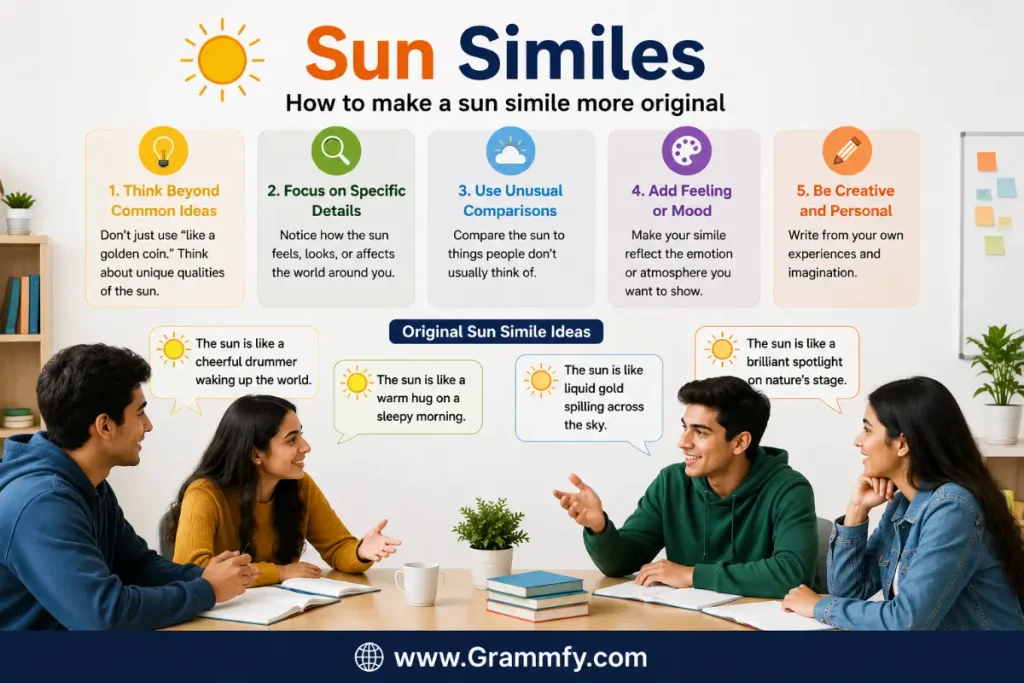
How to make a sun simile more original
Start with a familiar comparison, then add a specific detail.
Basic:
The sun was like gold.
More specific:
The morning sun spilled across the wet grass like melted gold.
The second sentence gives the reader:
- Time: morning
- Place: grass
- Light: golden
- Movement: spilled
- Image: melted gold
You can also combine a comparison with a sensory detail.
The sun was like a warm blanket, and its light rested softly on my face.
Now the reader can almost feel the warmth.
Sun similes for school essays
If you’re writing for school, keep your comparisons clear and relevant.
Examples:
The morning sun rose like a golden ball above the mountains.
The sunlight spread across the classroom like warm paint.
The hot afternoon sun was like a furnace in the cloudless sky.
The sunset looked like a painting filled with orange and red.
The sun shone like a bright lamp over the playground.
These examples are creative without being difficult to understand.
Sun similes for poetry
Poetry gives you more freedom with imagery and rhythm.
Examples:
The sun rose like a golden whisper over the hills.
Its rays stretched like fingers across the sleeping town.
The setting sun burned like an ember on the edge of the world.
Morning light spilled like honey across the fields.
The sun hung like a glowing jewel above the sea.
When writing poetry, think about sound as well as meaning. A comparison should fit the rhythm of the poem.
Sun similes for stories
Stories benefit from comparisons that reveal the setting or character’s experience.
For example:
By noon, the sun was like a giant furnace, and every step across the dusty road felt harder than the last.
This does more than describe the sun. It tells the reader that the environment is difficult.
For a happier scene:
The morning sun was like a warm smile after the storm.
The comparison also creates emotional meaning.
Sun similes for captions
Social media captions can be short.
Try:
- Golden like a dream.
- Bright as a diamond.
- Warm like a summer smile.
- Glowing like fire.
- Chasing the sun like it’s a treasure.
- Sunset like a painting.
- Sunshine like a little piece of happiness.
- Golden light like liquid honey.
Short comparisons are often more effective in captions than long descriptions.
20 original examples across real situations
Here are examples you can adapt for different types of writing.
Morning
The morning sun rose like a golden coin above the quiet town.
School
Sunlight entered the classroom like a bright ribbon through the window.
Beach
The sun sparkled on the ocean like thousands of tiny diamonds.
Desert
The desert sun burned like a furnace overhead.
Mountain
The rising sun appeared like a glowing crown behind the mountains.
Garden
Warm sunlight fell over the flowers like a soft blanket.
City
The afternoon sun shone between the buildings like a giant spotlight.
Road trip
The sun followed the car like a bright orange companion.
Sunset
The setting sun looked like a glowing ember on the horizon.
Rainy day
The returning sunlight was like a smile after a long silence.
Winter
The weak winter sun felt like a small candle in the cold.
Summer
The summer sun was as fierce as an open furnace.
Romance
Her smile was like sunshine breaking through dark clouds.
Children’s story
The sun was like a giant golden ball rolling across the blue sky.
Fantasy
The sun floated above the kingdom like a magical golden jewel.
Mystery
The pale sun hung in the sky like a distant eye.
Adventure
The rising sun was like a golden flag announcing the start of a new journey.
Sad scene
The fading sun was like a candle slowly losing its flame.
Celebration
The sunlight flashed across the crowd like golden confetti.
Peaceful ending
The evening sun rested on the hills like a warm blanket.
How to avoid repetitive sun descriptions
If you are writing a long story, don’t describe the sun in the same way every time.
Instead, focus on different qualities.
At sunrise:
The sun rose like a golden coin.
At noon:
The sun burned like a furnace.
In the afternoon:
The sunlight spread like honey across the fields.
At sunset:
The sun faded like a glowing ember.
This creates variety while keeping the descriptions connected.
You can also change the verb:
- Rose
- Shone
- Glowed
- Burned
- Floated
- Hung
- Spilled
- Stretched
- Flickered
- Faded
- Sank
- Peeked
- Appeared
- Disappeared
Strong verbs often make a description more vivid without requiring extra adjectives.
A formula for creating your own similes
You don’t have to memorize hundreds of examples. You can make your own.
Use this simple formula:
The sun + verb + like/as + familiar image.
Examples:
The sun glowed like a golden lantern.
The sun shone like a diamond.
The sun burned like fire.
Or use:
The sun was as + adjective + as + comparison.
Examples:
The sun was as bright as a diamond.
The sun was as hot as a furnace.
The sunlight was as soft as a blanket.
You can also add a place or time:
At sunrise, the sun glowed like a golden lantern above the hills.
That small detail makes the sentence feel more complete.
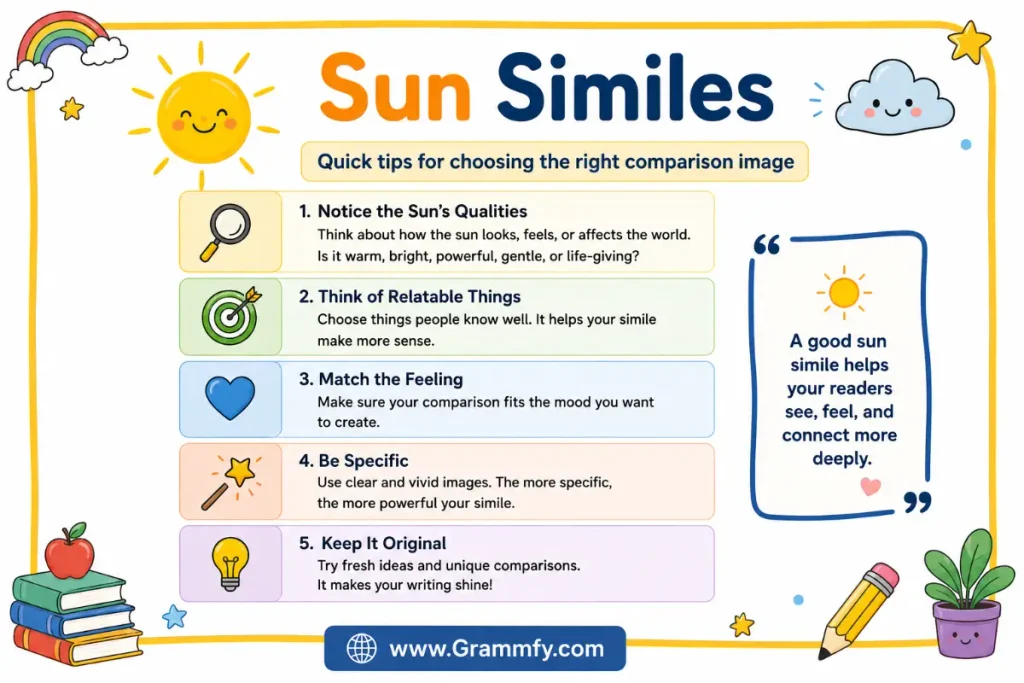
Quick tips for choosing the right comparison
- Think about the mood first.
- Decide whether you are describing heat, light, color, shape, or emotion.
- Choose an image your reader can easily understand.
- Use like or as if you need a true simile.
- Don’t use several unrelated comparisons in one sentence.
- Avoid overly complicated vocabulary when a simple image works.
- Make the comparison fit the setting.
- Use strong verbs such as glowed, burned, spilled, or faded.
- Add sensory details when appropriate.
- Avoid repeating the same comparison throughout a story.
- Prefer an original comparison when the writing calls for creativity.
- Read the sentence aloud to check its rhythm.
- Ask whether the comparison creates the feeling you want.
A useful final question is:
What do I want my reader to see or feel?
Once you know that, choosing a comparison becomes much easier.
Conclusion
Good descriptions help readers see more than just the object on the page. Sun similes can turn ordinary sunlight into gold, fire, a jewel, a blanket, or another familiar image that carries the feeling you want. The strongest comparison depends on your scene. A peaceful sunrise may need a soft image, while a scorching afternoon may call for a furnace or flame.
When creating your own comparison, first decide what you want to show: color, brightness, heat, shape, movement, or emotion. Then choose an image that clearly shares that quality. Keep it natural, avoid stacking too many comparisons together, and make sure your simile uses like or as. With a little practice, even a simple sentence about the sun can become vivid, memorable, and full of personality.
Frequently Asked Questions
What are sun similes in simple words?
Sun similes are comparisons that describe the sun or sunlight using “like” or “as.” For example, “The sun was like a golden ball” compares the sun to a familiar round object.
What is a good simile for the sun?
A good choice is “The sun was like a golden coin in the sky.” It creates a simple image of the sun’s round shape and golden color.
What’s another way to describe the sun without saying “bright”?
Use words such as glowing, radiant, dazzling, golden, blazing, luminous, or shimmering. You can also create a comparison, such as “The sun shone like a diamond.”
What is a simile for a hot sun?
A strong example is “The sun was as hot as a furnace.” This comparison emphasizes intense heat.
What is a simile for a beautiful sunset?
Try “The sunset was like a painting brushed across the sky.” It emphasizes the colors and beauty of the evening scene.
Are sun similes and sun metaphors the same?
No, a simile uses like or as, while a metaphor makes a direct comparison. “The sun is like a fireball” is a simile, while “The sun is a fireball” is a metaphor.
How can I make my sun comparisons more creative?
Focus on a specific quality such as color, heat, shape, or mood, then connect it to an unexpected but easy-to-understand image. Adding a strong verb and a setting can make the comparison even more vivid.
