
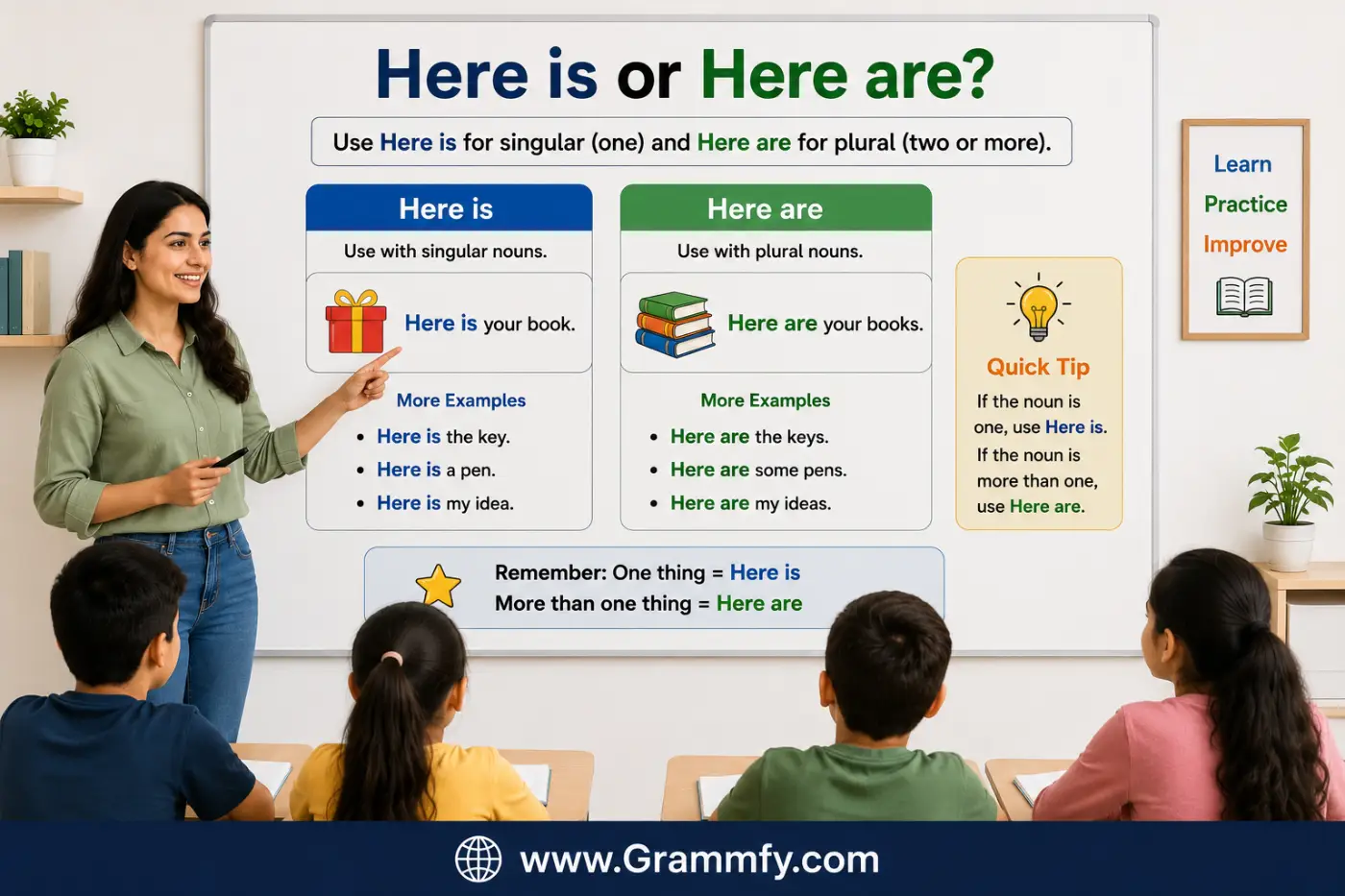
In this guide, we’ll explain the difference between “here is” vs “here are” and show you when to use each one correctly.
Imagine you’re writing an email and want to introduce a document: “Here is the files you asked for” or “Here are the files you asked for.” You know what you want to say, but one small grammar choice makes you stop.
The same problem appears in texts, school essays, resumes, reports, and everyday conversations. The words here is vs here are look almost identical, but the correct choice depends on the noun that comes after them.
Answer box: Use “here is” with a singular noun or an uncountable noun, and use “here are” with a plural noun. The noun after the phrase determines which form you need.
This guide explains the difference in plain English. You’ll learn why the forms work this way, how native speakers use them, which alternatives fit formal and casual writing, and how to avoid common mistakes. You’ll also see examples for emails, resumes, essays, texting, and speaking.
You can also learn about common plural forms in [in fact or infact].
What does “here is” mean?
Here is is used to introduce, point out, present, or identify one person, one thing, or an uncountable thing.
The word here refers to a place, situation, or point in a conversation. Is is the singular form of the verb be. Together, “here is” often means something like:
- This is here.
- This is what I’m showing you.
- I’m presenting this thing now.
- You can see this thing here.
- This is the item I mentioned.
For example:
- Here is my notebook.
- Here is your coffee.
- Here is the information you requested.
- Here is the answer.
- Here is the report.
The important point is that here does not decide whether you use is or are. The noun or noun phrase being introduced does.
Why does the noun matter?
English verbs usually agree with their subjects. A singular subject takes a singular verb, while a plural subject takes a plural verb.
Compare:
- The book is on the desk.
- The books are on the desk.
The same basic idea applies when you introduce something with “here.”
- Here is the book.
- Here are the books.
So, instead of memorizing a complicated rule, look at the thing you are introducing.
What does “here are” mean?
Here are is used to introduce or point out two or more countable things.
Examples include:
- Here are my keys.
- Here are the documents.
- Here are three reasons.
- Here are your shoes.
- Here are the answers.
The noun is plural, so are is the appropriate form.
Notice how the number changes the verb:
| Singular | Plural |
|---|---|
| Here is my key. | Here are my keys. |
| Here is the answer. | Here are the answers. |
| Here is the file. | Here are the files. |
| Here is one reason. | Here are several reasons. |
A quick test is simple: Look at the noun immediately being introduced.
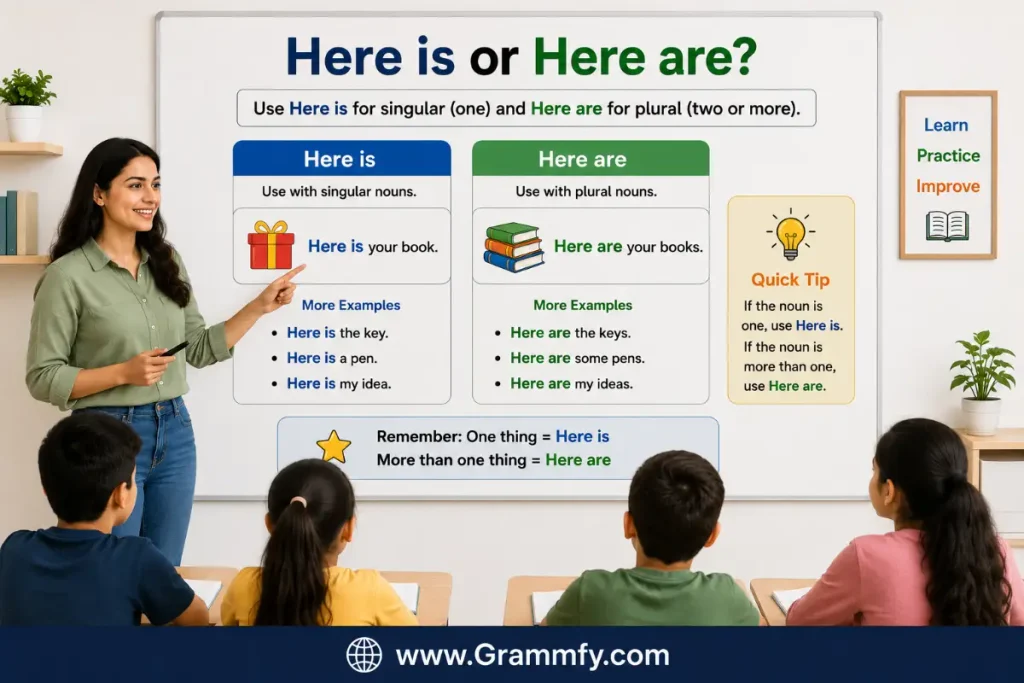
Why do we say “here is” vs “here are”?
The grammar comes from subject-verb agreement and the historical use of here as a pointing or location word.
In Old English and later forms of English, expressions involving here were often connected with location or presentation. Over time, phrases such as “here is” became common ways to present something to another person.
The phrase can now introduce physical objects:
- Here is the package.
It can also introduce ideas, information, explanations, or results:
- Here is the problem.
- Here is the solution.
- Here is what happened.
“Here are” developed naturally for plural nouns:
- Here are the packages.
- Here are the problems.
- Here are the solutions.
The modern rule is therefore not random. It follows the larger English pattern of singular and plural agreement.
Is “here” singular or plural?
Here itself is not what determines singular or plural agreement.
This is one of the biggest sources of confusion. Some learners see here at the beginning of the sentence and wonder whether “here” should be followed by is.
Instead, focus on the noun being presented.
| Sentence | Noun being introduced | Correct verb |
|---|---|---|
| Here is a pen. | pen | is |
| Here are two pens. | pens | are |
| Here is the information. | information | is |
| Here are the details. | details | are |
This pattern also explains why you can have a sentence such as:
Here is what I wanted to tell you.
The phrase after is is not simply a physical noun, but the construction still presents one idea or statement.
When should you use “here is”?
Use here is when the following noun is singular or uncountable.
Singular countable nouns
Use it with one countable item.
Examples:
- Here is a letter.
- Here is your phone.
- Here is the receipt.
- Here is one example.
- Here is my application.
Uncountable nouns
Some nouns are treated as singular in English even when they refer to a large amount or collection.
Examples include:
- information
- advice
- furniture
- equipment
- research
- homework
- money
So you can say:
- Here is some information.
- Here is useful advice.
- Here is the research you requested.
- Here is the equipment we need.
You normally would not say “here are some information” in standard English because information is uncountable.
One person
You can also introduce one person:
- Here is Sarah.
- Here is your teacher.
- Here is my brother.
- Here is the new manager.
If you introduce several people, the verb changes:
- Here are Sarah and Tom.
- Here are the students.
- Here are my parents.
When should you use “here are”?
Use here are when you are introducing two or more countable items or people.
Examples:
- Here are my notes.
- Here are the books.
- Here are five suggestions.
- Here are your tickets.
- Here are the students.
It is especially common when presenting a list.
For example:
Here are three things you should check before submitting your application.
The noun phrase three things is plural, so are is correct.
Here is vs Here are: the fastest grammar test
When you’re unsure, follow these three steps.
Step 1: Find the noun
Look at what you are presenting.
Example:
Here ___ the documents.
The noun is documents.
Step 2: Decide whether it is singular or plural
“Documents” is plural.
Step 3: Choose the matching verb
Plural noun → are.
Correct:
Here are the documents.
Try another:
Here ___ the final answer.
“Answer” is singular.
Correct:
Here is the final answer.
This method works in most everyday situations.
Master synonym and alternative list
There isn’t always a perfect synonym for the entire phrase because here is and here are perform a grammatical function. However, several expressions can replace them depending on the context.
| Word or phrase | Meaning | Tone | Example |
|---|---|---|---|
| This is | Introduces one thing | Simple | This is my report. |
| These are | Introduces several things | Simple | These are my notes. |
| That is | Points to one thing | Everyday | That is the answer. |
| Those are | Points to several things | Everyday | Those are the files. |
| I’m sharing | Giving something to someone | Everyday | I’m sharing the details below. |
| I’ve included | Added something | Everyday | I’ve included the report. |
| I’ve attached | Added a file | Email/Formal | I’ve attached the invoice. |
| See | Directs attention | Simple | See the examples below. |
| Look at | Directs attention | Casual | Look at these examples. |
| Meet | Introduces a person | Everyday | Meet my new colleague. |
| Introducing | Presents someone or something | Formal | Introducing our new manager. |
| Included below | Says something appears below | Formal | The details are included below. |
| Attached is | Introduces one attachment | Formal | Attached is the signed form. |
| Enclosed is | Introduces one enclosed item | Formal | Enclosed is your receipt. |
| Available here | Says something can be found here | Neutral | The full guide is available here. |
| Found here | Points to a location | Neutral | The answer can be found here. |
| Located here | Identifies a location | Formal | The office is located here. |
| Shown here | Points to something visible | Neutral | The process is shown here. |
| Check this out | Directs attention | Slang/Casual | Check this out! |
| Take a look | Invites someone to view something | Everyday | Take a look at these notes. |
| Have a look | Invites someone to view something | UK/Commonwealth | Have a look at the examples. |
These alternatives aren’t interchangeable in every sentence. Choose one based on what you are trying to do.
Which alternative is best for your situation?
The best replacement depends on the setting.
For simple everyday speech
Use:
- This is…
- These are…
- Look at…
- Take a look…
- Here you go.
Example:
This is your seat.
Or:
These are the keys you wanted.
For a professional email
Use:
- I’ve attached…
- I’ve included…
- You’ll find…
- Please see…
- Attached is…
- Attached are…
Example:
I’ve attached the updated report for your review.
This often sounds more natural than repeating “here is” in every email.
For formal documents
Use:
- The following…
- As shown below…
- Listed below…
- Included below…
- The results indicate…
Example:
The following are the main requirements.
For texting
Short alternatives work well:
- Here you go.
- This is it.
- These are the ones.
- Check this out.
- See below.
Synonyms and alternatives by intensity
“Here is” and “here are” are neutral expressions. They do not normally express strong emotion. However, alternatives can change how forceful or direct your message feels.
| Intensity | Useful expression | Example |
|---|---|---|
| Mild | You’ll find | You’ll find the details below. |
| Mild | Please see | Please see the attached file. |
| Neutral | Here is | Here is the report. |
| Neutral | Here are | Here are the results. |
| Direct | See | See the examples below. |
| Direct | Check | Check the figures again. |
| Strong | Take a look at this | Take a look at this result. |
| Very casual | Check this out | Check this out! |
| Formal | The following shows | The following shows the process. |
The phrase itself is usually polite and neutral, which makes it useful in many settings.
Alternatives by part of speech
The alternatives to “here is” and “here are” can have different grammatical forms.
Pronouns
You can use demonstrative pronouns:
- This is my book.
- These are my books.
- That is your seat.
- Those are your bags.
Verbs
You can use verbs that show presentation:
- See the chart below.
- Check the attached file.
- Review the document.
- Consider these examples.
Verb phrases
You can describe where something can be found:
- You’ll find the answer below.
- You can find the details in Section 2.
- The information appears on the next page.
Presentation phrases
For formal writing:
- The following information explains…
- The examples below show…
- The attached documents contain…
These alternatives give you more control over tone and style.
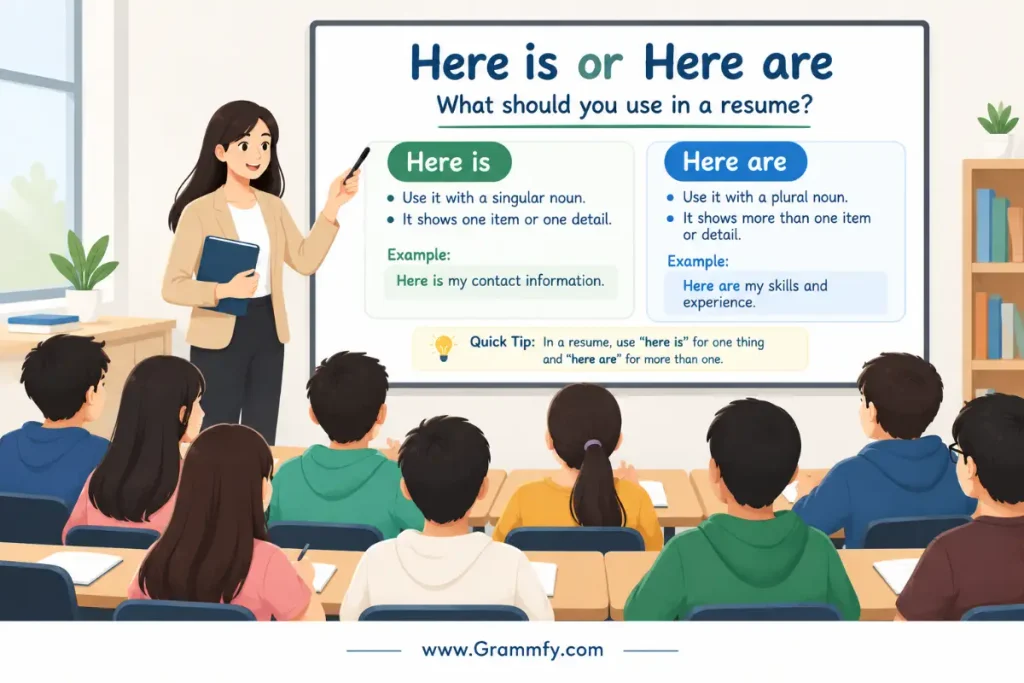
What should you use in a resume?
A resume usually benefits from direct, professional wording. You don’t often need “here is” or “here are” in resume bullet points.
Instead of:
Here are my main achievements.
Use a heading:
Key Achievements
Then list the achievements directly.
For a cover letter or email sending a resume, you could write:
I’ve attached my resume for your consideration.
Or:
Here is my updated resume.
Both can work, but the second is more conversational.
Resume example
Weak:
Here are my skills in digital marketing.
Better:
Digital Marketing Skills
- SEO
- Keyword research
- Content optimization
- Google Analytics
A resume should usually present information quickly rather than using unnecessary introductory phrases.
What should you use in an essay?
Academic essays often need more precise transitions.
Instead of repeatedly writing “here is,” consider:
- The following example shows…
- This evidence demonstrates…
- The results suggest…
- The main reason is…
- One important factor is…
For example:
The following example shows how social media can affect communication.
This sounds more academic than:
Here is an example of how social media can affect communication.
The second sentence is not wrong. It is simply less formal.
What should you use in an email?
In emails, here is and here are are perfectly useful.
For one attachment or item:
Here is the report you requested.
For multiple documents:
Here are the files you requested.
You can also use:
I’ve attached the files you requested.
The choice depends on whether you want to sound conversational or more direct.
Professional email examples
Here is the revised proposal. Please let me know if you have any questions.
Here are the three documents we discussed during the meeting.
I’ve attached the final version for your review.
You’ll find the requested information below.
All four are natural, but each has a slightly different focus.
What should you use when texting?
Texting is usually less formal, so short expressions are common.
You might write:
Here is the photo you wanted.
Or:
Here are the photos from yesterday.
For a very casual message:
Here you go!
This expression is especially useful when handing someone something or sending something they requested.
For example:
“Can you send me the address?”
“Here you go!”
The phrase “here you go” is different from “here is,” but it often serves a similar conversational purpose.
What should you use when speaking?
In conversation, “here is” and “here are” are natural when you physically present something or introduce information.
For example:
Here is your coffee.
Here are your keys.
Here is what I think we should do.
Here are the reasons I disagree.
In speech, contractions are also common:
Here’s your bag.
Here’s is short for here is.
You may hear:
Here’s the problem.
But be careful with plural nouns in standard English:
Here are the problems.
The safest formal rule is to match is/are with the noun.
Here’s vs. Here are: what’s different?
Here’s is the contraction of here is.
So:
Here’s my phone.
means:
Here is my phone.
For a plural noun, standard English uses here are:
Here are my phones.
This is an important distinction because some speakers use here’s informally before plural nouns, especially in casual speech.
You may hear expressions such as:
Here’s the reasons why…
But in careful standard English, write:
Here are the reasons why…
For schoolwork, professional writing, and formal communication, follow standard subject-verb agreement.
“Here is” vs. “This is” — what’s the difference?
Both can introduce something, but they emphasize different ideas.
| Here is | This is |
|---|---|
| Often points to something being presented | Identifies or defines something |
| Can suggest location or arrival | Focuses on the thing itself |
| Here is your order. | This is your order. |
| Here is the answer. | This is the answer. |
Compare:
Here is your package.
This sounds like you are handing it to someone.
This is your package.
This identifies the package.
The difference can be small, and both may be correct depending on context.
“Here are” vs. “These are” — what’s the difference?
The same distinction applies to plural forms.
Here are your shoes.
This presents or points out the shoes.
These are your shoes.
This identifies which shoes belong to you.
Both can be natural:
Here are the documents you requested.
These are the documents you requested.
The first focuses more on presenting them. The second focuses more on identifying them.
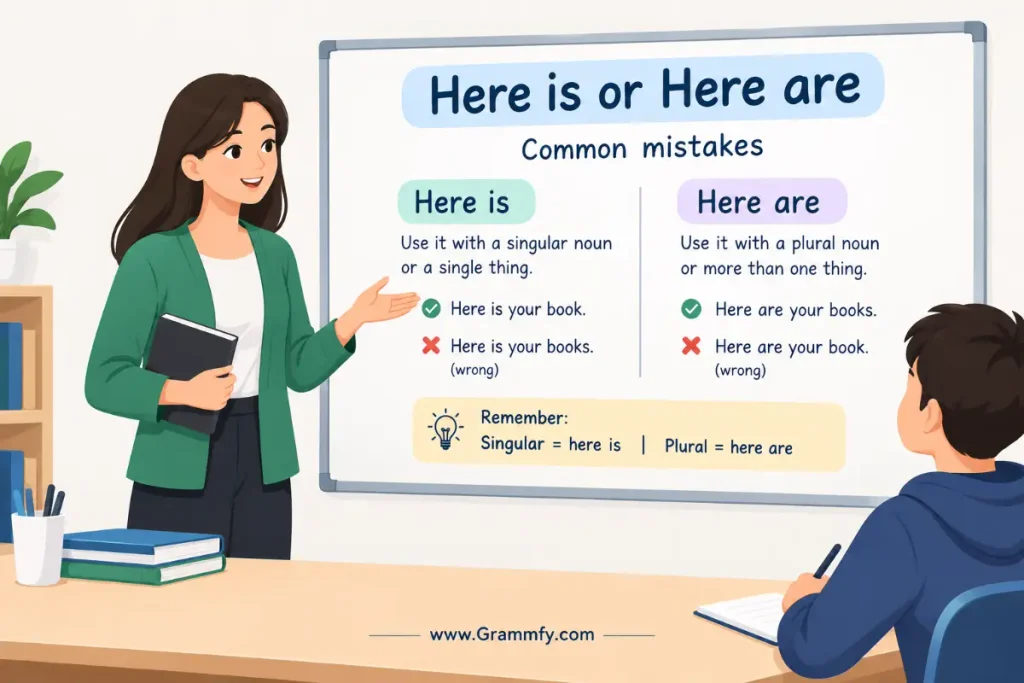
Common mistakes with “here is” vs “here are”
Mistake 1: Using “is” before a plural noun
Incorrect:
Here is the documents.
Correct:
Here are the documents.
Why? Documents is plural.
Mistake 2: Using “are” before a singular noun
Incorrect:
Here are the answer.
Correct:
Here is the answer.
Answer is singular.
Mistake 3: Treating “information” as plural
Incorrect:
Here are the information you need.
Correct:
Here is the information you need.
Information is uncountable in standard English.
If you want to use are, change the noun:
Here are the details you need.
Mistake 4: Confusing “here” with the subject
Some learners think the first word controls the verb:
Here is…
But here doesn’t mean you automatically need is.
Compare:
Here is one book.
Here are five books.
The number of books changes the verb.
Mistake 5: Using “here’s” in formal plural constructions
Casual speech may contain:
Here’s the documents.
But standard formal writing should use:
Here are the documents.
When in doubt, choose the grammatically standard form.
When should you NOT use “here is” vs “here are”?
These expressions are useful, but they aren’t necessary in every situation.
Avoid repetition
If every paragraph starts with “here is” or “here are,” your writing can sound repetitive.
Instead of:
Here is the first reason. Here is the second reason. Here are the examples.
Try:
The first reason is cost. The second is convenience. The examples below show the difference.
Avoid unnecessary filler
Instead of:
Here is an explanation of the process.
You might write:
The process works in three steps.
This gets to the point faster.
Avoid casual language in very formal writing
“Here is” is not wrong in formal writing, but some situations call for more precise wording.
Instead of:
Here is what the research tells us.
You could write:
The research shows that…
The second sentence directly states the purpose.
15+ real-life example sentences
Here are examples from different situations.
- Here is the book you asked me to bring.
- Here are the notes from yesterday’s class.
- Here is your appointment confirmation.
- Here are the documents you need to sign.
- Here is the information you requested.
- Here are five ways to improve your writing.
- Here is my final answer.
- Here are the reasons for the change.
- Here is a simple example.
- Here are some examples to help you understand the rule.
- Here is your coffee.
- Here are your keys.
- Here is what I think we should do next.
- Here are the results of the survey.
- Here is the resume I mentioned.
- Here are the files from the meeting.
- Here is some advice for your presentation.
- Here are two questions you should consider.
- Here is the main problem with that sentence.
- Here are the corrections I made.
Notice how the verb changes according to the noun or idea being introduced.
How does punctuation work with “here is” vs “here are”?
The punctuation depends on the complete sentence.
A normal sentence ends with a period:
Here is the report.
A question may use a question mark:
Here are the documents you needed?
This can occur in conversational contexts where the speaker is checking something.
A colon can introduce a list:
Here are the three things you need:
- Your ID
- Your application
- Your receipt
The colon is useful when a complete introductory statement is followed by a list.
What about “here is what” and “here are what”?
This is an area where sentence structure matters.
Here is what is common because what can introduce a clause representing one idea:
Here is what I mean.
Here is what happened.
Here is what you should remember.
But you should not automatically use here are what simply because several words follow.
Instead, consider the structure:
Here are the things that I mean.
The noun things is plural, so are agrees with it.
A useful strategy is to identify the actual noun being introduced instead of counting the words that come afterward.
What about “here is the reasons”?
This is a common agreement mistake.
Incorrect:
Here is the reasons I left.
Correct:
Here are the reasons I left.
Another natural option is:
These are the reasons I left.
Or, in formal writing:
The following are the reasons I left.
All three versions are grammatical, but the tone changes slightly.
What about “here are the information”?
This is also incorrect in standard English.
Information is an uncountable noun.
Correct:
Here is the information you need.
If you need a plural noun, use a countable alternative:
Here are the details you need.
Here are the facts you need.
Here are the pieces of information you need.
The last version is grammatical because pieces is countable.
US vs. UK English: is there a difference?
The basic rule is the same in US and UK standard English: singular nouns generally take is, and plural nouns generally take are.
For example:
- US: Here is the information.
- UK: Here is the information.
And:
- US: Here are the documents.
- UK: Here are the documents.
You may notice differences in vocabulary or pronunciation between American and British English, but this particular subject-verb agreement rule is shared.
One informal difference you may encounter is variation in spoken expressions. Native speakers sometimes use shortened or conversational constructions that are less common in careful writing.
For school, work, and professional communication, standard agreement is the safest choice.
Why do people say “here’s” before plural nouns?
In casual speech, here’s can sometimes appear before a plural expression.
You might hear:
Here’s the things we need.
This does occur in informal speech, but it is not the best choice for careful standard writing.
For a school essay, business email, website article, resume, or formal document, use:
Here are the things we need.
The standard version is clearer and avoids a subject-verb agreement error.
Antonyms and opposite ideas
“Here is” and “here are” don’t have direct antonyms in the same way that words like hot and cold do. However, several expressions can communicate an opposite idea.
For example:
- here ↔ there
- present ↔ absent
- included ↔ excluded
- available ↔ unavailable
- included below ↔ not included below
Compare:
Here is the report.
with:
The report is not here.
Or:
Here are the documents.
with:
The documents are missing.
The exact opposite depends on the meaning of the original sentence.
Quick tips for choosing the right form
Use these simple rules when writing.
- One thing → here is
- More than one thing → here are
- One person → here is
- Several people → here are
- Uncountable noun → here is
- Plural countable noun → here are
- Don’t let here determine the verb.
- Look at the noun being presented.
- In formal writing, avoid unnecessary repetition.
- Use here’s as a contraction of here is.
- Use here are with plural nouns in standard writing.
- If the sentence sounds awkward, consider this is, these are, I’ve attached, or you’ll find.
A simple decision chart
When you’re stuck, ask one question:
What am I introducing?
| What you’re introducing | Use | Example |
|---|---|---|
| One thing | Here is | Here is the file. |
| Several things | Here are | Here are the files. |
| One person | Here is | Here is Maria. |
| Several people | Here are | Here are Maria and John. |
| Uncountable information | Here is | Here is some information. |
| Several details | Here are | Here are the details. |
| One answer | Here is | Here is the answer. |
| Several answers | Here are | Here are the answers. |
This chart covers most everyday situations.
Practice: choose the correct form
Try completing each sentence before checking the answers.
- ___ my new notebook.
- ___ the documents you requested.
- ___ some useful advice.
- ___ three reasons to try it.
- ___ the final answer.
- ___ your keys.
- ___ the information from the website.
- ___ two examples.
- ___ my sister.
- ___ my sister and her friends.
Answers
- Here is my new notebook.
- Here are the documents you requested.
- Here is some useful advice.
- Here are three reasons to try it.
- Here is the final answer.
- Here are your keys.
- Here is the information from the website.
- Here are two examples.
- Here is my sister.
- Here are my sister and her friends.
The key is not the word here. The key is what follows it.
A useful editing trick
If you’re proofreading your writing, circle the noun after here is or here are.
Then ask:
Is this noun singular, plural, or uncountable?
For example:
Here is the results.
Circle results.
“Results” is plural.
Change the sentence:
Here are the results.
Now try:
Here are the information.
Circle information.
Information is uncountable.
Change it to:
Here is the information.
This technique is quick and works well for students, writers, and English learners.
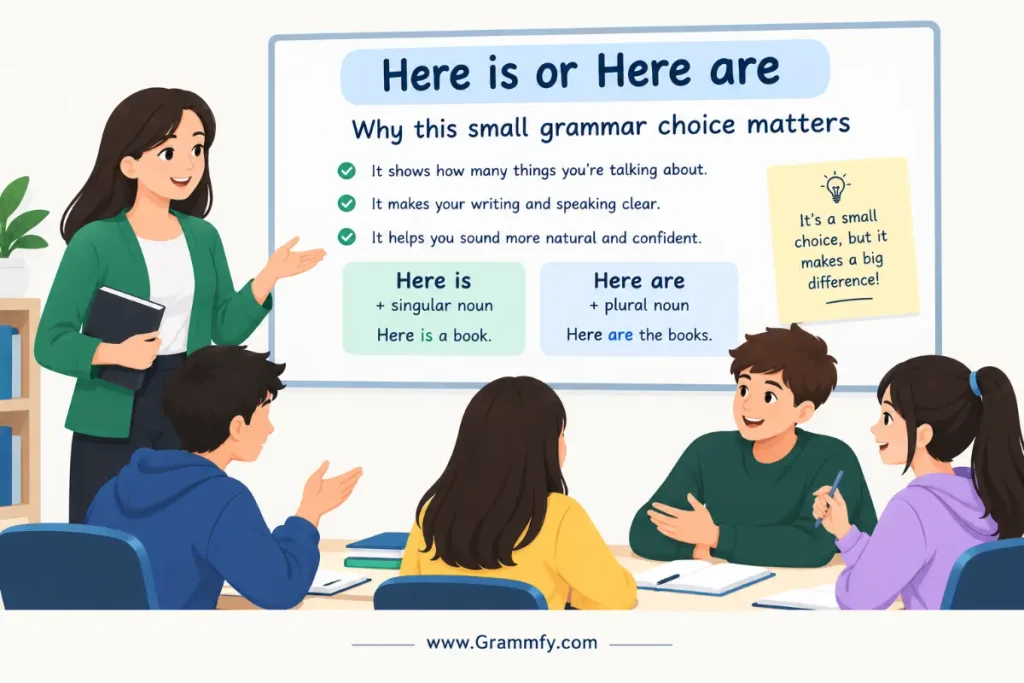
Why this small grammar choice matters
The difference between is and are may seem minor, but subject-verb agreement affects how polished your writing sounds.
A sentence such as:
Here are the results.
looks natural to a reader.
A sentence such as:
Here is the results.
creates a noticeable grammar problem because the singular verb does not agree with the plural noun.
This matters especially in:
- school assignments
- professional emails
- resumes
- cover letters
- reports
- website content
- applications
- presentations
Correct agreement helps your writing look clear and carefully edited.
Conclusion
The easiest way to choose between Here is or Here are is to ignore here and look at the noun that follows. One thing, one person, or an uncountable noun normally takes is: “Here is the answer” and “Here is some information.” Two or more people or things take are: “Here are the answers” and “Here are the documents.”
The phrase is useful in conversations, emails, schoolwork, and professional communication. Just remember that here is and here are are not interchangeable in standard English. If you’re unsure, identify the noun, decide whether it is singular or plural, and match the verb. With that quick habit, this common grammar choice becomes much easier.
Frequently Asked Questions
What is the difference between here is and here are?
Here is introduces a singular or uncountable noun, while here are introduces a plural noun. For example, “Here is the file” but “Here are the files.”
Is it correct to say here is the documents?
No, in standard English you should say “Here are the documents.” The noun documents is plural, so it needs are.
Can I say here’s with a plural noun?
In casual speech, you may hear here’s before plural expressions, but standard formal writing should use here are with plural nouns.
What’s another way to say here is or here are?
Useful alternatives include “this is,” “these are,” “I’ve attached,” “you’ll find,” “please see,” and “the following.” The best choice depends on the context and level of formality.
Should I use here is or here are with information?
Use here is because information is an uncountable noun. Say “Here is the information you requested,” not “Here are the information.”
Is here is formal English?
Yes, here is is standard English and can be used in professional and formal writing. However, alternatives such as “the following” or “I’ve included” may sound more precise in some formal contexts.
How can I remember which one to use?
Look at the noun you are introducing: one thing or an uncountable noun takes is, while two or more countable things take are.
