
Imagine you’re writing a school email and want to say that the teacher checked who was in class. You type, “The teacher took role call,” then stop and wonder if that sounds right. You may also see both roll call or role call online, which makes the choice even more confusing.
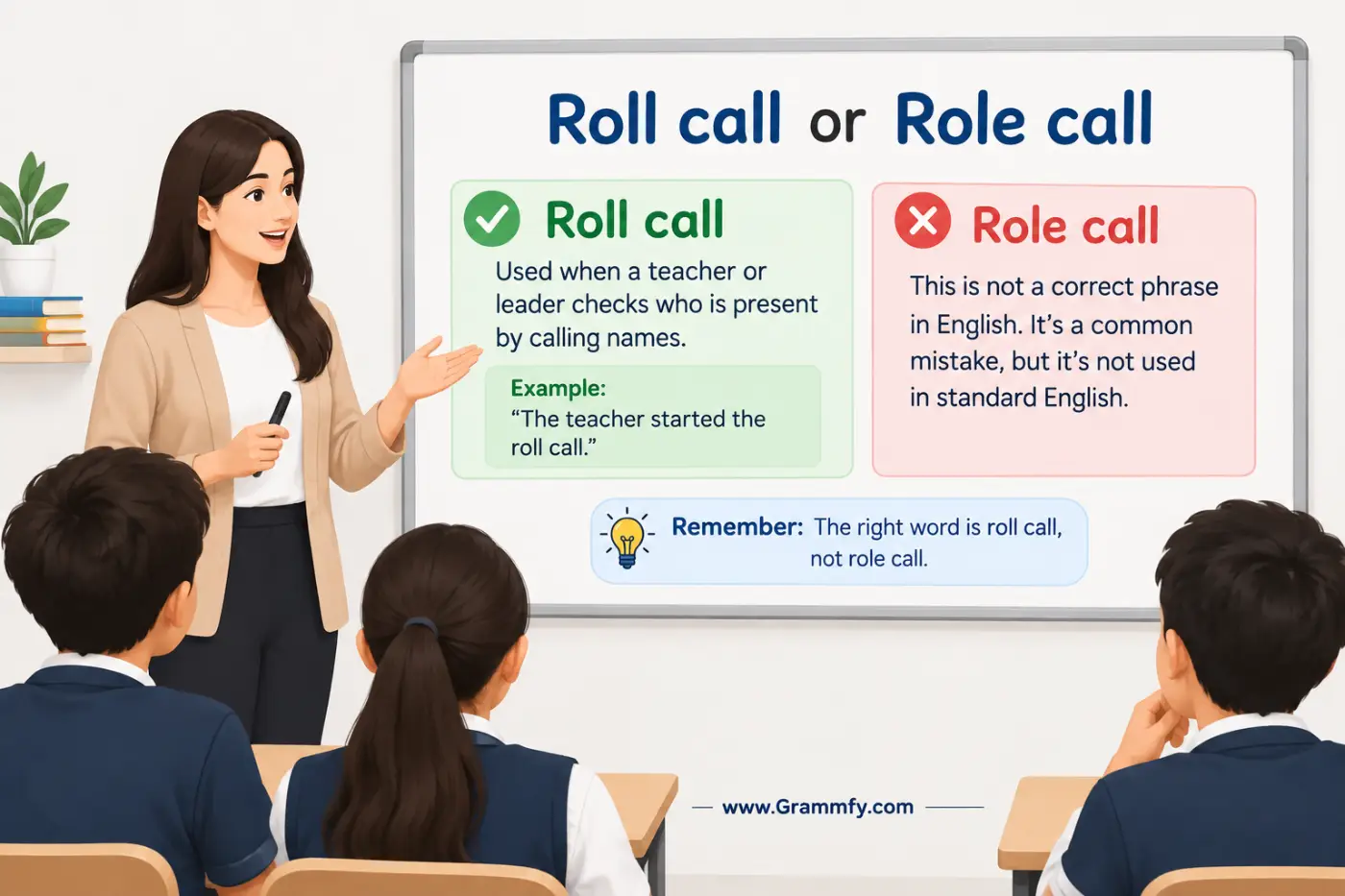
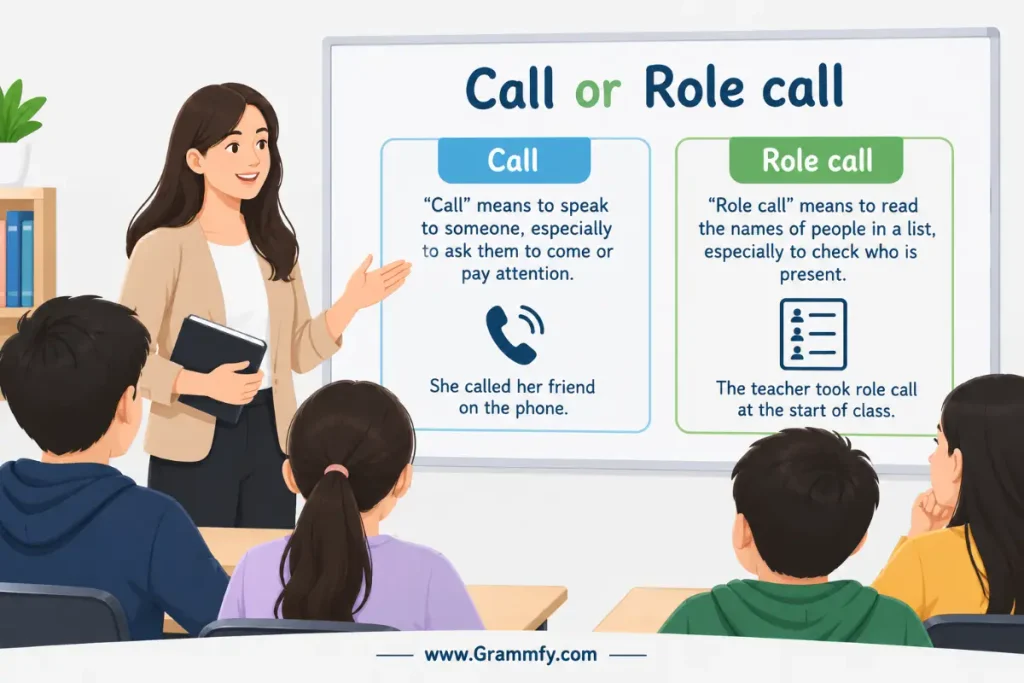
The correct expression is roll call when you mean the act of checking or reading a list of people’s names. Role means a person’s job, function, or part in a situation, so it doesn’t belong in this expression.
Answer box: Roll call is the correct term for checking names to see who is present. Role call is usually a spelling mistake caused by confusing roll with role.
This guide explains why roll call is correct, where the expression comes from, what words can replace it, and which option works best in school, work, email, texting, and formal writing. You’ll also see examples, common mistakes, synonym choices, regional notes, and quick tips for remembering the difference.
Want to avoid similar spelling mistakes? See [onsite or on site].
What does roll call mean?
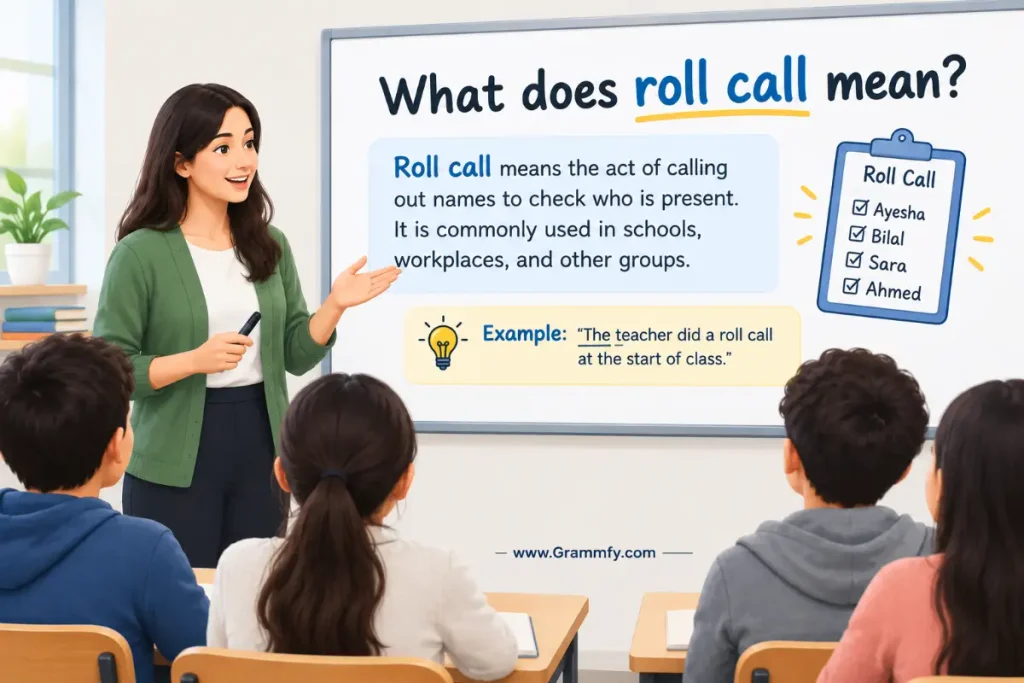
Roll call is the act of reading a list of people’s names and checking who is present. It is common in classrooms, military settings, meetings, workplaces, and organized groups.
For example:
- The teacher took roll call before starting the lesson.
- We waited for roll call before leaving the training area.
- The coach did a quick roll call before practice.
- The manager checked attendance during the morning roll call.
The word roll in this phrase refers to a list or register of names. When someone’s name is called, that person usually answers to show that they are present.
Is roll call one word or two words?
Roll call is normally written as two words.
Correct:
- roll call
- The teacher took roll call.
- We had roll call at 8:00 a.m.
Incorrect in standard usage:
- rollcall
- role call
Although you may occasionally see unusual forms online, roll call is the standard spelling for the attendance-related expression.
Why is roll call correct instead of role call?
The confusion comes from the fact that roll and role sound alike in most varieties of English.
They are homophones: words that sound the same but have different meanings and spellings.
Roll can refer to a list, a movement, or something that turns.
Role means a function, position, character, or part that someone has.
Compare these:
| Word | Meaning | Example |
|---|---|---|
| roll | A list of names | The students are on the class roll. |
| roll | To move by turning | The ball began to roll. |
| role | A function or position | She has an important role on the team. |
| role | A character in a performance | He played the role of a doctor. |
When you check attendance, you’re using a list of names. Therefore, the correct word is roll.
What does roll mean in roll call?
Here, roll has the older sense of a list or register.
Think of a class roll as a list containing the names of students. When a teacher reads those names to find out who is present, the teacher is conducting roll call.
This meaning is different from the more familiar verb roll, as in:
- Roll the ball.
- Roll down the hill.
- Roll up the paper.
The same spelling has several meanings depending on context.
What does role mean?
Role refers to what someone does, the position they hold, or the part they play.
Examples include:
- She has the role of team leader.
- Parents play an important role in education.
- What is your role in the project?
- The actor received a major role in the film.
Because attendance isn’t a person’s function or position, role isn’t the right word for the attendance expression.
Where did the phrase roll call come from?
The history of roll call is connected to the older use of roll as a written list or register.
Before modern digital attendance systems, organizations often kept written records containing people’s names. A roll could be a list of soldiers, students, members, or other people belonging to a group. Calling the names from that list became known as calling the roll, and the event itself became known as roll call.
Military organizations have long used the expression because knowing who is present can be important for organization and accountability. Schools, clubs, workplaces, and other groups later used the same basic idea.
The word role, however, has a different history and meaning. It developed from words associated with a written part or character in a play. Today, it can describe a person’s function, responsibility, or position.
So although roll and role sound identical, their meanings developed along different paths.
A simple history trick
You don’t need to memorize the entire history. Just remember:
Roll = list.
Role = job or part.
A list of names → roll.
A person’s function → role.
That small distinction solves most spelling questions.
What are the best synonyms for roll call?
There isn’t one perfect replacement for roll call in every situation. The best alternative depends on whether you’re talking about checking attendance, recording presence, or simply asking who is there.
Here is a broad synonym and related-word list grouped by tone.
Simple synonyms for roll call
| Word | Meaning | Tone | Example |
|---|---|---|---|
| attendance check | Checking who is present | Simple | We had an attendance check. |
| name check | Checking people’s names | Simple | The teacher did a name check. |
| presence check | Checking who is present | Simple | Let’s do a presence check. |
| attendance | The state or record of being present | Simple | Attendance was taken at nine. |
| check-in | Confirming someone’s arrival | Simple | Everyone completed the check-in. |
| headcount | Counting the people present | Simple | We need a quick headcount. |
| count | Counting people in a group | Simple | Let’s get a count before we leave. |
Everyday alternatives
| Word | Meaning | Tone | Example |
|---|---|---|---|
| check attendance | Find out who is present | Everyday | I’ll check attendance first. |
| take attendance | Record who is present | Everyday | The teacher will take attendance. |
| call the names | Read names and wait for responses | Everyday | She called the names one by one. |
| check who’s here | Find out who is present | Casual | Let’s check who’s here. |
| check who is present | Confirm attendance | Neutral | We need to check who is present. |
| member check | Check which members are there | Everyday | We’ll do a member check. |
| attendance check-in | Confirm arrival | Everyday | Please complete the attendance check-in. |
Formal alternatives
| Word | Meaning | Tone | Example |
|---|---|---|---|
| attendance verification | Formal confirmation of presence | Formal | Attendance verification begins at 8 a.m. |
| attendance record | Written or digital record of attendance | Formal | The attendance record was updated. |
| attendance register | Official list of attendance | Formal | Sign the attendance register. |
| attendance review | Review of who attended | Formal | The supervisor completed an attendance review. |
| participant verification | Confirming participants | Formal | Participant verification is required. |
| presence verification | Formal confirmation of presence | Formal | Presence verification will occur before entry. |
| participant check-in | Confirming participants’ arrival | Formal | Participant check-in closes at 9 a.m. |
Casual or slang-like alternatives
| Word | Meaning | Tone | Example |
|---|---|---|---|
| who’s here? | Asking who is present | Casual | Okay, who’s here? |
| who made it? | Asking who arrived | Casual | Let’s see who made it. |
| headcount | Counting everyone present | Casual/neutral | Quick headcount, everyone. |
| check-in | Confirming arrival | Casual | Give me a quick check-in. |
| roll | Informal shortening of roll call | Casual | We need to do roll first. |
| name check | Informal name-based attendance check | Casual | Let’s do a quick name check. |
Not every item above is a strict dictionary synonym. Some are related expressions that can replace roll call in specific situations. That distinction matters because attendance, headcount, and check-in don’t always mean exactly the same thing.
Which attendance word should you use?
The right choice depends on what you’re actually doing.
Use roll call when names are being called
Use roll call when someone reads names from a list and people respond.
Example:
The teacher started roll call at 8:15.
This creates a clear picture of names being called.
Use attendance when presence is being recorded
Attendance is broader.
Example:
The teacher took attendance.
The teacher might call names, use an electronic system, ask students to sign in, or use another method.
Use headcount when you need a number
A headcount focuses on how many people are present rather than their individual names.
Example:
We need a headcount before the bus leaves.
You don’t necessarily need to call every person’s name.
Use check-in when people confirm arrival
Check-in often suggests that people actively confirm that they’ve arrived.
Example:
Please check in at the front desk.
This is common at events, hotels, workplaces, classes, and appointments.
Which word is best by intensity?
Attendance-related expressions can also differ in how formal or specific they feel.
Mild and casual
These work well when you’re simply asking who is present:
- who’s here?
- who’s in?
- quick count
- name check
- check-in
Example:
Let’s see who’s here before we begin.
Neutral
These are useful in most everyday situations:
- attendance
- attendance check
- take attendance
- check attendance
- roll call
- headcount
Example:
We’ll take attendance before the presentation.
Stronger or more formal
These suggest an official or required process:
- attendance verification
- presence verification
- attendance register
- participant verification
- attendance review
Example:
Attendance verification is required for all participants.
The word stronger here refers to formality or official purpose, not emotional intensity.
What parts of speech are these words?
Understanding grammar can help you choose the right expression.
Roll call as a noun
Roll call is a noun phrase.
Examples:
- Roll call begins at 8 a.m.
- We finished roll call quickly.
- The teacher took roll call.
Roll as a noun
Roll can also be a noun meaning a list or register.
Example:
Her name appears on the class roll.
Call as a verb
Call can describe the action of reading names.
Example:
The teacher called each student’s name.
Role as a noun
Role is a noun meaning a function, position, or part.
Examples:
- She has a leadership role.
- His role is to organize the event.
- What role do you play on the team?
This is why replacing roll with role changes the meaning completely.
What should you use in a resume?
Use attendance or participation, not roll call, in most resumes
A resume usually focuses on your accomplishments, responsibilities, and professional skills. Roll call is rarely the best wording.
Instead of:
Responsible for roll call at daily meetings.
Consider:
Recorded employee attendance at daily meetings.
Or:
Maintained accurate attendance records for daily training sessions.
If your actual job involved checking people in, you could say:
Managed participant check-in for weekly training sessions.
These versions sound more professional because they describe the specific task.
What should you use in an essay?
Use roll call when discussing a specific attendance practice
Roll call works naturally in an essay if you’re describing a classroom, military, historical, or organizational situation.
Example:
The teacher used roll call to confirm that every student was present.
For a formal academic essay, attendance check or attendance verification may work if the subject is more technical.
Example:
The school introduced an electronic attendance verification system.
Don’t replace roll call with role call just because the essay sounds formal. Formal writing still requires the correct spelling.
What should you use in a text message?
Use roll call, attendance, or a casual phrase
In texting, your choice depends on how informal you want to sound.
Examples:
Are we doing roll call today?
Did the teacher take attendance?
Who’s here?
Quick headcount, please.
Who made it to class?
If you’re texting friends, who’s here? sounds much more natural than attendance verification.
What should you use in an email?
Use attendance or roll call based on the situation
For a normal school or workplace email:
The instructor will take attendance at the beginning of the session.
For a more formal notice:
Attendance will be recorded at the beginning of each session.
If you’re specifically talking about names being called:
The instructor will conduct roll call before the meeting begins.
Avoid role call in professional emails. It can make a polished message look like it contains a spelling mistake.
What should you use when speaking?
Use the word that matches the action
In everyday speech, roll call is perfectly natural.
You might say:
Are we doing roll call now?
Or:
Has the teacher taken attendance?
In a casual group, you might simply ask:
Who’s here?
The best spoken choice is usually the shortest phrase that clearly communicates what you mean.
Roll call vs attendance — what’s the difference?
These expressions are closely related, but they aren’t always interchangeable.
| Roll call | Attendance |
|---|---|
| Usually involves calling names | Refers more broadly to presence |
| Often sounds like a specific activity | Can describe a record or general condition |
| Common in classrooms and organized groups | Common in schools and workplaces |
| Can be a short event | Can be tracked over days or weeks |
| Example: “Roll call starts at 8.” | Example: “Her attendance is excellent.” |
Compare:
The teacher took attendance.
This doesn’t tell us exactly how the teacher checked students.
Now compare:
The teacher conducted roll call.
This strongly suggests that names were called.
So, attendance is the broader term, while roll call often describes a particular method or event.
Roll call vs headcount — what’s different?
A headcount focuses on the number of people. Roll call usually focuses on identifying people by name.
| Roll call | Headcount |
|---|---|
| Checks names | Counts people |
| Identifies who is present | Determines how many are present |
| Useful for classrooms | Useful for groups, trips, events, and emergencies |
| Example: “Let’s do roll call.” | Example: “Let’s get a headcount.” |
Imagine a school trip.
If the teacher calls:
Sarah?
Ali?
Emma?
That’s roll call.
If the teacher simply counts:
I have 28 students.
That’s a headcount.
The two methods can happen together, but they have different purposes.
Roll call vs check-in — what’s different?
Check-in usually means confirming arrival. Roll call usually means calling names from a list.
| Roll call | Check-in |
|---|---|
| Names are often called | People often confirm arrival themselves |
| Group activity | Can be individual |
| Common in classrooms | Common at events and workplaces |
| Example: “The coach took roll call.” | Example: “Players checked in at the desk.” |
A conference might use a check-in desk. A classroom might use roll call. Both can record attendance, but the process is different.
Common mistakes with roll call
Mistake 1: Writing role call
Incorrect:
The teacher took role call.
Correct:
The teacher took roll call.
The mistake happens because role and roll sound alike.
Mistake 2: Writing rollcall
Incorrect:
Rollcall started at nine.
Correct:
Roll call started at nine.
Write the expression as two words.
Mistake 3: Assuming role call is correct because roles are involved
The word role has nothing to do with attendance.
For example:
Her role is to lead the group.
Here, role means responsibility or function.
But:
The leader took roll call.
Here, roll refers to the list of names.
Mistake 4: Using roll call when you only mean a headcount
If you only need to know how many people are present, headcount may be more accurate.
Instead of:
We need a roll call of 50 people.
You may mean:
We need a headcount of 50 people.
If names must be checked individually, however, roll call is appropriate.
Mistake 5: Using formal words in casual messages
A phrase such as presence verification may sound unnecessarily formal in a text.
Instead of:
Please participate in the presence verification.
A casual message could say:
Please check in.
Good word choice isn’t only about correctness. It’s also about tone.
When should you not use roll call?
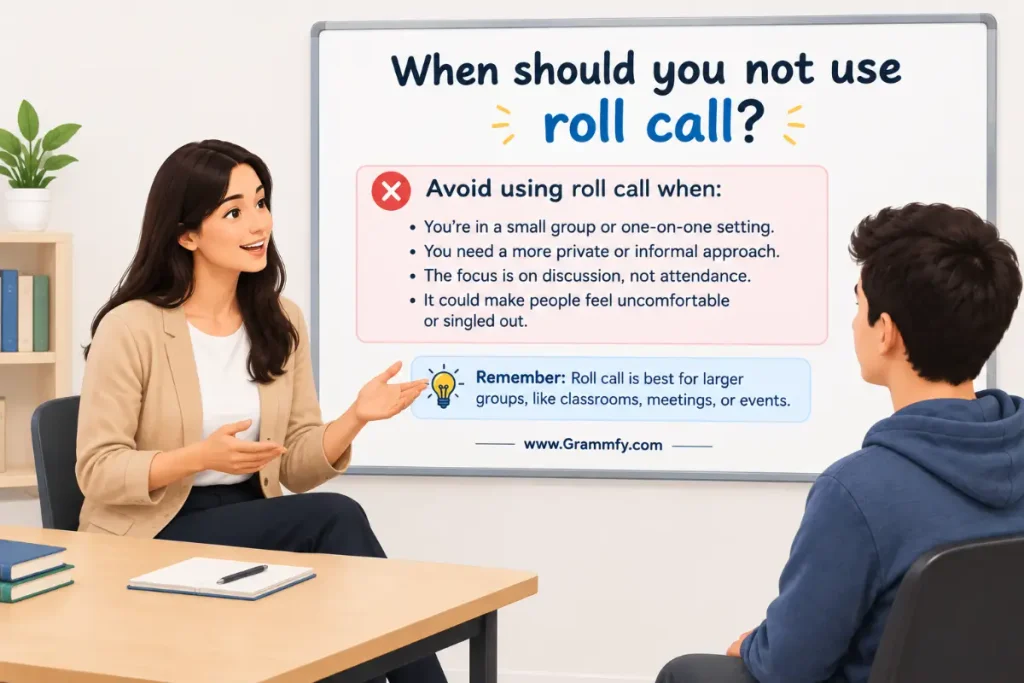
There are situations where another expression is clearer.
Don’t use it for someone’s job or responsibility
Use role, not roll call.
Her role is to manage the team.
Not:
Her roll is to manage the team.
Don’t use it when you’re describing attendance over time
Use attendance when talking about a person’s overall record.
His attendance improved this semester.
Roll call describes a specific attendance-checking event.
Don’t use it when only a number matters
Use headcount if you’re counting people.
We need a headcount before departure.
Don’t use it when people are checking themselves in
Use check-in if that’s the process.
Please complete check-in before entering the room.
Don’t use it as a synonym for role
Role and roll are not interchangeable.
She plays an important role in the project.
This has nothing to do with attendance.
What are the antonyms of roll call?
There isn’t one perfect opposite of roll call, because the phrase describes an action rather than a simple quality.
Depending on the context, useful contrasts include:
- absence
- nonattendance
- missing
- absent
- departure
- leaving
- dismissal
For example:
The roll call showed three students absent.
Here, present and absent are useful opposites when discussing attendance status.
| Attendance term | Contrasting idea |
|---|---|
| present | absent |
| attendance | nonattendance |
| arrival | departure |
| check-in | check-out |
| participation | nonparticipation |
These aren’t exact dictionary antonyms of roll call, but they express the opposite conditions or actions commonly connected with attendance.
How can you remember roll vs role?
Use a simple memory trick:
Roll = list
Think:
roll = list of names
A teacher has a class roll. A coach may have a team roll. A military unit may have a personnel roll.
So:
Roll call = calling the names on a list.
Role = job
Think:
role = job, function, or part
Examples:
- role in a project
- role on a team
- role in a movie
- role as a teacher
So:
Role = what someone does.
The two-second test
Ask yourself:
Am I talking about a list of names?
If yes, choose roll.
Ask:
Am I talking about someone’s job, function, or part?
If yes, choose role.
This quick test works in most situations.
12+ examples of roll call in real situations
1. School classroom
The teacher took roll call before beginning the lesson.
The teacher checked which students were present.
2. University lecture
The professor used an online system instead of traditional roll call.
The phrase describes the older or manual attendance process.
3. Military setting
The soldiers assembled for roll call early in the morning.
Here, the phrase refers to an organized attendance check.
4. Sports practice
The coach took roll call before practice started.
The coach wanted to know which players had arrived.
5. School trip
The teacher did roll call before the bus left.
Calling names helps make sure no student is missing.
6. Workplace training
The instructor completed roll call at the beginning of the training session.
The instructor checked the participants.
7. Emergency situation
The supervisor conducted roll call after everyone reached the assembly area.
The purpose was to confirm who was safely present.
8. Club meeting
We usually take roll call at the start of each club meeting.
The club uses the process to track members.
9. Online class
The instructor used a quick roll call to confirm that everyone had joined the meeting.
The names may have been read from a participant list.
10. Formal event
Staff completed roll call before opening the event to visitors.
This makes the attendance process clear.
11. Historical discussion
The recruits gathered for morning roll call.
The phrase can describe traditional organized routines.
12. Casual conversation
Did you hear your name during roll call?
This is a natural question about an attendance check.
13. Email
Please arrive five minutes early because roll call begins at 9:00 a.m.
The phrase works well when the reader already understands the attendance process.
14. Text message
Is there roll call today?
This is short and natural for a casual message.
How does roll call work in different settings?
The basic idea stays the same, but the process can change.
In schools
A teacher may read students’ names from a class list. Students respond verbally, raise a hand, or use another approved signal.
Some schools now use digital attendance systems instead.
In workplaces
A workplace may not use traditional roll call at all. Employees might use badges, apps, time clocks, or online check-in systems.
In that case, attendance record or check-in may be more accurate.
In the military
Roll call has a long association with organized groups such as military units. The process can be more formal and structured than a classroom attendance check.
At events
Event organizers often use check-in or registration instead of roll call.
For example:
Guest check-in begins at 6 p.m.
That sounds more natural than saying:
Guest roll call begins at 6 p.m.
During emergencies
A headcount may be more useful when the immediate goal is to determine whether everyone is accounted for.
For example:
The teacher completed a headcount after the evacuation.
If names are individually checked, roll call may also be appropriate.
US vs UK English: Is roll call different?
Roll call is widely understood in both American and British English.
The basic spelling remains roll call when referring to an attendance check.
Other attendance terms can vary by setting and region. For example, register is especially common in British educational contexts.
You may hear:
The teacher took the register.
In American English, take attendance is especially common:
The teacher took attendance.
Both expressions describe checking or recording who is present.
The key spelling distinction between roll and role does not change simply because the speaker is in the US or UK.
Is role call ever correct?
Role call can be correct only when role and call are being used separately for their normal meanings, not as the standard attendance expression.
For example, someone might discuss:
a call for role assignments
Here, role means a position or function, and call has its own meaning.
But if you mean checking people’s names for attendance, role call is not the standard expression.
A useful rule is:
Attendance = roll call.
Job or function = role.
This keeps the two words separate.
Can roll call be used as a verb?
Not usually in standard everyday English.
You normally say:
- take roll call
- conduct roll call
- have roll call
- call the roll
- take attendance
- check attendance
Examples:
The teacher took roll call.
The coach conducted roll call.
We had roll call at 8 a.m.
You generally wouldn’t write:
The teacher roll-called the students.
There may be informal or specialized uses of related forms, but they aren’t necessary for normal writing.
Is take roll call or take attendance better?
Both can be correct, but they have slightly different meanings.
Take attendance is broad and very common.
The teacher took attendance.
Take roll call sounds more specific.
The teacher took roll call.
If the teacher is simply recording who is present, take attendance is often the safest choice. If the process involves calling names from a list, take roll call gives a clearer picture.
Quick comparison chart
| Expression | Main meaning | Best use |
|---|---|---|
| roll call | Calling names to check presence | Specific attendance event |
| attendance | Presence or attendance record | General use |
| take attendance | Record who is present | School/work |
| headcount | Count people | Groups, trips, emergencies |
| check-in | Confirm arrival | Events, workplaces |
| register | Official attendance list/process | Especially UK contexts |
| role | Job, function, or part | Responsibilities |
| role call | Usually a mistaken form of roll call | Avoid for attendance |
Quick tips for choosing the right word “roll call or role call”
- Use roll call when names are being called.
- Use attendance for the general idea of being present.
- Use take attendance in most school and workplace situations.
- Use headcount when you mainly need a number.
- Use check-in when people confirm their arrival.
- Use register when that term fits the regional or institutional setting.
- Use role for a job, function, responsibility, or character.
- Don’t write role call when you mean attendance.
- Remember that roll can mean a list.
- Remember that role means a function or part.
- Write roll call as two words.
- Match the level of formality to your audience.
A simple decision tree about Roll call or Role call
Still unsure which term to choose?
Ask these questions:
Are you checking people’s names?
→ Use roll call.
Are you talking about whether someone attended?
→ Use attendance.
Are you counting the number of people?
→ Use headcount.
Are people confirming that they arrived?
→ Use check-in.
Are you talking about someone’s responsibility or function?
→ Use role.
For example:
The teacher took roll call.
Her attendance was excellent.
We need a headcount.
Please complete check-in.
Her role is to lead the group.
Each word has a clear job.
Conclusion
Choosing the right spelling becomes easy once you connect each word to its meaning. Roll call or Role call is not really a choice between two equal expressions. When you mean checking a list of names to see who is present, roll call is the standard form. The word roll can refer to a list or register, while role refers to a person’s function, responsibility, or part.
Use attendance when you’re talking about presence in general, headcount when you need a number, and check-in when people confirm their arrival. If you’re writing about someone’s job or responsibility, use role. Keep the simple memory trick in mind: roll = list, role = job. With that distinction, you’ll be able to choose the correct word confidently in schoolwork, emails, resumes, texts, and everyday conversation.
Frequently Asked Questions
What is the correct spelling: roll call or role call?
Roll call is the correct spelling when you mean checking attendance. Role call is usually a spelling mistake caused by confusing roll with role.
What’s another way to say roll call?
Other ways to express the idea include take attendance, attendance check, headcount, check-in, and call the names. The best alternative depends on whether you’re checking names, counting people, or recording attendance.
Is roll call one word or two?
Roll call is written as two words. The standard expression is not rollcall.
What does roll mean in roll call?
Roll refers to a list or register of names. A roll can contain the names of students, soldiers, members, or other people in a group.
What is the difference between roll and role?
Roll can mean a list, while role means a person’s function, responsibility, position, or part. For attendance, use roll; for a person’s function, use role.
Can I use roll call in formal writing?
Yes, roll call is acceptable in formal writing when you’re specifically referring to an attendance-checking process. In very formal contexts, attendance verification or attendance record may be more appropriate depending on what you mean.
Why do roll and role sound the same?
Roll and role are homophones in most varieties of English, meaning they share the same pronunciation but have different meanings and spellings. Their different meanings are what determine which spelling you should use.
