
You’re writing a text to a friend and want to describe someone who always wants to know what other people are doing. You type, “She’s so nosy,” but then you wonder: should it be nosy or nosey?
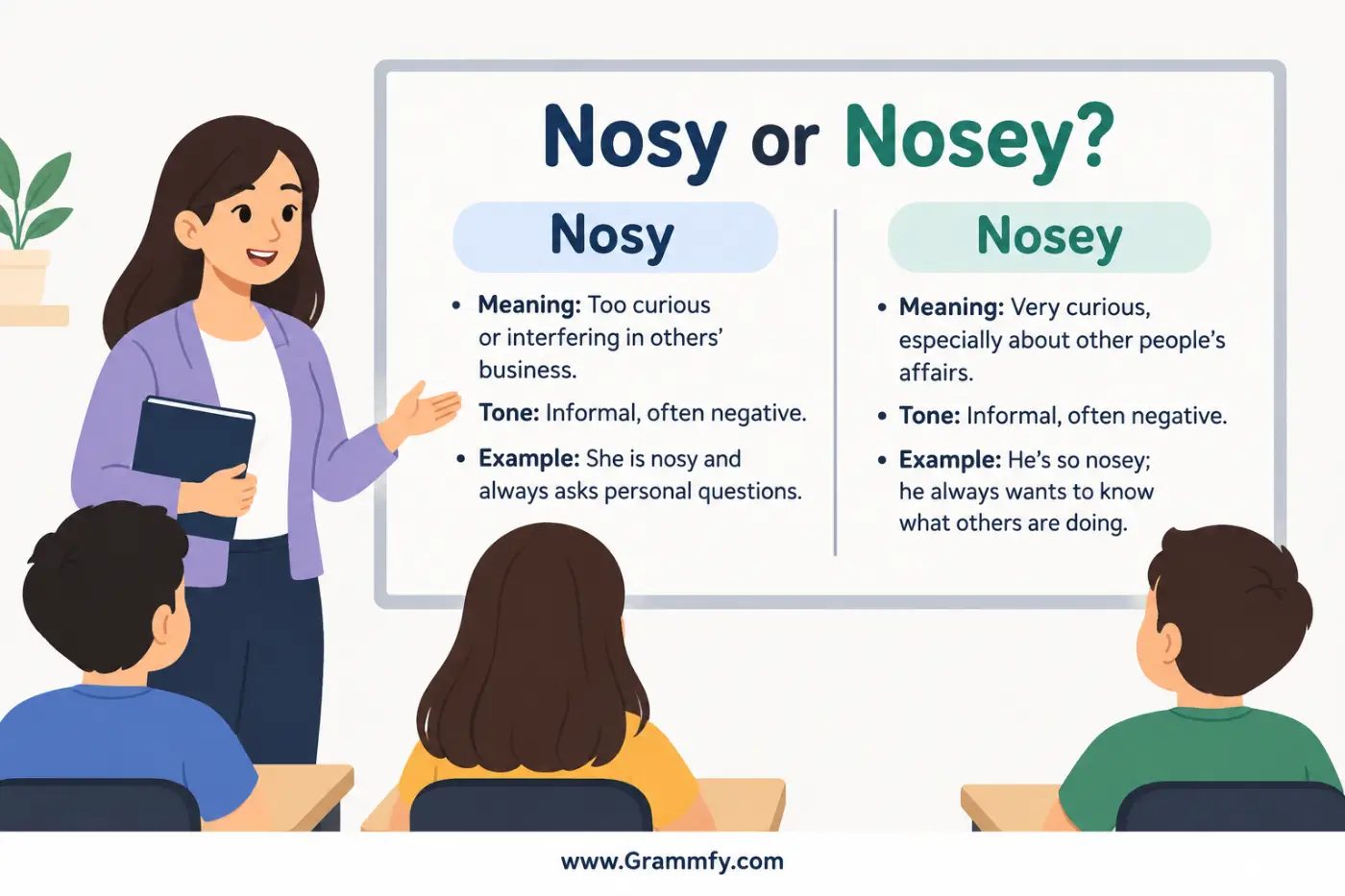
Both spellings are found in English, but they don’t have the same level of use in every region. Nosy is the standard and more common spelling in American English. Nosey is also a recognized variant, especially in British English.
Answer box: Nosy is the preferred spelling in American English, while nosey is a common British English variant. Both mean overly curious about other people’s private business.
The word usually describes someone who asks too many personal questions, pays too much attention to other people’s affairs, or tries to find out information that isn’t really their business. Depending on the situation, it can sound playful, teasing, rude, or critical.
This guide explains the difference between the two spellings, where the word came from, how its meaning developed, and which alternatives work best in texts, emails, essays, resumes, and conversation. You’ll also get examples, synonym comparisons, common mistakes, regional notes, and quick tips for choosing the right word.
You may also want to learn the difference between [roll call or role call].
What does nosy mean?
Nosy means too interested in other people’s private lives or personal business.
A nosy person may ask questions that feel too personal. They might listen to conversations that don’t involve them, look at things that aren’t theirs, or keep asking for details after someone has made it clear that the subject is private.
For example:
- My neighbor is nosy and always asks who visits me.
- Don’t be nosy about their family problems.
- I wasn’t trying to be nosy; I was just concerned.
- The children were curious, but they weren’t being nosy.
- He’s a little nosy, but he usually means well.
The word is usually negative, but its tone can change depending on context.
Compare:
You’re so nosy!
This could be playful between close friends.
But:
Our manager is always nosy about employees’ personal lives.
This sounds clearly critical.
Is nosy or nosey correct?
Both nosy and nosey are accepted English spellings.
However, nosy is the preferred spelling in American English and is generally the safest choice for US-focused writing. Nosey is especially common in British English.
| Spelling | Status | Common use |
|---|---|---|
| nosy | Standard spelling | Especially American English |
| nosey | Variant spelling | Especially British English |
If you’re writing for an American audience, choose nosy.
If you’re writing for a British audience, nosey may sound more familiar.
The difference is mainly spelling, not meaning. Both words describe someone who is overly interested in other people’s private affairs.
Why do people spell it nosey?
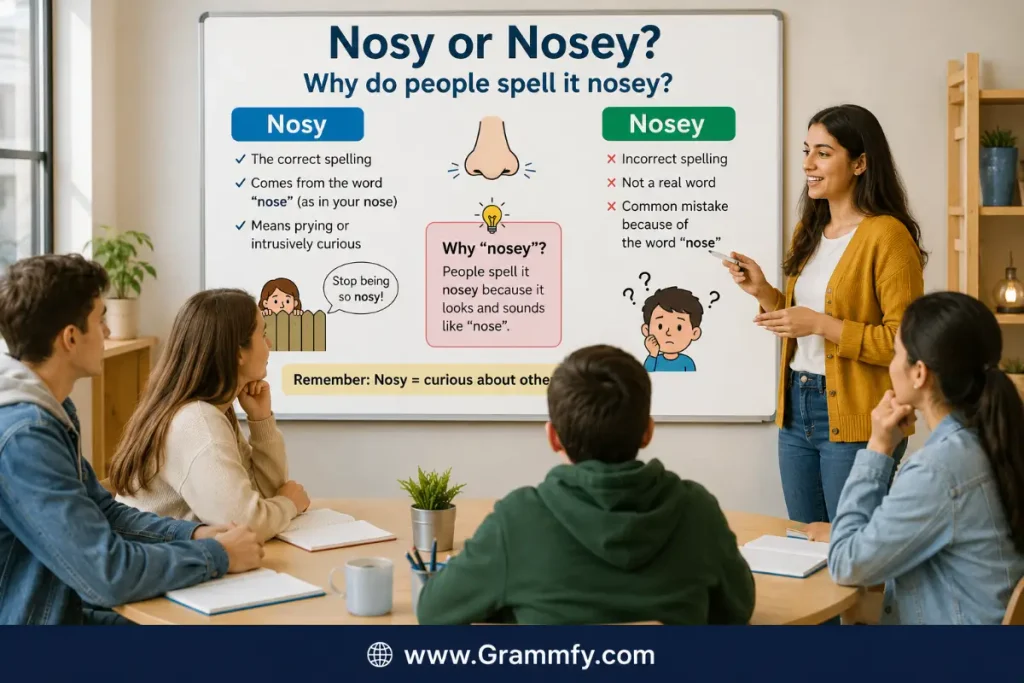
The spelling nosey makes intuitive sense because the word is connected to the idea of sticking one’s nose into other people’s business.
English speakers often use expressions such as:
Don’t stick your nose into my business.
The image is easy to understand: someone is putting their nose where it doesn’t belong.
Because of that connection, some writers naturally add the letter e and write nosey.
The spelling nosy, however, is well established and is especially standard in American English.
So you don’t need to think that one spelling is simply “wrong.” Instead, think about audience and regional style.
Where did the word nosy come from?
The history of the word is connected to nose.
English has long used the nose as a metaphor for curiosity and interference. Expressions such as poke one’s nose into something and stick one’s nose into someone’s business suggest getting involved in matters that aren’t yours.
The adjective developed from this idea.
The spelling also reflects a common English word-building pattern. The word nose can become nosy, meaning someone who behaves as though they are constantly putting their nose into other people’s affairs.
The exact history of the modern spelling is more complicated than simply adding a suffix to nose, but the connection is clear in modern English usage.
Why is the word related to the nose?
The idea is figurative rather than literal.
A person’s physical nose can be imagined as being pushed into a private situation. From there, the idea of “putting your nose where it doesn’t belong” developed into a description of someone who interferes or asks too many questions.
Similar expressions include:
- stick your nose into something
- poke your nose into someone’s business
- keep your nose out of it
- have a nose around
These expressions help explain why nosy has its current meaning.
What is the difference between curious and nosy?
Curious and nosy both involve wanting information, but the attitude is different.
| Curious | Nosy |
|---|---|
| Wants to learn or understand | Wants personal information |
| Often neutral or positive | Usually negative |
| Respects boundaries | May cross boundaries |
| Can involve general topics | Often involves private matters |
| Example: “I’m curious about astronomy.” | Example: “She’s nosy about her neighbors.” |
For example:
I’m curious about how the machine works.
This is positive or neutral.
But:
I’m curious about how much money you make.
Depending on the relationship, this might sound intrusive.
If the person keeps asking after you don’t want to answer, they may seem nosy rather than simply curious.
What is the difference between nosy and intrusive?
These words are close, but intrusive is often more formal and can sound stronger.
| Nosy | Intrusive |
|---|---|
| Often describes excessive curiosity | Describes unwanted involvement or interference |
| Common in everyday speech | More formal |
| Can sound playful | Usually more serious |
| Often involves questions | Can involve actions, questions, or behavior |
| “My aunt is nosy.” | “The questions were intrusive.” |
For example:
My friend is nosy and keeps asking about my dating life.
This is conversational.
The interviewer asked several intrusive questions.
This sounds more serious and professional.
If you’re writing a formal complaint, intrusive may be a better choice than nosy.
What is the difference between nosy and curious?
A useful way to remember the distinction is boundaries.
Curiosity usually respects boundaries.
Nosiness often ignores them.
Imagine that a coworker says:
I had a difficult weekend.
A curious response might be:
I hope you’re okay. Do you want to talk about it?
A nosy response might be:
What happened? Who was involved? Was it your family? Did you have a fight?
The second person may be asking questions that the coworker doesn’t want to answer.
Curiosity becomes nosiness when the person pushes too far.
What are the best synonyms for nosy?
There are many ways to describe someone who is overly interested in other people’s affairs. The best choice depends on how strong or formal you want to sound.
Simple synonyms
| Word | Meaning | Tone | Example |
|---|---|---|---|
| curious | Wanting to know something | Neutral | She was curious about the meeting. |
| inquisitive | Asking many questions | Neutral | He’s naturally inquisitive. |
| prying | Trying to discover private information | Negative | Her prying questions were uncomfortable. |
| meddlesome | Interfering in other people’s affairs | Negative | His meddlesome behavior caused problems. |
| intrusive | Entering someone’s private space or affairs | Negative | The questions felt intrusive. |
| interfering | Getting involved where unwanted | Negative | She’s tired of his interfering behavior. |
| interested | Wanting to know more | Neutral | He was interested in the project. |
Everyday alternatives
| Word | Meaning | Tone | Example |
|---|---|---|---|
| prying | Trying to learn private information | Negative | Stop asking prying questions. |
| nosy | Too interested in others’ affairs | Casual | My neighbor is nosy. |
| inquisitive | Frequently asking questions | Neutral | The child is very inquisitive. |
| meddling | Interfering in someone’s affairs | Negative | His meddling wasn’t helpful. |
| curious | Wanting information | Neutral | She was curious about the result. |
| questioning | Asking many questions | Neutral | His questioning became uncomfortable. |
| interfering | Involving yourself without being wanted | Negative | That was an interfering thing to do. |
Formal alternatives
| Word | Meaning | Tone | Example |
|---|---|---|---|
| intrusive | Inappropriately entering private matters | Formal | The questions were intrusive. |
| prying | Seeking private information | Formal/neutral | The report criticized the prying investigation. |
| meddlesome | Interfering unnecessarily | Formal | His meddlesome actions created tension. |
| interfering | Unwanted involvement | Formal | The policy prevents interfering behavior. |
| inquisitive | Eager to obtain information | Formal/neutral | Her inquisitive nature helped her research. |
| overcurious | Excessively curious | Formal | His overcurious behavior was noticeable. |
| impertinent | Rude or improperly personal | Formal | The question was considered impertinent. |
| indiscreet | Failing to respect privacy | Formal | His indiscreet comments caused embarrassment. |
Casual or slang-like alternatives
| Word | Meaning | Tone | Example |
|---|---|---|---|
| prying | Digging for private details | Casual | Quit prying. |
| busybody | Someone who interferes in others’ affairs | Casual | Don’t be a busybody. |
| nosy parker | A very nosy person | Informal, especially British | He’s a real nosy parker. |
| stickybeak | A person who interferes or asks too many questions | Informal, regional | Don’t be such a stickybeak. |
| rubbernecking | Looking too closely at something unusual | Casual | Everyone was rubbernecking at the scene. |
| peeking | Looking secretly or quickly | Casual | Stop peeking at my screen. |
| snooping | Searching or looking secretly | Casual | Who’s been snooping around? |
Not all of these are exact replacements in every sentence. For example, snooping usually suggests secretly looking for information, while nosy can simply mean asking too many questions.
Synonyms by intensity: mild to strong
Not every alternative sounds equally critical.
Mild
Use these when you don’t want to sound harsh:
- curious
- inquisitive
- interested
- questioning
- observant
Example:
She’s curious about what we’re planning.
These words don’t necessarily accuse someone of bad behavior.
Moderate
These suggest that someone may be crossing a social boundary:
- nosy
- prying
- meddling
- interfering
- snooping
Example:
He was getting a little prying about my personal life.
Strong
These can sound clearly negative or judgmental:
- intrusive
- meddlesome
- impertinent
- indiscreet
- invasive
- interfering
Example:
The interview included several intrusive questions about her family.
Choose the intensity carefully. Calling someone curious is much kinder than calling them invasive.
Synonyms by part of speech
Adjectives
These describe a person or behavior:
- nosy
- curious
- inquisitive
- prying
- intrusive
- meddlesome
- interfering
- inquisitive
- indiscreet
- impertinent
Examples:
She’s very inquisitive.
His questions were intrusive.
Nouns
These describe a person who behaves this way:
- busybody
- snoop
- meddler
- pryer
- interferer
Examples:
He’s a busybody who always wants to know everyone’s business.
Someone has been snooping around the office.
Verbs
These describe the action:
- pry
- snoop
- meddle
- interfere
- probe
- intrude
- investigate
Examples:
Don’t pry into her personal life.
He kept snooping through the files.
Adverbs
These describe how an action is done:
- inquisitively
- intrusively
- indiscreetly
- pryingly
In everyday writing, it is often more natural to rewrite the sentence rather than use an uncommon adverb.
Instead of:
She asked inquisitively.
You might write:
She asked a curious question.

What is the best word for a resume Nosy or Nosey?
Avoid nosy on a resume
Nosy is informal and usually negative, so it doesn’t belong on a professional resume.
If you’re trying to describe positive curiosity, use words such as:
- inquisitive
- curious
- observant
- analytical
- investigative
- detail-oriented
For example:
An inquisitive learner who enjoys researching unfamiliar topics.
Or:
An analytical professional with strong investigative skills.
This turns the idea of wanting information into a professional strength.
Don’t write:
I’m nosy and always want to know everything.
Even if you mean it as a joke, it isn’t suitable for most resumes.
What is the best word for an essay Nosy or Nosey?
Use nosy when the essay is informal or conversational
You can use nosy in a personal essay, story, or discussion when the tone allows it.
Example:
My nosy neighbor always wanted to know where I was going.
For formal academic writing, choose a more precise word.
Examples:
The interviewer asked intrusive questions.
The character displays a strong tendency to pry into private matters.
The journalist was criticized for invasive reporting practices.
The best word depends on exactly what the person did.
What is the best word for texting Nosy or Nosey?
Nosy is natural in casual texts
In a message to a friend, nosy sounds normal.
Examples:
You’re so nosy 😂
Don’t be nosy!
Sorry, I don’t mean to be nosy.
My sister is being nosy again.
You can also use:
Stop prying.
Why are you snooping?
Mind your business!
The last option is much stronger, so use it carefully.
What is the best word for email Nosy or Nosey?
Choose a softer term in professional emails
Calling someone nosy in a work email can sound rude.
Instead, use neutral or professional wording.
Instead of:
You’re being nosy about my personal situation.
Try:
I would prefer to keep that matter private.
Or:
I don’t feel comfortable discussing personal details.
If you need to describe someone’s behavior formally:
Some of the questions felt intrusive.
This communicates the concern without sounding childish or insulting.
What is the best word when speaking Nosy or Nosey?
Nosy works well in everyday conversation
In casual speech, nosy is common and easy to understand.
Examples:
My brother is so nosy.
I don’t mean to be nosy, but are you okay?
Why are you being so nosy?
It can also be softened with phrases such as:
I hope this isn’t too personal, but…
I don’t mean to pry, but…
If you don’t mind me asking…
These phrases show respect for someone’s privacy.
How can you politely say someone is nosy?
Sometimes you need to describe the behavior without directly insulting the person.
Try these alternatives:
- You’re asking a lot of personal questions.
- I’d rather keep that private.
- That’s a little personal.
- I don’t really want to discuss that.
- I appreciate your concern, but I’d rather not talk about it.
- Some of those questions feel a little intrusive.
- I’d prefer not to share those details.
- Let’s keep the conversation focused on the project.
These phrases are especially useful at work or in formal situations.
14+ original examples using nosy
Example 1: Neighbor
My neighbor is so nosy that she always asks who is visiting my house.
The person is asking about private activity that doesn’t concern them.
Example 2: Friend
I don’t mean to be nosy, but are you doing okay?
Here, nosy softens the speaker’s awareness that the question may be personal.
Example 3: Workplace
The new employee wasn’t trying to be nosy; she was simply learning how the team worked.
The sentence separates curiosity from unwanted interference.
Example 4: Family
My little brother is nosy whenever someone receives a package.
His curiosity is about something that isn’t necessarily his business.
Example 5: Classroom
The students became nosy when they noticed the teacher hiding something behind the desk.
Here, the word can have a playful tone.
Example 6: Social media
Some people get nosy when they see a vague relationship post online.
The sentence describes people wanting private details.
Example 7: Conversation
Don’t be nosy about my plans for the weekend.
This directly asks someone to respect a boundary.
Example 8: Children
Children are naturally curious, but adults should teach them when questions become too nosy.
This example shows the difference between healthy curiosity and intrusive questioning.
Example 9: Text message
You’re being nosy again! 😂
The emoji can make the criticism sound playful.
Example 10: Office conversation
I wasn’t trying to be nosy when I asked whether you needed help.
The speaker explains that the question came from concern rather than interference.
Example 11: Private information
She refused to answer his nosy questions about her finances.
The adjective clearly shows that the questions crossed a boundary.
Example 12: Story writing
The nosy shopkeeper seemed to know every secret in the neighborhood.
This creates a clear character description.
Example 13: Friendly teasing
You’re too nosy for your own good.
Depending on the relationship, this can be playful.
Example 14: Formal contrast
Instead of being nosy, the reporter focused on facts that were relevant to the story.
This contrasts unwanted curiosity with appropriate investigation.
What mistakes do people make with nosy?
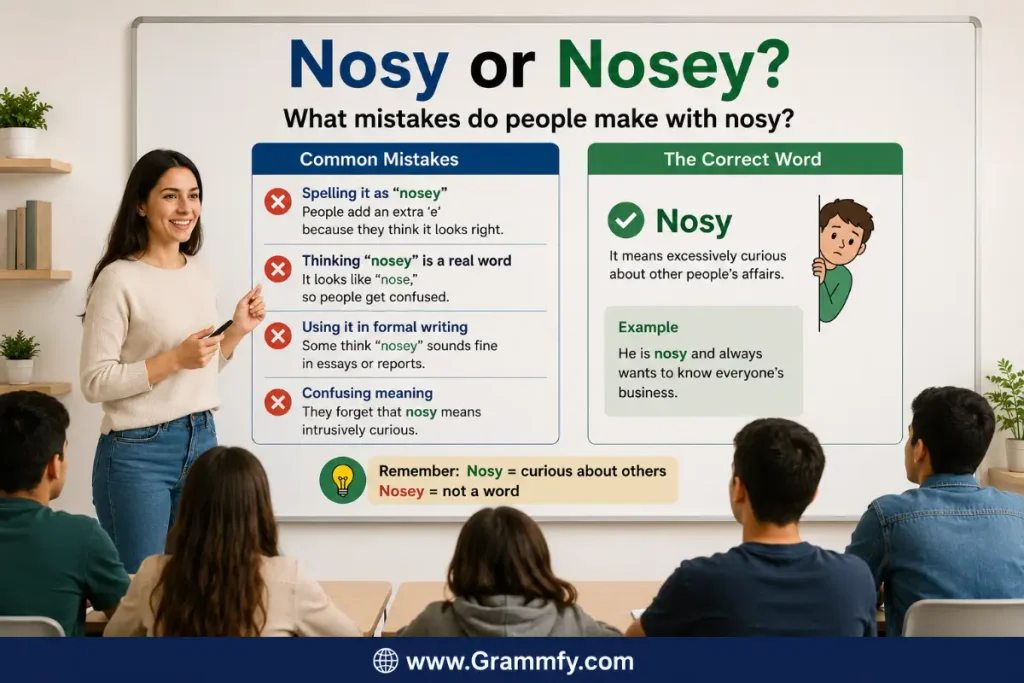
Mistake 1: Thinking nosey is always wrong
Nosey is a recognized spelling variant, especially in British English.
If you’re writing American English, nosy is usually the better choice.
Mistake 2: Thinking nosy means simply curious
The words overlap, but nosy usually carries a negative idea of crossing boundaries.
A person can be curious without being nosy.
Mistake 3: Using nosy as a professional compliment
Nosy normally isn’t positive.
If you mean someone likes learning, try:
- inquisitive
- curious
- analytical
- observant
- investigative
Mistake 4: Using intrusive when you only mean curious
Intrusive is stronger.
If someone asks one harmless question, calling them intrusive may sound unfair.
Mistake 5: Calling someone a snoop when they simply ask questions
A snoop often suggests secret searching or investigation.
For example:
He snooped through my desk.
That’s more serious than:
She asked a nosy question.
When should you not use nosy?
Avoid nosy when you’re describing healthy curiosity.
For example:
She was curious about how the computer worked.
Don’t change that to:
She was nosy about how the computer worked.
The second sentence suggests inappropriate interest.
Avoid it in professional settings when a neutral description would be better.
Instead of:
My coworker is nosy.
Write:
My coworker asked several personal questions.
This is more specific and less insulting.
Avoid it when the person is doing legitimate investigative work.
A journalist asking relevant questions isn’t necessarily nosy. A researcher asking participants about a study isn’t automatically intrusive. Context matters.
What are the antonyms of nosy?
Useful opposite ideas include:
- private
- discreet
- respectful
- reserved
- considerate
- tactful
- respectful of boundaries
- uninterested
- detached
- nonintrusive
The best opposite depends on what you mean.
- Someone who avoids personal questions may be discreet.
- A person who respects other people’s boundaries can be considerate.
- Someone who stays out of other people’s affairs is often described as hands-off.
| Nosy behavior | Opposite quality |
|---|---|
| Asking personal questions | Respecting privacy |
| Snooping | Being discreet |
| Interfering | Staying out of it |
| Prying | Being tactful |
| Invading privacy | Respecting boundaries |
How do nosy, prying, and intrusive differ?
These three words are close, but their emphasis changes.
| Word | Main idea | Strength | Example |
|---|---|---|---|
| nosy | Too interested in others’ affairs | Mild–moderate | She’s nosy about my dating life. |
| prying | Trying to discover private information | Moderate | He asked prying questions. |
| intrusive | Unwanted involvement or invasion of privacy | Strong | The questions were intrusive. |
Nosy is the most casual.
Prying often focuses on questions or attempts to discover secrets.
Intrusive is broader and more formal.
How do nosy, snoopy, and meddlesome differ?
These words also overlap, but each has a different focus.
Nosy
Interested in other people’s business.
My aunt is nosy about everyone’s relationships.
Snoopy
Secretly looking for information.
Someone was snoopy and looked through my messages.
Meddlesome
Interfering with other people’s decisions or affairs.
His meddlesome advice made the situation worse.
A person can be all three, but the behavior isn’t identical.
How do curious, inquisitive, and nosy differ?
These three words are especially easy to confuse.
Curious
Usually neutral or positive.
She was curious about the new software.
Inquisitive
Usually means eager to learn or ask questions. It can be positive, especially in education or work.
He’s an inquisitive student who asks thoughtful questions.
Nosy
Usually negative because the interest is too personal.
He’s nosy about his coworkers’ private lives.
A good rule is:
Curious = wants to know.
Inquisitive = actively asks and investigates.
Nosy = asks when it isn’t really their business.
US vs UK spelling: which one should you use?
If your audience is American, nosy is generally the safest choice.
If your audience is British, nosey is also common and may feel natural.
For a website aimed at a broad international audience, either spelling can be explained, but consistency matters.
For US-focused content, use:
nosy
You can mention:
Nosey is a common British variant.
This helps readers understand why they may see both forms.
The meaning remains essentially the same.
What about Australia and other English-speaking regions?
English spelling varies across countries, and nosey is also found outside the United States. Regional preferences can overlap, so spelling alone isn’t a perfect way to identify where a writer is from.
If you’re following a specific style guide, dictionary, publisher, school, or organization’s preferences, follow that standard.
For general American English, nosy is the safest default.
How do you pronounce nosy?
Nosy is generally pronounced like:
NOH-zee
The first part sounds like nose, followed by a sound similar to see with a voiced “z” sound.
The spelling nosey has the same pronunciation in normal use.
That makes this another example of why English spelling can be tricky: two spellings can represent essentially the same spoken word.
Is nosy rude?
Nosy can sound rude, but the effect depends heavily on context.
Compare:
You’re so nosy!
Between close friends, this may be playful.
Now compare:
My manager is nosy about my private medical appointments.
That sounds critical.
If you want to be polite, avoid labeling the person. Describe the behavior instead.
Instead of:
You’re nosy.
Try:
That’s a little personal.
Or:
I’d rather not discuss that.
This keeps the conversation calmer.
Can nosy be positive?
Usually, nosy has a negative meaning, but context can make it playful or affectionate.
For example:
My nosy little sister always wants to know what I’m doing.
The speaker may not seriously criticize the sister.
In contrast:
The reporter’s nosy behavior violated the family’s privacy.
Here, the word is clearly negative.
If you want a genuinely positive word, choose curious or inquisitive.
Quick tips for choosing the right word Nosy or Nosey
Use these rules when you’re unsure:
- Choose nosy for American English.
- Know that nosey is a common British variant.
- Use curious when the interest is neutral or positive.
- Use inquisitive when someone asks many questions in a thoughtful way.
- Use prying when someone tries to discover private information.
- Use intrusive when the behavior crosses a serious privacy boundary.
- Use snooping when someone secretly looks for information.
- Use meddling when someone interferes in another person’s affairs.
- Use busybody for a person who constantly interferes.
- Use discreet for someone who respects privacy.
- Don’t use nosy as a professional compliment.
- In formal writing, consider replacing it with a more precise term.
- In casual texts, nosy sounds natural.
- Remember that spelling and meaning are separate questions.
- When writing for Americans, default to nosy.
A quick word-choice chart
| If you mean… | Best word |
|---|---|
| Wants to learn | curious |
| Loves asking questions | inquisitive |
| Asks about private matters | nosy |
| Tries to discover secrets | prying |
| Secretly searches | snooping |
| Interferes in someone’s affairs | meddlesome |
| Crosses privacy boundaries | intrusive |
| Respectfully avoids personal questions | discreet |
| Interferes with decisions | meddling |
| Counts people | headcount |
| Investigates professionally | investigative |
The key is to describe the exact behavior rather than automatically choosing the strongest word.
A final memory trick for Nosy or Nosey
If you’re writing for an American audience, remember:
US English → nosy
If you’re reading British English, don’t be surprised by:
British English → nosey
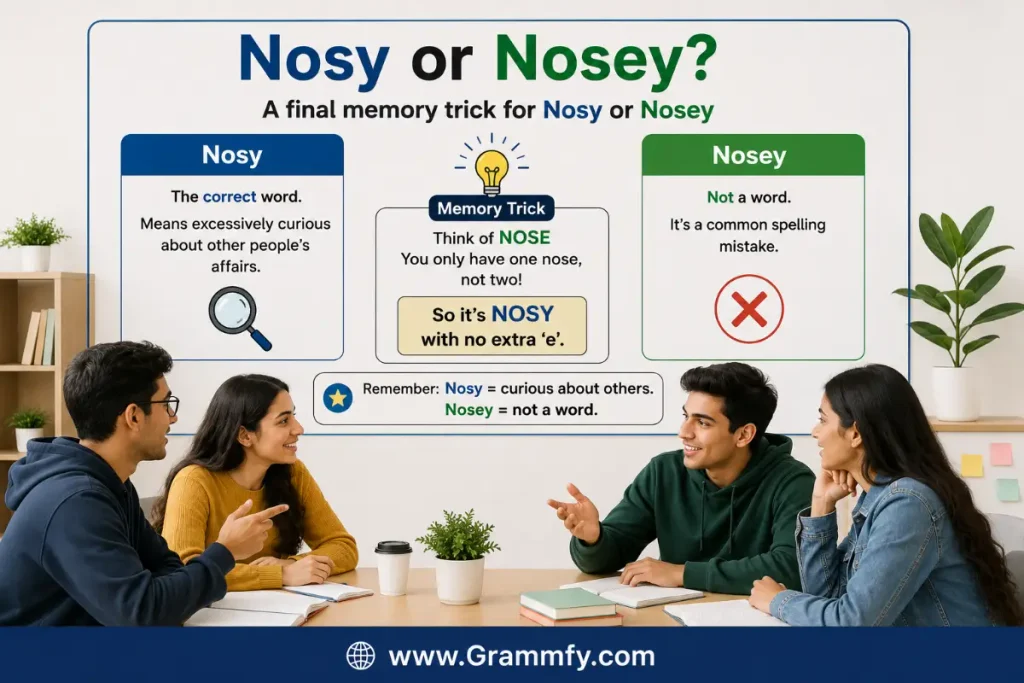
You can also connect the word to the phrase:
Stick your nose into someone’s business.
That expression makes the spelling nosey feel intuitive, but the shorter nosy spelling is the standard choice in American English.
If you need a neutral alternative, use curious.
If you need a stronger negative alternative, use intrusive or prying, depending on the situation.
The best word isn’t always the strongest one. It should match what the person actually did.
Conclusion
The easiest way to handle this spelling question is to think about your audience. Nosy or Nosey refers to the same basic idea: being too interested in other people’s private affairs. For American English, nosy is the preferred choice. Nosey is a common variant, especially in British English.
The more important issue is understanding the tone of the word. Curious can sound positive, inquisitive can describe an eager learner, prying suggests digging for private information, and intrusive is stronger and more formal. In casual conversation, nosy is perfectly natural, but in professional writing, describing the specific behavior is often more effective. When in doubt, ask whether the person is simply interested or actually crossing a boundary. That distinction will help you choose the most accurate word.
Frequently Asked Questions
Is nosy or nosey the correct spelling?
Nosy is the preferred spelling in American English, while nosey is a common British English variant. Both refer to someone who is overly interested in other people’s private affairs.
Is nosey a British spelling?
Yes, nosey is commonly used in British English. American English generally prefers nosy, although both spellings can be understood across English-speaking regions.
What’s another way to say nosy?
Good alternatives include curious, inquisitive, prying, intrusive, snooping, meddlesome, and busybody. Choose based on whether you want a neutral, casual, or strongly negative tone.
Is nosy a rude word?
Nosy can sound rude because it usually suggests that someone is crossing a privacy boundary. However, friends and family members often use it playfully.
What is the difference between curious and nosy?
Curious usually describes a healthy desire to learn, while nosy suggests unwanted interest in someone’s private affairs. The main difference is whether the person’s curiosity respects boundaries.
Can I use nosy in formal writing?
You can use nosy in formal writing, but a more precise word may be better. Depending on the situation, terms such as intrusive, prying, indiscreet, or meddlesome may communicate the exact meaning more clearly.
Why are nosy and nosey both spelled this way?
Nosy and nosey are spelling variants of the same adjective. The word is associated with the idea of putting one’s nose into other people’s business, which helps explain the longer spelling.
