

Have you ever typed a quick email, essay, resume, or text and stopped at the word Tweek vs Tweak? They look almost the same, and they sound the same when spoken. That makes the spelling easy to mix up, especially when you’re typing quickly.
The good news is that the choice is simple in standard English. Tweak is the correct spelling when you mean to make a small change, adjustment, or improvement. Cambridge Dictionary lists tweak as both a verb and a noun, with meanings connected to making slight changes and pulling or twisting something.
- Quick Answer: Tweak is the standard English spelling. It means to make a small adjustment or improvement. Tweek is usually a misspelling when this is the intended meaning.
This guide explains why people confuse these spellings, where tweak comes from, how to use it as a verb and noun, and which alternatives work in different situations. You’ll also see examples for school, work, technology, writing, texting, and everyday conversation.
If you’re working on your grammar, you may also find Simpler vs More Simple helpful.
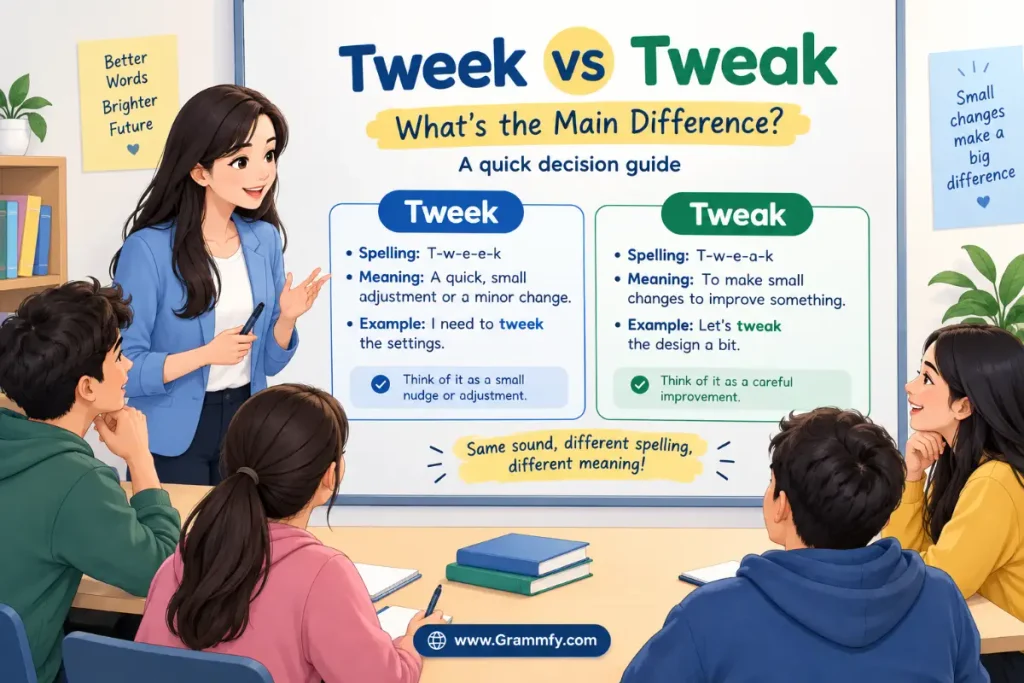
Tweek vs Tweak: What’s the Main Difference?
The main difference is spelling and standard usage.
| Word | Standard English? | Main meaning | Example |
|---|---|---|---|
| Tweak | Yes | Make a small change or adjustment | I need to tweak the design. |
| Tweek | Usually no | Usually a misspelling of tweak | I need to tweak the design. |
If you’re writing a normal English sentence about making a small change, choose tweak.
For example:
- Correct: I need to tweak my resume.
- Incorrect: I need to tweek my resume.
The same rule applies to technology:
- Correct: She tweaked the settings.
- Incorrect: She tweeked the settings.
And it applies to writing:
- Correct: Let’s tweak the final paragraph.
- Incorrect: Let’s tweek the final paragraph.
The spelling tweak is used in both American and British English. There isn’t a standard American version spelled tweek for this meaning. Cambridge gives the same pronunciation for the word in US and UK English.
What Does Tweak Mean in Plain English?
Tweak usually means to make a small change to something.
The change is normally limited. You’re not completely replacing or rebuilding something. You’re adjusting one part to make it work better, look better, or fit a situation more closely.
For example:
- I tweaked my essay before submitting it.
This suggests that the essay was already mostly finished. The writer made a few small changes.
Another example:
- We need to tweak the website layout.
This doesn’t usually mean creating a new website. It means changing a few parts of the existing layout.
Cambridge defines tweak as changing something slightly, especially to make it more correct, effective, or suitable.
Tweak can also mean pull or twist
The word has another meaning.
As a verb, tweak can mean to pull or twist something quickly or suddenly. This meaning is more physical.
For example:
- He tweaked his brother’s ear.
You might also hear:
- She tweaked a strand of hair into place.
This meaning is different from the modern everyday idea of making a small adjustment, but both meanings are legitimate. Cambridge and Merriam-Webster both record the physical sense.
Where Did the Word Tweak Come From?
The history of tweak helps explain why the word originally had a physical meaning.
Merriam-Webster traces the verb to Middle English twikken, meaning to pull sharply, and further connects it with Old English twiccian, meaning to pluck. The modern word was first recorded in the early 1600s.
Over time, the idea of making a small pull or adjustment developed into the modern figurative meaning of making a small change.
Think about turning a small control:
- You don’t move it all the way.
- You move it slightly.
- The small movement changes the result.
That is the basic idea behind tweak today.
You can tweak:
- a sentence
- a recipe
- a website
- a design
- a schedule
- software settings
- a plan
- a presentation
- a photo
- a resume
- a business strategy
- a machine
The word is especially useful when the change is small rather than major.
Why Do People Write Tweek Instead of Tweak?
The most common reason is pronunciation.
Tweak is pronounced with a long “ee” sound. Cambridge gives the pronunciation as /twiːk/ in both US and UK English.
That sound can make people expect the spelling tweek.
Consider these familiar words:
- week
- seek
- peek
- speak
- sleek
These words use ee or another spelling pattern for a long “ee” sound. So when someone hears tweak, they may naturally guess tweek.
But English spelling doesn’t always match pronunciation in a predictable way.
Compare:
- tweak
- week
- speak
- break
- steak
They contain similar vowel letters but don’t all follow the same sound pattern.
So the pronunciation isn’t a reliable way to remember the spelling.
A simple spelling trick
One useful memory trick is to notice that tweak contains weak:
t + weak = tweak
This isn’t the historical origin of the word. It’s simply a spelling aid.
If you need to remember the word while writing, think:
Tweak has “weak” inside it.
That can help you avoid adding an unnecessary second “e.”
Is Tweek a Correct English Word?
For ordinary standard English, tweek should not be used as the spelling of the verb meaning “make a small adjustment.”
If you write:
- I need to tweek the settings.
Most readers will understand what you mean, but the spelling is normally considered an error.
Write:
- I need to tweak the settings.
There can be special cases where Tweek appears as a name, title, character name, username, or specialized term. A proper name can have a spelling that doesn’t follow ordinary English spelling rules.
For example, Tweek Tweak is the name of a fictional character in South Park. That proper name doesn’t make tweek the standard spelling of the everyday English word.
So context matters.
When should you use Tweek?
Use Tweek only when it is intentionally part of a proper name, title, brand, username, or another specific reference.
For normal English writing, use tweak.
This distinction is important because a word can appear online without being a standard spelling. Search results, usernames, character names, and informal posts can contain unusual spellings.
For a school assignment, resume, email, article, report, or professional message, tweak is the safe choice.
Tweak as a Verb
Tweak is commonly used as a verb.
As a verb, it means to make a small adjustment or improvement. It can also describe a small pulling or twisting action.
Tweak means “adjust slightly”
Examples:
- I need to tweak the headline.
- She tweaked the recipe.
- We tweaked the schedule.
- The developer tweaked the code.
He tweaked the settings on his phone.
In each sentence, the change is relatively small.
Compare:
We redesigned the entire website.
with:
We tweaked the website.
The first sentence suggests a major change. The second suggests minor adjustments.
Common verb forms of tweak
| Verb form | Example |
|---|---|
| Base form: tweak | I need to tweak the plan. |
| Third-person singular: tweaks | She tweaks the settings regularly. |
| Past tense: tweaked | We tweaked the design yesterday. |
| Present participle: tweaking | He is tweaking the code. |
| Past participle: tweaked | The settings have been tweaked. |
The past tense is tweaked, not tweeked.
The present participle is tweaking, not tweeking.
This is another common spelling point to remember.
Tweak as a Noun
Tweak can also be a noun.
As a noun, it means a small change, adjustment, or improvement. Cambridge lists this noun meaning alongside its verb meanings.
Examples:
- The website needs a few tweaks.
- I made a small tweak to the paragraph.
- The designer suggested several tweaks.
- One final tweak made the presentation clearer.
Here, tweak refers to the change itself.
Compare:
Verb:
I need to tweak the design.
Noun:
The design needs a small tweak.
The meaning is closely related, but the grammar is different.
Tweak vs Adjust: What’s Different?
Tweak and adjust are close in meaning, but they don’t always create the same feeling.
| Tweak | Adjust |
|---|---|
| Usually suggests a small change | Can describe a small or larger change |
| Often sounds informal | More neutral |
| Common in technology and everyday speech | Very common in technical and professional writing |
| Often suggests improvement or fine-tuning | Focuses on changing something to fit a need |
Compare:
I tweaked the brightness.
I adjusted the brightness.
Both sentences are correct.
Tweaked can sound more casual and may suggest a minor improvement.
Adjusted is more neutral and works well when simply changing something to a suitable level.
For a technical manual, adjust may sound more precise.
For casual conversation, tweak can sound natural.
Tweak vs Modify: What’s the Difference?
Modify usually sounds more formal than tweak.
| Tweak | Modify |
|---|---|
| Small, minor change | Change to part or form of something |
| Informal to neutral | Neutral to formal |
| Often suggests fine-tuning | Doesn’t necessarily suggest a tiny change |
| Common in conversation | Common in academic and technical writing |
For example:
I tweaked my introduction.
This sounds natural and conversational.
I modified my introduction.
This sounds more formal.
The second sentence doesn’t necessarily tell us how large the change was.
So if the size of the change matters, tweak often gives more information.
Tweak vs Revise: What’s the Difference?
Revise is especially common when discussing writing, schoolwork, reports, or documents.
- I revised my essay.
This could mean that you changed several parts of the essay.
- I tweaked my essay.
This suggests smaller adjustments.
A useful scale is:
tweak → revise → rewrite
For example:
- Tweak: Change a few words.
- Revise: Improve several sections.
- Rewrite: Create much of the text again.
These aren’t strict rules, but they help show the difference in strength.
Master Synonym List for Tweak
There isn’t one perfect replacement for tweak in every situation. The best alternative depends on how large the change is and how formal your writing needs to sound.
The table below gives more than 20 useful alternatives and related expressions.
| Word | Meaning | Tone | Example |
|---|---|---|---|
| Adjust | Change slightly to fit a need | Neutral | Adjust the settings. |
| Alter | Change something | Neutral/Formal | We altered the schedule. |
| Revise | Improve by changing | Academic | Revise your essay. |
| Edit | Correct or improve text | Neutral | Edit the paragraph. |
| Refine | Improve small details | Formal | Refine the final draft. |
| Improve | Make something better | Neutral | Improve the layout. |
| Change | Make something different | Neutral | Change the font size. |
| Adapt | Change for a new purpose | Neutral | Adapt the plan. |
| Update | Make something current | Neutral | Update the information. |
| Correct | Fix an error | Neutral | Correct the spelling. |
| Rework | Change and improve | Neutral | Rework the introduction. |
| Polish | Improve the final details | Informal/Neutral | Polish your presentation. |
| Reshape | Change the form or structure | Neutral | Reshape the argument. |
| Recast | Present in a different form | Formal | Recast the sentence. |
| Redraft | Write a new version | Formal | Redraft the letter. |
| Rearrange | Change the order | Neutral | Rearrange the sections. |
| Realign | Bring into better agreement | Formal | Realign the strategy. |
| Calibrate | Adjust precisely | Technical | Calibrate the instrument. |
| Fine-adjust | Make precise small changes | Technical | Fine-adjust the controls. |
| Trim | Remove a small amount | Informal | Trim the final paragraph. |
| Simplify | Make easier or less complex | Neutral | Simplify the instructions. |
| Touch up | Make small improvements | Informal | Touch up the image. |
| Polish up | Improve the final details | Informal | Polish up the report. |
These words overlap with tweak, but they are not interchangeable in every sentence.
For example, correct usually means fixing an error, while tweak usually suggests a small adjustment whether or not something was actually wrong.
Synonyms by Intensity: Mild to Strong
The size of a change can help you choose the right word.
Very mild changes
Use these when only tiny adjustments are needed:
- tweak
- touch up
- fine-tune
- polish
- trim
- adjust
Example:
I just need to tweak the wording.
Moderate changes
Use these when several parts may need changing:
- edit
- revise
- modify
- rework
- adapt
- alter
Example:
We need to revise the marketing plan.
Stronger changes
Use these when the structure or basic form will change:
- redesign
- restructure
- transform
- replace
- rebuild
- rewrite
Example:
The company decided to redesign the entire website.
This scale prevents a common problem: using tweak for a change that is actually major.
If you’re replacing almost everything, calling it a “tweak” may make the description misleading.
Synonyms by Part of Speech
Different situations call for different forms.
Verbs
Useful verb alternatives include:
- adjust
- modify
- alter
- revise
- edit
- refine
- improve
- adapt
- update
- rework
- fine-tune
- polish
Example:
I need to refine the introduction.
Nouns
Useful noun alternatives include:
- adjustment
- modification
- revision
- edit
- improvement
- change
- refinement
- alteration
- update
- correction
- adjustment
Example:
The report needs a small adjustment.
Phrasal verbs and informal expressions
For casual speech, you may also hear:
- touch up
- clean up
- fix up
- work on
- play with
- tinker with
Example:
I’ll clean up the formatting before I send it.
These expressions are usually less suitable for very formal documents.
Tweak vs Tweak? Common Spelling Forms to Avoid
Once you know the correct word, it’s useful to recognize common incorrect forms.
❌ Tweek
Usually incorrect when you mean “make a small adjustment.”
❌ Tweeked
Usually incorrect as the past tense.
Use:
tweaked
❌ Tweeking
Usually incorrect as the -ing form.
Use:
tweaking
❌ Tweeking
This is another common misspelling.
Use:
tweaking
A simple pattern helps:
tweak → tweaked → tweaking
The spelling changes because of normal English spelling rules, but the base word remains tweak.
Is Tweak Formal or Informal?
Tweak is generally neutral to informal.
It’s common in:
- conversation
- emails
- technology
- business
- design
- writing
- marketing
- software
- everyday instructions
It can appear in professional writing, too. Cambridge’s Business English Dictionary uses tweak for making small changes to finish or improve something.
Still, there are situations where a more formal word may be better.
For example:
Casual:
We need to tweak the proposal.
More formal:
We need to revise the proposal.
Both can be correct. The second simply has a more formal tone.
Is Tweak Good for a Resume?
Tweak can work in a casual conversation about your resume, but more formal alternatives may be better on the resume itself.
For example:
I tweaked the company website.
A professional resume might say:
Improved the company website’s layout and usability.
Or:
Optimized the website layout to improve user experience.
The problem isn’t that tweak is grammatically wrong. The issue is that resume writing often benefits from precise, strong verbs.
Better choices include:
- improved
- optimized
- revised
- redesigned
- modified
- streamlined
- enhanced
Use tweak when talking about the process casually, but choose a more specific action verb when describing an achievement.
Best Word for an Essay
For an academic essay, revise, edit, modify, and refine may be better choices depending on the meaning.
For example:
I tweaked my conclusion.
This is understandable and not grammatically wrong.
But:
I revised my conclusion.
sounds more academic.
If you changed only a few words:
I edited the conclusion for clarity.
If you improved the wording:
I refined the conclusion.
Choose the word that accurately describes the amount and type of work.
Best Word for Texting
Tweak works very well in texting.
You can say:
I’ll tweak it and send it again.
Let me tweak the message first.
I just need to tweak a few things.
It’s short, natural, and easy to understand.
In casual texting, alternatives such as fix, change, or edit also work.
For example:
I’ll fix it.
I’ll change that part.
Tweak is useful when you want to show that the change is small.
Best Word for Email
Tweak is acceptable in many professional emails, especially when discussing a minor change.
For example:
I made a few tweaks to the document.
This sounds natural in a workplace.
If the email is highly formal, you could use:
I made several minor revisions to the document.
The choice depends on the relationship, industry, and purpose of the message.
Casual professional email
I’ve made a few tweaks to the presentation. Please take a look when you have time.
More formal email
I’ve made several minor revisions to the presentation. Please review the updated version at your convenience.
Both communicate the same basic idea.
Best Word for Speaking
Tweak is especially natural in everyday speech.
You might say:
We just need to tweak the plan.
Can you tweak the settings?
I’ll tweak the recipe next time.
It sounds less formal than modify or alter, which is why it fits casual conversation well.
If you’re speaking in a formal presentation, however, you may prefer adjust, revise, or modify.
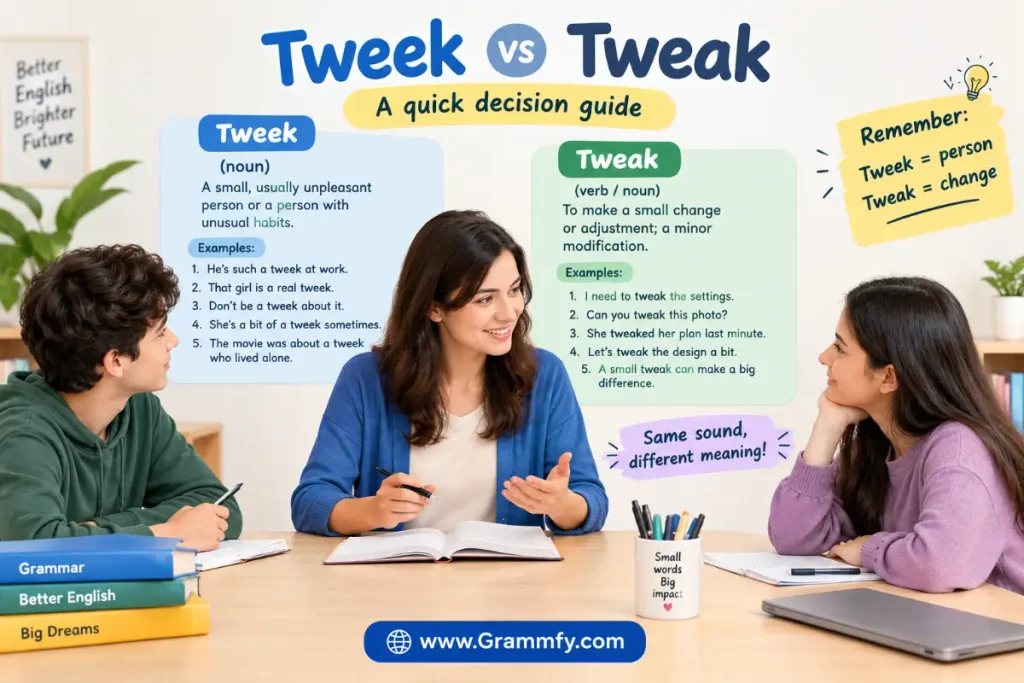
15+ Original Example Sentences
Here are practical examples showing how tweak works in different situations.
Writing
- I need to tweak the first paragraph before publishing the article.
- She tweaked the headline to make it clearer.
- We made a few tweaks to the final draft.
School
- I tweaked my essay after reading the teacher’s comments.
- He tweaked his answer to make the explanation more precise.
- The student made a small tweak to the conclusion.
Technology
- I tweaked the brightness settings on my laptop.
- The developer tweaked the code to improve performance.
- Try tweaking the audio settings before starting the video.
Business
- The team tweaked its marketing strategy after reviewing the results.
- We need to tweak the schedule before the meeting.
- The company made several small tweaks to its website.
Food
- She tweaked the recipe by adding less sugar.
- I might tweak the sauce next time.
Design
- The designer tweaked the colors before sending the final version.
- We made a few tweaks to the logo.
Everyday life
- I tweaked my workout schedule to fit my new routine.
- He tweaked the chair until it felt comfortable.
- She tweaked the settings on the television.
- Let’s tweak the plan instead of starting over.
These examples show the main idea clearly: a tweak is usually a relatively small change.
Tweak vs Change: What’s the Difference?
Change is much broader than tweak.
You can use change for almost any difference, large or small.
I changed the website.
This doesn’t tell us whether you changed one button or rebuilt the entire site.
I tweaked the website.
This strongly suggests a smaller adjustment.
So:
change = broad
tweak = small adjustment
This is why tweak can be more useful when you want to describe the size of a change.
Tweak vs Fix: What’s the Difference?
Fix usually suggests that something is wrong and needs correction.
- I fixed the broken link.
The link had a problem.
Tweak doesn’t necessarily mean something is broken.
- I tweaked the layout.
The layout may already have been fine. The person simply wanted to improve it.
So:
- Fix = correct a problem.
- Tweak = make a small adjustment or improvement.
Sometimes both words can work.
I tweaked the settings.
I fixed the settings.
The first suggests minor adjustment. The second suggests the settings were wrong or not working correctly.
Tweak vs Fine-Tune: What’s the Difference?
Fine-tune is one of the closest alternatives to tweak.
Both can describe small adjustments intended to improve performance or results.
However, fine-tune often suggests careful adjustment toward an ideal result.
Compare:
We tweaked the system.
This simply says that we made some small changes.
We fine-tuned the system.
This suggests careful, precise adjustments.
Fine-tune is especially common with:
- performance
- machinery
- software
- strategies
- skills
- processes
- systems
Example:
The engineer fine-tuned the machine.
The focus is on precision.
When Should You NOT Use Tweak?
There are times when tweak isn’t the best word.
Don’t use it for a major transformation
If something has been completely rebuilt, tweak may sound too weak.
Instead of:
We tweaked the entire website.
consider:
We redesigned the entire website.
Don’t use it when correcting a serious error
If a document contains many major problems, revise, rewrite, or correct may be more accurate.
Instead of:
I tweaked my essay after finding many errors.
you might say:
I revised my essay after finding several errors.
Don’t use it when the exact action matters more
In technical or scientific writing, a specific verb may communicate more clearly.
For example:
The technician calibrated the instrument.
is more precise than:
The technician tweaked the instrument.
Precision matters when the exact action is important.
Common Mistakes with Tweak
Mistake 1: Writing Tweek
❌ I need to tweek the design.
✅ I need to tweak the design.
Mistake 2: Writing tweeked
❌ She tweeked the settings.
✅ She tweaked the settings.
Mistake 3: Writing tweeking
❌ He is tweeking the code.
✅ He is tweaking the code.
Mistake 4: Using tweak for a huge change
❌ We tweaked the entire business model from scratch.
Better:
✅ We redesigned the business model from scratch.
Mistake 5: Assuming tweak only relates to technology
Tweak is not limited to computers.
You can tweak:
- a recipe
- a sentence
- a schedule
- a hairstyle
- a plan
- a design
- a strategy
- a machine
- a presentation
The word has a broad range of uses.
American English vs British English
The standard spelling is tweak in both American and British English.
| Feature | American English | British English |
|---|---|---|
| Standard spelling | tweak | tweak |
| Pronunciation | /twiːk/ | /twiːk/ |
| Verb | tweak | tweak |
| Past tense | tweaked | tweaked |
| -ing form | tweaking | tweaking |
| Noun | tweak | tweak |
Cambridge lists the same standard spelling and pronunciation for US and UK English.
So this is not a case like:
- color / colour
- center / centre
- organize / organise
There is no standard US/UK spelling difference between tweak and tweek.
How to Remember Tweak
Try these simple memory tricks.
Trick 1: Think “t + weak”
The spelling is:
t + weak = tweak
Again, this is a memory trick, not the historical origin of the word.
Trick 2: Connect it with small changes
Think:
A tweak is a small change.
Both ideas are short and easy to remember.
Trick 3: Remember the three forms
Keep this pattern in mind:
tweak → tweaked → tweaking
Don’t add an extra e.
Trick 4: Picture a small dial
Imagine turning a volume dial just a little.
That’s a tweak.
You’re not replacing the whole device. You’re making a small adjustment.
Quick Comparison Table about “Tweek vs Tweak”
| Question | Answer |
|---|---|
| Which spelling is standard? | Tweak |
| Is tweek normally correct? | No |
| What does tweak mean? | Make a small adjustment or improvement |
| Can tweak be a noun? | Yes |
| Can tweak be a verb? | Yes |
| What is the past tense? | Tweaked |
| What is the -ing form? | Tweaking |
| Is tweak used in US English? | Yes |
| Is tweak used in UK English? | Yes |
| Is tweak formal? | Neutral to informal |
| Is tweak useful in business? | Yes |
| Can tweak describe physical movement? | Yes |
| Is tweak only used for computers? | No |
Quick Tips for Choosing the Right Word “Tweek vs Tweak”
When you’re unsure, ask yourself what kind of change you’re describing.
Choose tweak when:
- The change is small.
- You’re making an improvement.
- You’re adjusting details.
- The original thing mostly stays the same.
- You’re speaking casually or writing in a neutral style.
Example:
I just need to tweak a few details.
Choose adjust when:
- You want a neutral word.
- Something needs to be moved to a suitable level or position.
- You’re writing technical or professional instructions.
Example:
Adjust the temperature to 70 degrees.
Choose revise when:
- You’re working on an essay, report, plan, or document.
- Several changes may be involved.
- The writing needs improvement.
Example:
Please revise your essay before submitting it.
Choose modify when:
- You want a more formal word.
- You’re describing a change to a design, system, process, or object.
Example:
The engineer modified the design.
Choose fix when:
- Something is wrong.
- You are correcting a problem.
Example:
I fixed the broken link.
Choose rewrite when:
- A large part of the original text must be written again.
Example:
I had to rewrite the introduction.
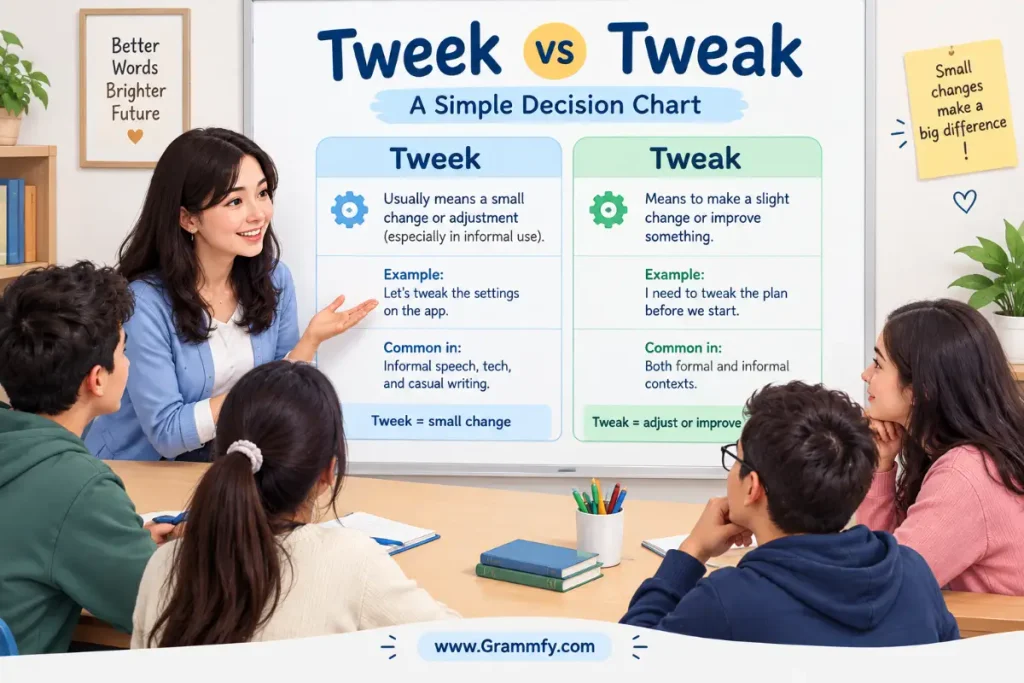
A Simple Decision Chart
When deciding between these words, use this quick guide:
Is the change small?
→ Yes → Tweak
Is something being moved to a better level or position?
→ Yes → Adjust
Is a document being improved?
→ Yes → Revise
Is something being changed in a formal or technical way?
→ Yes → Modify
Is there a problem that needs correcting?
→ Yes → Fix
Does most of the original text need to be written again?
→ Yes → Rewrite
This approach is more useful than trying to memorize dozens of definitions.
Antonyms of Tweak
The exact opposite depends on the context, but some useful contrasting words include:
- leave unchanged
- preserve
- maintain
- keep
- retain
- ignore
- abandon
For example:
We decided to leave the design unchanged.
This contrasts with:
We decided to tweak the design.
If the opposite idea is a major change rather than a small change, words such as transform, rebuild, or replace may provide a stronger contrast.
Why Correct Spelling Matters
A single extra letter can make your writing look less polished.
This matters most in:
- school assignments
- resumes
- job applications
- professional emails
- website content
- reports
- presentations
A reader will usually understand tweek, but that doesn’t make it the correct spelling for the ordinary word.
Compare:
Please tweek the paragraph.
with:
Please tweak the paragraph.
The second version is the standard form and should be your choice.
Correct spelling also helps search engines, spell-checkers, editors, and readers understand exactly which word you intend.
Conclusion
When choosing between Tweek vs Tweak, remember that tweak is the standard spelling for a small change or adjustment. It can be used as both a verb and a noun in everyday, professional, and technical writing. Tweek is usually a spelling mistake, although it may appear as a name or special term. If you’re writing an email, essay, resume, or website content, tweak is the safe and correct choice. When the change is larger, words such as revise, modify, redesign, or rewrite may be more accurate. A simple way to remember the spelling is t + weak = tweak.
Frequently Asked Questions
Is Tweek or Tweak the correct spelling?
Tweak is the correct standard spelling when you mean a small adjustment or improvement. Tweek is usually a misspelling of this word.
What does tweak mean?
Tweak means to make a small change or adjustment, often to improve something. It can also mean to pull or twist something quickly.
Is Tweek a real word?
Tweek is not the standard spelling of the ordinary English word meaning “make a small adjustment.” It can appear as a proper name or in specialized contexts, so context matters.
What’s another way to say tweak?
Adjust, modify, revise, refine, edit, alter, and fine-tune are useful alternatives. The best choice depends on the size and purpose of the change.
Can I use tweak in formal writing?
Yes, you can use tweak in professional and formal contexts, but a more precise word may sometimes be better. For example, revise, modify, or adjust may fit a highly formal document.
What is the past tense of tweak?
The past tense is tweaked. For example: “She tweaked the settings before the meeting.”
Why is tweak spelled with “ea” instead of “ee”?
The spelling comes from the word’s history and does not simply follow its pronunciation. English has many words where the spelling of a long vowel sound varies, so pronunciation alone isn’t a reliable spelling guide.
