
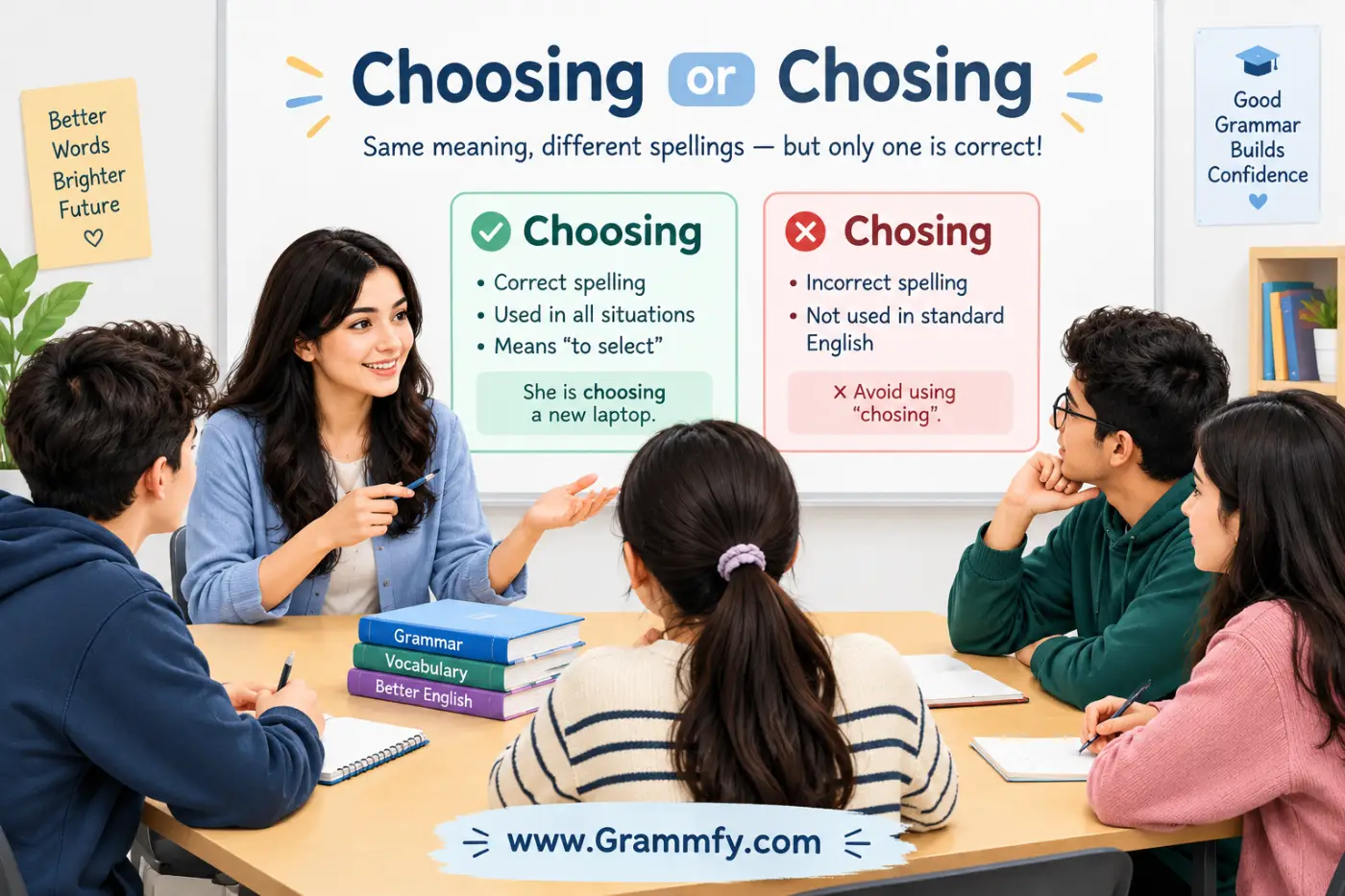
Writing an email, finishing an essay, or updating your resume can make you stop over a simple word: choosing. You may know exactly what you want to say, but then you wonder whether the correct spelling is choosing or chosing. This is a common spelling question because the word choose changes when you add -ing.
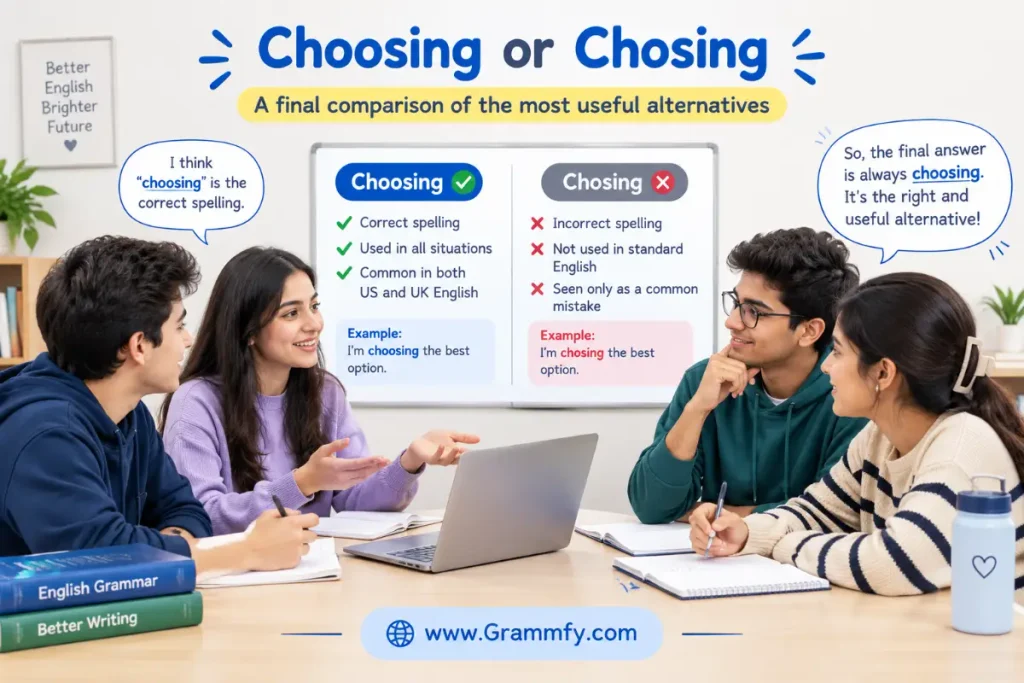
Choosing is the correct spelling. “Chosing” is incorrect.
In this guide, you’ll learn why choosing is spelled this way, where the word comes from, which synonyms fit different situations, and how to avoid common mistakes. You’ll also see examples for resumes, essays, emails, texts, and everyday speech.
For more help with English spelling, explore Tweek vs Tweak.
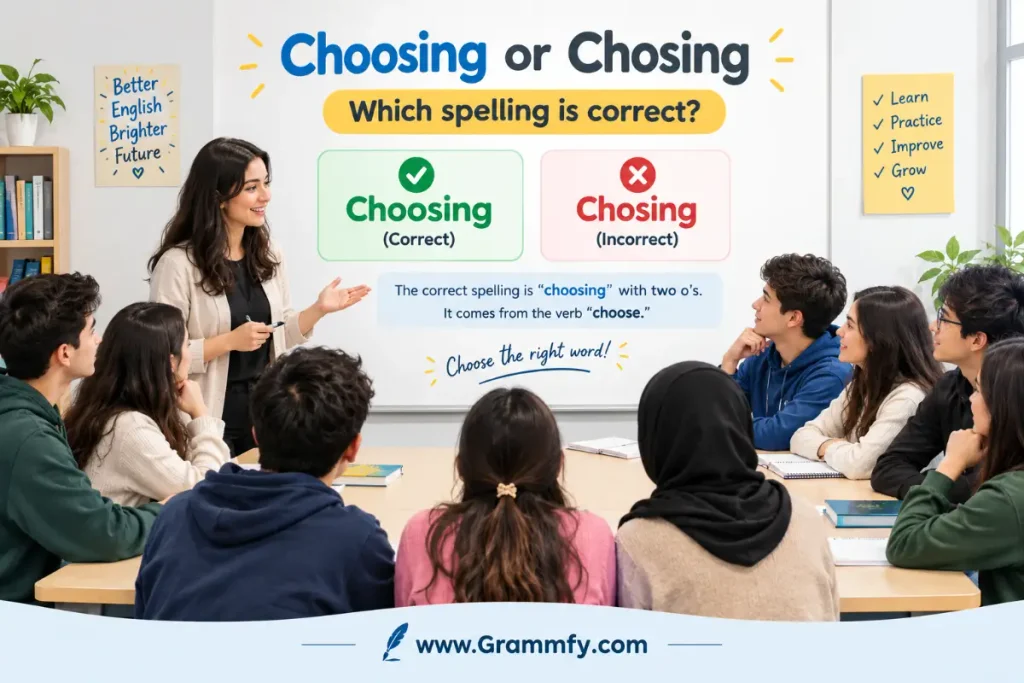
Choosing or Chosing: Which spelling is correct?
The correct form is choosing.
The word comes from the verb choose. When -ing is added, the final e is not removed because doing so would create an incorrect spelling. The correct form keeps the oo sound and becomes choosing.
| Spelling | Correct? | Example |
|---|---|---|
| choosing | Yes | I’m choosing a new laptop. |
| chosing | No | This spelling is incorrect. |
| chooseing | No | The extra e is incorrect. |
| choosed | No | Use chose or chosen, depending on the sentence. |
A useful way to remember it is:
choose → choosing
Not:
choose → chosing
Why is “choosing” spelled with two o’s?
The base word is choose, which contains oo. When -ing is added, the spelling becomes choosing:
- choose
- choosing
- chooser
- chosen
- chose
The oo stays in the word.
This is different from verbs such as make, which becomes making. The spelling pattern depends on the word and its pronunciation.
Where does the word “choosing” come from?
Choosing is the present participle of choose. The verb choose has a long history in English and is related to older Germanic words meaning to select, pick, or decide.
Modern English uses choose when someone selects one person, thing, action, or possibility from several options.
For example:
- I choose the blue shirt.
- She chooses the healthier option.
- We chose the restaurant yesterday.
- They have chosen a new leader.
- He is choosing a career path.
The form choosing shows an action that is happening now or continuing around a particular time.
For example:
She is choosing a dress for the party.
Here, choosing tells us what she is doing.
What does “choosing” mean in plain English?
Choosing means selecting one thing, person, action, or option from two or more possibilities.
It can describe a small decision, such as choosing lunch, or a major decision, such as choosing a career.
Choosing can mean selecting
I’m choosing the red notebook.
The person is selecting the red notebook.
Choosing can mean deciding
We’re choosing where to go on vacation.
The people are making a decision.
Choosing can mean preferring one option
She is choosing tea instead of coffee.
She is selecting tea because it is her preferred option.
Choosing can mean accepting one possibility
He is choosing to study tonight.
He has decided to study rather than do something else.
What are the best synonyms for choosing?
The best synonym depends on the situation. Some words are simple and natural, while others sound formal, technical, casual, or playful.
Here is a broad list of useful alternatives.
| Word | Meaning | Tone | Example |
|---|---|---|---|
| Selecting | Picking one option | Neutral/Formal | She is selecting a course. |
| Picking | Taking one from several choices | Everyday | I’m picking a movie. |
| Deciding | Making a choice | Everyday | We’re deciding what to eat. |
| Opting | Choosing one possibility | Neutral | He’s opting for online classes. |
| Preferring | Liking one option more | Neutral | She prefers tea. |
| Electing | Choosing someone for a position | Formal | Members are electing a chairperson. |
| Determining | Establishing a decision or result | Formal | The team is determining the best approach. |
| Settling on | Finally selecting | Everyday | We settled on a new design. |
| Going with | Selecting informally | Casual | I’ll go with the blue one. |
| Taking | Accepting one option | Everyday | I’ll take the smaller size. |
| Accepting | Agreeing to use or receive something | Neutral | She accepted the offer. |
| Adopting | Selecting and using an idea or method | Formal | The school is adopting a new policy. |
| Designating | Officially choosing for a purpose | Formal | The city is designating a new zone. |
| Favoring | Showing support for one option | Formal/Neutral | The committee is favoring the proposal. |
| Narrowing down | Reducing the number of options | Everyday | We’re narrowing down the choices. |
| Weighing | Comparing choices carefully | Neutral | She’s weighing her options. |
| Considering | Thinking about an option | Neutral | I’m considering a new job. |
| Exploring | Looking at possible choices | Neutral | They’re exploring several careers. |
| Grabbing | Taking an option quickly | Casual | I’ll grab the first available seat. |
| Settling for | Accepting something less desirable | Neutral | He settled for a smaller room. |
| Picking out | Selecting a particular item | Everyday | He picked out a gift. |
Not every synonym can replace choosing in every sentence. Meaning, grammar, and tone matter.
Choosing synonyms by intensity: mild to strong
Some alternatives describe a simple selection. Others suggest a firm decision.
Mild choice
These words work when the decision is small or casual:
- considering
- exploring
- weighing
- looking at
- thinking about
Example:
I’m considering several colleges.
The speaker hasn’t made a final decision.
Moderate choice
These words suggest that a person is actively selecting something:
- choosing
- picking
- selecting
- opting for
- going with
- settling on
Example:
We settled on the smaller apartment.
The decision is mostly complete.
Strong choice
These expressions suggest a firm commitment:
- deciding
- committing to
- adopting
- accepting
- electing
Example:
The company is committing to a five-year plan.
This sounds much stronger than simply considering a plan.
What part of speech is “choosing”?
Choosing can work in more than one grammatical role.
Choosing as a present participle
It can appear with a form of be to create a continuous verb tense.
I am choosing a new phone.
They are choosing their team members.
In these sentences, choosing describes an action in progress.
Choosing as a gerund
It can also function like a noun.
Choosing a college can be difficult.
Here, choosing a college is the subject of the sentence.
Another example:
Choosing carefully can save money.
The word describes an activity rather than simply an action happening at one specific moment.
Choosing in a phrase
You may also see it after prepositions or other structures.
She is interested in choosing a flexible schedule.
They talked about choosing a different route.
The grammar changes around the word, but the spelling remains choosing.
Is “choosing” different in US and UK English?
No. Choosing is the standard spelling in both American and British English.
The spelling does not change between:
- US English
- UK English
- Canadian English
- Australian English
The main differences may appear in vocabulary or style around the word.
For example, British English sometimes uses plump for as an informal expression for making a choice, while American English is more likely to use go with or pick.
Examples
US-style casual wording:
I’ll go with the black jacket.
Common in both US and UK English:
I’ll choose the black jacket.
British informal possibility:
I’ll plump for the black jacket.
For clear international writing, choosing, selecting, and deciding are safe choices.
What is the best word for a resume?
On a resume, choosing is correct, but a more specific professional verb may sound stronger.
Depending on the situation, consider:
- selecting
- evaluating
- identifying
- determining
- adopting
- implementing
- prioritizing
- deciding
Example
Less specific:
Choosing suitable software for the team.
More professional:
Selected software based on team requirements and project goals.
The second version gives the action a clearer professional purpose.
When should you use “choosing” on a resume?
Use it when the act of making a choice is important to the achievement.
For example:
Choosing cost-effective suppliers helped reduce annual expenses.
However, if you’re describing your own job duties, an action verb such as selected, evaluated, or recommended may be more direct.
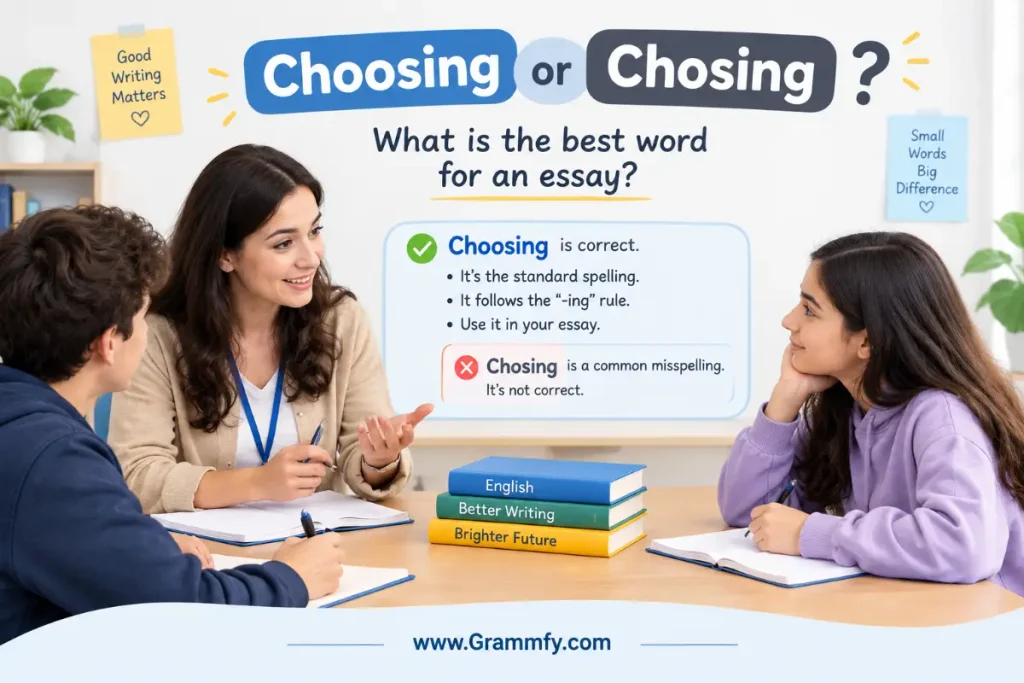
What is the best word for an essay?
Choosing works well in essays, especially when discussing decisions, behavior, literature, education, or personal responsibility.
Examples:
Choosing the right evidence can make an argument stronger.
The character’s choosing to leave changes the direction of the story.
For formal essays, you can sometimes use:
- selecting
- deciding
- opting for
- determining
- considering
- evaluating
Don’t replace choosing just to make your writing sound formal. A simple word is often clearer.
What is the best word for texting?
In texts, choosing, picking, and going with sound natural.
Examples:
What are you choosing?
I’m picking pizza.
I’ll go with the blue one.
Text messages usually don’t need formal vocabulary. Selecting may sound too formal in a casual conversation unless you’re joking.
What is the best word for an email?
The best choice depends on the email’s purpose.
- For a friendly email:
I’m choosing the afternoon option.
- For a workplace email:
We’re selecting the final design this week.
- For a formal email:
We are considering several options before making a final decision.
Use the word that matches the level of certainty. If the decision isn’t final, considering may be better than choosing.
What is the best word for speaking?
In everyday speech, choose, pick, and go with are all common.
Examples:
You can choose any seat.
Pick whichever one you like.
Let’s go with the first option.
Pick is especially common in casual American English.
What are some real-life examples of choosing?
The word appears in many everyday situations.
- School:I’m choosing my subjects for next semester.
- Work:The manager is choosing a new project leader.
- Shopping:She’s choosing between two pairs of shoes.
- Food:We’re choosing what to order.
- Travel:They are choosing a hotel near the airport.
- Technology:I’m choosing a laptop for college.
- Relationships:He is choosing to spend more time with his family.
- Writing:The writer is choosing words carefully.
- Sports:The captain is choosing players for the team.
- Career:
She is choosing a career that matches her interests.
- Home:
We’re choosing furniture for the living room.
- Daily routine:
I’m choosing to walk instead of driving today.
- Education:
Students are choosing between several programs.
- Business:
The company is choosing a new supplier.
- Personal goals:
I’m choosing to focus on one goal at a time.
These examples show that the word can describe both small and important decisions.
Choosing vs selecting: what’s the difference?
Choosing and selecting are close in meaning, but their tone is different.
| Choosing | Selecting |
|---|---|
| More common in everyday speech | More formal or professional |
| Natural and flexible | Often suggests a careful process |
| Works in casual writing | Common in business and technical writing |
| Can describe personal preferences | Often describes evaluation |
Compare:
I’m choosing a dress.
I’m selecting a dress.
Both are grammatically correct. The first sounds more natural in ordinary conversation. The second can sound more deliberate or formal.
Another example:
We are choosing a restaurant for dinner.
The committee is selecting a restaurant for the official event.
The second sentence suggests a more organized decision-making process.
Choosing vs deciding: what’s the difference?
These words are related but aren’t always interchangeable.
Choosing usually focuses on selecting one option.
Deciding focuses on reaching a decision.
Compare:
I’m choosing a laptop.
This means you’re selecting one laptop.
I’m deciding whether to buy a laptop.
This means you’re determining what you will do.
You can also use both:
I’m deciding which laptop to choose.
This sentence shows the difference clearly. Deciding is the process of reaching the decision, while choosing is the act of selecting the option.
Choosing vs picking: what’s the difference?
Picking is an informal synonym for choosing.
Compare:
Please choose one answer.
Please pick one answer.
Both are correct, but pick sounds more conversational.
In formal writing, choose or select is usually safer.
In casual speech:
Pick any seat you like.
sounds very natural.
In a formal instruction:
Select one answer from the options below.
sounds more appropriate.
Choosing vs opting: what’s the difference?
Opting for means deliberately selecting one possibility, often instead of another.
She is opting for the cheaper plan.
This suggests that she has considered the alternatives.
Choosing is broader:
She is choosing the cheaper plan.
The two sentences have almost the same meaning, but opting for often emphasizes a deliberate preference.
Also note the grammar:
- choosing a plan
- choosing to stay
- opting for a plan
- opting to stay
Don’t normally write:
opting a plan
Use opting for when the object is a noun.
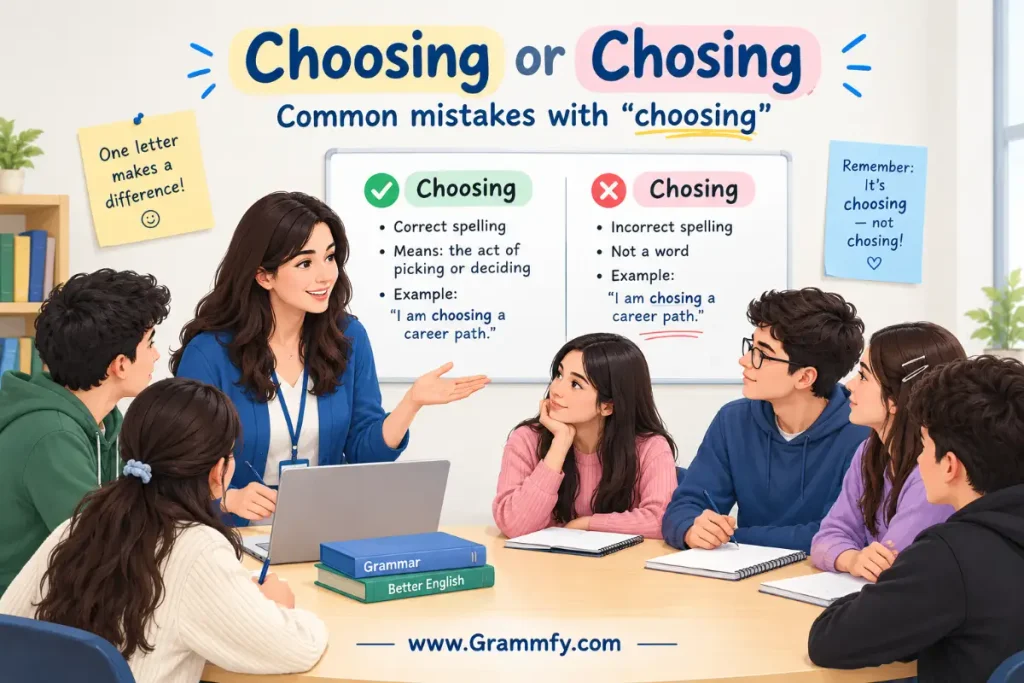
Common mistakes with “choosing”
Several spelling and grammar mistakes appear frequently.
Mistake 1: Writing “chosing”
Incorrect:
I am chosing a new course.
Correct:
I am choosing a new course.
The missing o is the main spelling problem.
Mistake 2: Writing “chooseing”
Incorrect:
She is chooseing a dress.
Correct:
She is choosing a dress.
Don’t keep the final e before -ing in this word.
Mistake 3: Using “choosed”
Incorrect:
I choosed the blue one yesterday.
Correct:
I chose the blue one yesterday.
The past tense of choose is chose.
Mistake 4: Confusing “chose” and “chosen”
Use chose for the simple past:
She chose the red dress yesterday.
Use chosen with a helping verb such as has, have, or had:
She has chosen the red dress.
Mistake 5: Confusing “choose” and “choice”
Choose is a verb.
Please choose one.
Choice is usually a noun.
You have three choices.
Mistake 6: Using “choosing” when no selection is happening
Consider:
I’m choosing to think about the problem.
This is correct because the person is deciding to think about it.
But if you simply mean thinking about an option, considering may be more accurate:
I’m considering the proposal.
The exact meaning matters.
When should you not use “choosing”?
Don’t use choosing automatically whenever you talk about an option.
Use “considering” when the decision isn’t made
I’m considering three universities.
This means you’re still evaluating them.
Use “deciding” when you are making the decision
I’m deciding where to study.
This focuses on the decision-making process.
Use “selecting” when the process is formal
The committee is selecting the finalists.
This sounds more professional than choosing in this context.
Use “preferring” when you want to express a personal preference
I prefer tea to coffee.
You could say:
I’m choosing tea over coffee.
But the first sentence focuses more clearly on preference.
Use “settling for” when the choice is less desirable
He settled for a smaller apartment.
This suggests that the person wanted something else but accepted the smaller option.
Saying:
He chose a smaller apartment.
doesn’t necessarily carry that negative or disappointed feeling.
What are the antonyms of choosing?
The best opposite depends on the context.
Possible antonyms include:
- rejecting
- refusing
- declining
- avoiding
- ignoring
- abandoning
- excluding
- discarding
- overlooking
For example:
She chose the offer.
Opposite idea:
She rejected the offer.
But these aren’t always exact opposites.
Choosing means selecting one option. Rejecting means deciding not to accept something. A person can reject several options without choosing a final one.
How can you remember the correct spelling?
A few simple tricks can help.
Remember “choose” keeps “oo”
Think:
choose + ing = choosing
The oo stays.
Connect it with “chose” and “chosen”
Remember the family:
choose → chose → chosen → choosing
Seeing the whole group can make the spelling easier to remember.
Say the word while writing
When typing quickly, slow down for a moment and notice the spelling:
choosing
The second o is easy to miss, especially because the word is often typed quickly.
Watch for the common typo
If you see chosing, stop and check it. The word needs the second o.
Quick tips for choosing the right synonym
The best synonym isn’t always the longest or most formal word. Match the word to your meaning.
- Use choosing for a general selection.
- Use picking for casual conversation.
- Use selecting for formal or professional situations.
- Use deciding when the focus is on reaching a decision.
- Use considering when the decision is still open.
- Use opting for when someone deliberately prefers one option.
- Use preferring when personal taste matters.
- Use settling on when a final choice has been reached.
- Use settling for when the chosen option isn’t ideal.
- Use committing to when the choice involves a strong promise or long-term decision.
- Use shortlisting when reducing a large group to a smaller group.
- Use electing when people vote for someone.
- Use appointing when an authority officially gives someone a role.
Before replacing a word, ask yourself: What exactly am I trying to say?
That question usually leads you to the best synonym.
A simple spelling test
Try filling in the blank:
- I am ________ a new book.
Which spelling looks correct?
- chosing
- chooseing
- choosing
The answer is choosing.
Try another:
- They are ________ a team captain.
Again, the correct form is choosing.
Now compare the past tense:
- They ________ a team captain yesterday.
The answer is chose, not choosing.
This small distinction can prevent many common grammar errors.
Choosing in common phrases
You’ll often see the word in phrases such as:
- choosing between two options
- choosing the right word
- choosing a career
- choosing a college
- choosing a name
- choosing a color
- choosing a topic
- choosing a side
- choosing a path
- choosing to stay
- choosing to leave
- choosing carefully
- choosing wisely
- choosing the best option
- choosing what to do
Notice that choosing can be followed by a noun, a noun phrase, or to + verb.
Examples:
She is choosing a new topic.
We’re choosing between two hotels.
He is choosing to stay home.
How does “choosing to” work?
The structure choosing to + verb means deciding to perform an action.
Examples:
I’m choosing to wait.
She is choosing to study abroad.
They are choosing to work together.
Here, choosing doesn’t mean selecting a physical object. It describes a decision about an action.
This structure is common when talking about personal decisions.
He is choosing to focus on his studies.
The sentence means that he has decided to focus on his studies.
How does “choosing between” work?
Use choosing between when there are two or more alternatives.
Examples:
I’m choosing between two laptops.
She is choosing between college and a full-time job.
We’re choosing between three restaurants.
You can also use choosing among when discussing a larger group of options, although choosing between is widely used for multiple choices in everyday English.
How does “choosing from” work?
Use choosing from when options come from a particular group or collection.
Examples:
Customers can choose from five colors.
Students can choose from several courses.
You can choose from three payment plans.
The pattern is:
choose/choosing + from + options
This structure is especially common in menus, websites, forms, and instructions.
Why do people write “chosing”?
The typo chosing is easy to make because English spelling doesn’t always match pronunciation perfectly. When people type quickly, they may mentally connect choose with the -ing ending and accidentally drop one of the two o’s.
Another reason is that English has many verbs that drop a final e before -ing:
- make → making
- write → writing
- take → taking
- use → using
That pattern can make learners expect a similar change in choose. But choose already has a spelling pattern that needs to remain intact.
The correct form is:
choose → choosing
not:
choose → chosing
A final comparison of the most useful alternatives
| If you mean… | Best word |
|---|---|
| General selection | Choosing |
| Casual selection | Picking |
| Formal selection | Selecting |
| Making a decision | Deciding |
| Thinking about options | Considering |
| Deliberate preference | Opting for |
| Personal preference | Preferring |
| Final selection | Settling on |
| Accepting a less ideal option | Settling for |
| Careful comparison | Weighing |
| Reducing options | Narrowing down |
| Choosing finalists | Shortlisting |
| Official selection by vote | Electing |
| Official assignment to a role | Appointing |
| Firm long-term decision | Committing to |
This table can help you avoid using the same word repeatedly in your writing.
Conclusion
Choosing is the correct spelling, while chosing is a common but incorrect spelling. The easiest way to remember it is to connect the word to its base form: choose → choosing. The two o’s remain in the word.
The word is useful in almost every kind of English, from casual conversations to academic writing and professional communication. When you need a synonym, choose one based on meaning and tone. Picking sounds casual, selecting sounds more formal, deciding focuses on the decision itself, and considering shows that the final choice may not have been made yet.
Once you remember the spelling pattern and the small differences between related words, you’ll be able to use the word confidently in emails, essays, resumes, texts, and everyday conversations.
Frequently Asked Questions
Is “choosing” or “chosing” correct?
Choosing is correct, while chosing is a misspelling. The correct spelling keeps the two o’s from choose.
Why is “chosing” wrong?
Chosing is wrong because the standard spelling of the verb is choose, and its -ing form is choosing. The spelling does not remove one of the two o’s.
What’s another way to say choosing?
Common alternatives include selecting, picking, deciding, opting for, and settling on. The best option depends on the situation and tone.
Is choosing a verb or a noun?
Choosing can function as a verb or a gerund. In “She is choosing a dress,” it is part of the verb phrase; in “Choosing a dress is difficult,” it acts like a noun.
What is the past tense of choosing?
The simple past of choose is chose. For example, “I chose the blue shirt yesterday,” while “I am choosing the blue shirt” describes an action happening now.
Is choosing spelled the same in American and British English?
Yes. Choosing is spelled the same in American and British English. Regional differences may affect related vocabulary or style, but not this spelling.
How do you remember the spelling of choosing?
Remember the basic pattern choose → choosing. The two o’s stay together when -ing is added.
