
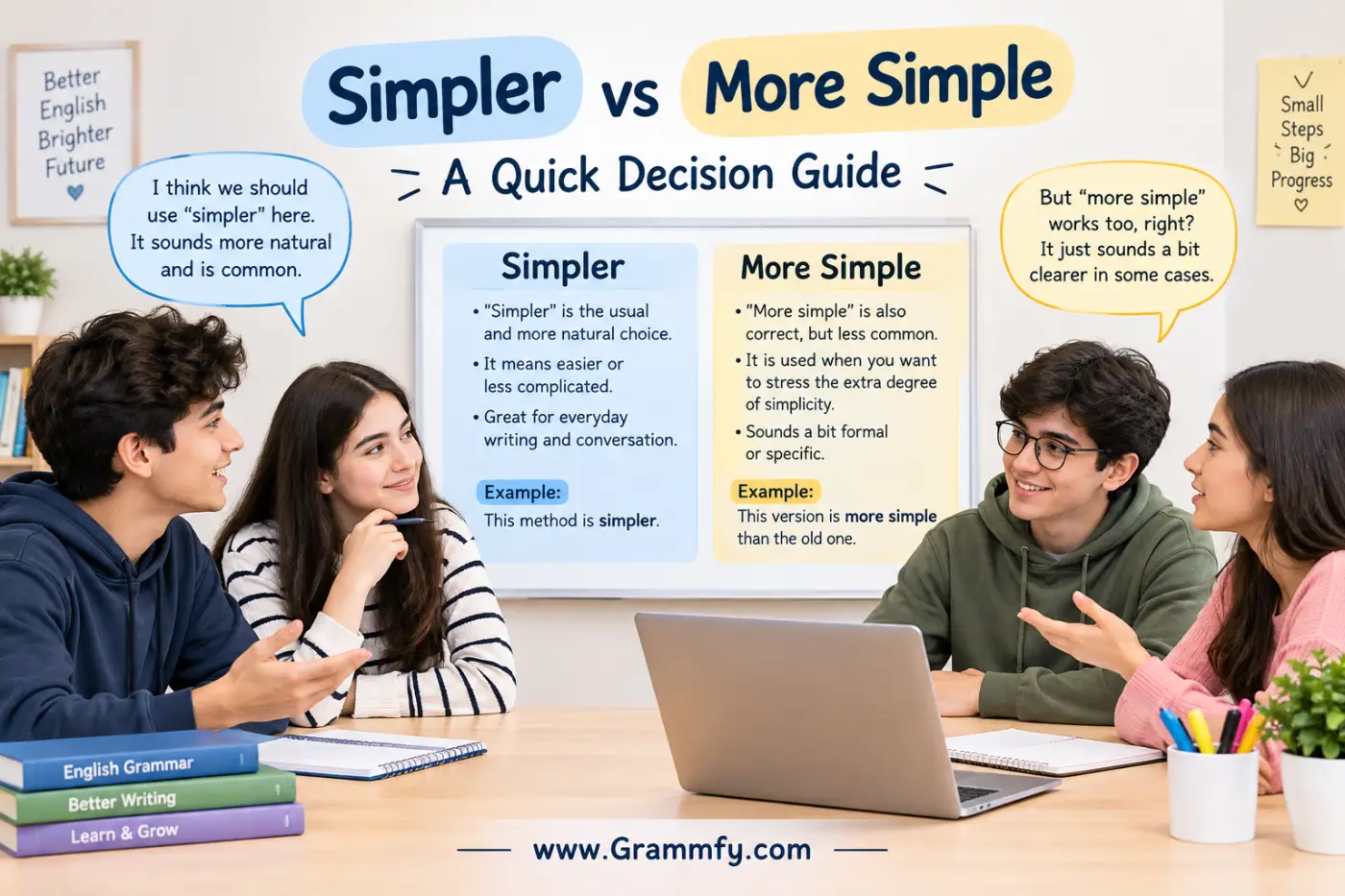
Writing an email, essay, resume, or text often makes you pause over small grammar choices. One common question is whether to write Simpler vs More Simple when comparing two things. Both forms can be found in English, but they are not equally common or natural.
Simpler is the usual comparative form of simple, while more simple is also grammatically possible but less common in many everyday contexts. Major learner dictionaries list simpler as the comparative and also note that more simple can be used.
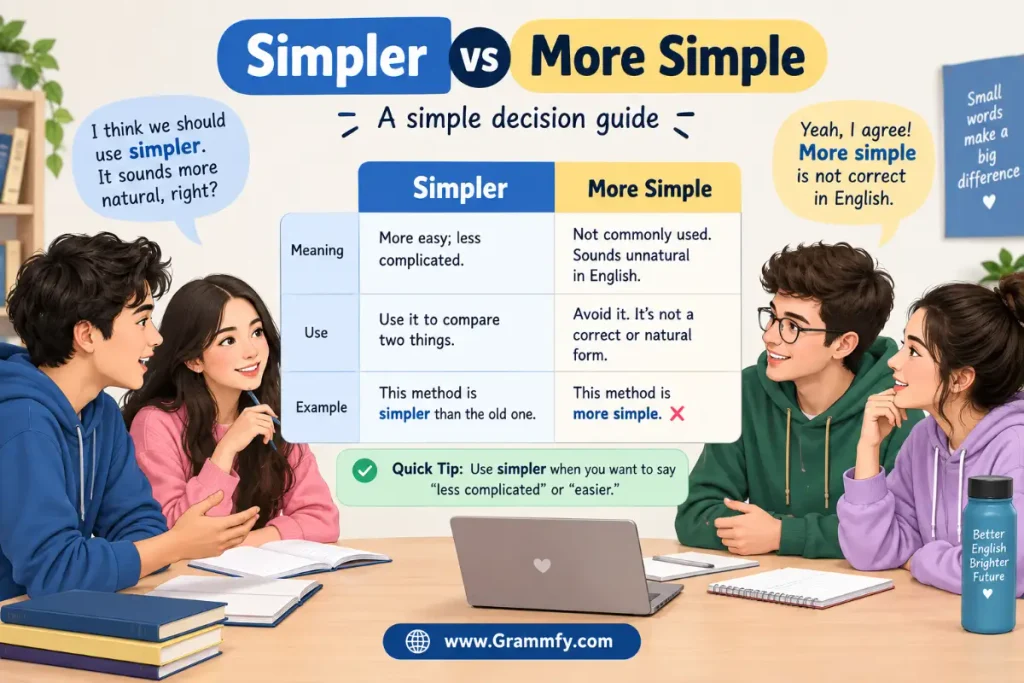
- Answer box: Simpler is the preferred comparative form of simple in most modern English. More simple is possible, but it is less common and often sounds less natural.
Knowing why the two forms exist can help you choose confidently. This guide explains the grammar rule, word history, useful alternatives, context-based choices, common mistakes, and real examples. It also shows when more simple may be acceptable instead of simply calling it wrong.
If you’re unsure how to spell or pluralize another word, read [Inclosed or Enclosed].
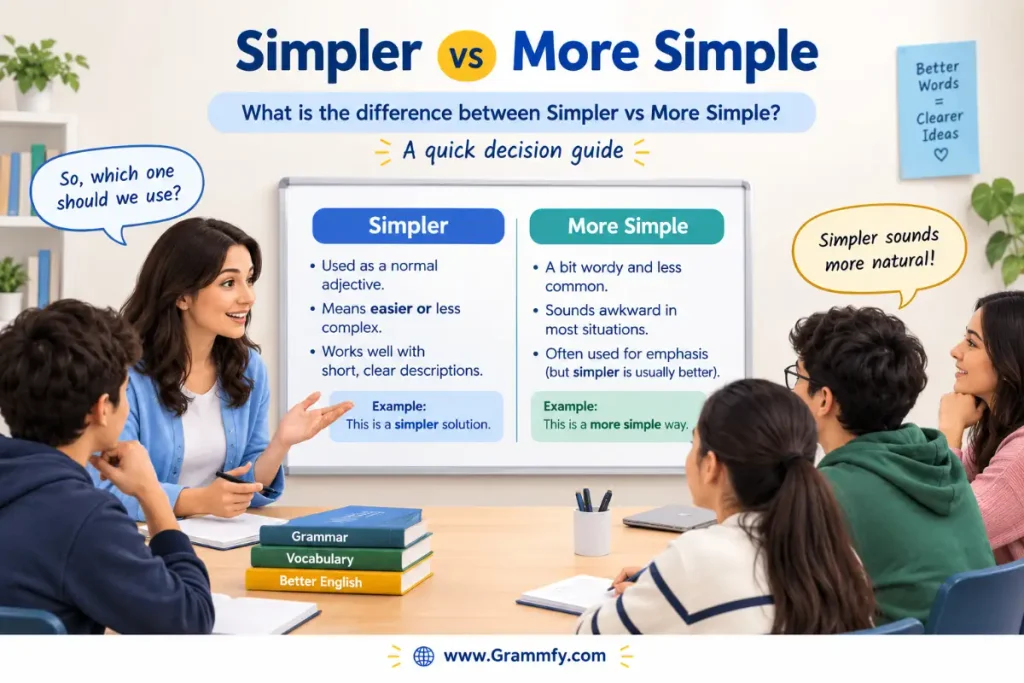
What is the difference between Simpler vs More Simple?
The basic difference is frequency and naturalness, not a major difference in meaning.
Simpler is the standard comparative form listed by dictionaries. Oxford gives simpler and simplest as the main comparative and superlative forms, while also noting that more simple and most simple can be used.
Both forms compare one thing with another:
- This explanation is simpler than the first one.
- This explanation is more simple than the first one.
The first sentence is usually the better choice for ordinary modern writing.
The reason is that simple is a two-syllable adjective that commonly takes the -er comparative ending. Cambridge specifically lists simple → simpler → simplest among adjectives that can take -er and -est.
So, if you need a quick rule, remember:
simple → simpler → simplest
That is the form most readers will expect.
Is Simpler vs More Simple grammatically correct?
Both forms are possible, but simpler is normally preferred.
This is an important point because English comparative rules are not completely mechanical. Some adjectives use -er, while longer adjectives usually use more.
Cambridge explains that one-syllable adjectives generally form the comparative with -er. It also notes that some two-syllable adjectives, including simple, can take -er and -est.
Oxford goes a step further by listing:
- simple → simpler → simplest
- simple → more simple → most simple
So more simple should not automatically be labeled an ungrammatical form. It is a possible comparative construction, although simpler is generally the more natural choice.
For most learners and most writing situations, this is the safest choice:
This method is simpler than the old one.
Why is simpler usually preferred?
English often favors shorter comparative forms when an adjective naturally accepts -er.
Compare:
| Base adjective | Comparative | Superlative |
|---|---|---|
| small | smaller | smallest |
| fast | faster | fastest |
| clear | clearer | clearest |
| simple | simpler | simplest |
| narrow | narrower | narrowest |
| quiet | quieter | quietest |
Cambridge lists simple among two-syllable adjectives that can use -er and -est.
This makes simpler feel natural and compact.
Compare these sentences:
The new system is simpler to use.
The new system is more simple to use.
The second sentence is understandable, but the first usually sounds smoother.
That doesn’t mean English speakers never say or write more simple. It means that simpler is generally the first choice when you simply want to compare two levels of simplicity.
What does simple mean?
Simple is an adjective with several related meanings.
Its most common meaning is easy to understand, do, or use. Cambridge gives examples such as simple instructions, simple recipes, and simple solutions.
For example:
The instructions are simple.
This means the instructions are easy to understand or follow.
The word can also mean not complicated:
She designed a simple system.
- It can mean plain or without unnecessary decoration:
He wore a simple black shirt.
- It can describe something made of only a few parts:
The machine has a simple design.
- It can also describe something basic or ordinary:
They enjoyed a simple meal.
These different meanings matter because the best comparative can depend on what you mean.
Where does the word simple come from?
The history of simple goes back through French to Latin and is connected with the idea of being single, uncomplicated, or made up of one part.
Over time, the English word developed several meanings. Today, it can describe something that is easy, plain, basic, uncomplicated, or made from few parts.
This explains why simpler can describe different kinds of comparisons:
- easier to understand
- less complicated
- less elaborate
- more basic
- plainer
- easier to use
The exact meaning comes from the noun or situation being described.
For example:
This explanation is simpler.
Here, simpler probably means easier to understand.
But:
This design is simpler.
could mean that the design has fewer decorative elements.
The adjective remains the same, but the context changes the meaning.
How do comparative adjectives work?
Comparative adjectives let us compare two people, objects, places, ideas, or situations.
For example:
- tall → taller
- fast → faster
- cold → colder
- interesting → more interesting
- expensive → more expensive
- simple → simpler
Cambridge explains that comparative adjectives show that one person or thing has more or less of a particular quality than another.
The basic pattern is:
Subject + comparative adjective + than + comparison
Examples:
This test is easier than the last one.
My new phone is faster than my old phone.
This explanation is simpler than the previous one.
The word than introduces the second part of the comparison.
Why does simple use -er?
The word simple has two syllables: sim-ple.
Learners sometimes think every two-syllable adjective must use more. That isn’t the rule.
English has several two-syllable adjectives that can take -er and -est, especially when their pronunciation and rhythm allow it. Cambridge specifically includes simple in this group.
Examples include:
- simple → simpler
- gentle → gentler
- quiet → quieter
- narrow → narrower
- clever → cleverer
So don’t rely only on the number of syllables.
The natural form of the adjective matters too.
What is the comparative form of simple?
The main comparative form is simpler.
The basic pattern is:
simple → simpler → simplest
Examples:
This question is simpler than the previous one.
The second method is simpler to understand.
We need a simpler solution.
This is the simplest way to explain the rule.
Oxford lists simpler as the comparative and simplest as the superlative, while also allowing more simple and most simple.
For normal writing, this pattern is the easiest one to remember.
Can you say more simple?
Yes, you can use more simple, but it is less common than simpler in many contexts.
Oxford’s dictionaries explicitly state that more simple and most simple can be used alongside simpler and simplest.
For example:
The second version is more simple than the first.
This is understandable and can be grammatically acceptable.
However, most writers would usually choose:
The second version is simpler than the first.
That version is shorter and more natural for general use.
So the practical rule is not:
More simple is always wrong.
Instead, use:
Simpler is normally the better choice. More simple is possible in some contexts.
That distinction gives learners a more accurate understanding of English.
When might more simple be useful?
Although simpler is usually preferred, more simple can sometimes appear when a writer wants to preserve a particular structure or contrast.
For example:
The goal is not to make the system simple, but to make it more simple and more flexible.
A writer may choose more simple because the phrase is being placed beside another more + adjective construction.
Another possible context is deliberate emphasis:
The revised plan is more simple, more direct, and easier to explain.
Even here, simpler may still sound more natural:
The revised plan is simpler, more direct, and easier to explain.
The important lesson is that more simple has a legitimate place in English, but you generally don’t need it when simpler works naturally.
Simpler vs More Simple: which one should you use?
For most writing, choose simpler.
| Situation | Recommended form |
|---|---|
| School assignment | simpler |
| Essay | simpler |
| Resume | simpler |
| Professional email | simpler |
| Website content | simpler |
| Text message | simpler |
| Everyday conversation | simpler |
| Formal comparison | simpler |
| Historical or stylistic writing | Either, depending on context |
| Deliberate parallel structure | more simple may work |
If you’re unsure, simpler is the safest choice.
Which form sounds more natural?
In ordinary modern English, simpler usually sounds more natural.
Compare:
This explanation is simpler.
This explanation is more simple.
Both communicate the idea, but the first is more direct.
The same pattern appears in many everyday sentences:
The new process is simpler.
The instructions are simpler.
Her solution is simpler.
The design is simpler.
The answer is simpler than I expected.
These sentences are short, clear, and natural.
What are common synonyms for simpler?
Depending on the meaning, you can replace simpler with several related words.
Master synonym list
| Word | Meaning | Tone | Example |
|---|---|---|---|
| Easier | Less difficult | Simple | This task is easier. |
| Plainer | Less complicated or decorated | Neutral | Use plainer language. |
| Basic | Having few features | Everyday | We need a basic version. |
| Simpler | Less complex | Neutral | This method is simpler. |
| Easier-to-use | More convenient to operate | Everyday | The new app is easier to use. |
| Cleaner | Less cluttered | Informal/Design | The new layout looks cleaner. |
| Lighter | Less heavy or complex in some contexts | Neutral | The software has a lighter design. |
| Plainer | More direct or less decorated | Neutral | His writing is plainer. |
| More basic | Less advanced | Neutral | This course is more basic. |
| More direct | Less indirect | Neutral | Her answer was more direct. |
| More accessible | Easier for people to understand or use | Formal | The guide is more accessible. |
| More manageable | Easier to handle | Neutral | The workload is more manageable. |
| Less complex | Having fewer connected parts | Formal | The model is less complex. |
| Less complicated | Easier because there are fewer difficulties | Everyday | The new process is less complicated. |
| Less difficult | Not as hard | Neutral | The second test was less difficult. |
| More user-friendly | Easier for users | Professional | The interface is more user-friendly. |
| More basic | Having fewer advanced features | Neutral | The older version is more basic. |
| Bare-bones | With only essential features | Informal | We chose a bare-bones design. |
| No-frills | Without unnecessary extras | Informal | It’s a no-frills service. |
| Easy | Not difficult | Everyday | The new method is easy. |
| Manageable | Easy enough to handle | Neutral | The project is manageable now. |
| Accessible | Easy to understand or use | Formal | The material is accessible. |
| Elementary | Basic and introductory | Academic | The course covers elementary concepts. |
| Minimal | Reduced to the essentials | Design/Formal | The interface has a minimal layout. |
| Streamlined | Made more efficient by removing unnecessary parts | Professional | The company created a streamlined process. |
| Basic-level | Suitable for beginners | Educational | This is a basic-level lesson. |
| Unfussy | Plain and not complicated | Informal | She prefers an unfussy style. |
Not every synonym means exactly the same thing.
For example, easier focuses on difficulty, while clearer focuses on understanding. Minimal focuses on having fewer elements, while streamlined often suggests improved efficiency.
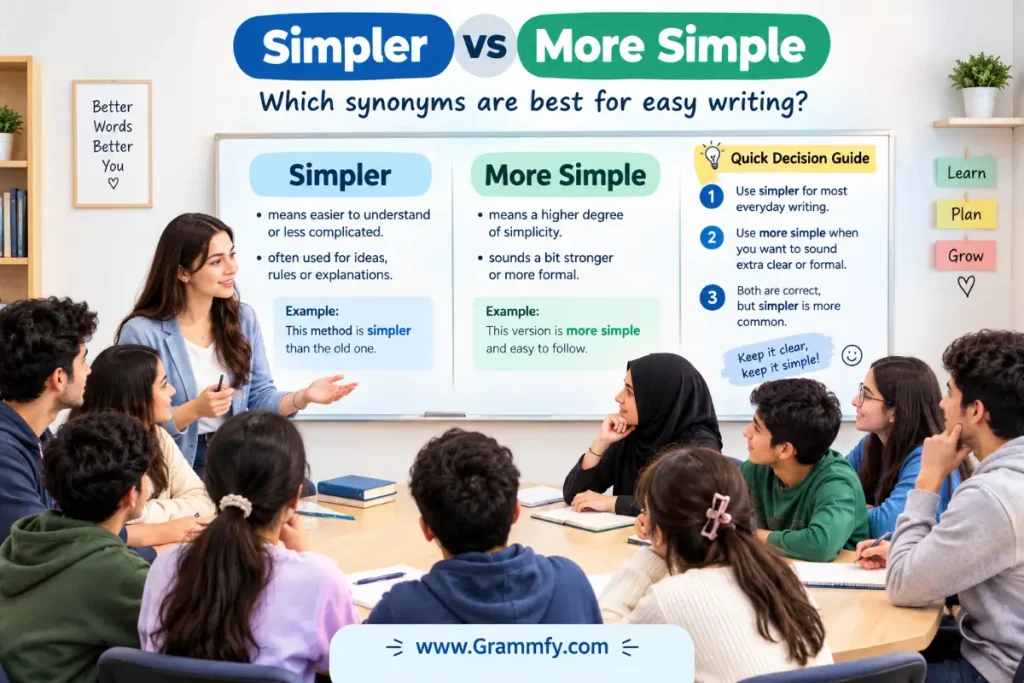
Which synonyms are best for easy writing?
If you’re writing for a general audience, these are strong choices:
- easier
- clearer
- straightforward
- basic
- less complicated
- manageable
- easy
Examples:
- The instructions are clearer now.
- The new process is easier to follow.
The solution is more straightforward.
These choices are useful when you want to avoid repeating simple.
Which synonyms are formal?
Professional and academic writing may use:
- less complex
- uncomplicated
- accessible
- manageable
- streamlined
- straightforward
- elementary
- minimal
For example:
The revised procedure is more streamlined.
This suggests that unnecessary steps have been removed.
Or:
The revised explanation is more accessible.
This means it is easier for the intended audience to understand.
Which synonyms are informal or conversational?
In casual speech, you might hear:
- easier
- no-frills
- bare-bones
- unfussy
- cleaner
For example:
Let’s use the no-frills version.
This means the version has only what is necessary.
Or:
The new layout looks cleaner.
Here, cleaner can mean less crowded or cluttered rather than simply easier.
Which synonyms describe different levels of simplicity?
Not every comparison means exactly the same degree of simplicity.
A rough scale can help:
| Level | Word | Meaning |
|---|---|---|
| Mild | Clearer | Easier to understand |
| Mild | More direct | Easier to follow |
| Moderate | Simpler | Less complicated |
| Moderate | Easier | Less difficult |
| Strong | Basic | Fewer or less advanced features |
| Strong | Minimal | Reduced to essentials |
| Strong | Bare-bones | Almost only the essentials |
For example:
The explanation is clearer.
This doesn’t necessarily mean it contains less information. It may simply be easier to understand.
The explanation is simpler.
This may mean the ideas or structure are less complicated.
The explanation is more basic.
This suggests that it covers less advanced material.
What are the synonyms by part of speech?
Simpler is an adjective, so its closest alternatives are usually adjectives.
Adjectives
- easier
- clearer
- plainer
- basic
- straightforward
- uncomplicated
- accessible
- manageable
- minimal
- streamlined
Example:
The new system is easier to use.
Adverbs
The related adverb is simply.
Its comparative meaning is often expressed with more simply.
Example:
She explained the topic more simply this time.
This is different from:
Her explanation was simpler this time.
The first uses an adverb. The second uses an adjective.
Simpler vs more simply: what’s different?
This is an important grammar distinction.
Simpler is an adjective.
More simply is an adverb phrase.
Compare:
The explanation is simpler.
Here, simpler describes the explanation.
She explained the topic more simply.
Here, more simply describes how she explained it.
Don’t confuse the two forms.
| Adjective | Adverb |
|---|---|
| simple | simply |
| simpler | more simply |
| simplest | most simply |
Examples:
- This lesson is simpler.
- The teacher explained the lesson more simply.
Both are correct, but they perform different jobs.
Simpler vs easier: what’s the difference?
These words are close, but they are not always interchangeable.
Easier usually focuses on difficulty.
Simpler often focuses on complexity or structure.
Compare:
This exam is easier than the last one.
The exam requires less effort or knowledge.
This explanation is simpler than the last one.
The explanation is less complicated.
Sometimes both work:
This method is easier.
This method is simpler.
The first focuses on how difficult the method is to use. The second focuses on how uncomplicated the method is.
Simpler vs clearer: what’s the difference?
Clearer means easier to understand.
Simpler means less complicated.
A long explanation can be clear without being simple.
For example:
- The professor gave a detailed but clear explanation.
The explanation contains lots of information, but the ideas are easy to follow.
A simpler explanation may remove some details:
- The teacher gave a simpler explanation.
That doesn’t automatically mean it is clearer, although it often may be.
Choose clearer when understanding is the main issue. Choose simpler when complexity is the main issue.
Simpler vs straightforward: what’s the difference?
Straightforward means easy to understand or deal with because there is little confusion or complexity.
For example:
The instructions are straightforward.
This suggests the reader can follow them without much trouble.
The instructions are simpler.
This suggests they have become less complex than another version.
A useful distinction is:
- simpler = less complicated
- straightforward = direct and easy to follow
Simpler vs less complicated: what’s the difference?
These two expressions often communicate nearly the same idea.
The new process is simpler.
The new process is less complicated.
The second version is useful when you want to avoid repeating simple.
It can also make a comparison especially clear:
- The updated system is less complicated than the previous version.
This is a good alternative for formal writing.
How should you use simpler in a resume?
A resume should be concise, so simpler can be useful when describing processes, systems, or communication.
Examples:
Created a simpler workflow for processing customer requests.
Developed simpler instructions for new employees.
Designed a simpler reporting system.
However, don’t use simpler unless there is a clear comparison or improvement.
Instead of:
Made a simpler system.
you could write:
Simplified the reporting process.
The second sentence uses the verb simplified, which can sound stronger on a resume.
How should you use simpler in an essay?
In an essay, simpler works well when comparing explanations, arguments, methods, or ideas.
Examples:
The second theory provides a simpler explanation.
A simpler approach may help students understand the concept.
The revised argument is simpler than the original one.
Academic writing should still be clear. Don’t replace simpler with complicated words just to sound more formal.
How should you use simpler in texting?
Text messages usually favor short and natural language.
Examples:
This way is simpler.
The new app is simpler to use.
Can we find a simpler option?
These sentences sound normal in casual conversation.
You don’t need to use more simple just because you’re writing informally.
How should you use simpler in an email?
In professional emails, simpler is usually a good choice.
Examples:
I think there is a simpler way to handle this.
Could we use a simpler format for the report?
The revised process should be simpler for the team.
These sentences are clear without sounding too formal.
How should you use simpler when speaking?
Simpler is completely natural in everyday speech.
You might say:
There’s a simpler way to do it.
This option is much simpler.
Life would be simpler if we planned ahead.
The new instructions are simpler.
In conversation, simpler often sounds more natural than more simple.
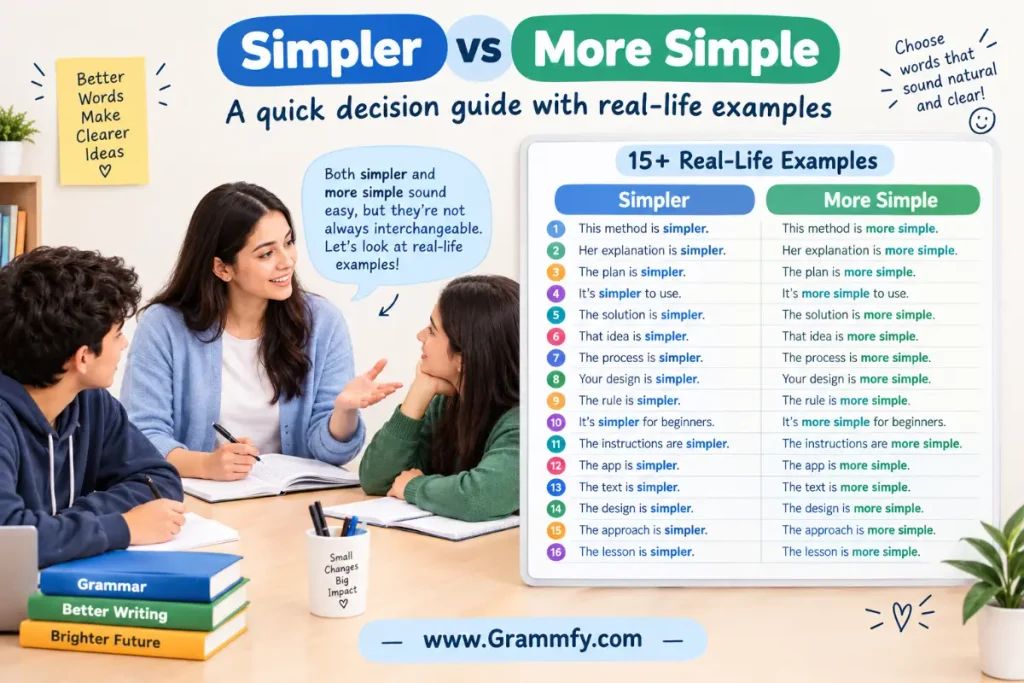
15+ real-life examples with simpler
Here are examples from school, work, technology, home life, and everyday communication.
- This explanation is simpler than the one in the textbook.
- The new software is simpler to use.
- We need a simpler way to organize these files.
- Her answer was simpler and easier to understand.
- The teacher gave us a simpler example.
- This recipe is simpler than the one I tried last week.
- The company created a simpler application process.
- My new schedule is simpler because it has fewer steps.
- The second design looks simpler and cleaner.
- Could you explain the rule in a simpler way?
- The instructions became simpler after the editor removed unnecessary details.
- This route is simpler than taking three different buses.
- We chose a simpler solution because the original plan was too complicated.
- The website has a simpler layout now.
- His explanation was simpler than mine.
- A simpler example may help beginners understand the idea.
- The updated form is simpler to complete.
- She wanted a simpler design for her presentation.
- The process seems simpler after the new steps were added.
- This version gives students a simpler way to practice the skill.
Examples where more simple can work
Because more simple is a possible form, it is useful to understand how it may appear.
- The revised explanation is more simple than the original.
- The design became more simple after several features were removed.
- The author wanted the language to be more simple and direct.
- The new system is more simple in structure.
- The second model has a more simple design.
These sentences can be understood, but in most ordinary contexts, simpler would be the more natural choice:
The revised explanation is simpler than the original.
The design became simpler after several features were removed.
The author wanted the language to be simpler and more direct.
That is why style matters even when a construction is grammatically possible.
What is the superlative form of simple?
The standard superlative is simplest.
The complete pattern is:
simple → simpler → simplest
Examples:
This is the simplest solution.
She chose the simplest option.
That was the simplest explanation.
Oxford also notes that most simple can be used, but simplest is the normal choice.
Just as you normally choose simpler over more simple, you will normally choose simplest over most simple.
Can you say more simpler?
No. In standard English, avoid more simpler when you mean a single comparative form.
Why?
Because simpler already contains the comparative ending -er.
The correct choices are:
simpler ✓
or, where appropriate:
more simple ✓
But not:
more simpler ✗
The same problem appears in forms such as:
- more faster ✗
- more smaller ✗
- more clearer ✗
- more easier ✗
Cambridge notes that English does not normally combine more with an adjective already carrying -er.
What about much simpler?
Much simpler is completely correct.
Here, much strengthens the comparative adjective.
Examples:
This version is much simpler.
The new instructions are much simpler than the old ones.
The second method is much simpler to understand.
Other words can also strengthen a comparative:
- much simpler
- far simpler
- a lot simpler
- even simpler
- considerably simpler
Cambridge explains that words such as much, a lot, and far can strengthen comparative adjectives.
What about a little simpler?
You can also make the comparison weaker.
Examples:
- This version is a little simpler.
- The new process is slightly simpler.
- The instructions are a bit simpler now.
These phrases show a small difference rather than a major change.
What about simpler and simpler?
When something keeps becoming less complicated, use:
simpler and simpler
Examples:
The instructions are becoming simpler and simpler.
The design became simpler and simpler as the project developed.
Cambridge explains that repeated comparative adjectives can describe a continuing change.
You can also use:
The process is getting simpler and simpler.
This is natural and common.
What about the simpler, the better?
This is another useful comparative structure.
Examples:
The simpler, the better.
A more complete sentence is:
The simpler the process, the better.
This means that reducing unnecessary complexity improves the result.
Other examples include:
The simpler the instructions, the easier they are to follow.
The simpler the design, the easier it is to maintain.
Cambridge describes the pattern the + comparative, the + comparative as a way to show a linked change.
Common mistakes with simpler
Mistake 1: Using more simpler
Incorrect:
This method is more simpler.
Correct:
This method is simpler.
Or, if you have a reason to use the alternative construction:
This method is more simple.
But more simpler combines two comparative markers.
Mistake 2: Assuming every two-syllable adjective uses more
Some learners memorize:
Two syllables = more.
That isn’t reliable.
Simple is one of the two-syllable adjectives that can take -er and -est.
So:
simple → simpler
is correct.
Mistake 3: Using simpler when you mean more clearly
Incorrect:
She explained the rule simpler.
If you mean that she explained it in an easier-to-understand way, use:
She explained the rule more simply.
If you want an adjective, write:
Her explanation was simpler.
Mistake 4: Confusing simpler with easiest
Simpler compares two things or two levels.
Simplest usually identifies the highest degree of simplicity in a group.
Compare:
This method is simpler than that one.
Two methods are compared.
This is the simplest method.
One method is identified as the easiest or least complicated among the relevant choices.
Mistake 5: Using simple when a comparison is needed
Compare:
This method is simple.
This makes no direct comparison.
This method is simpler than the old one.
This clearly compares two methods.
When should you avoid simpler?
There are times when another word gives a more precise meaning.
- Use easier for difficulty
This test is easier than the last one.
- Use clearer for understanding
The instructions are clearer now.
- Use more direct for communication style
Her answer was more direct.
- Use less complex for technical writing
The model is less complex.
- Use streamlined for improved processes
The company introduced a streamlined workflow.
The best word depends on the exact quality you’re comparing.
What are the antonyms of simpler?
The opposite of simpler can be expressed in several ways.
Common antonyms include:
- more complicated
- more complex
- harder
- more difficult
- less clear
- more elaborate
- more involved
- complicated
- complex
Examples:
This method is simpler than the old one.
Opposite idea:
This method is more complicated than the old one.
Or:
This method is more complex than the old one.
The best antonym depends on what simple means in the original sentence.
Simpler vs more complex: what’s different?
These are often opposites.
Simpler suggests fewer complications or easier understanding.
More complex suggests more parts, relationships, details, or difficulty.
For example:
The new model is simpler.
The old model is more complex.
However, a complex system isn’t necessarily bad. Complexity may be necessary when a system has many functions.
Likewise, a simple design isn’t automatically better. It depends on the goal.
Simpler vs easier: choose based on the question
A useful trick is to ask:
Am I talking about complexity or difficulty?
- If the answer is complexity, choose simpler.
The design is simpler.
- If the answer is difficulty, choose easier.
The exam is easier.
- If both ideas apply, either word may work:
The new software is simpler to use.
The new software is easier to use.
Both are natural, but they focus on slightly different aspects.
How does simpler work with than?
Use than when the second part of the comparison is stated.
Examples:
This method is simpler than the old one.
Her explanation was simpler than mine.
The new design is simpler than the original.
The structure is:
simpler + than + comparison
If the comparison is obvious, you can omit it:
This version is simpler.
The listener understands that you mean simpler than another known option.
How does simpler work before a noun?
Simpler can come directly before a noun.
Examples:
- a simpler method
- a simpler explanation
- a simpler design
- a simpler solution
- a simpler process
- a simpler answer
- a simpler approach
- a simpler system
For example:
We need a simpler solution.
This is often more natural than writing:
We need a more simple solution.
How does simpler work after a linking verb?
You can use simpler after verbs such as be, seem, and become.
Examples:
The process is simpler.
The instructions seem simpler.
The system became simpler.
The explanation looks simpler.
These structures are common in everyday English.
Why does word choice matter?
Choosing simpler instead of more simple is not only about grammar. It can also improve style.
Compare:
We need a more simple approach to the problem.
We need a simpler approach to the problem.
The second sentence is shorter.
It also follows the familiar comparative pattern:
simple → simpler
Good writing often benefits from direct forms when they communicate the same idea.
Still, don’t turn this into an absolute rule. English contains variation, and reputable dictionaries recognize more simple as a possible form.
Quick tips for choosing the right form
Keep these rules in mind:
- Use simpler as your normal comparative form.
- Remember simple → simpler → simplest.
- More simple is possible but less common in many contexts.
- Don’t write more simpler.
- Use more simply when you need an adverb.
- Use easier when you’re focusing on difficulty.
- Use clearer when you’re focusing on understanding.
- Use less complex when discussing technical complexity.
- Use streamlined for a process made more efficient.
- Use simplest for the superlative in most cases.
- Check the meaning before choosing a synonym.
- In school, professional, and website writing, simpler is usually the safest choice.
A simple decision chart
| If you mean… | Choose |
|---|---|
| Less complicated | Simpler |
| Less difficult | Easier |
| Easier to understand | Clearer |
| More direct | More direct |
| Less complex | Less complex |
| Basic or introductory | More basic |
| Easier to manage | More manageable |
| More efficient | More streamlined |
| Very basic | Bare-bones |
| The easiest/least complicated option in a group | Simplest |
Conclusion
When choosing between Simpler vs More Simple, simpler is usually the best option. It is the standard comparative form of simple, and it sounds natural in schoolwork, professional writing, conversation, and online content. Cambridge lists simple → simpler → simplest as a normal comparative pattern, while Oxford also recognizes more simple and most simple as possible alternatives.
That means more simple isn’t something you need to treat as completely impossible. It can appear in English, especially when a writer has a particular stylistic reason for choosing it. Still, when you’re unsure, simpler is the clear and practical choice.
Remember the main pattern: simple → simpler → simplest. Avoid more simpler, use more simply when you need the adverb, and choose words such as easier, clearer, or less complex when they express your meaning more precisely.
Frequently Asked Questions
Is simpler or more simple correct?
Simpler is the preferred comparative form in most modern English. More simple is also possible, but it is less common in many contexts.
Is more simple grammatically wrong?
No, more simple is not automatically wrong. Major dictionaries recognize it as an alternative comparative form, although simpler is normally the more natural choice.
Which sounds more natural, simpler or more simple?
Simpler usually sounds more natural. It is the standard comparative form taught for simple and is widely used in everyday English.
What’s another way to say simpler?
Common alternatives include easier, clearer, more straightforward, less complicated, and less complex. Choose the synonym that matches the exact meaning you want.
Can I say more simpler?
No, avoid more simpler in standard English. Use simpler or, where appropriate, more simple, but don’t combine both comparative forms.
What is the comparative and superlative of simple?
The usual forms are simple, simpler, simplest. Dictionaries also recognize more simple and most simple as possible alternatives.
Should I use simpler in formal writing?
Yes, simpler is an excellent choice for formal writing. It is concise, standard, and clear, so it works well in essays, reports, professional emails, and other polished writing.
