
Writing an email, essay, resume, or text can make you stop over a tiny spelling choice. You may want to write that you enclosed a document, or you may describe something that a wall, fence, or other boundary surrounds. Which form should you choose? Have you ever wondered whether to use Ignitor or Igniter? Learn the difference between these two spellings and discover which one is right for your writing.
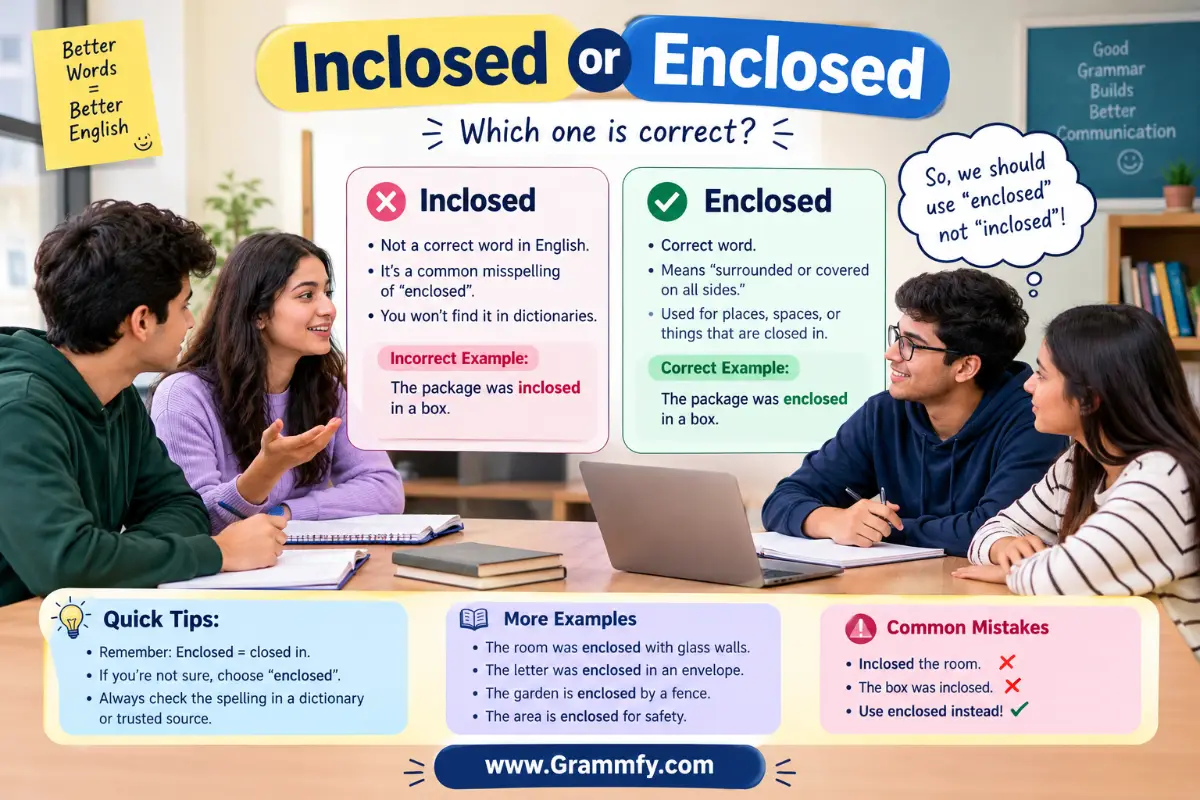
Enclosed is the standard modern spelling. Inclosed is an older or less common spelling connected with the historical form inclose. Modern dictionaries list inclose as a less common spelling of enclose, while enclosed is the normal past tense and past participle of enclose.
- Answer box: Enclosed is the standard spelling in modern English. Inclosed is an older or less common variant, so use enclosed for most writing.
This guide explains the meaning and history of both forms, shows useful synonyms, compares related words, and gives examples for emails, resumes, essays, texts, and everyday speech. You’ll also learn when an older form may appear and how to avoid common mistakes.
You may also find our guide to [Ignitor or Igniter] useful when writing.
What does enclosed mean?
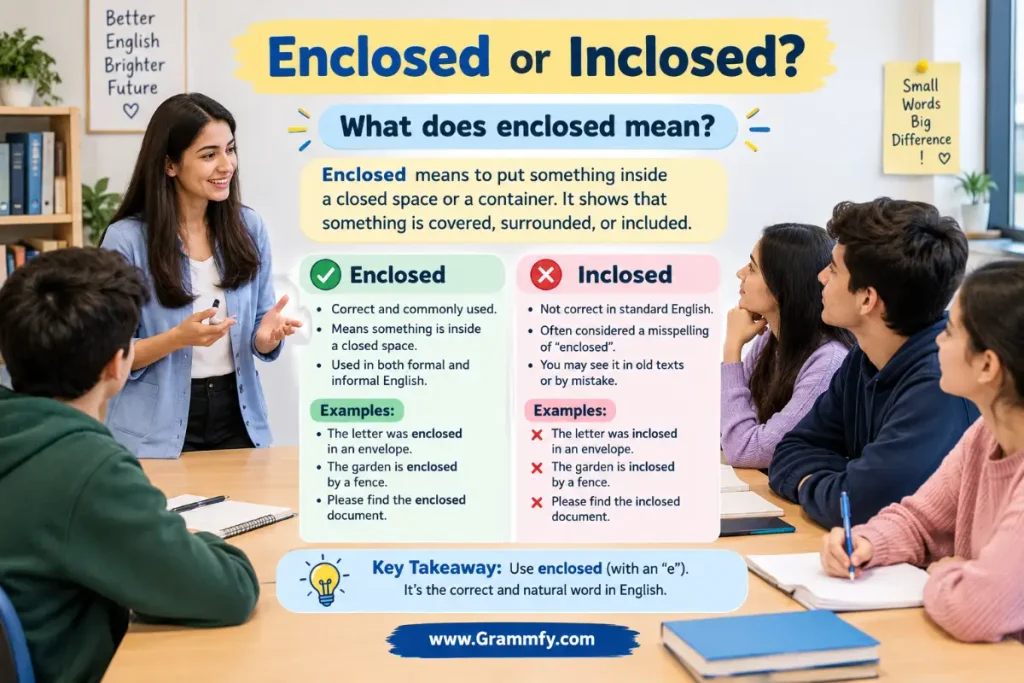
Enclosed is the past tense and past participle of enclose. It means that someone has surrounded or closed something in, or placed it inside another object, such as an envelope or package. Dictionary.com defines it as surrounding something on all sides or placing something inside the same envelope or package.
The word can describe physical spaces:
- A tall fence enclosed the garden.
- The staff kept the animals in an enclosed area.
- The building has an enclosed courtyard.
- Workers enclose the playground for safety.
It can also describe something placed inside a letter or package:
- We enclosed the completed form with this letter.
- Please find the requested document enclosed.
- Someone enclosed a receipt in the package.
The same word therefore has two common ideas:
- Surrounded or closed in
- Included inside an envelope, package, or similar container
These meanings come from the verb enclose, which means to shut or hem something in, surround it, or put something inside an envelope or wrapper.
What is the difference between inclosed and enclosed?
The main difference is modern usage and spelling preference.
Enclosed is the standard form used in modern English.
Inclosed is a less common or historical form associated with inclose, an older spelling of enclose. Dictionary.com specifically lists inclose as a less common spelling of enclose and gives inclosed among its forms.
| Form | Modern status | Meaning | Best choice today? |
|---|---|---|---|
| Enclosed | Standard | Surrounded or included inside | Yes |
| Inclosed | Older/less common variant | Same basic meaning | Usually no |
| Enclose | Standard verb | Surround or put inside | Yes |
| Inclose | Less common spelling | Same basic verb meaning | Usually no |
If you’re writing a school assignment, professional email, website, resume, or general article, enclosed is the clear choice.
Why Do People Prefer the Spelling Enclosed?
Modern English uses enclose as the verb and enclosed as its past form.
The spelling follows a familiar pattern:
enclose → enclosed
Writers retain the final e before adding -d.
- close → closed
- enclose → enclosed
- use → used
- include → included
This makes enclosed easy to recognize as the past form of enclose.
By contrast, inclose is an older spelling. Dictionary.com records inclose as a less common spelling and gives examples of historical uses of inclosed.
That historical connection explains why you may occasionally encounter the older form in old books, archived documents, or historical quotations.
Where does the word enclose come from?
The history of enclose helps explain why both spellings have existed.
Dictionary.com dates enclose to the late Middle English period and traces it to enclosen, with the word built from elements related to in- and close.
Think about a fence around a garden. The fence encloses the garden.
Think about a document inside an envelope. The envelope encloses the document.
Think about a room surrounded by walls. The walls enclose the room.
The spelling changed and developed over time, but the central idea of containment remained.
Why does inclosed appear in older writing?
English spelling was not always as standardized as it is today.
Historical writers used forms that may look unusual to modern readers. Inclose was one such spelling. Dictionary.com still records it as a less common spelling of enclose, with inclosed appearing as its past form.
This means you might find sentences such as:
The letter was inclosed with the report.
or:
The land was inclosed by a stone wall.
A modern editor would normally write:
The letter was enclosed with the report.
or:
The land was enclosed by a stone wall.
When reading older material, don’t assume that an unfamiliar spelling is automatically a typo. It may reflect the spelling conventions of the period.
Do writers spell “inclosed” incorrectly?
Not exactly.
Inclosed is a recognized older or less common form, but enclosed is the standard modern choice. Dictionary.com lists inclose as a less common spelling of enclose, which confirms that the form has a place in English usage.
So there is an important difference between saying:
“Inclosed is completely wrong.”
and:
“Enclosed is the preferred spelling in modern English.”
The second statement is more accurate.
If you’re writing for a modern audience, use enclosed. If you’re quoting a historical document, discussing historical spelling, or reproducing an original text, you may need to preserve inclosed exactly as it appears.
What does enclosed mean in a letter?
People often use “enclosed” in letters and emails to mean that they have included something with the message.
For example:
- Please find the completed application enclosed.
This means the sender included the application with the letter.
Another example is:
- I have enclosed a copy of my resume.
Here, “enclosed” means that the sender included the resume with the letter or package.
The word is especially common in formal correspondence. Dictionary.com lists the meaning of putting something in the same envelope or package as one of the standard meanings of enclosed.
In a modern email, however, attached is often more natural when referring to a digital file.
Compare:
I have enclosed the report.
This traditionally suggests a physical document sent with a letter.
I have attached the report.
This naturally suggests a digital file sent with an email.
Enclosed vs. attached: what’s the difference?
Enclosed usually suggests something physically included in a letter, package, or container. Attached is especially common for digital files and email messages.
| Enclosed | Attached |
|---|---|
| Often used for physical documents | Often used for digital files |
| Common in formal letters | Very common in emails |
| Suggests something inside a package or envelope | Suggests a file connected to a message |
| The document is enclosed with the letter | The document is attached to the email |
Examples:
- I have enclosed a signed copy of the agreement.
- I have attached a PDF copy of the agreement.
Both sentences can communicate inclusion, but the second is usually better for modern email.
What does enclosed mean when talking about a place?
In descriptions of buildings, land, rooms, gardens, and other spaces, enclosed means surrounded or closed in.
For example:
- The patio is enclosed by glass walls.
The glass walls surround the patio.
Another example:
- The children played in an enclosed courtyard.
The courtyard is surrounded by walls or another boundary.
Dictionary.com defines enclose as shutting or hemming something in and surrounding something with a fence or wall.
This physical meaning is common in everyday English.
Examples of physical enclosure
- an enclosed garden
- an enclosed balcony
- an enclosed porch
- an enclosed courtyard
- an enclosed parking area
- an enclosed walkway
- an enclosed playground
- an enclosed animal area
- an enclosed room
- an enclosed space
The word can describe complete or partial physical boundaries depending on context.
What are the best synonyms for enclosed?
There isn’t one perfect replacement for enclosed in every sentence. The best synonym depends on whether you mean physically surrounded, placed inside, restricted, or protected.
Here is a broad list of useful alternatives.
| Word | Meaning | Tone | Example |
|---|---|---|---|
| Closed | Shut rather than open | Simple | The door remained closed. |
| Shut | Firmly closed | Everyday | The gate was shut. |
| Surrounded | Having something around it | Everyday | The house was surrounded by trees. |
| Covered | Having something over it | Everyday | The box was covered with a lid. |
| Restricted | Limited to a certain area | Formal | Access was restricted. |
| Sealed | Closed tightly | Formal | The package was sealed. |
| Walled | Surrounded by walls | Descriptive | The garden was walled. |
| Included | Put together with something else | Neutral | A receipt was included. |
| Wrapped | Covered in paper or another material | Everyday | The gift was wrapped. |
| Covered over | Hidden or protected by a covering | Everyday | The opening was covered over. |
| Guarded | Protected by people or barriers | Neutral | The entrance was guarded. |
| Locked | Closed with a lock | Everyday | The room was locked. |
| Blocked | Closed so movement is prevented | Neutral | The entrance was blocked. |
| Isolated | Kept apart from others | Formal | The patient was isolated. |
| Bounded | Limited by boundaries | Formal | The property was bounded by a river. |
| Enveloped | Completely covered or surrounded | Literary/Formal | Mist enveloped the valley. |
| Sheltered | Protected from outside conditions | Neutral | The plants were sheltered from wind. |
Some of these are close synonyms, but many are context-specific. For example, sealed suggests tight closure, while surrounded focuses on what is around something. Included usually refers to something being supplied with another thing rather than physically surrounded.
Which synonyms are simple and everyday?
For basic English, the easiest alternatives are:
- closed
- shut
- surrounded
- inside
- included
- covered
- fenced
- locked
- packed
These words are usually easier for younger students and general readers.
For example:
- The garden was surrounded by a fence.
is very clear.
- The garden was enclosed by a fence.
is also correct but slightly more formal.
When writing for a broad audience, choose the simplest word that keeps the intended meaning.
Which synonyms are formal?
Formal writing may use words such as:
- confined
- restricted
- contained
- encased
- encompassed
- bounded
- isolated
- sealed
These can be useful in reports, academic writing, technical documents, and professional communication.
However, don’t replace enclosed with a more complicated word just to sound formal.
For example:
The documents were enclosed in the envelope.
is already clear.
Changing it to:
The documents were encapsulated within the envelope.
would sound unnatural unless a very specific technical meaning is intended.
Which synonyms describe physical surroundings?
When something is physically surrounded, these words can work:
- surrounded
- fenced
- walled
- bounded
- ringed
- encased
- hemmed in
- enveloped
The exact choice depends on the boundary.
Surrounded
General and flexible.
The house was surrounded by trees.
Fenced
Specifically suggests a fence.
The field was fenced to keep the animals inside.
Walled
Suggests walls.
The old city was walled.
Encased
Suggests something is covered or surrounded closely.
The artifact was encased in glass.
Ringed
Often used for natural or visual surroundings.
The lake was ringed by mountains.
Which synonyms describe something included in a package?
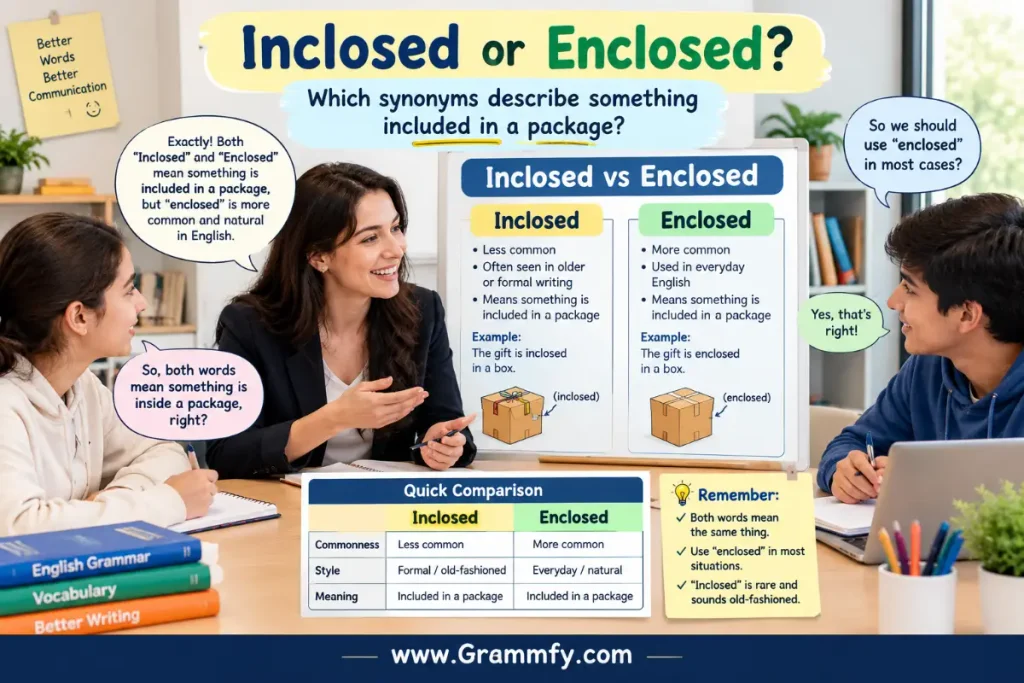
When the meaning is “put inside,” consider:
- included
- inserted
- contained
- packed
- enclosed
- placed inside
For example:
- A copy of the receipt was included with the order.
This is often more natural than enclosed in casual writing.
For formal correspondence:
- A copy of the receipt is enclosed.
works well.
Enclosed vs. contained: what’s different?
Enclosed means surrounding something or placing it within a boundary. Contained means holding something inside something else.
Compare:
| Enclosed | Contained |
|---|---|
| Focuses on enclosure or surrounding | Focuses on what something holds |
| Often suggests a boundary | Often suggests contents |
| The garden was enclosed by a wall | The box contained books |
| The document was enclosed in the envelope | The envelope contained the document |
For example:
- The garden was enclosed by a stone wall.
The wall creates the boundary.
- The box contained several books.
The box holds the books.
The words can overlap, but the focus is different.
Enclosed vs. surrounded: what’s different?
Surrounded simply means something is around another thing. Enclosed often suggests that the surrounding boundary closes something in.
Compare:
The house was surrounded by trees.
The trees were around the house.
The garden was enclosed by a fence.
The fence creates a boundary around the garden.
People can surround a place without fully enclosing it. For example, trees can surround a building while leaving it completely open to the outside.
This distinction can make your writing more precise.
Enclosed vs. confined: what’s different?
Enclosed is usually neutral. Confined often suggests limitation, restriction, or lack of freedom.
Compare:
The animals were in an enclosed area.
This simply describes their surroundings.
The animals were confined to a small area.
This emphasizes that their movement was restricted.
The second sentence can sound negative because confined often suggests that someone or something cannot move freely.
What are the synonyms by intensity?
Different words can express different levels of restriction.
| Level | Word | Typical feeling |
|---|---|---|
| Mild | Included | Simply added |
| Mild | Contained | Held inside |
| Mild | Surrounded | Has things around it |
| Moderate | Enclosed | Closed in or included |
| Moderate | Sealed | Closed tightly |
| Moderate | Restricted | Limited |
| Strong | Confined | Strongly limited |
| Strong | Trapped | Unable to escape |
| Strong | Isolated | Kept apart |
| Strong | Imprisoned | Kept against one’s freedom |
These aren’t perfect synonyms, but the scale helps show how word choice changes the feeling of a sentence.
For example:
- The document was enclosed in an envelope.
is neutral.
- The animal was confined to a small cage.
is much stronger.
- The animal was trapped inside the cage.
suggests that escape is impossible or unwanted.
Does “enclosed” function as a verb, an adjective, or both?
Enclosed is primarily the past tense and past participle of the verb enclose, but it can also function as an adjective.
As a verb:
She enclosed the documents with her application.
Here, enclosed describes an action.
As an adjective:
Please read the enclosed document.
Here, enclosed describes the document.
Another adjective example:
The children played in an enclosed area.
Understanding this difference helps you build sentences correctly.
How does enclosed work as a verb?
As the past form of enclose, it tells us that someone surrounded something or put something inside another object.
Examples:
- She enclosed the receipt with the form.
- The builders enclosed the patio with glass.
- Workers enclosed the area with temporary fencing.
- He enclosed a copy of the contract in the envelope.
The action happened in the past.
The present form is enclose:
Please enclose a copy of your ID.
The past form is enclosed:
She enclosed a copy of her ID.
The present participle is enclosing:
Workers are enclosing the construction area.
How does enclosed work as an adjective?
As an adjective, enclosed describes something that is surrounded or included.
Examples:
- Please read the enclosed instructions.
- The enclosed patio stays warm in winter.
- The animals were kept in an enclosed space.
- The enclosed document contains the payment details.
This use is especially common in formal letters.
Which word should you use on a resume: Inclosed or Enclosed?
For a resume, enclosed can be appropriate when describing a physical document, but attached is usually more natural when talking about a digital resume.
- For example, in a traditional letter:
I have enclosed my resume for your consideration.
- For an email:
I have attached my resume for your consideration.
The difference is practical rather than grammatical.
- If you’re describing an enclosed work area or facility on your resume, use the word when it adds useful information:
Managed operations in an enclosed storage facility.
Don’t use enclosed simply because it sounds professional. Make sure the word gives the reader meaningful information.
Which word should you use in an essay: Inclosed or Enclosed?
For an essay, enclosed is a useful word when you are describing something surrounded by a boundary.
Example:
The village was enclosed by a stone wall.
It can also describe something physically contained:
The letter enclosed a detailed explanation of the plan.
However, in many academic sentences, surrounded, contained, or included may be simpler.
Choose based on the exact relationship you want to describe.
What is the best word for texting Inclosed or Enclosed?
Texting usually favors simpler words.
Instead of:
The document is enclosed.
you might write:
I sent the document with the letter.
Or, for a digital message:
I attached the document.
If you’re talking about a physical place, enclosed is perfectly normal:
The balcony is enclosed now.
There is no need to avoid the word in casual communication. Just use the word that sounds natural for the situation.
Which word should you use in an email: Inclosed or Enclosed?
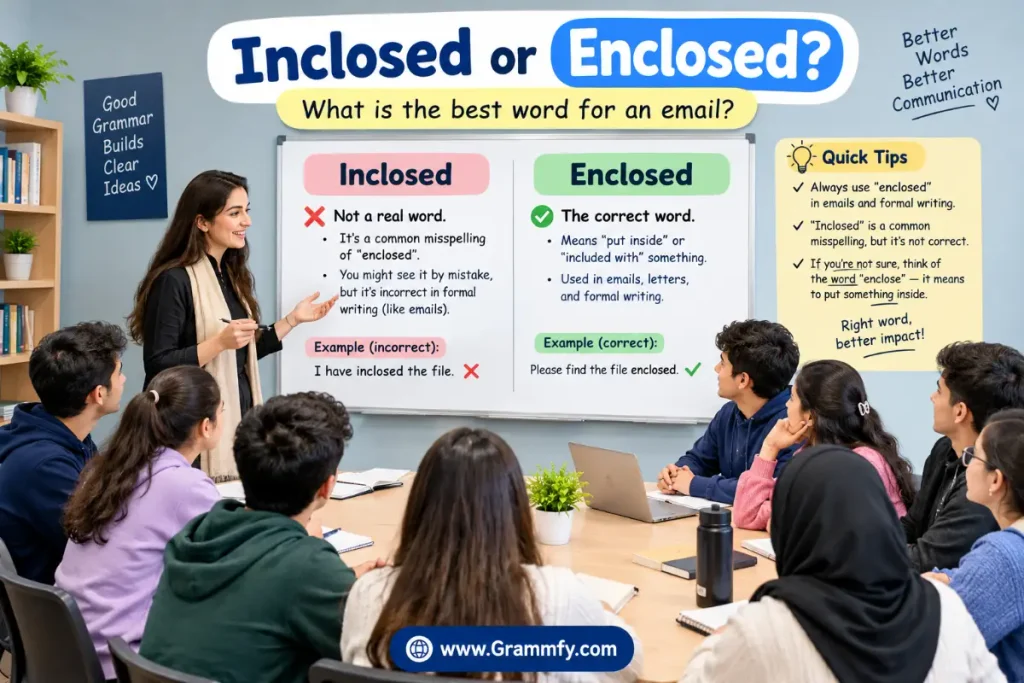
For a modern email, attached is usually the clearest choice for a digital file.
For example:
I’ve attached the report for your review.
If the message refers to a physical letter or package, enclosed is appropriate:
The signed form is enclosed with the letter.
This distinction is useful because older business-writing advice often uses enclosed in situations where modern email writers would naturally say attached.
What is the best word for speaking Inclosed or Enclosed?
In everyday speech, enclosed is common enough, especially when talking about spaces.
For example:
- The porch is fully enclosed.
When discussing documents, people may say:
- I included the form.
or:
- I put the form in the envelope.
These can sound more conversational than:
- I enclosed the form.
Still, enclosed is not too formal for speech. It simply has a slightly more formal tone in some contexts.
15+ original examples using enclosed
Here are examples from different real-life situations.
- The garden was enclosed by a wooden fence.
- Please review the enclosed document before signing it.
- I have enclosed a copy of the receipt with the letter.
- The children played safely in the enclosed playground.
- The balcony was enclosed with clear glass panels.
- The package contained an enclosed instruction sheet.
- The farm has an enclosed area for young animals.
- A signed copy of the agreement was enclosed with the application.
- The old courtyard was completely enclosed by brick walls.
- The technician inspected the enclosed electrical compartment.
- The email included a digital file, so the writer used attached instead of enclosed.
- The parking area was enclosed by a security fence.
- The museum placed the artifact in an enclosed glass case.
- The letter said that a payment form was enclosed.
- The plants were kept in an enclosed greenhouse.
- The construction site was enclosed with temporary barriers.
- The dog remained in an enclosed yard while the gate was repaired.
- The report was enclosed in the folder for the manager.
- The narrow courtyard was enclosed on three sides by buildings.
- The hikers entered an enclosed viewing area near the trail.
These examples show that the word can work in formal, everyday, physical, and document-related contexts.
10 examples using the older form inclosed
The older spelling may appear in historical material or when someone intentionally preserves an original form.
- The letter was inclosed with the official notice.
- The document was inclosed in a sealed envelope.
- The garden was inclosed by a high stone wall.
- A copy of the agreement was inclosed with the letter.
- The animals were inclosed within a wooden enclosure.
- The old manuscript described land inclosed by a fence.
- The writer said that a receipt was inclosed with the payment.
- The parcel arrived with a note inclosed inside.
- The estate was inclosed by a boundary wall.
- The historical record used the spelling inclosed throughout.
These examples are useful for understanding older texts, but they do not mean that you should normally use the spelling in modern writing.
Common mistakes with inclosed or enclosed
Mistake 1: Using inclosed in modern formal writing
Although the form exists historically, it can look outdated to a modern reader.
Instead of:
- Please find the document inclosed.
write:
- Please find the document enclosed.
Mistake 2: Assuming inclosed and enclosed have different meanings
They generally refer to the same basic idea.
The important distinction is usage and spelling history, not a completely different definition.
Mistake 3: Confusing enclosed with included
These words overlap in some contexts, but they are not always interchangeable.
- The report was included with the application.
means the report was supplied as part of the application.
- The report was enclosed in the envelope.
focuses on its physical placement inside the envelope.
Mistake 4: Using enclosed for a digital attachment
In an email, this can sound old-fashioned or unclear.
Instead of:
- Please find the report enclosed.
you can write:
- Please find the report attached.
This is especially useful when the reader is opening a digital document.
Mistake 5: Confusing enclosed with locked
A room can be enclosed without being locked.
- The balcony is enclosed by glass.
does not mean the balcony is locked.
Likewise, something can be locked without being enclosed by walls.
These words describe different features.
When should you not use enclosed?
Avoid enclosed when another word gives the meaning more accurately.
- Use attached for digital files
I’ve attached the invoice.
- Use included when something is supplied as part of a group
The package included a user guide.
- Use surrounded when describing things around an object
The house was surrounded by trees.
- Use sealed when something is closed tightly
The envelope was sealed.
- Use confined when movement is restricted
The animal was confined to a small area.
- Use covered when something has a covering
The table was covered with a cloth.
Precise word choice makes your writing clearer.
What are the antonyms of enclosed?
The opposite of enclosed depends on its meaning.
- For a physical space, possible opposites include:
- open
- exposed
- uncovered
- accessible
- unconfined
- unrestricted
- For something included inside a package, possible contrasts include:
- removed
- excluded
- separate
- outside
- omitted
For example:
The patio is enclosed.
The contrast might be:
The patio is open.
For a document:
The receipt is enclosed.
The contrast could be:
The receipt was left out.
There isn’t one perfect antonym for every use.
Enclosed vs. open: what’s different?
These words often form a simple contrast.
Enclosed suggests that a boundary surrounds or closes something.
Open suggests that there is no such complete barrier or restriction.
Compare:
The porch is enclosed with glass.
The porch is open on three sides.
The first describes a protected space with a boundary. The second emphasizes access to the outside.
Enclosed vs. sealed: what’s different?
Someone seals an object tightly to prevent air, liquid, dust, or other material from entering or leaving.
An enclosed object simply has something around it or inside a container.
For example:
The document was enclosed in the envelope.
The document is inside.
The envelope was closed tightly.
You can enclose a document in an envelope and then seal it.
Enclosed vs. covered: what’s different?
People usually cover something by placing one thing over another.
Compare:
- The food was covered with foil.
The foil is over the food.
- The food was enclosed in a container.
The container surrounds or holds the food.
This distinction is useful in descriptions of packaging, buildings, and objects.
US vs. UK spelling: is there a difference?
There is no major modern US-versus-UK spelling difference that requires American writers to use enclosed and British writers to use inclosed.
That is an important point.
Dictionary.com lists enclose in both American and British English and records inclose as a less common spelling.
So don’t treat inclosed as “the British spelling” and enclosed as “the American spelling.” That would be misleading.
The more useful distinction is:
- Enclosed = standard modern form
- Inclosed = older or less common variant
Modern writers in both varieties of English will normally choose enclosed.
How do historical writers handle spelling?
If you’re quoting an old document, preserve the original spelling when accuracy matters.
For example, if the original text says:
- The letter was inclosed with the report.
you shouldn’t silently change the quotation to enclosed if your purpose is to reproduce the original wording.
However, if you’re writing your own modern summary of that document, use current spelling:
- The letter was enclosed with the report.
This distinction matters in:
- historical research
- academic quotations
- archival documents
- literary analysis
- transcriptions
- discussions of language history
What is the easiest way to remember the correct spelling?
Use the base word enclose.
Then add -d:
enclose → enclosed
You can connect it with familiar words:
- close → closed
- enclose → enclosed
- expose → exposed
- compose → composed
If you’re writing modern English and hesitate between the two forms, choose enclosed.
A second memory trick is to connect the word with the phrase “close inside.”
Something that is enclosed is usually:
- closed in,
- surrounded,
- or placed inside.
Quick tips for choosing the right word Inclosed or Enclosed
Keep these rules handy:
- Choose enclosed for normal modern English.
- Treat inclosed as an older or less common variant.
- Don’t assume inclosed is the standard British spelling.
- Use attached for most digital email files.
- Use included when something is simply part of a group.
- Use surrounded when the focus is on things around something.
- Use confined when someone restricts movement or freedom.
- Use sealed when someone closes something tightly.
- Use covered when someone places something over another thing.
- Use enclosed when a boundary surrounds something or someone places something inside an envelope or package.
- Keep historical spellings when accurately quoting original documents.
- Don’t switch between inclosed and enclosed randomly in modern writing.
- Pick the word that describes the exact relationship you mean.
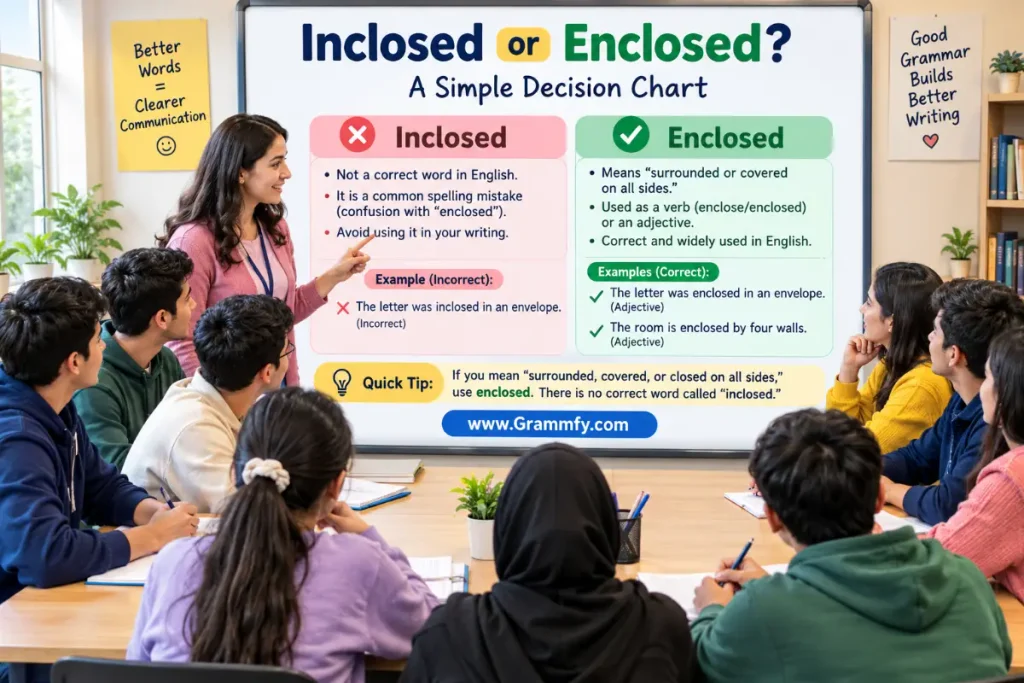
A simple decision chart About Inclosed or Enclosed
| What do you mean? | Best word |
|---|---|
| Standard modern spelling | Enclosed |
| Older historical spelling | Inclosed |
| Put a file into an email | Attached |
| Put something inside a physical letter | Enclosed |
| Add something as part of a group | Included |
| Have something all around another thing | Surrounded |
| Keep something within limits | Confined |
| Close something tightly | Sealed |
| Put something over another thing | Covered |
| Keep something away from others | Isolated |
| Protect something from outside conditions | Sheltered |
What should you write in a professional letter?
If you’re writing a traditional paper letter, enclosed is a natural formal choice.
Examples:
- I have enclosed a copy of the signed agreement.
- Please review the enclosed form.
- I have enclosed the requested documents.
These sentences are professional and clear.
If you’re writing an email, attached will often be more natural:
- I have attached a copy of the signed agreement.
- Please review the attached form.
- I have attached the requested documents.
The medium changes the most natural word.
What should you write in a school assignment?
For schoolwork, use enclosed when it accurately describes the meaning.
Example:
- A tall wall enclosed the garden.
Avoid inclosed unless you’re specifically discussing historical spelling.
A teacher reading modern English will generally expect the current standard form.
What should you write in a grammar or spelling article?
For a modern educational article, use enclosed as the main form and explain inclosed as an older or less common variant.
This approach gives readers the answer they need while also explaining why they may have seen the alternative spelling.
A useful explanation is:
- Enclosed is the standard modern form. Inclosed is an older or less common spelling related to inclose.
That distinction is more helpful than simply labeling one word “wrong.”
Why does spelling history matter?
Spelling history explains why English contains words that look unusual but are still recognizable.
English developed through centuries of contact among different languages, writing traditions, and regional varieties. As spelling became more standardized, some older forms became less common.
The history of inclose and enclose is a small example of this larger process. Dictionary.com still records inclose as a less common spelling of enclose.
Learning this helps you read older English without assuming every unfamiliar spelling is an error.
It also explains why dictionaries sometimes list variants instead of declaring that only one form has ever existed.
Conclusion
When choosing between inclosed or enclosed, modern writers should normally choose enclosed.
People use this standard spelling when they describe something surrounded, closed in, or placed inside a letter, envelope, package, or other container.
Inclosed isn’t simply meaningless or invented. It comes from the older spelling inclose, which dictionaries still record as a less common form of enclose. You may therefore see it in historical books, old correspondence, or original documents.
For schoolwork, professional writing, websites, resumes, and everyday communication, stick with enclosed. If you’re writing an email about a digital file, attached may be even more natural. Once you focus on the exact meaning rather than just the spelling, choosing the right word becomes much easier.
Frequently Asked Questions
Is inclosed or enclosed correct?
Enclosed is the standard modern spelling. Inclosed is an older or less common variant connected with inclose.
Is inclosed a real word?
Yes, inclosed is a recognized historical or less common form. Modern writers should normally use enclosed instead.
What does enclosed mean?
Enclosed means surrounded, closed in, or placed inside an envelope, package, or similar container. The exact meaning depends on context.
What’s another way to say enclosed?
Possible alternatives include surrounded, contained, included, confined, sealed, covered, and encased. The best choice depends on what you mean.
Should I use enclosed in an email?
Use attached for most digital email files. Use enclosed when referring to something physically included with a letter or package.
Is inclosed the British spelling of enclosed?
No, not as a simple US-versus-UK spelling rule.
Dictionaries record inclose as a less common spelling of enclose, but modern English speakers and writers use enclose as the standard form.
How do I remember the spelling of enclosed?
Remember the base verb “enclose” and add “-d” to form “enclosed.” If you’re writing modern English, choose enclosed unless you’re intentionally reproducing an older spelling.
