
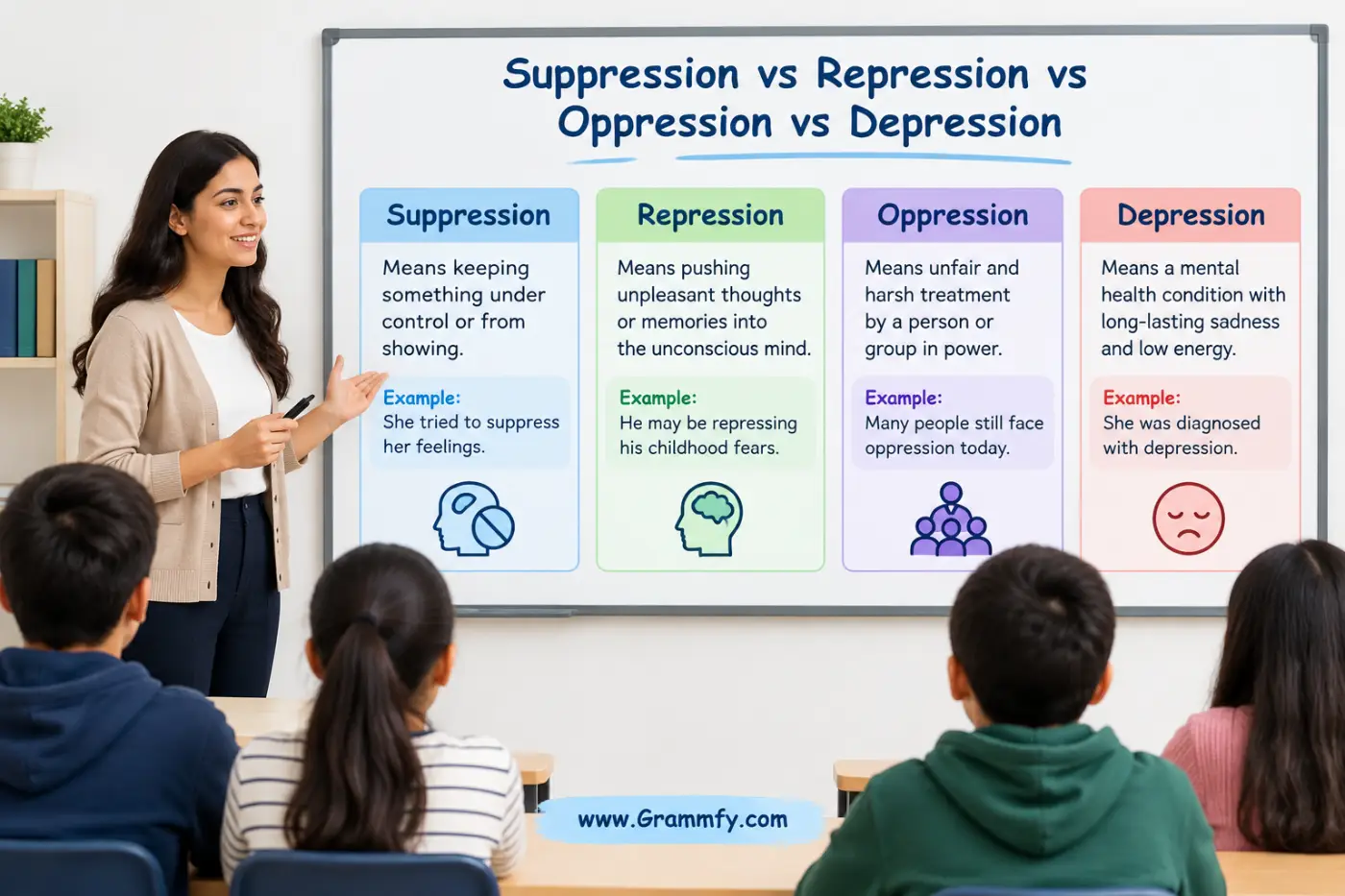
Have you ever searched for the right word to describe a difficult feeling or situation? Maybe you’re writing an essay, a text, a personal statement, or an email and get stuck between words that seem almost the same. Suppression vs repression vs oppression vs depression can be confusing because all four words relate to something being held down, controlled, or experienced as painful. But they describe very different ideas.
Quick answer: Suppression is the deliberate holding back of something, while repression usually involves pushing thoughts or feelings out of conscious awareness. Oppression means unfair or cruel control over people, while depression is a mental health condition involving persistent low mood and other symptoms.
The key difference is what is being held down, who is doing it, and whether the word describes an action, social condition, or health condition. Suppression can be intentional and conscious. Repression often refers to thoughts or feelings being kept outside awareness. Oppression involves power and unfair treatment. Depression describes a condition that affects mood, thinking, behavior, and daily life.
In this guide, you’ll learn the plain-English meanings, word origins, intensity levels, synonyms, common mistakes, context-based examples, and the small differences that make each word useful.
This is one of several grammar rules that can cause confusion. Learn more in [may or might].

What is the difference between suppression, repression, oppression, and depression?
The four words share the Latin root premere, meaning “to press” or “to push down.” Their prefixes change the meaning.
| Word | Plain-English meaning | Main idea |
|---|---|---|
| Suppression | Holding something back or stopping it from being expressed | Deliberate control |
| Repression | Pushing unwanted thoughts or feelings out of awareness | Psychological blocking |
| Oppression | Cruel, unfair, or unjust control over people | Abuse of power |
| Depression | A condition involving persistent low mood and other symptoms | Mental health |
A simple way to remember them is:
- Suppression = hold it back
- Repression = push it out of awareness
- Oppression = keep people down
- Depression = a condition that can make you feel persistently low
These definitions overlap slightly in everyday language, but they aren’t interchangeable.
For example:
- A student may suppress a laugh during a serious meeting.
- Someone may repress a painful memory.
- A government or powerful group may oppress a population.
- A person with depression may experience persistent sadness, loss of interest, low energy, or other symptoms.
The surrounding context usually tells you which word fits.
Where do these four words come from?
Understanding the word origins makes the differences easier to remember.
Where does “suppression” come from?
Suppression comes from Latin roots related to pressing down. The verb suppress developed the idea of stopping, restraining, or preventing something from being shown or continued.
Today, we use it in many situations:
- suppress a laugh
- suppress a reaction
- suppress information
- suppress a protest
- suppress an impulse
- suppress evidence
The central idea is stopping something from coming out, continuing, or becoming visible.
Where does “repression” come from?
Repression also comes from a Latin root connected with pressing back.
In psychology, repression became associated with the idea of unwanted thoughts, memories, or feelings being kept outside conscious awareness.
For example:
The character struggles with repressed memories from childhood.
The word can also have a broader meaning involving the restriction of expression or activity. However, its psychological use is especially important.
Where does “oppression” come from?
Oppression comes from a Latin root meaning to press down upon.
Its modern meaning developed around the idea of one person or group exercising cruel or unjust power over another.
You might read about:
- political oppression
- social oppression
- religious oppression
- economic oppression
- racial oppression
- oppression of a minority group
Unlike suppression, oppression normally involves power, inequality, and people being treated unfairly.
Where does “depression” come from?
Depression comes from a Latin root meaning to press down or lower.
The word has several historical meanings. It can describe a low area, a reduction, or a period of low economic activity. In mental health, depression refers to a condition that can involve persistent low mood, loss of interest or pleasure, changes in sleep or appetite, low energy, difficulty concentrating, and other symptoms.
So although all four words have a “pressing down” history, their modern meanings have moved in different directions.
What does suppression mean in simple English?
Suppression means deliberately holding something back, stopping it, or preventing it from being expressed.
It can involve emotions, information, actions, sounds, reactions, or events.
For example:
She suppressed her laughter during the ceremony.
She wanted to laugh, but she intentionally stopped herself.
Another example:
The company faced criticism for the suppression of important information.
Here, information was prevented from becoming known.
Suppression doesn’t always mean something negative. Sometimes controlling a reaction is useful.
He suppressed his anger and calmly explained the problem.
The person felt angry but chose not to show it.
Common forms of suppression
You can suppress:
- laughter
- anger
- tears
- emotions
- information
- evidence
- speech
- a reaction
- an impulse
- a protest
The important idea is holding something back.
What does repression mean in simple English?
Repression usually means keeping unwanted thoughts, feelings, memories, or desires outside conscious awareness.
The word is strongly associated with psychology.
For example:
She had repressed feelings of anger toward her father.
The idea is not simply that she decided not to show anger. Rather, those feelings may have been pushed away from conscious awareness.
This is an important difference from suppression.
Compare:
He suppressed his anger during the meeting.
He knew he was angry and intentionally controlled his reaction.
He repressed his anger.
This suggests that the anger was pushed away psychologically rather than simply hidden for a few minutes.
In ordinary conversation, people sometimes use repression loosely to mean “holding feelings inside.” In psychology, however, the concept can be more specific.
What does oppression mean in simple English?
Oppression means treating people unfairly or cruelly through the use of power or control.
It normally involves a person, institution, government, or social system having power over others.
For example:
The community fought against political oppression.
The word doesn’t simply mean “feeling bad.” It describes an unfair power relationship.
Other examples include:
The novel explores the oppression of poor workers.
The movement challenged years of social oppression.
The law was criticized as a tool of oppression.
Oppression can be physical, political, social, economic, or institutional.
What makes oppression different?
Look for these ideas:
- Power
- Control
- Unfair treatment
- A person or group being restricted or harmed
If those ideas aren’t present, oppression may not be the right word.
What does depression mean in simple English?
Depression is a mental health condition that can cause persistent low mood, loss of interest or pleasure, low energy, changes in sleep or appetite, difficulty concentrating, and other symptoms.
It is much more than having a bad day.
For example:
Depression can affect a person’s work, relationships, sleep, and daily activities.
The word also has non-medical meanings:
- economic depression
- depression in the land
- atmospheric depression
Because of this, context matters.
When discussing mental health, depression refers to a health condition. When discussing economics, it can refer to a severe and prolonged economic downturn.
Suppression vs repression vs oppression vs depression: what’s the easiest way to remember them?
Think of the direction of the action.
| Word | Think of it as | Example |
|---|---|---|
| Suppression | Holding something back | She suppressed a laugh. |
| Repression | Pushing something out of awareness | He repressed painful feelings. |
| Oppression | Keeping people down through unfair power | The group suffered oppression. |
| Depression | A persistent low state or health condition | She is receiving help for depression. |
A useful memory trick is:
Suppress = stop it.
Repress = push it away.
Oppress = push people down.
Depress = press down or lower.
What are the synonyms for suppression vs repression vs oppression vs depression?
The best synonym depends on the meaning and tone. A word that works for suppression may sound completely wrong when describing depression.
Here is a larger synonym list grouped by style.
Simple synonyms
| Word | Meaning | Tone | Example |
|---|---|---|---|
| holding back | Preventing expression | Neutral | She was holding back her tears. |
| stopping | Preventing something | Simple | The rule is stopping the noise. |
| control | Keeping something under control | Neutral | He controlled his reaction. |
| silencing | Preventing someone from speaking | Strong | The policy was accused of silencing critics. |
| blocking | Preventing something from happening | Neutral | Fear was blocking her progress. |
| restraint | Controlled behavior | Formal-neutral | He showed restraint. |
| restriction | Limiting freedom or action | Neutral | The restriction affected local businesses. |
Everyday synonyms
| Word | Meaning | Tone | Example |
|---|---|---|---|
| hide | Keep something from view | Casual | She hid her disappointment. |
| bottle up | Keep emotions inside | Casual | Don’t bottle up your feelings. |
| hold in | Stop an emotion or reaction from showing | Casual | He held in his laughter. |
| keep quiet | Avoid speaking | Casual | She decided to keep quiet. |
| push aside | Avoid dealing with something | Everyday | He pushed aside his worries. |
| shut down | Stop expression or activity | Casual | He shut down during the argument. |
| keep down | Prevent something from rising or growing | Everyday | The medicine helped keep the symptoms down. |
Formal synonyms
| Word | Meaning | Tone | Example |
|---|---|---|---|
| repression | Psychological pushing away of unwanted material | Formal | The paper examines emotional repression. |
| constraint | A limit placed on action | Formal | The policy created serious constraints. |
| prohibition | An official ban | Formal | The prohibition prevented public demonstrations. |
| subjugation | Bringing people under control | Strong/formal | The history describes the subjugation of local communities. |
| domination | Strong control over others | Formal | The region resisted foreign domination. |
| subordination | Placing someone in a lower position | Formal | The system reinforced social subordination. |
| marginalization | Pushing a group to the edge of society | Formal | The policy increased the marginalization of rural communities. |
| coercion | Using force or threats to control someone | Formal | The agreement was made under coercion. |
Informal or slang-like alternatives
These are not exact synonyms in every context, so use them carefully.
| Word/Phrase | Meaning | Tone | Example |
|---|---|---|---|
| bottle it up | Keep feelings inside | Informal | He tends to bottle it up. |
| hold it in | Stop a reaction from coming out | Informal | I had to hold it in. |
| bury it | Avoid dealing with a feeling | Informal | She tried to bury the memory. |
| shut someone down | Stop someone from speaking or acting | Informal | They tried to shut him down. |
| keep a lid on | Keep something controlled | Informal | The manager tried to keep a lid on the dispute. |
| push it down | Avoid facing a feeling | Informal | He kept pushing his anger down. |
These expressions shouldn’t replace oppression or depression when you’re talking about their specific meanings.
What are synonyms for suppression from mild to strong?
The intensity changes depending on the word you choose.
Mild
- hold back
- manage
- control
- restrain
- limit
Moderate
- restrict
- conceal
- silence
- block
- inhibit
Strong
- suppress
- censor
- prohibit
- crush
- silence completely
Very strong or context-specific
- subjugate
- persecute
- dominate
- oppress
Be careful with the last group. Oppress is not simply a stronger version of suppress. It describes unfair control over people.
What are synonyms for repression from mild to strong?
For emotional or psychological contexts, you can move through several levels:
Mild
- hide feelings
- hold feelings back
- avoid
- ignore
- push aside
Moderate
- bottle up
- bury feelings
- inhibit
- block
- keep out of awareness
Strong
- repress
- deeply internalize
- shut down emotionally
Not every synonym has exactly the same psychological meaning. For formal writing, repression is usually more precise than casual expressions such as “bottling things up.”
What are synonyms for oppression from mild to strong?
Because oppression involves power and unfair treatment, its synonyms are more serious.
Less intense or broader
- restriction
- control
- domination
- inequality
- discrimination
Stronger
- exploitation
- persecution
- subjugation
- tyranny
- coercion
Very strong
- systemic oppression
- brutal domination
- severe persecution
Again, these aren’t perfect substitutes. Discrimination, for example, can describe unfair treatment without necessarily describing the full system of power implied by oppression.
What are synonyms for depression?
The right alternative depends on whether you mean the medical condition or a general feeling.
- For everyday sadness
- sadness
- unhappiness
- low mood
- discouragement
- disappointment
- gloom
- despair
- For formal writing
- depressive symptoms
- depressive disorder
- persistent low mood
- emotional distress
- For economic depression
- severe economic downturn
- prolonged recession
- economic collapse
- major economic decline
Don’t automatically use sadness as a synonym for clinical depression. A person can feel sad without having depression.

Suppression vs repression: what’s different?
The clearest difference is awareness and intention.
| Suppression | Repression |
|---|---|
| Often conscious | Often outside conscious awareness |
| Usually intentional | Usually described as psychological |
| You know you’re holding something back | You may not fully recognize what has been pushed away |
| Can involve information, behavior, emotions, or actions | Commonly involves thoughts, memories, feelings, or desires |
Consider these two sentences:
Maria suppressed her tears during the interview.
She knew she was about to cry and tried not to show it.
Maria repressed memories of the traumatic event.
The sentence suggests that the memories were kept outside conscious awareness.
Which word should you use?
Use suppression when you mean deliberately holding something back.
Use repression when you mean psychologically pushing unwanted material away, especially in formal or psychological contexts.
Suppression vs oppression: what’s different?
These two words are easy to confuse because both can involve control.
Suppression focuses on stopping something.
Oppression focuses on unfair control over people.
Compare:
The government suppressed the protest.
The sentence focuses on stopping the protest.
The people suffered under government oppression.
The sentence focuses on an unjust system of control over people.
The same situation might involve both words:
The authorities used suppression to silence protests against political oppression.
Here, suppression describes an action, while oppression describes the broader unjust condition.
Repression vs oppression: what’s different?
The main difference is what is being pushed down.
Repression often concerns thoughts, memories, feelings, or desires.
Oppression concerns people and their freedom or rights.
Compare:
He experienced emotional repression.
versus:
The community experienced political oppression.
The first describes an internal psychological process. The second describes an external social or political condition.
Depression vs oppression: what’s different?
These words sound similar but describe very different things.
Depression can describe a mental health condition or a state of economic or physical lowering.
Oppression describes unfair or cruel control.
For example:
She sought professional help for depression.
The workers protested against oppression.
A person can experience both emotional distress and an oppressive environment, but the words themselves aren’t interchangeable.
Suppression vs depression: what’s different?
These words can appear together when discussing emotions, but they have different meanings.
He suppressed his feelings.
This means he held them back.
He experienced depression.
This describes a health condition or state, depending on context.
Don’t use depression simply because someone is hiding emotions. Likewise, don’t use suppression to name a mental health condition.
How do these words work as different parts of speech?
Each word has related noun, verb, and adjective forms.
| Noun | Verb | Adjective | Example |
|---|---|---|---|
| suppression | suppress | suppressed | The policy suppressed criticism. |
| repression | repress | repressed | She repressed painful emotions. |
| oppression | oppress | oppressive | The regime was oppressive. |
| depression | depress | depressed/depressive | He felt depressed. |
There are important differences in how these forms are used.
For example:
The government suppressed the protest.
But:
The government used suppression to stop the protest.
Likewise:
The system oppressed the workers.
But:
The workers lived under oppression.
Which word should you use in an essay?
For an academic essay, choose the word that precisely matches your idea.
Use suppression when:
- discussing censorship
- describing restricted information
- explaining controlled reactions
- discussing the stopping of protests or activity
Example:
The suppression of public criticism limited open discussion.
Use repression when:
- discussing psychology
- describing unwanted memories or feelings
- discussing emotional control
- analyzing literary characters
Example:
The novel explores the repression of painful memories.
Use oppression when:
- discussing social injustice
- analyzing political systems
- describing unequal power
- discussing historical abuse
Example:
The essay examines how political oppression affected ordinary citizens.
Use depression when:
- discussing mental health
- discussing depressive symptoms
- discussing economic history
- discussing a physical low point
Example:
The essay explains how depression can affect concentration and daily life.
Which word works best in a resume “Suppression vs Repression vs Oppression vs Depression”?
A resume usually needs precise, professional language. These words are less common than action verbs, but they can still appear in the right context.
Better uses of suppression
Developed procedures to suppress system errors.
Better uses of oppression
Usually, oppression isn’t a resume word unless you’re describing relevant research, advocacy, education, or community work.
Conducted research on social oppression and workplace inequality.
Better uses of repression
Use it mainly for relevant academic, research, counseling, or social science experience.
Studied emotional repression in modern literature.
Better uses of depression
If relevant to your professional experience, use precise language and avoid making unsupported claims.
Conducted research on depression and workplace stress.
A resume should focus on your skills and experience rather than using serious terms simply because they sound powerful.
Which word works best in a text message “Suppression vs Repression vs Oppression vs Depression”?
Texting usually favors simple, natural language.
Instead of:
I’m experiencing emotional repression.
A friend might say:
I’ve been holding my feelings in.
Instead of:
The government is engaged in oppression.
A casual message might say:
They keep treating people unfairly.
But if you’re discussing a serious political issue, oppression may still be the most accurate word.
For depression, avoid casually labeling normal sadness as depression.
Instead of:
I’m depressed because my team lost.
You could say:
I’m really upset that my team lost.
This keeps the language proportional to the situation.
Which word works best in an email “Suppression vs Repression vs Oppression vs Depression”?
Professional emails need clear wording.
- For information
The report discusses the suppression of key findings.
- For emotions
I tried to suppress my frustration during the meeting.
- For social issues
The presentation examines the effects of political oppression.
- For mental health
Use depression only when it is actually relevant.
The study focuses on workplace factors associated with depression.
Avoid using these words to make a normal workplace problem sound more dramatic than it is.
Which word works best when speaking “Suppression vs Repression vs Oppression vs Depression”?
In everyday speech, simpler phrases often sound more natural.
Instead of:
I experienced emotional repression.
You might say:
I kept my feelings inside.
Instead of:
I attempted to suppress my anger.
You might say:
I tried not to show my anger.
However, suppression, repression, oppression, and depression are perfectly normal words when the situation calls for them.
The goal isn’t to avoid difficult words. The goal is to use the word that expresses your exact meaning.
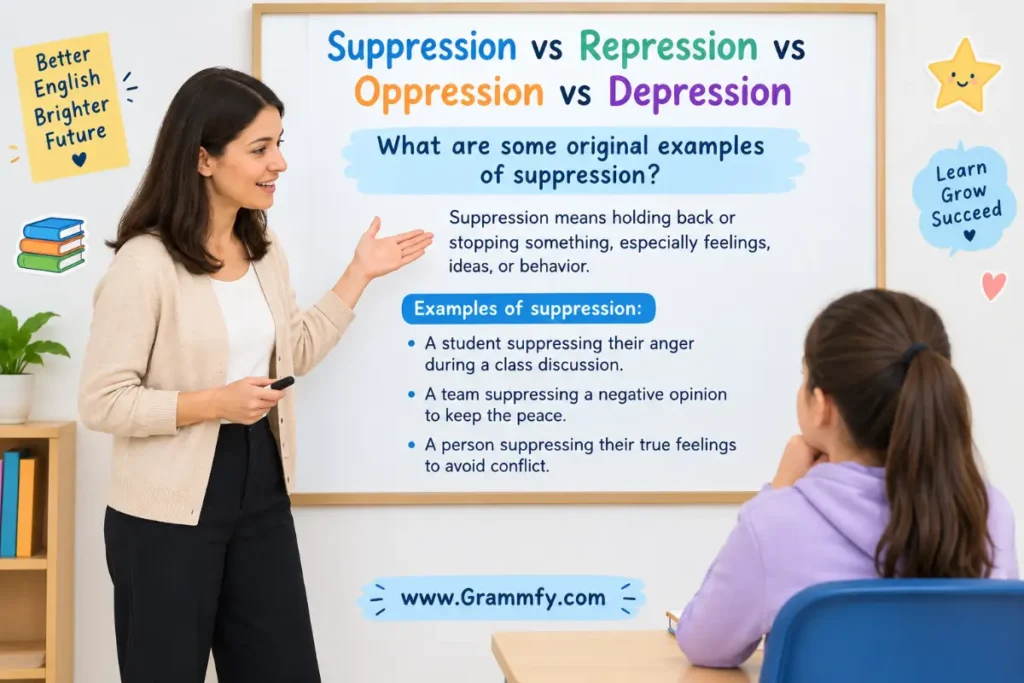
What are some original examples of suppression?
Here are several real-life examples:
- She suppressed a laugh when the teacher made a joke.
- The editor questioned the suppression of important facts.
- He tried to suppress his anger during the discussion.
- The medication was used to suppress the allergic response.
- The authorities attempted to suppress the protest.
Notice that suppression can involve emotions, information, physical responses, or public activity.
What are some original examples of repression?
- The character shows signs of repressed anger.
- The story explores the repression of painful memories.
- Years of emotional repression affected his relationships.
- The therapist helped her talk about feelings she had pushed away.
- The novel presents repression as a source of inner conflict.
The word often appears in psychological and literary discussions.
What are some original examples of oppression?
- The novel describes life under political oppression.
- The workers organized to challenge unfair treatment and oppression.
- The documentary examines the history of social oppression.
- The community resisted a system that had oppressed them for years.
- The law was criticized for reinforcing economic inequality and oppression.
These examples involve power and unfair treatment.
What are some original examples of depression?
- Depression can affect a person’s energy and concentration.
- She sought professional support after experiencing persistent symptoms of depression.
- The book discusses how depression can affect daily routines.
- The country experienced a severe economic depression during the historical period described.
- The doctor explained that depression involves more than occasional sadness.
The context tells you whether depression refers to mental health, economics, or another meaning.
What are the most common mistakes with these words?
Mistake 1: Using suppression and repression as exact synonyms
They overlap, but they aren’t always identical.
Better:
He suppressed his anger during the meeting.
Use repression when the context points to a psychological process involving unwanted material being pushed outside awareness.
Mistake 2: Using oppression for any difficult situation
Oppression involves unfair or cruel control.
Incorrect:
My homework is oppression.
Better:
My workload is stressful.
Mistake 3: Calling ordinary sadness depression
Feeling sad after a disappointing event doesn’t automatically mean someone has depression.
Better:
I feel sad today.
Use depression when discussing the health condition or a context where the word is actually appropriate.
Mistake 4: Treating repression as simply “not talking”
Someone can choose not to discuss a feeling without that being psychological repression.
She didn’t discuss her anger.
This is different from making a claim about repression.
Mistake 5: Using the strongest word when a simple one works
Strong vocabulary isn’t automatically better vocabulary.
Compare:
The company suppressed the report.
with:
The company hid the report.
Depending on the facts, the second sentence may be clearer.
Mistake 6: Confusing “oppressive” with “depressive”
Oppressive means harsh, unfair, or burdensome.
Depressive relates to depression or a lowering effect.
For example:
The oppressive heat made it difficult to work.
This does not mean the heat caused clinical depression.
When should you NOT use suppression?
Don’t use suppression when you simply mean:
- sadness
- confusion
- disagreement
- disappointment
- normal silence
For example:
I felt suppression after losing my job.
This is unclear.
Better:
I felt sadness after losing my job.
Or, if appropriate:
I tried to suppress my sadness after losing my job.
The second sentence clearly describes an action.
When should you NOT use repression?
Avoid repression when you only mean that someone made a temporary decision not to speak.
She didn’t mention the problem.
is not necessarily:
She repressed the problem.
The second statement makes a stronger psychological claim.
When should you NOT use oppression?
Don’t use oppression as a synonym for every form of pressure.
For example:
My boss gave me a deadline. That’s oppression.
This is normally an exaggerated use.
Better:
My boss put pressure on me to finish the project.
Oppression is appropriate when the situation involves serious, unjust, or systematic control.
When should you NOT use depression?
Don’t use depression simply to describe:
- one bad day
- temporary sadness
- boredom
- disappointment
- tiredness
- frustration
Those feelings can be real and important without being depression.
If you’re discussing mental health, it’s better to use the term carefully and avoid diagnosing yourself or another person based on a single feeling.
What are the antonyms of these words?
The opposite depends on the specific meaning.
| Word | Possible antonyms |
|---|---|
| Suppression | expression, release, disclosure, freedom |
| Repression | awareness, expression, acknowledgment |
| Oppression | freedom, equality, liberation, justice |
| Depression | well-being, happiness, recovery, elevation |
These aren’t perfect opposites in every sentence.
For example, the opposite of suppress information is often disclose information, while the opposite of suppress a laugh may be express a laugh or simply laugh openly.
How can you choose the right word quickly “Suppression vs Repression vs Oppression vs Depression”?
Ask four simple questions.
1. Am I talking about holding something back?
Choose suppression.
He suppressed his reaction.
2. Am I talking about unwanted thoughts or feelings being pushed outside awareness?
Choose repression.
The story explores repressed memories.
3. Am I talking about unfair control over people?
Choose oppression.
The movement challenged political oppression.
4. Am I talking about a mental health condition or another state of being pressed down?
Choose depression.
The article discusses depression and its symptoms.
This four-question test works in most everyday situations.
Can suppression and repression happen at the same time?
Yes. A person can consciously hold back an emotion while also having deeper psychological processes related to that emotion.
For example:
He suppressed his anger whenever his family discussed the subject.
That sentence only tells us that he intentionally controlled his expression.
A different sentence might say:
The novel suggests that he had repressed anger connected to his childhood.
That sentence presents a deeper psychological idea.
The two concepts can overlap, but they shouldn’t automatically be treated as identical.
Can oppression cause emotional distress?
Yes, living under unfair or abusive conditions can be deeply stressful and can affect emotional well-being. However, oppression and depression still describe different things.
Oppression describes the external social or power condition.
Depression describes a mental health condition.
A sentence can mention both without treating them as synonyms:
The novel examines how political oppression affected the characters’ mental health.
This is much more precise than replacing one word with another.
Are these words always negative?
Not all of them are negative in every grammatical context.
Suppression can be neutral or negative.
The system suppresses harmful bacteria.
This isn’t necessarily a bad thing.
Repression is generally negative when used psychologically, but the tone depends on context.
Oppression is strongly negative because it describes unjust treatment.
Depression is serious when referring to the mental health condition, but the word can be neutral in other technical contexts.
The depression in the valley is visible from above.
Here, it means a low area, not a mental health condition.
What does “suppression of information” mean?
Suppression of information means preventing information from being shared, published, revealed, or accessed.
For example:
The report raised concerns about the suppression of information.
This phrase is common in journalism, politics, law, and academic writing.
You could also say:
- withholding information
- concealing information
- restricting access to information
- preventing disclosure
The best choice depends on exactly what happened.
What does “emotional suppression” mean?
Emotional suppression means consciously or intentionally holding back the expression of an emotion.
For example:
Emotional suppression may occur when someone feels unable to show anger at work.
The person may still be aware of the emotion but decide not to express it.
This is why suppression often works well when discussing conscious emotional control.
What does “repressed memories” mean?
Repressed memories is a psychological phrase describing memories that are believed to have been kept outside conscious awareness.
For example:
The character begins to confront repressed memories.
In fiction, psychology, and everyday speech, the phrase is common. In real-world mental health discussions, however, memory is complex, so it’s better not to make confident claims about a person’s hidden memories without appropriate evidence.
What does “systemic oppression” mean?
Systemic oppression refers to patterns within social, political, or institutional systems that unfairly disadvantage certain groups.
The focus is not one isolated rude act. It is the broader structure, pattern, or system.
For example:
The report examines systemic oppression in access to housing.
This is much more specific than simply saying:
Housing is oppressive.
What does “clinical depression” mean?
Clinical depression is a common term used to refer to a depressive disorder diagnosed or assessed in a clinical setting.
In everyday writing, people often use depression for the same general idea.
However, sadness alone doesn’t establish depression. Mental health professionals consider symptoms, duration, severity, and effects on daily functioning when assessing depressive disorders.
How do US and UK English use these words?
The four words have broadly similar meanings in American and British English.
There is no major US-versus-UK difference that changes the basic distinction:
- suppression = holding back or stopping
- repression = pushing unwanted material away, especially psychologically
- oppression = unjust control
- depression = a low state or health condition
Spelling is also generally the same in US and UK English.
What can vary is the preferred phrase around the word.
For example, both varieties commonly use:
political oppression
emotional repression
information suppression
clinical depression
Regional context may affect how formal or common a particular phrase sounds, but the core meanings remain stable.
How can writers avoid sounding repetitive?
If you’re writing an essay about these concepts, don’t repeat the same word in every sentence simply to target a keyword.
Instead, use accurate related terms.
- For suppression, you might use:
- restraint
- restriction
- withholding
- censorship
- concealment
- For repression:
- emotional blocking
- hidden feelings
- psychological avoidance
- internalized emotion
- For oppression:
- unjust control
- domination
- inequality
- exploitation
- subjugation
- For depression:
- depressive symptoms
- low mood
- depressive disorder
- emotional distress
Always choose the synonym based on the exact meaning.
A quick comparison table for writers
| If you mean… | Use… | Example |
|---|---|---|
| Holding back a laugh | Suppression | She suppressed a laugh. |
| Hiding an emotion intentionally | Suppression | He suppressed his anger. |
| Pushing an unwanted memory away | Repression | She struggled with repressed memories. |
| Keeping unwanted feelings outside awareness | Repression | The story explores emotional repression. |
| Unfair control of a population | Oppression | The people resisted oppression. |
| Cruel social or political control | Oppression | The book examines political oppression. |
| A mental health condition | Depression | Depression can affect daily life. |
| A severe economic downturn | Depression | The country entered an economic depression. |
| A low physical area | Depression | Water collected in a shallow depression. |
What is the fastest memory trick for all four?
Use the “press” trick.
All four words are connected historically to the idea of pressing down.
- Sup-press: press down or hold back something.
- Re-press: press back or push away.
- Op-press: press down on people through unjust power.
- De-press: press down or lower.
Then ask what is being pressed down:
Something? → suppression.
A thought or feeling? → repression.
People through unfair power? → oppression.
Mood, functioning, an economic period, or a physical low point? → depression.
This isn’t a complete dictionary definition, but it’s a useful way to remember the basic distinction.

Conclusion
Choosing the right word becomes much easier when you focus on the exact action or condition you’re describing. suppression vs repression vs oppression vs depression isn’t just a spelling or vocabulary comparison. Each word points to a different idea.
Use suppression for deliberately holding something back. Repression describes unwanted thoughts or feelings being pushed outside awareness, especially in psychological contexts. Oppression involves unfair or cruel control over people. Depression, meanwhile, refers to a mental health condition or another context involving a low state.
When you’re unsure, ask yourself one simple question: What is being held down, and why? That will usually lead you to the right word. With practice, these four terms become much easier to separate and use naturally.
Frequently Asked Questions
What is the difference between suppression and repression?
Suppression usually means consciously holding something back, while repression often refers to unwanted thoughts or feelings being pushed outside conscious awareness. The two terms can overlap, but they aren’t exact synonyms.
Is oppression the same as suppression?
No. Suppression means stopping or holding something back, while oppression means unfair or cruel control over people. A government can use suppression as part of an oppressive system.
Is repression a mental health condition?
No. Repression is a psychological concept or process, not the name of a mental health condition. Depression, by contrast, can refer to a mental health condition.
What’s another way to say suppression?
Depending on the context, you can say restraint, restriction, withholding, concealment, control, holding back, or silencing. The best alternative depends on what is being suppressed.
What is the difference between depression and oppression?
Depression can refer to a mental health condition or another kind of low state, while oppression refers to unjust or cruel control over people. They describe completely different concepts.
Is bottling up emotions the same as repression?
Not exactly. “Bottling up emotions” is an everyday expression for keeping feelings inside, while repression has a more specific psychological meaning. Suppression may be a better word when someone knowingly controls an emotional reaction.
How do I remember suppression, repression, oppression, and depression?
Remember what is being “pressed down”: suppression holds something back, repression pushes unwanted thoughts or feelings away, oppression keeps people down through unfair power, and depression describes a low state or health condition.
