
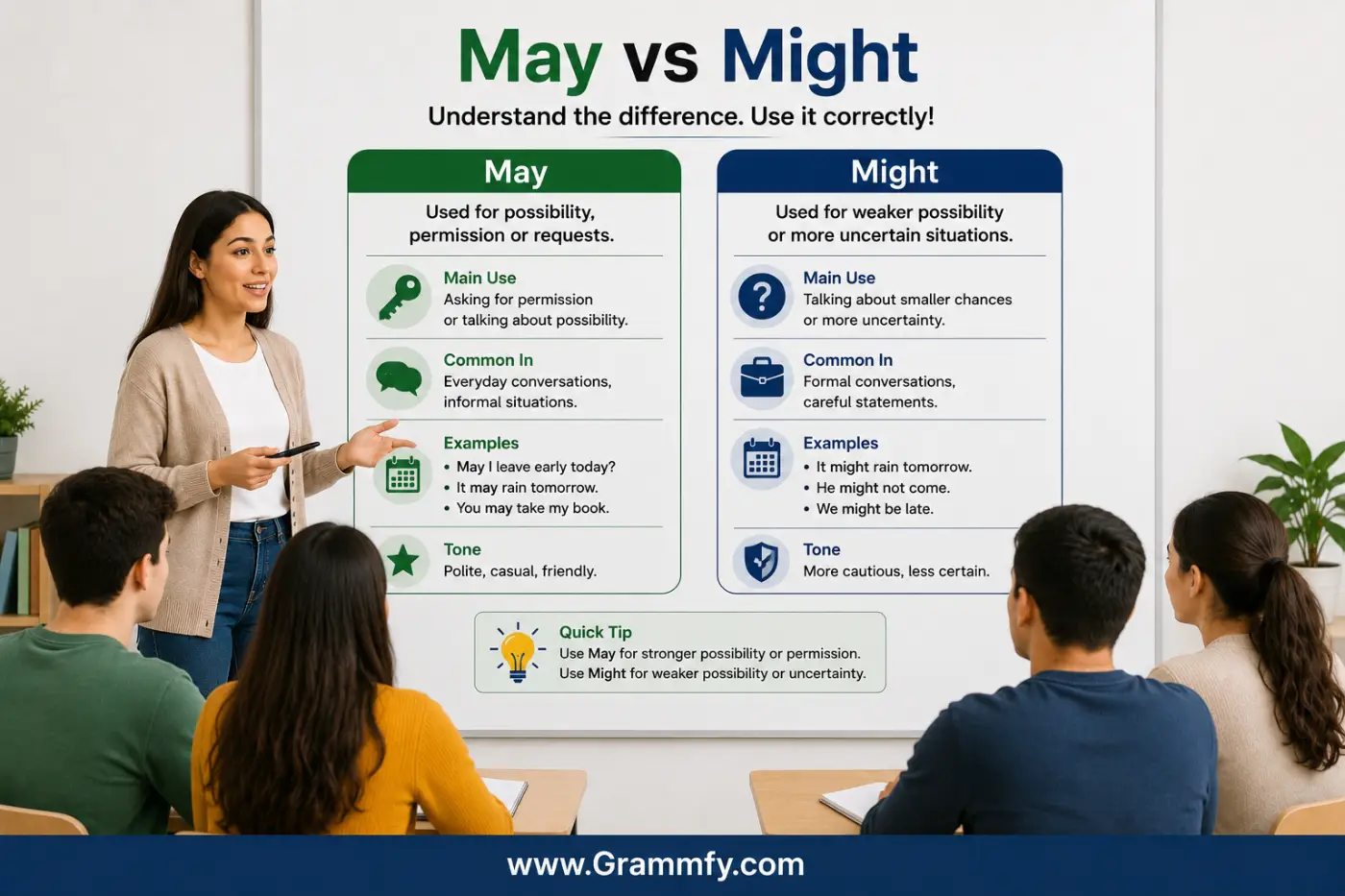
When you’re writing an email, finishing an essay, or sending a quick text, you may pause over May vs Might. Both words can talk about possibility, so they often seem interchangeable. In many sentences, they are very close in meaning. Still, there are differences in tone, certainty, grammar, and common usage that are worth knowing.
Answer Box: May and might both express possibility, but might often suggests a weaker or less certain possibility. In modern English, the two can overlap, so context usually matters more than a strict rule.
For example, “It may rain tonight” and “It might rain tonight” both mean that rain is possible. The second sentence can sound a little more uncertain, but many native speakers use the two forms almost interchangeably.
The choice becomes more interesting when you talk about past possibilities, hypothetical situations, permission, reported speech, or formal writing. This guide explains those differences in simple English, with real examples, synonym lists, common mistakes, regional notes, and practical rules for choosing the right word.
For more practical grammar examples, explore [may or shall].
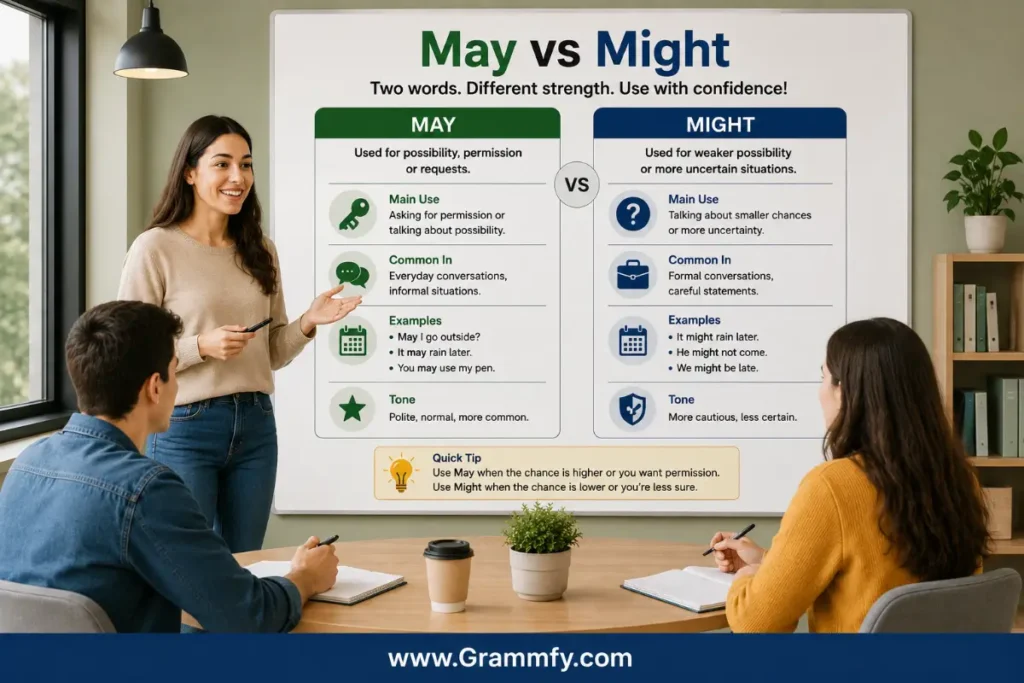
What is the basic difference between May vs Might?
May and might are modal auxiliary verbs. Their most common shared job is to express possibility.
May for possibility
Use may when something is possible.
She may come to the party tonight.
This means that her arrival is possible, but the speaker doesn’t know for certain.
Might for possibility
Use might in a similar way.
She might come to the party tonight.
This also means that her arrival is possible.
In many everyday sentences, there is very little difference.
| Word | Common meaning | Example |
|---|---|---|
| may | Possible | It may rain later. |
| might | Possible | It might rain later. |
| may | Formal permission | May I leave? |
| might | Weaker/hypothetical possibility | We might go later. |
| may | Present/future possibility | He may call. |
| might | Past possibility | He said he might call. |
The traditional rule says that might is less certain than may. That can be useful, but real English is more flexible.
When should you use may?
Use may when you want to express possibility, formal permission, or a possible future event.
May for present possibility
Sarah may be at home.
The speaker thinks Sarah is possibly at home.
May for future possibility
We may visit Boston next month.
The trip is possible, but the plan isn’t definite.
May for permission
May I ask a question?
This is a formal or polite request for permission.
May for a possible result
This change may improve the system.
The speaker believes improvement is possible.
In these examples, may often sounds neutral and slightly formal.
When should you use might?
Use might to express possibility, especially when the possibility feels uncertain, hypothetical, or dependent on a condition.
Might for uncertain possibility
I might go to the concert.
The speaker hasn’t decided.
Might for a weaker possibility
It might snow tonight.
The speaker sees snow as possible but doesn’t sound very confident.
Might for a hypothetical situation
If we leave early, we might avoid traffic.
The result depends on a condition.
Might for past possibility
She might have forgotten the appointment.
The speaker is guessing about something that may have happened.
Might is extremely common in everyday English because it lets speakers talk about uncertain situations without sounding too definite.
May vs Might: what’s the main difference?
The difference is often one of certainty, context, and tone, rather than a strict change in meaning.
A traditional explanation looks like this:
| Expression | Traditional idea |
|---|---|
| may | More likely possibility |
| might | Less likely possibility |
For example:
It may rain.
This can suggest a reasonable possibility.
It might rain.
This can suggest a less certain possibility.
However, don’t treat this as an exact percentage of probability. English speakers don’t normally use may to mean a specific level of certainty and might to mean another fixed level.
You can’t reliably say:
May = 70%
Might = 40%
English doesn’t work that precisely.
Context, tone, and the speaker’s attitude all affect the meaning.
Can May vs Might mean the same thing?
Yes. Very often they can.
Compare:
John may come tomorrow.
John might come tomorrow.
Both mean that John’s arrival is possible.
Another example:
The package may arrive today.
The package might arrive today.
Again, both express possibility.
The difference is subtle. Might can sound slightly less certain, more tentative, or more cautious.
In ordinary conversation, native speakers don’t always stop to calculate the difference.
Where did may come from?
May comes from Old English magan, a verb related to ideas of having power, ability, or being able.
Over time, its meanings developed. The word became associated with possibility and permission.
That history helps explain why modern English uses may in several ways:
- possibility: “It may rain.”
- permission: “You may leave.”
- formal requests: “May I enter?”
- wishes in certain expressions: “May you have a wonderful day.”
The older connection to ability is no longer the main meaning of modern may.
Where did might come from?
Might developed as the past form of may.
Historically, English modal verbs often had relationships between present and past forms.
For example:
- may → might
- can → could
- shall → should
- will → would
But modern English doesn’t always use these pairs as simple present-versus-past forms.
Might has developed independent uses. It can express:
- present possibility
- future possibility
- hypothetical situations
- past possibility
- indirect or reported speech
So although might is historically related to the past form of may, it doesn’t always refer to the past.
Can might talk about the present?
Yes.
This is a common misunderstanding.
She might be at home.
This sentence refers to a possible present situation.
It does not mean she was at home in the past.
Similarly:
He might know the answer.
This is about what he possibly knows now.
Present examples
- They might be waiting outside.
- She might need help.
- He might know where the keys are.
- The store might be closed.
- You might be right.
All of these refer to the present.
Can might talk about the future?
Yes, and it does so very often.
We might travel next summer.
She might call tomorrow.
The company might launch the product next year.
These sentences describe possible future events.
Might is especially useful when the speaker doesn’t want to sound certain.
Compare:
We will travel next summer.
This sounds definite.
We may travel next summer.
The trip is possible.
We might travel next summer.
The trip is possible and may sound even less certain.
Can may talk about the past?
Yes, but usually not by itself when you want to describe a past possibility.
For past possibility, English commonly uses:
may have + past participle
For example:
She may have forgotten.
This means it is possible that she forgot.
Other examples:
- He may have missed the bus.
- They may have taken the wrong road.
- She may have left early.
- The package may have arrived yesterday.
May have is very useful when you’re uncertain about something that already happened.
Can might talk about the past?
Yes.
Use:
might have + past participle
Examples:
She might have forgotten.
He might have missed the train.
They might have taken the wrong exit.
Like may have, might have expresses uncertainty about a past event.
Compare:
She may have forgotten.
She might have forgotten.
Both mean that forgetting is possible.
The second can sound a little more tentative.
May vs Might for past possibility
This is one of the most useful comparisons.
| Sentence | Meaning |
|---|---|
| She may have left. | It is possible she left. |
| She might have left. | It is possible she left, perhaps with more uncertainty. |
| He may have forgotten. | Forgetting is possible. |
| He might have forgotten. | Forgetting is possible, perhaps less confidently. |
In many situations, either form works.
The important grammar point is the structure:
may/might + have + past participle
Examples:
may have gone
might have gone
may have seen
might have seen
may have forgotten
might have forgotten
May vs Might for permission
This is where the two words are not interchangeable in ordinary modern English.
May is commonly used to ask for formal permission.
May I come in?
May I use your phone?
May I leave early?
Might can appear in very formal or old-fashioned requests, but it is not the normal choice for everyday permission.
Might I ask a question?
This sentence is grammatically possible, but it sounds extremely formal to many speakers.
For ordinary permission, use:
May I ask a question?
For casual permission, can is usually more natural:
Can I ask a question?
So if you’re asking permission, remember:
Can = casual
May = formal
Might = unusually formal or uncommon
May vs Might for hypothetical situations
Might is especially useful in hypothetical situations.
If we leave now, we might catch the train.
The result depends on the condition.
Another example:
If I had more time, I might learn Italian.
This describes a hypothetical possibility.
May can also appear in some conditional or hypothetical contexts, but might is often the more natural choice.
If you study hard, you might pass the exam.
This sounds natural.
If you study hard, you may pass the exam.
This is also correct, but it can sound slightly more neutral or formal.
What are the synonyms for May vs Might?
There isn’t one perfect synonym for these words because they express different shades of possibility and permission.
Here is a broad list of useful alternatives and related expressions.
Simple alternatives
| Word or phrase | Meaning | Tone | Example |
|---|---|---|---|
| maybe | Possibly | Neutral/Casual | Maybe she’ll come. |
| perhaps | Possibly | Neutral/Formal | Perhaps she’ll come. |
| possibly | In a possible way | Neutral | She could possibly come. |
| could | Possible | Neutral | She could come. |
| might | Possible | Neutral | She might come. |
| may | Possible | Neutral/Formal | She may come. |
| likely | Probably true | Neutral | She’s likely to come. |
| probably | More likely than not | Neutral | She’ll probably come. |
Everyday alternatives
| Word or phrase | Meaning | Tone | Example |
|---|---|---|---|
| maybe | Possible | Casual | Maybe I’ll go. |
| could | Possible option | Everyday | We could leave now. |
| might | Possible | Everyday | He might call. |
| might be able to | Possible ability | Everyday | I might be able to help. |
| there’s a chance | Possible | Everyday | There’s a chance he’ll come. |
| it’s possible | Possible | Everyday | It’s possible she’ll call. |
| I guess | Uncertain opinion | Casual | I guess she might come. |
| I think | Belief with uncertainty | Everyday | I think he might know. |
Formal alternatives
| Word or phrase | Meaning | Tone | Example |
|---|---|---|---|
| perhaps | Possibly | Formal/Neutral | Perhaps the plan will work. |
| possibly | Maybe | Formal | The change could possibly help. |
| it is possible that | A possible situation | Formal | It is possible that costs will rise. |
| it is conceivable that | Possible to imagine | Formal | It is conceivable that this could happen. |
| there is a possibility that | A possible outcome | Formal | There is a possibility that the event will be delayed. |
| is likely to | Probably | Formal/Neutral | The policy is likely to change. |
| is expected to | Anticipated | Formal | Sales are expected to increase. |
| may potentially | Possible | Formal | The policy may potentially help. |
Casual expressions
English doesn’t have many true slang replacements for may and might, but speakers often use informal phrases.
| Expression | Meaning | Tone | Example |
|---|---|---|---|
| maybe | Possibly | Casual | Maybe he’ll show up. |
| could be | Possibly true | Casual | Could be he’s busy. |
| might be | Possibly true | Casual | Might be too late. |
| I guess | Uncertain belief | Casual | I guess she might come. |
| I suppose | Uncertain belief | Casual | I suppose it could happen. |
| there’s a chance | Possible | Casual | There’s a chance we’ll win. |
| who knows | Uncertain | Very casual | Who knows? He might come. |
| maybe so | Possibly | Casual | Maybe so. |
Synonyms by intensity: mild to strong
Possibility expressions can suggest different levels of confidence.
| Level | Expression | Example |
|---|---|---|
| Very uncertain | It’s possible that | It’s possible that he’ll come. |
| Very uncertain | Might | He might come. |
| Uncertain | May | He may come. |
| Uncertain | Could | He could come. |
| Moderate | Likely to | He is likely to come. |
| Strong | Probably | He’ll probably come. |
| Very strong | Almost certainly | He’ll almost certainly come. |
| Certain | Will | He will come. |
These categories aren’t exact mathematical levels. They simply show how speakers often perceive the expressions.
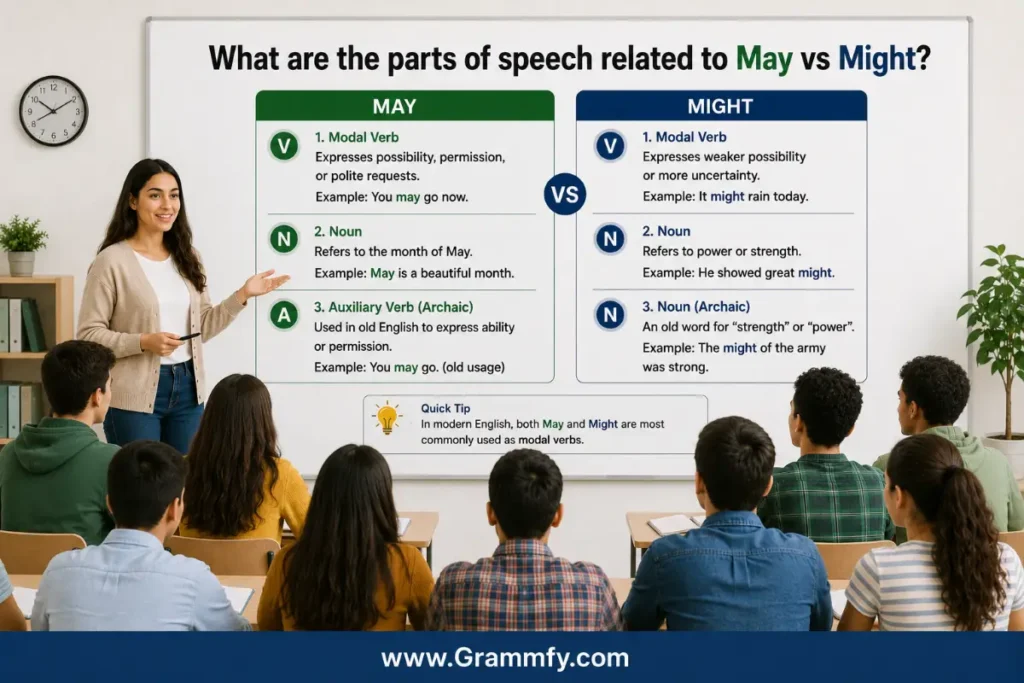
What are the parts of speech related to May vs Might?
May and might are modal auxiliary verbs.
They work with a main verb.
She may leave.
She might leave.
The main verbs leave and leave stay in the base form.
You don’t say:
She may leaves.
or:
She might leaves.
The correct structures are:
may + base verb
might + base verb
With the perfect form
For past possibility:
may have + past participle
might have + past participle
Examples:
He may have forgotten.
He might have forgotten.
With continuous forms
You can also use:
may be + -ing
might be + -ing
Examples:
She may be sleeping.
She might be sleeping.
These mean that sleeping is a possibility happening around now.
May vs Might: what’s different in everyday speech?
In everyday speech, both are common, but might is often a natural choice when someone is being tentative.
For example:
I might go later.
This sounds very natural.
I may go later.
This is also correct, but it can sound slightly more formal in some American English contexts.
Similarly:
It might be expensive.
is very natural.
It may be expensive.
is also natural, especially in more careful or formal speech.
The difference is not huge.
May vs Might in American English
Both words are standard in American English.
May often sounds more formal when used for possibility:
The results may change.
Might is very common in ordinary conversation:
The results might change.
When asking permission, Americans commonly use:
Can I…?
for casual situations and:
May I…?
for formal situations.
Might I…? is uncommon outside highly formal, literary, or deliberately polite speech.
May vs Might in British English
British English also uses both words.
The same basic distinctions apply:
- may for possibility
- might for possibility
- may for formal permission
- might for hypothetical or tentative situations
British speakers may use might in some contexts where American speakers might prefer may, but there is no simple rule that separates the varieties.
Both are correct across major English-speaking regions.
Which word should you use in a resume May vs Might?
A resume usually needs clear, confident language.
Neither may nor might is usually the best choice when you’re describing skills.
Instead of:
I might be able to manage large projects.
write:
Managed large projects.
Instead of:
I may be able to analyze data.
write:
Analyze complex data sets.
If you’re describing a possible future role or responsibility, one of the modal verbs may be appropriate, but strong action verbs are usually better for resumes.
Better resume examples
Weak:
May be able to improve team performance.
Better:
Improved team performance by 20%.
Weak:
Might be able to train new employees.
Better:
Trained and mentored new employees.
The goal is to show what you have done and what skills you possess.
Which word is better for an essay May vs Might?
Both can work in essays.
Use may when making a careful academic claim:
This treatment may reduce symptoms in some patients.
Use might when emphasizing uncertainty or a hypothetical possibility:
The treatment might produce different results in another population.
Academic writing often values cautious language because researchers don’t always want to make absolute claims.
Other useful expressions include:
- may suggest
- might indicate
- may result in
- might contribute to
- may be associated with
- might explain
Example
Too certain:
This policy will solve the problem.
More cautious:
This policy may reduce the problem.
Even more tentative:
This policy might reduce the problem.
The appropriate choice depends on the evidence.
Which word works best for texting May vs Might?
Might is often very natural in casual texts.
I might be late.
We might go tonight.
She might come with us.
May is also correct:
I may be late.
But it can sound a little more formal depending on the sentence.
For a quick message to a friend, might often feels relaxed and natural.
Which word works best in an email May vs Might?
Both are useful.
Casual or friendly email
I might be able to join the meeting tomorrow.
Professional email
I may be able to join the meeting tomorrow.
The second can sound slightly more formal.
If you’re making a cautious professional statement, may can be a good choice:
The project may require additional time.
If you’re offering a tentative plan:
We might need to reschedule.
Both are natural.
Which word is best when speaking May vs Might?
In conversation, both are common.
Might is especially useful for tentative statements:
I might go later.
It might be too expensive.
She might know.
May can sound slightly more formal:
The weather may change later.
This may cause problems.
If you’re speaking casually, don’t worry about avoiding may. Both forms are standard.
What are 15 real-life examples of May vs Might?
1. Weather
It may rain this evening.
Rain is possible.
2. Casual future plan
I might go to the gym after work.
The speaker hasn’t made a firm decision.
3. School
The teacher may give us a quiz tomorrow.
The speaker thinks a quiz is possible.
4. Work
The meeting might take longer than expected.
The speaker isn’t certain.
5. Travel
We may visit California next year.
The trip is possible.
6. Family
My sister might call tonight.
The call is uncertain.
7. Business
The company may increase prices next month.
This is a possible future change.
8. Past event
John might have missed the train.
The speaker is guessing about what happened.
9. Present situation
Sarah may be at the library.
The speaker thinks this is possible.
10. Health-related general statement
Lack of sleep may affect concentration.
This presents a possible effect without claiming certainty.
11. Hypothetical situation
If we leave now, we might get there before dark.
The result depends on the condition.
12. Formal permission
May I use your computer?
This is a polite request.
13. Uncertain decision
We might order pizza tonight.
The decision isn’t final.
14. Possible explanation
He may be tired after the long trip.
The speaker offers one possible reason.
15. Cautious conclusion
The evidence might suggest that the plan needs revision.
This is deliberately cautious.
16. Possible problem
The new software may cause compatibility issues.
The problem is possible.
17. Uncertain arrival
They might arrive late because of traffic.
The speaker isn’t sure.
18. Possible past mistake
She may have entered the wrong address.
This is one possible explanation.
May vs Might: what’s the difference in these examples?
Look closely at these pairs.
Pair 1: Future plans
I may travel next month.
I might travel next month.
Both mean travel is possible.
Might can make the plan sound more tentative.
Pair 2: Weather
It may snow tonight.
It might snow tonight.
Both are natural.
The speaker’s level of certainty is not precisely defined.
Pair 3: Past possibility
He may have forgotten.
He might have forgotten.
Both express uncertainty about the past.
Pair 4: Hypothetical situation
If we hurry, we might catch the bus.
Might sounds very natural because the outcome depends on a condition.
Pair 5: Permission
May I leave?
This is normal formal permission.
Might I leave?
Possible, but unusually formal.
This is one of the clearest cases where may is the better choice.
May vs Could: what’s different?
Could is another close relative of may and might.
All three can express possibility:
She may come.
She might come.
She could come.
The tone differs slightly.
May can sound neutral or formal.
Might can sound tentative.
Could often presents an option or possibility.
Compare:
We may go to the beach.
This means going is possible.
We might go to the beach.
This sounds tentative.
We could go to the beach.
This often presents the beach as one possible choice.
May vs Maybe: what’s different?
These two words look related because they are, but they have different grammar.
May is a modal verb.
She may come.
Maybe is an adverb.
Maybe she will come.
Don’t confuse the structures.
Incorrect:
Maybe she may come tomorrow?
This isn’t necessarily ungrammatical, but it may sound redundant depending on context.
Natural:
Maybe she’ll come tomorrow.
or:
She may come tomorrow.
Easy rule
May goes before a verb.
Maybe often appears at the beginning of a sentence or before another phrase.
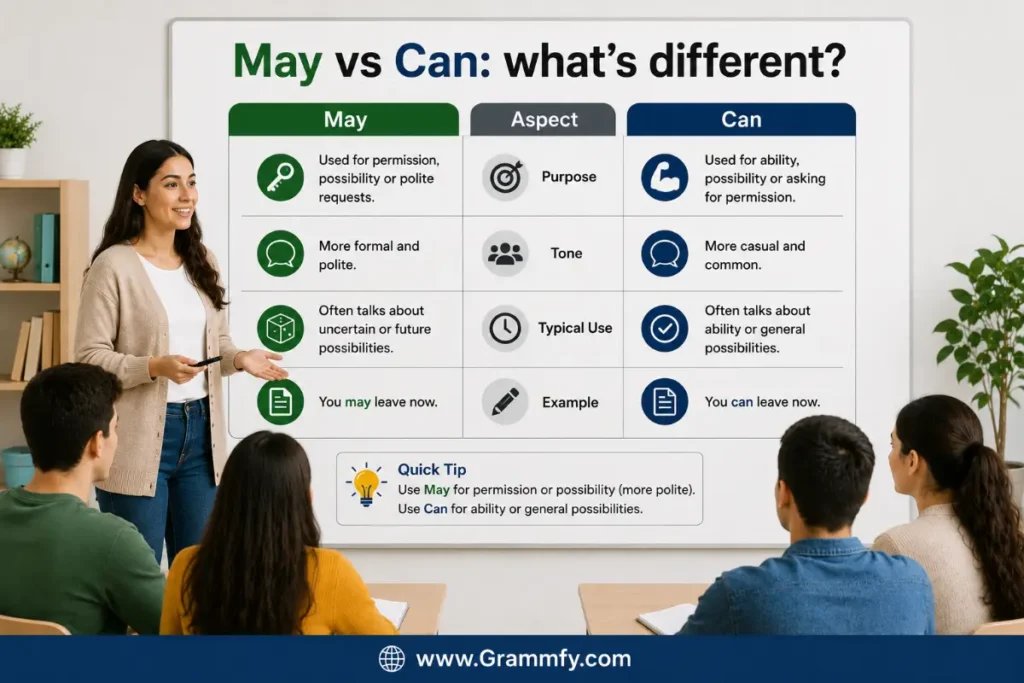
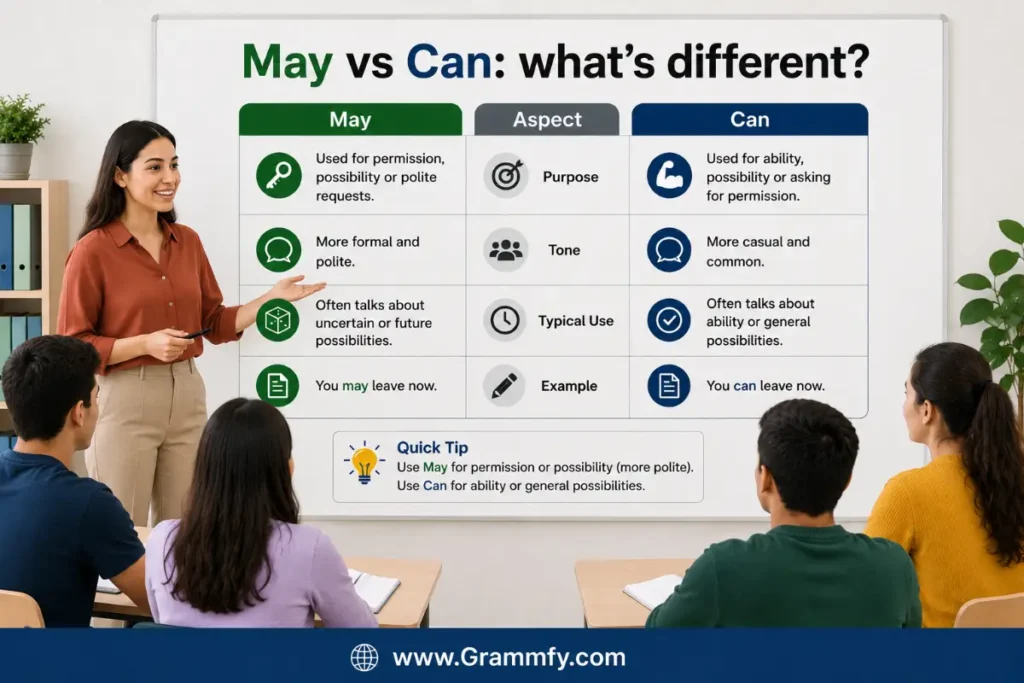
May vs Can: what’s different?
May and can sometimes overlap when talking about permission.
Formal:
May I leave?
Casual:
Can I leave?
But their other meanings differ.
Can commonly expresses ability:
I can swim.
May expresses possibility:
I may swim later.
These don’t mean the same thing.
Can can also express general possibility:
It can get very hot here.
The word “may” can express a specific possibility.
It may get hot tomorrow.
May vs Must: what’s different?
May expresses possibility.
She may be home.
The speaker isn’t sure.
Must can express strong logical conclusion.
She must be home.
The speaker believes the evidence makes this very likely.
Compare:
He may be tired.
Possible.
He must be tired.
The speaker is making a strong conclusion.
This distinction is useful in both conversation and formal writing.
Common mistakes with May vs Might
Mistake 1: Thinking might always means past
This is one of the most common errors.
She might come tomorrow.
This refers to the future.
Might doesn’t automatically mean past time.
Mistake 2: Thinking may is always more certain
The traditional rule says may is more likely than might, but real speakers don’t always use them that strictly.
It may rain.
It might rain.
Both can describe an uncertain forecast.
Don’t treat the difference as a fixed probability scale.
Mistake 3: Using might for ordinary permission
Might I use your phone?
This is grammatically possible but sounds very formal.
Better:
May I use your phone?
Or casually:
Can I use your phone?
Mistake 4: Forgetting “have” for past possibility
Incorrect:
She might forgot.
Correct:
She might have forgotten.
For a past possibility, use:
might have + past participle
Mistake 5: Using the wrong verb form
Incorrect:
He may goes home.
Correct:
He may go home.
After may and might, use the base form.
Mistake 6: Confusing maybe with may be
These are different.
Maybe he is tired.
Maybe = perhaps.
He may be tired.
May be = modal verb + verb.
The pronunciation can be similar, but the grammar is different.
Mistake 7: Using “to” after may or might
Incorrect:
She may to come.
Correct:
She may come.
Incorrect:
He might to leave.
Correct:
He might leave.
Modal verbs are followed directly by the base verb.
When should you NOT use may?
Don’t use may when you clearly mean ability.
Incorrect if you mean ability:
She may speak French.
That sentence normally means it is possible that she speaks French, not that she has the skill.
If you mean ability:
She can speak French.
Also, don’t use may for casual permission if the formal tone feels unnatural.
May I borrow your pen, dude?
Grammatically fine, but awkward in a casual setting.
Use:
Can I borrow your pen?
When should you NOT use might?
Don’t use might when you need to give ordinary formal permission.
Instead of:
Might I enter the room?
use:
May I enter the room?
Don’t use might when you’re making a definite statement.
She might arrive at 8.
means arrival is uncertain.
If the schedule confirms the arrival:
She will arrive at 8.
If you are describing a planned expectation:
She is expected to arrive at 8.
Choose the modal according to how certain the information is.
What are the antonyms of May vs Might?
Because may and might express possibility, their opposites depend on the sentence.
Possibility vs impossibility
It may happen.
Opposite:
It cannot happen.
Possible vs impossible
She might come.
Opposite:
She definitely won’t come.
Permission vs prohibition
You may enter.
Opposite:
You may not enter.
For strong prohibition:
You must not enter.
There isn’t one universal antonym for both modal verbs.
How do May vs Might work in negative sentences?
Negative forms are useful because they can express uncertainty about something not happening.
May not
She may not come.
This means it is possible that she won’t come.
Might not
She might not come.
This also means her absence is possible.
Both are common.
Permission warning
Be careful with:
You may not enter.
Here, may not can mean you are not permitted to enter, not “perhaps you won’t enter.”
Context tells you which meaning is intended.
Compare:
She may not come tonight.
Possible absence.
You may not enter this room.
No permission.
How do may and might work with “be”?
Both can be followed by be.
He may be tired.
He might be tired.
These mean that tiredness is possible.
You can also use:
She may be working.
She might be working.
This suggests that working is possibly happening now.
And:
They may be ready.
They might be ready.
The condition is possible.
How do May vs Might work with “have”?
Use have for past possibilities.
He may have forgotten.
He might have forgotten.
The pattern is:
may/might + have + past participle
More examples:
- She may have left.
- She might have left.
- They may have misunderstood.
- They might have misunderstood.
- He may have taken the wrong bus.
- He might have taken the wrong bus.
How do May vs Might work in reported speech?
Might often appears when a statement is reported from the past.
Direct speech:
“I may go tomorrow,” she said.
Reported speech:
She said she might go the next day.
This is a common sequence-of-tenses pattern.
However, English doesn’t always require a change from may to might, especially when the original possibility is still current.
The exact choice depends on the speaker’s meaning and the reporting structure.
How do May vs Might work in formal writing?
Both are useful in formal writing.
May is common when writers want to state a possibility carefully:
The policy may affect small businesses.
Might can sound even more tentative:
The policy might affect small businesses.
In academic and professional writing, both help avoid unnecessarily absolute claims.
Compare:
The change will cause problems.
This is definite.
The change may cause problems.
That is possible.
The change might cause problems.
This is also possible and may sound more tentative.
Which is better for cautious academic writing?
Neither is always better.
Use may when the evidence supports a reasonable possibility.
The findings may indicate a connection between the two factors.
Use might when you want to emphasize uncertainty or a hypothetical interpretation.
The findings might indicate a connection between the two factors.
Both are acceptable.
The writer should choose based on how strong the evidence is and how cautious the claim needs to be.
Quick tips for choosing the right word “May vs Might”
- Use may for possibility.
- Use might for possibility too.
- Use might when the situation is especially tentative or hypothetical.
- Don’t assume might always refers to the past.
- Use may I…? for formal permission.
- Use can I…? for casual permission.
- Avoid might I…? unless the very formal tone is intentional.
- Use may have + past participle for past possibility.
- Use might have + past participle for past possibility.
- Use may be and might be for possible conditions.
- Don’t add to after may or might.
- Use the base verb after both modals.
- Don’t treat may and might as exact probability percentages.
- Use context to determine the intended meaning.
- In casual texting, might often sounds very natural.
- In formal writing, may is common for cautious claims.
- For strong certainty, consider will, must, or another appropriate expression.
A simple memory trick for May vs Might
Try this:
MAY = possible
MIGHT = possible, often more tentative
For permission:
MAY I? = formal permission
For past possibility:
MAY HAVE / MIGHT HAVE = possible past event
For example:
It may rain.
Possible.
It might rain.
Possible, perhaps less certain.
May I leave?
Formal permission.
She might have left.
Possible past event.
This simple framework covers most everyday uses.
May vs Can: what’s different?
| Situation | Better choice | Example |
|---|---|---|
| General possibility | May/might | It may rain. |
| Tentative possibility | Might | It might rain. |
| Future possibility | May/might | She may come. |
| Present possibility | May/might | He might be home. |
| Past possibility | May have/might have | She may have left. |
| Hypothetical possibility | Might | We might go if we have time. |
| Formal permission | May | May I leave? |
| Casual permission | Can | Can I leave? |
| Academic possibility | May/might | The results may vary. |
| Casual texting | Might | I might be late. |
| Strong certainty | Neither | She will arrive. |
| Strong logical conclusion | Must | She must be home. |
What should you use in different situations?
For a resume
Use may or might only when uncertainty is truly necessary. Strong action verbs are usually better for describing skills.
Managed a team of five employees.
is stronger than:
Might be able to manage a team.
For an essay
Use either for careful claims.
The policy may improve access to education.
For texting
Might often sounds natural.
I might be late.
For a professional email
May can sound polished and careful.
The project may require additional time.
For everyday speaking
Both are natural.
I might go later.
I may go later.
The first may sound more conversational.
For asking permission
Use:
May I…?
for formal situations.
Use:
Can I…?
for casual situations.
Conclusion
The key to May vs Might is understanding that both words express possibility, while might often gives a more tentative or hypothetical feeling. In many everyday sentences, however, they are close enough that either can work. Use may for neutral or formal possibility and formal permission, especially in phrases such as “May I…?” Use might when you’re being tentative, discussing a hypothetical result, or talking about an uncertain possibility in casual conversation. For past possibilities, both can be followed by have + past participle. Don’t treat the traditional “may is more certain, might is less certain” rule as an exact formula. Instead, focus on meaning, context, tone, and how certain you want to sound. With practice, the difference becomes much easier to recognize.
Frequently Asked Questions
Is might more uncertain than may?
Often, yes, but the difference is not absolute. Might can sound more tentative, while may can sound slightly more confident or formal.
Can I use may and might interchangeably?
You can in many sentences that express possibility. However, may is the normal choice for formal permission, while might is better suited to tentative or hypothetical situations.
Is “May vs Might” the same as present vs past?
No. Although might historically developed as a past form of may, modern English uses might for present, future, and hypothetical possibilities too.
What’s another way to say “might”?
Depending on the context, you can use may, could, maybe, perhaps, possibly, there’s a chance, or it is possible that.
Can might be used for permission?
It can appear in very formal expressions such as “Might I ask a question?”, but this is uncommon in everyday American English. May I…? is the normal formal permission request.
Should I use may or might in an academic essay?
Both can work for cautious claims. May is common for presenting a reasonable possibility, while might can make the statement sound more tentative.
Can I say “might have” for something that happened in the past?
Yes. Might have + past participle expresses a possible past event, as in “She might have forgotten the appointment.”
