
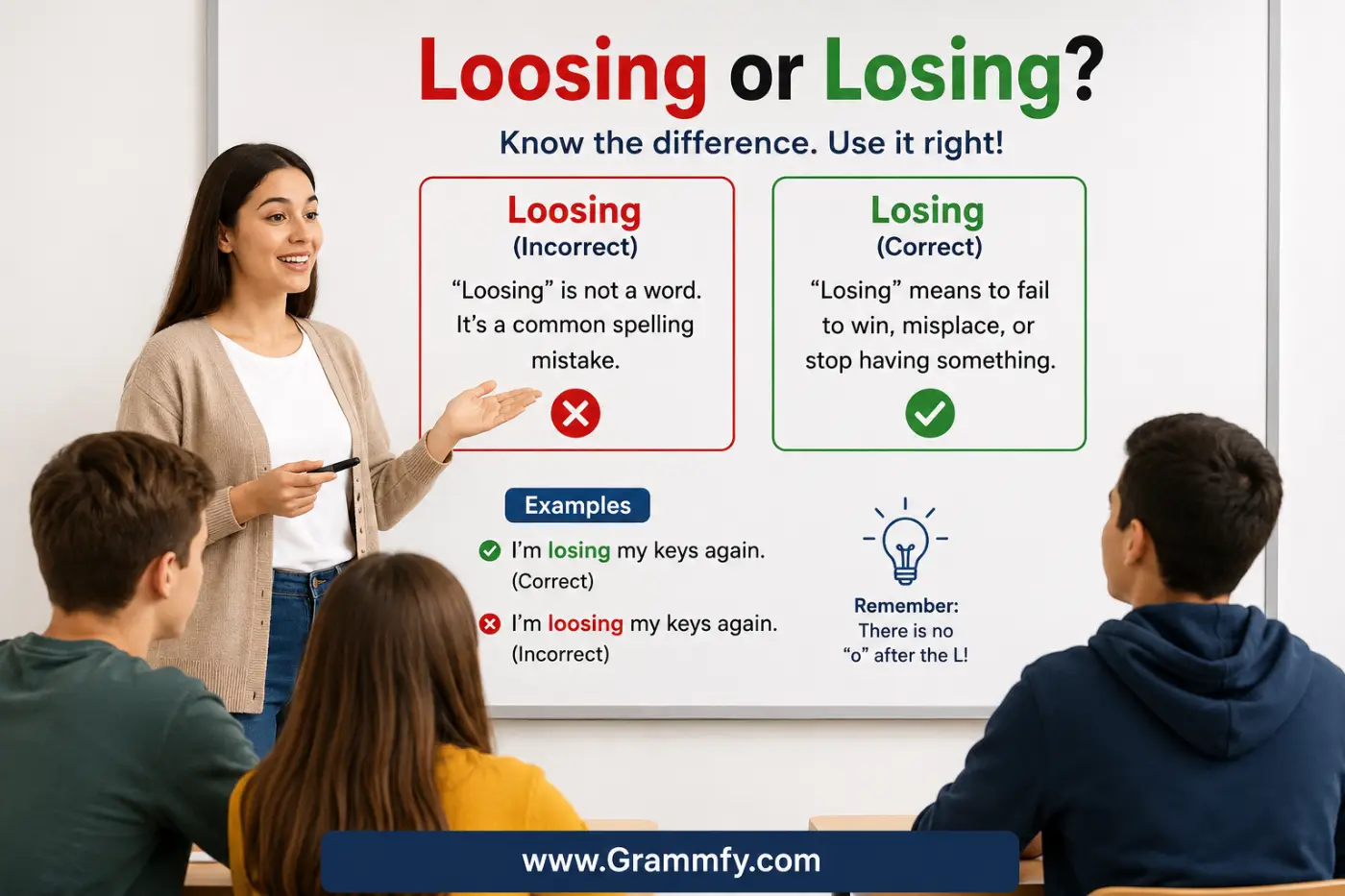
Have you ever typed a sentence in an email, essay, or text and stopped because you weren’t sure whether to write loosing or losing? You’re not alone. These two words look almost identical, but they have different meanings and different grammatical uses.
The good news is that the difference is easy to understand once you connect each spelling with its meaning. Losing is the correct form when you mean failing to win, misplacing something, or no longer having something. Loosing is a real word, but it is much less common and means releasing, freeing, or making something loose.
Answer Box: Losing means no longer having something or failing to win, while loosing means releasing or setting something free.
For example, you might say, “I am losing my keys,” but you wouldn’t normally say, “I am loosing my keys.” If you’re writing about releasing an animal, however, loosing can be correct: “The farmer is loosing the horses.”
This guide explains the meanings, origins, grammar, synonyms, examples, common mistakes, regional usage, and best word choices for different situations. By the end, you’ll know exactly when to use each spelling.
If you often mix up similar words, check out our guide to [suppression vs repression vs oppression vs depression].

What is the difference between “Loosing or Losing”?
The main difference is simple:
- Losing means failing to keep, win, find, or maintain something.
- Loosing means releasing, freeing, or making something loose.
The words come from different base verbs.
| Word | Base verb | Main meaning | Example |
|---|---|---|---|
| Losing | lose | Failing to keep or win something | I’m losing my wallet. |
| Loosing | loose | Releasing or setting free | They are loosing the horses. |
What does losing mean?
Losing is the present participle or gerund form of lose.
It can describe many situations:
I am losing my keys.
Our team is losing the game.
She is losing interest.
He is losing money.
They are losing patience.
In each case, something is being lost, reduced, or no longer kept.
What does loosing mean?
Loosing comes from the verb loose.
As a verb, loose means to release something or set it free.
For example:
The hunter is loosing an arrow.
The soldiers are loosing the prisoners.
The farmer is loosing the animals from the enclosure.
This use is grammatically correct, but it is relatively uncommon in everyday modern English.
Why is losing usually the correct word?
Most people who confuse these spellings actually mean losing.
That’s because lose is a very common English verb. We use it for:
- losing a game
- losing money
- losing weight
- losing keys
- losing time
- losing interest
- losing patience
- losing a job
- losing contact
- losing an opportunity
The spelling can be confusing because lose becomes losing, not loosing.
The silent e is removed before adding -ing:
lose → losing
The same pattern appears in:
use → using
choose → choosing
move → moving
improve → improving
So if you’re talking about the verb lose, the correct spelling is losing.
Why does loosing exist as a word?
Loosing isn’t simply a misspelling. It is the -ing form of the verb loose.
The adjective loose usually means not tight or not firmly attached:
The shirt is loose.
The screw is loose.
The dog is loose.
But loose can also function as a verb meaning to release or set free.
For example:
The farmer loosed the cattle.
The present participle is:
The farmer is loosing the cattle.
This form is correct, but the verb loose is much less common than lose in modern everyday English.
Where did lose come from?
The verb lose has a long history in English. It can be traced back through Old English forms related to the idea of being deprived of something or failing to keep it.
Over time, its meaning expanded.
Today, lose can describe:
- physical objects
- competitions
- relationships
- opportunities
- money
- time
- control
- confidence
- physical weight
For example:
I lost my phone.
We lost the match.
She lost her job.
He lost control of the car.
The broad meaning is usually connected to no longer having, keeping, finding, or winning something.
Where did loose come from?
Loose has roots connected to the idea of being free, unbound, or not tightly held.
That basic meaning remains today.
As an adjective:
The rope is loose.
As a verb:
The prisoner was loosed from his chains.
Because of this, loosing carries the idea of releasing something.
This is very different from losing, which usually describes deprivation, failure, or no longer possessing something.
How can you remember Loosing or Losing?
A simple memory trick can help.
Remember: one “o” after the “l” means lose
Lose → Losing
Think:
Lose a game → losing a game
Lose your keys → losing your keys
Lose money → losing money
Remember: loose has two “o” letters
Loose → Loosing
Think of something becoming free or being released:
Loose → release → loosing
The spelling follows the base word.
| Base word | -ing form |
|---|---|
| lose | losing |
| loose | loosing |
If you can identify the base verb, the spelling becomes much easier.
When should you use losing?
Use losing when the base verb is lose.
Here are the most common uses.
Losing a competition
Our team is losing the game.
The player is losing the match.
They are losing badly.
The meaning is failing to win.
Losing an object
I’m losing my keys again.
She is losing her phone all the time.
He is worried about losing his wallet.
The meaning is no longer having or being unable to find something.
Losing money
The business is losing money.
We are losing thousands of dollars.
The meaning is experiencing a financial loss.
Losing weight
She is losing weight through regular exercise.
This means her body weight is decreasing.
Losing interest
I’m losing interest in the project.
This means your interest is becoming weaker.
Losing patience
The teacher is losing patience.
This means the teacher is becoming less patient.
Losing control
The driver is losing control of the vehicle.
This means control is slipping away.
When can you use loosing?
Use loosing when the base verb is loose and the meaning is release or set free.
For example:
The farmer is loosing the horses.
This means the farmer is releasing the horses.
Another example:
The soldiers were loosing the prisoners.
This means they were freeing the prisoners.
A more literary example is:
The warrior was loosing an arrow.
This means the warrior was releasing an arrow from a bow.
This use is correct but uncommon in ordinary modern conversation.
Is loosing a real word?
Yes, loosing is a real English word.
It is not automatically a spelling error.
However, many people rarely use it because the verb loose is less common than lose.
For most everyday sentences, losing is probably the word you need.
Compare:
I am losing my keys.
This is very common.
I am loosing the horses.
This is grammatically possible but describes the unusual action of releasing horses.
The context determines which spelling is correct.
Why do people confuse Loosing or Losing?
The confusion mainly comes from their similar spelling and pronunciation.
Both words contain:
lo—
and both relate to the words lose and loose, which themselves are frequently confused.
Another reason is that learners may think:
lose + ing = loosing
But English spelling doesn’t work that way here.
The correct form is:
lose → losing
The e is dropped before -ing.
By contrast:
loose → loosing
The word loose already ends in -se, so the spelling becomes loosing.

Is losing pronounced like loosing?
No. They have different vowel sounds.
Losing is pronounced roughly like:
LOO-zing
Loosing is pronounced roughly like:
LOO-sing
The s sound is different.
In losing, the s has a /z/ sound.
In loosing, the s has an /s/ sound.
This pronunciation difference can help you remember the spelling.
| Word | Approximate pronunciation | Meaning |
|---|---|---|
| losing | LOO-zing | Failing to keep or win |
| loosing | LOO-sing | Releasing or setting free |
What are the synonyms for losing?
The best synonym depends on the meaning of losing.
Simple synonyms
| Word | Meaning | Tone | Example |
|---|---|---|---|
| Missing | Unable to find | Everyday | I’m missing my keys. |
| Failing | Not succeeding | Neutral | We are failing to win. |
| Dropping | Becoming lower | Everyday | Sales are dropping. |
| Forgetting | Failing to remember | Everyday | I’m forgetting his name. |
| Wasting | Using badly | Neutral | We’re wasting time. |
| Giving up | Stopping an effort | Casual | He’s giving up. |
| Misplacing | Putting something somewhere and not finding it | Neutral | I’m misplacing my glasses. |
| Declining | Becoming lower | Formal | Profits are declining. |
Everyday synonyms
| Word | Meaning | Tone | Example |
|---|---|---|---|
| Missing | Not having or finding | Everyday | My phone is missing. |
| Dropping | Decreasing | Everyday | Prices are dropping. |
| Falling behind | Becoming less advanced | Everyday | We’re falling behind. |
| Slipping | Gradually losing | Everyday | She’s slipping behind. |
| Forgetting | Failing to remember | Everyday | I’m forgetting the details. |
| Giving up | Ending an effort | Casual | Don’t give up. |
| Fading | Becoming weaker | Everyday | His interest is fading. |
| Losing ground | Becoming less successful | Everyday | The company is losing ground. |
Formal synonyms
| Word | Meaning | Tone | Example |
|---|---|---|---|
| Declining | Becoming lower | Formal | Revenue is declining. |
| Diminishing | Becoming smaller or weaker | Formal | The effect is diminishing. |
| Forfeiting | Giving up a right or benefit | Formal | He is forfeiting his claim. |
| Relinquishing | Giving something up | Formal | She is relinquishing control. |
| Surrendering | Giving up control | Formal | The army is surrendering territory. |
| Decreasing | Becoming less | Formal/Neutral | Demand is decreasing. |
| Deteriorating | Becoming worse | Formal | Conditions are deteriorating. |
| Failing | Not achieving success | Formal/Neutral | The plan is failing. |
Casual or slang-related alternatives
| Word | Meaning | Tone | Example |
|---|---|---|---|
| Blowing it | Making a serious mistake | Casual | We’re blowing it. |
| Messing up | Making a mistake | Casual | I keep messing up. |
| Bombing | Performing very badly | Casual | The team is bombing. |
| Tanking | Performing very poorly | Informal | The stock is tanking. |
| Flopping | Failing badly | Informal | The movie is flopping. |
| Slipping | Losing an advantage | Casual | We’re slipping fast. |
These aren’t exact replacements in every sentence. Choose a synonym based on the specific meaning.
What are synonyms for loosing?
Because loosing means releasing or setting free, its synonyms are different.
Common alternatives
- releasing
- freeing
- unfastening
- untying
- unlocking
- unbinding
- letting go
- setting free
- opening
- liberating
- discharging
- unleashing
Examples:
They are releasing the animals.
She is untying the rope.
The guard is freeing the prisoner.
The company is unleashing a new campaign.
These words are generally more common than loosing.
Losing synonyms by intensity
The word losing can describe different degrees of failure or decline.
Mild
- slipping
- declining
- weakening
- decreasing
- fading
Example:
The team’s confidence is fading.
Moderate
- falling behind
- losing ground
- struggling
- deteriorating
- failing
Example:
The company is falling behind its competitors.
Strong
- collapsing
- failing badly
- surrendering
- forfeiting
- losing everything
Example:
The business is collapsing after years of debt.
The right synonym depends on how serious the situation is.
Loosing synonyms by intensity
The same idea of release can also vary in strength.
Mild release
- opening
- unfastening
- untangling
- untying
Example:
She is untying the rope.
Normal release
- releasing
- freeing
- letting go
- setting free
Example:
The keeper is releasing the birds.
Strong release
- unleashing
- liberating
- breaking free
Example:
The storm unleashed powerful winds.
These choices give your writing more precision.
What are the best alternatives to losing in an essay?
In academic writing, choose a word that explains exactly what is being lost.
Instead of:
The company is losing money.
You might write:
The company is experiencing financial losses.
Instead of:
The effect is losing strength.
Write:
The effect is diminishing.
Instead of:
The country is losing control.
Write:
The country is relinquishing control.
However, don’t replace a simple word just to sound formal. Losing is perfectly acceptable in many academic sentences.
For example:
Losing access to clean water can affect public health.
That’s clear and natural.
What is the best word for a resume Loosing or Losing?
A resume should usually avoid vague statements.
Instead of:
Losing customers
use a more precise phrase when possible:
Customer retention declined by 12%.
Instead of:
Losing money
write:
Reduced annual losses by 15%.
Instead of:
Losing market share
write:
Market share declined from 20% to 16%.
A resume benefits from specific results and measurable facts.
What about loosing on a resume?
Loosing is rarely necessary on a resume.
If you mean releasing something, use a clearer verb:
Released new software updates.
Unleashed a new marketing campaign.
Freed resources for a major project.
These choices are easier for readers to understand.
Which spelling works best in an essay Loosing or Losing?
If you mean failing, misplacing, or no longer having something, use losing.
Losing sleep can affect concentration.
Losing a close friend can be painful.
Losing money can create financial stress.
If you mean releasing something, loosing can be grammatically correct:
The process involves loosing the trapped material.
But in many technical or academic contexts, releasing would be clearer:
The process involves releasing the trapped material.
Which word should you use in a text message Loosing or Losing?
For texting, losing is overwhelmingly more likely.
Examples:
I’m losing my mind 😂
We’re losing the game.
I keep losing my keys.
You would use loosing only if you genuinely mean releasing something.
For example:
We’re loosing the dogs now.
Even then, many people would write:
We’re letting the dogs out now.
The second version sounds much more natural.
Which word is best in an email Loosing or Losing?
In professional emails, losing is common when describing a problem.
We’re losing customers because of the delay.
I don’t want us to risk losing this opportunity.
We’re losing valuable time.
If you mean releasing something, choose a clearer alternative when possible:
We’re releasing the documents tomorrow.
This is usually easier to understand than:
We’re loosing the documents tomorrow.
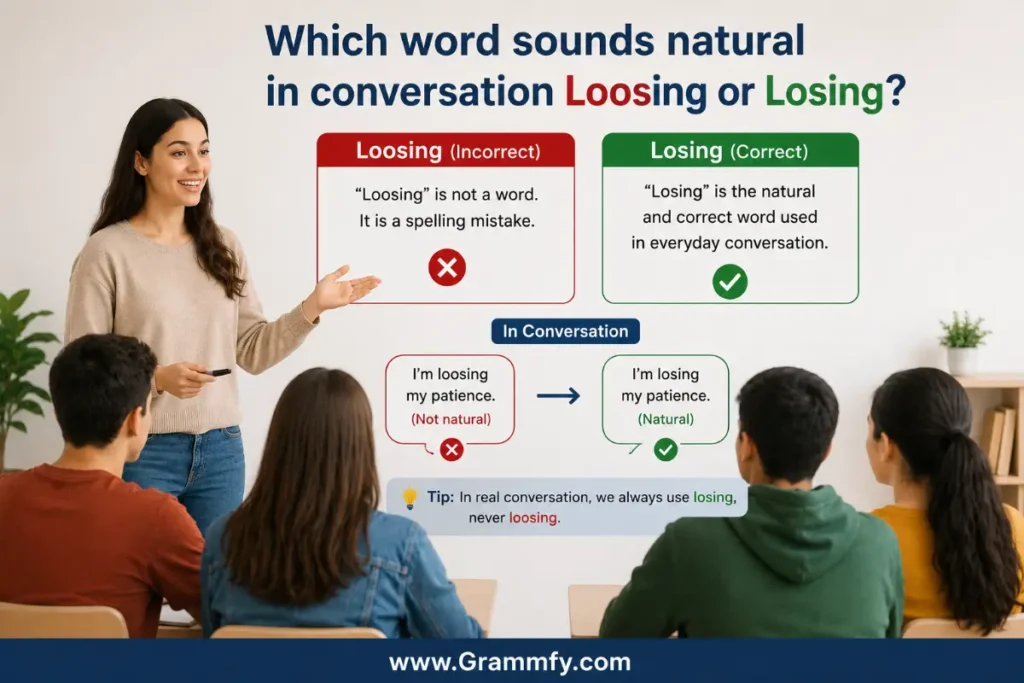
Which word sounds natural in conversation Loosing or Losing?
Losing is extremely common in everyday speech.
I’m losing my phone again.
We’re losing time.
You’re losing me.
I think we’re losing the game.
Loosing is much less common.
Instead of:
I’m loosing the dog.
a speaker would usually say:
I’m letting the dog loose.
or:
I’m letting the dog out.
This distinction is important because everyday English often prefers phrases built around loose rather than the verb loose.
What are 15 examples of losing?
1. Losing a game
Our team is losing the game by two points.
2. Losing an object
I’m losing my keys again.
3. Losing money
The company is losing money this year.
4. Losing weight
She is losing weight through regular exercise.
5. Losing interest
The students are losing interest in the lesson.
6. Losing patience
I’m losing patience with this computer.
7. Losing time
We’re losing valuable time.
8. Losing confidence
He is losing confidence after several mistakes.
9. Losing control
The driver is losing control of the car.
10. Losing an opportunity
We could be losing a great opportunity.
11. Losing contact
They are losing contact with their old friends.
12. Losing focus
I’m losing focus after working for six hours.
13. Losing support
The candidate is losing public support.
14. Losing power
The battery is losing power quickly.
15. Losing hope
The family is losing hope after the long delay.
In all of these examples, losing comes from lose.
What are 10 examples of loosing?
Because the word is uncommon, these examples use contexts where release is genuinely intended.
1. Releasing animals
The farmer is loosing the horses from the stable.
2. Releasing prisoners
The guards were loosing the prisoners.
3. Releasing an arrow
The archer was loosing an arrow toward the target.
4. Releasing a bird
The keeper was loosing the bird from its cage.
5. Setting people free
The leader was loosing the captives.
6. Releasing a force
The device was loosing a powerful burst of energy.
7. Releasing animals into the wild
The team was loosing the rescued animals into the forest.
8. Literary writing
The hero was loosing his anger upon his enemies.
9. Historical writing
The soldiers were loosing arrows from the walls.
10. Figurative writing
The speech was loosing a wave of excitement through the crowd.
Some of these examples sound literary or formal because loose as a verb has limited everyday use.
What is the difference between lose, loose, losing, and loosing?
This is one of the most useful comparisons to learn.
| Word | Part of speech | Meaning | Example |
|---|---|---|---|
| lose | Verb | Fail to keep or win | Don’t lose your keys. |
| loose | Adjective | Not tight | My shirt is loose. |
| loose | Verb | Release | They loose the animals. |
| losing | Verb form | Failing to keep/win | I’m losing the game. |
| loosing | Verb form | Releasing | They are loosing the animals. |
The key is to identify the base word.
lose → losing
loose → loosing
Loosing or Losing: what’s the difference?
These words have different grammatical roles and meanings.
Losing
Losing comes from lose.
She is losing her phone.
Meaning: she can’t keep or find it.
Loose
Loose usually describes something that isn’t tight.
Her shoes are loose.
Meaning: the shoes aren’t tight enough.
Compare:
I’m losing my belt.
This means the speaker is no longer keeping or finding the belt.
My belt is loose.
This means the belt isn’t tight.
The difference is substantial.
Losing vs lost: what’s the difference?
Losing describes an ongoing action or process.
I’m losing my keys.
Lost is the past form or past participle.
I lost my keys.
Compare:
| Form | Example | Meaning |
|---|---|---|
| lose | Don’t lose it. | Base verb |
| losing | I’m losing it. | Ongoing action |
| lost | I lost it. | Past action |
Using the correct form depends on the tense of the sentence.
Loosing vs releasing: what’s the difference?
Loosing and releasing can have similar meanings.
They are loosing the animals.
They are releasing the animals.
Both can mean setting the animals free.
However, releasing is much more common in modern English.
That’s why replacing loosing with releasing is often a good choice when clarity matters.
Loosing vs letting loose: what’s the difference?
These can also describe similar actions.
They are loosing the dogs.
They are letting the dogs loose.
The second sentence is more natural in everyday English.
Let loose is a common expression meaning to release something or allow someone or something to move freely.
Examples:
The children were let loose in the playground.
He let the dog loose.
For casual writing, let loose may sound more natural than loosing.
What are common mistakes with losing?
Mistake 1: Writing loosing when you mean losing
Incorrect:
I’m loosing the game.
Correct:
I’m losing the game.
Mistake 2: Writing loosing weight
Incorrect:
She is loosing weight.
Correct:
She is losing weight.
Mistake 3: Writing loosing money
Incorrect:
The company is loosing money.
Correct:
The company is losing money.
Mistake 4: Writing loosing interest
Incorrect:
I’m loosing interest.
Correct:
I’m losing interest.
Mistake 5: Adding an extra “o” to lose
Incorrect:
I am loosing my phone.
Correct:
I am losing my phone.
The extra o changes the base word from lose to loose.
What are common mistakes with loosing?
The biggest mistake is assuming loosing is always wrong.
It isn’t.
For example:
The archer is loosing an arrow.
This can be correct.
The real question is:
Do you mean losing or releasing?
If you mean losing something:
losing
If you mean releasing something:
loosing
This simple meaning test is more useful than trying to memorize spelling alone.
When should you avoid loosing?
Even when loosing is grammatically correct, another word may be clearer.
Instead of:
The keeper is loosing the animals.
consider:
The keeper is releasing the animals.
Instead of:
They are loosing the prisoners.
consider:
They are freeing the prisoners.
Instead of:
She is loosing the rope.
consider:
She is untying the rope.
Clear, familiar verbs usually work better for general audiences.
Is loosing common in American English?
Loosing is recognized in American English, but it is uncommon.
Most American speakers are much more likely to use:
- releasing
- freeing
- letting go
- setting free
- untying
- unleashing
For that reason, loosing may look unusual to many readers.
That doesn’t automatically make it incorrect. It simply means the context needs to support its use.
Is loosing common in British English?
British English also recognizes loosing, but it is not an everyday word there either.
The same general rule applies:
lose → losing
loose → loosing
Regional differences don’t change the basic spelling.
How can you choose the right word quickly Loosing or Losing?
Try this three-step test.
Step 1: Ask what you mean
Do you mean:
failing to keep or win something?
Use losing.
Do you mean:
releasing or setting something free?
Use loosing.
Step 2: Find the base verb
If the base verb is lose:
lose → losing
If the base verb is loose:
loose → loosing
Step 3: Check whether a simpler word works
If you mean releasing, ask whether releasing, freeing, or letting go sounds clearer.
For most readers, it probably will.
A quick editing checklist
Before publishing an article, email, essay, or social media post, check these questions:
- Am I talking about failure or loss?
- Am I talking about releasing something?
- Is the base verb lose?
- Is the base verb loose?
- Does the sentence describe an ongoing action?
- Would releasing be clearer than loosing?
- Would losing make more sense than loosing?
- Am I talking about a competition?
- Am I talking about an object I can’t find?
- Am I talking about weight, money, time, or interest?
- Am I describing something being set free?
If the sentence describes a game, object, opportunity, amount, relationship, or advantage that is no longer being kept, losing is almost certainly correct.
If something is being released, loosing may be correct.
A simple memory chart for “Loosing or Losing”
Keep this chart handy:
| If you mean… | Use… |
|---|---|
| Failing to win | losing |
| Misplacing something | losing |
| No longer having something | losing |
| Losing weight | losing |
| Losing money | losing |
| Losing interest | losing |
| Losing control | losing |
| Releasing something | loosing |
| Setting something free | loosing |
| Releasing an arrow | loosing |
| Freeing a captive | loosing |
| Making something free | loosing |
Final grammar tip
The safest rule is simple:
Lose → losing
Loose → loosing
If you mean not winning, misplacing, or no longer having something, choose losing.
If you mean releasing or setting something free, loosing can be correct, although releasing or freeing is often more natural.
Most everyday sentences need losing, not loosing. So if you’re writing “I’m ___ my keys,” “We’re ___ the game,” or “She’s ___ weight,” the correct choice is losing.

Conclusion
Understanding loosing or losing becomes much easier when you focus on meaning. Use losing when you mean failing to win, misplacing something, or no longer having something. Use loosing when you mean releasing or setting something free, although this word is uncommon in everyday English. A quick way to remember the difference is lose → losing and loose → loosing. In most everyday sentences, losing is the correct choice. When you’re unsure, check the base verb and ask what action you’re describing. With this simple rule, you can avoid one of the most common spelling mistakes and write with greater confidence.
Frequently Asked Questions
Is loosing or losing correct?
Losing is correct when you mean failing to keep, find, or win something. Loosing is correct only when you mean releasing or setting something free.
Is “loosing” a real word?
Yes, loosing is a real word. It is the -ing form of the verb loose, which can mean to release or set free.
Why do people confuse loosing and losing?
People confuse them because lose and loose look and sound similar. The easiest solution is to identify the meaning and base verb before choosing the spelling.
What’s another way to say losing?
Depending on the context, alternatives include missing, failing, declining, decreasing, slipping, falling behind, misplacing, and forfeiting.
How do I remember the difference between losing and loosing?
Remember lose → losing for failure or no longer having something, and loose → loosing for releasing something. Most everyday sentences use losing.
Is “loosing weight” correct?
No. The correct phrase is “losing weight.” Weight decreases, so the verb is lose, not loose.
Is “loosing the game” correct?
No, not if you mean failing to win. The correct sentence is “losing the game.” The word loosing would imply releasing something.
