
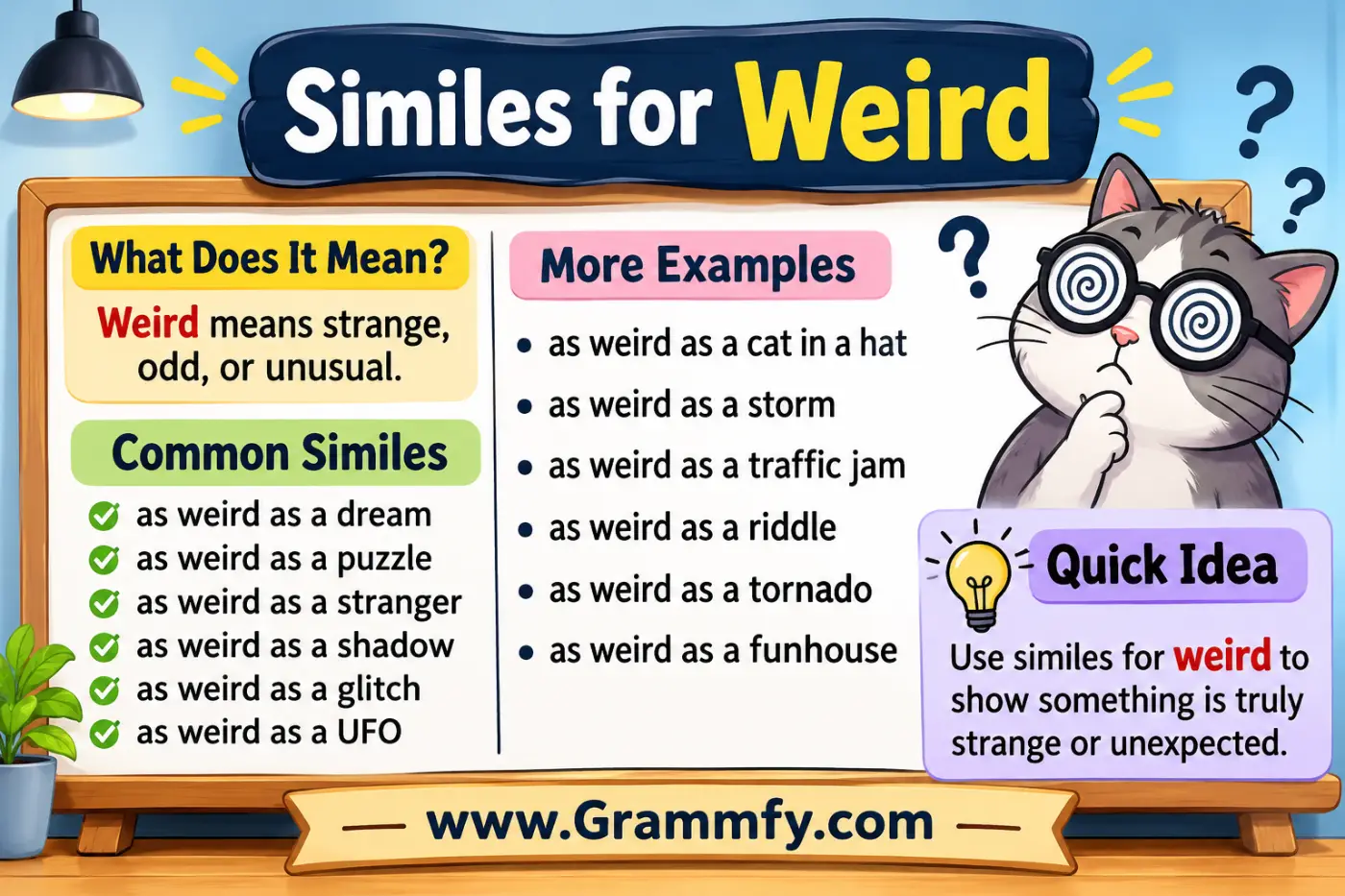
Have you ever tried to describe something strange in an essay, story, or text message but couldn’t find the right words? Maybe you saw an unusual object, met someone with an unexpected habit, or experienced a moment that felt completely out of place. Simply calling it “weird” may explain your reaction, but it doesn’t help readers picture what made the situation so unusual. A good comparison can turn an ordinary description into something vivid, funny, mysterious, or even unsettling. Similes for Weird help you describe strange, unusual, or unexpected things in a more creative and memorable way.
Similes for Weird help you describe unusual people, strange situations, odd behaviors, and unexpected experiences in creative ways. These comparisons use words such as like or as to connect something unusual with a familiar image. For example, you could write, “His laugh sounded like a squeaky door in an empty house.” This comparison gives readers a clearer picture of the unusual sound than simply saying his laugh was weird.
In this guide, you’ll find more than 50 original examples, learn how to create your own comparisons, and discover which expressions work best for different situations. You’ll also explore related words, differences between similar terms, common mistakes, and practical tips for making your descriptions clear and memorable.
Need a more vivid way to describe scary? Explore our guide to creative scary similes and examples for fresh ideas and examples.
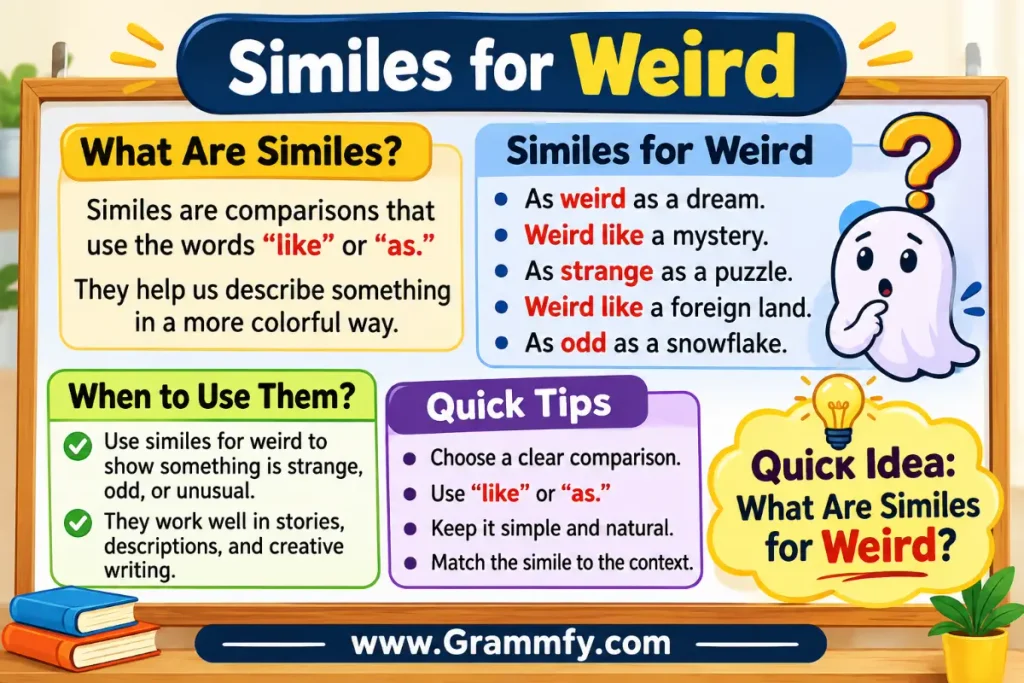
Quick Idea: What Are Similes for Weird?
A simile is a figure of speech that compares two different things using like or as. A comparison for something weird connects an unusual person, object, behavior, or experience to a recognizable image that helps readers understand why it seems strange.
For example:
- Like a fish riding a bicycle: Describes something that seems completely out of place.
- As odd as a dream without a beginning: Suggests an unusual or confusing experience.
- Like a clock running backward: Describes something that goes against normal expectations.
- As strange as a talking shadow: Creates a mysterious or imaginative image.
The best comparison depends on your purpose. Use a playful image when describing something funny, a mysterious image when writing about an unexplained event, and a more thoughtful comparison when describing behavior that seems unusual. A good simile makes the meaning clearer instead of making the sentence harder to understand.
What Makes a Simile Sound Weird or Unusual?
A strong comparison connects something unexpected with an image readers can recognize. The image may seem funny, mysterious, confusing, unnatural, or completely out of place. Readers then use that familiar image to understand the unusual situation.
Three elements help make a comparison effective:
- A clear subject: Identify the person, object, sound, behavior, or event you want to describe.
- An unexpected image: Choose something familiar that highlights what makes the subject unusual.
- A suitable tone: Make sure the comparison fits whether you want to sound humorous, curious, serious, or mysterious.
Consider these examples:
- Basic: The room looked weird.
- More descriptive: The room looked like a puzzle with missing pieces.
- More imaginative: The room looked like a dream designed by someone who had forgotten the rules of reality.
Each sentence communicates something unusual, but the images create different effects. The puzzle suggests confusion, while the dream suggests an imaginative world where ordinary rules no longer apply.
A comparison doesn’t have to be complicated to work well. A familiar image can be more effective than a long, unusual phrase if readers understand it immediately. Choose words that help your audience picture the scene without forcing them to guess what you mean.
What Are the Best Similes for Weird Things?
Different kinds of unusual experiences call for different comparisons. A strange object, an unusual person, and a confusing situation may all feel weird, but they don’t create the same impression. The following examples are grouped by purpose so you can choose an expression that fits your writing.
What Are Some Simple Similes for Weird?
Simple comparisons work well in school assignments, everyday conversations, short stories, and beginner writing. They use familiar images to communicate an unusual feeling without complicated vocabulary.
| No. | Simile | Meaning | Example sentence |
|---|---|---|---|
| 1 | Like a fish riding a bicycle | Completely out of place | Wearing winter boots at the beach felt like a fish riding a bicycle. |
| 2 | As odd as a square wheel | Unusual or impractical | His invention was as odd as a square wheel. |
| 3 | Like a clock running backward | Opposite to what is expected | The strange schedule felt like a clock running backward. |
| 4 | As unusual as snow in summer | Rare or unexpected | Seeing snow during the July picnic was as unusual as snow in summer. |
| 5 | Like a puzzle with missing pieces | Confusing or incomplete | Her explanation sounded like a puzzle with missing pieces. |
| 6 | As strange as a silent alarm | Unusual or contradictory | The announcement seemed as strange as a silent alarm. |
| 7 | Like a bird swimming underwater | Unnatural or out of place | The robot moved like a bird swimming underwater. |
| 8 | As unexpected as rain indoors | Surprising and unusual | His sudden appearance was as unexpected as rain indoors. |
These comparisons are useful when you want readers to understand the unusual nature of something quickly. They’re also easy to adapt to different situations. For example, “like a puzzle with missing pieces” can describe a confusing explanation, an incomplete plan, or a mystery that lacks important clues.
Choose an image that matches the subject. A square wheel may suggest something impractical, while a clock running backward suggests that events are happening in an unexpected order. The closer the image matches the intended meaning, the stronger the comparison becomes.
Which Similes Describe Extremely Strange Things?
Some experiences feel so unusual that ordinary words don’t fully capture them. These comparisons are useful for imaginative stories, strange dreams, unusual discoveries, and situations that seem to challenge normal expectations.
| No. | Simile | Meaning | Example sentence |
|---|---|---|---|
| 9 | Like a dream without a beginning or end | Difficult to understand or follow | The endless hallway felt like a dream without a beginning or end. |
| 10 | As strange as a shadow moving alone | Mysterious or unnatural | The shape on the wall was as strange as a shadow moving alone. |
| 11 | Like a map drawn by a wandering mind | Disorganized or confusing | His plan looked like a map drawn by a wandering mind. |
| 12 | As bizarre as a moon made of glass | Imaginative and highly unusual | The sculpture was as bizarre as a moon made of glass. |
| 13 | Like a door opening into yesterday | Suggests an impossible event | The old photograph felt like a door opening into yesterday. |
| 14 | As confusing as a riddle with no answer | Difficult to make sense of | The instructions were as confusing as a riddle with no answer. |
| 15 | Like a mirror showing another world | Strange or unreal | The reflection looked like a mirror showing another world. |
| 16 | As unexpected as a whisper from an empty room | Mysterious and surprising | The sudden voice was as unexpected as a whisper from an empty room. |
These comparisons are particularly helpful when describing something that doesn’t follow ordinary rules. They can make an imaginary world feel mysterious without explaining every detail.
For example, a character might discover a room where every clock shows a different time. Instead of simply calling it strange, you could write, “The room felt like a dream without a beginning or end.” This comparison suggests confusion and uncertainty while allowing readers to imagine the details for themselves.
Use stronger imagery when the situation deserves it. If every ordinary event receives an extreme comparison, the writing may feel exaggerated. Save your most imaginative expressions for the moments you want readers to remember.
What Are Some Funny Similes for Weird Things?
Weirdness often creates humor when something behaves in a way that seems completely unexpected. Funny comparisons work well in casual conversations, social media captions, comedy writing, and stories involving unusual characters.
| No. | Simile | Meaning | Example sentence |
|---|---|---|---|
| 17 | Like a penguin wearing roller skates | Awkward or out of place | He walked into the party like a penguin wearing roller skates. |
| 18 | As confused as a cat in a swimming pool | Completely puzzled | I felt as confused as a cat in a swimming pool during the surprise quiz. |
| 19 | Like a chicken trying to solve a crossword | Comically out of its depth | My sleepy brain felt like a chicken trying to solve a crossword. |
| 20 | As mismatched as socks from different planets | Unusually different | Their costumes were as mismatched as socks from different planets. |
| 21 | Like a potato giving a speech | Unexpectedly ridiculous | The tiny robot looked like a potato giving a speech. |
| 22 | As awkward as a giraffe in a tiny elevator | Uncomfortable or clumsy | I felt as awkward as a giraffe in a tiny elevator during the introduction. |
| 23 | Like a duck leading a marching band | Silly and unexpected | The little dog ran ahead like a duck leading a marching band. |
| 24 | As ridiculous as a hat on a watermelon | Funny because it looks unusual | The decoration looked as ridiculous as a hat on a watermelon. |
Humorous comparisons are most effective when the image is easy to imagine. A penguin on roller skates creates an amusing picture because the animal and activity seem mismatched. A giraffe in a tiny elevator suggests an obvious problem of size and space.
These expressions can make ordinary experiences more entertaining. However, avoid comparisons that insult someone for a personal characteristic or make a harmless difference seem negative. Humor works best when it fits the situation and doesn’t make the reader feel targeted.
What Similes Describe Weird People or Behavior?
People may seem unusual because of their habits, reactions, speech, or ways of thinking. A comparison can describe these qualities without simply labeling someone as weird.
| No. | Simile | Meaning | Example sentence |
|---|---|---|---|
| 25 | Like a radio changing stations by itself | Constantly shifting attention or topics | His conversation moved like a radio changing stations by itself. |
| 26 | As unpredictable as a bouncing ball | Difficult to anticipate | Her reactions were as unpredictable as a bouncing ball. |
| 27 | Like a book written in invisible ink | Difficult to understand | His reasoning felt like a book written in invisible ink. |
| 28 | As restless as a squirrel in a library | Unable to remain still | The child was as restless as a squirrel in a library. |
| 29 | Like a compass spinning without direction | Uncertain or inconsistent | His decisions seemed like a compass spinning without direction. |
| 30 | As mysterious as a locked diary | Difficult to understand or interpret | Her quiet expression was as mysterious as a locked diary. |
| 31 | Like a puzzle that changes every time you solve it | Complicated and unpredictable | Working with the constantly changing plan felt like solving a puzzle that changes every time you solve it. |
| 32 | As unusual as a musician playing without a tune | Different from normal expectations | His performance was as unusual as a musician playing without a tune. |
When describing a person, focus on the specific behavior rather than making a broad judgment about their personality. For example, “His conversation moved like a radio changing stations by itself” describes a habit of jumping between topics. It doesn’t claim that the person is strange in every part of life.
This distinction makes your writing more precise and respectful. It also gives readers a clearer idea of what happened rather than asking them to accept a vague label.
What Similes Describe Weird Places and Objects?
An unusual setting or object can create curiosity before anyone understands why it looks different. These comparisons are useful for fantasy stories, mystery writing, descriptions of unusual buildings, and imaginative school projects.
| No. | Simile | Meaning | Example sentence |
|---|---|---|---|
| 33 | Like a staircase climbing into the clouds | Impossibly high or dreamlike | The staircase looked like a staircase climbing into the clouds. |
| 34 | As crooked as a tree grown in a storm | Bent or uneven | The old fence was as crooked as a tree grown in a storm. |
| 35 | Like a house built from forgotten dreams | Imaginative or unreal | The colorful building looked like a house built from forgotten dreams. |
| 36 | As misplaced as a piano in a forest | Completely out of place | The shiny statue seemed as misplaced as a piano in a forest. |
| 37 | Like a window opening onto the ocean floor | Strange or impossible | The painting looked like a window opening onto the ocean floor. |
| 38 | As tangled as headphones in a pocket | Complicated or twisted | The wires were as tangled as headphones in a pocket. |
| 39 | Like a clockwork garden | Unusual, mechanical, or artificial | The metal flowers made the courtyard look like a clockwork garden. |
| 40 | As unexpected as a staircase beneath a lake | Improbable or surprising | The hidden entrance was as unexpected as a staircase beneath a lake. |
These descriptions are useful when the appearance of a place matters to the story. An ordinary room might contain furniture arranged in an unusual pattern, while a fantasy setting could feature impossible staircases and mechanical flowers.
The most effective comparison highlights a feature that readers can picture. If an object is crooked, choose an image that suggests bending. If a room feels artificial, a mechanical garden may be more suitable than a natural landscape.
What Similes Describe Weird Dreams and Experiences?
Dreams often combine familiar objects with impossible events. Comparisons can capture the confusion, surprise, or unreal quality of these experiences.
| No. | Simile | Meaning | Example sentence |
|---|---|---|---|
| 41 | Like flying through a room made of water | Unreal and disorienting | The dream felt like flying through a room made of water. |
| 42 | As confusing as a story told backward | Difficult to follow | My dream was as confusing as a story told backward. |
| 43 | Like running on a road that never ends | Endless or frustrating | The strange chase felt like running on a road that never ends. |
| 44 | As unreal as a sunrise at midnight | Impossible or dreamlike | The glowing sky was as unreal as a sunrise at midnight. |
| 45 | Like a song playing in reverse | Strange or unnatural | The voices sounded like a song playing in reverse. |
| 46 | As unpredictable as a dream changing scenes | Constantly changing | The strange adventure was as unpredictable as a dream changing scenes. |
| 47 | Like a staircase turning into a river | Surreal and imaginative | The dream became like a staircase turning into a river. |
| 48 | As mysterious as a face behind frosted glass | Difficult to recognize or understand | The figure in my dream was as mysterious as a face behind frosted glass. |
Dream-related comparisons can also describe real situations that feel unreal. For instance, a surprising announcement might make someone feel as if they are dreaming. A complicated day could seem like a story told backward because events happened in an unexpected order.
These expressions work best when they highlight one main quality, such as confusion, impossibility, or constant change. If you combine too many unrelated images, readers may lose track of the feeling you want to communicate.
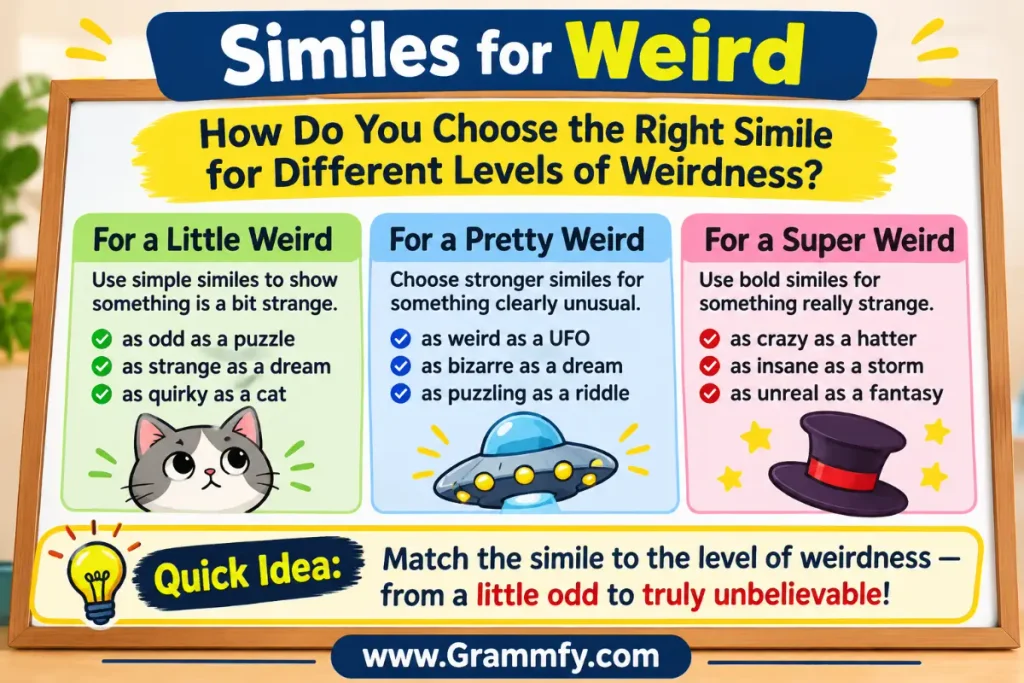
How Do You Choose the Right Simile for Different Levels of Weirdness?
Not every unusual experience is equally strange. Some things are slightly odd, while others are confusing, unbelievable, or completely surreal. Choosing the right comparison helps readers understand the degree of unusualness.
Which Similes Work for Mild Weirdness?
Mild weirdness describes something that seems a little unusual without being shocking or difficult to understand. It may involve an unexpected outfit, a funny habit, or an object placed in the wrong location.
Suitable examples include:
- Like a book placed on the wrong shelf.
- As odd as a clock with mismatched hands.
- Like a bird sitting inside an empty mailbox.
- As unusual as a sandwich served for breakfast.
- Like a shoe on the wrong foot.
Example: “The painting looked like a book placed on the wrong shelf because its bright colors clashed with the quiet room.”
This kind of comparison communicates a small mismatch. It doesn’t suggest that something impossible or frightening has happened. Such expressions work well in everyday descriptions and lighthearted stories.
Which Similes Work for Strong Weirdness?
Strong weirdness appears when something seems difficult to explain or goes against ordinary expectations. A strange machine, an unusual dream, or a confusing experience might call for a more imaginative comparison.
Examples include:
- Like a map that redraws itself.
- As confusing as a puzzle with moving pieces.
- Like a mirror reflecting a different room.
- As unusual as a clock that measures memories.
- Like a doorway leading into yesterday.
Example: “The machine behaved like a map that redrew itself every time we looked away.”
This sentence suggests that the machine does something unexpected and difficult to understand. It creates curiosity because readers want to know why the map changes.
Use this level of imagery when the situation genuinely feels unusual. A more direct comparison may be better if the subject is only slightly different from normal.
Which Similes Work for Completely Bizarre Situations?
Bizarre situations seem extremely unusual, unreal, or almost impossible. They are common in surreal fiction, fantasy, comedy, and descriptions of strange dreams.
Examples include:
- Like a moon dancing inside a teacup.
- As bizarre as a fish teaching mathematics to clouds.
- Like a staircase floating through outer space.
- As unreal as a city built inside a snowflake.
- Like a shadow casting its own light.
Example: “The dream was as bizarre as a city built inside a snowflake, with streets that disappeared whenever the sun rose.”
The comparison creates an imaginative image that doesn’t follow ordinary rules. It works because the setting is already dreamlike and the reader understands that the scene is not meant to be realistic.
Avoid using extremely bizarre imagery for every unusual event. Strong comparisons are more effective when they stand apart from ordinary descriptions.
What Is the Difference Between Weird, Strange, Odd, and Bizarre?
These words share a similar meaning, but each one can create a slightly different impression. Understanding the differences helps you choose more precise vocabulary.
| Word | Plain-English meaning | Typical tone | Example |
|---|---|---|---|
| Weird | Unusual or unexpected | Casual and flexible | The machine sounded like a radio changing stations by itself. |
| Strange | Unfamiliar or difficult to explain | Neutral or mysterious | The room felt like a dream with no clear ending. |
| Odd | Slightly unusual or out of place | Mild or informal | The chair looked like a puzzle with one extra piece. |
| Bizarre | Extremely unusual or surprising | Strong and dramatic | The sculpture looked like a planet made of tangled wire. |
| Peculiar | Distinctive in an unusual way | Formal or thoughtful | His habit was as peculiar as a clock that rang at noon every night. |
| Uncanny | Strange in a way that feels almost unnatural | Mysterious or unsettling | Her voice sounded like an echo coming from another room. |
| Surreal | Dreamlike or disconnected from ordinary reality | Imaginative or artistic | The landscape looked like a painting melting into the sky. |
| Quirky | Unusual in an interesting or charming way | Often positive | The little shop felt like a treasure chest filled with mismatched objects. |
Use weird when you want a broad, casual description. Choose strange when something is unfamiliar or difficult to explain. Odd often suggests a smaller difference, while bizarre emphasizes how unusual or surprising something is.
The word uncanny is useful when something seems familiar but also feels wrong. Surreal works well for dreamlike scenes, and quirky is often more positive than the other choices. A quirky character may have unusual habits that make them interesting rather than confusing or unpleasant.
How Can You Use Weird Similes in Different Types of Writing?
A comparison that works in a comedy story may sound out of place in a professional email. The best expression depends on your audience, purpose, and tone.
Which Similes Work Best in a Resume?
A resume should focus on skills, achievements, and professional value. Comparisons about weirdness are rarely appropriate in the main sections because employers need clear information about your experience.
Instead of writing, “My problem-solving style is like a puzzle with missing pieces,” explain your actual skill: “I solve complex problems by identifying missing information and testing practical solutions.”
Creative comparisons may be appropriate in a portfolio or personal introduction when the role involves storytelling, comedy, or creative work. Even then, clarity should come first.
For example, a creative portfolio might describe an unusual design as “a visual puzzle with pieces from different worlds.” This wording communicates an artistic idea without making the applicant’s professional abilities seem confusing.
Which Similes Work Best in a School Essay?
School essays benefit from comparisons that support the main idea. Choose expressions that readers can understand easily and that fit the subject.
For example:
“The old machine sounded like a radio changing stations by itself, switching between clicks, whistles, and low buzzing noises.”
This sentence gives readers a clearer picture of the machine’s behavior than simply calling it weird. It also includes details that support the comparison.
If your essay is formal, avoid adding humorous or imaginative comparisons where they distract from the argument. A descriptive assignment allows more creativity than a scientific report, so adjust your language to match the task.
Which Similes Work Best in Text Messages?
Casual messages are a natural place for playful and familiar comparisons. You can use them to describe funny situations, unexpected events, or experiences that are hard to explain.
Examples include:
- “That dream was like a movie written by a confused robot.”
- “His new hairstyle looks like a pineapple wearing a hat.”
- “The whole situation felt like a game with rules nobody knew.”
- “My morning was as chaotic as a room full of bouncing balls.”
These expressions sound conversational because they use recognizable images and a light tone. They also help you communicate your reaction without writing a long explanation.
However, consider how the recipient might interpret your words. A funny comparison between objects is often harmless, while a comparison aimed at someone’s appearance or behavior may sound insulting. Choose expressions that fit the relationship and the conversation.
Which Similes Work Best in Emails?
Most professional emails should be clear, direct, and polite. Comparisons involving weirdness are useful only when they support the purpose of the message, such as explaining an unusual technical problem or describing a creative idea.
For example:
“The software displayed a pattern like a map that redrew itself each time the page refreshed.”
This sentence explains the unusual behavior through a recognizable image. In a technical email, you should also include the actual error, the steps that caused it, and any relevant details.
Avoid describing a serious workplace problem as “a bizarre nightmare” if a precise explanation would be more helpful. Professional readers usually need facts and solutions rather than dramatic language.
Which Similes Work Best in Speaking?
In everyday conversation, short and familiar comparisons are usually easier to understand than complicated literary images. A listener should be able to picture your meaning without stopping to interpret the sentence.
You might say, “That was as strange as a clock running backward,” or “The whole day felt like a dream changing scenes.” Both examples communicate an unusual experience in a natural way.
Tone also matters. A humorous comparison may make a funny story more entertaining, while a calm description may be better when discussing something genuinely confusing. Select an image that fits what happened and how you felt about it.
What Are 15 Original Sentences Using Weird Similes?
The following examples show how unusual comparisons can work in different situations. Each sentence uses a specific image to communicate a strange, funny, mysterious, or confusing experience.
- At school: The science experiment bubbled like a tiny volcano trying to learn chemistry.
- At home: The old refrigerator hummed like a robot singing itself to sleep.
- During a dream: The hallway stretched like a road that kept growing every time I blinked.
- At a party: The decorations looked like a rainbow had spilled its paint across the ceiling.
- In a classroom: The teacher’s demonstration worked like a puzzle whose pieces changed shape halfway through.
- During a walk: The clouds floated like islands that had forgotten where the ocean was.
- In a fantasy story: The castle stood like a giant umbrella turned upside down against the sky.
- While using a computer: The screen flickered like a television trying to remember an old program.
- At a museum: The sculpture looked like a collection of spoons assembled by a dreaming inventor.
- During a conversation: His explanation wandered like a dog chasing several different balls at once.
- In a garden: The metal flowers shone like tiny moons growing from the soil.
- At a restaurant: The unusual dessert looked like a sandwich designed by a painter.
- During a storm: The branches twisted like dancers who had forgotten the music.
- In a mystery story: The photograph felt like a window looking into a world that had disappeared.
- During a confusing day: Every new problem arrived like another page from a book written in invisible ink.
These sentences demonstrate how the same broad idea can take different forms. A strange sound can be compared to a robot, a confusing explanation can resemble a wandering dog, and an unusual object can look like something created in a dream.
When creating your own examples, pay attention to the main feature you want to highlight.
Use a visual comparison when something looks unusual. For unexpected behavior, compare the actions to something familiar. When an experience feels confusing, choose an image that shows uncertainty or missing information.
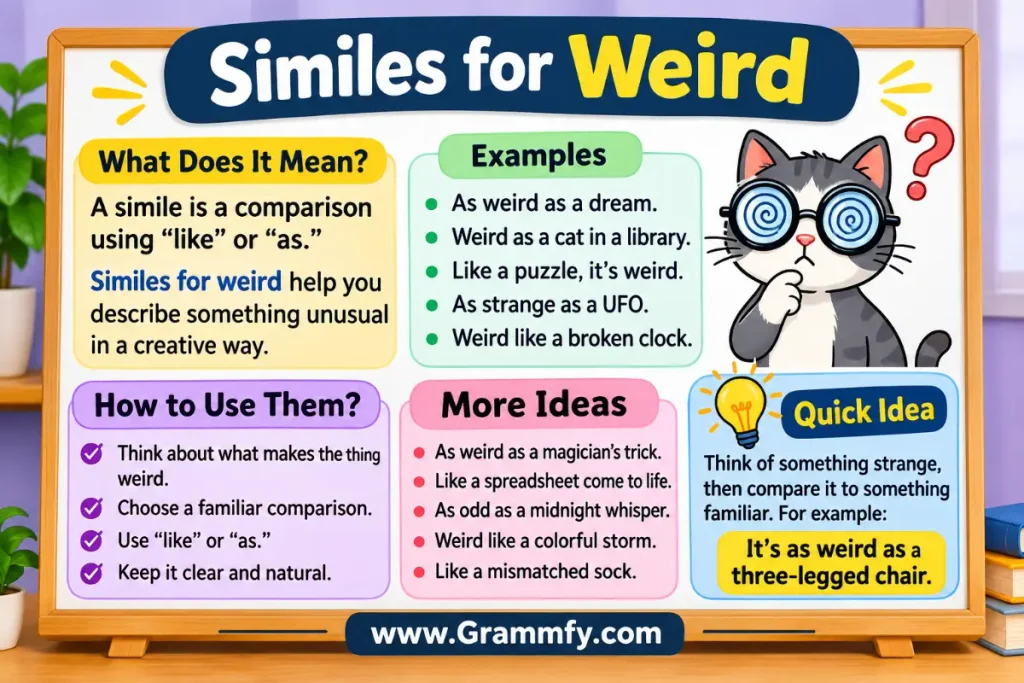
How Do You Create Your Own Similes for Weird Things?
Creating original comparisons helps your writing sound personal rather than copied from a list. You don’t need advanced vocabulary or complicated ideas. Start with something familiar and connect it to the unusual feature you want to describe.
Step 1: Identify What Seems Unusual
Ask yourself what makes the subject different from normal expectations. Is it the appearance, behavior, sound, movement, or overall feeling?
For example, a clock that moves backward is unusual because clocks normally move forward. A conversation that jumps between unrelated topics may feel strange because people generally expect some connection between ideas.
Identifying the main feature gives your comparison a clear purpose.
Step 2: Choose a Familiar Object or Experience
Think of something readers already understand. Useful sources include household objects, animals, weather, everyday activities, machines, dreams, and familiar places.
If you are describing an object that looks out of place, you might compare it to a piano in a forest. If a person’s behavior changes constantly, a bouncing ball or a radio changing stations may provide a useful image.
The comparison doesn’t need to be realistic. In fact, an unexpected combination can make the description more interesting, provided the meaning remains clear.
Step 3: Connect the Ideas With Like or As
Use like or as to create a direct comparison.
Basic example: The machine was weird.
Improved example: The machine behaved like a clock that had forgotten how to measure time.
The improved sentence suggests unusual behavior rather than simply labeling the machine. Readers can imagine something familiar behaving in an unexpected way.
Step 4: Add a Specific Detail
A specific detail makes your image more memorable. Instead of writing, “The room looked like a dream,” you could say, “The room looked like a dream where every door opened into the same hallway.”
The second version creates a clearer image and suggests repetition or confusion. It also gives the reader something to imagine beyond the general idea of a dream.
Choose details that support the meaning you want to communicate. Adding random objects or extra descriptions can make the comparison harder to understand.
Step 5: Check the Tone
Decide whether you want the sentence to sound funny, mysterious, serious, or imaginative. The same subject can produce different effects depending on the comparison.
For example:
- Funny: The robot moved like a duck learning ballet.
- Mysterious: The robot moved like a shadow crossing an empty room.
- Imaginative: The robot moved like a metal flower opening toward the moon.
Each sentence describes unusual movement, but the tone changes. Select the version that suits your audience and the scene.
Step 6: Remove Unnecessary Words
A good comparison should make the sentence clearer, not longer without reason.
Weak: The very strange and extremely weird machine looked like something that was really unusual and hard to understand.
Better: The machine looked like a puzzle built by someone who had forgotten the rules.
The revised version communicates the idea through one clear image. Reading your sentence aloud can help you notice repetition and awkward phrasing.
What Are the Common Mistakes When Using Weird Similes?
Comparisons can make descriptions more engaging, but careless use may confuse readers or weaken the intended effect.
1. Using Too Many Comparisons in One Sentence
A sentence becomes difficult to follow when it compares the same subject to several unrelated things.
Weak: “The room was like a fish, a clock, a storm, and a dancing potato.”
Better: “The room looked like a puzzle with pieces from different worlds.”
The improved version uses one main image. If you need additional details, introduce them in separate sentences.
2. Choosing an Image That Doesn’t Match the Meaning
A comparison should highlight a feature of the subject. If you want to describe confusion, choose an image that suggests uncertainty. If you want to communicate humor, use a playful image.
For example, comparing a quiet room to a marching band may work if you are describing an unexpected noise, but it won’t naturally communicate silence. Make sure the connection between the two ideas is understandable.
3. Repeating the Word Weird
Using weird in every sentence can make a passage feel repetitive. Try words such as odd, peculiar, strange, unusual, quirky, or surreal when they fit the meaning.
Instead of writing, “The machine was weird, the sound was weird, and the room was weird,” describe each feature separately.
“The machine clicked like a clock with loose gears. A strange buzzing sound came from the corner, while the room looked like a puzzle with missing pieces.”
This version gives readers more information without repeating the same adjective.
4. Making Every Comparison Overly Complicated
An imaginative image is useful only when readers can understand it. A long comparison filled with unrelated details may distract from the main idea.
For example, “The chair looked like a forgotten moon traveling through a mechanical ocean of invisible memories” may be suitable for a highly surreal poem, but it could confuse readers in a simple school essay.
A clearer version might be, “The chair looked like a moon made from twisted metal.”
Choose the level of detail that suits your writing.
5. Using a Simile When a Direct Description Is Better
Not every sentence needs a comparison. Sometimes a direct statement communicates the meaning more effectively.
For example, “The instructions were confusing” may be clearer than “The instructions were like a maze designed by a sleepy astronaut” in a professional report.
However, the more imaginative version may work well in a humorous story. Consider your audience and purpose before deciding which approach to use.
6. Confusing Similes With Metaphors
A simile compares two things using like or as. A metaphor describes one thing as another without using those comparison words.
- Simile: The room looked like a puzzle with missing pieces.
- Metaphor: The room was a puzzle with missing pieces.
Both sentences communicate confusion, but they use different figures of speech. Recognizing the difference can help you meet the requirements of a school assignment or writing exercise.
What Are the Best Antonyms for Weird?
Antonyms are words with opposite or contrasting meanings. The best choice depends on whether you mean unusual, confusing, mysterious, or quirky.
| Word | Meaning | Example sentence |
|---|---|---|
| Normal | Following what is usual or expected | The machine returned to its normal pattern of movement. |
| Ordinary | Common or not unusual | The unusual building stood beside an ordinary house. |
| Familiar | Easily recognized or known | The room felt familiar after the strange journey. |
| Typical | Matching what commonly happens | His response was typical of someone facing a difficult question. |
| Conventional | Following accepted practices or standards | The design was conventional rather than experimental. |
| Predictable | Easy to anticipate | The ending was predictable, unlike the strange beginning. |
| Commonplace | Ordinary and frequently seen | The object looked commonplace among the other tools. |
| Straightforward | Easy to understand | The instructions were straightforward after the confusing introduction. |
These words aren’t exact opposites in every context. Normal describes what is usual, while familiar describes something you recognize. Conventional refers to accepted practices, and straightforward describes something easy to understand.
Choose the word that expresses the contrast you intend. For example, a strange object may be unusual in appearance but straightforward to use. Similarly, a quirky character may still behave normally in many situations.
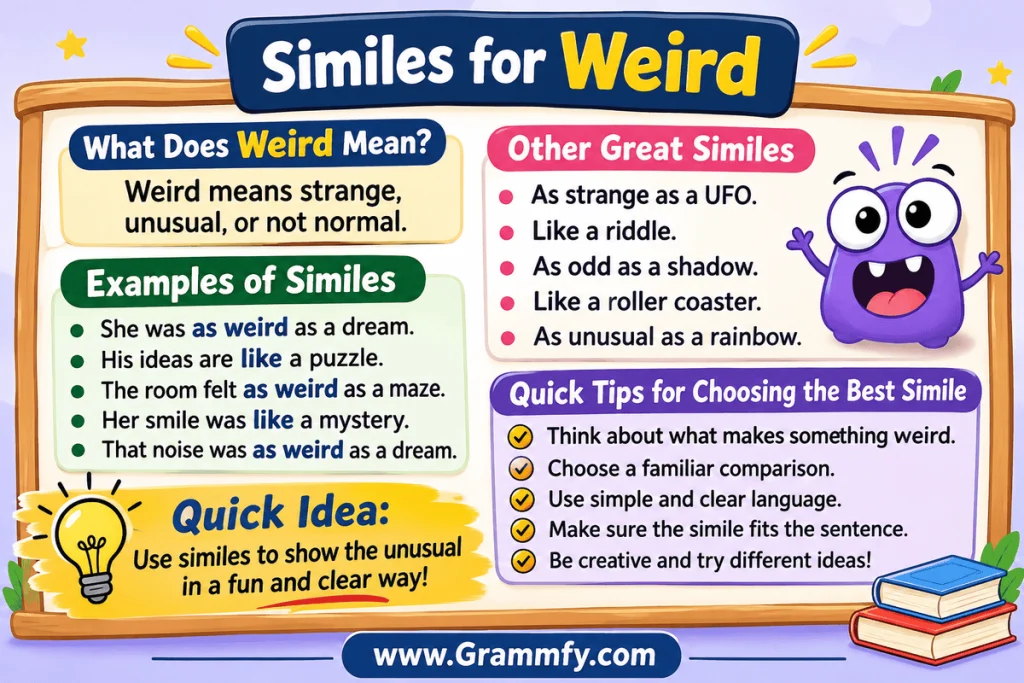
Quick Tips for Choosing the Best Simile
Use these tips to make your descriptions clearer and more engaging.
- Identify the main feature. Decide whether the subject is funny, confusing, mysterious, unexpected, or simply different.
- Choose a familiar image. Everyday objects, animals, weather, and common experiences help readers understand unusual comparisons.
- Match the tone to your audience. Use playful imagery for comedy, clear comparisons for schoolwork, and imaginative descriptions for creative writing.
- Use like or as clearly. These words help readers recognize a direct comparison.
- Focus on one main idea. A comparison works best when readers can understand the connection between the subject and the image.
- Avoid unnecessary repetition. Replace repeated adjectives with specific details or related words when appropriate.
- Use strong imagery selectively. Save the most unusual comparisons for moments when they add real value.
- Consider the reader’s perspective. Choose an image that your audience can picture without needing a lengthy explanation.
- Read the sentence aloud. Rewrite comparisons that sound awkward or overly complicated.
- Keep the meaning clear. Creativity is useful, but readers should still understand what makes the subject unusual.
The strongest comparison isn’t always the funniest or strangest one. It is the one that helps readers picture the subject and understand your intended meaning.
Conclusion: How Can You Describe Weird Things More Clearly?
Unusual experiences can be difficult to describe with a single adjective. A carefully chosen comparison gives readers a clearer picture of what makes a person, object, place, or situation different from what they expect. A clock running backward can suggest confusion, a fish riding a bicycle can create humor, and a mirror showing another world can make a scene feel mysterious.
When using Similes for Weird, focus on the feature you want to highlight and select an image that communicates it clearly. Think about your audience, the tone of your writing, and the emotion you want readers to experience. Simple comparisons often work best for everyday communication, while more imaginative ones can make creative writing stand out. Avoid forcing too many images into one sentence, and don’t use a comparison just to make your writing longer. With practice, you can create original descriptions that feel natural, memorable, and easy to understand.
Frequently Asked Questions
What is a simile for something weird?
A simile for something weird compares an unusual person, object, or experience to a familiar image using like or as. For example, “The machine sounded like a radio changing stations by itself” describes an unusual noise through a recognizable comparison.
What are some short similes for weird things?
Short examples include “like a clock running backward,” “as odd as a square wheel,” “like a fish riding a bicycle,” and “as strange as a talking shadow.” Each expression describes something unusual in a different way.
What’s another way to describe something weird?
You can use words such as strange, odd, peculiar, bizarre, quirky, or surreal. Choose quirky for an unusual but often charming quality, and bizarre for something extremely unexpected or difficult to explain.
How do you write your own weird simile?
Identify what makes the subject unusual, choose a familiar image, and connect the two ideas using like or as. For example, “The hallway looked like a road that kept changing direction” describes a confusing space through a clear comparison.
What are the best Similes for Weird situations?
Some useful Similes for Weird situations include “like a puzzle with missing pieces,” “as confusing as a story told backward,” and “like a mirror showing another world.” Choose one that matches whether the situation feels confusing, unexpected, humorous, or mysterious.
What is the difference between a simile and a metaphor?
A simile compares two things using like or as, while a metaphor describes one thing as another. “The room looked like a puzzle” is a simile, whereas “The room was a puzzle” is a metaphor.
Can I use weird similes in school essays and everyday conversations?
Yes, comparisons can make descriptive writing and everyday conversations more engaging when they fit the context. Use clear, relevant imagery in school essays and familiar, playful comparisons in casual conversations.

Tylerbrooks is a US-based English grammar writer and contributor at Grammfy. He writes helpful articles about grammar, spelling, commonly confused words, and vocabulary. His goal is to explain English topics in simple language with clear examples and practical tips. Through his articles, he helps readers improve their writing and everyday English skills.