
Problems are part of everyday life. You might face a difficult question in an exam, struggle to finish a project, or try to solve a misunderstanding with a friend. Sometimes, the word problem doesn’t fully express how stressful or complicated a situation feels. A creative comparison can make your meaning clearer.
Similes for Problems compare difficulties to familiar things using words such as “like” or “as.” They help readers picture challenges, understand emotions, and connect with a situation.
For example, you might describe a difficult problem as a maze with no exit or a mountain too steep to climb. These comparisons make an ordinary sentence more vivid and memorable.
Whether you’re writing a school essay, a story, an email, or a personal message, the right simile can help you explain a challenge in a natural way. Below, you’ll find useful examples, meanings, intensity levels, writing tips, and answers to common questions.
Need a more vivid way to describe weird? Explore our guide to creative weird similes and examples for fresh ideas and examples.
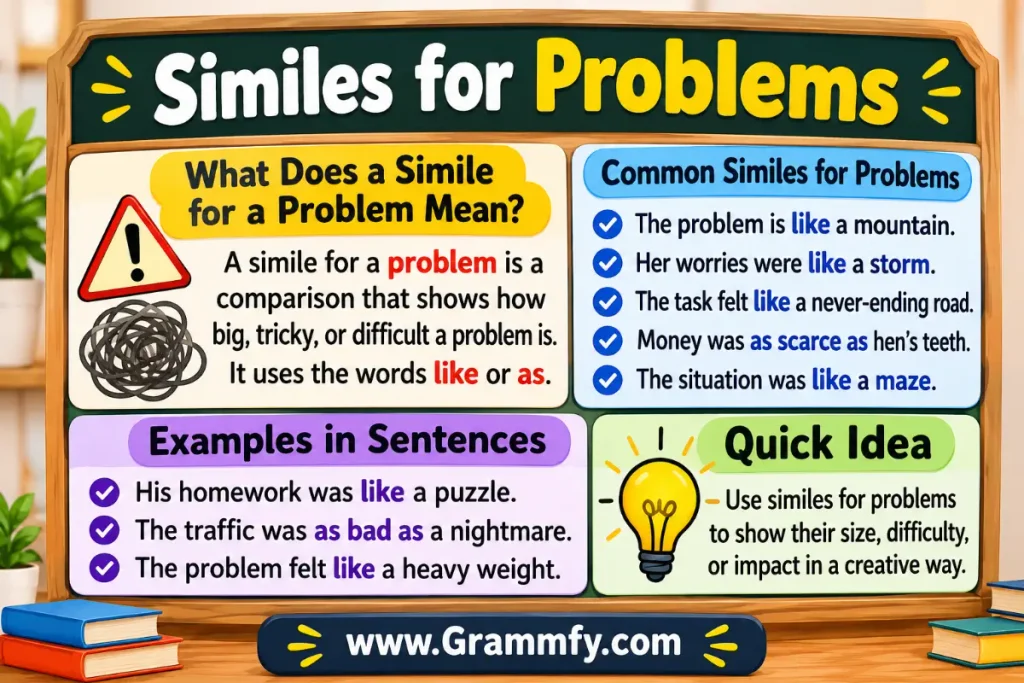
What Does a Simile for a Problem Mean?
A simile compares one thing with another to show a shared quality. It usually uses like or as.
When you compare a problem to a tangled knot, you suggest that it’s difficult to understand or solve. When you compare it to a mountain, you suggest that it feels large or demanding.
Consider these examples:
- The problem was like a locked door with no key.
- Her workload felt as heavy as a sack of stones.
- The mystery spread like a maze of winding paths.
Each comparison gives readers more information than the word problem alone. It can show how difficult, confusing, frightening, or frustrating a challenge feels.
Why Do Writers Compare Problems to Familiar Things?
Writers use comparisons because readers can picture familiar objects and situations more easily than abstract ideas.
A problem is an abstract concept. You can’t touch it or see its shape. However, you can imagine a mountain, a tangled rope, or a storm.
These images can communicate different feelings:
- Difficulty: A steep mountain suggests a demanding task.
- Confusion: A maze suggests a situation with no clear direction.
- Pressure: A heavy backpack suggests a growing burden.
- Danger: A storm suggests a situation that may become worse.
- Frustration: A locked door suggests an obstacle that blocks progress.
- Complexity: A tangled web suggests several connected issues.
Choose a comparison that matches the experience you’re describing. That way, your writing feels clear rather than exaggerated.
Where Does the Word “Problem” Come From?
The word problem comes through Latin from the Greek word problema, which referred to something put forward as a question or task. Its earlier roots relate to putting or throwing something forward.
Today, English speakers use problem for a question that needs an answer, a difficulty that needs attention, or a situation that requires a solution.
The word has several common uses:
- A practical difficulty: We have a problem with the printer.
- A personal challenge: She has a problem managing her time.
- A question to solve: The math problem took ten minutes.
- A serious concern: Pollution is a growing problem in many cities.
- A disagreement: They discussed their problems calmly.
The meaning depends on context. A math problem may be simple and enjoyable, while a family problem may be emotional and complicated.
A simile adds another layer by showing how the challenge feels or behaves.
50+ Best Similes for Problems and Their Meanings
These comparisons cover everyday difficulties, complicated situations, stressful tasks, and serious challenges. Each example includes a meaning and a sentence to show how you can use it.
| Simile | Meaning | Example sentence |
|---|---|---|
| Like a mountain to climb | Difficult and demanding | Finishing the project felt like a mountain to climb. |
| Like a tangled knot | Complicated and confusing | Their disagreement became like a tangled knot. |
| Like a heavy backpack | A burden that is hard to carry | Her unpaid bills felt like a heavy backpack. |
| Like a thorn in your side | A constant annoyance | The noisy computer was like a thorn in my side. |
| Like a cloud over your head | A worry that affects your mood | The upcoming deadline felt like a cloud over his head. |
| Like a tangled pair of headphones | A small but frustrating mess | Fixing the settings felt like untangling a pair of headphones. |
| Like a ship without a compass | A challenge without clear direction | The new team felt like a ship without a compass. |
| Like a ball of tangled yarn | Several connected complications | The scheduling issue became like a ball of tangled yarn. |
| Like a house of cards in the wind | A fragile situation | Their plan was like a house of cards in the wind. |
| Like a snowball rolling downhill | A small issue growing larger | One missed payment became like a snowball rolling downhill. |
| Like a mountain hidden in fog | A challenge whose size is unclear | The new assignment felt like a mountain hidden in fog. |
| Like a jigsaw missing its center | A problem with one crucial detail missing | The case felt like a jigsaw missing its center. |
These comparisons aren’t interchangeable. A mountain suggests a major challenge, while a tangled knot suggests complexity. A ticking clock emphasizes urgency, and a broken compass emphasizes a lack of direction.
Which Similes Describe Problems From Mild to Severe?
The strength of a comparison should match the seriousness of the situation. A small inconvenience doesn’t need the same language as a crisis.
Mild Problems: Small Annoyances
Use gentle comparisons for minor issues that are irritating but manageable.
- Like a pebble in your shoe: A small, repeated annoyance.
- Like a squeaky wheel: Something that keeps drawing attention.
- Like a tiny snag in a sweater: A minor complication.
- Like a fly around your head: A distraction that’s hard to ignore.
- Like a slow-moving line: A delay that tests your patience.
Example: The outdated software was like a pebble in my shoe during the workday.
Moderate Problems: Challenges That Need Effort
These comparisons suit issues that take time, planning, or patience to resolve.
- Like a tangled knot: A complicated situation.
- Like a road full of potholes: A process with several setbacks.
- Like a puzzle with missing pieces: A challenge with incomplete information.
- Like a heavy backpack: A growing workload or responsibility.
- Like a door with too many locks: A task with several barriers.
Example: Organizing the community event was like driving along a road full of potholes.
Serious Problems: Major Obstacles
Choose stronger images when a challenge affects important plans, relationships, or responsibilities.
- Like a mountain too steep to climb: A task that feels overwhelming.
- Like a storm that won’t pass: A continuing hardship.
- Like quicksand: A situation that becomes worse with each attempt.
- Like a bridge collapsing beneath you: A sudden loss of support.
- Like a fire spreading through dry grass: A problem growing rapidly.
Example: The sudden loss of funding felt like a bridge collapsing beneath the entire project.
Urgent Problems: Immediate Action Is Needed
Use comparisons that emphasize time, risk, or rapid change.
- Like a ticking clock: Time is running out.
- Like a fire alarm: A warning that needs immediate attention.
- Like a train rushing toward a barrier: A dangerous situation approaching quickly.
- Like a storm breaking overhead: A serious problem happening now.
- Like a leak flooding a room: A small issue becoming an emergency.
Example: The failing server was like a ticking clock because the team had only minutes to save the files.
What Words Can You Use Instead of “Problem”?
Sometimes a direct synonym is better than a simile. The right word depends on what kind of difficulty you mean.
The following list groups alternatives by tone and use. Some are nouns for challenges, while others describe the condition or feeling around them.
Simple Words for Problems
These familiar words work well in school assignments and everyday conversations.
| Word | Meaning | Tone | Example |
|---|---|---|---|
| Issue | A matter that needs attention | Neutral | We found an issue with the schedule. |
| Trouble | Difficulty or an unwanted situation | Everyday | The printer is giving us trouble. |
| Challenge | Something that takes effort to overcome | Positive or neutral | Learning a new skill is a challenge. |
| Difficulty | Something hard to do or manage | Neutral | She had difficulty following the instructions. |
| Concern | Something that causes worry | Neutral | The delay is a concern for the team. |
| Hurdle | An obstacle that must be overcome | Encouraging | The final exam is one more hurdle. |
| Setback | An event that delays progress | Neutral | The power cut caused a setback. |
| Obstacle | Something that blocks progress | Neutral | Cost was the main obstacle. |
Everyday Words for Problems
These words fit informal conversations, personal stories, and practical explanations.
| Word | Meaning | Tone | Example |
|---|---|---|---|
| Mess | A confused or poorly managed situation | Informal | The paperwork turned into a mess. |
| Headache | An annoying or difficult task | Informal | Sorting out the bills was a headache. |
| Hassle | Something that takes extra time or effort | Informal | Returning the item was a hassle. |
| Snag | A small unexpected problem | Informal | We hit a snag during setup. |
| Glitch | A minor technical failure | Informal | A software glitch stopped the upload. |
| Hitch | An unexpected difficulty | Informal | The plan went ahead without a hitch. |
| Complication | Something that makes a situation harder | Neutral | A new rule added a complication. |
| Hang-up | A delay or obstacle, often informal | Informal | The final signature was the main hang-up. |
Formal Words for Problems
Use these alternatives in reports, professional writing, academic work, and business communication.
| Word | Meaning | Tone | Example |
|---|---|---|---|
| Challenge | A demanding task or situation | Professional | The company faces a major challenge. |
| Dilemma | A choice between difficult options | Formal | The manager faced an ethical dilemma. |
| Predicament | A difficult situation with limited choices | Formal | They found themselves in a difficult predicament. |
| Complication | A factor that makes something harder | Formal | The revised deadline created a complication. |
| Obstruction | Something that blocks progress | Formal | The missing document was an obstruction. |
| Impediment | Something that slows or prevents progress | Formal | Limited funding remains an impediment. |
| Difficulty | A condition that makes something hard | Formal or neutral | The report explains the main difficulties. |
| Concern | A matter requiring attention | Professional | We have a concern about data accuracy. |
| Deficiency | A lack or weakness | Formal | The audit identified a deficiency in the process. |
| Predicament | A challenging position or situation | Formal | The team faced a financial predicament. |
Slang and Informal Expressions for Problems
These expressions can sound natural in conversation, but they may be too casual for formal documents.
| Word or expression | Meaning | Tone | Example |
|---|---|---|---|
| Pain | An annoying or difficult thing | Informal | Updating every file by hand is a pain. |
| Pain in the neck | A persistent annoyance | Informal | The broken printer is a pain in the neck. |
| Sticky situation | An awkward or difficult position | Informal | We were in a sticky situation after the booking error. |
| Pickle | A difficult position | Playful | I’m in a pickle because I lost the keys. |
| Jam | A difficult situation | Informal | We were in a jam when the bus broke down. |
| Mess-up | A mistake that causes trouble | Informal | The booking mess-up delayed our trip. |
| Snafu | A confused situation or mishap | Informal | A delivery snafu delayed the order. |
| Bump in the road | A temporary setback | Informal | The rejection was just a bump in the road. |
Quick note: A synonym and a simile do different jobs. A synonym replaces the word problem. A simile compares the problem to something familiar. For stronger writing, you can use both: “The delay was a major obstacle, like a wall blocking the road.”

What Are the Best Similes for Problems in Different Situations?
The best comparison depends on the setting, audience, and emotion you want to communicate.
Which Simile Works Best for a Resume?
A resume should sound confident and professional. Avoid dramatic phrases that make you appear overwhelmed. Instead, describe challenges as opportunities to solve problems, improve processes, or manage competing demands.
Useful expressions include:
- A hurdle to overcome: A challenge that required action.
- A puzzle to solve: A task that needed analysis.
- A road with a few turns: A project that required flexibility.
- A knot to untangle: A complicated process that needed careful work.
Example: “I treated the reporting delay as a puzzle to solve and improved the team’s tracking process.”
For a resume, focus on what you did and what changed. The comparison should support your achievement rather than replace concrete evidence.
Which Simile Works Best in an Essay?
An essay often needs clear, controlled language. Choose an image that supports your main argument instead of distracting from it.
Good choices include:
- Like a bridge with a missing section: Useful for gaps in research or reasoning.
- Like a maze: Useful for complicated systems or rules.
- Like a snowball rolling downhill: Useful for problems that grow over time.
- Like a chain with a weak link: Useful for explaining a weakness in a process.
Example: “Without clear public guidance, the application process became like a maze for first-time applicants.”
After using a comparison, explain what it means. This helps readers connect the image to your argument.
Which Simile Works Best in a Text Message?
Text messages are usually casual, so a short, familiar comparison works best.
Try these:
- Like a headache: An irritating issue.
- Like a maze: A confusing situation.
- Like quicksand: Something getting worse.
- Like a mountain: A task that feels huge.
- Like a bump in the road: A temporary setback.
Example: “Sorting out my timetable is like solving a maze right now.”
For friendly conversations, humor can make a difficult day easier to discuss. Still, avoid jokes when someone is dealing with a serious loss or emergency.
Which Simile Works Best in a Professional Email?
A professional email should explain the difficulty without sounding emotional or blaming someone.
Useful comparisons include:
- A bottleneck: A point where progress slows.
- A missing link: A gap in information or communication.
- A roadblock: Something preventing progress.
- A moving target: A requirement that keeps changing.
Example: “The missing approval has become a roadblock to completing the project.”
In formal emails, you may not need a simile at all. A direct sentence such as “The missing approval is delaying the project” is often clearer. Use a comparison only when it helps explain the situation.
Which Simile Works Best When Speaking?
In conversation, choose comparisons that people can understand quickly.
- Like a mountain to climb: A demanding task.
- Like a thorn in my side: A recurring annoyance.
- Like a ticking clock: Time pressure.
- Like a tangled knot: A complicated issue.
- Like a bump in the road: A temporary setback.
Example: “Getting the whole group to agree was like untangling a knot.”
Everyday comparisons are usually more effective than elaborate images when you’re speaking. The listener should understand your meaning without needing an explanation.
15+ Original Examples of Similes for Problems in Real Life
Examples make it easier to see how comparisons work in context. Notice how each sentence connects the image to a specific situation.
- School: The science project felt like a mountain to climb because we had only two days left.
- Homework: The final question was like a locked door without a key until I reviewed the lesson.
- Work: The sudden change in instructions was like a road full of potholes for the design team.
- Technology: Fixing the computer error felt like searching for a needle in a haystack.
- Friendship: Their misunderstanding became like a tangled knot because neither person wanted to explain what happened.
- Money: The unpaid bills sat in his mind like a heavy backpack.
- Travel: The canceled train turned the journey into a maze with no clear exit.
- Time management: My schedule was like a rope stretched too tight, with no room for unexpected tasks.
- Business: The missing delivery was like a broken bridge between the supplier and the customer.
- Family: Planning the reunion became like solving a puzzle with missing pieces because everyone had different plans.
- Health appointment: Booking a suitable time was like finding a needle in a haystack.
- Moving house: Packing the entire apartment felt like facing a mountain of paperwork and boxes.
- Teamwork: The project became like a ship without a compass when the team leader left.
- Online shopping: Returning the damaged item was like opening a door that led to another locked door.
- Weather: The leaking roof during the storm was like a small problem inviting a bigger one.
- Customer service: Waiting for a reply felt like watching a ticking clock while the deadline approached.
How to Make These Examples More Specific
A comparison becomes stronger when it includes a clear reason or result.
Instead of writing, “The task was like a mountain,” add the detail that makes the task difficult.
- General: The task was like a mountain.
- More specific: Preparing for three exams in one week felt like climbing a mountain with a heavy backpack.
- General: The situation was like a maze.
- More specific: The confusing application process felt like a maze because every form sent us to another department.
Specific details help readers picture the challenge. They also prevent your writing from sounding like a list of unrelated phrases.
What Is the Difference Between a Problem, an Obstacle, and a Setback?
These words are related, but they don’t mean exactly the same thing.
| Word | Main meaning | Example | Useful comparison |
|---|---|---|---|
| Problem | A situation that needs a solution | The laptop won’t start. | A locked door |
| Obstacle | Something that blocks progress | A missing permit stops construction. | A wall across a road |
| Setback | An event that delays progress | A storm delays the delivery. | A bump in the road |
| Challenge | A demanding task or situation | Learning a new language takes practice. | A mountain to climb |
| Dilemma | A difficult choice between options | She must choose between two job offers. | A fork in the road |
| Complication | Something that makes a situation harder | A new rule changes the plan. | A knot becoming tighter |
| Crisis | A serious situation needing urgent action | A major system failure affects customers. | A storm breaking overhead |
Use problem as the broad term. Choose obstacle when something blocks progress, setback when progress is delayed, and dilemma when a difficult choice is involved.
This distinction helps you choose a more precise simile. A setback might be a bump in the road, while a dilemma might feel like standing at a fork in the road.
Simile vs. Metaphor: What’s the Difference?
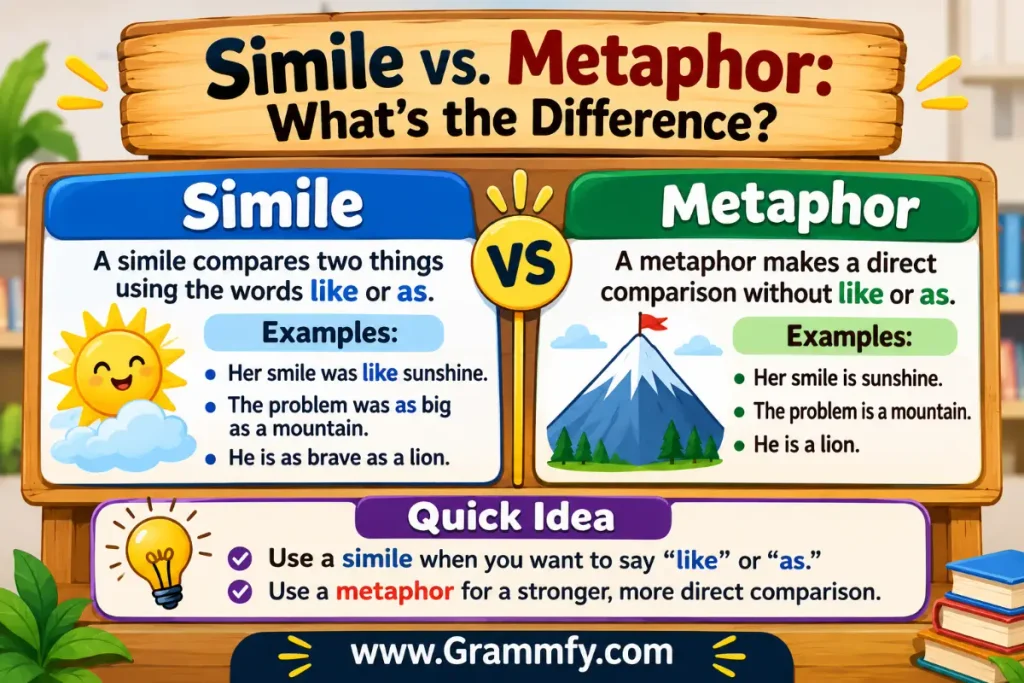
A simile makes an explicit comparison, usually with like or as. A metaphor describes one thing as another without using those comparison words.
| Simile | Metaphor |
|---|---|
| The problem was like a mountain. | The problem was a mountain. |
| Her workload felt like a heavy backpack. | Her workload was a heavy backpack. |
| The argument spread like wildfire. | The argument was a wildfire. |
| The instructions were like a maze. | The instructions were a maze. |
Both devices can make writing vivid. A simile is often easier for beginners because it clearly signals the comparison. A metaphor can sound more direct and dramatic.
Choose the form that fits your sentence. If you want to explain the comparison clearly, use a simile. If you want a stronger, more immediate image, a metaphor may work better.
Simile vs. Idiom: How Are They Different?
A simile creates a comparison, while an idiom is an expression whose meaning may not be clear from its individual words.
For example:
- Simile: The task was like climbing a mountain.
- Idiom: We were in a tight spot.
- Simile: The project grew like a snowball rolling downhill.
- Idiom: We hit a snag.
- Simile: Her responsibilities felt like a heavy backpack.
- Idiom: She had her hands full.
An idiom can be useful in casual speech, while a simile lets you create a more specific image. Both can help readers understand a challenge, but they serve different purposes.
Common Mistakes When Describing Problems With Similes
Comparisons can improve writing, but a poorly chosen image may confuse readers or make a small issue sound too serious.
1. Using a Dramatic Simile for a Small Problem
A minor delay probably isn’t a disaster.
- Overstated: Waiting five minutes was like surviving a hurricane.
- Better: Waiting five minutes was like watching a slow-moving line.
Match the strength of your comparison to the actual situation.
2. Mixing Two Images in One Sentence
Combining unrelated comparisons can make your meaning hard to follow.
- Confusing: The problem was a mountain, a locked door, and a storm in the road.
- Better: The problem was like a mountain because it required weeks of effort.
Use one main image unless you have a clear reason to combine them.
3. Choosing a Comparison That Doesn’t Match the Meaning
A ticking clock suggests urgency, not confusion. A maze suggests confusion, not necessarily danger.
Before choosing an image, ask what you want to emphasize:
- Difficulty
- Confusion
- Pressure
- Delay
- Risk
- Frustration
Then select a comparison that communicates that quality.
4. Using a Simile Without Explaining the Connection
A sentence such as “The problem was like a garden” doesn’t tell the reader much. A garden can represent growth, beauty, neglect, or hard work.
Make the connection clear: “The neglected project was like a garden full of weeds because small issues had grown unchecked.”
5. Repeating the Same Comparison Too Often
Using mountain to climb in every paragraph can make an essay feel repetitive. Try changing the image according to the situation.
For example, describe a difficult assignment as a mountain, a confusing instruction sheet as a maze, and a tight deadline as a ticking clock.
6. Using Informal Expressions in Formal Writing
Words such as pickle, mess-up, and pain in the neck work in casual conversation. They may not fit a formal report or academic essay.
For professional writing, consider challenge, obstacle, complication, or concern.
7. Treating Every Problem as Something Negative
Not every challenge is harmful. Some problems lead to learning, better decisions, or useful changes.
For example: “Learning to manage the new software was like climbing a mountain, but the view from the top was worth the effort.”
This comparison acknowledges the difficulty while showing the reward.
When Should You Avoid Using a Simile?
A simile isn’t always the best choice. Sometimes direct language is more accurate, respectful, or useful.
Avoid comparisons when:
- Giving urgent instructions: Say exactly what needs to happen instead of using figurative language.
- Writing technical steps: Clear directions are more useful than creative images.
- Reporting facts: Use precise information rather than dramatic descriptions.
- Discussing sensitive experiences: A comparison may sound dismissive if it doesn’t respect someone’s feelings.
- Writing a short professional email: A direct explanation may save time and prevent confusion.
- Describing a legal or financial matter: Exact terms are often more appropriate than figurative language.
For example, “The payment system is unavailable” is clearer than “The payment system is like a ship lost at sea” when a customer needs practical information.
Creative language should make a message easier to understand. If it hides the facts, leave it out.
What Are the Antonyms of “Problem”?
An antonym is a word with an opposite or contrasting meaning. The best opposite of problem depends on the context.
| Word | Meaning | Example |
|---|---|---|
| Solution | An answer that resolves a problem | We found a solution to the delay. |
| Answer | A response to a question | Her answer solved the puzzle. |
| Advantage | A helpful feature or benefit | Flexible hours are an advantage. |
| Opportunity | A chance to do something useful | The challenge became an opportunity to learn. |
| Success | A favorable result | The project ended in success. |
| Benefit | Something that helps | The new system offers several benefits. |
| Ease | A state of comfort or lack of difficulty | The updated process made the task easier. |
These words aren’t exact opposites in every sentence. Solution is the most direct choice when you mean an answer to a difficulty. Opportunity works when a challenging situation creates a useful possibility.
How Can You Choose the Right Simile for a Problem?
A strong comparison should communicate one clear idea. Follow these practical steps to choose one that fits your writing.
1. Decide What Kind of Difficulty You Mean
Ask whether the situation is confusing, stressful, urgent, complicated, or simply annoying.
- For confusion, try a maze.
- For pressure, try a heavy backpack.
- For urgency, try a ticking clock.
- For complexity, try a tangled knot.
- For a temporary delay, try a bump in the road.
This first step helps you avoid choosing an image that sends the wrong message.
2. Think About Your Audience
A school essay, business report, and text message need different tones.
For an essay, a puzzle with missing pieces may be clear and descriptive. In a text message, a total headache may sound more natural. In a professional report, a major obstacle may be more appropriate than a dramatic comparison.
Choose language your readers will understand.
3. Use Familiar Images
A reader shouldn’t need to stop and decode your comparison. Mountains, roads, doors, knots, and clocks are familiar images that work in many situations.
Original comparisons can be effective, too, but the connection should remain easy to understand.
4. Add a Detail That Makes the Image Clear
A short explanation helps the reader see why the comparison fits.
Instead of “The project was like a storm,” write, “The project was like a storm because new requests arrived from every direction.”
The second sentence gives the image a clear purpose.
5. Read the Sentence Aloud
A comparison may look good on the page but sound unnatural when spoken.
Read it aloud and ask:
- Does the meaning make sense immediately?
- Is the image appropriate for the situation?
- Does it sound natural in American English?
- Is the sentence too dramatic?
- Could a simpler phrase work better?
If the sentence feels awkward, choose a more familiar comparison or state the point directly.
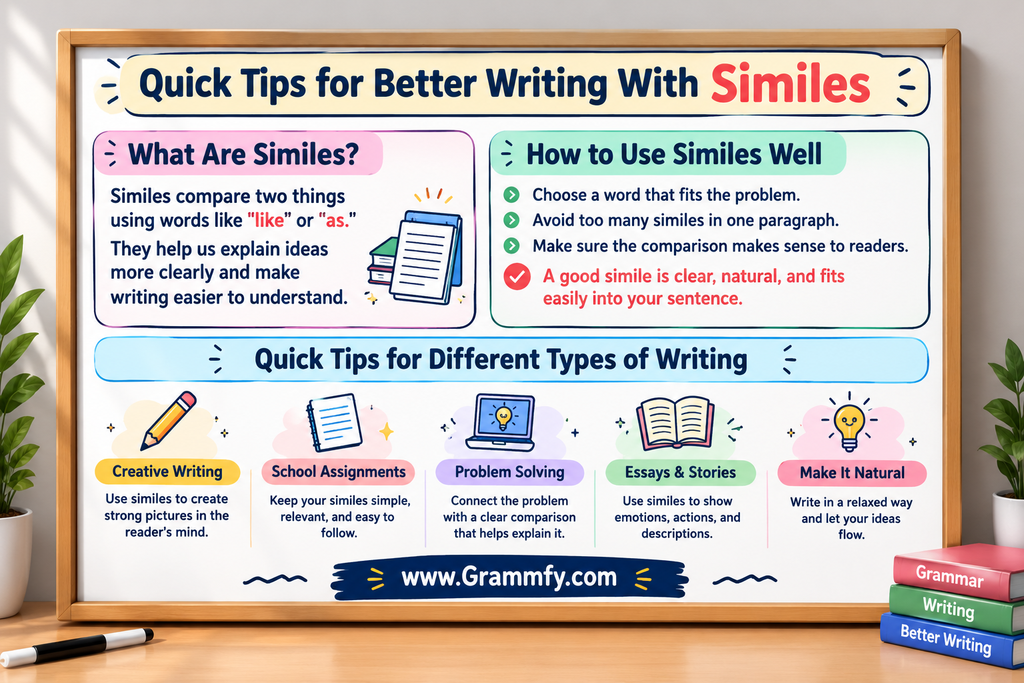
Quick Tips for Better Writing With Similes
Keep these reminders in mind when describing challenges.
- Be specific: Explain what makes the situation difficult.
- Match the tone: Use casual comparisons in conversation and restrained language in formal writing.
- Choose one main image: Avoid mixing unrelated comparisons.
- Vary your wording: Use different images for confusion, pressure, delay, and frustration.
- Keep it clear: A simile should help the reader understand your point.
- Avoid exaggeration: Don’t describe every small inconvenience as a disaster.
- Consider the audience: Choose familiar language for readers who may be learning English.
- Connect the comparison to the point: Explain how the image relates to the difficulty.
- Use direct wording when needed: Accuracy matters more than creativity in instructions and reports.
- Edit repeated phrases: Remove comparisons that don’t add new meaning.
A useful way to practice is to take a plain sentence and rewrite it with one clear comparison.
Plain sentence: “The assignment was difficult.”
Improved sentence: “The assignment was like a maze because each question led to another question.”
The improved version explains not only that the assignment was hard but also why it felt confusing.
Conclusion
A good comparison can turn a vague description into a clear picture. Instead of simply saying that something is difficult, you can describe it as a mountain to climb, a maze with no exit, or a knot that keeps tightening. Each image highlights a different part of the experience.
When choosing Similes for Problems, think about the feeling or obstacle you want readers to understand. Use a mountain for a demanding task, a ticking clock for time pressure, and a tangled knot for a complicated situation. Keep the wording natural, match the tone to your audience, and explain the connection when necessary.
You don’t need an elaborate comparison in every sentence. One well-chosen image can be enough to make your writing clearer and more memorable. Practice with everyday situations, and you’ll soon find it easier to describe challenges with confidence.
Frequently Asked Questions
What are similes for problems?
Similes for problems are comparisons that describe a difficulty by relating it to something familiar. Examples include “like a mountain to climb,” “like a tangled knot,” and “like a maze with no exit.”
What’s another way to say a problem is difficult?
You can say the problem is like a mountain to climb, a puzzle with missing pieces, or a locked door without a key. Each comparison emphasizes a different kind of difficulty.
What is a good simile for a complicated problem?
A tangled knot is a good simile for a complicated problem because it suggests that several parts are connected and difficult to separate. A maze also works when the solution is hard to find.
What is a simile for a problem that keeps getting worse?
A problem that keeps getting worse can be compared to a snowball rolling downhill or a fire spreading through dry grass. Both images suggest that a small issue can grow into something much larger.
Can I use similes for problems in an academic essay?
Yes, if the comparison supports your point and fits the essay’s tone. Use a clear image, explain its meaning, and avoid dramatic language that distracts from your argument.
What is the difference between a simile and a metaphor?
A simile compares two things using words such as like or as. A metaphor describes one thing as another, such as “The problem was a mountain.”
What is the opposite of a problem?
A solution is often the closest opposite when you mean an answer to a difficulty. Depending on the context, words such as success, benefit, or opportunity may also express a contrasting idea.

Tylerbrooks is a US-based English grammar writer and contributor at Grammfy. He writes helpful articles about grammar, spelling, commonly confused words, and vocabulary. His goal is to explain English topics in simple language with clear examples and practical tips. Through his articles, he helps readers improve their writing and everyday English skills.