
Imagine you’re writing a story about a rainy afternoon. Water slips down a window, a tiny stream moves over the stones, and a small trickle runs from a broken faucet. You want readers to picture the scene, but the word trickling doesn’t quite capture its gentle movement. A good simile can make that moment easier to imagine.
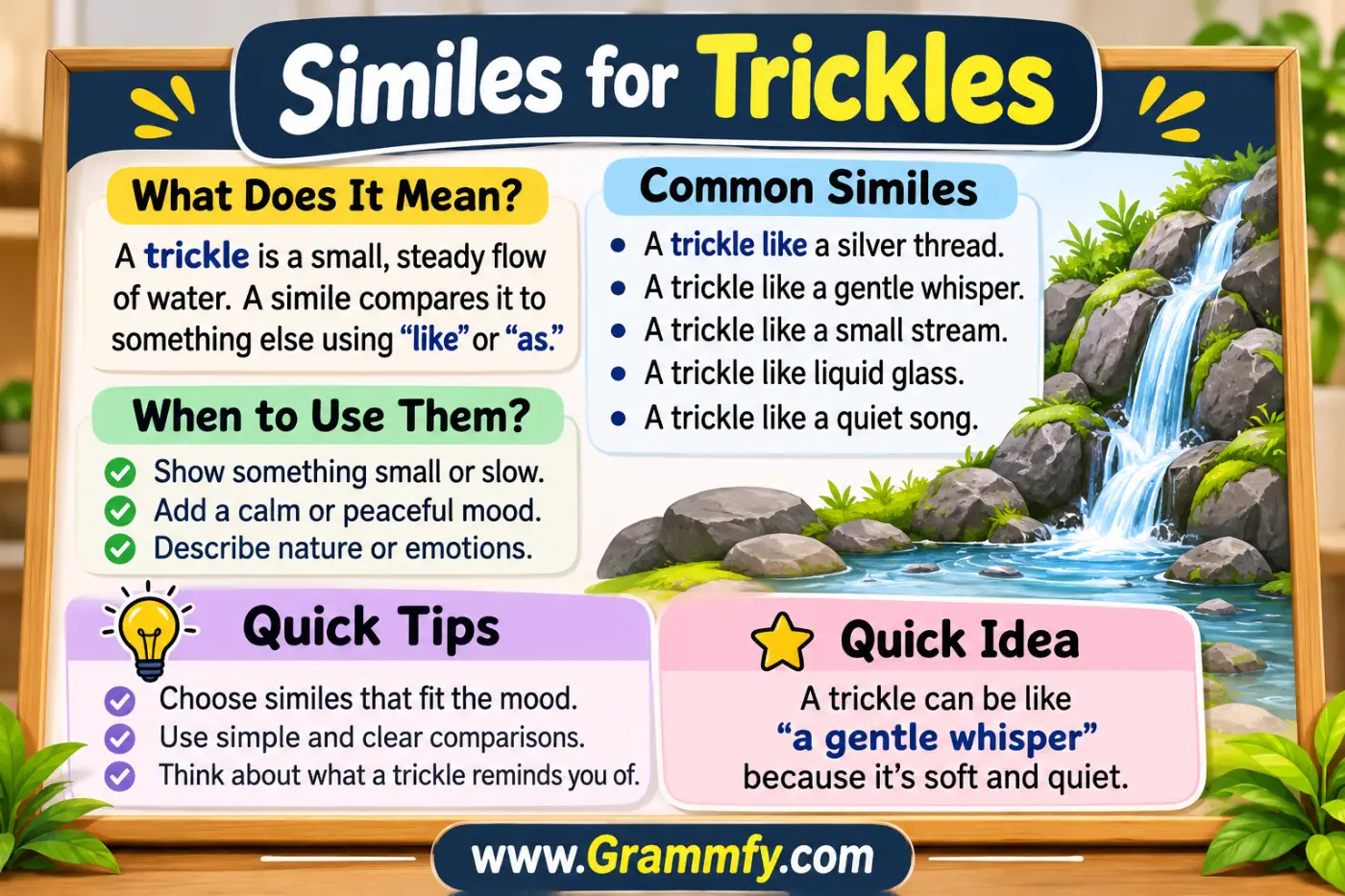
Similes for Trickles compare a small, slow, or gentle flow of water to something familiar. These comparisons help readers picture how water moves, sounds, and looks in different situations. They can also describe small amounts of other things that flow gradually, such as sand, light, or even tears.
The best comparison depends on the scene you’re describing. A trickle moving over smooth rocks may resemble a silver thread, while water dripping from a damaged pipe may sound like a quiet ticking clock. Each comparison creates a different feeling.
In this guide, you’ll discover creative examples, simple explanations, comparisons by mood and intensity, and practical ways to write your own similes. You’ll also learn which expressions work best in stories, school essays, emails, and everyday conversations.
Need a more vivid way to describe problems? Explore our guide to creative problems similes and examples ]for fresh ideas and examples.
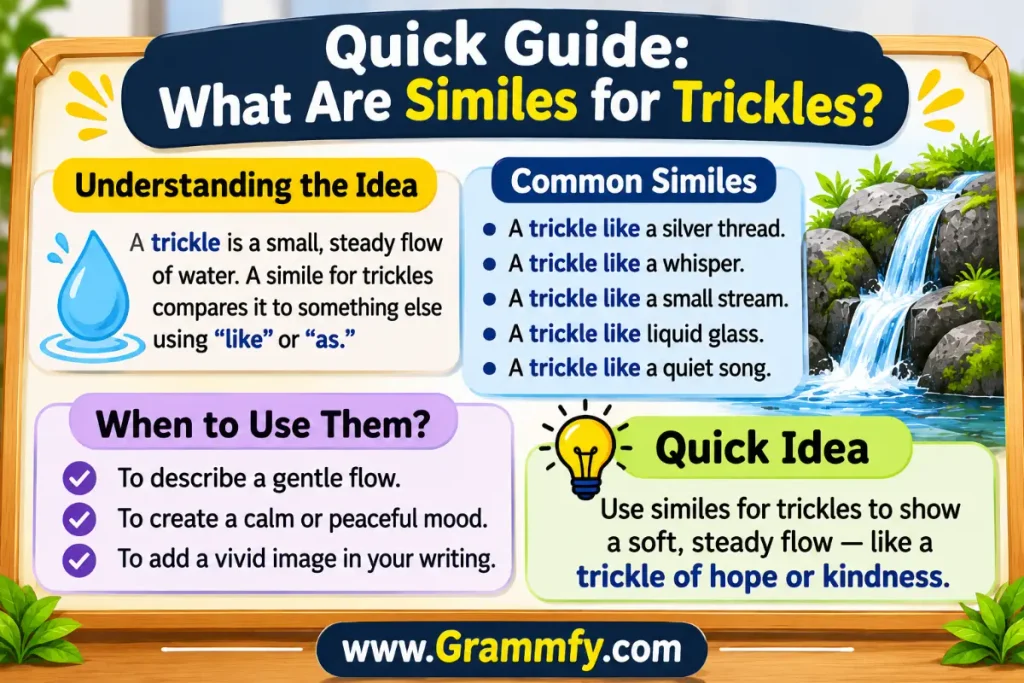
Quick Guide: What Are Similes for Trickles?
Similes for Trickles are expressions that compare a small or gentle flow to another object, action, or experience using words such as like or as. For example, “The water flowed like a thin silver ribbon” compares moving water to a narrow ribbon to help readers visualize its appearance.
Simple Definition
A trickle is a small, slow flow of liquid. A simile describes that flow by comparing it to something readers already understand.
Examples at a Glance
- The water trickled like a silver thread across the stone.
- Rain ran down the window like tiny glass beads.
- The stream moved like a sleepy snake through the grass.
- Tears rolled down her cheeks like drops of morning dew.
- Water slipped through the crack like a thin ribbon.
What Makes a Good Trickle Simile?
A strong comparison does more than mention water. It helps readers picture a particular quality.
- Movement: Does the water crawl, slide, creep, or glide?
- Sound: Is it whispering, ticking, murmuring, or barely audible?
- Appearance: Does it look like a thread, ribbon, string, or line of glass?
- Mood: Does it create a peaceful, sad, mysterious, or tense feeling?
- Amount: Is the flow tiny, steady, weak, or gradually increasing?
For example, “The water trickled like a silver thread” focuses on appearance. “The water trickled like a whisper” emphasizes sound and softness. Both describe a small flow, but each creates a different picture.
What Does the Word Trickle Mean?
The word trickle describes a small, slow, or thin flow of liquid. It can be used as both a noun and a verb.
Trickle as a Noun
As a noun, trickle refers to a small amount of flowing liquid.
Examples:
- A trickle of water crossed the dusty road.
- She noticed a trickle of blood on her finger.
- A trickle of rainwater gathered near the doorway.
- Only a trickle of water came from the old faucet.
The noun often suggests that the amount is limited. It doesn’t usually describe a powerful river or a heavy flood.
Trickle as a Verb
As a verb, trickle describes the action of flowing slowly in a small amount.
Examples:
- Water trickled down the wall.
- Rain trickled through a gap in the roof.
- Tears trickled from his eyes.
- A narrow stream trickled between the rocks.
The verb can also describe things that move or arrive gradually.
For example, “Students trickled into the classroom” means that students arrived slowly, one by one, rather than all at once.
Where Does the Word Trickle Come From?
Trickle is an old English word associated with the idea of flowing in small amounts. Its historical development is connected with the sense of liquid moving gradually rather than rushing.
For modern writers, the most useful point is its meaning: a trickle is usually small, gentle, or limited in volume.
The word can describe physical movement, but it can also create a picture of gradual change.
Consider these examples:
- Physical: Water trickled down the hillside.
- Emotional: A trickle of tears escaped her eyes.
- Informational: News trickled through the small town.
- Financial: A trickle of donations reached the shelter.
These uses share the idea of something arriving or moving in a limited, gradual way.
What Are the 25 Best Similes for Trickles?
The following comparisons cover peaceful scenes, nature, rain, sadness, and creative writing. Each example includes a short explanation so you can choose one that fits your meaning.
| No. | Simile | Meaning | Best Use |
|---|---|---|---|
| 1 | Like a silver thread | A thin, shining flow | Describing a stream |
| 2 | Like a whisper | A very soft, quiet flow | Peaceful scenes |
| 3 | Like a sleepy snake | A slow, winding movement | Nature writing |
| 4 | Like a glass ribbon | A smooth, clear flow | Descriptive stories |
| 5 | Like tiny beads | Small drops moving along a surface | Rainy scenes |
| 6 | Like a leaking tap | A weak, steady flow | Everyday situations |
| 7 | Like a thread of silk | A delicate, narrow stream | Poetic descriptions |
| 8 | Like a quiet melody | A gentle, continuous sound | Relaxing scenes |
| 9 | Like a slow-moving snail | Extremely slow movement | Humorous writing |
| 10 | Like a thin pencil line | A narrow, visible path | Simple descriptions |
| 11 | Like morning dew | Small drops of moisture | Nature poetry |
| 12 | Like a tiny waterfall | A small but continuous cascade | Rocks and gardens |
| 13 | Like a silver snake | A narrow, winding flow | Scenic descriptions |
| 14 | Like a fading song | A flow that becomes weaker | Emotional writing |
| 15 | Like a quiet clock ticking | A soft, repeated dripping sound | Suspenseful scenes |
| 16 | Like a ribbon slipping downhill | Water moving smoothly downward | Hillsides |
| 17 | Like a tear on glass | A small, visible trail of liquid | Windows and sadness |
| 18 | Like a narrow stream of light | A thin line moving through darkness | Figurative writing |
| 19 | Like a thread pulled through cloth | A delicate line passing through a space | Creative descriptions |
| 20 | Like a gentle sigh | A soft, almost unnoticed movement | Reflective writing |
Which Trickle Simile Is Best for a Peaceful Scene?
Choose a comparison that emphasizes soft movement or gentle sound.
Examples:
- The stream murmured like a whisper beneath the trees.
- Water slipped over the pebbles like a ribbon of glass.
- The fountain trickled like a quiet melody in the garden.
These comparisons suit gardens, forests, quiet mornings, and relaxing scenes.
Which Simile Works Best for a Sad Scene?
Choose an image that connects the flow of water with tears, fading sounds, or loneliness.
Examples:
- Tears trickled down her face like rain on a cold window.
- A thin stream of water fell like a lonely silver thread.
- The drops faded like the last notes of a sad song.
These comparisons help establish an emotional atmosphere without explaining every feeling directly.
Which Simile Is Best for a Funny Scene?
A playful comparison can make a tiny flow seem amusing.
Examples:
- Water trickled from the faucet like a tired snail crossing the kitchen.
- The old tap dripped like a clock that had forgotten how to hurry.
- The garden hose released water like someone squeezing the last drop from a sponge.
Humor works especially well when the comparison exaggerates how slowly the water moves.
What Are Some Simple Similes for Trickles?
Simple comparisons are ideal for students, beginners, and anyone who wants clear language.
- The water moved like a thin string.
- Rain trickled down the glass like tiny beads.
- The stream flowed like a narrow ribbon.
- Water ran like a small silver line.
- The drops fell like slow tears.
- The creek moved like a sleepy snake.
- Water slipped like silk over the stones.
- The faucet dripped like a ticking clock.
- The stream sounded like a quiet whisper.
- Rainwater crept like a little trail across the ground.
These examples use familiar objects and actions. Readers don’t need special knowledge to understand them.
How Can You Make a Simple Simile More Interesting?
Start with a basic sentence:
“The water trickled down the rock.”
Then add a comparison:
“The water trickled down the rock like a thin ribbon.”
Finally, include a detail that helps readers imagine the scene:
“Under the morning sun, the water trickled down the dark rock like a thin silver ribbon.”
The last sentence gives readers information about the time, light, surface, and appearance of the water.
You don’t need to make every sentence this detailed. One strong image is often enough.
What Are Some Creative and Poetic Similes for Trickles?
Poetic comparisons help readers experience a scene through images, sounds, and emotions.
| Simile | Image Created | Mood |
|---|---|---|
| Like a silver thread stitched into the earth | A narrow, shining stream | Peaceful |
| Like a whisper escaping the forest | Quiet water in a natural setting | Mysterious |
| Like a ribbon of moonlight slipping downhill | Water reflecting moonlight | Dreamy |
| Like a song too soft to hear clearly | A barely audible flow | Reflective |
| Like a tear slipping from the sky | Rain falling gently | Sad |
| Like silk sliding over stone | Smooth movement | Calm |
| Like a secret finding its way through a crack | Water moving through a narrow opening | Mysterious |
| Like a tiny path drawn by nature | A small trail of water | Hopeful |
| Like a silver necklace broken into drops | Shining droplets | Delicate |
| Like a quiet thought crossing the mind | A subtle, gradual movement | Thoughtful |
How Do Poetic Similes Improve Descriptions?
Poetic comparisons let readers connect physical details with feelings.
For example:
“The creek trickled through the forest.”
This tells readers what happened.
“The creek trickled through the forest like a secret whispered beneath the trees.”
This version adds mystery. The word secret encourages readers to imagine a hidden place.
Similarly:
“Rain trickled down the window like a tear slipping from the sky.”
This comparison gives an ordinary rainy scene a sad, reflective quality.
Use poetic images when the mood matters as much as the action. In technical writing, a direct description is usually better.
What Are Some Similes for a Very Slow Trickle?
A slow trickle moves gradually and may seem almost still.
These comparisons emphasize patience, weak movement, or the passage of time.
- The water moved like a snail crossing a wet stone.
- The old faucet dripped like a clock counting the seconds.
- The creek crept forward like a tired traveler.
- Water slipped through the crack like a thread pulled slowly through cloth.
- The drops fell like sleepy raindrops from a leaf.
- The tiny stream crawled like a caterpillar across the soil.
- Water descended like a lazy ribbon over the edge.
- The last drops escaped like reluctant guests leaving a party.
When Should You Use a Slow-Movement Comparison?
Use these expressions when you want to show that the water is moving slowly enough for a reader to notice each moment.
For example, a story about a broken faucet might say:
“Every few seconds, another drop escaped, falling like a clock counting down the quiet minutes.”
This comparison emphasizes both the dripping sound and the long wait.
However, avoid comparing a fast-moving stream to a snail or a sleepy traveler. The comparison should match what actually happens in the scene.
What Are Some Similes for a Thin Trickle of Water?
A thin trickle is narrow, delicate, and limited in volume. Comparisons with threads, strings, lines, and ribbons work well because these objects are also narrow.
Examples include:
- Water crossed the stone like a silver thread.
- A thin stream ran down the wall like a pencil line.
- Rain slipped through the roof like a string of glass.
- The spring flowed like a ribbon tucked between rocks.
- Water ran through the crack like a strand of silk.
- A narrow trickle crossed the ground like a line drawn in silver.
- The liquid escaped from the bottle like a loose thread.
- A small stream curved around the stone like a delicate wire.
Why Do Thread and Ribbon Comparisons Work?
Threads and ribbons are familiar examples of narrow shapes. They help readers imagine a flow without measuring its width.
The objects also create slightly different impressions:
- Thread: Emphasizes thinness and delicacy.
- Ribbon: Emphasizes a smooth, continuous shape.
- Pencil line: Emphasizes a narrow, clearly defined path.
- String: Suggests a simple, narrow line.
- Silver wire: Suggests a thin line that catches the light.
Choose the object that best matches the appearance of the water.
What Are Some Similes for the Sound of Trickling Water?
A trickle can be heard even when it is difficult to see. Its sound might be soft, repetitive, musical, or slightly irritating.
These comparisons focus on what the listener hears.
| Simile | Sound or Effect | Example |
|---|---|---|
| Like a whisper | Very soft | Water trickled like a whisper beneath the bridge. |
| Like a ticking clock | Repeated drops | The leaking faucet sounded like a ticking clock. |
| Like a quiet melody | Gentle and musical | The fountain trickled like a quiet melody. |
| Like a soft sigh | Airy and gentle | Water slipped through the rocks like a soft sigh. |
| Like fingers tapping glass | Light, repeated sounds | The drops tapped the metal bowl like fingers tapping glass. |
| Like a distant stream | Faint, continuous water sounds | The water murmured like a distant stream. |
| Like a tiny drumbeat | Repeated tapping | Drops struck the bucket like a tiny drumbeat. |
| Like a fading song | Gradually weakening sound | The trickle faded like a song drifting away. |
How Do You Describe Quiet Water Without Repeating the Word Quiet?
Try verbs and comparisons that suggest softness.
- The water murmured beneath the bridge.
- The creek whispered through the grass.
- The drops tapped gently against the bowl.
- The stream hummed over the pebbles.
- Water sighed as it slipped through the narrow gap.
These descriptions help you vary your writing while keeping the same peaceful atmosphere.
Remember that not every trickle makes a musical sound. A metal pipe may produce sharp, hollow drops, while water running over moss may be nearly silent.

What Are Some Similes for Trickles in Nature?
Natural trickles appear in streams, forests, gardens, mountains, and rainy landscapes.
The strongest comparisons often connect water with nearby natural features.
In a Forest
- The creek trickled like a silver snake between the roots.
- Water slipped through the moss like silk over velvet.
- A tiny stream wandered through the trees like a lost traveler.
- The spring murmured like a secret beneath the leaves.
In a Garden
- The fountain trickled like a gentle melody among the flowers.
- Water moved through the garden like a ribbon winding around the plants.
- A thin stream crossed the soil like a line drawn by a careful hand.
- Drops fell from the leaves like tiny glass beads.
On a Mountain
- The mountain stream trickled like a silver thread down the rocky slope.
- Water wound between the stones like a sleepy snake.
- A small waterfall spilled over the ledge like a narrow curtain.
- The spring crept from the hillside like a secret emerging from the earth.
During Rain
- Rainwater slid down the window like tiny beads on glass.
- A trickle ran from the roof like a thin silver ribbon.
- Water crossed the pavement like a winding thread.
- Drops gathered along the gutter like pearls on a string.
What Makes a Nature Simile Believable?
Look at the surroundings before choosing a comparison.
A mountain stream may reflect sunlight, move around rocks, and descend a steep slope. A garden fountain may produce a gentle, repetitive sound. Rain on a window may leave narrow trails.
When the comparison fits these details, it feels natural instead of forced.
What Are Some Similes for Trickles of Tears?
A trickle of tears often suggests sadness, relief, fear, or a strong emotional moment.
The comparison should reflect the character’s feelings rather than simply describe the liquid.
- Tears trickled down her cheeks like rain on a cold window.
- A tear slipped from his eye like a drop of morning dew.
- Tears ran down her face like tiny streams after a storm.
- One tear rolled down his cheek like a bead of glass.
- Her tears fell like raindrops from a heavy cloud.
- A small trickle of tears escaped like water through a broken dam.
- Tears moved silently down his face like a narrow stream through the grass.
- Her tears glistened like tiny pearls in the afternoon light.
Which Tear Simile Fits Each Emotion?
| Emotion | Suggested Comparison | Why It Works |
|---|---|---|
| Quiet sadness | Like rain on a window | Creates a reflective mood |
| Relief | Like water escaping a dam | Suggests pressure being released |
| Deep grief | Like rain after a long storm | Suggests accumulated emotion |
| A single tear | Like a bead of glass | Emphasizes one visible drop |
| Hidden sadness | Like a stream beneath leaves | Suggests feelings kept out of sight |
| Joyful tears | Like morning dew in sunlight | Creates a fresh, hopeful image |
Be careful with emotional comparisons. A tiny trickle may suggest restrained sadness, while a powerful river or flood may suggest overwhelming emotion.
What Are Some Similes for Trickles in Stories and Essays?
In creative writing, similes help readers picture an action without relying on plain statements.
Here are examples from different situations.
1. A Broken Faucet
“The old faucet released water like a tired clock, dropping one bead at a time into the sink.”
This comparison emphasizes the slow pace and repeated sound.
2. A Rainy Window
“Rain trickled down the window like tiny glass beads racing toward the sill.”
The comparison gives readers a clear image of droplets moving across the glass.
3. A Forest Stream
“The stream wound between the roots like a silver thread stitched into the forest floor.”
This creates a visual connection between the narrow stream and a thin thread.
4. A Mountain Spring
“Water slipped from the hillside like a ribbon falling over a stone ledge.”
The ribbon comparison emphasizes smooth, downward movement.
5. A Sad Character
“A single tear trickled down his cheek like a drop of rain on a cold morning.”
This helps readers imagine the tear and the character’s quiet sadness.
6. A Garden Fountain
“The fountain trickled like a soft melody while butterflies moved between the flowers.”
The musical comparison supports a peaceful setting.
7. A Leaking Roof
“Water crept through the ceiling like a thin string searching for the floor.”
This creates a clear image of a narrow flow moving downward.
8. A Dry Season
“After weeks without rain, a trickle crossed the dusty ground like a tiny road through a desert.”
The comparison emphasizes how small the amount of water is compared with the dry surroundings.
9. A Mysterious Cave
“Water dripped into the darkness like a clock ticking in an empty room.”
The comparison creates suspense by making the sound feel noticeable and repetitive.
10. A Quiet Morning
“The little creek whispered like a secret as sunlight passed through the trees.”
This connects the sound of the water with a peaceful, slightly mysterious atmosphere.
11. A Busy Street
“Rainwater trickled along the curb like a narrow ribbon weaving between parked cars.”
This makes a small stream easy to picture in an everyday urban setting.
12. A Water Bottle
“Water escaped from the loose cap like a thin thread slipping through a needle’s eye.”
This comparison works when the opening is small and the liquid comes out in a narrow flow.
13. A School Garden
“Water trickled through the flower bed like a little silver path leading to the roots.”
This suits a school essay about gardening or nature.
14. A Quiet Hospital Room
“The tap dripped like a distant clock while the room remained still.”
This sentence uses sound to emphasize the stillness around the water.
15. A Stream at Sunset
“The stream glowed like a copper ribbon as it trickled beneath the orange sky.”
The color comparison creates a visual image of reflected sunset light.
How Can You Use These Examples Without Copying Them?
Use the same writing technique but change the details to fit your own scene.
- Identify what the water is doing.
- Choose one noticeable feature, such as its speed, shape, sound, or color.
- Find a familiar object with a similar feature.
- Connect the two using like or as.
- Read the sentence aloud to see whether the image makes sense.
For example, if your scene takes place beside a snowy mountain, you might compare the water to a thin ribbon of ice-colored light. If it takes place in a warm garden, you might compare it to a shining thread among the flowers.
The setting should guide the comparison.
How Do Trickle Similes Change From Mild to Strong?
Not all trickles are equally noticeable. Some are barely visible, while others become stronger as more water arrives.
Choosing a comparison that matches the intensity helps your description feel accurate.
| Intensity | Example Simile | What It Suggests |
|---|---|---|
| Barely noticeable | Like a whisper | Almost silent movement |
| Very weak | Like a loose thread | A narrow, limited flow |
| Gentle | Like silk sliding over stone | Smooth, soft movement |
| Slow | Like a sleepy snail | Unhurried progress |
| Steady | Like a quiet melody | Continuous movement |
| Noticeable | Like a silver ribbon | A clearly visible flow |
| Increasing | Like a stream waking after rain | Gradually growing movement |
| Stronger | Like a small waterfall | A more active, continuous flow |
| Forceful | Like a narrow jet from a hose | A concentrated, fast stream |
Which Comparisons Suggest the Weakest Flow?
Use comparisons involving whispers, threads, single drops, or slow-moving objects.
Examples:
- Water crept like a thread across the stone.
- The faucet dripped like a clock in an empty room.
- A tiny stream slipped like a whisper beneath the bridge.
Which Comparisons Suggest a Growing Flow?
Choose images that suggest increasing movement.
Examples:
- The trickle grew like a stream waking after a long drought.
- Water spread like a ribbon slowly unfurling across the ground.
- The narrow flow expanded like a path opening into a road.
A trickle usually describes a small amount of water. If it becomes a powerful torrent, the comparison should show that change rather than continue to describe the flow as tiny.
What Are Some Close-Synonym Comparisons for Trickles?
Related words can describe similar movements, but they don’t all mean the same thing. Choosing the right verb makes a simile more accurate.
Trickle vs. Drip: What’s the Difference?
A trickle usually describes a small, continuous flow. A drip often refers to individual drops falling one at a time.
| Feature | Trickle | Drip |
|---|---|---|
| Main idea | A small flow | A falling drop or drops |
| Movement | Often continuous | Often separated into drops |
| Sound | May be soft and steady | May be repetitive and distinct |
| Example | Water trickled down the wall like a silver thread. | Water dripped into the bowl like a ticking clock. |
Choose trickle when you want readers to imagine a narrow flow moving along a surface.
Choose drip when you want to emphasize separate drops or a repeated tapping sound.
Trickle vs. Stream: What’s the Difference?
A stream is a flow of liquid and can also refer to a small natural watercourse. A trickle emphasizes a small or limited amount of flowing liquid.
| Feature | Trickle | Stream |
|---|---|---|
| Amount | Usually small | Can vary |
| Movement | Often gentle or limited | May be gentle or strong |
| Typical image | A thin thread of water | A continuous path of water |
| Example | Water trickled like a silver thread. | The stream flowed like a ribbon across the valley. |
Use trickle when the limited amount matters. Use stream when you want to describe the watercourse or the overall flow.
Trickle vs. Drizzle: What’s the Difference?
A trickle is a small flow of liquid. A drizzle usually refers to light rain made up of very small drops.
| Feature | Trickle | Drizzle |
|---|---|---|
| Typical use | Small flows of liquid | Light rain |
| Direction | Along or down a surface | Falling from the sky |
| Example | Water trickled down the gutter. | Rain fell like a fine mist over the street. |
A trickle may form when drizzle collects and runs down a roof. However, the two words describe different parts of the scene.
Trickle vs. Seep: What’s the Difference?
A trickle is a small flow that may be visible. Seep often describes liquid slowly passing through a tiny opening, porous material, or narrow space.
| Feature | Trickle | Seep |
|---|---|---|
| Main idea | Small, slow flow | Gradual passage through a space or material |
| Visibility | Often visible | May be difficult to notice |
| Example | Water trickled down the wall like a thin ribbon. | Moisture seeped through the crack like a secret escaping a room. |
Use trickle to emphasize the visible flow. Use seep when the liquid gradually passes through a barrier or opening.

What Are Some Common Mistakes When Writing Trickle Similes?
A creative comparison can make a sentence stronger, but an unsuitable comparison can confuse readers.
Mistake 1: Comparing a Small Flow to Something Too Powerful
Incorrect for a tiny trickle:
“The water moved like a giant ocean wave.”
The comparison suggests enormous movement rather than a small flow.
Better:
“The water moved like a thin ribbon across the stone.”
Mistake 2: Using a Comparison That Doesn’t Match the Shape
Suppose water flows in a narrow line down a wall.
Less effective:
“The water trickled like a giant round ball.”
A ball doesn’t resemble the shape of a narrow flow.
Better:
“The water trickled like a silver thread down the wall.”
Mistake 3: Mixing Too Many Images
Overloaded example:
“The water trickled like a snake, a ribbon, a whisper, and a clock.”
Each comparison suggests a different quality. Using all four at once makes the sentence difficult to imagine.
Better:
“The water trickled like a silver snake between the rocks.”
Choose one main comparison and develop it only if needed.
Mistake 4: Using a Metaphor Instead of a Simile
A simile uses a comparison word such as like or as.
- Simile: The trickle was like a silver thread.
- Metaphor: The trickle was a silver thread.
Both can be effective. However, if your assignment specifically asks for a simile, use the correct comparison structure.
Mistake 5: Repeating the Same Comparison
Using silver thread in every paragraph can make your writing feel predictable.
Try varying the feature you describe:
- For shape: like a thin ribbon.
- For sound: like a whisper.
- For speed: like a sleepy snail.
- For repeated drops: like a ticking clock.
- For emotion: like a tear on glass.
Variety makes your descriptions more engaging.
Mistake 6: Choosing an Unclear Comparison
A reader should be able to understand the connection between the water and the object.
For example, “The water trickled like an idea” may sound poetic, but the physical image is unclear without more context.
A clearer version might be:
“The water trickled through the crack like a secret slipping through a locked door.”
This gives the comparison a more specific image.
When Should You Avoid Using a Trickle Simile?
Avoid elaborate comparisons when the reader needs precise information.
For example, a maintenance report should say:
“Water is leaking slowly from the lower pipe joint.”
It shouldn’t say:
“Water escapes like a sleepy snake from the pipe.”
The second sentence is creative, but it doesn’t sound suitable for a technical report.
In general, use similes when imagery improves understanding. Choose direct language when accuracy, speed, or professional clarity matters most.
What Are Some Words Related to Trickles?
The best related word depends on whether you want to describe the movement, the amount of water, or the way it sounds.
Words for Small Flows
- Drip
- Dribble
- Stream
- Thread
- Run
- Flow
- Seep
- Trickle
Words for Gentle Movement
- Glide
- Slide
- Creep
- Slip
- Meander
- Wind
- Drift
- Curdle
Note that curdle does not mean to flow gently; it usually describes a liquid changing into lumps or a thickened state. It should not be used as a synonym for trickle.
Words for Sound
- Murmur
- Whisper
- Tinkle
- Drip
- Patter
- Splash
- Gurgle
- Ripple
These words describe different sounds. A whisper is quiet, a splash is more noticeable, and a gurgle suggests liquid moving with bubbling sounds.
Words for Appearance
- Narrow
- Thin
- Slender
- Silver
- Shining
- Delicate
- Transparent
- Winding
These descriptive words can help you build your own comparisons.
For example, combine narrow with ribbon to create “like a narrow ribbon.” Combine shining with thread to create “like a shining thread.”
The combinations become more effective when they match the scene.
What Are the Opposites of Trickle?
The opposite of a trickle depends on what you want to contrast.
A trickle usually suggests a small, slow flow. Words such as gush, pour, rush, and surge can describe a larger or more forceful flow.
| Word | Meaning | Example |
|---|---|---|
| Gush | Flow out suddenly and forcefully | Water burst through like a broken dam. |
| Rush | Move quickly | Water rushed down the slope like a racing horse. |
| Surge | Rise or move forward powerfully | Water surged like a wave after a storm. |
| Pour | Flow steadily in a substantial amount | Rainwater poured from the roof like a curtain. |
| Flood | Cover an area with a large amount of water | Water spread like a sea across the street. |
These words are not exact opposites in every situation. However, they offer useful contrasts in volume, speed, and force.
For instance:
“The water trickled like a thin thread before the storm, then rushed like a racing river after the rain.”
The contrast shows how the flow changes.
How Can You Write Your Own Similes for Trickles?
You don’t need complicated vocabulary to create an original comparison. Start with one clear detail and build from there.
Step 1: Decide What the Water Looks Like
Ask yourself whether the flow is narrow, shiny, winding, transparent, or uneven.
Example:
“The water trickled like a silver ribbon.”
This focuses on shape and appearance.
Step 2: Decide How the Water Moves
Does it slide, creep, wind, or fall?
Example:
“The water crept like a sleepy snake through the grass.”
This emphasizes slow, winding movement.
Step 3: Decide What the Water Sounds Like
Listen to the sound or imagine it.
Example:
“The trickle sounded like a whisper beneath the bridge.”
This focuses on sound.
Step 4: Choose an Object With a Similar Feature
Look for familiar objects that match the water’s shape, movement, or sound.
| Water Feature | Possible Comparison |
|---|---|
| Thin shape | Thread, string, pencil line |
| Smooth movement | Ribbon, silk, sliding glass |
| Slow movement | Snail, sleepy traveler |
| Soft sound | Whisper, sigh, quiet melody |
| Repeated drops | Clock, tapping fingers |
| Shining surface | Silver chain, glass beads |
| Winding path | Snake, garden path |
Step 5: Add a Setting
A setting helps the comparison feel specific.
Basic sentence:
“The water trickled like a ribbon.”
Improved sentence:
“The water trickled like a silver ribbon between the moss-covered stones.”
The added details create a clearer picture.
Step 6: Check Whether the Simile Makes Sense
Ask these questions:
- Does the comparison match the flow’s size?
- Does it describe a real feature of the water?
- Does it suit the mood of the scene?
- Is the sentence easy to understand?
- Does it add something that a plain description cannot?
If the answer to most of these questions is yes, your simile is probably effective.
Can You Create a Simile Without Using the Word Water?
Yes. The surrounding sentence may already make the subject clear.
For example:
- It slipped like a silver thread between the stones.
- The tiny flow moved like a sleepy snake.
- It whispered like a secret beneath the bridge.
These versions work when the reader already knows what it refers to.
If the subject is unclear, name it directly:
“The stream slipped like a silver thread between the stones.”
Clear writing should come before clever wording.
Which Simile Should You Use for Different Situations?
The right comparison depends on the purpose of your writing. A school essay, a story, a text message, and a professional email may need different levels of description.
Which Trickle Simile Works Best in a Resume?
A resume usually doesn’t need a poetic water comparison. Use direct language to describe gradual progress or a small increase.
For example:
“Helped develop a steady stream of qualified leads through consistent outreach.”
If you want to emphasize a small beginning, you might write:
“Built an initial trickle of leads that grew through targeted outreach.”
However, avoid using trickle when it makes your results sound weak. A resume should emphasize your actual achievements clearly.
Which Trickle Simile Works Best in an Essay?
A school essay can use a simple, vivid comparison.
Example:
“The stream trickled like a silver thread through the forest.”
This sentence is easy to understand and creates a clear image.
For a more formal descriptive essay, you might write:
“A narrow stream wound through the rocks like a delicate ribbon.”
Choose one comparison that supports the essay’s purpose.
Which Trickle Simile Works Best in Texting?
Text messages usually benefit from short, natural expressions.
Examples:
- “The faucet is dripping like a clock again.”
- “There’s only a tiny trickle coming from the tap.”
- “The rain is sliding down the window like little beads.”
You don’t need a complicated poetic comparison in a casual conversation.
Which Trickle Simile Works Best in an Email?
Most emails should prioritize clarity.
For an informal email about a garden, you might write:
“The small fountain trickles like a quiet stream, so the garden feels peaceful.”
For a maintenance email, use direct wording instead:
“The faucet is releasing only a small trickle of water and may need repair.”
The second version is more useful when someone needs to take action.
Which Trickle Simile Works Best When Speaking?
Choose comparisons that people can understand immediately.
Examples:
- “The water was moving like a thin ribbon.”
- “The faucet was dripping like a clock.”
- “The creek sounded like a soft whisper.”
Simple comparisons are easier to understand during conversation because listeners cannot reread the sentence.
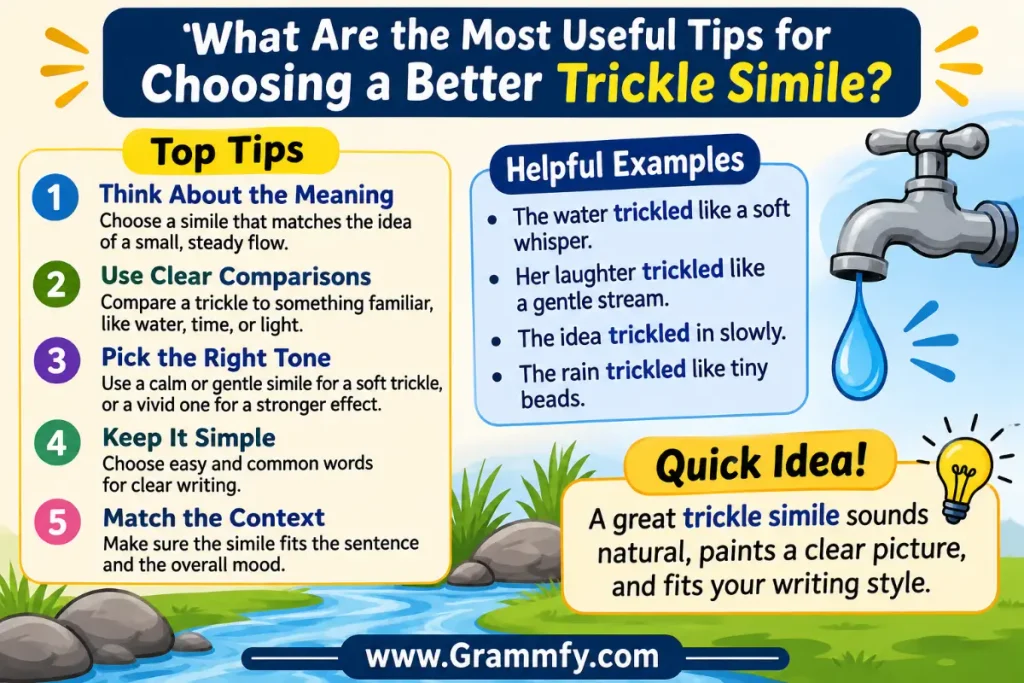
What Are the Most Useful Tips for Choosing a Better Trickle Simile?
Use these practical tips to improve your descriptions.
- Focus on one feature. Decide whether you’re describing movement, sound, shape, or mood.
- Use familiar objects. Threads, ribbons, clocks, and raindrops are easy to imagine.
- Match the intensity. A tiny trickle shouldn’t sound like a raging waterfall unless you’re deliberately exaggerating.
- Choose a suitable mood. A whisper suggests calmness, while a ticking clock can create tension.
- Keep the sentence natural. Avoid adding several comparisons to one short description.
- Use specific details. A silver ribbon on dark stone creates a clearer image than a generic ribbon.
- Consider the audience. Younger students may prefer simple comparisons, while poetry can support more imaginative images.
- Avoid forced rhymes. A comparison doesn’t need to rhyme to be effective.
- Read it aloud. If the sentence sounds confusing, simplify it.
- Don’t overuse similes. One strong image can be more memorable than several weak ones.
A Quick Formula for Writing Your Own Comparison
Try this simple pattern:
Subject + action + like/as + familiar image.
Examples:
- The stream moved like a silver thread.
- Rainwater slipped like silk over the stone.
- The faucet dripped like a ticking clock.
- The tiny creek wandered like a sleepy snake.
You can also add a detail about the setting:
“The tiny creek wandered like a sleepy snake beneath the old wooden bridge.”
The formula is a starting point, not a strict rule. The best comparisons are the ones that fit your meaning.
Conclusion: How Can You Make Trickle Descriptions More Vivid?
A good simile helps readers picture a small flow of water without making the sentence difficult to understand. The most effective Similes for Trickles describe a specific feature, such as a thin shape, slow movement, gentle sound, or emotional effect.
For a narrow stream, try comparing it to a silver thread or ribbon. A soft sound might be better described as a whisper or quiet melody. When describing repeated drops, a ticking clock can create a more effective comparison.If you’re describing tears, choose an image that fits the character’s emotions.
Always consider your audience and the purpose of your writing. A school essay can benefit from a simple comparison, while a poem may call for a more imaginative image. A technical report usually needs direct language instead.
Start with one clear detail, choose a familiar image, and make sure the comparison feels natural. With practice, you’ll create descriptions that are vivid, original, and easy to understand.
Frequently Asked Questions
What are some examples of similes for trickles?
Examples include “like a silver thread,” “like a quiet whisper,” and “like a ticking clock.” Each comparison highlights a different feature, such as shape, sound, or repeated movement.
How do you describe water trickling slowly?
You can describe slow-moving water as crawling like a snail, slipping like silk, or creeping like a sleepy snake. Choose an image that matches the water’s speed and direction.
What’s another way to say water trickles?
You can say that water drips, trickles, seeps, or flows gently, depending on how it moves. Use drips for separate drops and seeps when liquid slowly passes through a small opening.
What are the best Similes for Trickles in poetry?
Poetic comparisons include water flowing like a silver thread, slipping like moonlight over stone, or whispering like a secret beneath the trees. These images add atmosphere and help readers imagine the scene.
Can a trickle describe something other than water?
Yes. A trickle can describe small amounts of other things that arrive or move gradually, including information, donations, people, or tears. For example, “News trickled into the village like whispers passing from one neighbor to another.”
What is the difference between a trickle and a drip?
A trickle usually describes a small, continuous flow, while a drip often refers to an individual drop falling. For example, water can trickle down a wall while drops drip into a bowl.
How do I write my own simile for a trickle?
Choose one feature of the flow, such as its shape, sound, or speed, and compare it to something familiar using like or as. For example, if the water is narrow and shiny, you could write, “The stream moved like a silver thread across the dark stones.”

Tylerbrooks is a US-based English grammar writer and contributor at Grammfy. He writes helpful articles about grammar, spelling, commonly confused words, and vocabulary. His goal is to explain English topics in simple language with clear examples and practical tips. Through his articles, he helps readers improve their writing and everyday English skills.