
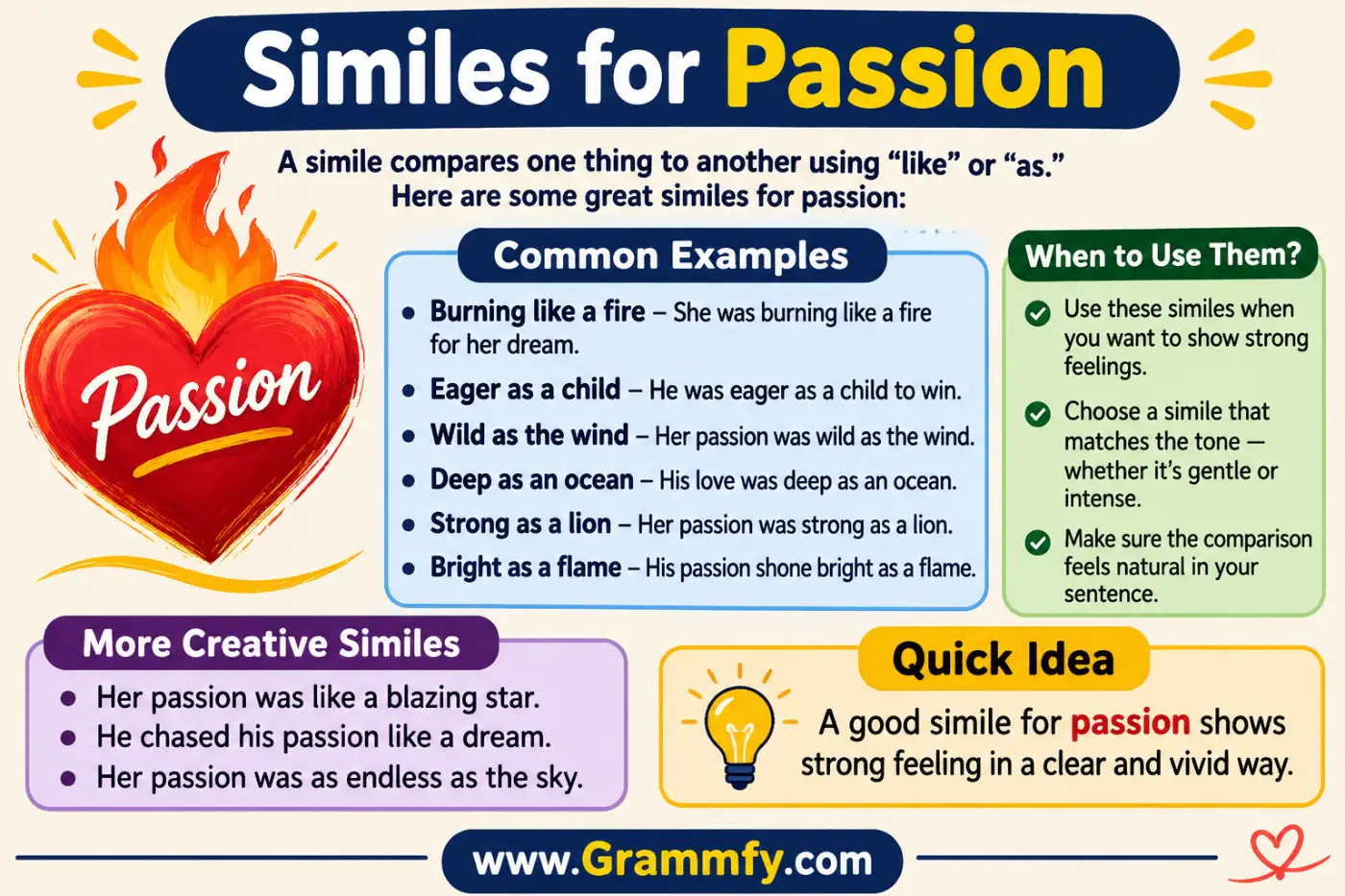
Passion can make someone work harder, love deeper, or chase a dream without giving up. Imagine writing an email to describe your excitement about a new project. Simply saying “I’m passionate about this” may not fully express how strongly you feel. A creative comparison can make your message more interesting and memorable. That’s where Similes for Passion become useful. They help readers picture powerful emotions through familiar things, such as a burning flame, a roaring fire, or a racing heartbeat. Instead of describing an emotion directly, you connect it to something people can easily imagine.
A good simile can express different kinds of passion. It might show romantic love, strong ambition, creative energy, or dedication to a personal goal. The right comparison depends on the feeling you want to communicate and the situation in which you’re writing.
In this guide, you’ll discover creative comparisons, their meanings, intensity levels, useful synonyms, and examples from everyday situations. You’ll also learn how to choose the right expression for essays, professional writing, conversations, and personal messages.
Need a more vivid way to describe trickles? Explore our guide to creative trickles similes and examples for fresh ideas and examples.
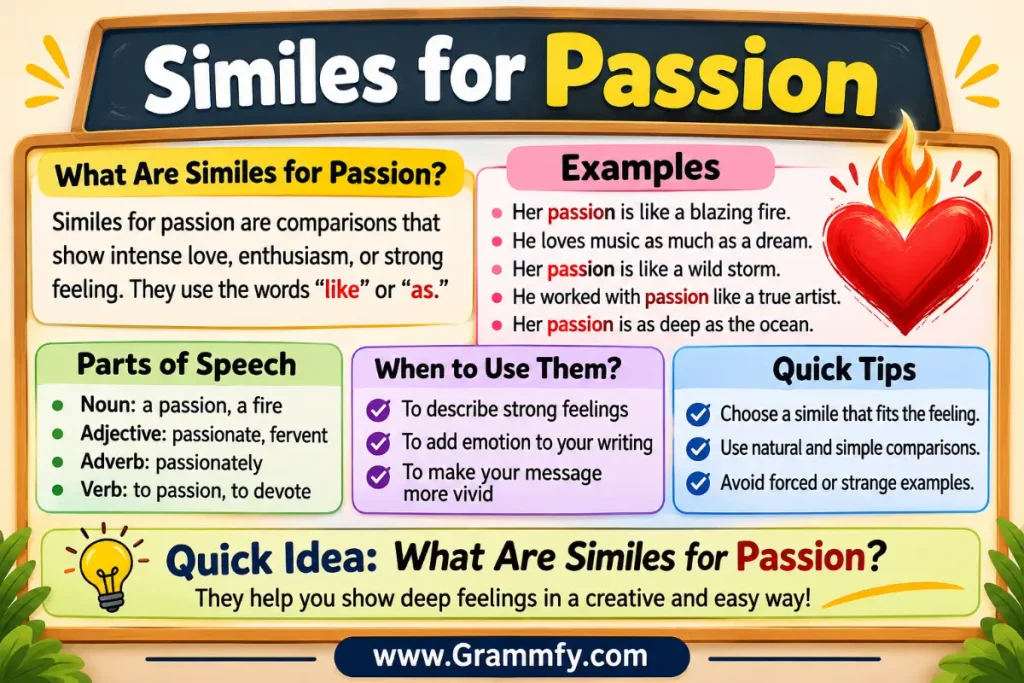
Quick Idea: What Are Similes for Passion?
Similes for Passion are expressions that compare intense feelings, enthusiasm, love, or dedication to something familiar using words such as “like” or “as.”
For example:
- Her passion burned like a thousand candles.
- His ambition was as strong as a mountain.
- Their love moved like a river that never stopped flowing.
Quick definition: A simile for passion compares a powerful emotion or strong commitment to something familiar to help readers understand its intensity.
1. What Does Passion Mean in Simple English?
Passion is a strong feeling of love, excitement, interest, or dedication toward someone or something. It can motivate people to work toward their goals, develop new skills, and continue doing what matters to them.
Passion isn’t limited to romantic relationships. A person can feel passionate about music, education, sports, art, business, family, or helping others.
Consider these situations:
- Career: A teacher feels passionate about helping children learn.
- Relationships: Someone shows deep passion for their partner.
- Hobbies: An artist spends hours creating beautiful paintings.
- Sports: A player trains every day because of a strong desire to improve.
- Personal goals: An entrepreneur works hard to build a successful business.
In each situation, passion creates a reason to keep going.
What Is the Origin of the Word Passion?
The word passion comes from the Latin word passio, meaning suffering or enduring. It entered English through Old French and Middle English.
Historically, the word was strongly connected with suffering, especially in religious contexts. Over time, its meaning expanded to include powerful emotions, desires, and enthusiasm.
Today, people use it in several ways:
- Romantic passion describes intense feelings of love and attraction.
- Creative passion describes a strong interest in artistic activities.
- Professional passion describes enthusiasm for work or a career.
- Personal passion describes something that gives a person excitement and purpose.
This history helps explain why passion can describe both deep emotional feelings and strong personal interests.
How Is Passion Different From Ordinary Interest?
Interest and passion are related, but they don’t express the same level of emotion.
| Interest | Passion |
|---|---|
| A general feeling of curiosity | A powerful emotional connection |
| May last for a short time | Can continue for many years |
| Doesn’t always require action | Often encourages action and effort |
| Can be casual | Usually feels deeply meaningful |
| Example: I enjoy painting. | Example: Painting is my life’s passion. |
The main difference: Interest makes you curious, while passion gives you a stronger reason to become involved.
2. What Are the 35 Best Similes for Passion?
A powerful comparison can make an emotional description easier to understand. Some expressions suggest warmth and affection, while others communicate ambition, excitement, and determination.
Here are 35 original examples with simple explanations.
| No. | Simile | Meaning |
|---|---|---|
| 1 | Like a blazing fire | Full of powerful emotion |
| 2 | Like a burning candle | Steady and lasting enthusiasm |
| 3 | Like a roaring flame | Strong and exciting feelings |
| 4 | Like a rising sun | Growing excitement and hope |
| 5 | Like a rushing river | Powerful and unstoppable energy |
| 6 | Like a beating drum | Constant excitement and motivation |
| 7 | Like a shooting star | Bright and exciting enthusiasm |
| 8 | Like a blooming flower | Passion that grows beautifully |
| 9 | Like a summer storm | Intense and overwhelming emotion |
| 10 | Like a shining lighthouse | A powerful source of direction |
| 11 | Like an endless ocean | Deep and lasting feelings |
| 12 | Like a racing heartbeat | Excitement that feels impossible to hide |
| 13 | Like a mountain sunrise | Beautiful and inspiring determination |
| 14 | Like a wildfire in dry grass | Quickly spreading enthusiasm |
| 15 | Like a river meeting the sea | Two powerful feelings coming together |
| 16 | Like a powerful engine | Energy that keeps someone moving |
| 17 | Like a spark in darkness | A sudden feeling of excitement |
| 18 | Like thunder in the sky | Strong and dramatic emotion |
| 19 | Like a bird taking flight | Freedom and excitement |
| 20 | Like a diamond in sunlight | Bright and valuable feelings |
These comparisons work in different types of writing. For example, a blazing fire is suitable for intense feelings, while a growing flower works better when describing something that develops slowly.
Remember: The strongest comparison isn’t always the most dramatic one. Choose an image that matches the actual emotion.
3. What Are the Best Words to Describe Passion?
Sometimes, you don’t need a full comparison. A single descriptive word can communicate enthusiasm, love, or dedication.
The following list contains 32 useful words grouped by tone and everyday usage.
Simple Words for Passion
These words are easy to understand and work well in everyday conversations.
| Word | Meaning | Tone | Example |
|---|---|---|---|
| Love | A deep positive feeling | Warm | I love helping people. |
| Joy | Great happiness | Positive | Music brings me joy. |
| Interest | Curiosity about something | Neutral | She has an interest in science. |
| Energy | Strength and activity | Positive | He brings energy to every project. |
| Care | Concern and attention | Gentle | She works with care. |
| Excitement | A strong feeling of happiness | Energetic | The game filled him with excitement. |
| Desire | A strong wish | Neutral | He has a desire to improve. |
| Hope | Belief in something good | Positive | Hope keeps her moving forward. |
Everyday Words for Passion
These expressions sound natural in conversations, personal messages, and informal writing.
| Word | Meaning | Tone | Example |
|---|---|---|---|
| Enthusiasm | Strong interest and excitement | Friendly | Her enthusiasm inspires everyone. |
| Dedication | Commitment to something | Respectful | His dedication is impressive. |
| Devotion | Deep loyalty or love | Emotional | Her devotion to music is clear. |
| Ambition | A strong desire to succeed | Motivational | His ambition drives his career. |
| Eagerness | Excitement to do something | Energetic | She showed eagerness to learn. |
| Zeal | Great enthusiasm | Strong | He approached the task with zeal. |
| Motivation | A reason to take action | Positive | Her motivation comes from her family. |
| Commitment | A promise to remain involved | Professional | Their commitment helped the team succeed. |
Formal Words for Passion
These words are useful in academic writing, professional communication, and serious discussions.
| Word | Meaning | Tone | Example |
|---|---|---|---|
| Fervor | Intense enthusiasm | Formal | She spoke with great fervor. |
| Ardor | Strong emotional warmth | Literary | His ardor for learning was clear. |
| Conviction | Strong belief in something | Serious | She defended her ideas with conviction. |
| Vigor | Physical or mental strength | Formal | He worked with vigor. |
| Devotedness | The quality of being deeply dedicated | Formal | Her devotedness impressed the group. |
| Intensity | The strength of a feeling | Descriptive | The intensity of his emotions surprised everyone. |
| Enthrallment | Strong fascination | Literary | Her enthrallment with astronomy began young. |
| Exuberance | Lively excitement | Expressive | His exuberance lifted everyone’s mood. |
Slang and Informal Expressions for Passion
These expressions are more casual. They’re suitable for friendly conversations and social media.
| Word or Phrase | Meaning | Tone | Example |
|---|---|---|---|
| Fired up | Very excited or motivated | Casual | I’m fired up about the new project. |
| Pumped | Extremely excited | Casual | She’s pumped for the competition. |
| Crazy about | Very interested in or fond of something | Informal | He’s crazy about photography. |
| All in | Fully committed | Casual | She’s all in on her business idea. |
| Obsessed | Extremely interested | Informal | I’m obsessed with learning languages. |
| On fire | Performing with great energy | Casual | The team is on fire today. |
| Into it | Interested and involved | Casual | He’s really into music. |
| Living for | Finding great excitement in something | Informal | She’s living for her next adventure. |
Quick language tip: Words such as devotion and commitment often emphasize lasting dedication. Expressions like fired up and pumped describe temporary excitement.
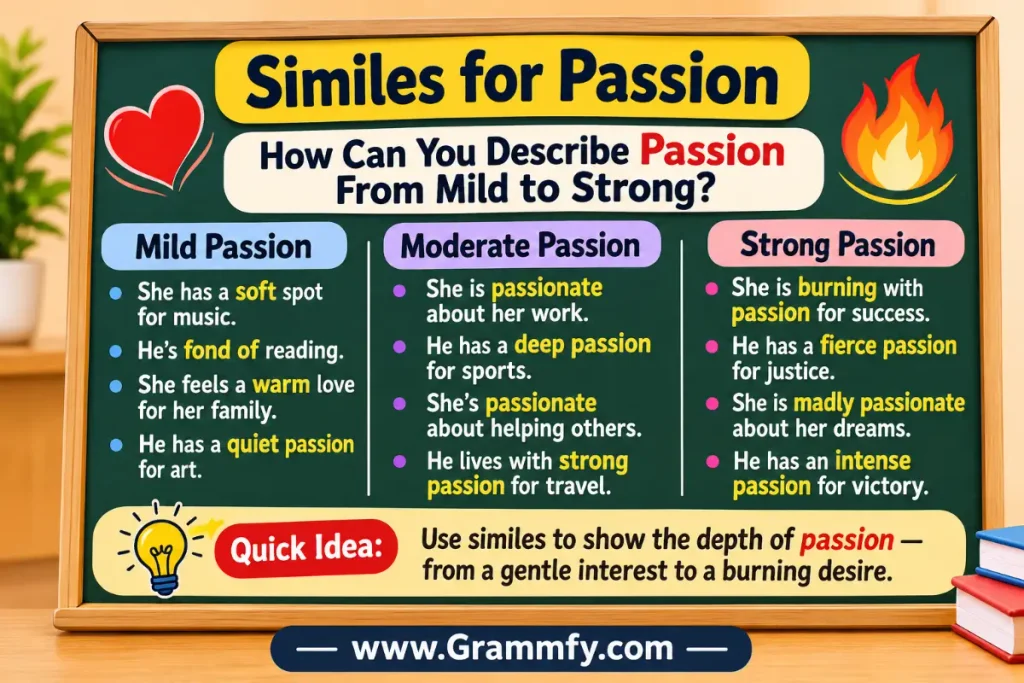
4. How Can You Describe Passion From Mild to Strong?
Not every situation requires an intense emotional word. A person who enjoys reading may have an interest in books, while someone who spends every day studying literature might feel a deep devotion to it.
Choosing the right intensity makes your writing more accurate.
Mild Passion
These words describe early interest, gentle enthusiasm, or a positive feeling.
- Curiosity: A desire to learn or discover something.
- Interest: A general attraction to a subject.
- Enjoyment: Pleasure from an activity.
- Fondness: A warm liking for someone or something.
- Appreciation: Recognition of value or beauty.
Example: She has a growing interest in photography.
Moderate Passion
These expressions show stronger feelings and a willingness to become involved.
- Enthusiasm: Strong excitement.
- Eagerness: A strong desire to participate.
- Dedication: Regular effort and commitment.
- Motivation: An inner reason to take action.
- Commitment: A serious decision to continue.
Example: His dedication to teaching helps him support his students.
Strong Passion
These words communicate powerful emotions and deep personal commitment.
- Devotion: Deep love or loyalty.
- Zeal: Intense enthusiasm.
- Fervor: Powerful emotional excitement.
- Ardor: Strong emotional warmth.
- Determination: A firm decision to achieve something.
Example: Her determination helped her overcome several difficult challenges.
Extremely Intense Passion
Use these expressions when the emotion feels overwhelming or extraordinary.
- Obsession: An extremely strong interest that can become unhealthy.
- Fervency: Powerful and sincere emotion.
- Fire: A strong inner drive.
- Unstoppable enthusiasm: Excitement that continues despite difficulties.
- Unwavering devotion: Deep commitment that doesn’t weaken.
Example: His unwavering devotion to his craft shaped his entire career.
Important distinction: Stronger words aren’t automatically better. Obsession, for example, can suggest an unhealthy lack of balance. Use it carefully.
5. Which Words for Passion Work as Different Parts of Speech?
Understanding parts of speech helps you use descriptive words correctly. Some words describe a person’s feelings, while others explain an action or quality.
Nouns That Describe Passion
Nouns name emotions, qualities, or states.
| Noun | Meaning | Example |
|---|---|---|
| Passion | Strong emotion or interest | Her passion is writing. |
| Enthusiasm | Excitement | His enthusiasm is contagious. |
| Devotion | Deep commitment | Her devotion to art is admirable. |
| Ambition | Desire to achieve success | Ambition pushed him forward. |
| Zeal | Intense enthusiasm | She worked with zeal. |
| Ardor | Strong emotional warmth | His ardor was easy to notice. |
Adjectives That Describe Passion
Adjectives describe a person, feeling, or activity.
| Adjective | Meaning | Example |
|---|---|---|
| Passionate | Having strong feelings | She is passionate about science. |
| Enthusiastic | Showing excitement | He is enthusiastic about learning. |
| Dedicated | Committed to a purpose | She is a dedicated musician. |
| Devoted | Deeply loyal or committed | They are devoted partners. |
| Ardent | Showing intense emotion | He is an ardent supporter. |
| Fervent | Extremely sincere or enthusiastic | She made a fervent appeal. |
Verbs That Express Passion
Verbs show actions connected with strong feelings or commitment.
| Verb | Meaning | Example |
|---|---|---|
| Love | Feel deep affection | I love creating new designs. |
| Admire | Respect or appreciate | She admires his determination. |
| Pursue | Work toward something | He pursues his dreams. |
| Cherish | Value deeply | They cherish their friendship. |
| Devote | Give time or effort | She devotes her time to teaching. |
| Inspire | Encourage someone | His story inspires young artists. |
Adverbs That Show Passion
Adverbs explain how someone performs an action.
| Adverb | Meaning | Example |
|---|---|---|
| Passionately | With strong emotion | She spoke passionately. |
| Enthusiastically | With excitement | He enthusiastically joined the team. |
| Devotedly | With deep commitment | She devotedly supports the cause. |
| Eagerly | With excitement or interest | They eagerly awaited the results. |
| Vigorously | With energy and strength | He vigorously defended his ideas. |
Grammar tip: Don’t confuse passion with passionate. Passion is a noun, while passionate is an adjective.
- Correct: She has a passion for writing.
- Correct: She is passionate about writing.
- Incorrect: She has a passionate for writing.
6. How Do You Use Passion in Different Types of Writing?
The right comparison depends on your audience and purpose. A romantic message needs a different expression from a resume or academic essay.
Here are practical ways to use emotional comparisons in different situations.
How Do You Describe Passion in an Essay?
Academic writing should communicate feelings without sounding overly dramatic. Choose comparisons that support your main point.
Examples:
- Her passion for education burned like a steady flame.
- His determination was as strong as an ancient oak.
- Their enthusiasm spread like sunlight across the classroom.
- Her love for science flowed like a river that never ran dry.
Writing tip: Use one strong comparison to support your argument. Too many emotional expressions can distract readers from your main idea.
How Do You Describe Passion on a Resume?
A resume should focus on professional qualities, skills, and achievements. Most employers prefer clear descriptions over poetic language.
You can use words such as:
- Dedicated
- Motivated
- Enthusiastic
- Committed
- Driven
- Results-focused
Examples:
- I bring the energy of a racing engine to challenging projects.
- My dedication to customer service remains as steady as a lighthouse.
- I approach new responsibilities with enthusiasm and determination.
However, don’t depend on comparisons alone. Connect your enthusiasm to measurable results.
Better resume example:
“My dedication to customer service helped improve customer satisfaction and strengthen team performance.”
Best advice: On a resume, demonstrate passion through achievements rather than simply claiming to be passionate.
How Do You Describe Passion in Text Messages?
Text messages allow more emotional and informal language. You can use simple comparisons to express excitement or affection.
Examples:
- My love for music burns like a bright flame.
- I’m as excited as a child waiting for a surprise.
- My excitement is like fireworks lighting up the sky.
- I feel like a river overflowing with happiness.
These expressions sound friendly and natural in personal conversations.
How Do You Describe Passion in an Email?
Professional emails should remain clear and respectful. Use expressions that communicate genuine interest without sounding exaggerated.
Examples:
- I’m excited about the opportunity to contribute to this project.
- My interest in this field continues to grow like a young tree.
- I’m committed to helping the team reach its goals.
- I look forward to bringing fresh energy to the upcoming work.
For formal emails, phrases such as strong interest, genuine enthusiasm, and long-term commitment are usually more suitable than dramatic comparisons.
How Do You Describe Passion When Speaking?
Spoken language should sound natural. Choose familiar images that people can understand immediately.
Examples:
- My excitement is like a fire that keeps getting bigger.
- Her love for dancing shines like the morning sun.
- His determination is as strong as a mountain.
- Their enthusiasm spreads like a wave through the crowd.
You can also explain your feelings through a personal story. Real experiences often communicate emotion better than complicated vocabulary.
7. What Are 15 More Examples of Passion in Real-Life Situations?
Examples make emotional language easier to understand. The following sentences show how different comparisons can fit relationships, careers, hobbies, and personal goals.
Passion for Love and Relationships
- Her love for him burned like a candle that never went out.
- Their affection flowed like a gentle river through a peaceful valley.
- His heart raced like a drum whenever he saw her.
- Their relationship grew like a flower opening in the spring.
- Her devotion was as deep as the endless ocean.
These expressions work well in romantic stories, personal letters, and creative writing.
Passion for Work and Career
- His enthusiasm spread through the office like sunlight through an open window.
- Her dedication stood like a strong tree during a storm.
- The designer’s creativity flowed like water from a mountain spring.
- His ambition burned like a fire that refused to fade.
- Their commitment was as steady as a lighthouse guiding ships.
These comparisons communicate professional motivation and long-term dedication.
Passion for Hobbies and Personal Interests
- Her love for painting sparkled like stars across a dark sky.
- His excitement for football exploded like fireworks after a winning goal.
- My passion for reading grows like a garden after the rain.
- Their energy moved like a powerful wave across the dance floor.
- His interest in astronomy shone like a distant star.
These examples are useful for personal essays, blog posts, and descriptive paragraphs.

8. What Is the Difference Between Passion and Similar Emotions?
Several words can describe strong feelings, but their meanings aren’t identical. Understanding the differences helps you avoid using the wrong expression.
Passion vs. Enthusiasm: What’s the Difference?
Both words describe positive feelings, but they focus on different things.
| Passion | Enthusiasm |
|---|---|
| A deep emotional connection | Strong excitement or interest |
| Can last for many years | Can be temporary |
| Often creates long-term commitment | Often encourages immediate participation |
| May involve love or dedication | Usually involves excitement |
Examples:
- Her passion for medicine motivated her to study for years.
- His enthusiasm for the new game made everyone excited.
Which should you choose?
Use passion when describing a deep connection or lasting commitment. Choose enthusiasm when you want to highlight excitement and positive energy.
Passion vs. Obsession: What’s the Difference?
These words can describe powerful interests, but obsession often carries a negative meaning.
| Passion | Obsession |
|---|---|
| Can be healthy and balanced | Can become unhealthy |
| Allows room for other responsibilities | May interfere with everyday life |
| Encourages meaningful effort | Can create excessive focus |
| Usually brings satisfaction | May cause stress or anxiety |
Examples:
- Her passion for photography encourages her to improve her skills.
- His obsession with winning makes him ignore everything else.
Which should you choose?
Use passion for healthy interest and dedication. Use obsession when someone’s attention becomes excessive or difficult to control.
Passion vs. Ambition: What’s the Difference?
Passion describes strong feelings, while ambition focuses on achieving something.
| Passion | Ambition |
|---|---|
| Emotional interest | Desire for success |
| Connected with enjoyment and meaning | Connected with goals and achievements |
| Can exist without a specific goal | Usually involves a desired outcome |
Examples:
- Her passion for music makes her happy.
- Her ambition is to become a successful musician.
A person can have both. Passion provides emotional energy, while ambition gives that energy a direction.
9. What Are Common Mistakes When Describing Passion?
Even a good comparison can sound unnatural when used incorrectly. Pay attention to meaning, context, and sentence structure.
Mistake 1: Using Overly Dramatic Comparisons
Not every emotion needs to sound like a natural disaster.
Incorrect: His passion was like a thousand exploding volcanoes during a terrible storm.
Better: His passion burned like a bright flame.
A simple comparison often creates a stronger impression.
Mistake 2: Confusing Passion With Obsession
Passion usually describes a strong but meaningful interest. Obsession can suggest an unhealthy level of attention.
Incorrect: She has a passion for checking her phone every minute, even when it harms her work.
Better: She has developed an unhealthy obsession with checking her phone.
Choose the word that reflects the actual behavior.
Mistake 3: Repeating the Same Comparison
Using fire, flames, and burning in every paragraph can make your writing repetitive.
Instead, explore different images:
- A flowing river for continuous energy.
- A rising sun for growing motivation.
- A mountain for determination.
- A beating drum for excitement.
- A blooming flower for developing love.
Different images give your writing more variety.
Mistake 4: Forgetting the Words “Like” and “As”
A traditional simile uses a comparison word such as like or as.
Simile: Her passion was like a blazing fire.
Simile: He was as determined as a mountain climber.
Metaphor: Her passion was a blazing fire.
The metaphor makes a direct comparison without using like or as.
Mistake 5: Using Informal Expressions in Formal Writing
Words such as pumped, crazy about, and fired up are common in casual conversations. They may sound out of place in a formal report.
Instead, use:
- Genuine enthusiasm
- Strong commitment
- Deep dedication
- Professional motivation
Always consider your audience.
When Should You NOT Use a Passion Simile?
There are situations where direct language is more effective.
- Legal documents: Use precise language rather than emotional comparisons.
- Scientific reports: Explain observations clearly and objectively.
- Professional resumes: Focus on skills, achievements, and measurable results.
- Sensitive conversations: Avoid exaggerated comparisons when someone needs sincere support.
- Technical instructions: Prioritize clarity over creative descriptions.
Remember: Creative language should improve understanding, not make a simple message confusing.
10. What Are the Opposite Words of Passion?
Antonyms are words with opposite or contrasting meanings. They can help you describe a lack of enthusiasm, emotional distance, or little interest.
| Antonym | Meaning | Example |
|---|---|---|
| Apathy | Lack of interest or emotion | His apathy toward the project was noticeable. |
| Indifference | Lack of concern | She showed indifference to the results. |
| Disinterest | Lack of interest | His disinterest became clear during the meeting. |
| Unconcern | Lack of worry or attention | Her unconcern surprised the team. |
| Detachment | Emotional distance | He approached the situation with detachment. |
| Lethargy | Lack of energy | Lethargy affected his daily routine. |
| Coldness | Lack of warmth or affection | Her coldness hurt his feelings. |
| Disengagement | Lack of involvement | The team’s disengagement slowed progress. |
Not every antonym works in every situation.
For example, apathy describes a lack of interest, while coldness is more closely connected with emotional warmth. Select the word according to the meaning you want.
11. How Can You Choose the Best Comparison for Passion?
A useful comparison should match your intended meaning. Before choosing one, think about the emotion, audience, and writing style.
Here are seven practical tips.
1. Identify the Type of Passion
First, decide what kind of feeling you’re describing.
- Romantic love: Use a warm flame or endless ocean.
- Career dedication: Use a strong tree or steady lighthouse.
- Creative excitement: Use fireworks or a rising sun.
- Personal ambition: Use a mountain or powerful engine.
- Long-term commitment: Use deep roots or a flowing river.
The image should support the emotion.
2. Match the Intensity
A gentle feeling doesn’t need an aggressive comparison.
For mild interest, choose a blooming flower. For powerful determination, a mountain or rushing river may work better.
3. Think About Your Audience
A school essay, professional email, and romantic message have different expectations.
Children may understand simple images such as sunlight, flowers, and candles. Professional readers may prefer clear expressions about commitment and motivation.
4. Avoid Clichés When Possible
Some comparisons are used so often that they lose their impact.
For example, describing every strong emotion as a burning fire can make your writing predictable.
Try fresh images:
- Passion is like a compass that keeps pointing toward a dream.
- Her enthusiasm was like fresh rain waking a sleeping garden.
- His dedication was like roots reaching deep into the earth.
These comparisons offer a more personal touch.
5. Keep Your Comparison Easy to Understand
A good simile creates a clear mental picture.
Avoid combining unrelated images in one sentence. A reader should understand the comparison without needing to interpret several different ideas.
6. Use Sensory Details
Think about what people can see, hear, feel, or imagine.
- Sight: A bright flame.
- Sound: A beating drum.
- Touch: A warm blanket.
- Movement: A rushing river.
- Nature: A flower opening in spring.
Sensory images make emotional writing more engaging.
7. Read Your Sentence Aloud
A comparison might look good on paper but sound awkward when spoken.
Read your sentence aloud. If it feels too long, dramatic, or confusing, simplify it.
Quick test: Can someone understand the feeling without needing an explanation? If yes, your comparison is probably effective.
Conclusion: Express Passion With the Right Words
Strong emotions deserve clear and meaningful descriptions. A well-chosen comparison can help readers understand feelings that ordinary words sometimes fail to express. Whether you’re describing romantic love, creative energy, professional dedication, or personal ambition, the right image makes your message more memorable.
The best Similes for Passion aren’t always the loudest or most dramatic. A steady candle can represent lasting commitment, while a rushing river can express unstoppable energy. Think about what you want your reader to feel before choosing your comparison.
You can also improve your writing by exploring related words such as enthusiasm, devotion, ambition, and dedication. Try different expressions, read your sentences aloud, and keep the meaning clear. With practice, you’ll find natural ways to describe powerful emotions in everyday conversations and creative writing.
12. Frequently Asked Questions
What Are the Best Similes for Passion?
The best Similes for Passion include comparisons such as a blazing fire, a rushing river, a racing heartbeat, and a shining star. Each one expresses a different level or type of emotional intensity.
What’s Another Way to Say Someone Is Passionate?
You can describe someone as enthusiastic, devoted, dedicated, driven, or fervent. Choose the word that best explains their feelings or behavior.
How Do You Describe Passion in One Sentence?
Passion is a powerful feeling that motivates someone to love, create, learn, or work toward something meaningful. For example, “Her passion burned like a bright flame.”
Is Passion Stronger Than Enthusiasm?
Passion often suggests a deeper emotional connection or lasting commitment, while enthusiasm focuses more on excitement and interest. However, the strength of both feelings depends on the context.
What Is a Good Simile for Strong Love?
“Her love was like an endless ocean” is a good simile for strong and lasting affection. It suggests that her feelings are deep and continue over time.
Can Passion Be Used for Work and Hobbies?
Yes, passion can describe strong interest in careers, hobbies, education, sports, and creative activities. For example, “His passion for photography inspires him to capture beautiful moments.”
What Is the Difference Between a Simile and a Metaphor for Passion?
A simile compares passion using words such as like or as, while a metaphor makes a direct comparison. For example, “Her passion was like fire” is a simile, while “Her passion was fire” is a metaphor.

Tylerbrooks is a US-based English grammar writer and contributor at Grammfy. He writes helpful articles about grammar, spelling, commonly confused words, and vocabulary. His goal is to explain English topics in simple language with clear examples and practical tips. Through his articles, he helps readers improve their writing and everyday English skills.