
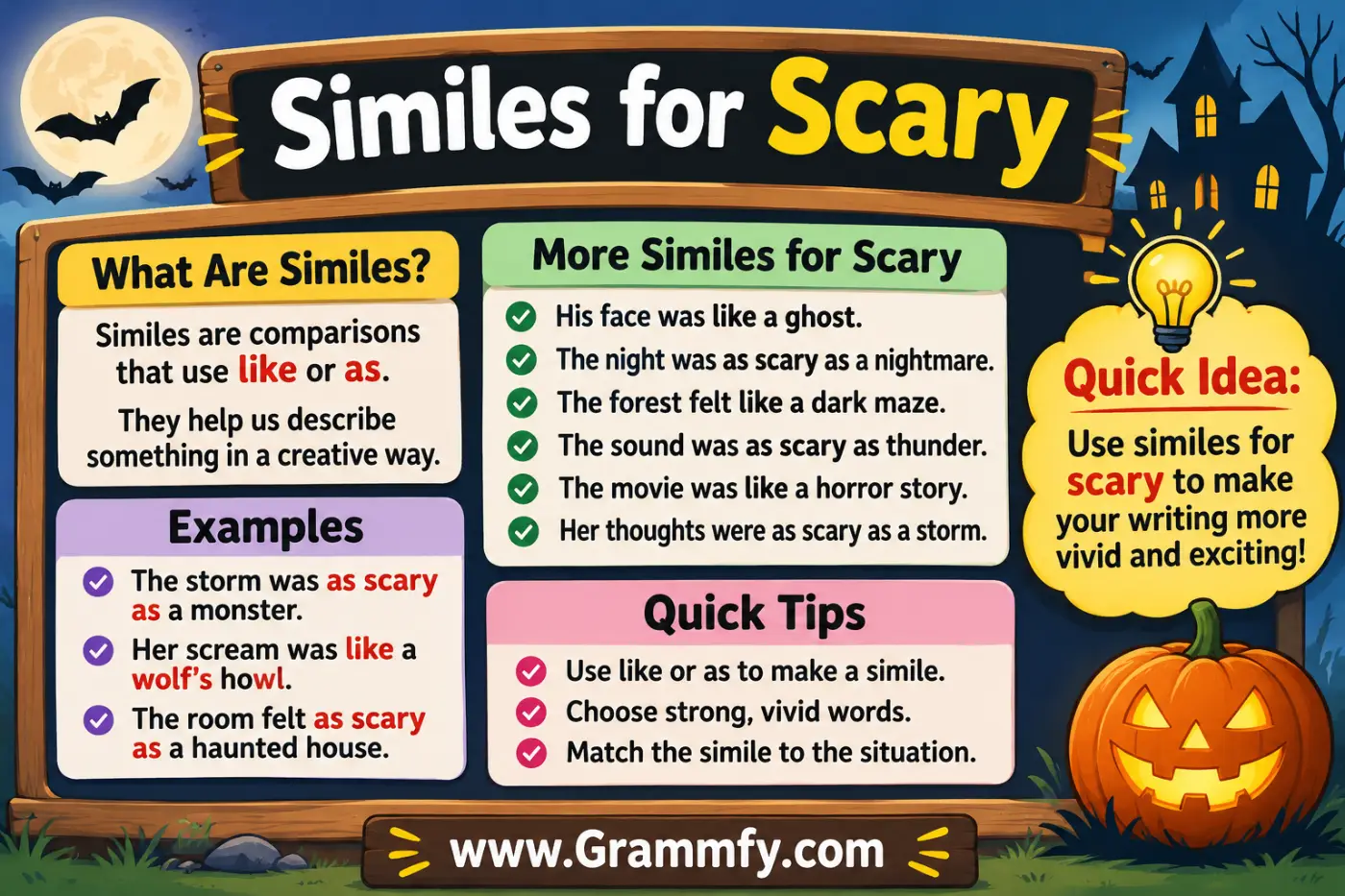
Have you ever tried to describe a frightening moment in a story, essay, or text message but struggled to find the right words? You might write that a dark hallway was scary, a strange noise was scary, or a storm was scary. Although these sentences explain the feeling, they don’t help readers picture what makes the situation frightening. A well-chosen comparison can make a scene more vivid by connecting fear to something readers already understand, such as a sudden scream, a shadow in the dark, or the feeling of being watched. Similes for Scary help you describe frightening moments, creepy places, and fearful emotions in a vivid and memorable way.
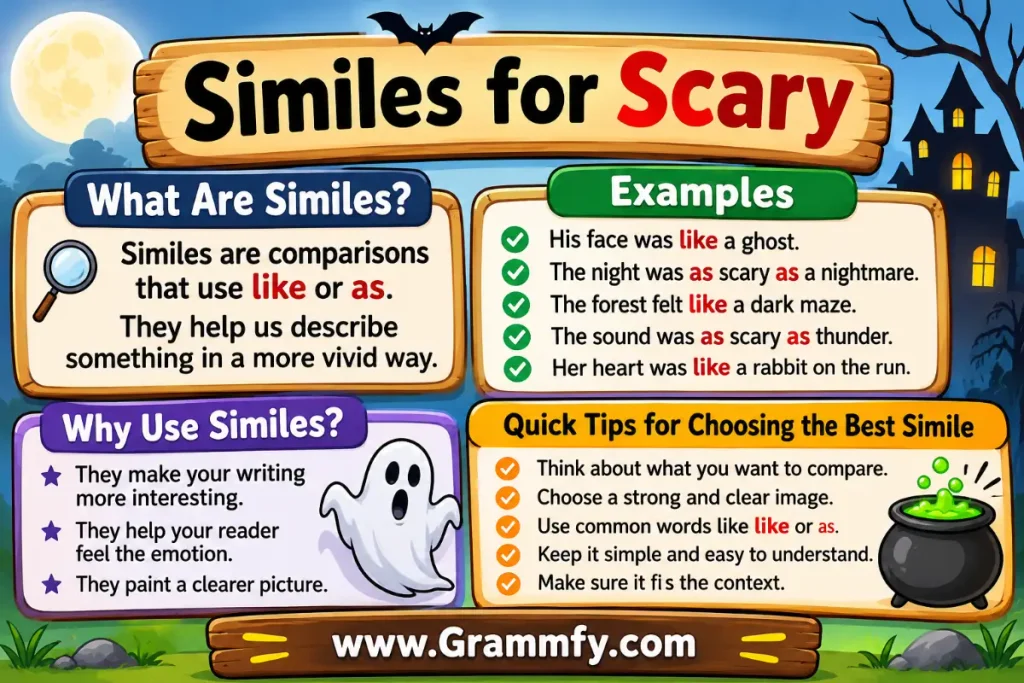
Similes for Scary help writers describe frightening people, places, sounds, situations, and emotions in a memorable way. These comparisons use words such as like or as to connect something frightening with another image that communicates fear. For example, you could write, “The abandoned house was as frightening as a nightmare.” This sentence gives readers a clearer idea of the house’s atmosphere than simply calling it scary.
Similes also help readers experience a scene instead of merely learning what happened. A character who is “shaking like a leaf” seems more frightened than a character who is simply nervous. Similarly, a forest that is “as silent as a graveyard” creates an uneasy atmosphere before anything dangerous appears. These comparisons work especially well in horror stories, creative writing, school assignments, poems, and everyday conversations.
In this guide, you’ll discover more than 50 original comparisons, learn how to choose the right level of fear, and explore examples for different writing situations. You’ll also find explanations of simile structure, common mistakes, useful alternatives, and practical tips for making frightening descriptions sound natural rather than exaggerated.
Need a more vivid way to describe friendship? Explore our guide to creative friendship similes and examples for fresh ideas and examples.
Quick Idea: What Are Similes for Scary?
A simile is a figure of speech that compares two different things using like or as. A frightening simile connects a person, place, sound, emotion, or event with something that creates a sense of fear, danger, suspense, or uneasiness.
For example:
- As frightening as a nightmare: Describes something that causes intense fear.
- Like a shadow creeping across the wall: Creates a mysterious and unsettling image.
- Shaking like a leaf in a storm: Shows how fear affects someone’s body.
- As silent as a graveyard: Establishes an eerie atmosphere.
The best comparison depends on the feeling you want readers to experience. A mild simile can suggest nervousness, while a stronger one can communicate terror or panic. Instead of choosing the most dramatic comparison every time, select an image that fits the scene, the characters, and the intended audience.
What Makes a Simile Sound Scary?
A frightening comparison works by connecting an unfamiliar or unsettling situation to a recognizable image. Readers already know what a nightmare feels like, how an unexpected bang sounds, or how a dark corridor can create uncertainty. When a writer uses one of these experiences in a comparison, the reader can imagine the scene more easily.
Three important elements help make a simile effective:
- A clear comparison: The sentence connects two things that readers can understand.
- A frightening image: The comparison suggests danger, uncertainty, isolation, or fear.
- A suitable level of intensity: The image matches the seriousness of the situation instead of making every small problem sound terrifying.
Consider these examples:
- Simple: The room was scary.
- More descriptive: The room was as frightening as a nightmare.
- More suspenseful: The room felt like a trap waiting to close around us.
The third sentence creates a stronger sense of danger because it suggests that something bad might happen. However, it is not a strict simile in the most direct grammatical sense if the intended comparison is unclear. To make the comparison explicit, write, “The room felt like a trap waiting to snap shut around us.” This connects the room’s threatening atmosphere to a recognizable danger.
The goal is not to add as many descriptive words as possible. A single well-chosen comparison can communicate more than several sentences filled with general descriptions of fear.
50+ Similes for Scary Situations, People, and Feelings
Different situations call for different comparisons. A frightened child, a haunted building, a sudden noise, and a dangerous storm don’t create exactly the same kind of fear. The following examples are organized by purpose so you can find a comparison that suits your writing.
What Are Some Simple Similes for Scary?
Simple comparisons are useful for school assignments, beginner writing, everyday conversations, and short stories. They communicate a clear feeling without requiring complicated vocabulary.
| No. | Simile | Meaning | Example sentence |
|---|---|---|---|
| 1 | As scary as a nightmare | Extremely frightening | The strange figure looked as scary as a nightmare. |
| 2 | Like a monster in the dark | Threatening or frightening | The coat hanging behind the door looked like a monster in the dark. |
| 3 | As frightening as a ghost story | Eerie and unsettling | His description of the old house was as frightening as a ghost story. |
| 4 | Like a sudden scream | Startling and unexpected | The alarm cut through the silence like a sudden scream. |
| 5 | As creepy as an abandoned house | Unsettling and lonely | The empty classroom was as creepy as an abandoned house. |
| 6 | Like a shadow following me | Suggests a constant, uneasy presence | The strange feeling stayed with me like a shadow following me. |
| 7 | As dark as a moonless night | Describes deep darkness | The narrow path was as dark as a moonless night. |
| 8 | Like a door opening by itself | Suggests something mysterious | The cupboard creaked like a door opening by itself. |
These comparisons work well when you want a reader to understand the feeling quickly. They are also easy to adapt. For instance, “as creepy as an abandoned house” could become “as creepy as an empty hospital” if the setting involves a deserted medical building.
Choose an image that belongs naturally in the scene. If your story takes place in a school, an empty classroom may feel more relevant than a distant castle. Familiar details help readers imagine the frightening situation without needing a long explanation.
Which Similes Describe Intense Fear?
Stronger comparisons are useful when a scene involves serious danger, overwhelming panic, or a character who believes something terrible is about to happen. These examples create a more intense emotional effect.
| No. | Simile | Meaning | Example sentence |
|---|---|---|---|
| 9 | As terrifying as a living nightmare | Almost unbearably frightening | The accident felt as terrifying as a living nightmare. |
| 10 | Like standing at the edge of a cliff | Suggests extreme danger and uncertainty | Waiting for the verdict felt like standing at the edge of a cliff. |
| 11 | As frightening as a predator in the dark | Suggests a hidden threat | The sound behind the bushes was as frightening as a predator in the dark. |
| 12 | Like a storm about to break | Suggests approaching danger | His silence felt like a storm about to break. |
| 13 | As dreadful as facing the unknown | Describes fear of uncertainty | The journey ahead seemed as dreadful as facing the unknown. |
| 14 | Like being trapped in a nightmare | Suggests helplessness and fear | She felt like she was trapped in a nightmare. |
| 15 | As chilling as a warning from the dead | Creates a supernatural atmosphere | The message sounded as chilling as a warning from the dead. |
| 16 | Like a warning bell before disaster | Suggests danger is approaching | The sudden silence rang through my mind like a warning bell before disaster. |
Intense comparisons are most effective when the situation deserves them. A character facing an immediate threat might experience terror, while someone waiting for an exam result might feel nervous rather than terrified. Matching the comparison to the character’s actual experience makes the writing more believable.
You can also build intensity gradually. Begin with an uneasy sound, describe the character’s reaction, and then introduce a stronger comparison when the danger becomes clearer. This approach creates suspense because readers discover the threat alongside the character.
What Similes Make a Place Feel Creepy?
A frightening setting often creates suspense before the characters encounter any actual danger. Empty buildings, narrow corridors, dark forests, and deserted roads can feel threatening because readers cannot see what lies ahead.
| No. | Simile | Meaning | Example sentence |
|---|---|---|---|
| 17 | As silent as a graveyard | Completely quiet and eerie | The village was as silent as a graveyard after midnight. |
| 18 | Like a forest swallowing the light | Suggests darkness and isolation | The trees stood like a forest swallowing the light around us. |
| 19 | As empty as a forgotten town | Suggests abandonment | The streets were as empty as a forgotten town. |
| 20 | Like a maze with no escape | Suggests confusion and helplessness | The underground tunnels felt like a maze with no escape. |
| 21 | As cold as an abandoned cellar | Creates a chilly, unsettling atmosphere | The basement was as cold as an abandoned cellar. |
| 22 | Like a house holding its breath | Creates suspense and unnatural stillness | The old building stood like a house holding its breath. |
| 23 | As lonely as a road through the wilderness | Suggests isolation | The narrow track was as lonely as a road through the wilderness. |
| 24 | Like a tunnel leading into darkness | Suggests uncertainty and possible danger | The passage stretched ahead like a tunnel leading into darkness. |
Notice how these comparisons focus on different details. Silence creates uneasiness, darkness hides information, and isolation makes characters seem vulnerable. A writer can combine these elements to create a convincing atmosphere without repeatedly using the word scary.
For example, instead of writing, “The forest was scary,” describe the trees closing around a narrow path, the wind disappearing, and the darkness hiding the ground. One carefully chosen simile can bring these details together: “The trees stood like silent guards around a road that seemed to lead nowhere.”
What Similes Describe a Frightening Sound?
Sound can create fear even when a character cannot see its source. A distant footstep, a sudden crash, a low whisper, or a door creaking in an empty building can make an ordinary situation feel dangerous.
| No. | Simile | Meaning | Example sentence |
|---|---|---|---|
| 25 | Like a scream cutting through the night | A sudden, sharp sound | The siren sounded like a scream cutting through the night. |
| 26 | As loud as thunder in a small room | An overwhelming noise | The metal tray hit the floor as loud as thunder in a small room. |
| 27 | Like footsteps following from behind | Suggests an approaching presence | The repeated taps sounded like footsteps following from behind. |
| 28 | As eerie as a whisper in an empty house | Creates supernatural uneasiness | The voice was as eerie as a whisper in an empty house. |
| 29 | Like a branch snapping in a silent forest | A sharp, unexpected sound | The crack echoed like a branch snapping in a silent forest. |
| 30 | As unsettling as a child’s laugh in the dark | A familiar sound in an unnatural setting | The distant laughter was as unsettling as a child’s laugh in the dark. |
| 31 | Like a warning echo from underground | Suggests hidden danger | The rumble sounded like a warning echo from underground. |
| 32 | As sharp as glass breaking in the night | Sudden and startling | The crash was as sharp as glass breaking in the night. |
These comparisons are particularly useful in suspense and horror writing. However, the sound itself does not need to be unusual. An ordinary clock ticking in a quiet room can become unsettling if the character is waiting for someone who may never arrive.
To make a sound more effective, explain how the character responds to it. Does the character stop walking? Does the sound repeat? You might also wonder whether it comes from a place that should be empty. These details give the comparison a purpose and help readers understand why the sound matters.
What Similes Describe a Frightened Person?
Fear affects both the mind and the body. A person may shake, freeze, breathe quickly, avoid eye contact, or struggle to speak. Comparisons that describe these reactions help readers understand a character’s emotions.
| No. | Simile | Meaning | Example sentence |
|---|---|---|---|
| 33 | Shaking like a leaf in the wind | Trembling with fear | He stood shaking like a leaf in the wind. |
| 34 | Frozen like a statue | Unable to move from fear or shock | She stood frozen like a statue when the door slammed. |
| 35 | Pale as a sheet | Looking extremely frightened or unwell | He turned pale as a sheet when he saw the broken window. |
| 36 | Jumping like a startled cat | Reacting suddenly to a surprise | I jumped like a startled cat when the phone rang. |
| 37 | Trembling like a candle flame in a draft | Shaking slightly and uncontrollably | Her hands trembled like a candle flame in a draft. |
| 38 | Breathing like someone who has run a race | Breathing rapidly after panic or exertion | He was breathing like someone who had run a race after escaping the room. |
| 39 | Stiff as a board | Becoming tense or rigid | His shoulders went stiff as a board when he heard the footsteps. |
| 40 | Clinging like a frightened child | Holding on because of fear | The little boy clung to his mother like a frightened child in a storm. |
A strong character description focuses on a specific physical response instead of telling readers that someone is afraid. For example, “Her fingers trembled like a candle flame in a draft” provides a visual detail that readers can imagine.
Be careful not to treat every physical reaction as proof of fear. Shaking may result from cold, and rapid breathing may follow exercise. The surrounding details should make the intended emotion clear.
What Similes Describe Fear in Nature and Weather?
Nature can make a scene feel threatening through powerful winds, heavy rain, crashing waves, and sudden changes in the sky. These comparisons are useful for adventure stories, storm scenes, and descriptions of dangerous outdoor situations.
| No. | Simile | Meaning | Example sentence |
|---|---|---|---|
| 41 | Like a storm chasing the horizon | Suggests approaching danger | Dark clouds gathered like a storm chasing the horizon. |
| 42 | As fierce as a raging sea | Describes overwhelming power | The waves were as fierce as a raging sea. |
| 43 | Like branches clawing at the windows | Creates an image of threatening movement | The wind pushed the branches against the glass like branches clawing at the windows. |
| 44 | As wild as thunder in the mountains | Suggests powerful, uncontrolled energy | The storm sounded as wild as thunder in the mountains. |
| 45 | Like a river fighting its banks | Suggests destructive force | The floodwater rushed through the village like a river fighting its banks. |
Nature-based comparisons can also reflect a character’s emotions. A storm might represent growing anger, while a heavy wave might represent panic that becomes difficult to control. This connection between the setting and a character’s feelings can make a description more meaningful.
Still, the weather should fit the scene. If the story takes place on a bright summer afternoon, a sudden storm may feel distracting unless it serves a clear purpose. Use natural details to support the mood rather than adding dramatic weather simply because the scene needs to feel frightening.
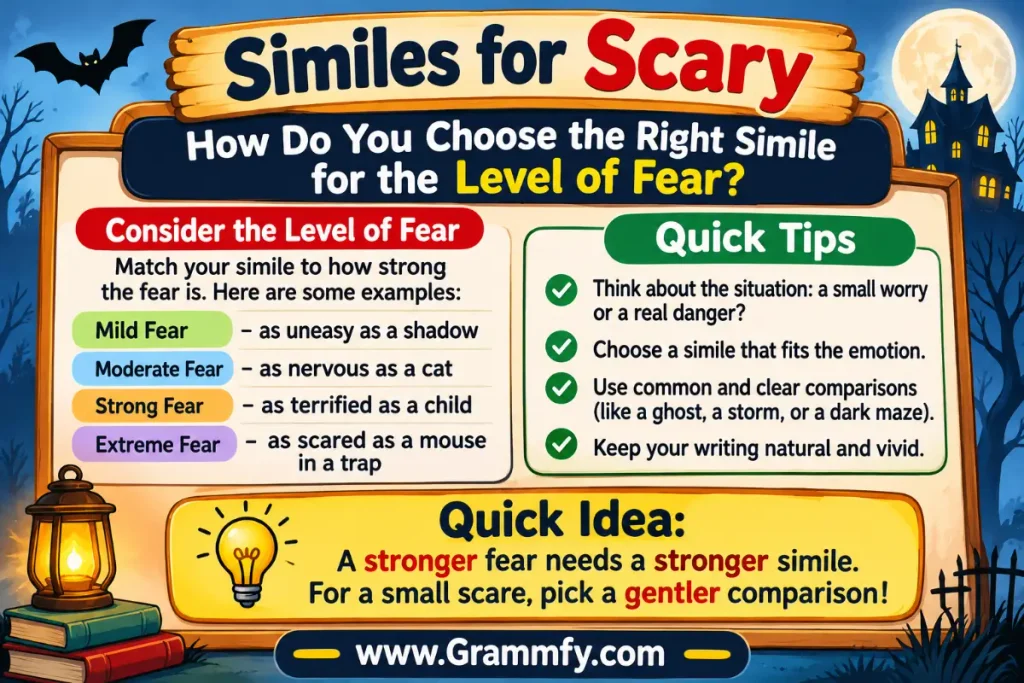
How Do You Choose the Right Simile for the Level of Fear?
Not every frightening scene needs the same emotional intensity. A strange noise outside a bedroom window creates a different feeling from a character escaping a dangerous situation. Choosing the right comparison helps readers understand the seriousness of the moment.
Which Similes Work for Mild Fear?
Mild fear includes nervousness, uncertainty, and the uncomfortable feeling that something is wrong. Use comparisons that suggest uneasiness without making the situation seem life-threatening.
Suitable examples include:
- Like a shadow moving at the edge of sight.
- As unsettling as a strange noise upstairs.
- Like a door left open in an empty house.
- As uneasy as waiting alone after dark.
- Like a whisper that disappears before you understand it.
Example: “The unfamiliar hallway felt like a door left open in an empty house.”
This sentence creates curiosity. It suggests that something might be wrong, but it does not reveal a specific danger. Such comparisons are useful at the beginning of a mystery or horror story because they encourage readers to keep wondering what will happen.
Which Similes Work for Strong Fear?
Strong fear appears when a character senses real danger or believes a situation could become harmful. Choose comparisons that communicate urgency, helplessness, or a growing threat.
Examples include:
- Like a trap closing around its victim.
- As frightening as being followed through a dark alley.
- Like a warning siren before a disaster.
- As tense as a rope stretched to its limit.
- Like a storm gathering over an isolated house.
Example: “Every step toward the locked door felt like walking into a trap.”
The comparison creates pressure because the character seems to be moving toward danger rather than away from it. This kind of description works well in suspenseful scenes, especially when the reader knows more about the danger than the character does.
Which Similes Work for Extreme Terror?
Extreme terror occurs when a character faces overwhelming danger, experiences a horrifying discovery, or believes escape may be impossible. Strong comparisons can communicate this feeling, but they should be used carefully.
Examples include:
- Like being trapped inside a living nightmare.
- As terrifying as facing an unknown creature in complete darkness.
- Like a scream caught inside the chest.
- As helpless as a person lost in a raging sea.
- Like being chased through a nightmare with no way out.
Example: “When the figure appeared behind the glass, the room became like a nightmare with no way out.”
This comparison makes the character’s fear feel immediate and overwhelming. It is most effective when earlier details have prepared readers for the moment. If every paragraph describes extreme terror, the effect becomes weaker because readers have no opportunity to experience a change in intensity.
What Is the Difference Between Scary, Creepy, Eerie, and Terrifying?
These words are related, but they do not always describe the same feeling. Choosing the right one helps you select a comparison that fits the scene.
| Word | Meaning | Typical situation | Example |
|---|---|---|---|
| Scary | Causing fear or worry | A frightening noise or dangerous situation | The abandoned building looked scary. |
| Creepy | Causing an uncomfortable, strange feeling | An empty house or an unsettling stare | His smile was as creepy as a mask in a dark room. |
| Eerie | Strange, mysterious, and often unnatural | An unusually quiet street or a strange sound | The forest was as eerie as a dream without people. |
| Frightening | Causing fear or alarm | A threatening event or disturbing discovery | The warning sounded as frightening as a cry for help. |
| Terrifying | Causing extreme fear | Immediate danger or overwhelming horror | The escape felt like running through a terrifying nightmare. |
| Horrifying | Causing intense fear, shock, or disgust | A deeply disturbing discovery | The scene was as horrifying as a nightmare brought to life. |
| Alarming | Creating sudden worry about possible danger | A warning, unusual result, or unexpected event | The sound was as alarming as a fire alarm at midnight. |
| Menacing | Suggesting a threat or harmful intention | A threatening person, object, or atmosphere | The figure stood like a menacing shadow in the doorway. |
Use creepy when a situation feels wrong or uncomfortable, even if there is no obvious danger. Use eerie when the atmosphere seems strange or unnatural. Choose terrifying when the fear is much more intense.
For example, an empty playground at dusk might feel eerie, while a stranger chasing someone through it might create a terrifying situation. The difference helps you choose a comparison that communicates the correct emotion.
What Is the Difference Between Similar Scary Similes?
Some comparisons appear interchangeable because they describe related emotions. However, their meanings can change depending on the image, the situation, and the way the sentence is written.
“As Silent as a Graveyard” vs. “As Dark as a Moonless Night”
Both comparisons can help create a frightening setting, but they focus on different details.
| Feature | As silent as a graveyard | As dark as a moonless night |
|---|---|---|
| Main focus | Lack of sound | Lack of light |
| Feeling created | Uneasiness and isolation | Uncertainty and hidden danger |
| Best setting | An empty building or deserted street | A forest, basement, or unlit road |
| Example | The village was as silent as a graveyard. | The road was as dark as a moonless night. |
Choose the first comparison when silence makes a location feel abandoned or unnatural. Choose the second when darkness prevents a character from seeing what lies ahead.
You can also combine the ideas when the scene supports both: “The road was as dark as a moonless night, and the surrounding forest was as silent as a graveyard.” This creates a stronger atmosphere because the reader experiences both the lack of light and the lack of sound.
“Shaking Like a Leaf” vs. “Frozen Like a Statue”
These comparisons describe different physical reactions to fear.
| Feature | Shaking like a leaf | Frozen like a statue |
|---|---|---|
| Main action | Trembling | Becoming still |
| Emotional effect | Shows visible nervousness | Shows shock or an inability to react |
| Typical moment | Before a difficult encounter | Immediately after a frightening discovery |
| Example | He was shaking like a leaf while waiting outside. | She stood frozen like a statue when the window shattered. |
A character may shake while waiting for danger or become motionless when something unexpected happens. Both reactions are believable, but they communicate different experiences.
To make the description more personal, include a detail about the character. For instance, “His hands shook like leaves in a storm, but he forced himself to reach for the door handle.” The contrast between fear and action gives the character more depth.
“Like a Trap Closing” vs. “Like a Storm About to Break”
These comparisons both suggest danger, but the first emphasizes restriction while the second emphasizes approaching force.
| Feature | Like a trap closing | Like a storm about to break |
|---|---|---|
| Main idea | Escape is becoming difficult | Trouble is approaching |
| Emotional tone | Helplessness and pressure | Tension and anticipation |
| Best use | A character surrounded by danger | A situation that is about to change |
| Example | The narrow passage felt like a trap closing around us. | His silence felt like a storm about to break. |
A trap suggests that the character’s options are disappearing. A storm suggests that something powerful is building and may soon happen. These differences matter when you want readers to understand whether a character is already in danger or only senses that danger is approaching.
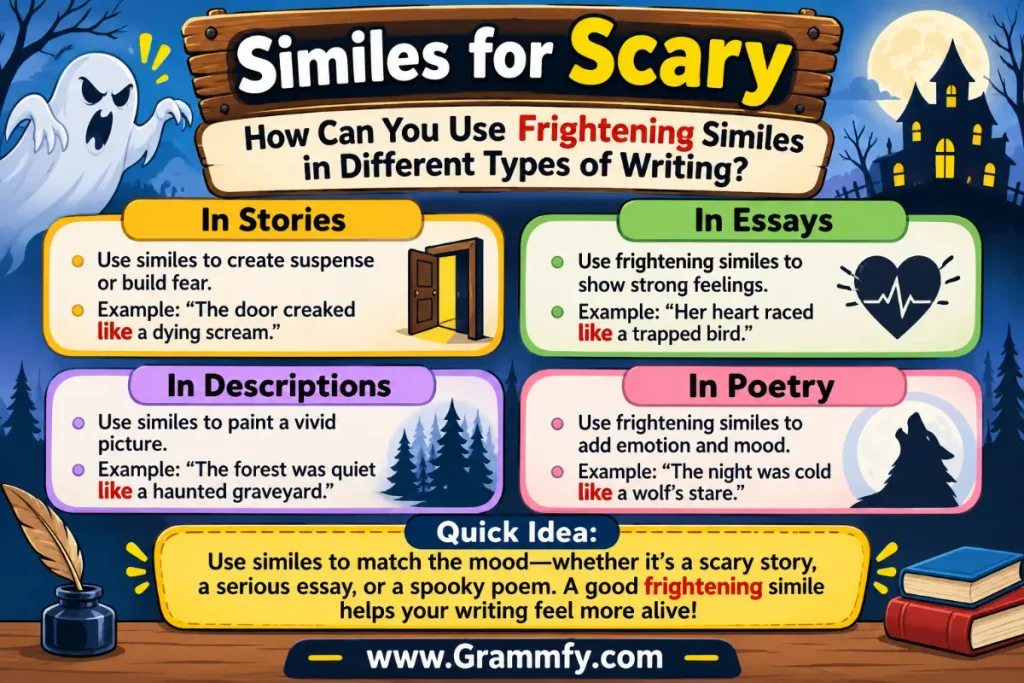
How Can You Use Frightening Similes in Different Types of Writing?
A comparison that works in a horror story might sound exaggerated in a school essay or professional email. The best choice depends on your purpose, audience, and writing style.
Which Similes Work Best in a School Essay?
School essays usually benefit from clear language and relevant descriptions. A comparison should support your main point rather than distract readers with overly dramatic imagery.
For example, if you are writing about a frightening experience, you might say:
“The empty corridor was as silent as a graveyard, and each footstep seemed louder than the last.”
This sentence helps readers picture the setting while keeping the language understandable. You could also write, “I felt frozen like a statue when the teacher announced the unexpected test results.”
Use comparisons sparingly in formal assignments. One or two relevant examples can improve a descriptive paragraph, but too many comparisons may make the writing feel exaggerated.
Which Similes Work Best in a Horror Story?
Horror writing often relies on uncertainty, atmosphere, and the possibility of danger. Comparisons can help establish these elements before the main frightening event occurs.
For example:
“The house stood like a forgotten giant at the end of the road. Its windows were dark, and the front door moved like a tired mouth trying to speak. When I stepped inside, the silence felt as unnatural as a dream in which nobody could see me.”
This passage uses several comparisons, but each one serves a different purpose. The forgotten giant makes the building seem imposing, the moving door suggests something strange, and the final comparison makes the silence feel unnatural.
In longer horror scenes, spread your comparisons throughout the action. Describe the setting first, introduce an unusual sound, and then use a stronger image when the character discovers the danger. This gradual development keeps the scene from becoming overwhelming too quickly.
Which Similes Work Best in Text Messages?
Casual messages usually benefit from short, familiar comparisons. You don’t need a long description to explain why something frightened you.
Examples include:
- “That sound was like something from a horror movie!”
- “I was shaking like a leaf during the presentation.”
- “The empty house looked as creepy as a nightmare.”
- “That unexpected notification scared me like a sudden scream.”
These sentences sound natural because they resemble everyday speech. They also work well in friendly conversations where the purpose is to share a reaction rather than create a detailed literary scene.
Remember that context matters. A humorous comparison may be appropriate when discussing a scary movie with friends, but a serious description is better when discussing a genuinely dangerous experience.
Which Similes Work Best in Emails?
Most professional emails should be direct, polite, and easy to understand. Frightening comparisons are rarely necessary unless the email describes an incident, a safety concern, or a creative project.
For example, in a report about a building inspection, you could write:
“The unlit staircase felt as dark as a moonless night, making it difficult to identify the steps safely.”
This comparison communicates the problem, but the sentence also explains the practical concern. In a professional context, that information matters more than creating a dramatic atmosphere.
Avoid phrases that exaggerate ordinary problems. Describing a minor scheduling delay as “a nightmare of terrifying proportions” can make a professional message sound unserious. Choose clear language that matches the importance of the situation.
Which Similes Work Best When Speaking?
In conversation, familiar comparisons are often more effective than complicated literary images. Listeners usually understand a short, direct sentence more easily than a long description filled with unusual expressions.
You might say, “I was as scared as a child hearing strange noises at night,” or “The road was as dark as a moonless night.” Both comparisons communicate a recognizable feeling without requiring listeners to stop and interpret an unfamiliar image.
When speaking, pay attention to tone and context. A dramatic comparison can make a story entertaining, while a simpler one may be better when describing a real experience. The goal is to help listeners understand what happened and why it affected you.
What Are More Than 10 Original Sentences Using Scary Similes?
The following examples show how to use comparisons in different situations. Each sentence connects a specific detail with an image that helps readers understand the atmosphere or emotion.
- At school: The empty science laboratory felt as eerie as a room abandoned after a strange experiment, especially when the lights began to flicker.
- During a storm: The wind howled like a wild animal outside our bedroom window, making it difficult to fall asleep.
- In a forest: The twisted branches reached across the path like bony fingers trying to stop us from moving forward.
- At home: When the cupboard door opened by itself, I froze like a statue and stared at the dark space behind it.
- In a horror story: The old clock ticked like a warning that something terrible was about to happen.
- Before an exam: Waiting for the results felt like standing at the edge of a cliff, unsure whether the next step would bring relief or disappointment.
- During a power outage: The familiar living room looked as strange as an unfamiliar place after the lights went out.
- On a deserted road: The road stretched into the darkness like a tunnel with no visible end.
- After hearing a noise: A sudden bang echoed through the house like thunder inside a cave.
- During a chase: My heart pounded like a drum as the footsteps behind me grew louder.
- In an abandoned building: The broken windows stared like empty eyes from the walls of the old factory.
- During a mystery: His expression changed like a door slamming shut when I mentioned the missing key.
- At a campsite: The forest became as silent as a graveyard after the last bird stopped calling.
These examples demonstrate an important principle: the comparison should match the detail you want readers to notice. A pounding heart suggests physical fear, a silent forest creates suspense, and a road disappearing into darkness suggests uncertainty. The strongest descriptions don’t simply label something frightening; they show readers what makes it frightening.
How Do You Write Your Own Similes for Scary Situations?
Creating your own comparisons is often more effective than copying familiar expressions. Original imagery can make your writing feel personal, specific, and memorable.
Step 1: Identify the Feeling You Want to Describe
Start by deciding whether the scene involves nervousness, suspense, shock, panic, or extreme terror. These feelings overlap, but each one creates a different writing opportunity.
For example, a character who hears an unfamiliar noise may feel uneasy. A character who sees someone following them may feel threatened. Someone who discovers a serious danger may experience overwhelming fear. Identifying the emotion helps you choose a suitable comparison.
Step 2: Choose a Concrete Image
Think about something readers can picture clearly. Useful sources of imagery include weather, animals, shadows, familiar objects, enclosed spaces, and ordinary physical reactions.
For instance, imagine a character who feels trapped in a narrow corridor. You could compare the corridor to a tunnel with no exit, a box closing around its contents, or a path disappearing into darkness. Each image creates a slightly different impression.
Choose the image that best matches the scene rather than selecting one simply because it sounds dramatic.
Step 3: Connect the Two Ideas Naturally
Use like or as to make the comparison clear. Check that the sentence communicates the intended feeling without forcing unrelated ideas together.
Weak example: The room was scary like a happy song.
Improved example: The room was as unsettling as a song playing in an empty house.
The improved version creates a recognizable contrast between an ordinary sound and an uncomfortable setting. However, the image should still fit the story. If the comparison seems confusing, choose a more direct one.
Step 4: Add a Specific Detail
A concrete detail can make a familiar comparison more personal. Instead of writing, “The forest was like a nightmare,” you could write, “The forest felt like a nightmare in which every path led back to the same dead tree.”
The second sentence gives readers something specific to imagine. It also suggests that the character cannot escape, which adds tension to the scene.
Step 5: Read the Sentence Aloud
Reading your work aloud helps you notice awkward wording, unnecessary repetition, and comparisons that don’t sound natural. If a sentence feels difficult to say or understand, simplify it.
For example, “The extremely frightening and terrifying hallway was like a very scary nightmare” repeats the same idea several times. A clearer version is, “The hallway felt like a nightmare with no exit.”
A useful comparison should make the meaning stronger, not simply make the sentence longer.
What Are Common Mistakes When Using Frightening Similes?
Similes can improve creative writing, but careless use may weaken the effect. Avoid the following mistakes when describing frightening scenes.
1. Using Too Many Comparisons in One Sentence
A sentence becomes confusing when it compares the same object to several unrelated things. Readers may struggle to understand which image matters most.
Weak: “The house was like a monster, a storm, a graveyard, and a nightmare.”
Better: “The house stood like a monster against the dark sky.”
The improved sentence focuses on one image. You can add other details in later sentences if they contribute something new.
2. Choosing an Image That Doesn’t Match the Emotion
Not every comparison communicates fear. Some images suggest happiness, comfort, excitement, or calmness instead.
For example, comparing a frightening room to a sunny garden may confuse readers unless the contrast is intentional. If you want to describe a strange, unsettling room, an image involving darkness, silence, or uncertainty may be more effective.
3. Repeating the Same Words
Using scary, terrifying, and frightening in every sentence can make a passage repetitive. Instead, describe what the character sees, hears, feels, or does.
For example, rather than writing, “The room was scary, the sound was scary, and the door was scary,” try this:
“The room was as silent as a graveyard. A low sound came from behind the door, and my hands began to shake like leaves in the wind.”
The revised passage communicates fear through several different details without repeatedly using the same adjective.
4. Making Every Scene Extremely Dramatic
If every noise sounds like an approaching disaster and every room resembles a nightmare, readers may become less responsive to the frightening moments. Give your descriptions room to develop.
Begin with a small detail, such as an unfamiliar sound. Then introduce a more unsettling detail, such as a door moving without explanation. Save the strongest comparison for the moment when the character discovers what is happening.
This approach helps suspense build naturally.
5. Forgetting the Purpose of the Comparison
A simile should help readers understand a feeling, picture a scene, or recognize an important detail. If the comparison adds nothing to the meaning, remove it.
For example, “The room was as frightening as a nightmare” may be enough when the scene needs only a brief description. If the scene focuses on a character’s reaction, “My hands trembled like leaves in the wind” may be more useful.
Always ask yourself what the comparison helps the reader understand.
What Are the Best Antonyms for Scary?
Antonyms are words with opposite or contrasting meanings. Understanding them can help you describe the difference between a frightening atmosphere and a peaceful one.
| Word | Meaning | Example sentence |
|---|---|---|
| Comforting | Making someone feel reassured | Her comforting voice made the dark room feel less threatening. |
| Peaceful | Calm and free from disturbance | The peaceful garden felt far removed from the frightening street. |
| Reassuring | Helping someone feel less worried | His reassuring smile helped the frightened child relax. |
| Safe | Protected from danger | The well-lit room felt safe after the frightening journey. |
| Pleasant | Enjoyable or agreeable | The pleasant evening felt nothing like the stormy night before. |
| Soothing | Helping someone feel calm | The soothing music helped me forget the strange noise. |
| Welcoming | Making someone feel accepted or comfortable | The welcoming house seemed warm after the eerie walk through the forest. |
These words are not perfect opposites in every situation. For example, safe describes the absence of danger, while comforting describes something that reduces worry or provides emotional support. Choosing the right word depends on whether you want to describe a person’s feelings, a physical situation, or the atmosphere of a place.
You can also create contrast by placing opposite images in the same passage. A dark, unfamiliar corridor might lead to a bright, welcoming room. This change gives readers a sense of relief and makes the earlier frightening scene more effective.
Quick Tips for Choosing the Best Simile
Use these practical tips when writing a story, school assignment, descriptive paragraph, or creative caption.
- Identify the emotion first. Decide whether you want to show nervousness, uneasiness, suspense, panic, or terror before choosing a comparison.
- Choose a recognizable image. Nightmares, shadows, sudden noises, storms, and empty buildings are familiar enough for most readers to understand.
- Match the intensity to the situation. A strange sound may feel unsettling, while an immediate threat may justify a much stronger comparison.
- Use like or as clearly. A direct comparison helps readers recognize the figure of speech without having to guess what you mean.
- Describe specific details. A character’s trembling hands or a door creaking in an empty house often creates a stronger impression than simply saying something is scary.
- Avoid unnecessary repetition. If one sentence already communicates the feeling, use the next sentence to introduce a new detail rather than another similar comparison.
- Consider your audience. A school assignment may need simple language, while a horror story can support more unusual and imaginative imagery.
- Read your writing aloud. If the comparison sounds awkward or confusing, rewrite it using a clearer image.
- Use contrast when it helps. A peaceful setting can make a sudden frightening event feel more unexpected.
- Keep the reader’s experience in mind. The purpose of a comparison is to make the scene easier to imagine, not to prove how many descriptive words you know.
The most effective simile is not necessarily the longest or most dramatic. It is the one that helps readers understand exactly what makes a moment frightening.
Conclusion: How Can You Make Scary Descriptions More Powerful?
Strong frightening descriptions come from clear images, precise language, and a good understanding of emotion. Instead of repeatedly calling a place scary, describe its silence, darkness, unfamiliar sounds, or the way a character reacts to it. A comparison such as “as silent as a graveyard” creates atmosphere, while “shaking like a leaf in the wind” shows fear through physical action. Both approaches help readers picture the scene and understand the experience.
When choosing Similes for Scary, consider the situation, the level of fear, and the effect you want your words to create. A mild comparison can build curiosity, while a stronger one can communicate danger or panic. Use familiar images when clarity matters, and try original comparisons when you want your writing to stand out. Above all, make every comparison serve a purpose. With practice, you’ll learn to describe frightening moments in ways that feel natural, vivid, and memorable.
Frequently Asked Questions
What is a simile for something scary?
A simile for something scary compares a frightening person, place, feeling, or event to another image using like or as. For example, “The abandoned house was as frightening as a nightmare” compares the house’s atmosphere to a frightening dream.
What are some short similes for fear?
Short similes for fear include “shaking like a leaf,” “frozen like a statue,” “pale as a sheet,” and “like a shadow in the dark.” These expressions describe physical reactions or create an unsettling atmosphere without requiring lengthy explanations.
What’s another way to describe something scary?
You can describe something as creepy, eerie, chilling, terrifying, unsettling, or menacing, depending on the situation. You can also use a comparison, such as “The hallway felt like a trap with no escape,” to show why a place seems frightening.
How do you write a simile for a scary story?
Start by identifying the emotion you want to communicate, then choose an image that readers can picture easily. For example, “The wind scratched at the windows like a creature trying to get inside” creates a threatening atmosphere through a familiar sound and an unsettling comparison.
What are the best Similes for Scary situations?
Some useful Similes for Scary situations include “as silent as a graveyard,” “like being trapped in a nightmare,” and “shaking like a leaf in the wind.” Choose the comparison that best matches the setting, the character’s reaction, and the intensity of the fear.
What is the difference between a simile and a metaphor in horror writing?
A simile makes an explicit comparison using words such as like or as, while a metaphor describes one thing as another without using those comparison words. For example, “The house was like a monster” is a simile, whereas “The house was a monster” is a metaphor.
Can I use similes in school essays and everyday writing?
Yes, similes can make descriptive writing clearer and more engaging when you use them appropriately. In school essays, choose relevant comparisons that support your ideas, and in everyday conversations, use familiar expressions that communicate your feelings naturally.

Tylerbrooks is a US-based English grammar writer and contributor at Grammfy. He writes helpful articles about grammar, spelling, commonly confused words, and vocabulary. His goal is to explain English topics in simple language with clear examples and practical tips. Through his articles, he helps readers improve their writing and everyday English skills.