
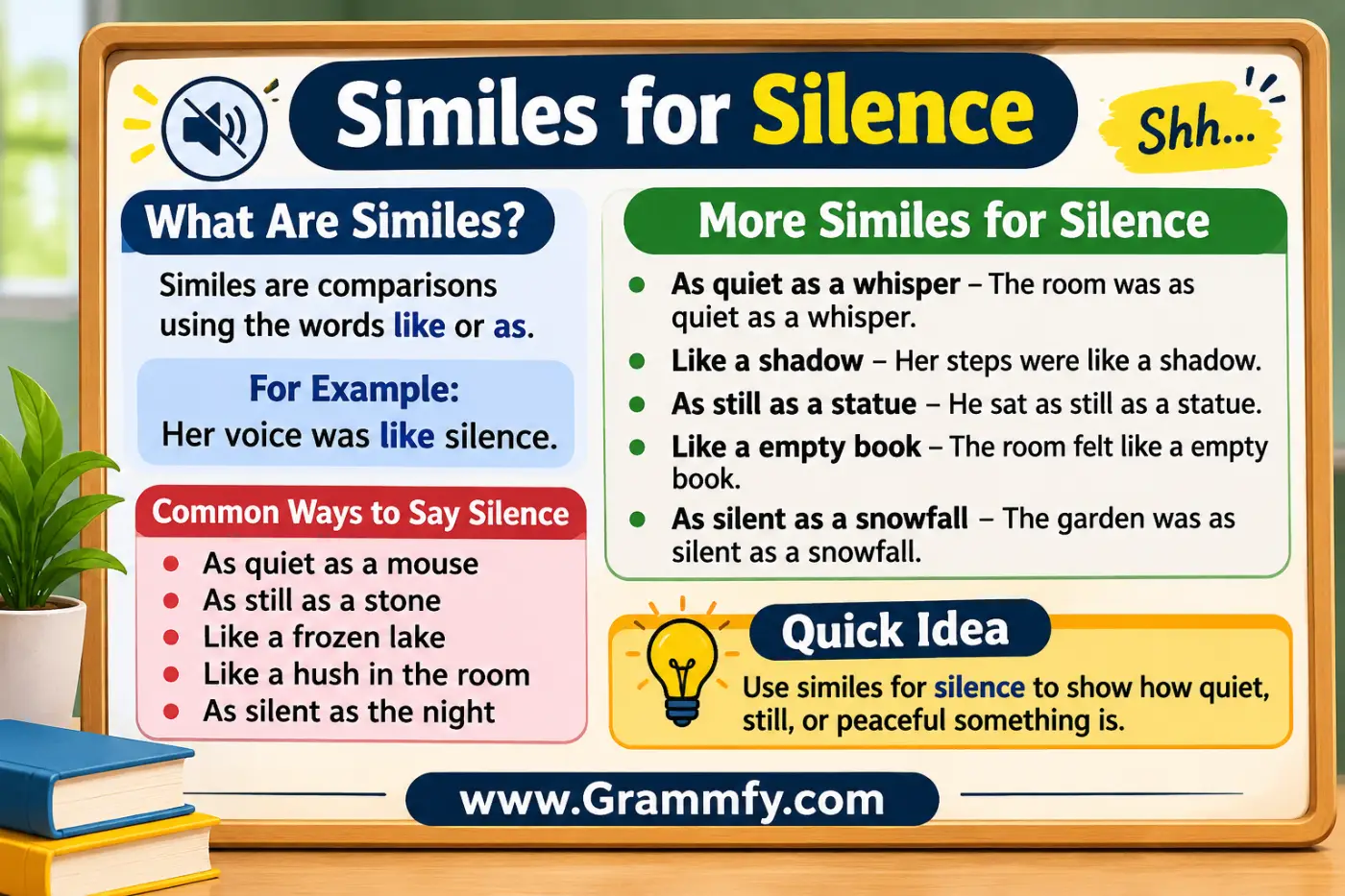
Silence can feel peaceful, awkward, heavy, or even frightening. Imagine writing an essay about an empty classroom, describing a tense moment in a story, or sending a text when nobody replies. The right simile can help readers feel that silence instead of simply reading the word. Similes for Silence help you describe quiet moments in creative ways, making your writing more vivid, emotional, and memorable.
Similes for Silence compare quietness to something familiar, such as a deserted street, falling snow, or a room after everyone has left. These comparisons make descriptions more vivid and help readers understand the mood behind the quiet.
For example, “The room was as silent as a sealed tomb” creates a feeling of deep, almost frightening quiet. In contrast, “The forest was as quiet as freshly fallen snow” suggests peace and calm.
In this guide, you’ll find original comparisons for peaceful, awkward, tense, and complete silence. You’ll also learn what each simile means, when to use it, and how to create your own examples for essays, stories, conversations, and everyday writing.
Need a more vivid way to describe short? Explore our guide to creative short similes and examples for fresh ideas and examples.
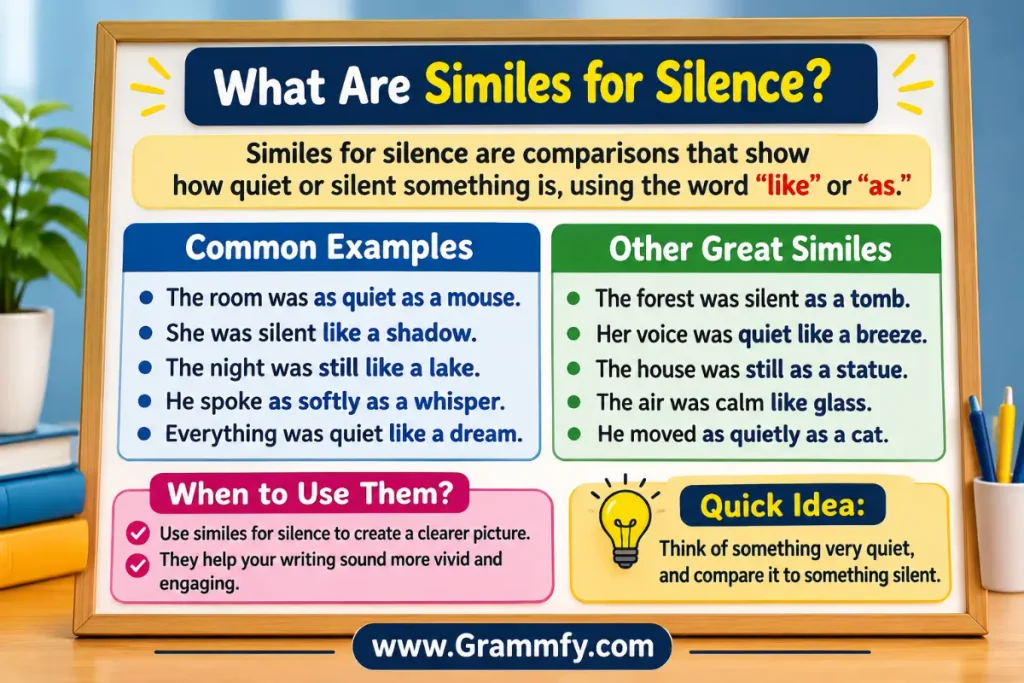
What Are Similes for Silence?
A simile is a figure of speech that compares two different things using the words like or as. Writers use similes to explain an idea, create an image, or express an emotion in a memorable way.
Silence is the absence of sound or speech. However, quietness can mean much more than simply having no noise. It might suggest comfort, fear, loneliness, suspense, respect, or anger.
Consider these two sentences:
- Simple: The classroom was quiet.
- With a simile: The classroom was as quiet as a library after closing time.
The second sentence gives readers a clearer picture. They can imagine a place where even a small sound would stand out.
Here are a few more examples:
| Simile | What it suggests |
|---|---|
| As quiet as a sleeping baby | Gentle, peaceful quiet |
| As silent as a grave | Deep, unsettling quiet |
| Like a whisper in an empty hall | A faint sound surrounded by quiet |
| As still as a frozen lake | Complete stillness and calm |
| Like the world holding its breath | Suspense before something happens |
A good comparison doesn’t just tell readers that a place is quiet. It helps them understand what kind of quietness they should imagine.
What Is the Origin of the Word Silence?
The English word silence comes through Old French silence from Latin silentium, meaning stillness or the state of being silent. It is related to the Latin verb silere, meaning to be quiet.
The word has long been used to describe the absence of speech or sound. Today, it also appears in expressions about emotions, communication, and social behavior.
For example:
- Physical silence: The house fell silent after the television was switched off.
- Emotional silence: Her silence showed that she was still upset.
- Social silence: Nobody answered when the teacher asked the question.
- Symbolic silence: The character’s silence suggested that he was hiding a secret.
A simile builds on these meanings by connecting quietness to a familiar experience. Comparing silence to snowfall suggests peace, while comparing it to a grave creates a darker mood.
This is why the comparison matters as much as the word itself. The right image helps readers understand the scene without needing a long explanation.
35+ Best Similes for Silence With Meanings
The following examples cover different situations. Some are gentle and comforting, while others suggest tension, loneliness, or mystery.
Note: These are creative comparisons for writing and learning. Some are familiar literary images, while others are original examples.
1. Peaceful and Calm Silence
Use these comparisons when you want readers to feel relaxed, safe, or comfortable.
| Simile | Meaning | Example sentence |
|---|---|---|
| As quiet as falling snow | Almost noiseless and gentle | The garden was as quiet as falling snow. |
| As peaceful as a sleeping baby | Soft and comforting | The nursery was as peaceful as a sleeping baby. |
| Like a still lake at dawn | Calm with little disturbance | The room felt like a still lake at dawn. |
| As silent as a sleeping village | Deep nighttime quiet | The street was as silent as a sleeping village. |
| Like a whisper in the wind | Barely noticeable sound | Her footsteps seemed like a whisper in the wind. |
| As quiet as an empty library | Calm and undisturbed | The study hall was as quiet as an empty library. |
| Like a garden before sunrise | Gentle quiet before activity begins | The backyard rested like a garden before sunrise. |
| As still as a frozen pond | No movement or noticeable noise | The winter landscape was as still as a frozen pond. |
Best choice: Use comparisons involving snow, lakes, gardens, or sleeping places when the scene should feel restful rather than frightening.
2. Deep and Complete Silence
These examples suggest that almost nothing can be heard. Depending on the setting, they can also create mystery or unease.
| Simile | Meaning | Example sentence |
|---|---|---|
| As silent as a grave | Extremely quiet and often eerie | The abandoned house was as silent as a grave. |
| As quiet as a sealed room | No noticeable sound escapes | The recording booth was as quiet as a sealed room. |
| Like a world without echoes | Sound seems completely absent | The cave felt like a world without echoes. |
| As silent as a deserted church | Deep, solemn quiet | The old building was as silent as a deserted church. |
| Like a book with no words | Nothing is being expressed | His face remained like a book with no words. |
| As quiet as midnight in the desert | Wide, empty stillness | The campsite was as quiet as midnight in the desert. |
| Like a theater after the final curtain | Activity has ended | The auditorium felt like a theater after the final curtain. |
| As still as a room in a forgotten house | Unused, undisturbed quiet | The upstairs bedroom was as still as a room in a forgotten house. |
Best choice: Grave, deserted church, and forgotten-house imagery works well in suspense, horror, and mystery writing. Use these comparisons carefully in lighthearted scenes because they can create a dark mood.
3. Awkward and Uncomfortable Silence
Sometimes silence feels uncomfortable because people don’t know what to say. These comparisons work well in conversations, meetings, interviews, and family gatherings.
| Simile | Meaning | Example sentence |
|---|---|---|
| Like a question nobody wants to answer | People avoid an uncomfortable subject | His comment hung in the air like a question nobody wanted to answer. |
| As awkward as a first meeting without introductions | Nobody knows how to begin | The silence was as awkward as a first meeting without introductions. |
| Like a joke that nobody laughs at | An expected response never comes | Her remark landed in a silence like a joke that nobody laughed at. |
| As uncomfortable as shoes that don’t fit | The situation feels wrong | The silence between the coworkers was as uncomfortable as shoes that didn’t fit. |
| Like an unfinished conversation | Something important remains unsaid | Their silence felt like an unfinished conversation. |
| As tense as a stretched rubber band | Pressure seems ready to snap | The room grew as tense as a stretched rubber band. |
Best choice: Use these comparisons when silence comes from embarrassment, disagreement, or uncertainty rather than a complete lack of sound.
4. Frightening and Suspenseful Silence
A quiet place can feel frightening when someone expects danger or waits for something unexpected to happen.
| Simile | Meaning | Example sentence |
|---|---|---|
| Like the world holding its breath | Everyone seems to be waiting | The forest went quiet like the world holding its breath. |
| As silent as a predator waiting to strike | Quietness suggests hidden danger | The hallway was as silent as a predator waiting to strike. |
| Like the pause before a thunderstorm | Something troubling may happen soon | The silence felt like the pause before a thunderstorm. |
| As quiet as a locked basement | Closed-off, unsettling quiet | The cellar was as quiet as a locked basement. |
| Like a shadow creeping across a room | Silence slowly changes the mood | The silence spread like a shadow creeping across a room. |
| As tense as a wire pulled tight | Pressure is building | The room was as tense as a wire pulled tight. |
| Like footsteps that never arrive | Someone is expected but remains absent | Waiting in the dark felt like listening for footsteps that never arrived. |
| As still as a forest before a storm | Nature seems to be waiting for change | The woods were as still as a forest before a storm. |
Best choice: Use storm, predator, and shadow imagery to build suspense. For a stronger effect, place the simile just before an important action or revelation.
5. Sad, Lonely, and Empty Silence
Quietness can also communicate loss or loneliness. These comparisons are useful in poems, reflective essays, and emotional stories.
| Simile | Meaning | Example sentence |
|---|---|---|
| Like an empty chair at dinner | Someone important is missing | Her silence felt like an empty chair at dinner. |
| As lonely as a house after everyone leaves | The place feels abandoned | The old home was as lonely as a house after everyone left. |
| Like a letter that never arrives | Someone is waiting for a response | His silence felt like a letter that never arrived. |
| As empty as a street after midnight | The surroundings feel deserted | The road was as empty as a street after midnight. |
| Like an echo fading into the distance | A connection is slowly disappearing | Their conversation ended like an echo fading into the distance. |
| As cold as an unanswered message | Silence feels distant or uncaring | Her response was as cold as an unanswered message. |
| Like a song that has lost its final note | Something feels unfinished | The farewell ended like a song that had lost its final note. |
| As distant as a voice across a valley | Someone feels emotionally far away | Their silence felt as distant as a voice across a valley. |
Best choice: Use an empty chair or unanswered message when the sadness comes from a missing person or broken connection. Use fading echoes when you want to suggest that a relationship or memory is slowly disappearing.
How Do You Choose the Right Simile for Silence?
The strongest comparison depends on the emotion you want to communicate. Before choosing one, ask yourself three questions:
- What does the silence feel like? Is it calm, strange, uncomfortable, or threatening?
- Where does it happen? A classroom, a forest, a hospital, and a family dinner suggest different images.
- What should readers feel? You might want them to relax, worry, laugh, or feel sympathy.
Compare these examples:
- Peaceful: The room was as quiet as a snow-covered field.
- Awkward: The room was as quiet as a meeting after an embarrassing mistake.
- Frightening: The room was as quiet as a house where nobody should be.
- Sad: The room was as quiet as a home after a loved one leaves.
All four describe quietness, but each creates a different experience. Choose the image that supports your main idea instead of picking the most dramatic comparison.
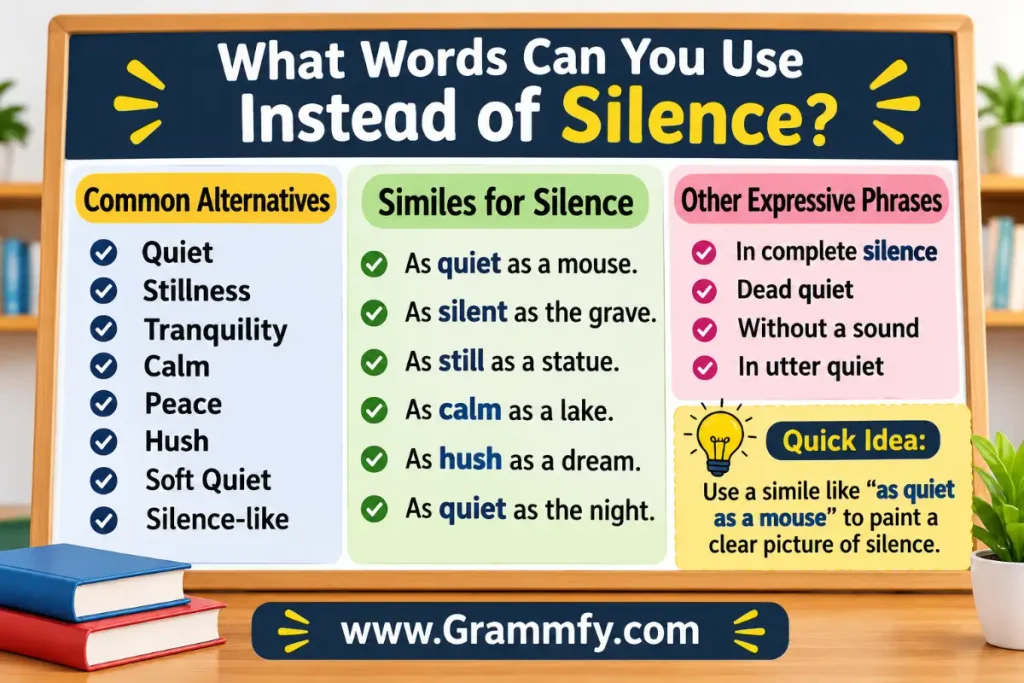
What Words Can You Use Instead of Silence?
The word silence has several related words, but they aren’t all interchangeable. Some describe a lack of sound, others describe a lack of speech, and some suggest secrecy or emotional distance.
Use this master list to choose a word that fits your sentence.
Simple words for silence
| Word | Meaning | Tone | Example |
|---|---|---|---|
| Quiet | Little or no noise | Neutral | The house was quiet. |
| Stillness | A lack of movement or disturbance | Peaceful | Stillness filled the garden. |
| Calm | A peaceful state | Positive | Calm settled over the room. |
| Hush | A state of quietness | Gentle | A hush fell over the class. |
| Rest | A break from activity or noise | Relaxed | The village enjoyed a moment of rest. |
| Peace | Freedom from disturbance | Positive | Peace filled the empty chapel. |
| Pause | A short break in activity or speech | Neutral | She took a pause before answering. |
| Quietness | The state of being quiet | Neutral | The quietness helped him focus. |
Everyday words for silence
| Word | Meaning | Tone | Example |
|---|---|---|---|
| Muteness | The state of being unable to speak or not speaking | Neutral to clinical | His muteness during the discussion surprised us. |
| Wordlessness | A state of having no words to express something | Emotional | She stared in wordlessness. |
| Soundlessness | The absence of audible sound | Descriptive | Soundlessness surrounded the cabin. |
| Speechlessness | An inability to speak, often from surprise | Emotional | The news left him speechless. |
| Still | A condition without movement or activity | Calm | Everything stood still. |
| Quiet spell | A period with little sound or conversation | Informal | A quiet spell followed the announcement. |
| Gap | A break in speech or activity | Neutral | A gap opened in the conversation. |
| Pause | A temporary stop before continuing | Neutral | A pause followed her question. |
Formal and literary words for silence
| Word | Meaning | Tone | Example |
|---|---|---|---|
| Silence | Absence of sound or speech | Neutral or serious | Silence followed the speech. |
| Tranquility | Peaceful freedom from disturbance | Formal, positive | Tranquility filled the countryside. |
| Solitude | The state of being alone | Reflective | He welcomed the solitude of the hills. |
| Seclusion | Separation from other people | Formal | She worked in the seclusion of her office. |
| Quietude | A state of quietness and calm | Literary | Quietude settled over the garden. |
| Hush | A sudden or deliberate quiet | Literary or everyday | A hush spread through the audience. |
| Taciturnity | A tendency to say little | Formal | His taciturnity made him difficult to read. |
| Reticence | Unwillingness to speak freely | Formal | Her reticence suggested caution. |
| Reserve | A tendency to hold back thoughts or feelings | Formal | His reserve made the interview difficult. |
Informal and slang expressions for silence
| Word or expression | Meaning | Tone | Example |
|---|---|---|---|
| Dead quiet | Completely quiet | Informal | The house was dead quiet. |
| Pin-drop quiet | So quiet that even a tiny sound would be noticed | Informal | The classroom was pin-drop quiet. |
| Radio silence | No communication or updates | Informal, professional, or technical | We heard radio silence from the team all morning. |
| Crickets | No response, often when one is expected | Casual, humorous | I posted the question and got crickets. |
| Zip | No words or information | Casual | He said zip about the surprise. |
| Not a peep | Not even a small sound | Informal | The children didn’t make a peep. |
| Mum’s the word | A request to keep something secret | Informal | Mum’s the word about the party. |
| Give someone the silent treatment | Deliberately refuse to speak to someone | Informal, negative | He gave his brother the silent treatment. |
Important distinction: Words related to silence often describe different things. Solitude means being alone, not necessarily being quiet. Reticence means holding back from speaking, while radio silence usually refers to a lack of communication. Choose the word that matches the situation.
How Does Silence Change From Mild to Strong?
The intensity of a word or comparison affects how readers understand a scene. A mild expression may suggest comfort, while a strong one can signal danger or distress.
| Intensity | Word or expression | What it communicates | Example |
|---|---|---|---|
| 1. Very mild | A brief pause | A short break in speech | A brief pause followed her question. |
| 2. Mild | Quiet | Little noise | The office was quiet. |
| 3. Gentle | Hush | Soft, shared quiet | A hush fell over the room. |
| 4. Peaceful | Stillness | Calm with little disturbance | Stillness covered the lake. |
| 5. Noticeable | Dead quiet | Almost no sound | The hallway was dead quiet. |
| 6. Complete | Pin-drop quiet | Even small noises seem obvious | The hall became pin-drop quiet. |
| 7. Uncomfortable | Awkward silence | People don’t know what to say | An awkward silence followed his joke. |
| 8. Heavy | Stifling silence | Quietness feels emotionally oppressive | A stifling silence filled the office. |
| 9. Eerie | Grave-like silence | A disturbing absence of sound | Grave-like silence surrounded the ruins. |
| 10. Ominous | An unnatural hush | Quietness suggests approaching danger | An unnatural hush settled over the woods. |
These levels aren’t fixed rules. Context changes the effect. Dead quiet can describe a peaceful library or a frightening abandoned building. The surrounding details tell readers how to interpret it.
How can you make a silence comparison stronger?
Start with a simple sentence and increase the emotional intensity.
- Mild: The room was quiet.
- Clearer: The room was as quiet as an empty library.
- More emotional: The room was as quiet as a house after everyone had left.
- Suspenseful: The room was as quiet as a house waiting for someone to enter.
- Frightening: The room was as silent as a grave beneath the winter ground.
The goal isn’t always to make a comparison stronger. Sometimes a gentle image is more effective because it matches the scene.
What Is the Difference Between Silence, Quiet, and Stillness?
These words overlap, but each has a slightly different meaning.
| Word | Main idea | Best use | Example |
|---|---|---|---|
| Silence | No sound or speech | When nothing is being said or heard | Silence followed the announcement. |
| Quiet | Little noise or activity | When a place is calm or not noisy | The children played quietly. |
| Stillness | Little or no movement | When a scene appears motionless | The stillness of the lake was beautiful. |
Silence focuses on sound and speech. Quiet allows for some sound, as long as it isn’t loud or disruptive. Stillness focuses more on movement, although it often creates an impression of quiet.
For instance, a library can be quiet even when people turn pages. A lake can be still while birds call nearby. A room can fall silent when everyone stops talking, even if the air conditioner continues to hum.
Use the distinction to make your writing more precise. Choose silence when a scene has no speech. If there’s little noise, use quiet. When nothing appears to move, choose stillness.
What Is the Difference Between an Awkward Silence and a Heavy Silence?
Both expressions describe uncomfortable quietness, but they communicate different feelings.
| Feature | Awkward silence | Heavy silence |
|---|---|---|
| Main feeling | Embarrassment or uncertainty | Sadness, anger, grief, or tension |
| Typical situation | A failed joke or an unfamiliar meeting | An argument, a loss, or a difficult confession |
| Duration | Often brief | May feel prolonged |
| Example | An awkward silence followed the introduction. | A heavy silence settled over the family. |
An awkward silence often occurs because people don’t know what to say next. A heavy silence suggests that unspoken feelings or serious events are weighing on everyone.
Consider a family dinner after a harmless joke goes wrong. Awkward silence is probably the better choice. If the family has just received sad news, heavy silence may convey the mood more accurately.
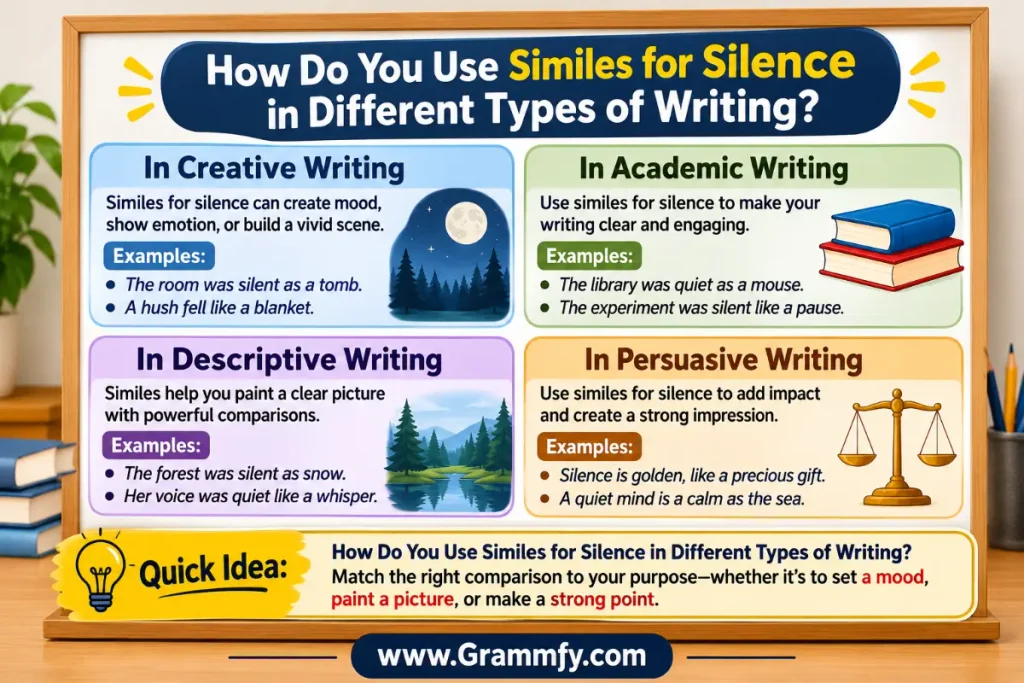
How Do You Use Similes for Silence in Different Types of Writing?
The same comparison doesn’t work equally well in every setting. A resume needs direct language, a poem can use imaginative imagery, and a text message usually benefits from simple expressions.
In a resume
Professional resumes rarely need literary comparisons. Use words such as discreet, thoughtful, or reserved when describing a relevant personal strength. Don’t claim that you are “as silent as a grave” in a professional profile.
Example:
- Less suitable: I am as quiet as falling snow during meetings.
- Better: I listen carefully, communicate thoughtfully, and respect confidential information.
A simile may work in a creative portfolio, but clear and measurable skills are usually stronger in a resume.
In an essay
Use a comparison to explain a scene or support an argument. Choose an image that relates to the main point instead of adding a simile simply to decorate a paragraph.
Example:
The school library was as quiet as a snow-covered forest. Students concentrated on their books, and even the soft turning of pages seemed noticeable.
This example connects the comparison to the setting and explains why the quiet matters.
In texting
Text messages usually work best with familiar, conversational language.
Examples:
- “It’s been dead quiet in the group chat.”
- “I asked a question and got crickets.”
- “The house is so quiet without everyone here.”
These expressions sound natural in casual conversation. A phrase such as the stillness of a forgotten cathedral may sound overly dramatic unless you’re joking or telling a story.
In an email
In a professional email, describe a lack of response directly. A simile is more appropriate in a friendly or creative message than in a formal request.
Formal example:
I haven’t received a response yet, so I’m following up on my previous email.
Friendly example:
The group chat has been as quiet as a library today. Is everyone busy?
Choose the tone based on your relationship with the recipient.
In speaking
Spoken comparisons should be easy to understand the first time someone hears them.
Example:
“After the final question, the room went as quiet as a library.”
This comparison is short and familiar. You can use it in a classroom discussion, a presentation, or a story about an unexpected event.
In poetry and creative writing
Poetry gives you more freedom to use surprising images. You can connect quietness to an object, place, feeling, or event.
Example:
The night sat beside my window, as quiet as a letter never sent.
The image of an unsent letter suggests both silence and feelings that have not been expressed. This makes the comparison more meaningful than simply saying the night was quiet.
15 Original Simile Examples for Real-Life Situations
Here are more examples showing how comparisons can fit into everyday life, school, work, and storytelling.
- During an exam: The classroom was as quiet as a room full of sleeping cats while students worked through the final question.
- After an argument: Their silence hung between them like a closed door neither wanted to open.
- In a hospital: The waiting room was as quiet as a garden before dawn, with everyone lost in their thoughts.
- During a storm: The forest became as silent as a theater before the show begins.
- At a family gathering: The table went as quiet as a paused song when Grandpa shared his unexpected news.
- In an empty school: The corridor was as quiet as a playground after the last bell of the year.
- During a job interview: The silence after the difficult question felt like a bridge suspended over deep water.
- While waiting for a reply: His unanswered message sat in the conversation like a chair nobody wanted to fill.
- In a mystery story: The hallway was as silent as a locked room hiding a secret.
- In a peaceful garden: The morning rested over the flowers like a soft blanket.
- After a performance: The stage stood as quiet as a room after its final guest has departed.
- During a difficult confession: Her silence stretched between them like a road disappearing into fog.
- In a library: The reading room was as quiet as snow settling on a roof.
- Before a surprise: The group became as silent as a crowd waiting for the curtain to rise.
- After a goodbye: The empty house felt as quiet as a song whose last note had faded away.
Common Mistakes When Writing Similes About Silence
Even a creative comparison can become confusing if it doesn’t match the situation.
1. Confusing a simile with a metaphor
A simile compares two things using like or as. A metaphor describes one thing as another without making the comparison explicit.
- Simile: The silence was like a blanket covering the room.
- Metaphor: A blanket of silence covered the room.
Both can work, but they use different figures of speech.
2. Using an image that doesn’t fit the mood
A comparison about a peaceful lake may weaken a scene meant to feel terrifying. Likewise, a grave-related image may make a calm morning sound disturbing.
How to fix it: Identify the emotion first. Then choose an image that supports it.
3. Making every comparison dramatic
Not every quiet moment needs a powerful literary image. Too many intense comparisons can make writing feel exaggerated.
- Overdone: The silence was a thousand endless oceans of unbearable emptiness.
- Clearer: The silence felt as wide as an empty sea.
Choose the simplest image that communicates the feeling.
4. Repeating the same comparison
Using as silent as a grave several times in one paragraph can make the writing predictable.
How to fix it: Vary the imagery. You might use an empty house for loneliness, falling snow for peace, and a paused song for an unfinished conversation.
5. Treating silence and stillness as identical
A room can be silent while people move around. A still room may contain the quiet hum of a fan.
How to fix it: Decide whether your sentence emphasizes sound, movement, or both.
6. Using an unclear comparison
An original simile can be creative, but readers still need to understand the connection.
- Unclear: The silence was like a purple staircase.
- Clearer: The silence was like a staircase leading into an empty attic.
The second comparison gives readers a recognizable scene and a reason to imagine the quiet as mysterious.
7. Forgetting the surrounding sentence
A simile should contribute to the scene instead of standing alone without purpose.
Weak: The room was as quiet as falling snow.
Stronger: The room was as quiet as falling snow, and Maya could hear the clock ticking above the door.
The added detail helps readers experience the quietness.
What Are the Antonyms of Silence?
An antonym is a word with the opposite or a contrasting meaning. The best opposite depends on whether silence refers to sound, speech, or activity.
| Antonym | Meaning | Example |
|---|---|---|
| Noise | Unwanted or noticeable sound | Noise filled the hallway. |
| Sound | Something that can be heard | A strange sound came from upstairs. |
| Clamor | Loud, confused noise | Clamor rose from the crowd. |
| Din | A continuous, unpleasant loud noise | The din of traffic filled the street. |
| Chatter | Informal, continuous conversation | Chatter spread across the classroom. |
| Conversation | An exchange of spoken words | Conversation resumed after the announcement. |
| Outcry | A loud expression of protest or emotion | An outcry followed the decision. |
| Hubbub | Busy, confused noise from people | The hubbub of the market grew louder. |
Remember that these aren’t exact opposites in every situation. Noise contrasts with the absence of sound, while conversation contrasts more directly with the absence of speech.
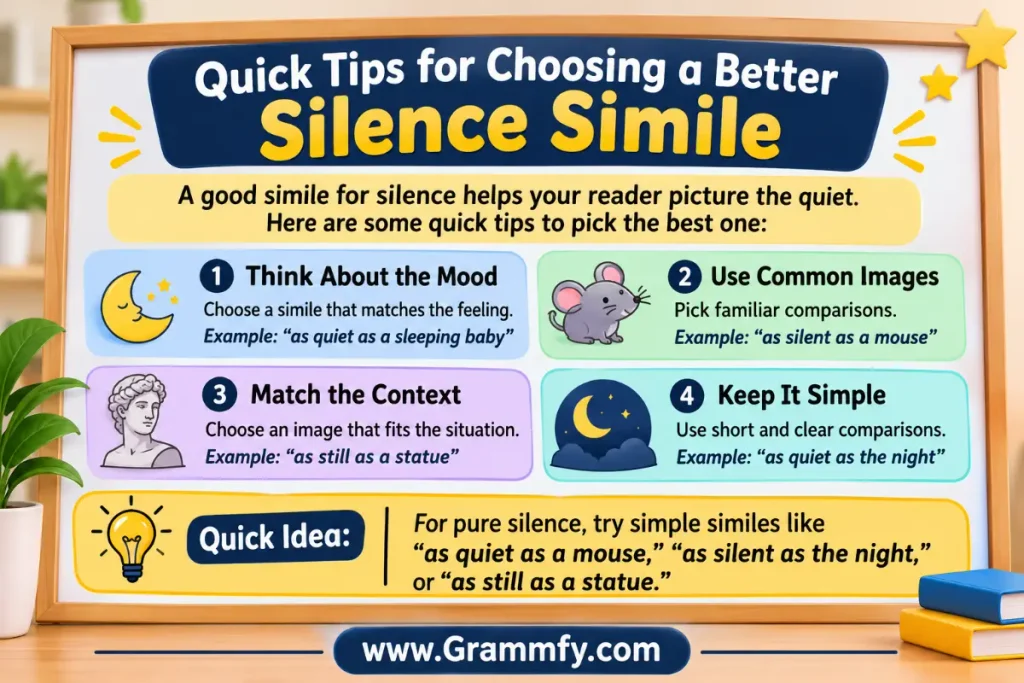
Quick Tips for Choosing a Better Silence Simile
Use these practical tips to make your comparisons clearer and more effective.
- Match the mood. Use snow or a calm lake for peace, an empty house for loneliness, and an approaching storm for suspense.
- Think about the setting. A classroom, forest, hospital, and crowded restaurant each offer different images.
- Use familiar objects. A closed door, empty chair, ticking clock, or fading song can help readers imagine quietness.
- Keep the sentence natural. A short, clear comparison often works better than a long description filled with extra details.
- Avoid mixed images. Don’t combine unrelated comparisons in a way that confuses the reader.
- Consider the audience. Use everyday expressions for texts and conversations, and more imaginative imagery for stories and poems.
- Read the sentence aloud. If the comparison sounds awkward when spoken, try a simpler version.
- Add a sensory detail. Mention a ticking clock, moving curtain, or distant bird to make the silence more vivid.
- Don’t force a simile into every sentence. Sometimes the plain word silence is the strongest choice.
- Make the comparison meaningful. The image should reveal something about the people, place, or situation.
A useful test is to remove the simile and read the sentence again. If the sentence loses an important feeling or image, the comparison is probably doing useful work.
Conclusion:
Silence isn’t always empty. It can bring comfort, create tension, reveal sadness, or make a moment feel full of possibility. The best simile helps readers understand which kind of quietness you mean without making the description unnecessarily complicated.
When choosing Similes for Silence, start with the emotion you want to communicate. A snow-covered landscape can suggest peace, an empty chair can suggest loss, and a closed door can suggest distance between people. Think about your setting, your audience, and the purpose of the sentence before choosing an image.
Try writing the same quiet moment in two or three different ways. Compare the feelings each version creates, then keep the one that fits your meaning best. With practice, your descriptions will become more vivid, natural, and memorable.
Frequently Asked Questions
What are some good similes for silence?
Good examples include as quiet as falling snow, as silent as a grave, and like the world holding its breath. Each comparison creates a different mood, so choose one that matches your scene.
What is a simile for complete silence?
A simile such as as silent as a sealed tomb suggests almost total quietness. For a gentler image, try as quiet as a sleeping village.
What’s another way to describe silence in writing?
You can describe silence as a hush, stillness, quietude, or an absence of sound. You can also compare it to familiar images, such as an empty room or a lake at dawn.
How do I describe awkward silence?
Describe it as a question nobody wants to answer or a joke that nobody laughs at. These comparisons suggest that people feel uncomfortable and don’t know how to respond.
Can silence be used as a metaphor?
Yes. For example, a blanket of silence covered the room is a metaphor because it describes silence as a blanket without using like or as.
What are the best Similes for Silence for a poem?
The best choices depend on the poem’s mood. Try like a letter never sent for unspoken feelings, like an echo fading away for loss, or as quiet as falling snow for peace.
What is the difference between silence and stillness?
Silence refers to a lack of sound or speech, while stillness refers mainly to a lack of movement. A room can be still without being completely silent.

Tylerbrooks is a US-based English grammar writer and contributor at Grammfy. He writes helpful articles about grammar, spelling, commonly confused words, and vocabulary. His goal is to explain English topics in simple language with clear examples and practical tips. Through his articles, he helps readers improve their writing and everyday English skills.