
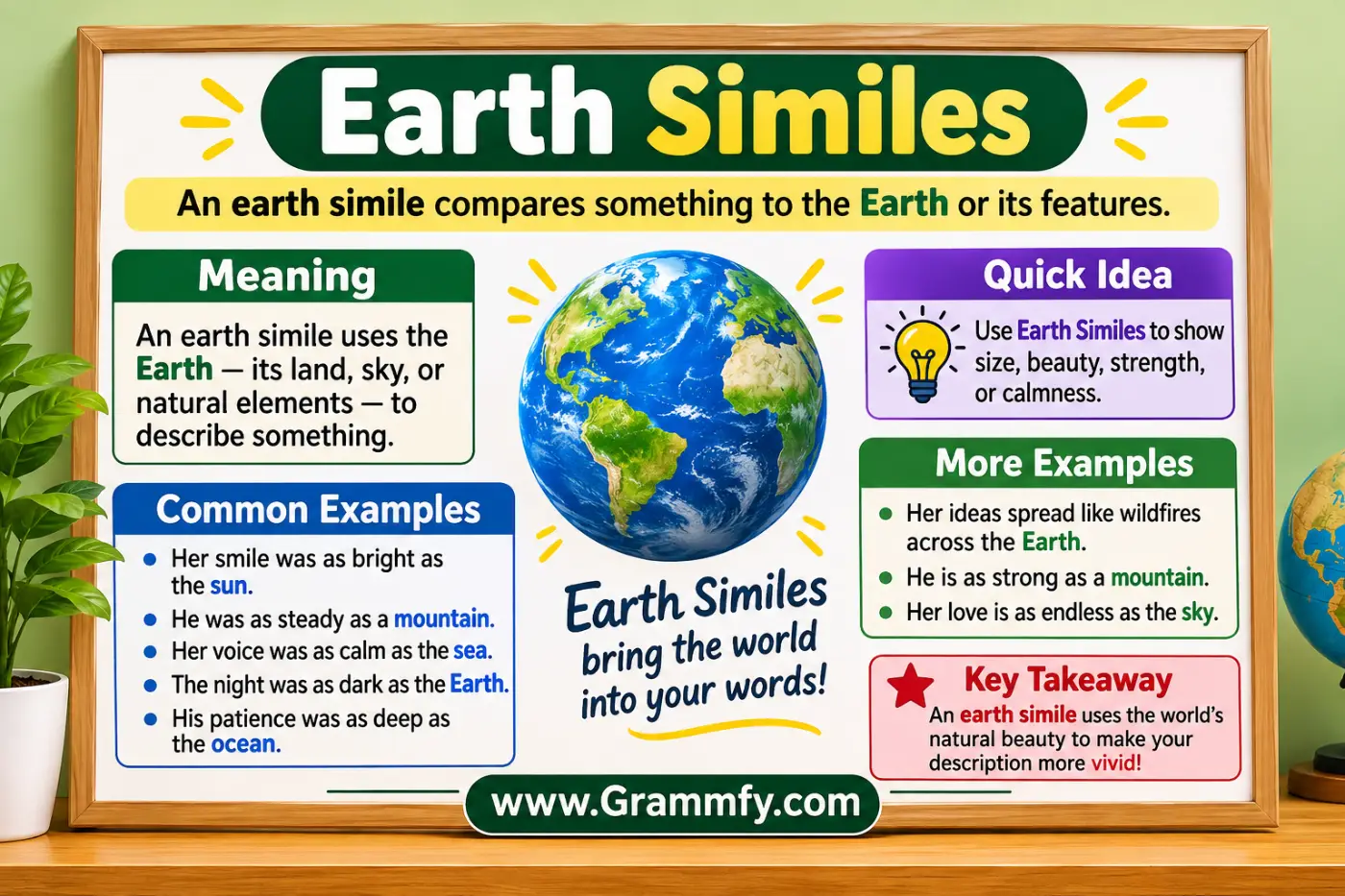
Have you ever described the Earth in a school essay, nature poem, or story and struggled to find the right words? A simple sentence like “The Earth is beautiful” shares an idea, but a creative comparison can help readers picture its beauty. Earth similes make descriptions more vivid by comparing our planet to familiar things, such as a giant blue marble, a living garden, or a peaceful home.
Earth Similes compare our planet, its land, or its natural features to familiar things using like or as. These comparisons can describe the Earth’s round shape, rich soil, vast landscapes, and connection to life.
- For example, “The Earth is like a giant blue marble” helps readers imagine our planet from space. Similarly, “The Earth is as generous as a mother” suggests that the planet provides the resources living things need.
Whether you’re writing a poem, completing a school assignment, or improving your creative writing, the right comparison can make your description more memorable. Below, you’ll find examples with meanings, original sentences, writing tips, and answers to common questions.
Need a more vivid way to describe silence? Explore our guide to creative silence similes and examples for fresh ideas and examples.
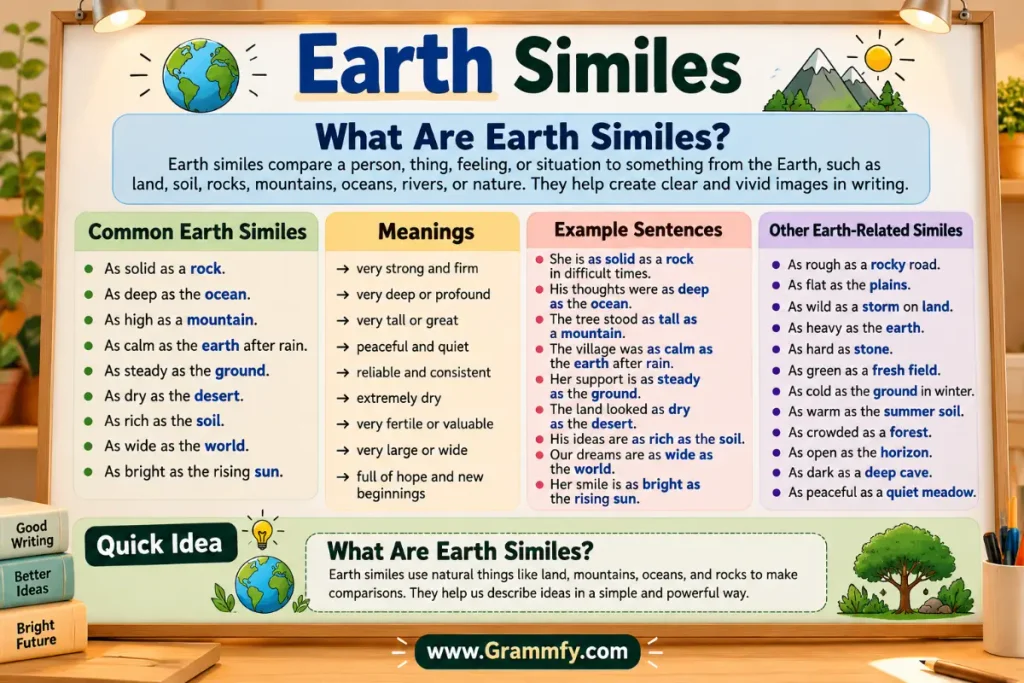
What Are Earth Similes?
Earth similes are comparisons that describe the planet Earth or its natural features by connecting them to something familiar. They use like or as to help readers imagine a shape, quality, feeling, or natural process.
Consider these examples:
- The Earth is like a giant blue marble. This describes its round shape and blue appearance when viewed from space.
- The soil is as rich as a treasure chest. This suggests that healthy soil contains valuable nutrients for plants.
- The Earth is like a caring mother. This presents the planet as a source of life and nourishment.
- The mountains stood like sleeping giants. This makes the landscape seem enormous and powerful.
A good simile does more than describe an object. It creates a mental picture and helps readers connect with the subject.
35+ Best Earth Similes With Meanings
These comparisons cover the planet’s appearance, natural beauty, strength, resources, and changing landscapes. Each example includes a meaning and a sentence to show how it works in context.
1. Similes About Earth’s Shape and Appearance
Our planet has a nearly spherical shape, blue oceans, and broad areas of land. These features make it easy to create vivid comparisons.
| Simile | Meaning | Example sentence |
|---|---|---|
| Like a giant blue marble | Round and blue when viewed from space | The Earth looked like a giant blue marble against the darkness. |
| As round as a ball | Describes its nearly spherical shape | The model showed the Earth as round as a ball. |
| Like a spinning top | Suggests rotation and movement | The Earth turned like a spinning top through space. |
| Like a blue jewel | Highlights beauty and color | Our planet shone like a blue jewel in the sunlight. |
| As colorful as a painter’s canvas | Refers to varied land, water, and vegetation | The Earth looked as colorful as a painter’s canvas from above. |
| Like a glowing lantern in the dark | Creates a striking image of the planet in space | In the illustration, Earth appeared like a glowing lantern in the dark. |
| As vast as an endless map | Emphasizes the planet’s enormous variety of places | The world seemed as vast as an endless map to the young traveler. |
Best choice: Use the blue marble comparison when describing Earth from space. Choose the painter’s canvas when you want to emphasize different landscapes, climates, and colors.
2. Similes About Earth’s Beauty and Nature
The natural world offers many images for describing Earth’s beauty. Mountains, forests, rivers, and flowers can help communicate wonder and peace.
| Simile | Meaning | Example sentence |
|---|---|---|
| Like a garden full of wonders | Suggests variety and natural beauty | The Earth is like a garden full of wonders waiting to be explored. |
| As beautiful as a painted landscape | Highlights the variety of natural scenery | The valley was as beautiful as a painted landscape. |
| Like a blanket of green | Describes broad areas of vegetation | Forests spread across the hills like a blanket of green. |
| As peaceful as a sleeping village | Suggests a calm and quiet landscape | The countryside looked as peaceful as a sleeping village at dawn. |
| Like a necklace of precious stones | Describes beautiful lakes or islands across a region | The lakes sparkled like a necklace of precious stones. |
| As lively as a festival | Suggests abundant activity and life | The rainforest was as lively as a festival filled with music. |
| Like a masterpiece painted by nature | Presents a landscape as a work of art | The mountain range looked like a masterpiece painted by nature. |
Best choice: Garden and masterpiece comparisons suit descriptive essays and poems. A lively festival works well when describing wildlife, birdsong, or a busy rainforest.
3. Similes About Earth’s Strength and Power
Earth’s landscapes can appear strong and unchanging, although the planet’s surface changes through erosion, earthquakes, volcanic activity, and other natural processes.
| Simile | Meaning | Example sentence |
|---|---|---|
| As solid as a rock | Suggests strength and firmness | The rocky ground felt as solid as a rock beneath our feet. |
| Like a giant fortress | Presents the land as strong and protective | The mountains surrounded the valley like a giant fortress. |
| As powerful as a raging ocean | Emphasizes the force of natural processes | The moving glacier seemed as powerful as a raging ocean. |
| Like a sleeping giant | Suggests hidden power beneath a calm surface | The volcano stood like a sleeping giant on the horizon. |
| As tough as ancient stone | Suggests endurance over time | The cliffs looked as tough as ancient stone. |
| Like a mighty shield | Suggests protection or shelter | The hills curved around the village like a mighty shield. |
| As enduring as an old mountain | Emphasizes long-lasting presence | The ancient landscape seemed as enduring as an old mountain. |
Best choice: Use the sleeping giant for a volcano or another feature that suggests hidden power. Choose ancient stone when describing age, endurance, or a weathered landscape.
4. Similes About Earth as a Source of Life
The Earth provides habitats, water, soil, and other conditions that support life. Comparisons can help explain this relationship in a simple and emotional way.
| Simile | Meaning | Example sentence |
|---|---|---|
| Like a caring mother | Suggests nourishment and support | The Earth is like a caring mother, providing resources that sustain life. |
| As generous as a fruit tree | Suggests that nature provides many useful resources | The fertile land was as generous as a fruit tree in harvest season. |
| Like a cradle for life | Describes a place where life can begin and grow | The Earth serves like a cradle for life. |
| As nurturing as a garden | Suggests support for growth | Healthy soil is as nurturing as a garden filled with compost. |
| Like a home shared by millions | Highlights the many forms of life on Earth | The planet is like a home shared by millions of species. |
| As essential as water to a seed | Emphasizes something necessary for growth | Clean soil is as essential as water to a seed. |
| Like a pantry filled with nature’s gifts | Suggests a store of useful resources | The forest seemed like a pantry filled with nature’s gifts. |
Best choice: The mother and cradle comparisons work well in reflective writing. For science assignments, explain the real processes behind the comparison, such as photosynthesis, nutrient cycling, and habitat support.
5. Similes About Earth’s Size and Diversity
The Earth contains deserts, rainforests, frozen regions, grasslands, oceans, and crowded cities. These comparisons can help readers imagine the scale and variety of the planet.
| Simile | Meaning | Example sentence |
|---|---|---|
| Like a book with endless chapters | Suggests many places and stories | The Earth is like a book with endless chapters to explore. |
| As diverse as a crowded marketplace | Highlights variety and activity | The world’s cultures are as diverse as a crowded marketplace. |
| Like a patchwork quilt | Describes different regions joined together | The landscape looked like a patchwork quilt of farms and forests. |
| As wide as an open horizon | Suggests a broad, seemingly limitless view | The plain stretched as wide as an open horizon. |
| Like a puzzle made of countless pieces | Shows how different places form one planet | The Earth is like a puzzle made of countless pieces. |
| As varied as a box of mixed colors | Highlights different natural features | The world’s landscapes are as varied as a box of mixed colors. |
| Like a stage for countless stories | Connects the planet to human and natural experiences | The Earth is like a stage for countless stories. |
Best choice: Use a patchwork quilt for a landscape with many different features. A book with endless chapters is especially useful when writing about travel, history, or the discovery of new places.
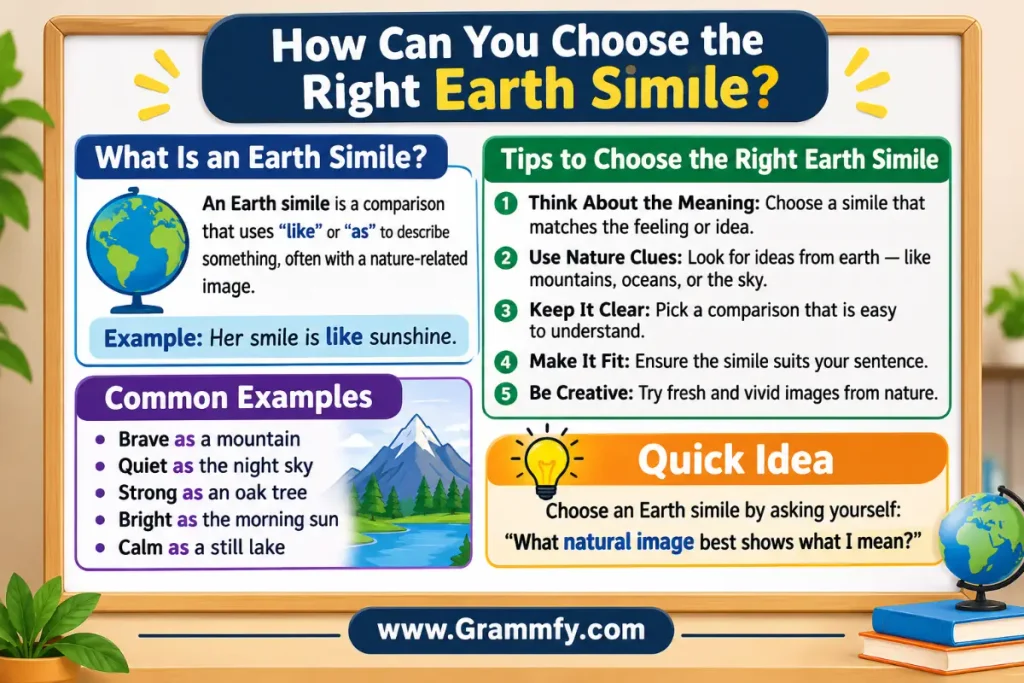
How Can You Choose the Right Earth Simile?
Start by deciding which feature of the planet you want readers to notice.
| Your main idea | Useful comparison | Why it works |
|---|---|---|
| Shape | A blue marble | Creates a clear picture of Earth’s round appearance. |
| Beauty | A masterpiece | Emphasizes the visual appeal of landscapes. |
| Strength | An ancient mountain | Suggests endurance and age. |
| Life | A cradle | Connects Earth with growth and living things. |
| Diversity | A patchwork quilt | Shows how different landscapes fit together. |
| Hidden power | A sleeping giant | Creates suspense or a sense of force. |
| Resources | A generous garden | Suggests nourishment and natural abundance. |
Before choosing, ask yourself:
- What is the main feature I want to describe?
- What familiar object has a similar quality?
- Does the comparison match the mood of my writing?
- Will my reader understand the connection immediately?
For example, if you’re describing the planet’s appearance from space, a blue marble is more precise than a sleeping giant. If you’re writing about a volcano, the sleeping giant creates a stronger impression of hidden power.
12 Original Earth Simile Sentences for Real-Life Situations
Use these examples as models for your own writing. Each one connects the planet or its natural features to a familiar object or experience.
- School science project: Our planet looks like a giant blue marble floating in the darkness of space.
- Nature essay: The green valley spread below us like a patchwork quilt sewn from forests, farms, and meadows.
- Poem about the environment: The Earth held life like a cradle holds a sleeping child.
- Travel journal: The mountain peaks rose like stone towers above the clouds.
- Story about a volcano: The volcano waited like a sleeping giant beneath the pale morning sky.
- Description of a forest: The trees stood as close together as books on a crowded shelf.
- Essay about fertile soil: The dark soil was as rich as a treasure chest for the growing plants.
- Description of an ocean: The blue sea stretched like a sheet of glass toward the distant horizon.
- Writing about biodiversity: The rainforest was like a busy city where thousands of living things shared the same space.
- A paragraph about Earth’s beauty: From the hilltop, the countryside looked like a painting filled with green, gold, and blue.
- A story about a desert: The sandy plain spread like a golden blanket beneath the burning sun.
- An environmental speech: Our planet is like a shared home, and every living thing depends on its health.
These sentences are starting points, not fixed formulas. Change the objects, settings, and details to fit your own topic.
What Is the Difference Between an Earth Simile and an Earth Metaphor?
A simile makes an explicit comparison using like or as. A metaphor describes one thing as another without those comparison words.
| Feature | Simile | Metaphor |
|---|---|---|
| How it works | Compares two things directly | Describes one thing as another |
| Common structure | Like or as | Direct statement |
| Example | Earth is like a blue marble. | Earth is a blue marble. |
| Main effect | Makes the comparison clear | Often creates a stronger, more direct image |
Both forms can make writing more vivid. A simile is often easier for young writers to recognize, while a metaphor can sound more direct and poetic.
For example:
- Simile: The Earth is like a giant garden.
- Metaphor: The Earth is a giant garden.
The first sentence highlights a resemblance. The second presents the image more directly, without suggesting that the planet is literally a garden.
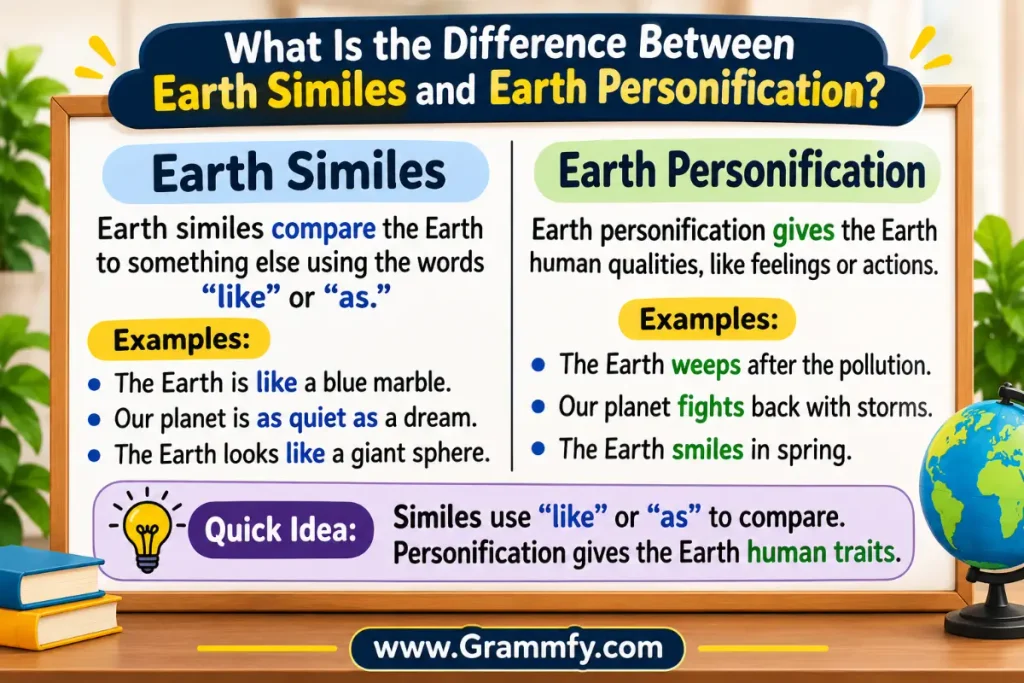
What Is the Difference Between Earth Similes and Earth Personification?
Personification gives human qualities or actions to something that isn’t human. Similes compare two things using like or as.
| Writing device | Example | Explanation |
|---|---|---|
| Simile | The Earth is like a generous mother. | Compares Earth with a mother. |
| Personification | The Earth welcomes the morning sun. | Gives Earth a human-like action. |
| Metaphor | The Earth is our mother. | Directly describes Earth as a mother. |
These techniques can appear together in creative writing. For example, “The Earth woke like a tired giant” uses personification in woke and a simile in like a tired giant.
What Are Common Mistakes When Using Earth Similes?
Creative comparisons are useful, but they should remain clear and accurate.
1. Confusing similes with metaphors
A simile uses like or as to compare two things. A metaphor makes a direct comparison.
- Simile: The Earth is like a blue marble.
- Metaphor: The Earth is a blue marble.
Both are correct, but they are different literary devices.
2. Choosing an unrelated comparison
A comparison should have a clear connection to the subject.
- Unclear: The Earth is like a pencil.
- Clearer: The Earth is like a blue marble floating in space.
The second example connects to the planet’s appearance.
3. Treating creative language as scientific fact
Saying the Earth is as solid as a rock can describe the feeling of standing on firm ground. However, the planet is not a single solid rock. It has several layers, and its surface changes over time.
In science writing, use similes to explain ideas, then provide accurate facts.
4. Using too many comparisons together
A sentence can become confusing when it compares Earth to several unrelated objects at once.
Instead of saying, “The Earth was a marble, a garden, a fortress, and a sleeping giant,” choose one image that fits the paragraph.
5. Repeating familiar images too often
Blue marbles, mothers, and gardens are useful comparisons, but repeating them throughout the same piece can make your writing predictable.
Try describing a specific feature instead. A river might look like a silver ribbon, while a field might resemble a patchwork quilt.
6. Forgetting the intended mood
A powerful image suits a dramatic paragraph, while a gentle comparison may work better in a peaceful nature poem.
Read the sentence aloud and check whether the image creates the feeling you want.
What Are the Antonyms of Earth Similes?
Earth similes don’t have direct antonyms because they are figures of speech rather than single descriptive words. However, you can contrast the ideas within them.
| Idea | Contrasting idea | Example |
|---|---|---|
| Fertile land | Barren land | The fertile valley contrasted with the barren desert. |
| Calm landscape | Turbulent landscape | The quiet meadow stood in contrast to the stormy coast. |
| Living environment | Lifeless environment | The thriving forest contrasted with the lifeless rocky plain. |
| Strong structure | Fragile structure | The mountain appeared sturdy beside the fragile sandcastle. |
| Abundance | Scarcity | The lush garden contrasted with the dry field. |
These contrasts can help you describe changes in weather, land, resources, or living conditions.
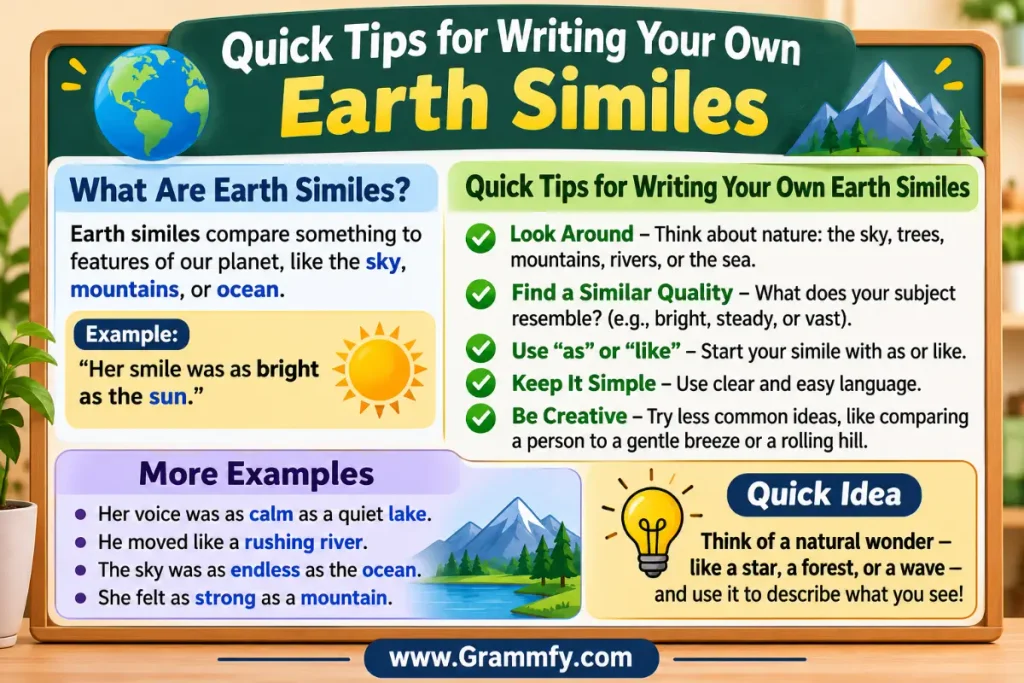
Quick Tips for Writing Your Own Earth Similes
- Focus on one feature. Choose shape, color, size, strength, or beauty.
- Use familiar objects. A marble, blanket, garden, or puzzle can make a complex idea easier to picture.
- Keep the comparison logical. Readers should understand why the two things are alike.
- Choose precise details. Describe a specific mountain, river, forest, or desert instead of relying only on general statements.
- Match the mood. A sleeping giant suggests power, while a peaceful garden suggests comfort.
- Avoid exaggeration when accuracy matters. In scientific writing, explain what the comparison represents.
- Vary your vocabulary. Don’t repeat the same comparison in every paragraph.
- Try different versions. Write two or three alternatives, then choose the clearest one.
- Consider your audience. Simple comparisons often work best for younger readers, while more original images may suit poetry.
- Use the comparison with purpose. A simile should improve the sentence, not merely make it longer.
One useful exercise is to look outside and choose a natural feature. Think of an object with a similar shape, color, movement, or feeling. Then connect the two using like or as.
For example, a winding river might resemble a ribbon, a mountain could look like a giant’s shoulder, and a field of flowers might appear like a colorful carpet. Each comparison helps readers picture a familiar scene in a fresh way.
Conclusion: Make Your Earth Descriptions More Vivid
The strongest Earth Similes help readers picture our planet’s appearance, understand its natural features, and connect with the beauty of the world around them. A blue marble can describe Earth’s shape, a patchwork quilt can show the variety of its landscapes, and a cradle can suggest its role in supporting life.
Choose comparisons that match your subject and purpose. For a school science assignment, keep the imagery clear and pair it with accurate facts. For poetry or storytelling, explore more imaginative descriptions that create emotion and atmosphere.
You don’t need complicated words to make a sentence memorable. Start with a familiar object, find a meaningful connection, and explain the image in a natural way. With practice, you’ll develop comparisons that make your writing clearer, more engaging, and more original.
Frequently Asked Questions
What are some examples of Earth similes?
Examples include “The Earth is like a giant blue marble” and “The mountains stood like sleeping giants.” These comparisons describe the planet’s appearance and the size of its natural features.
What is a simile for the beauty of Earth?
“The Earth is like a masterpiece painted by nature” is a useful simile for describing the planet’s beauty. It highlights the variety of colors and landscapes found around the world.
What is a simile for Earth in a poem?
“The Earth is like a cradle for life” works well in a poem about nature or the environment. It suggests that the planet provides conditions that allow living things to grow.
How do you write your own Earth simile?
Choose a feature of Earth, such as its shape, color, or strength, and compare it with something familiar using like or as. For example, “The river curved like a silver ribbon across the land.”
What is the difference between an Earth simile and a metaphor?
A simile compares Earth to something else using like or as, while a metaphor makes a direct comparison. “Earth is like a garden” is a simile, whereas “Earth is a garden” is a metaphor.
Can I use Earth similes in a school essay?
Yes, Earth similes can make descriptive and creative essays more engaging. In scientific writing, make sure the comparison supports the facts rather than replacing an accurate explanation.
What are some similes for Earth’s natural beauty?
You could describe a valley as “beautiful as a painted landscape” or a forest as “a blanket of green.” Both comparisons help readers imagine the colors and shapes of nature.

Tylerbrooks is a US-based English grammar writer and contributor at Grammfy. He writes helpful articles about grammar, spelling, commonly confused words, and vocabulary. His goal is to explain English topics in simple language with clear examples and practical tips. Through his articles, he helps readers improve their writing and everyday English skills.