
Have you ever tried to describe a short person, a tiny object, or a brief moment in a more interesting way? Maybe you’re writing a school essay, creating a story, or sending a funny text to a friend. A simple comparison can help readers picture exactly what you mean. That’s where similes come in handy.
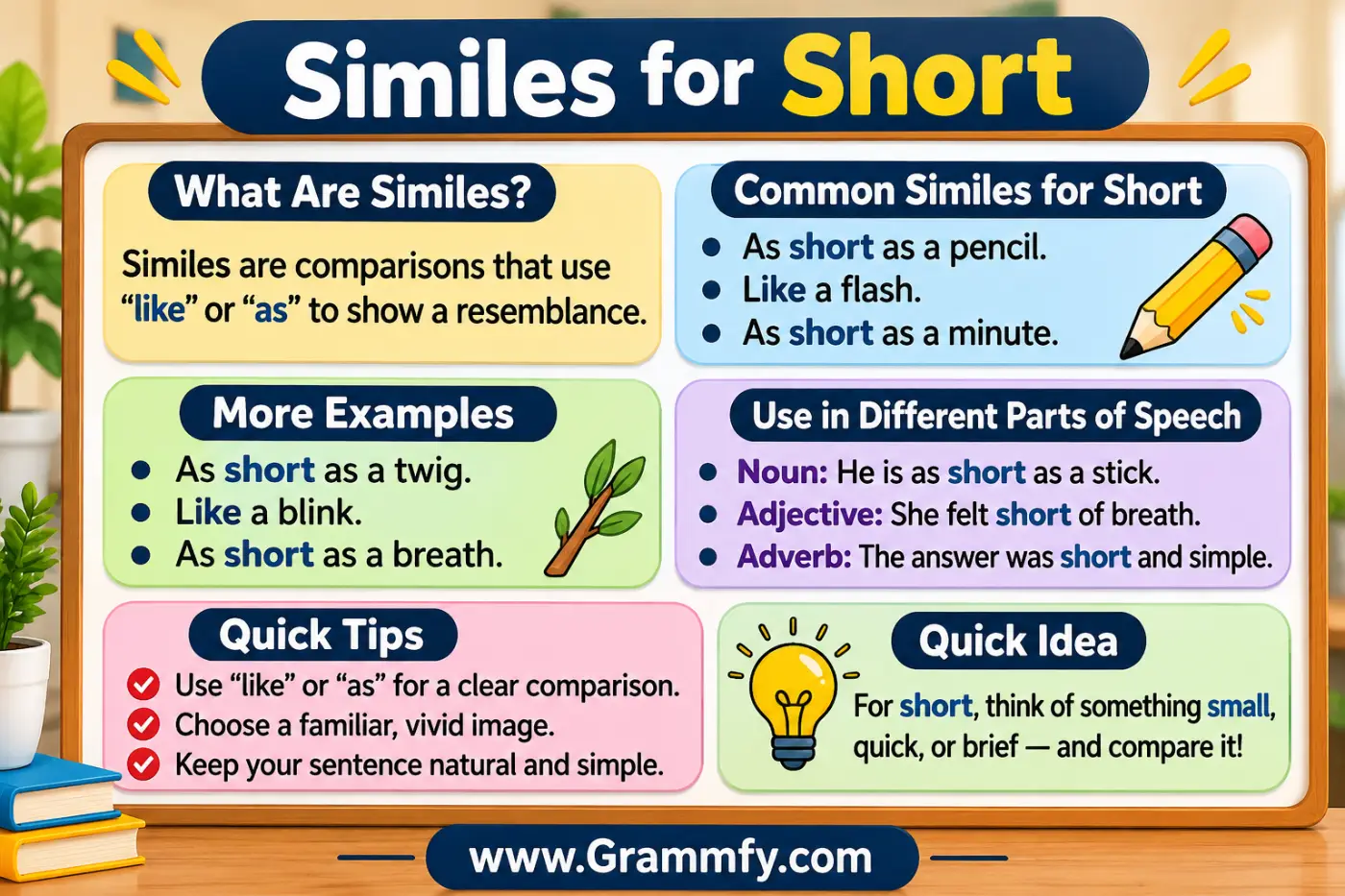
Similes for Short compare something small in height, length, size, or duration to something familiar. They use words such as like or as to create a clear picture. For example, “The pencil was as short as a stubby twig” helps readers imagine a small pencil without a long explanation.
The best simile depends on what you’re describing. A short person might be compared to a little sparrow, while a short pencil could resemble a tiny stick. A brief visit might be over as quickly as a blink. Each comparison creates a different feeling, from playful and friendly to serious and descriptive.
In this guide, you’ll find useful comparisons, simple meanings, examples for school and everyday writing, and tips for choosing the right expression. You’ll also learn how to avoid awkward comparisons and make your descriptions sound natural.
Need a more vivid way to describe calm similes? Explore our guide to creative calm similes similes and examples for fresh ideas and examples.
What Are Similes for Short?
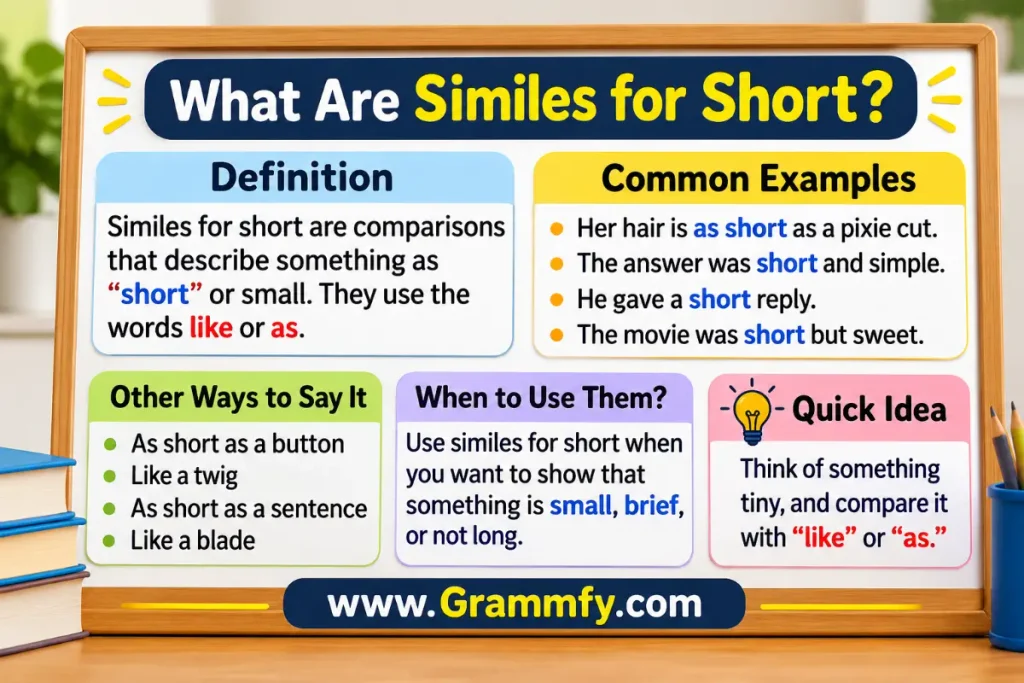
Similes for short are comparisons that describe something with little height, length, size, or duration by relating it to something familiar. They usually include like or as to help readers understand the intended meaning.
For example:
- As short as a pencil stub: Describes something with very little length.
- Like a tiny button: Suggests something small in size.
- As brief as a blink: Describes something that lasts only a moment.
- Like a little sparrow: Creates an image of a small person or creature.
These comparisons make ordinary descriptions more vivid. Instead of saying, “The meeting was short,” you might write, “The meeting was over as quickly as a blink.”
The second sentence gives the reader a stronger sense of how little time passed.
What makes a good simile for short?
A good simile connects the thing you’re describing with something readers can picture easily. It should make the intended meaning clear without forcing readers to guess.
Consider these three examples:
| Simile | What it describes | Effect |
|---|---|---|
| As short as a broken pencil | Length | Creates a concrete picture |
| Like a tiny sparrow | Height or size | Sounds gentle and friendly |
| As brief as a passing cloud | Duration | Suggests something that doesn’t last long |
Notice that each comparison focuses on a different meaning of short. That’s important because short height, short length, and short duration are not the same thing.
A comparison that works well for a short object may sound strange when used for a short amount of time.
What Does the Word Short Mean?
The word short has several related meanings. Understanding them helps you choose a simile that fits your sentence.
Short means having little height
When describing a person, animal, building, or plant, short can mean not tall.
Examples:
- The short child stood beside the tall basketball player.
- A short fence surrounded the garden.
- The little plant remained short despite receiving sunlight.
A simile can make these descriptions more vivid. For instance, “The little plant was as short as a garden gnome” creates a recognizable image.
Short means having little length
Something can be short because it doesn’t extend very far from one end to the other.
Examples include a short pencil, a short rope, a short road, and a short haircut.
You could write, “The pencil was as short as a matchstick.” This tells readers that very little pencil remained.
Short means lasting little time
The word can also describe something that ends quickly.
Examples include a short conversation, a short break, a short visit, or a short delay.
For instance, “Our conversation was as brief as a summer shower” suggests that the discussion ended quickly.
Short means limited in amount or extent
Sometimes short describes something that falls below what is needed or expected.
- We are short of time.
- The team finished a short list of tasks.
- The student gave a short answer.
These uses don’t always describe physical size. When writing a simile, identify the exact meaning first.
Where Does the Word Short Come From?
The English word short comes from Old English sceort, meaning short or not long. It has Germanic roots and is related to words in other Germanic languages that express a similar idea.
Over time, the word developed several common uses. It can describe physical dimensions, limited duration, insufficient amounts, and even direct communication.
For example, a short story is limited in length, while a short person has relatively little height. A short reply contains few words, and a short break lasts only a little time.
The word’s history helps explain why it works in so many different expressions. However, a simile doesn’t need to be historically complicated to be effective. The strongest comparisons often use familiar objects and experiences.
Consider “as short as a snapped twig.” Most readers can picture a small piece of wood immediately. That familiar image makes the comparison easy to understand.
What Are the Best Similes for Short?
Here are some original comparisons you can use in creative writing, school assignments, stories, and everyday conversation.
| Simile | Meaning | Best use |
|---|---|---|
| As short as a pencil stub | Very little length remains | Describing an object |
| Like a tiny sparrow | Small in size or height | Gentle character descriptions |
| As brief as a blink | Extremely short in time | Moments and events |
| Like a little button | Small and compact | Cute, playful descriptions |
| As short as a matchstick | Very limited length | Small objects |
| Like a miniature tree | Short compared with a larger version | Plants or decorative objects |
| As brief as a passing cloud | Doesn’t last long | Moments and experiences |
| Like a pocket-sized notebook | Small enough to carry easily | Products and objects |
| As short as a snapped twig | Shortened or broken in length | Physical descriptions |
| Like a tiny seedling | Small and not yet grown | Young plants or developing things |
| As brief as a quick wave | Over in a moment | Greetings and encounters |
| Like a little pebble | Small in size | Objects and scenery |
| As short as a child’s ruler | Limited in length | Classroom descriptions |
| Like a miniature house | Small compared with an ordinary house | Models and toys |
| As brief as a camera flash | Very quick | Sudden moments |
| Like a small button on a coat | Tiny in comparison with its surroundings | Visual descriptions |
| As short as a clipped thread | Very limited in length | Crafting and sewing |
| Like a tiny leaf | Small and delicate | Nature writing |
| As brief as a quick breath | Lasting very little time | Emotional or dramatic writing |
| Like a little acorn | Small but full of potential | Characters and ideas |
These are creative comparisons rather than fixed idioms. You can adapt them to suit your sentence, as long as the comparison remains clear.
Which similes work best for a short person?
When describing a person’s height, choose comparisons that fit the tone of your writing. Gentle images are usually better than comparisons that might embarrass someone.
Examples:
- She was as small as a sparrow beside her tall sister.
- The young boy stood like a little sapling among towering trees.
- He was as short as a garden gnome in the family photograph.
- The little girl looked like a tiny doll in her oversized coat.
- Beside the basketball players, he seemed as small as a field mouse.
These comparisons emphasize height or size. Be careful when using animal or toy comparisons for real people because they can sound insulting in the wrong situation.
For a friendly story, “She was as small as a sparrow” may sound affectionate. In a formal description, “She was shorter than most of her classmates” is more respectful and direct.
Which similes describe short objects?
Physical objects are often easier to describe with comparisons because their dimensions can be observed directly.
Try these examples:
- The pencil was as short as a matchstick.
- The rope looked like a clipped piece of string.
- The little ladder was as short as a child’s ruler.
- The broken branch resembled a snapped twig.
- The notebook was like a pocket-sized diary.
These expressions work well when the reader needs to picture an object’s size or length.
Which similes describe a short time?
When short refers to time, use comparisons associated with speed or brief experiences.
Examples:
- The holiday ended as quickly as a blink.
- Their conversation was as brief as a quick wave.
- The pause lasted like a single heartbeat.
- The announcement was over as quickly as a camera flash.
- The wait felt as short as one deep breath.
These expressions can make a scene feel fast, surprising, or emotionally intense.
What Words Can Replace Short?
There are many alternatives to short, but each has a slightly different meaning. Some describe physical dimensions, while others refer to time, writing, or quantity.
The following master list groups more than 30 useful alternatives by tone and context.
Simple words for short
These words are easy to understand and work well in school writing.
| Word | Meaning | Tone | Example |
|---|---|---|---|
| Small | Limited in size | Neutral | The small box fit in my bag. |
| Little | Small in size or amount | Friendly | A little bird landed nearby. |
| Tiny | Extremely small | Informal | A tiny seed lay on the soil. |
| Brief | Lasting a short time | Neutral | We had a brief meeting. |
| Shortened | Made shorter | Neutral | The teacher gave us a shortened lesson. |
| Mini | A smaller version | Informal | She carried a mini umbrella. |
| Petite | Small and delicately built | Descriptive | The petite vase sat on the shelf. |
| Low | Not high | Neutral | A low wall surrounded the yard. |
These words are not interchangeable in every sentence. Tiny usually describes size, while brief describes duration. Low refers to height or level rather than length.
Everyday words for short
These words fit conversations, emails, stories, and general descriptions.
| Word | Meaning | Tone | Example |
|---|---|---|---|
| Compact | Small but efficiently arranged | Positive | The compact camera fit in my pocket. |
| Little-sized | Small in size; less common than small | Informal | The small-sized cup held less coffee. |
| Miniature | A very small version of something | Descriptive | The miniature train ran around the tree. |
| Stubby | Short and thick | Informal | A stubby pencil lay on the desk. |
| Truncated | Cut off or shortened | Technical | The truncated sentence lacked an ending. |
| Concise | Short but clear and complete | Positive | Her concise reply answered every question. |
| Quick | Taking little time | Everyday | We took a quick walk. |
| Fleeting | Lasting only briefly | Expressive | A fleeting smile crossed his face. |
| Momentary | Lasting for a moment | Neutral | There was a momentary pause. |
Notice the difference between concise and truncated. A concise answer includes the important information in few words. A truncated answer may be incomplete because something has been cut off.
Formal words for short
Use these words when precision matters, especially in essays, reports, business writing, or technical descriptions.
| Word | Meaning | Tone | Example |
|---|---|---|---|
| Concise | Expressed clearly in few words | Formal | The report provides a concise summary. |
| Succinct | Brief and direct | Formal | Her succinct explanation solved the problem. |
| Limited | Restricted in size, amount, or extent | Neutral/formal | We had limited time for discussion. |
| Abbreviated | Shortened from a fuller version | Formal | The book includes an abbreviated edition. |
| Condensed | Made shorter by removing or combining material | Formal | The article offers a condensed overview. |
| Abridged | Shortened while retaining selected material | Formal | Students read an abridged novel. |
| Curt | Brief and possibly rude | Formal | His curt reply ended the conversation. |
| Transient | Lasting for a short time | Formal | The effect was transient. |
| Ephemeral | Lasting for a very short time | Literary/formal | The beauty of the blossom was ephemeral. |
| Diminutive | Very small in size or stature | Formal | A diminutive figure stood in the doorway. |
Some formal alternatives describe writing rather than physical size. Abridged, condensed, and abbreviated generally suggest that a longer version has been shortened.
Informal and slang alternatives for short
These expressions are useful in casual conversation, but some may sound unsuitable in formal writing.
| Word or phrase | Meaning | Tone | Example |
|---|---|---|---|
| Stubby | Short and thick | Informal | I used a stubby pencil. |
| Bite-sized | Small enough to manage easily | Casual | The course breaks lessons into bite-sized parts. |
| Mini | A smaller version | Casual | She bought a mini notebook. |
| Pocket-sized | Small enough to fit in a pocket | Casual | He carried a pocket-sized guide. |
| Quickie | Something done in a short time; context-dependent | Very informal | We had a quickie meeting before lunch. |
| Tiny little | Very small, with emphasis | Conversational | A tiny little flower grew between the stones. |
| Short and sweet | Brief but pleasant or effective | Idiomatic | Keep your thank-you speech short and sweet. |
| In a flash | Very quickly | Idiomatic | The break was over in a flash. |
Use slang only when it fits your audience. For example, quickie can have meanings beyond a brief task, so quick meeting is usually clearer in workplace communication.
What Are Synonyms for Short From Mild to Strong?
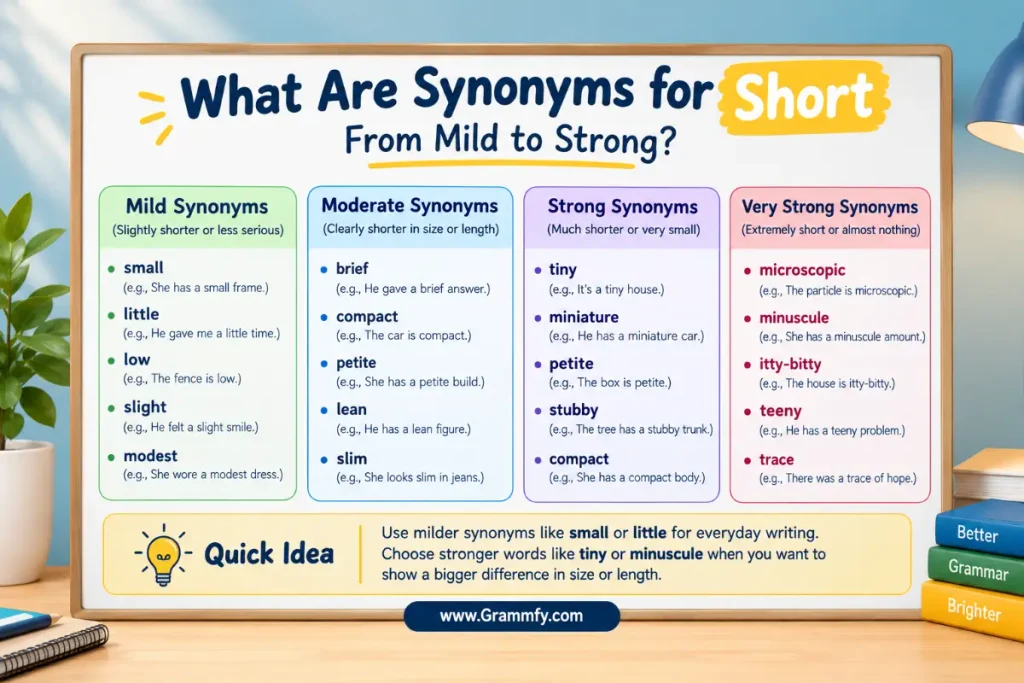
The right word depends on how small or brief something is. A mild word suggests a modest difference, while a stronger word suggests an extreme difference.
Mild alternatives
Use these when something is somewhat shorter or smaller than usual.
- Small
- Little
- Compact
- Limited
- Brief
- Concise
Example: “We had a brief discussion before class.”
The word brief communicates that the discussion was short without suggesting that it ended instantly.
Moderate alternatives
These words suggest a noticeable lack of size, length, or duration.
- Tiny
- Stubby
- Miniature
- Fleeting
- Momentary
- Abbreviated
Example: “The tiny pencil barely reached the bottom of my pencil case.”
Here, tiny suggests a stronger degree of smallness than small.
Strong alternatives
These words emphasize extreme size differences, very brief duration, or a sharply reduced length.
- Minuscule
- Microscopic
- Extremely brief
- Split-second
- Truncated
- Ephemeral
Example: “The opportunity lasted for a split second.”
Microscopic usually describes something so small that it may require a microscope to see clearly. Don’t use it for an ordinary small object unless you intend to exaggerate.
How do you choose the right intensity?
Ask yourself what the reader needs to understand.
| Intended meaning | Good choice | Why |
|---|---|---|
| A little shorter than expected | Slightly shorter | Precise and neutral |
| Small enough to carry | Compact | Suggests convenient size |
| Very small | Tiny or minuscule | Emphasizes size |
| Short but complete writing | Concise | Suggests clarity and efficiency |
| Short and incomplete writing | Truncated | Signals that content was cut off |
| Lasting only a moment | Momentary | Describes duration |
| Lasting briefly and disappearing | Fleeting | Suggests something passing quickly |
A strong word isn’t automatically better. Choose the one that communicates the intended meaning without exaggeration.
What Are Similes for Short by Part of Speech?
The word short can function as an adjective, while shorten is a verb and shortness is a noun. Related words can help you create more precise descriptions.
Adjectives that describe shortness
Adjectives describe people, objects, experiences, and ideas.
Examples include:
- Tiny
- Small
- Brief
- Compact
- Concise
- Stubby
- Petite
- Fleeting
- Truncated
- Diminutive
Example: “The compact desk fit neatly into the corner.”
For a simile, you can add a familiar comparison: “The compact desk was like a little box beside the large conference table.”
Verbs that express becoming shorter
Verbs describe actions or changes.
| Verb | Meaning | Example |
|---|---|---|
| Shorten | Make something shorter | We shortened the presentation. |
| Reduce | Make smaller in size or amount | The editor reduced the article’s length. |
| Trim | Remove a small amount | She trimmed the paragraph. |
| Condense | Make more compact | He condensed the report into one page. |
| Abbreviate | Use a shorter form | We abbreviated the title. |
| Cut | Remove part of something | The editor cut the final section. |
These verbs help you explain what happened rather than simply describing the result.
Nouns that describe shortness
Nouns name qualities, states, or results.
- Brevity: the quality of being brief.
- Conciseness: the quality of expressing something clearly in few words.
- Shortness: limited length, height, or duration.
- Reduction: a decrease in size, amount, or length.
- Abbreviation: a shortened form of a word or expression.
- Condensation: a shortened or more compact version.
Example: “The brevity of her speech made it easy to remember.”
You can also use figurative language: “The speech passed like a summer breeze.”
Are There Differences Between US and UK English?
The main meanings of short and most common alternatives are the same in American and British English. However, spelling, vocabulary, and everyday usage can differ by region.
| Word or phrase | US English | UK English | Note |
|---|---|---|---|
| Short | Common | Common | Same general meanings |
| Tiny | Common | Common | Widely understood |
| Brief | Common | Common | Often used for time or writing |
| Petite | Common | Common | Often describes a small body frame |
| Miniature | Common | Common | Used for small versions of objects |
| Concise | Common | Common | Used in formal and everyday writing |
| Pocket-sized | Common | Common | Also written pocket-sized in both |
| Short trousers | Less common for this meaning | Common in some contexts | Americans usually say shorts for the clothing item |
A simile such as “as brief as a blink” will be understood by readers in both countries. There’s no need to create separate versions unless your article targets a regional audience or uses region-specific expressions.
Which spelling differences should you know?
Some related words have different spellings in American and British English. For example:
- Color / colour: American English generally uses color, while British English uses colour.
- Organize / organise: Both spellings are used regionally, with organize common in the US and organise common in British usage.
- Center / centre: American English uses center, while British English generally uses centre.
These spelling differences don’t change the meaning of short or the way similes work. They matter when your writing needs to follow a consistent style guide.
Which Simile for Short Works Best in Different Situations?
The same comparison doesn’t fit every type of writing. A playful simile may work in a story but feel out of place in a resume or business email.
What simile should you use in a resume?
In a resume, clear and professional wording is usually better than a decorative simile. Employers want to understand your skills, achievements, and experience quickly.
Instead of writing:
“My presentation was as short as a blink.”
Write:
“I delivered a concise presentation covering the team’s key results.”
The second sentence explains the benefit of the short presentation. It also sounds professional.
If you want a figurative comparison in a personal statement, use one sparingly and make sure it supports the point.
Example:
“My approach to reporting is like a well-edited summary: clear, focused, and free of unnecessary detail.”
This comparison emphasizes efficiency without making the resume sound childish.
What simile works best in an essay?
In an essay, choose a comparison that supports the topic and helps explain an idea.
Example:
“The pause between the two speeches was as brief as a blink, leaving the audience little time to react.”
This simile emphasizes how quickly the event moved.
For an academic essay, avoid overusing playful expressions. A direct sentence may be better when discussing evidence, history, or scientific facts.
Tip: Use a simile to clarify a point, not to replace evidence.
What simile should you use in a text message?
Text messages often allow humor, exaggeration, and casual expressions.
Examples:
- “That break was over in a flash!”
- “My pencil is shorter than a matchstick now.”
- “The meeting was as brief as a blink.”
- “Your visit was short and sweet!”
These expressions sound natural in friendly conversations. They also make a message more vivid without requiring a long explanation.
What simile works best in an email?
In a work email, use a comparison only when it adds clarity or a friendly tone.
For example:
“The update is short and sweet, with the main changes listed below.”
This common expression suggests that the update is brief and effective.
For a formal email, you might write:
“I’ve prepared a concise summary for your review.”
The direct version is usually better for important instructions, deadlines, and business decisions.
What simile works best in speaking?
Spoken language benefits from familiar, easy-to-picture comparisons.
Examples:
- “The wait was over in a flash.”
- “He gave a short answer, like a quick nod.”
- “The little house looked like a toy beside the tall buildings.”
- “The break was as brief as one song.”
When speaking, consider how quickly listeners can understand the comparison. Avoid unusual words if you want the message to feel natural.
What simile should you use in a poem?
Poetry allows more imaginative comparisons. You can connect shortness with nature, emotions, movement, or sound.
Examples:
- “The moment faded like mist at sunrise.”
- “Her short shadow rested like a folded ribbon.”
- “The little branch reached like a finger toward the sky.”
- “The brief goodbye vanished like a note in the wind.”
Poetic similes can suggest more than physical dimensions. They can also create mood, symbolism, and emotion.
What simile works best in a children’s story?
Children’s stories often benefit from comparisons involving familiar objects, animals, and playful scenes.
Examples:
- The tiny rabbit was as small as a mitten.
- The little boat looked like a toy in the pond.
- The short pencil was like a tiny wooden wand.
- The visit ended as quickly as a magic trick.
Keep the image easy to understand. A child should be able to picture the comparison without needing to look up a difficult word.
What Are 12 Original Examples of Similes for Short?
Here are examples across everyday life, school, work, nature, and creative writing. Each sentence shows how a comparison can fit naturally into a real situation.
1. A short pencil in the classroom
“The pencil was as short as a matchstick, but Mia kept using it to finish her drawing.”
Why it works: The matchstick gives readers a familiar reference for the pencil’s limited length.
2. A short school break
“Our break was over as quickly as a blink, and the bell was already ringing.”
Why it works: The comparison emphasizes how quickly the break ended.
3. A short person in a crowd
“Beside the tall parade performers, the little drummer looked like a tiny sparrow.”
Why it works: The contrast makes the drummer’s size more noticeable.
4. A short conversation
“Their conversation was as brief as a passing cloud before both friends returned to work.”
Why it works: The image suggests a short exchange that quickly passes.
5. A small garden plant
“The seedling looked like a miniature tree standing alone in the wide garden bed.”
Why it works: The comparison helps readers picture the plant’s small size in a larger space.
6. A short speech
“His speech was short and sweet, like a carefully wrapped gift that needed no extra decoration.”
Why it works: The comparison suggests that the speech was brief but thoughtful.
7. A quick visit
“Grandma’s visit felt as brief as a quick wave from the train window.”
Why it works: The image conveys a warm encounter that ended too soon.
8. A short story
“The story was like a pocket-sized adventure, full of excitement despite its few pages.”
Why it works: The comparison links the story’s limited length to the idea of something compact and complete.
9. A short road
“The narrow path was as short as a garden walkway, ending just beyond the old gate.”
Why it works: The familiar setting gives readers a sense of limited distance.
10. A brief moment of happiness
“Her smile appeared like a flash of sunlight between the clouds.”
Why it works: The comparison describes a moment that appeared quickly and didn’t last long.
11. A short meeting at work
“The morning meeting was over in a flash, leaving everyone time to finish their reports.”
Why it works: The expression emphasizes speed while keeping the sentence suitable for everyday workplace conversation.
12. A tiny object on a desk
“The button looked like a little pebble beside the thick stack of notebooks.”
Why it works: The contrast with the notebooks makes the button’s size more noticeable.
These examples demonstrate an important principle: the best simile doesn’t need to be complicated. A familiar comparison can be more effective than an elaborate image that distracts from the main idea.
What Is the Difference Between Short, Small, and Tiny?
These words overlap, but they don’t always mean the same thing.
| Word | Main meaning | Example |
|---|---|---|
| Short | Limited in height, length, or duration | The short ladder reached only halfway up the wall. |
| Small | Limited in overall size or amount | The small box held three pencils. |
| Tiny | Extremely small | A tiny insect sat on the leaf. |
Choose short when you’re talking about height, length, or duration. Use small for general size and tiny when you want to show that something is very small.
Compare these sentences:
- “The book is short.” This usually means it has few pages or little text.
- “The book is small.” This usually means its physical dimensions are limited.
- “The book is tiny.” This emphasizes that its physical size is unusually small.
A book can be short but physically large, or small but very long in content. Context determines the intended meaning.
Short vs. brief: What’s the difference?
Short is a general word for limited length, height, or duration. Brief usually emphasizes limited time or a small amount of communication.
| Short | Brief |
|---|---|
| A short fence | Not usually replaced by brief |
| A short meeting | A brief meeting |
| A short answer | A brief answer |
| A short pencil | Not usually replaced by brief |
| A short visit | A brief visit |
You can say, “The meeting was short” or “The meeting was brief.” Both are correct. However, “The pencil was brief” doesn’t work because a pencil has physical length rather than duration.
Short vs. concise: What’s the difference?
Short describes limited length or duration. Concise describes communication that expresses an idea clearly in few words.
A short explanation may leave out important details. A concise explanation keeps the important details while avoiding unnecessary words.
Compare:
- Short: “The answer was only two words.”
- Concise: “Her answer explained the cause and solution in two clear sentences.”
The second example emphasizes clarity, not just length.
If you’re writing an essay, email, or report, concise is often the stronger word when you mean that a response is both brief and effective.
Short vs. tiny: What’s the difference?
Short focuses on height, length, or duration. Tiny emphasizes a very small overall size.
Examples:
- The short ruler measured only six inches.
- The tiny bead was difficult to pick up.
- The short visit lasted ten minutes.
- The tiny bead looked like a speck of dust.
A bead can be tiny without being short in the usual sense. A visit can be short because it lasts little time, but calling it tiny would usually sound unnatural.
What Are Common Mistakes When Using Similes for Short?
Similes work best when the comparison makes sense and fits the sentence. Avoid these common mistakes.
Mistake 1: Comparing the wrong qualities
A simile should connect the intended quality with a relevant image.
Awkward: “The short meeting was like a tiny button.”
Better: “The meeting was over as quickly as a blink.”
A button suggests physical size, not duration. The blink creates a clearer time comparison.
Mistake 2: Using a comparison that exaggerates too much
Exaggeration can be funny, but it may confuse readers when accuracy matters.
Awkward in a factual report: “The building was as tiny as a grain of sand.”
Better: “The building was much shorter than the neighboring tower.”
Save extreme exaggeration for humor, fantasy, or clearly figurative writing.
Mistake 3: Confusing a simile with a metaphor
A simile generally uses like or as to compare two things.
- Simile: The speech was as brief as a blink.
- Metaphor: The speech was a blink.
The metaphor states the comparison directly. Both can work, but they create different effects.
Mistake 4: Forgetting the grammar of “as … as”
A common simile pattern uses an adjective between two instances of as.
Correct: “The pencil was as short as a matchstick.”
Incorrect: “The pencil was as short like a matchstick.”
Choose either as … as or a like comparison:
- The pencil was as short as a matchstick.
- The pencil was like a tiny wooden stick.
Don’t combine the two patterns unnecessarily.
Mistake 5: Using formal words in casual conversations
Words such as ephemeral, diminutive, and truncated are useful in the right setting, but they may sound unnatural in a casual text.
Instead of “Our conversation was ephemeral,” try “Our conversation was over in a flash.”
Use advanced vocabulary when it improves accuracy or tone, not just to make a sentence sound impressive.
Mistake 6: Repeating the same comparison
Using “as brief as a blink” several times can make an article or story feel repetitive.
Try changing the image when the context allows it:
- As brief as a blink
- Over in a flash
- Gone in a heartbeat
- As quick as a passing shadow
These alternatives have slightly different meanings, so choose carefully.
Mistake 7: Making fun of someone’s height
Comparisons involving tiny animals, toys, or objects can sound unkind when used to describe real people.
If you’re writing a respectful description, consider neutral language:
- She is shorter than her teammates.
- He has a compact build.
- The child is small for his age.
A playful simile may suit a fictional character, but it should not be used to embarrass someone.
Mistake 8: Treating every synonym as interchangeable
Words such as brief, concise, compact, and stubby describe different qualities.
- Brief usually refers to time or communication.
- Concise refers to clear communication with few words.
- Compact suggests efficient arrangement or small dimensions.
- Stubby describes something short and thick.
Choose the word that matches the object or situation.
What Are the Antonyms of Short?
Antonyms help you understand a word by showing the opposite meaning. The best opposite of short depends on how the word is being used.
| Antonym | Meaning | Example |
|---|---|---|
| Tall | Having greater height | The tall tree shaded the yard. |
| Long | Having greater length or duration | We took a long walk. |
| Lengthy | Taking a lot of time or using many words | The lengthy report covered every detail. |
| Extended | Made longer or continuing for more time | The class received an extended break. |
| Prolonged | Lasting longer than usual | The prolonged meeting delayed lunch. |
| Extensive | Covering a large amount or range | The team completed extensive research. |
| Detailed | Including many specific facts | The report provided a detailed explanation. |
Notice that tall is generally an opposite of short when height is involved, while long is the usual opposite when length or duration is involved.
For example, a person can be short rather than tall, a road can be short rather than long, and a meeting can be brief rather than prolonged.
How Can You Choose the Right Simile for Short?
Choosing the right comparison becomes easier when you follow a few simple steps.
1. Identify what is short
First, decide whether you’re describing height, length, time, writing, or quantity.
- Person: height
- Pencil: length
- Meeting: duration
- Email: amount of text
- Budget: available amount
This step prevents mismatched comparisons.
2. Choose an image readers recognize
Familiar objects and experiences make similes easy to understand.
Think of a matchstick or pencil stub to describe length. For time, use examples like a blink or a flash. To show small size, compare it to a button, seed, or pebble.
The image should help readers picture the quality you’re describing.
3. Match the tone to your audience
A playful story can use imaginative comparisons. A school essay may need a clearer, more restrained image. A professional email usually benefits from direct language.
For example:
- Playful: The pencil was as short as a mouse’s whisker.
- Neutral: The pencil was about two inches long.
- Professional: The summary was concise and easy to review.
The best choice depends on what the sentence needs to accomplish.
4. Avoid unnecessary words
A simile should make your sentence clearer, not bury the meaning.
Wordy: “The meeting was extremely short in a way that was similar to how a blink happens very quickly.”
Better: “The meeting was over as quickly as a blink.”
The second sentence delivers the image immediately.
5. Read the sentence aloud
If a comparison sounds awkward when spoken, try a simpler one.
For example, “The report was as short as a tiny seed” doesn’t clearly connect the report’s length with the seed’s size.
A better sentence is: “The report was brief enough to read during a coffee break.”
That version uses an everyday situation to show how little time the report requires.
6. Check whether the comparison adds meaning
Not every sentence needs a simile. Sometimes a direct description is stronger.
Compare:
- “The meeting lasted five minutes.”
- “The meeting was over in a flash.”
The first gives an exact duration. The second emphasizes how quickly the meeting seemed to pass.
Use the first when precision matters and the second when you want to create a feeling.
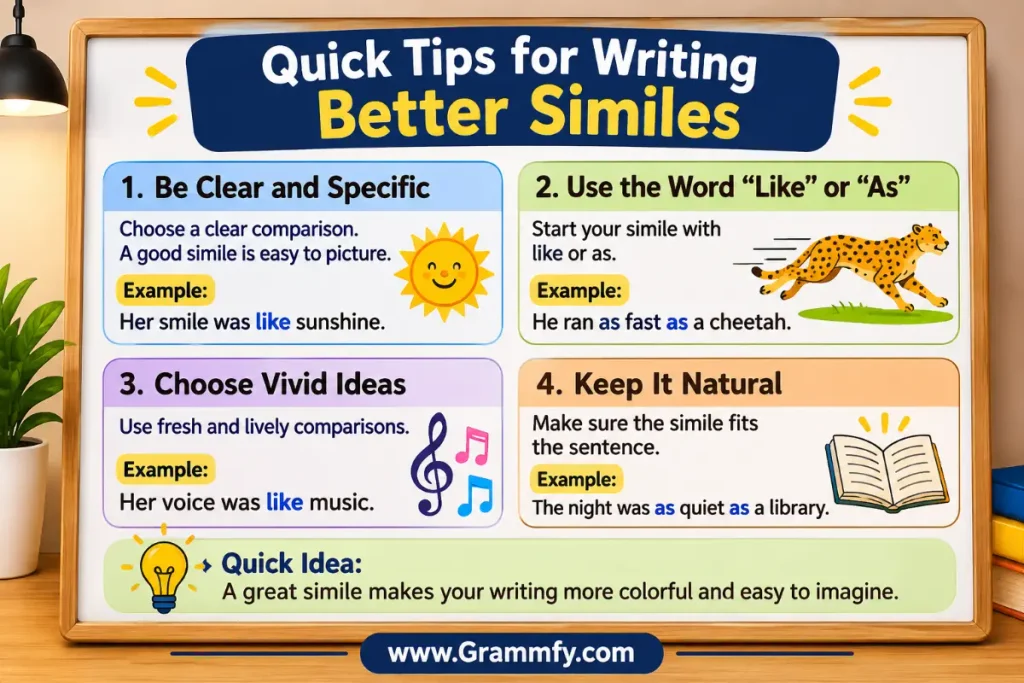
Quick Tips for Writing Better Similes
Keep these practical tips in mind:
- Be specific: Choose an image that matches the quality you want to describe.
- Keep it natural: Familiar comparisons are often easier to understand.
- Use variety: Avoid repeating the same simile throughout a story or article.
- Respect your audience: A joke about height may not be suitable for every situation.
- Prefer clarity: Don’t use an obscure comparison when a simple one works.
- Check the grammar: Use “as short as” or a natural “like” comparison.
- Match the tone: Formal reports usually need precise wording, while stories allow more imagination.
- Don’t force a simile: Direct language is sometimes the best choice.
- Use contrast carefully: Comparing a tiny object with a large one can emphasize size, but the difference should be clear.
- Read your sentence aloud: A natural rhythm often makes a comparison more effective.
A useful final test is to ask, “Would a reader understand this comparison immediately?” If the answer is yes, the simile is probably doing its job.
Conclusion:
The right comparison can turn an ordinary sentence into something readers remember. Whether you’re describing a small object, a person of short stature, or a moment that passes quickly, choose an image that matches the meaning you want to express.
The best Similes for Short are clear, familiar, and suited to the situation. A pencil stub can show limited length, a tiny sparrow can suggest small size, and a blink can represent a brief moment. Each image serves a different purpose.
Remember that a simile should improve your writing rather than make it harder to understand. Use playful comparisons in stories, gentle language when describing people, and precise wording in professional documents. You don’t need an elaborate expression to make an impact. Sometimes, one simple comparison is enough to help a reader see exactly what you mean.
Frequently Asked Questions
What is a simile for short?
A simile for short compares something with limited height, length, size, or duration to a familiar object or experience. For example, “The meeting was as brief as a blink” describes something that ended quickly.
What are some examples of similes for short?
Examples include “as short as a pencil stub,” “like a tiny sparrow,” “as brief as a blink,” and “like a little button.” Choose the example that matches whether you’re describing length, height, size, or time.
What’s another way to say something is very short?
You can say tiny, brief, compact, minuscule, or momentary, depending on the context. Use minuscule for extremely small size and momentary for something that lasts only a moment.
What is a good simile for a short person?
“Like a little sparrow” can describe a short person in a gentle, imaginative way. However, a direct description such as “shorter than her classmates” is often more respectful when discussing a real person.
What is the difference between a short simile and a metaphor?
A simile makes a comparison using words such as like or as, while a metaphor describes one thing as another. For example, “The moment was as brief as a blink” is a simile, while “The moment was a blink” is a metaphor.
How do I describe a short amount of time creatively?
You can use phrases such as “over in a flash,” “as brief as a blink,” or “gone in a heartbeat.” Each expression suggests that an event ended quickly, though the exact feeling depends on the context.
Can I use similes for short in a formal essay?
Yes, but choose comparisons that support your point and fit the subject. In academic writing, a phrase such as “as brief as a blink” can add emphasis, while precise wording is usually better when you need to present facts or evidence.

Tylerbrooks is a US-based English grammar writer and contributor at Grammfy. He writes helpful articles about grammar, spelling, commonly confused words, and vocabulary. His goal is to explain English topics in simple language with clear examples and practical tips. Through his articles, he helps readers improve their writing and everyday English skills.