
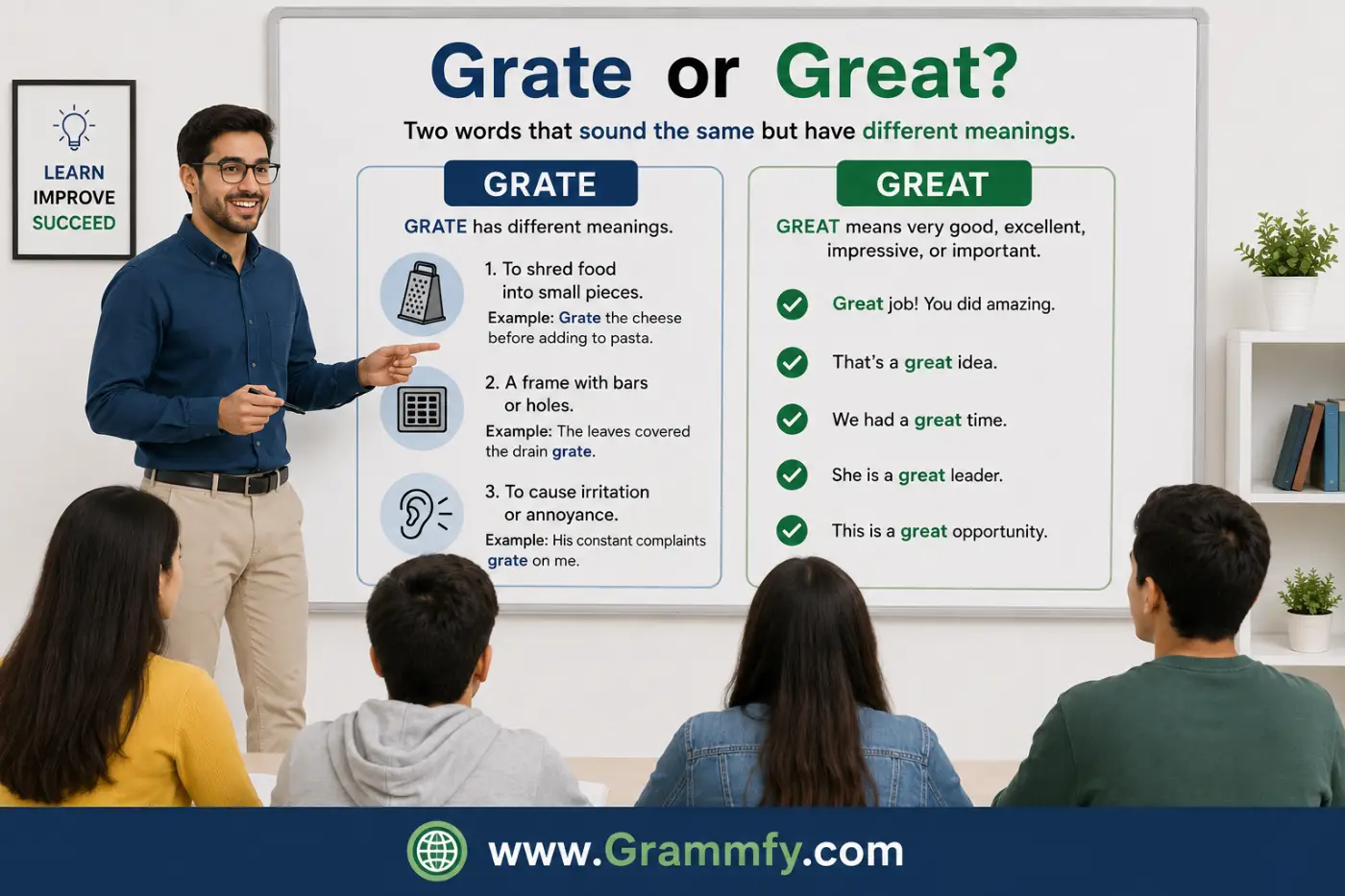
If you’re writing an email, essay, resume, or quick text, you may stop and wonder: grate or great? These two words sound almost the same, but they have completely different meanings. Choosing the wrong one can make your sentence confusing or even funny.
Great is one of the most common English words for something excellent, impressive, important, large in degree, or very enjoyable. Grate usually refers to a frame with openings, a kitchen tool used for shredding food, or the verb meaning to scrape or annoy.
Answer: Use great when you mean excellent, wonderful, impressive, or very good. Use grate when you mean a metal frame, a shredding tool, or the action of scraping or irritating.
In this guide, you’ll learn the difference between these words, where they came from, how to use them in real situations, which synonyms fit different levels of intensity, and the mistakes to avoid. You’ll also see examples for texting, school writing, resumes, emails, and everyday speech.
For another common word-choice problem, see [flaunt vs flout].
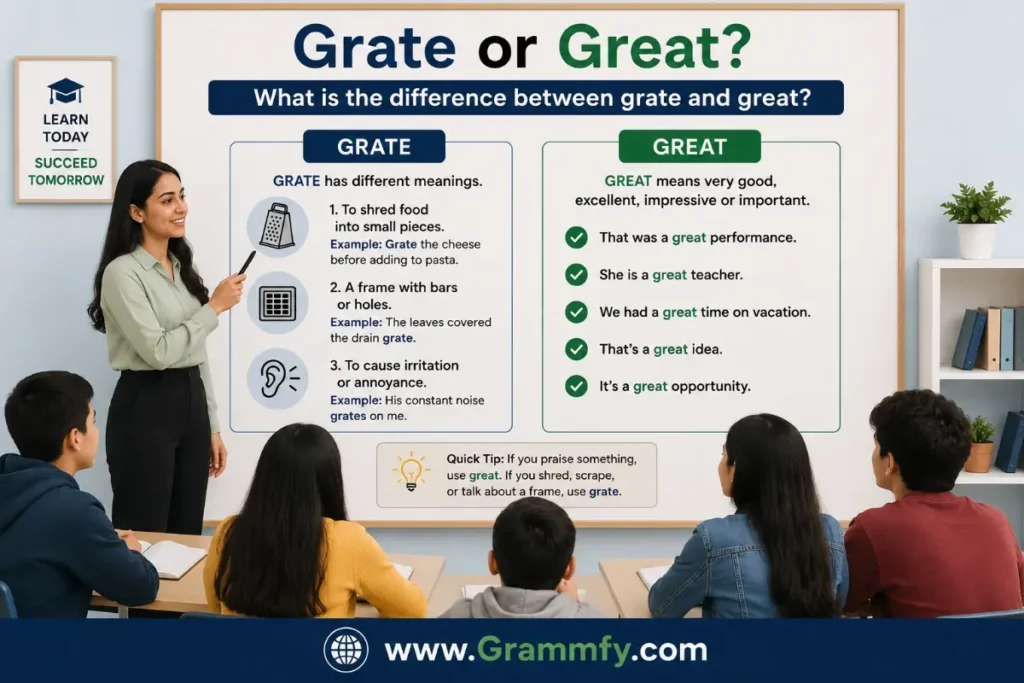
What is the difference between grate and great?
The easiest way to remember the difference is to focus on meaning rather than pronunciation.
| Word | Main meaning | Example |
|---|---|---|
| Great | Excellent, wonderful, impressive, or very good | You did a great job. |
| Grate | A frame, a shredding tool, or to scrape/annoy | Please grate the cheese. |
Great is normally an adjective. It describes a person, thing, experience, result, or quality.
- She is a great teacher.
- That was a great movie.
- You have a great idea.
- We had a great time.
Grate has several meanings. As a noun, it can be a metal or wooden frame with openings.
- The fireplace has an iron grate.
- Leaves covered the drain grate.
As a verb, grate can mean to shred food into small pieces.
- Grate the cheese over the pasta.
- I need to grate some carrots.
It can also mean to irritate someone.
- His loud voice began to grate on me.
- The constant noise really grated on everyone.
So, if you’re praising something, you almost certainly want great, not grate.
Where did great come from?
The word great has a long history in English. It comes from Old English grēat, a word connected with ideas such as large, big, thick, or powerful.
Over time, its meaning expanded. English speakers began using it not only for physical size but also for importance, strength, quality, and ability.
For example, something could be physically large, but a person could also be called “great” because of important achievements.
Today, great can describe:
- high quality
- strong ability
- major importance
- impressive achievement
- enjoyable experiences
- large size or degree
- positive feelings
Consider these sentences:
- Alexander was a great leader.
- That’s a great opportunity.
- We had a great vacation.
- She has great talent.
- There was a great distance between the two towns.
The meaning depends on context.
Where did grate come from?
Grate has a different history and meaning. It entered English through French and Latin roots associated with scraping or rubbing.
The word developed into several related meanings. A grate can be a framework made of bars or openings. As a verb, grate can describe scraping something or causing irritation.
That’s why these two words should not be treated as interchangeable. Their similar sound is simply a spelling and pronunciation trap.
Why do grate and great sound so similar?
Grate and great are commonly pronounced the same in standard English. They are examples of homophones: words that sound alike but have different spellings and meanings.
This makes them easy to confuse in speech.
For example, if someone says:
“You did a great job.”
You cannot hear the spelling. You understand the intended word from the meaning and context.
In writing, however, the spelling matters.
- Great job! = Excellent job!
- Grate job! = Incorrect if you mean “excellent job.”
A useful strategy is to ask yourself:
Am I praising something, or am I talking about scraping, shredding, or a frame?
If you’re praising something, choose great.
If you’re talking about cheese, carrots, a fireplace frame, or something irritating, grate may be correct.
What does great mean in simple English?
Great usually means very good, excellent, impressive, or important.
It can describe both people and things.
Great meaning “excellent”
- You did a great job.
- This is a great book.
- She gave a great presentation.
- That’s a great idea.
When great means “important”
- He was a great historical figure.
- The event had great importance.
- She showed great courage.
Great meaning “large”
In some contexts, great can mean large or considerable.
- The project requires a great amount of effort.
- He showed great concern about the issue.
Great meaning “enjoyable”
In casual American English, people often use great to show that something was enjoyable or satisfying.
- The concert was great.
- We had a great weekend.
- Your dinner was great.
What does grate mean in simple English?
Grate has three useful meanings to remember.
Grate as a kitchen verb
When you grate something, you rub it against a rough surface with small sharp holes to break it into tiny pieces.
- Grate the cheese.
- Grate the carrots.
- Grate some fresh ginger.
Grate as a noun
A grate is a frame or structure with openings, often made from metal.
- The fireplace grate was covered in ash.
- Water disappeared through the street grate.
Grate as a verb meaning annoy
If something grates on you, it bothers or irritates you.
- His rude comments grated on me.
- The constant buzzing began to grate on her nerves.
This third meaning is useful in more descriptive writing.
What are the best synonyms for great?
When you mean “excellent,” great has many alternatives. The best choice depends on your audience, tone, and situation.
Simple synonyms for great
These are easy words that work well in everyday English.
| Word | Meaning | Tone | Example |
|---|---|---|---|
| Good | Positive or satisfactory | Simple | You did a good job. |
| Nice | Pleasant or enjoyable | Casual | That’s a nice idea. |
| Fine | Good or acceptable | Neutral | The results are fine. |
| Excellent | Very high quality | Positive | She gave an excellent answer. |
| Wonderful | Very enjoyable or pleasing | Warm | We had a wonderful day. |
| Amazing | Extremely impressive | Enthusiastic | That was an amazing performance. |
| Awesome | Very impressive | Casual | Your project is awesome. |
Everyday synonyms for great
These words are common in conversation and informal writing.
| Word | Meaning | Tone | Example |
|---|---|---|---|
| Fantastic | Extremely good | Enthusiastic | We had a fantastic trip. |
| Terrific | Very good | Friendly | You did a terrific job. |
| Cool | Good, interesting, or enjoyable | Casual | That’s a cool design. |
| Fun | Enjoyable | Casual | The party was fun. |
| Impressive | Worthy of admiration | Neutral | Your results are impressive. |
| Brilliant | Extremely clever or good | Casual/UK-leaning | That’s a brilliant solution. |
| Superb | Excellent | Positive | The service was superb. |
Formal synonyms for great
Use these when you want a more professional or academic tone.
| Word | Meaning | Tone | Example |
|---|---|---|---|
| Outstanding | Exceptionally good | Formal | She made an outstanding contribution. |
| Exceptional | Unusually excellent | Formal | He showed exceptional skill. |
| Remarkable | Worth special attention | Formal | The study produced remarkable results. |
| Distinguished | Highly respected or successful | Formal | She had a distinguished career. |
| Notable | Worth noticing | Formal | The report contains several notable findings. |
| Superior | Better than another option | Formal | This method produced superior results. |
| Commendable | Deserving praise | Formal | Your effort was commendable. |
Slang and very casual alternatives
These choices can work in texts or relaxed conversations, but they don’t belong in every setting.
| Word | Meaning | Tone | Example |
|---|---|---|---|
| Awesome | Extremely good | Casual | That game was awesome. |
| Epic | Extremely impressive or memorable | Slang | That was an epic adventure. |
| Rad | Very cool | Slang | That’s a rad bike. |
| Sick | Extremely cool or impressive | Slang | Those shoes are sick. |
| Lit | Very exciting or energetic | Slang | The concert was lit. |
| Dope | Very cool or impressive | Slang | That’s a dope jacket. |
| Fire | Extremely good or impressive | Slang | This song is fire. |
Not every slang word is appropriate for school, business, or formal communication. When in doubt, use excellent, impressive, or outstanding.
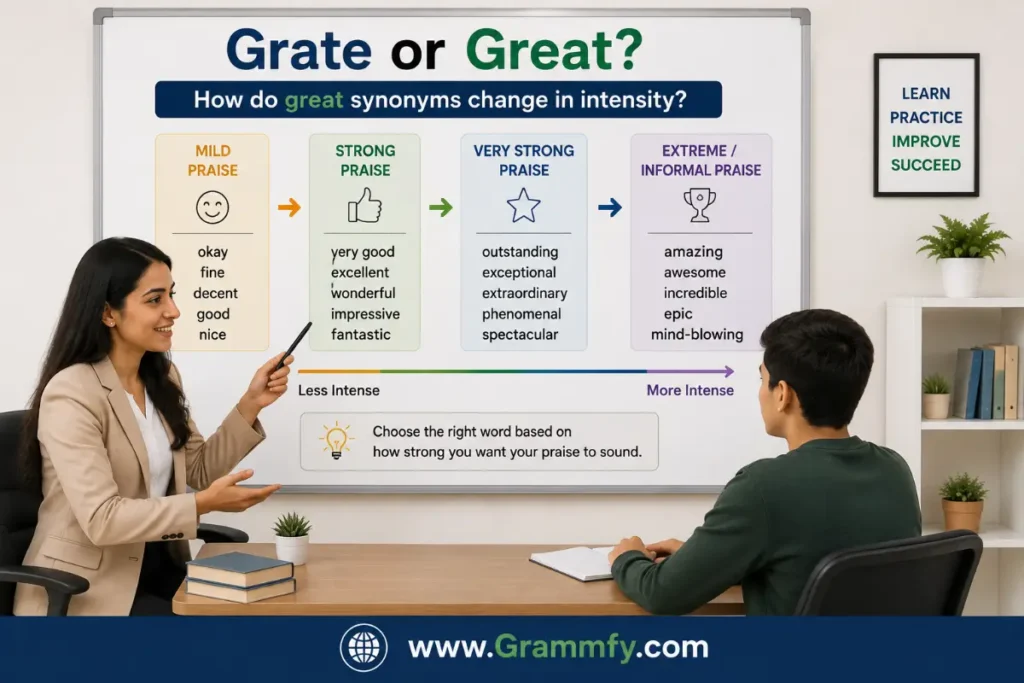
How do great synonyms change in intensity?
Not all synonyms mean exactly the same level of praise. You can think of them as a scale.
Mild praise
- okay
- fine
- decent
- good
- nice
Example:
The presentation was good.
This sounds positive but not extremely enthusiastic.
Strong praise
- very good
- excellent
- wonderful
- impressive
- fantastic
Example:
The presentation was excellent.
This shows stronger approval.
Very strong praise
- outstanding
- exceptional
- extraordinary
- phenomenal
- spectacular
Example:
Her presentation was outstanding.
These words suggest an unusually high level of quality.
Extreme or informal praise
- amazing
- awesome
- epic
- incredible
- fantastic
These can sound emotional and energetic, especially in conversation.
Choosing the right intensity makes your writing sound more natural. Calling a simple cup of coffee “phenomenal” may sound exaggerated unless you really mean it.
Which synonym should you use in a resume?
For a resume, replace great with a more specific and professional word when possible.
“Great employee” is understandable, but it doesn’t tell the reader much.
Instead, show the quality through evidence:
- Outstanding customer service skills
- Exceptional communication skills
- Strong leadership abilities
- Excellent project management skills
- Remarkable sales growth
For example:
Demonstrated excellent communication skills while working with clients.
Even better:
Increased customer satisfaction by 20% through clear and responsive communication.
The second sentence is stronger because it gives evidence instead of simply saying something was great.
Which word should you use in an essay?
In an academic essay, great is not always wrong, but it can be vague.
Instead of:
Technology has had a great effect on education.
Try:
Technology has had a significant effect on education.
Or:
Technology has had a major impact on education.
The best replacement depends on what you mean.
Use significant for importance, substantial for a large amount or effect, remarkable for something unusual, and excellent for high quality.
Essay example
Weak:
The scientist made a great discovery.
Clearer:
The scientist made a significant discovery.
More precise:
The scientist made a groundbreaking discovery.
Precision is more useful than simply choosing a stronger synonym.
Which word sounds best in a text message?
In texting, great is completely natural.
You can also use casual alternatives such as:
- awesome
- cool
- amazing
- fantastic
- nice
- perfect
Examples:
Great! See you at 7.
That sounds awesome!
Nice! I knew you could do it.
That’s amazing!
Avoid formal words such as commendable or distinguished unless you’re joking or deliberately sounding formal.
Which word should you use in an email?
The best choice depends on who receives the email.
For a coworker:
Great work on the report!
For a customer:
Excellent work on the presentation.
When writing to a customer:
We appreciate your excellent feedback.
In a formal business email:
Thank you for your valuable feedback.
A simple word can be professional when the sentence is clear and polite. You don’t need an impressive synonym in every email.
Which word works best in everyday speaking?
Great is one of the safest choices in everyday American English.
You can use it to respond to news, describe experiences, praise someone, or show agreement.
- Great! Let’s start.
- That’s great news.
- You look great today.
- We had a great time.
- Great job on the test.
It is flexible, friendly, and easy to understand.
What are 10 real-life examples of great?
Here are examples from common situations.
- School:You gave a great answer in class.
- Work:Your team did a great job on the project.
- Texting:Great! I’ll meet you there.
- Travel:We had a great time in Chicago.
- Food:This restaurant has great food.
- Sports:She is a great basketball player.
- Family:That’s great news about your brother.
- Shopping:This store has a great selection.
- Writing:You made a great point in your essay.
- Customer service:
Thank you for the great service.
Notice how great works in many different contexts.
What are 10 real-life examples of grate?
Because grate has multiple meanings, these examples show each one.
- Cooking:Grate the cheese before adding it to the soup.
- Cooking:She used a small tool to grate the ginger.
- Cooking:Grate two carrots for the salad.
- Fireplace:The logs rested on the iron grate.
- Drain:Leaves were blocking the storm-drain grate.
- Street:Water flowed through the metal grate.
- Irritation:His constant complaining began to grate on me.
- Noise:The scraping sound grated on my ears.
- Personality:Her sarcastic tone sometimes grates on her coworkers.
- Writing:
The repeated phrase began to grate on the reader.
These sentences show why replacing grate with great can completely change the meaning.
Great vs excellent — what’s the difference?
Great and excellent are close in meaning, but they have slightly different uses.
| Great | Excellent |
|---|---|
| Very common in casual English | More strongly positive |
| Flexible and conversational | Often sounds more formal |
| Can mean enjoyable | Usually emphasizes high quality |
| Works in many situations | Common in school and professional settings |
Compare:
We had a great weekend.
This sounds natural and friendly.
We had an excellent weekend.
This is grammatical, but it sounds a little more deliberate or formal.
Now compare:
She did a great job.
She did an excellent job.
Both work. Excellent gives slightly stronger praise.
Great vs amazing — what’s the difference?
Amazing often expresses surprise or strong emotional reaction.
You did a great job.
This is positive and normal.
You did an amazing job.
This sounds more enthusiastic.
If a friend sends you an impressive photo, you might say:
That’s amazing!
If a coworker completes a task well, you might say:
Great work!
The best choice depends on how strong you want your reaction to sound.
Great vs wonderful — what’s the difference?
Wonderful often carries a warm, positive feeling.
We had a great vacation.
We had a wonderful vacation.
Both are correct. Wonderful can sound warmer and more expressive.
For people, wonderful can also suggest kindness or pleasant personality:
She is a wonderful friend.
Great is broader:
She is a great friend.
Both are natural.
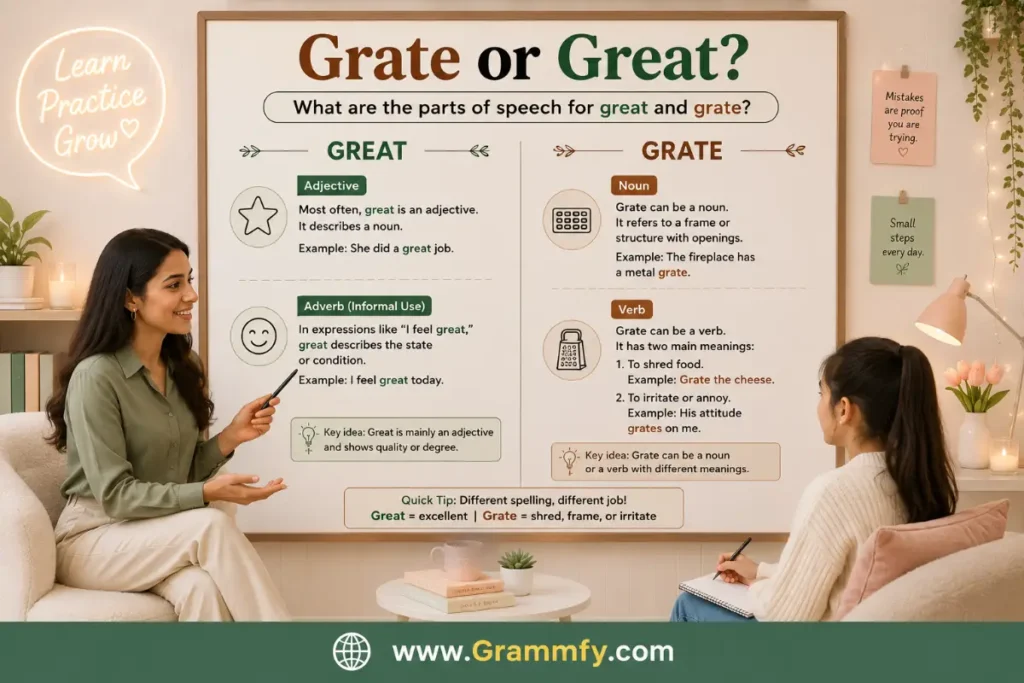
What are the parts of speech for great and grate?
Understanding grammar can help you avoid mistakes.
Great as an adjective
Most often, great is an adjective.
That is a great idea.
She is a great teacher.
We had a great experience.
Great as an adverb in informal speech
In expressions such as “I feel great,” great describes the condition or state after the linking verb.
I feel great today.
Grate as a noun
The fireplace has a metal grate.
Grate as a verb
Grate the cheese.
It can also mean to irritate:
His attitude grated on me.
Knowing the grammatical role makes the spelling easier to choose.
Are grate and great different in the US and UK?
The meanings and spellings are generally the same in American and British English.
Both varieties use:
- great for excellent or very good
- grate for a frame, shredding action, or irritation
Pronunciation can vary slightly by speaker and region, but the two words are still commonly pronounced alike.
One useful regional note is that some synonyms have different levels of popularity. For example, brilliant is especially common as a casual positive expression in British English, while American speakers often use awesome or great in similar situations.
The spelling of great and grate, however, does not change between US and UK English.
What are common mistakes with grate and great?
Mistake 1: Writing “grate job”
Incorrect:
You did a grate job.
Correct:
You did a great job.
The phrase is praise, so use great.
Mistake 2: Writing “grate idea”
Incorrect:
That’s a grate idea.
Correct:
That’s a great idea.
Again, you’re saying the idea is excellent.
Mistake 3: Writing “great the cheese”
Incorrect:
Please great the cheese.
Correct:
Please grate the cheese.
Here, you’re shredding the cheese, so grate is the correct verb.
Mistake 4: Writing “a great” for a fireplace frame
Incorrect:
The firewood is sitting on the great.
Correct:
The firewood is sitting on the grate.
The metal frame is a grate.
Mistake 5: Confusing “grate on” with “great”
Incorrect:
His attitude really greats on me.
Correct:
His attitude really grates on me.
The expression grate on someone means to irritate or annoy them.
When should you NOT use great?
Although great is extremely useful, it can sometimes be too vague.
For example:
The company had a great increase in sales.
This sounds understandable, but great increase doesn’t give a precise idea of the change.
Better:
The company had a significant increase in sales.
Or:
The company increased sales by 25%.
In professional and academic writing, specific words often communicate more clearly than general praise.
Avoid using great when you actually mean:
- large
- significant
- successful
- important
- impressive
- enjoyable
- powerful
- skilled
Choose the word that expresses the exact idea.
When should you use grate instead?
Use grate when the context involves:
- shredding food
- a metal or wooden framework
- scraping
- irritating someone
A quick test is to look for clues.
If you see words such as:
- cheese
- carrots
- ginger
- fireplace
- drain
- metal
- scrape
- annoy
- nerves
Grate may be the word you need.
If you see:
- excellent
- wonderful
- job
- idea
- news
- experience
- teacher
- movie
- opportunity
Great is much more likely.
What are the antonyms of great?
The opposite of great depends on the meaning.
If great means “excellent,” possible antonyms include:
- bad
- poor
- terrible
- awful
- disappointing
- unsatisfactory
Example:
That was a great performance.
Opposite:
That was a poor performance.
If great means “large,” the opposite could be:
- small
- little
- minor
- tiny
Example:
A great amount of effort was required.
Opposite:
Only a small amount of effort was required.
This shows why context matters when choosing an antonym.
What is the easiest memory trick?
Try this simple rule:
Great = good.
Both words contain the letter g, and you can connect great with “good.”
For grate, think of a grater in the kitchen.
Great = excellent
Grate = shred, scrape, or metal frame
Another memory trick is to picture the words:
Great: ⭐
Grate: 🧀
The star reminds you of something excellent. The cheese reminds you of a kitchen grater.
Quick tips for choosing the right word
Use these checks before you finish your sentence.
Tip 1: Are you praising something?
Use great.
You did a great job.
Tip 2: Are you talking about cheese or vegetables?
Use grate.
Grate the carrots.
Tip 3: Are you describing a fireplace or drain frame?
Use grate.
The leaves covered the grate.
Tip 4: Are you describing something excellent?
Use great.
That’s a great idea.
Tip 5: Does something annoy you?
Use grate.
His repeated interruptions grated on me.
Tip 6: Are you writing formally?
Consider a more precise synonym instead of automatically using great.
Try:
- significant
- excellent
- outstanding
- substantial
- remarkable
Tip 7: Check the sentence meaning
Don’t choose the spelling only because the word sounds right. Ask what the sentence actually means.
A quick comparison chart
| If you mean… | Choose | Example |
|---|---|---|
| Excellent | Great | That’s a great idea. |
| Very good | Great | You did a great job. |
| Enjoyable | Great | We had a great time. |
| Important | Great | He had great influence. |
| Shred food | Grate | Grate the cheese. |
| Metal frame | Grate | The drain grate is blocked. |
| Scrape | Grate | The rough surface can grate the material. |
| Irritate | Grate | His voice grates on me. |
How can you remember grate or great in one sentence?
Remember this:
Great describes something good, while grate describes something you shred, scrape, or use as a frame.
That’s enough to solve most spelling questions.
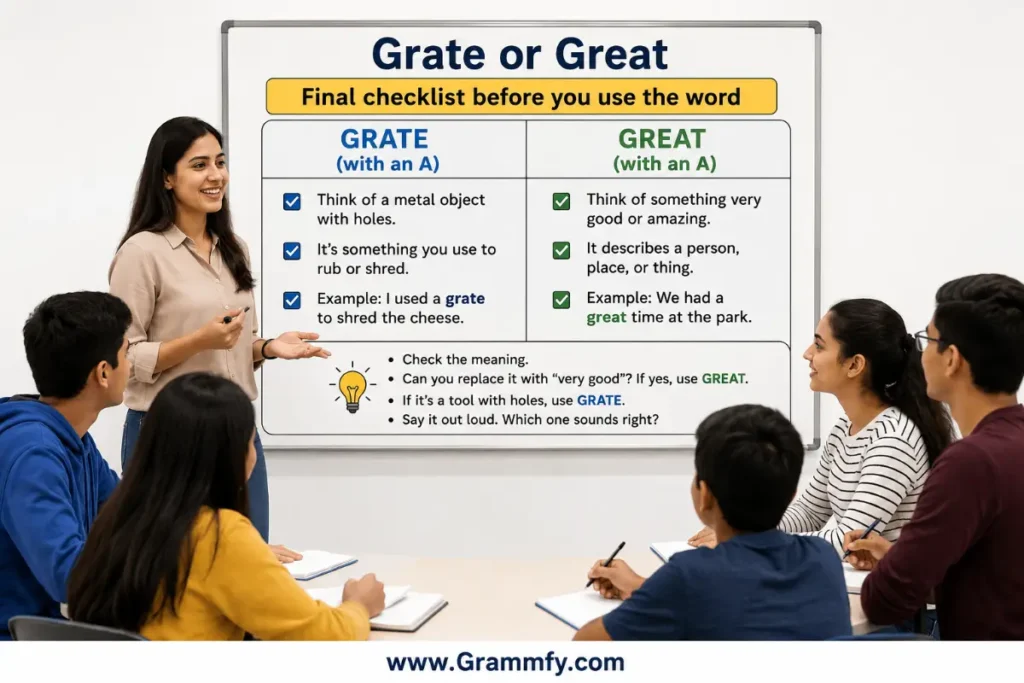
Final checklist before you use the word
Ask yourself these five questions:
- Am I saying something is excellent or very good?
- Am I talking about a kitchen grater?
- Am I describing a metal frame?
- Am I talking about scraping or irritation?
- Would a more precise synonym make my sentence clearer?
When the answer to the first question is yes, use great.
If one of the middle questions applies, use grate.
If you’re writing a formal sentence, check whether a more exact word would communicate your idea better.
Conclusion
The key to grate or great is meaning. Great is the word you want when you’re describing something as excellent, enjoyable, impressive, important, or very good. Grate has a completely different job: it can describe a metal frame, the act of shredding food, or something that irritates you. Although the words sound alike, their spellings cannot be swapped.
When you’re unsure, look at the words around them. A “great idea,” “great job,” or “great experience” needs great. Cheese, carrots, fireplaces, drains, scraping, and irritation point toward grate. With a little attention to context, this common homophone pair becomes easy to handle. The next time you write an email, essay, text, or resume, you’ll know which spelling fits your meaning.
Frequently Asked Questions
Is it great job or grate job?
The correct phrase is great job when you mean that someone performed well. Grate does not mean excellent.
What is the difference between grate and great?
Great means excellent, very good, impressive, or important, while grate can mean a frame, a kitchen shredding action, or something that irritates.
What’s another way to say great?
Another way to say great is excellent, wonderful, amazing, fantastic, outstanding, or impressive, depending on the context and tone.
Is grate a real English word?
Yes, grate is a real English word. It can be a noun for a frame, a verb for shredding food, or a verb meaning to irritate.
Should I use great in a formal essay?
You can use great in an essay, but a more precise word such as significant, substantial, excellent, or remarkable may communicate your exact meaning better.
How do I use grate in a sentence?
You can use grate as a verb for shredding food, as a noun for a frame, or as a verb meaning to irritate: “Please grate the cheese” or “His voice began to grate on me.”
Why do great and grate sound the same?
They are commonly pronounced alike, making them homophones, but they have different spellings, histories, and meanings.
