
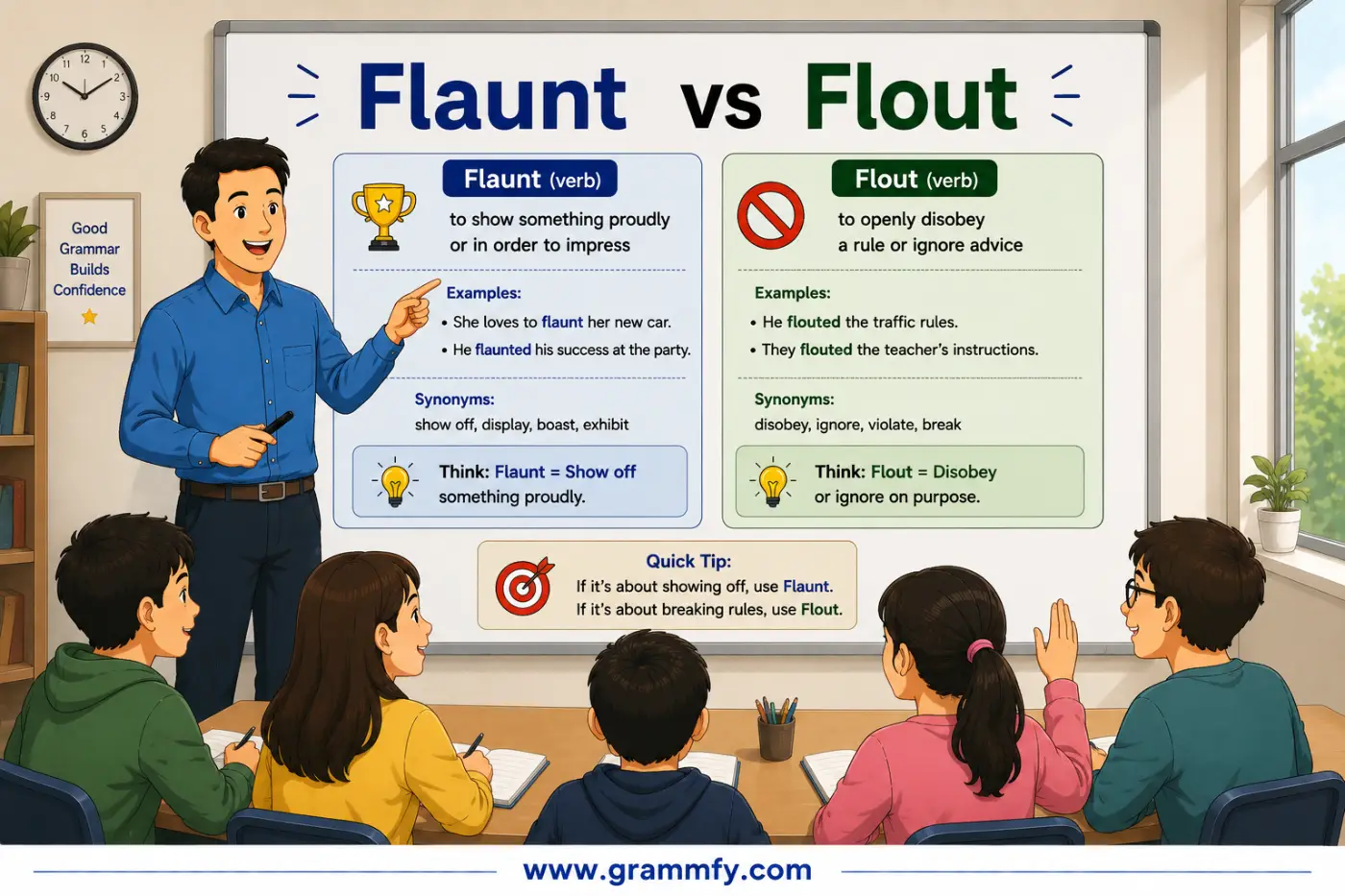
Have you ever paused while writing an email, essay, or social media post because you weren’t sure whether to use flaunt vs flout? You’re not alone. The words sound similar, but they have very different meanings. Mixing them up is one of the most common English writing mistakes.
Understanding flaunt vs flout can make your writing clearer and help you avoid embarrassing errors. Whether you’re a student, job seeker, or content writer, knowing the difference is a useful skill.
Quick Answer:
Flaunt means to show something off proudly, often to impress others. Flout means to openly ignore or break a rule, law, or accepted standard.
These two words may look and sound alike, but they’re never interchangeable. In this guide, you’ll learn their meanings, origins, pronunciation, memory tricks, real-life examples, common mistakes, and much more.
Another commonly confused pair worth knowing is [medal vs meddle].
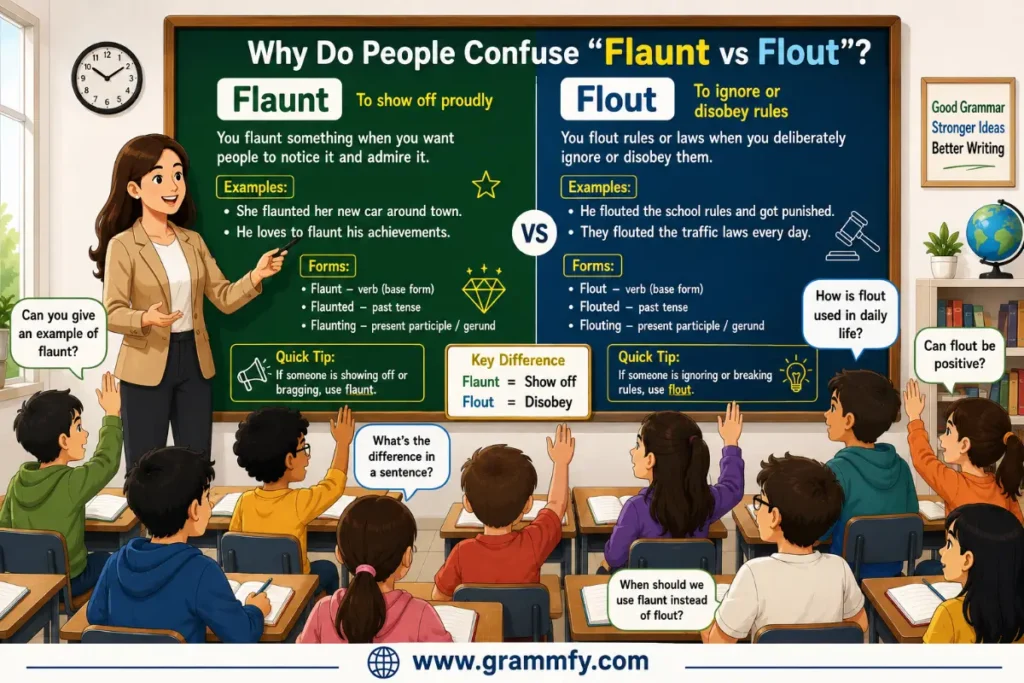
Why Do People Confuse “Flaunt vs Flout”?
The confusion happens for three simple reasons:
- They start with the same three letters: fla-
- They sound somewhat alike.
- They’re both used in formal writing and news articles.
However, their meanings are completely different.
| Word | Meaning | Easy Memory Tip |
|---|---|---|
| Flaunt | Show something off proudly | Think flash or show off |
| Flout | Break or ignore a rule | Think out of the rules |
Once you remember this simple difference, choosing the correct word becomes much easier.
What Does “Flaunt” Mean?
Flaunt is a verb.
It means to proudly display something so other people notice it. Sometimes the action is positive, but often it suggests showing off in a way that feels boastful or attention-seeking.
Simple Definition
Flaunt = Show off proudly.
You can flaunt:
- Wealth
- Jewelry
- Success
- Talent
- Fashion
- Awards
- Expensive cars
- Vacation photos
- Confidence
Examples
- She loves to flaunt her designer handbags.
- He flaunted his new sports car around town.
- Some influencers flaunt luxury vacations online.
- The athlete didn’t want to flaunt his success.
- They proudly flaunted their championship trophy.
Notice that every sentence involves displaying something.
What Does “Flout” Mean?
Flout is also a verb.
It means to openly ignore, disobey, or break a rule, law, or social expectation.
Simple Definition
Flout = Ignore or break a rule on purpose.
People often flout:
- Laws
- Rules
- School policies
- Safety guidelines
- Court orders
- Dress codes
- Traffic regulations
- Company policies
Examples
- Drivers who flout speed limits risk getting tickets.
- The company was fined for flouting environmental laws.
- Some students flout classroom rules.
- He continued to flout the judge’s order.
- Tourists should never flout local customs.
In every example, someone ignores a rule or expectation.
“Flaunt vs Flout”: What’s the Difference?
This is the key difference:
| Flaunt | Flout |
|---|---|
| Show off proudly | Break or ignore rules |
| About displaying something | About disobeying something |
| Usually involves possessions or achievements | Usually involves laws, policies, or standards |
| Focuses on attention | Focuses on defiance |
Compare These Sentences
✅ She flaunted her diamond necklace.
❌ She flouted her diamond necklace.
✅ The company flouted safety regulations.
❌ The company flaunted safety regulations.
The first sentence talks about showing something.
The second talks about breaking rules.
A Quick Memory Trick for “Flaunt vs Flout”
Need an easy way to remember flaunt vs flout?
Remember This
Flaunt = Flash
Both words begin with Fla-.
If you’re flashing something for people to see, you’re flaunting it.
Flout = Out
The word out appears inside flout.
Think:
You’re out of the rules.
That means you’re ignoring them.
Another easy trick:
| Word | Think Of |
|---|---|
| Flaunt | Flash, Fashion, Fame |
| Flout | Out of the rules |
These simple connections make the meanings easier to remember.
Word Origin and History of “Flaunt vs Flout”
Many articles explain the meanings but skip where these words came from. Their history makes the difference easier to understand.
Origin of “Flaunt”
The word flaunt first appeared in English during the 16th century.
Its exact origin isn’t completely certain, but early uses described something moving or waving in a noticeable way, such as bright clothing or colorful decorations. Over time, the meaning shifted toward displaying something proudly to attract attention.
Today, it usually describes someone intentionally showing off wealth, beauty, achievements, or possessions.
Origin of “Flout”
The word flout also dates back several centuries.
It originally meant to mock or treat with contempt. Over time, that meaning expanded into openly ignoring or disrespecting rules and authority.
Modern English mostly uses it when talking about breaking laws, regulations, or accepted standards.
The history helps explain today’s meanings.
- Flaunt grew from the idea of something noticeable or eye-catching.
- Flout grew from the idea of disrespect or defiance.
Even though they sound similar, they developed along different paths.
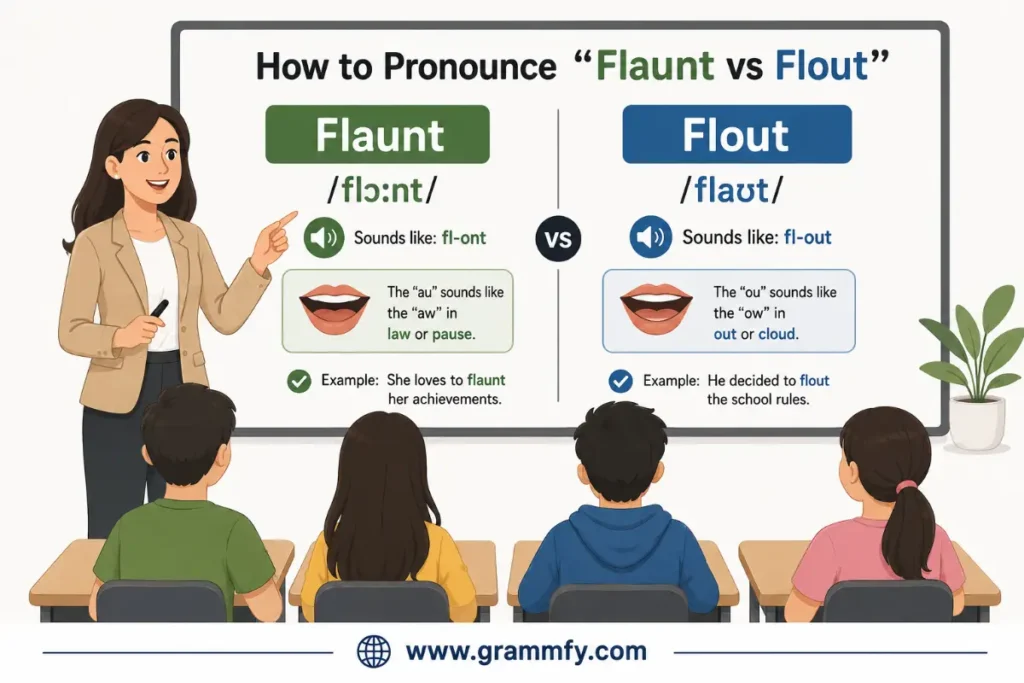
How to Pronounce “Flaunt vs Flout”
Correct pronunciation can also help you remember the difference.
| Word | Pronunciation | Sounds Like |
|---|---|---|
| Flaunt | FLAWNT | haunt, taunt |
| Flout | FLOWT | out, shout |
Speaking Tip
Say them slowly:
- Flaunt → “flawnt”
- Flout → “flowt”
The vowel sounds are different.
When Should You Use “Flaunt”?
Use flaunt whenever someone intentionally attracts attention by displaying something.
Common Situations
- Showing expensive clothes
- Displaying wealth
- Posting luxury vacations
- Showing awards
- Displaying skills
- Showing confidence
- Showing success
Examples
- She likes to flaunt her fashion sense.
- They flaunted their new home during the party.
- He never flaunts his achievements.
- The singer flaunted her new hairstyle.
- Some brands flaunt celebrity endorsements.
When Should You Use “Flout”?
Use flout whenever someone deliberately ignores rules or expectations.
Common Situations
- Breaking school rules
- Ignoring company policies
- Violating laws
- Refusing safety procedures
- Ignoring traffic signs
- Breaking court orders
Examples
- Many drivers flout parking regulations.
- Businesses shouldn’t flout tax laws.
- He was criticized for flouting health guidelines.
- Employees who flout company policies may face discipline.
- Visitors should respect local customs instead of flouting them.
Real-Life Examples of “Flaunt vs Flout”
Seeing both words together makes the difference much clearer.
Example 1
❌ He flouted his expensive watch.
✅ He flaunted his expensive watch.
A watch is something you show off, not a rule you break.
Example 2
❌ The company flaunted environmental regulations.
✅ The company flouted environmental regulations.
Regulations are rules, so flout is correct.
Example 3
❌ She flouted her beautiful dress.
✅ She flaunted her beautiful dress.
A dress can be proudly displayed.
Example 4
❌ Drivers often flaunt traffic laws.
✅ Drivers often flout traffic laws.
Traffic laws are meant to be followed, not shown off.
Example 5
❌ He flouted his award during the ceremony.
✅ He flaunted his award during the ceremony.
Awards are displayed with pride.
Can Flaunt Ever Be Positive?
Yes. While flaunt sometimes suggests showing off too much, it isn’t always negative.
For example:
- She flaunted her graduation medal with pride.
- The artist flaunted years of hard work through her paintings.
- The team proudly flaunted its championship trophy.
In these cases, the display celebrates an achievement rather than showing arrogance.
However, context matters. Saying someone flaunted their wealth may imply they were trying to impress others unnecessarily.
Master Synonym List for “Flaunt vs Flout”
The words flaunt and flout don’t share the same meaning, so their synonyms are different. Choosing the right one depends on whether you’re talking about showing something off or breaking a rule.
Simple and Everyday Synonyms
| Word | Meaning | Tone | Example |
|---|---|---|---|
| Show off | Display proudly | Casual | He likes to show off his new phone. |
| Display | Put on view | Neutral | The museum displayed rare coins. |
| Exhibit | Show publicly | Neutral | The gallery exhibited local artwork. |
| Reveal | Let others see | Neutral | She revealed her new design. |
| Present | Show formally | Neutral | The company presented its latest product. |
| Wear proudly | Display with pride | Friendly | She wore her medal proudly. |
| Parade | Walk around showing something | Casual | They paraded their trophy through town. |
| Flash | Show quickly to impress | Casual | He flashed his expensive watch. |
| Feature | Put something in focus | Neutral | The website featured customer stories. |
| Demonstrate | Show through action | Neutral | The coach demonstrated the new skill. |
Formal Synonyms
| Word | Meaning | Tone | Example |
|---|---|---|---|
| Exhibit | Display publicly | Formal | The museum exhibits ancient artifacts. |
| Showcase | Highlight the best parts | Formal | The event showcased local talent. |
| Brandish | Display boldly | Formal | He brandished the signed contract. |
| Publicize | Make widely known | Formal | The company publicized its success. |
| Promote | Encourage attention | Formal | They promoted the new service. |
| Advertise | Make known publicly | Formal | Businesses advertise new products. |
| Highlight | Draw attention to | Formal | The report highlighted key findings. |
| Emphasize | Give importance | Formal | The speaker emphasized teamwork. |
| Reveal | Make visible | Formal | The author revealed the ending later. |
| Unveil | Show for the first time | Formal | They unveiled a new logo. |
Slang and Informal Synonyms
| Word | Meaning | Tone | Example |
|---|---|---|---|
| Flex | Show off | Slang | He’s always flexing his sneakers. |
| Brag | Talk proudly | Informal | She bragged about her grades. |
| Blow your own horn | Praise yourself | Informal | Stop blowing your own horn. |
| Rub it in | Show success to others | Informal | He rubbed it in after winning. |
| Strut | Walk proudly | Informal | She strutted across the stage. |
Synonyms for Flout
| Word | Meaning | Tone | Example |
|---|---|---|---|
| Ignore | Pay no attention | Neutral | He ignored the warning sign. |
| Break | Fail to follow | Neutral | They broke the rules. |
| Disobey | Refuse to obey | Neutral | The child disobeyed his parents. |
| Violate | Break officially | Formal | The company violated safety rules. |
| Defy | Resist openly | Strong | She defied the court order. |
| Disregard | Ignore deliberately | Formal | He disregarded the instructions. |
| Contravene | Go against | Very Formal | The policy contravenes the law. |
| Breach | Break an agreement | Formal | They breached the contract. |
| Resist | Refuse to accept | Neutral | The workers resisted the changes. |
| Overlook | Fail to follow | Neutral | He overlooked the requirement. |
| Bypass | Avoid following | Neutral | They bypassed the normal process. |
| Reject | Refuse to accept | Neutral | She rejected the proposal. |
| Oppose | Act against | Neutral | Many people opposed the decision. |
| Challenge | Question authority | Neutral | They challenged the regulation. |
| Snub | Ignore intentionally | Informal | He snubbed the official advice. |
Synonyms by Intensity
Sometimes you need a softer or stronger word than flaunt or flout.
For “Flaunt”
| Intensity | Best Word |
|---|---|
| Very Mild | Show |
| Mild | Display |
| Mild | Present |
| Medium | Exhibit |
| Medium | Showcase |
| Strong | Parade |
| Strong | Flash |
| Very Strong | Brandish |
| Strongest | Flex (informal) |
For “Flout”
| Intensity | Best Word |
|---|---|
| Very Mild | Ignore |
| Mild | Disregard |
| Medium | Break |
| Medium | Violate |
| Strong | Defy |
| Very Strong | Contravene |
| Strongest | Openly rebel against |
Synonyms by Part of Speech
Both flaunt and flout are verbs, but related nouns and adjectives can make your writing more natural.
Related to Flaunt
| Part of Speech | Word | Example |
|---|---|---|
| Verb | Flaunt | She flaunted her award. |
| Noun | Display | The display attracted visitors. |
| Noun | Exhibition | The exhibition opened today. |
| Adjective | Showy | He wore a showy jacket. |
| Adjective | Flashy | They bought a flashy car. |
| Adjective | Stylish | She looked stylish at the event. |
Related to Flout
| Part of Speech | Word | Example |
|---|---|---|
| Verb | Flout | They flouted the law. |
| Noun | Violation | The violation resulted in a fine. |
| Noun | Defiance | His actions showed defiance. |
| Adjective | Defiant | The student remained defiant. |
| Adjective | Unlawful | The act was unlawful. |
| Adjective | Illegal | Illegal parking carries a penalty. |
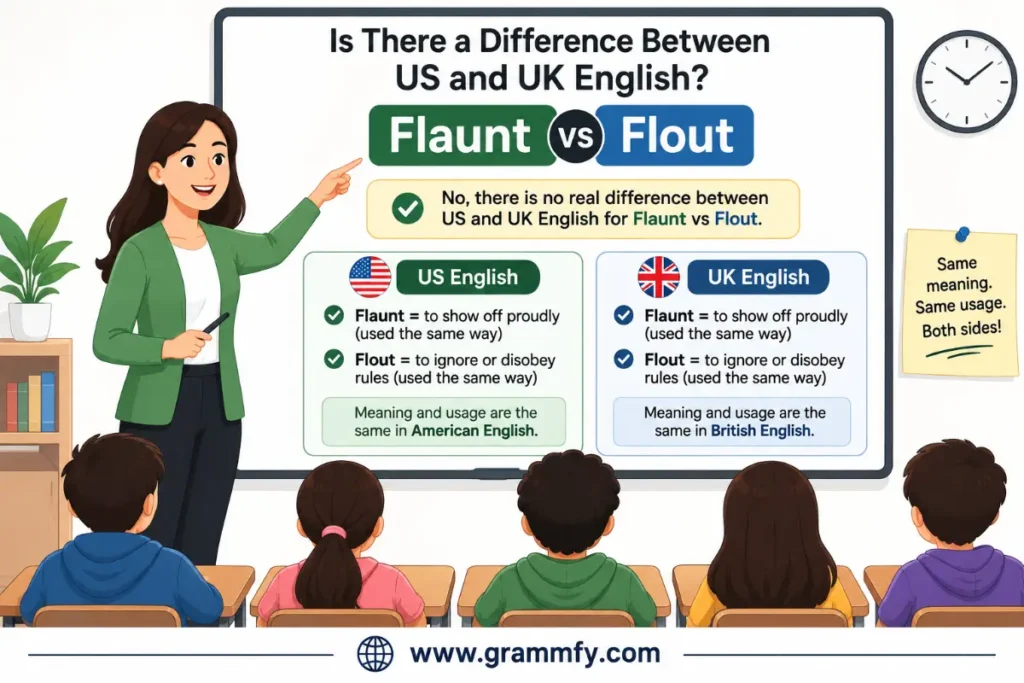
Is There a Difference Between US and UK English?
There isn’t a major difference. Both American and British English use flaunt and flout with the same meanings.
The only difference is frequency. Flout appears more often in British newspapers and formal writing, while flaunt is common in everyday speech and media in both countries.
So whether you’re writing for a US or UK audience, the meanings stay the same.
What’s the Best Word for a Resume?
A resume should sound professional and modest. Avoid flaunt because it can suggest bragging.
Instead, use words like:
- Highlight
- Demonstrate
- Showcase
- Present
- Emphasize
Example
❌ I flaunted my leadership skills.
✅ I demonstrated strong leadership skills by managing a team of ten employees.
What’s the Best Word for an Essay?
In essays, choose precise words that match the situation.
Use flaunt when discussing someone proudly displaying wealth, fashion, or success.
Use flout when writing about laws, rules, ethics, or social norms.
Examples
- The celebrity flaunted her luxury lifestyle on social media.
- The company flouted environmental regulations for years.
What’s the Best Word for Text Messages?
In casual texting, people rarely use flout.
Instead, you’ll often see:
- Show off
- Flex
- Brag
Examples
- He’s just trying to show off.
- Stop flexing your new phone.
- She’s bragging again.
These sound more natural in everyday conversations.
What’s the Best Word for Emails?
Professional emails should avoid emotional or judgmental language.
Instead of saying someone flaunted something, you can say they:
- Presented
- Shared
- Highlighted
- Demonstrated
Instead of flouted, you can use:
- Violated
- Failed to follow
- Did not comply with
Example
Instead of:
The supplier flouted our policy.
Write:
The supplier did not comply with our policy.
This sounds more professional while keeping the meaning clear.
What’s the Best Word for Speaking?
When speaking, simple words are usually best.
Instead of saying:
- He flaunted his success.
You might naturally say:
- He showed off his success.
Instead of:
- They flouted the rules.
You could say:
- They ignored the rules.
- They broke the rules.
Simple language is often easier for listeners to understand.
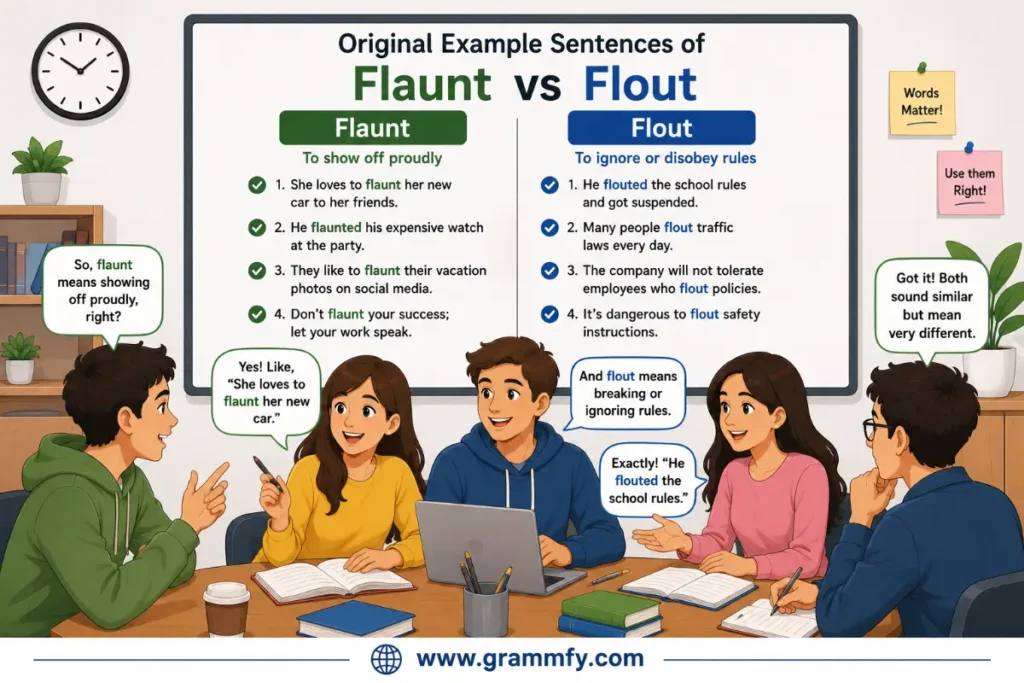
Original Example Sentences of “Flaunt vs Flout”
Here are more real-life examples to help you remember the difference between flaunt vs flout.
- She didn’t want to flaunt her promotion in front of coworkers.
- The influencer continued to flaunt expensive vacations online.
- He proudly flaunted the trophy after the final match.
- They flaunted their new house during the family gathering.
- The fashion model flaunted the latest designer collection.
- Several companies were punished for flouting labor laws.
- The driver was fined for flouting traffic regulations.
- Students shouldn’t flout school policies just because others do.
- The restaurant was closed after flouting health standards.
- Tourists should respect local customs instead of flouting them.
- She never flaunts her wealth, even though she’s successful.
- The politician was criticized for flouting campaign rules.
Conclusion
Understanding flaunt vs flout is easier once you remember their core meanings. Flaunt means to proudly display or show something off, while flout means to openly ignore or break a rule or standard. Since these words sound similar, they’re often confused, but using the correct one makes your writing clearer and more professional. A simple memory trick is: flaunt = show off; flout = break rules. With a little practice, you’ll never mix them up again.
FAQs for “Flaunt vs Flout”
1. What is the difference between flaunt and flout?
Flaunt means to show something off proudly, while flout means to openly ignore or disobey a rule, law, or custom.
2. Is it “flaunt the rules” or “flout the rules”?
The correct phrase is flout the rules because it means to ignore or break them.
3. Can flaunt and flout be used interchangeably?
No. Although they sound similar, they have different meanings and should not be used interchangeably.
4. How can I remember the difference?
Think of flaunt as “show off” and flout as “break rules.”
5. What is an example of flaunt?
She likes to flaunt her new designer handbag.
6. What is an example of flout?
Many drivers flout the speed limit despite the warning signs.
7. Why do people confuse flaunt and flout?
They are commonly confused because they sound alike and have similar spelling, but their meanings are completely different.
8. Which word is more common in everyday English?
Flaunt is more common in casual conversations, while flout is often used in formal writing, news, and legal contexts.
