
Have you ever stopped while writing an email, essay, or work report because you couldn’t remember whether to use eminent or imminent? You’re not alone. The difference between eminent vs imminent confuses many English learners and even native speakers because the words look and sound similar.
Using the wrong one can completely change the meaning of your sentence. Luckily, the distinction is simple once you understand what each word means and when to use it.
Quick Answer:
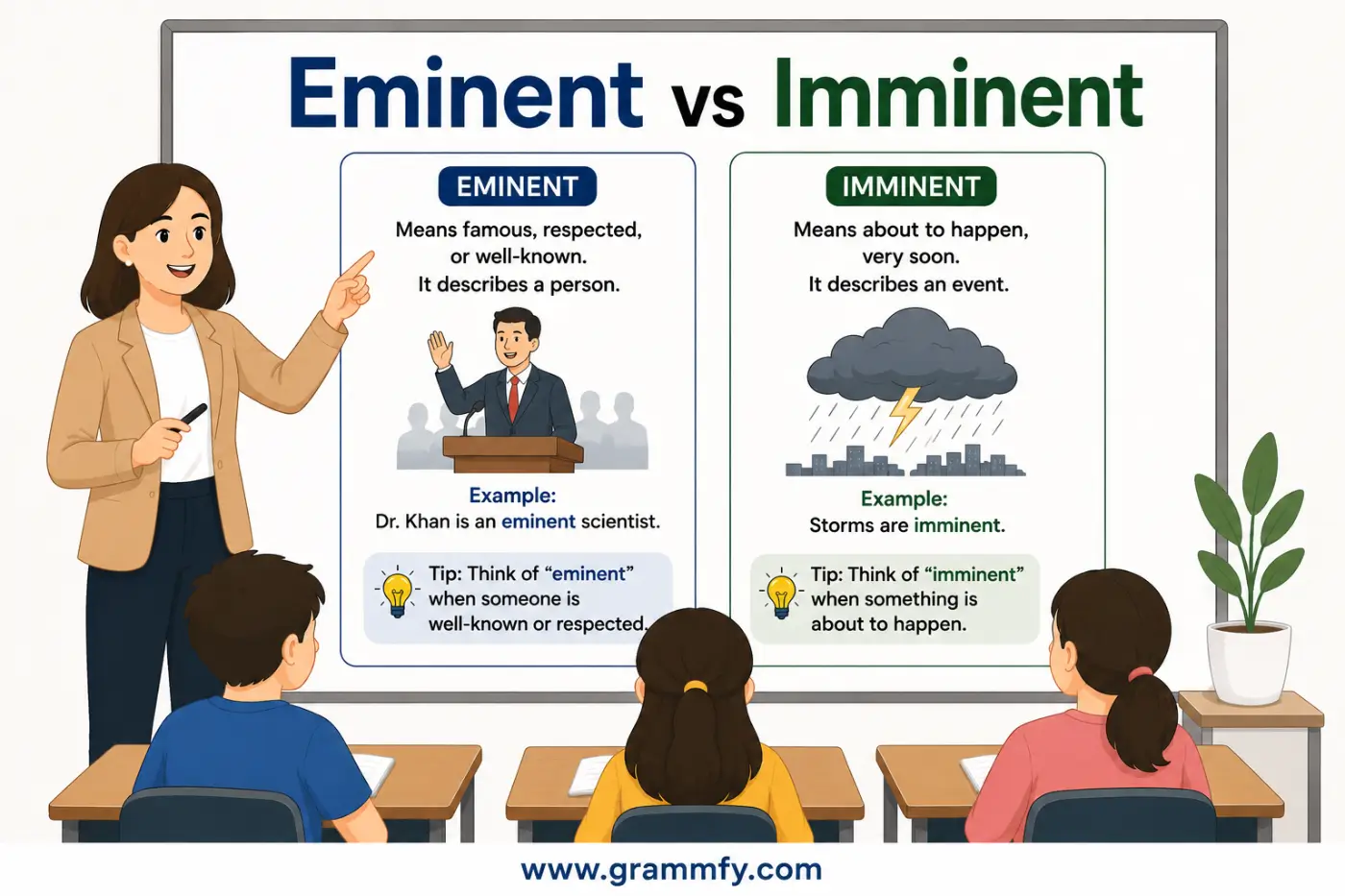
Eminent means famous, respected, or highly important. Imminent means about to happen very soon. Although the words are similar in spelling, they have completely different meanings.
In this guide, you’ll learn the meanings, origins, pronunciation, memory tricks, real-life examples, common mistakes, and much more. By the end, you’ll know exactly when to use each word with confidence.
For another common word-choice problem, see [grate or great].
Why Do People Confuse “Eminent vs Imminent”?
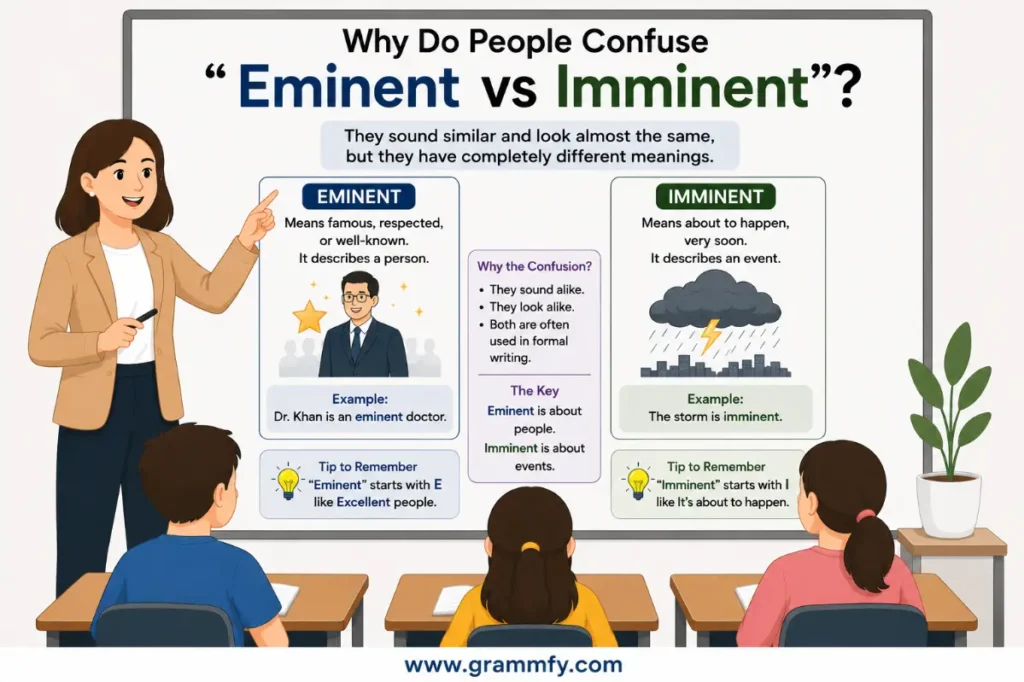
The confusion comes from three main reasons:
- They begin with almost the same letters.
- Their pronunciation is similar.
- Both words are common in formal English.
However, their meanings are completely different.
| Word | Meaning | Easy Memory Tip |
|---|---|---|
| Eminent | Famous or highly respected | Think expert or excellent |
| Imminent | About to happen very soon | Think immediate |
Remember this simple rule:
- Eminent = Important person
- Imminent = About to happen
That one trick helps many people avoid mixing them up.
What Does “Eminent” Mean?
Eminent is an adjective.
It describes someone who is well-known, highly respected, successful, or important, especially in their profession or field
Eminent = Famous and respected because of skill or achievements.
You might describe these people as eminent:
- Doctors
- Scientists
- Writers
- Judges
- Professors
- Artists
- Researchers
- Historians
- Lawyers
Examples
- She is an eminent heart surgeon.
- The university invited an eminent scientist to speak.
- He became an eminent lawyer after years of hard work.
- The award honored several eminent researchers.
- An eminent historian wrote the new textbook.
In each sentence, the word describes someone respected for their expertise or achievements.
What Does “Imminent” Mean?
Imminent is also an adjective.
It means something is very likely to happen soon.
Simple Definition
Imminent = About to happen at any moment.
Things that can be imminent include:
- Storms
- Deadlines
- Exams
- Arrivals
- Danger
- Changes
- Decisions
- Launches
- Events
Examples
- Heavy rain is imminent.
- The deadline is imminent.
- Officials warned that flooding was imminent.
- The company’s announcement is imminent.
- Doctors believed recovery was imminent.
Unlike eminent, this word never describes people. It describes events or situations that will happen very soon.
“Eminent vs Imminent” : What’s the Difference?
Understanding eminent vs imminent becomes easy when you focus on what each word describes.
| Eminent | Imminent |
|---|---|
| Describes people | Describes events or situations |
| Means respected or famous | Means about to happen |
| Talks about reputation | Talks about timing |
| Refers to achievement | Refers to the near future |
Compare these examples:
✅ She is an eminent professor.
❌ She is an imminent professor.
A professor can be respected, not “about to happen.”
Another example:
✅ A storm is imminent.
❌ A storm is eminent.
Storms happen soon; they aren’t famous.
A Simple Memory Trick To Remember “Eminent vs Imminent”
Need an easy way to remember eminent vs imminent?
Eminent = Excellent
Both words begin with E.
Think:
Eminent = Excellent and respected.
If someone is excellent in their field, they’re probably eminent.
Imminent = Immediate
Notice that imminent and immediate both begin with Immi-.
Think:
Imminent = Immediate future.
If something is happening very soon, it’s imminent.
Another Easy Trick
| Word | Think Of |
|---|---|
| Eminent | Expert, Excellent, Esteemed |
| Imminent | Immediate, Incoming, Soon |
These simple connections make the meanings much easier to remember.
Word Origin and History of “Eminent vs Emminent”
Knowing where these words came from makes them easier to understand.
Origin of “Eminent”
The word eminent comes from the Latin word eminere, meaning to stand out or rise above.
That original meaning still fits today. Someone who is eminent stands out because of their achievements, knowledge, or reputation.
Over time, English speakers began using it to describe highly respected people in fields such as medicine, science, education, law, literature, and politics.
Origin of “Imminent”
The word imminent comes from the Latin word imminere, meaning to overhang or project over.
Imagine something hanging directly above you and ready to happen. That’s the idea behind imminent.
Today, it means an event is expected very soon.
Why the Origins Matter
Their Latin roots explain why the meanings are so different.
- Eminent focuses on someone who rises above others because of excellence.
- Imminent focuses on an event that is hanging over you and about to occur.
Understanding these origins helps you remember the difference more naturally.
How to Pronounce “Eminent vs Imminent”
Correct pronunciation also helps separate the two words in your mind.
| Word | Pronunciation | Sounds Like |
|---|---|---|
| Eminent | EM-uh-nent | “EM-in-ent” |
| Imminent | IM-uh-nent | “IM-in-ent” |
The only difference is the first vowel sound.
- Eminent starts with “Em.”
- Imminent starts with “Im.”
Speaking them aloud a few times can make the distinction easier to remember.
When Should You Use “Eminent”?
Use eminent when describing a person who is respected, accomplished, or widely recognized for their expertise.
Common situations include:
- Academic writing
- News articles
- Biographies
- Professional introductions
- Award ceremonies
- Historical writing
Examples
- The hospital hired an eminent surgeon.
- She studied under an eminent professor.
- The conference welcomed several eminent economists.
- An eminent author signed copies of his latest book.
- The judge was considered one of the country’s most eminent legal experts.
When Should You Use “Imminent”?
Use imminent when talking about something that is expected to happen very soon.
Common situations include:
- Weather reports
- News updates
- Business announcements
- Medical reports
- Safety warnings
- Project deadlines
Examples
- The train’s arrival is imminent.
- Scientists warned that an eruption was imminent.
- The exam is imminent, so students are studying hard.
- A decision from the committee is imminent.
- Emergency workers prepared because flooding seemed imminent.
Real-Life Examples of “Eminent vs Imminent”
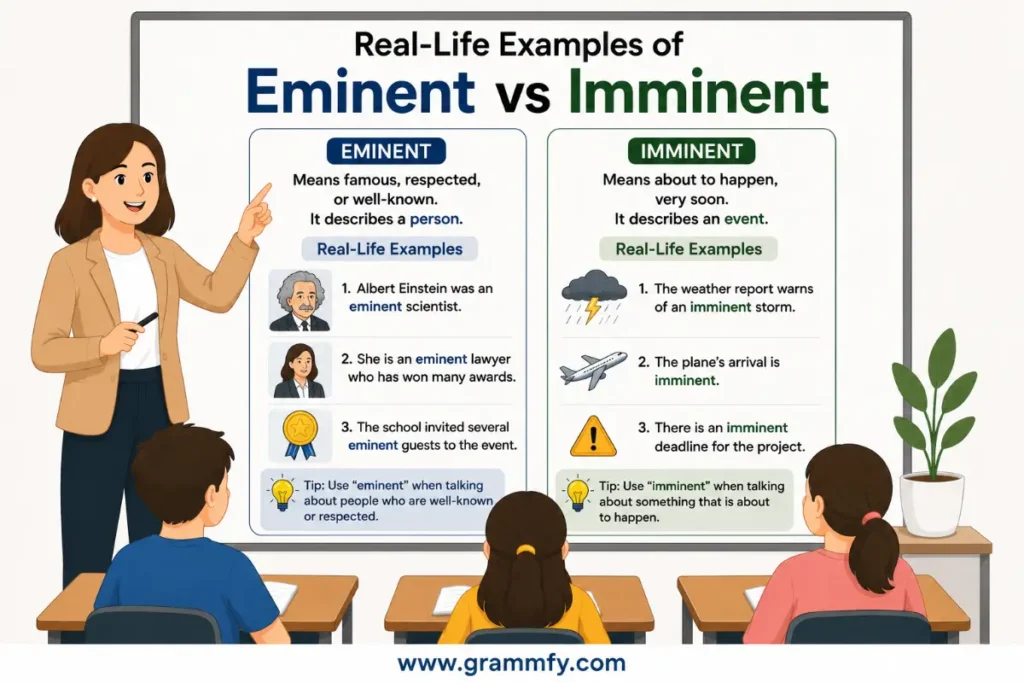
Seeing both words side by side makes the difference much clearer.
Example 1
❌ The imminent doctor received an award.
✅ The eminent doctor received an award.
Doctors can be respected, not “about to happen.”
Example 2
❌ An eminent storm is approaching.
✅ An imminent storm is approaching.
Storms happen soon; they aren’t famous.
Example 3
❌ She became an imminent scientist after years of research.
✅ She became an eminent scientist after years of research.
Years of achievement make someone eminent.
Example 4
❌ The eminent deadline worried everyone.
✅ The imminent deadline worried everyone.
Deadlines are about timing, so imminent is correct.
Example 5
❌ Officials expected an eminent evacuation.
✅ Officials expected an imminent evacuation.
An evacuation can happen soon, making imminent the right choice.
Master Synonym List for “Eminent vs Imminent”
Although eminent and imminent look alike, they have completely different meanings. Their synonyms are also different, so choosing the right one depends on whether you’re talking about a respected person or an event that is about to happen.
Simple and Everyday Synonyms for Eminent
| Word | Meaning | Tone | Example |
|---|---|---|---|
| Famous | Known by many people | Neutral | She is a famous artist. |
| Well-known | Recognized by many | Neutral | He’s a well-known teacher. |
| Respected | Admired by others | Neutral | She is a respected doctor. |
| Skilled | Very good at something | Neutral | He is a skilled engineer. |
| Successful | Has achieved great results | Neutral | She’s a successful lawyer. |
| Top | Among the best | Casual | He’s a top chef. |
| Leading | One of the best | Neutral | She’s a leading researcher. |
| Distinguished | Highly respected | Formal | He is a distinguished author. |
| Outstanding | Better than most | Neutral | She gave an outstanding speech. |
| Excellent | Extremely good | Neutral | He’s an excellent musician. |
Formal Synonyms for Eminent
| Word | Meaning | Tone | Example |
|---|---|---|---|
| Prestigious | Highly respected | Formal | She joined a prestigious university. |
| Renowned | Famous for excellence | Formal | The renowned scientist won another award. |
| Esteemed | Deeply respected | Formal | He is an esteemed professor. |
| Illustrious | Famous and admired | Very Formal | They honored an illustrious leader. |
| Prominent | Important or noticeable | Formal | She is a prominent businesswoman. |
| Celebrated | Publicly praised | Formal | He’s a celebrated writer. |
| Influential | Has strong influence | Formal | She is an influential economist. |
| Accomplished | Highly skilled | Formal | He’s an accomplished pianist. |
| Notable | Worth noticing | Formal | A notable historian attended the event. |
| Exceptional | Better than average | Formal | She showed exceptional leadership. |
Slang and Informal Synonyms for Eminent
| Word | Meaning | Tone | Example |
|---|---|---|---|
| Big name | Very famous | Informal | He’s a big name in sports. |
| Superstar | Extremely successful | Informal | She’s a superstar singer. |
| Legend | Highly admired | Informal | That coach is a legend. |
| Big shot | Important person | Informal | Everyone wanted to meet the big shot. |
| Rock star | Extremely admired | Informal | She’s the rock star of the team. |
Synonyms for Imminent
| Word | Meaning | Tone | Example |
|---|---|---|---|
| Near | Close in time | Neutral | The deadline is near. |
| Soon | Happening shortly | Neutral | Help will arrive soon. |
| Approaching | Getting closer | Neutral | Winter is approaching. |
| Coming | On the way | Neutral | A change is coming. |
| Expected | Likely to happen | Neutral | Rain is expected tomorrow. |
| Upcoming | Happening in the near future | Neutral | The upcoming event is sold out. |
| Pending | Waiting to happen | Formal | The decision is pending. |
| At hand | Very close | Formal | Victory seemed at hand. |
| Looming | Appearing close and serious | Formal | A crisis is looming. |
| Around the corner | Very soon | Informal | Summer is around the corner. |
| On the horizon | Expected soon | Neutral | New opportunities are on the horizon. |
| Brewing | Developing | Informal | Trouble is brewing. |
| Impending | About to happen | Formal | An impending storm forced evacuations. |
| Forthcoming | Happening soon | Formal | Further details are forthcoming. |
| Close | Not far away | Neutral | The finish line is close. |
Synonyms by Intensity
Some situations need a softer or stronger word than eminent or imminent.
For “Eminent”
| Intensity | Best Word |
|---|---|
| Very Mild | Skilled |
| Mild | Respected |
| Mild | Well-known |
| Medium | Prominent |
| Medium | Distinguished |
| Strong | Renowned |
| Strong | Celebrated |
| Very Strong | Illustrious |
| Strongest | Legendary (informal) |
For “Imminent”
| Intensity | Best Word |
|---|---|
| Very Mild | Near |
| Mild | Approaching |
| Mild | Upcoming |
| Medium | Coming |
| Medium | Expected |
| Strong | At hand |
| Strong | Looming |
| Very Strong | Impending |
| Strongest | About to happen |
Synonyms by Part of Speech
Since eminent and imminent are adjectives, related nouns and adverbs can improve your writing.
Related to Eminent
| Part of Speech | Word | Example |
|---|---|---|
| Adjective | Eminent | She is an eminent scientist. |
| Noun | Eminence | His eminence earned worldwide respect. |
| Noun | Reputation | She has an excellent reputation. |
| Adverb | Eminently | The plan was eminently practical. |
| Adjective | Distinguished | He is a distinguished lawyer. |
| Noun | Prestige | The award increased the school’s prestige. |
Related to Imminent
| Part of Speech | Word | Example |
|---|---|---|
| Adjective | Imminent | A decision is imminent. |
| Noun | Imminence | The imminence of the storm worried residents. |
| Adverb | Imminently | The launch was expected imminently. |
| Noun | Arrival | The arrival was expected soon. |
| Adjective | Impending | An impending crisis required action. |
| Noun | Approach | The approach of winter was obvious. |
Is There a Difference Between US and UK English?
There is almost no difference between American and British English when using these words.
Both countries use:
- Eminent to describe respected or famous people.
- Imminent to describe events that will happen very soon.
British newspapers may use imminent slightly more often in political and legal reporting, but the meaning stays exactly the same.
What’s the Best Word for a Resume?
On a resume, avoid describing yourself as eminent because it can sound exaggerated unless you’re internationally recognized.
Instead, use words like:
- Experienced
- Skilled
- Accomplished
- Qualified
- Professional
Example
❌ I am an eminent software developer.
✅ I am an experienced software developer with five years of industry experience.
What’s the Best Word for an Essay “Eminent vs Imminent”?
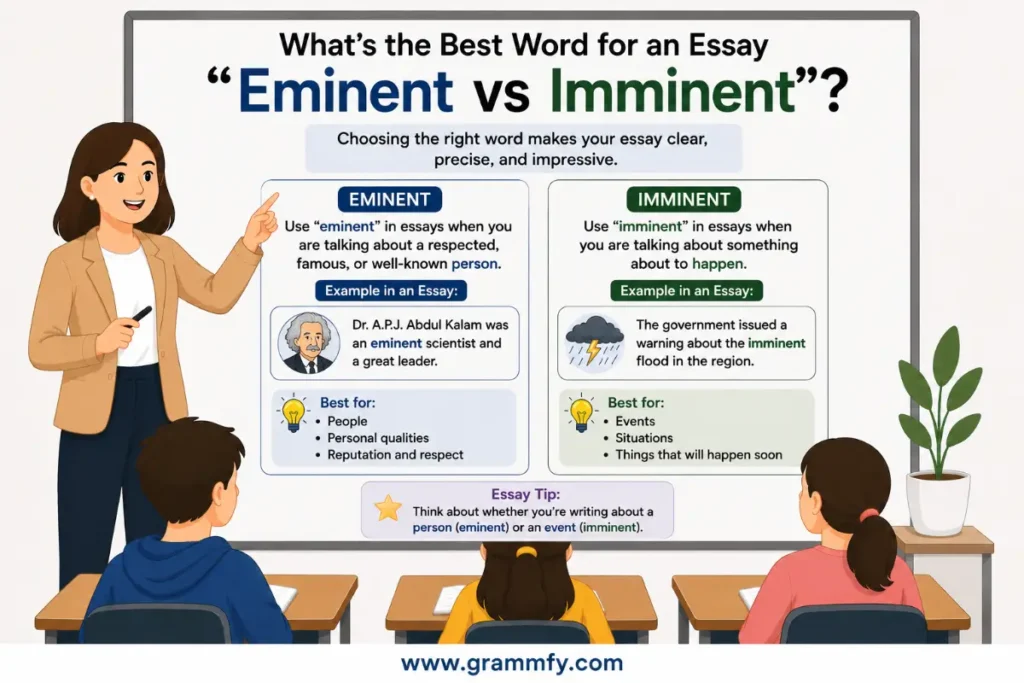
In essays, choose the word based on the meaning.
Use eminent for respected people.
Use imminent for events expected to happen soon.
Examples
- The university invited an eminent economist to deliver the keynote speech.
- Scientists warned that further flooding was imminent.
What’s the Best Word for Text Messages “Eminent vs Imminent”?
In everyday texting, people rarely use eminent or imminent.
Instead, they often say:
For eminent
- Famous
- Well-known
- Top
- Great
For imminent
- Soon
- Almost here
- About to happen
- Coming soon
Examples
- He’s a famous chef.
- The movie is coming soon.
These alternatives sound more natural in casual conversations.
What’s the Best Word for Emails “Eminent vs Imminent”?
Professional emails should stay clear and simple.
Instead of writing:
The meeting is imminent.
You could write:
The meeting will begin shortly.
Instead of:
She is an eminent consultant.
You might write:
She is a highly respected consultant.
These versions are easier for a broad audience to understand.
What’s the Best Word for Speaking “Eminent vs Imminent” ?
When speaking, shorter and more familiar words often sound more natural.
Instead of saying:
- He’s an eminent professor.
You might say:
- He’s a highly respected professor.
Instead of:
- The announcement is imminent.
You could say:
- The announcement will happen soon.
Simple language improves clarity in conversations.
Original Example Sentences of “Eminent vs Imminent”
Here are more real-life examples to help you remember eminent vs imminent.
- The hospital hired an eminent heart specialist.
- She studied under an eminent professor during college.
- The museum honored an eminent historian.
- Everyone admired the eminent architect’s work.
- The award recognized several eminent scientists.
- Heavy snowfall is imminent, according to the weather forecast.
- The project’s deadline is imminent, so the team is working overtime.
- Officials warned that an evacuation was imminent.
- The company said a product launch is imminent.
- Parents prepared because the storm seemed imminent.
- An eminent judge delivered the opening speech at the conference.
- Investors expected an imminent announcement from the company.
Eminent vs Prominent: What’s the Difference?
Both eminent and prominent describe people who are important or well-known, but they are not always interchangeable.
| Eminent | Prominent |
|---|---|
| Means highly respected for achievements or expertise | Means widely known or easily noticed |
| Focuses on excellence | Focuses on visibility |
| Usually carries stronger praise | Can simply mean well-known |
Examples
| Eminent | Prominent |
|---|---|
| She is an eminent surgeon with decades of experience. | She is a prominent business owner in the city. |
| The conference featured an eminent scientist. | He is a prominent member of the community. |
Tip: An eminent person is usually prominent, but a prominent person isn’t always eminent.
Imminent vs Impending: What’s the Difference?
These words are very close in meaning.
| Imminent | Impending |
|---|---|
| About to happen very soon | Likely to happen soon, often with a negative feeling |
| Neutral or positive | Usually negative |
| Common in everyday writing | More common in formal writing |
Examples
| Imminent | Impending |
|---|---|
| The meeting is imminent. | An impending storm forced evacuations. |
| A decision is imminent. | The country faced an impending crisis. |
Common Mistakes and When NOT to Use These Words
Many writers confuse these words because they look alike. Here are the most common mistakes.
Mistake 1: Using imminent for a person
❌ She is an imminent scientist.
✅ She is an eminent scientist.
People can be eminent, not imminent.
Mistake 2: Using eminent for an event
❌ The eminent deadline is tomorrow.
✅ The imminent deadline is tomorrow.
Deadlines happen soon, so they are imminent.
Mistake 3: Assuming both words mean “important”
They do not.
- Eminent = respected person.
- Imminent = event happening soon.
Mistake 4: Using them as nouns
Both are adjectives.
❌ He is an eminent.
✅ He is an eminent doctor.
❌ The imminent arrived.
✅ The imminent storm caused concern.
When Should You Avoid “Eminent”?
Don’t use eminent when talking about:
- Weather
- Deadlines
- Meetings
- Accidents
- Launch dates
- Exams
- Storms
These situations involve timing, not reputation.
When Should You Avoid “Imminent”?
Don’t use imminent for:
- Famous people
- Experts
- Professionals
- Celebrities
- Award winners
These describe people, so eminent is the better choice.
Antonyms
Eminent
| Word | Meaning |
|---|---|
| Unknown | Not recognized |
| Ordinary | Average |
| Unimportant | Not significant |
| Obscure | Not well known |
| Average | Neither exceptional nor famous |
Imminent
| Word | Meaning |
|---|---|
| Distant | Far away in time |
| Remote | Not happening soon |
| Future | At a later time |
| Unlikely | Not expected |
| Far-off | Not close |
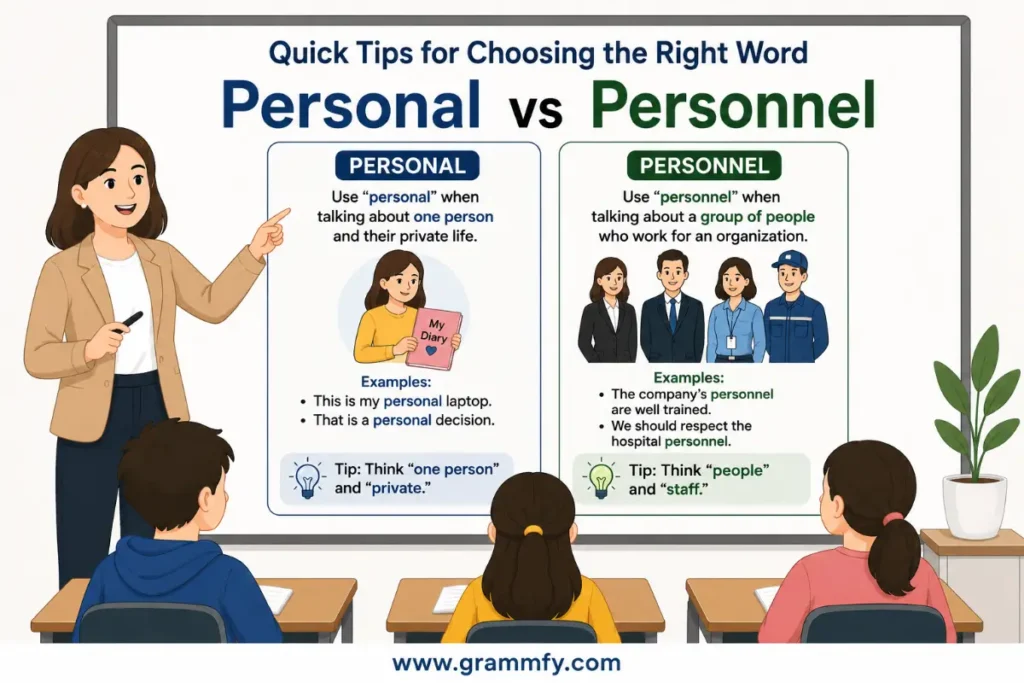
Quick Tips for Choosing the Right Word
Remember these simple rules whenever you’re unsure about eminent vs imminent.
- Ask yourself if you’re talking about a person or an event.
- If it’s a respected or famous person, choose eminent.
- If something is about to happen, choose imminent.
- Think Excellent = Eminent.
- Think Immediate = Imminent.
- If you can replace the word with well-known, use eminent.
- If you can replace it with very soon, use imminent.
- Read the sentence aloud. The correct choice often sounds more natural.
Conclusion
Understanding eminent vs imminent is easier once you focus on what each word describes. Eminent refers to a person who is respected, accomplished, or widely admired for their expertise. Imminent, on the other hand, describes an event or situation that is expected to happen very soon. Although the words look and sound similar, they are never interchangeable. A simple memory trick—Excellent equals eminent and Immediate equals imminent—can help you choose the right word every time. The more you read and practice using these words in real-life sentences, the more natural they will become. With these tips, examples, and comparisons, you’ll be able to use both words accurately and confidently in essays, emails, conversations, and professional writing.
Frequently Asked Questions
What is the difference between eminent and imminent?
The difference is simple. Eminent vs imminent comes down to meaning: eminent describes someone who is respected or famous, while imminent describes something that is about to happen very soon.
Is eminent used only for people?
Mostly, yes. Eminent usually describes people who are respected for their knowledge, achievements, or influence. It can occasionally describe institutions or positions, but that’s much less common.
Can imminent describe a person?
No. Imminent describes events, situations, or actions that will happen soon—not people.
What’s another way to say eminent?
Some common alternatives include respected, renowned, distinguished, prominent, celebrated, and well-known. Choose the synonym that best fits your sentence.
What’s another way to say imminent?
You can often use soon, approaching, near, forthcoming, impending, or about to happen depending on the context.
Which word is used more often in everyday English?
Imminent appears more often in news reports and formal writing, while eminent is commonly used when discussing respected professionals, experts, or historical figures.
How can I easily remember eminent vs imminent?
Think of Excellent = Eminent and Immediate = Imminent. This memory trick makes eminent vs imminent much easier to remember.
