
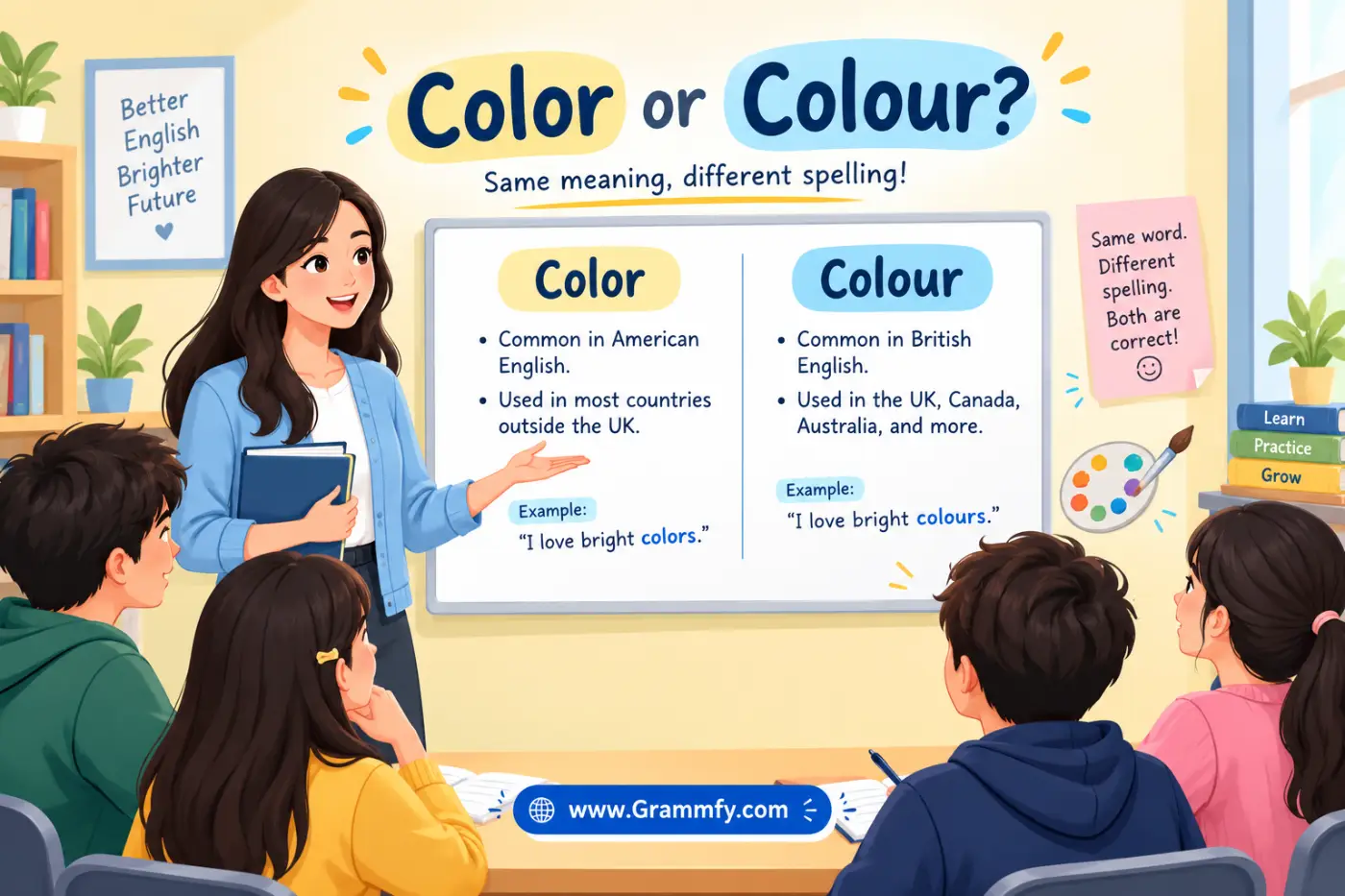
Have you ever typed a sentence for an email, essay, resume, or text and paused over Color or Colour? Both spellings look correct, and both have the same meaning. The difference isn’t about grammar or meaning. It mainly depends on which variety of English you’re using.
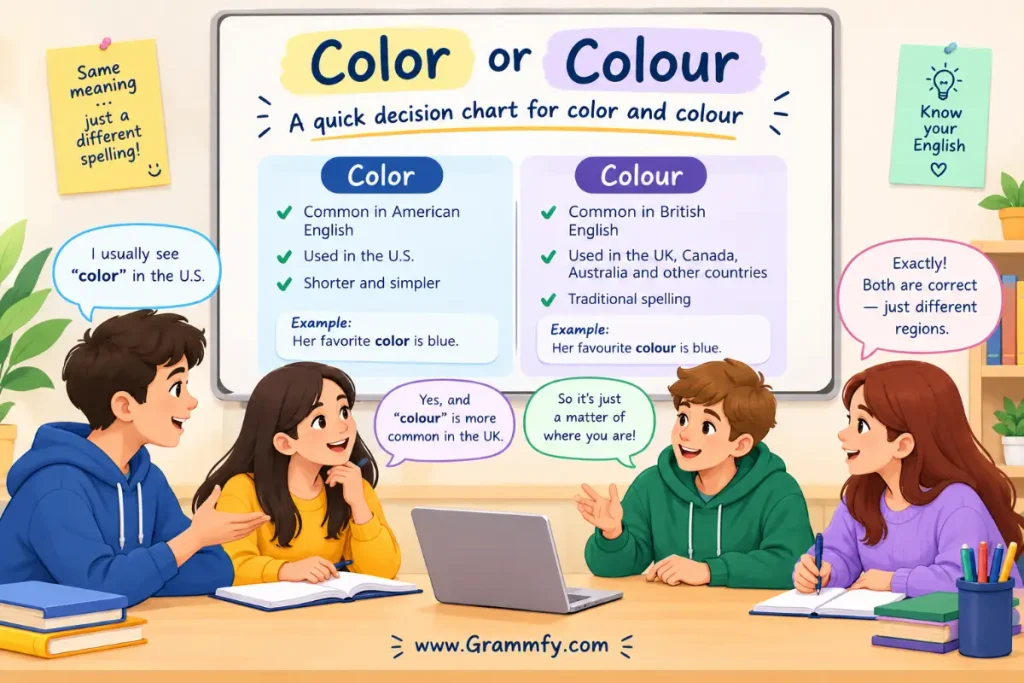
Color is the standard spelling in American English, while colour is the standard spelling in British English and several other varieties of English. Neither spelling is wrong when it matches the English variety you’re following.
Answer: Color is the American English spelling, while colour is the British English spelling. Both words mean the same thing.
The difference becomes important when you’re writing for a specific audience. A US resume, school assignment, or website will usually use color, while a document intended for readers in the UK will normally use colour. Consistency matters more than choosing one spelling as universally correct.
This guide explains the history behind the two spellings, their meanings, related vocabulary, regional differences, common mistakes, useful examples, and the best choice for resumes, essays, emails, texts, and everyday conversation.
If you want more examples of commonly confused words, explore [Sale vs Sell].
What is the difference between color and colour?
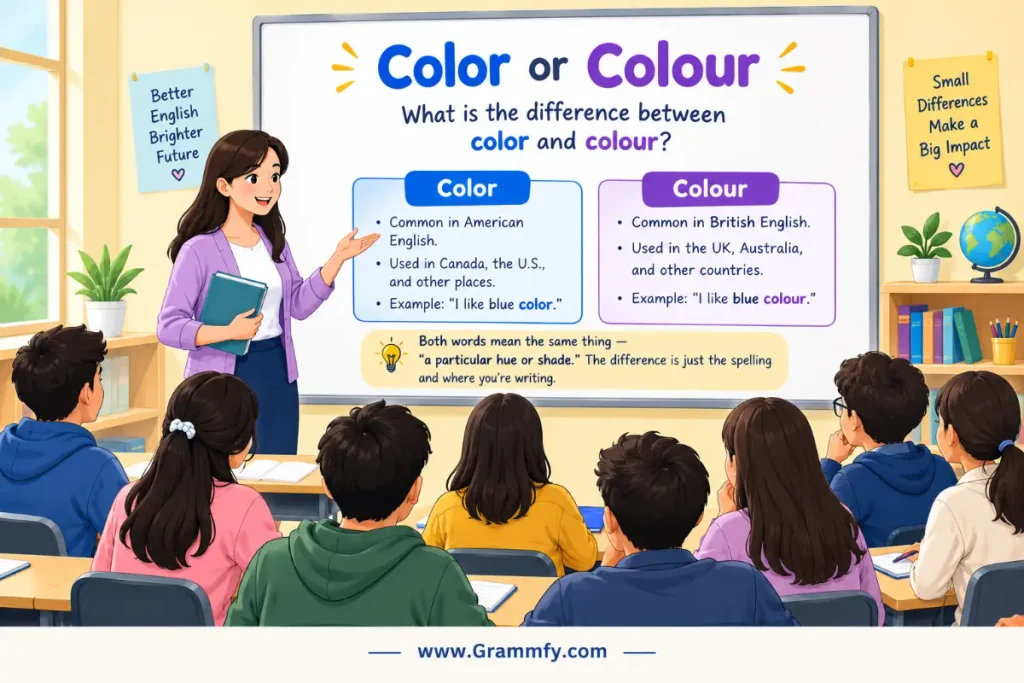
The main difference between color or colour is spelling, not meaning.
| Spelling | Main variety | Example |
|---|---|---|
| Color | American English | I like the color blue. |
| Colour | British English | I like the colour blue. |
Both versions describe the visual quality we see when light interacts with an object. They can also be used in expressions such as:
- favorite color
- bright color
- dark color
- color scheme
- color palette
- color combination
- primary colors
- natural colors
British English uses the same expressions but normally adds the u:
- favourite colour
- bright colour
- dark colour
- colour scheme
- colour palette
- colour combination
- primary colours
- natural colours
The meaning doesn’t change when the spelling changes.
Is color or colour correct?
Both are correct. Color is correct in American English, while colour is correct in British English and other English varieties that follow British spelling conventions.
For example:
The color of the wall is beautiful.
is standard American English.
The colour of the wall is beautiful.
is standard British English.
The important rule is to follow the spelling system used by your audience.
Why does American English use “color” without the u?
The shorter American spelling comes from historical spelling preferences that became common in the United States.
English spelling was not always completely fixed. Different writers and dictionaries used different forms. During the development of American English, spelling reformers favored some shorter forms, especially words ending in -our.
Examples include:
| British English | American English |
|---|---|
| colour | color |
| honour | honor |
| favour | favor |
| labour | labor |
| neighbour | neighbor |
| humour | humor |
| behaviour | behavior |
American English generally dropped the u in these words.
The change doesn’t mean that Americans pronounce the word differently in normal speech. The main difference is written spelling.
Where did the word color come from?
The word has a long history. It entered English through Old French and ultimately traces back to Latin color, meaning appearance, hue, or complexion.
British English developed the spelling colour, influenced by French spelling traditions. American English later favored the shorter color form.
This history explains why the two spellings look different even though they are clearly related.
You don’t need to memorize the historical details to use the word correctly. A simple regional rule is enough:
US English → color
UK English → colour
What does color mean in plain English?
Color means the visual appearance of something based on the light it reflects or emits.
Common examples include:
- red
- blue
- green
- yellow
- orange
- purple
- black
- white
- brown
- pink
You can use the word for physical objects:
The color of my shirt is blue.
It can also describe design:
The website uses a warm color palette.
The word has several figurative meanings too.
Color can mean character or interest
In some contexts, color means something that makes a story, event, or person more interesting.
The details added color to the story.
Color can describe a person’s complexion
The word may describe changes in someone’s face:
A color came to her cheeks.
This use is less common in everyday modern English than the basic meaning related to visual appearance.
Color can refer to a team or organization
A sports team may have official colors.
The team’s colors are blue and white.
Schools, clubs, and organizations can also have official colors.
What does colour mean in plain English?
Colour has the same meanings as color. The only major difference is the spelling used in British English and related varieties.
For example:
What is your favorite colour?
A British writer would normally write:
What is your favourite colour?
An American writer would write:
What is your favorite color?
Notice that the regional difference can affect more than one word in the same sentence.
What are the best synonyms for color?
The best synonym depends on what you mean. A word describing a specific visual shade may need a different alternative from a word describing personality, style, or interest.
Master synonym list
| Word | Meaning | Tone | Example |
|---|---|---|---|
| Hue | A particular shade or color | Neutral/formal | The wall has a warm hue. |
| Shade | A variation of a color | Everyday | Choose a darker shade. |
| Tone | A variation or quality of a color | Neutral | This tone works well with gray. |
| Dye | Substance used to color material | Everyday/technical | The fabric was treated with dye. |
| Tinge | A small amount of a color | Everyday | The sky had a pink tinge. |
| Stain | A mark or color left on a surface | Everyday | Coffee left a brown stain. |
| Pigmentation | Natural or applied coloring | Formal/technical | Skin pigmentation varies. |
| Brightness | How light or vivid a color appears | Neutral | Adjust the brightness of the image. |
| Vibrancy | Strength and liveliness of a color | Descriptive | The painting has great vibrancy. |
| Saturation | Strength or purity of a color | Technical | Increase the saturation slightly. |
| Palette | A selected group of colors | Design/art | The designer chose a soft palette. |
| Look | Overall visual style | Casual | I like the new look. |
| Style | A particular visual approach | Everyday/formal | Her style uses bold colors. |
| Vividness | Quality of being strong and bright | Formal/descriptive | The image has unusual vividness. |
| Shade | A darker variation of a color | Everyday | This shade of green is popular. |
| Tint | A lighter variation of a color | Technical | Add a white tint to the paint. |
| Tone | A modified or balanced version of a color | Neutral | The gray tone looks calm. |
| Accent | A color used to draw attention | Design/business | Gold works as an accent color. |
| Flair | A distinctive style or visual touch | Casual/descriptive | The bright sign adds flair. |
Some of these terms are close to color, but they aren’t exact replacements in every sentence.
For instance, hue usually refers to a particular color or shade, while palette refers to a collection of colors.
What are color synonyms from mild to strong?
Color vocabulary can also describe intensity.
Mild or subtle
Use these when the color is soft or barely noticeable:
- hint
- tinge
- touch
- wash
- pale shade
- soft tone
- muted hue
Example:
There was a slight tinge of pink in the sky.
Medium intensity
These words work for normal descriptive writing:
- shade
- hue
- tone
- tint
- pigment
- color
Example:
The designer selected a warm shade of brown.
Strong or vivid
These words suggest a noticeable visual effect:
- vivid
- bright
- bold
- brilliant
- vibrant
- intense
- saturated
Example:
The artist used vibrant colors throughout the painting.
The choice depends on the effect you want. Color is neutral, while vibrant gives the reader more information about intensity.
What are the parts of speech related to color?
Color can work as a noun and a verb in English.
Color as a noun
This is the most common use.
Blue is my favorite color.
The color of the car is unusual.
Color as a verb
In American English, color can also mean to add color to something.
Children like to color pictures.
She colored the drawing with crayons.
British English usually uses colour as the verb too:
The children like to colour pictures.
Color as an adjective-like modifier
English often places color before another noun to describe a type or purpose.
Examples:
- color printer
- color photo
- color chart
- color theory
- color palette
- color scheme
- color blindness
British English usually changes these to:
- colour printer
- colour photo
- colour chart
- colour theory
- colour palette
- colour scheme
- colour blindness
Does color become colour in British English?
Yes. British English normally uses colour wherever American English uses color.
The same spelling pattern appears in many related words.
| American English | British English |
|---|---|
| color | colour |
| colored | coloured |
| coloring | colouring |
| colorful | colourful |
| discolor | discolour |
| discoloration | discolouration |
For example:
American:
The artist used colorful patterns.
British:
The artist used colourful patterns.
The underlying meaning remains the same.
What is the difference between color and colour in the US and UK?
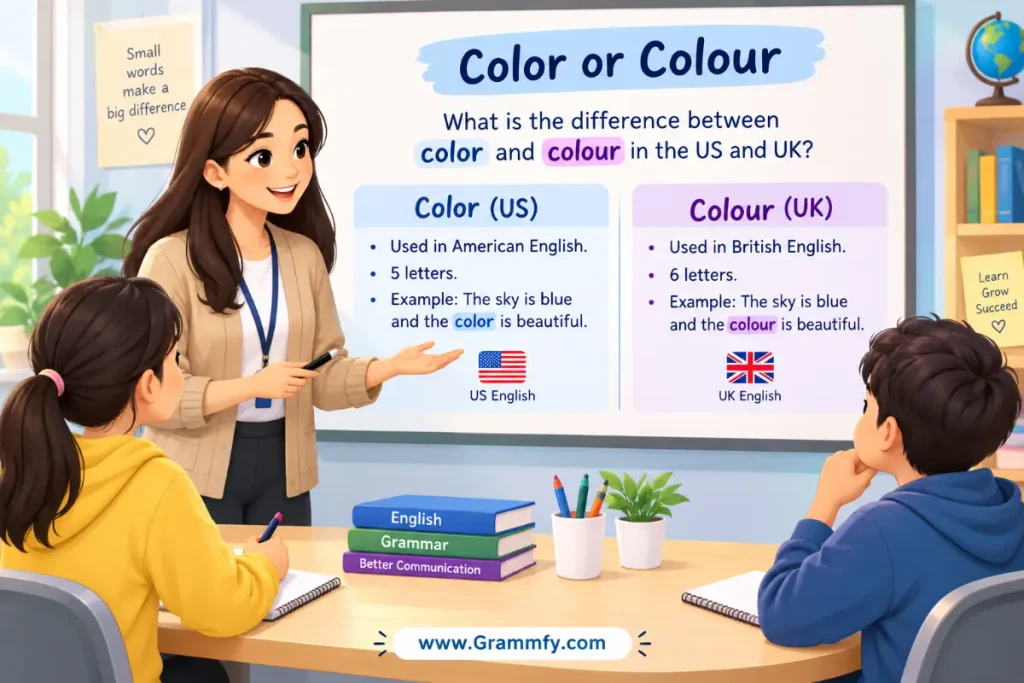
The US and UK use different spelling conventions for this word.
American English generally prefers color.
British English generally prefers colour.
Canadian, Australian, and New Zealand English commonly follow British-style spelling for this word, although regional usage can vary in some settings.
If your audience is American, use:
color
If your audience is British, Australian, or generally following British spelling, use:
colour
A consistent style is the most important thing.
Which spelling should you use in a resume?
For a US resume, use color.
Example:
Created a consistent color palette for marketing materials.
For a UK resume, use colour.
Example:
Created a consistent colour palette for marketing materials.
Don’t mix the two systems without a reason. A resume can look less polished if one sentence says color and another says colour.
US resume example
Designed social media graphics using a consistent color scheme.
UK resume example
Designed social media graphics using a consistent colour scheme.
The professional meaning is identical.
Which spelling is best for an essay?
The correct choice depends on the required English variety.
American school essay
The author uses color to symbolize different emotions.
British school essay
The author uses colour to symbolize different emotions.
If your teacher, school, publisher, or assignment specifies a style, follow that requirement.
When no special instruction is given, use the spelling expected by your educational system.
Which spelling should you use in texting?
In casual texting, either spelling may appear, but your choice often reflects the English variety you normally use.
An American texter might write:
What color should I get?
A British texter might write:
What colour should I get?
Both are completely understandable.
Texting doesn’t remove the regional spelling difference. It simply makes people less concerned about strict spelling.
Which spelling is best in an email?
Use the spelling that matches your audience.
For an American client:
Could you confirm which color you prefer?
For a British client:
Could you confirm which colour you prefer?
A professional email should ideally use one consistent spelling system throughout.
Which spelling should you use when speaking?
There is no spelling choice when speaking because color and colour are pronounced essentially the same in standard varieties of English.
You hear the difference mainly in writing.
For example, an American speaker and a British speaker can both say:
What color is it?
The written forms may differ, but the spoken word is very similar.
This is why English learners sometimes find the distinction confusing: there is no obvious pronunciation clue telling you which spelling to write.
What are common mistakes with color and colour?
Mistake 1: Thinking one spelling is wrong
Incorrect assumption:
“Colour is wrong because I learned American English.”
That’s not correct.
Colour is standard British English.
Likewise, color is not wrong simply because a British writer normally uses colour. It is standard American English.
Mistake 2: Mixing spelling systems
A writer might use:
color, favourite, centre, and organise
This combination mixes American and British conventions.
For a US document, a more consistent version would be:
color, favorite, center, and organize
For a UK document, it would generally be:
colour, favourite, centre, and organise
The exact UK spelling of some words can vary, but consistency should be your goal.
Mistake 3: Writing “colur”
A common typing mistake is:
colur
The correct spellings are:
color
or
colour
Mistake 4: Adding the u in American English
If you’re writing specifically for a US audience, colour may look inconsistent with the rest of an American English document.
Use:
color
Mistake 5: Removing the u in British English
If you’re writing specifically for a British audience, use:
colour
rather than:
color
The issue isn’t grammar. It’s regional spelling.
When should you NOT use color or colour?
Don’t use either word when a more precise term describes what you actually mean.
For example, if you’re talking about a specific variation, shade may be better.
Instead of:
I like this color.
You could say:
I like this shade of blue.
If you’re discussing a technical printing process, pigment or saturation might be more accurate.
For a design project, palette or color scheme may communicate the idea more clearly.
Choosing a precise word makes your writing stronger without making it complicated.
What are the antonyms of color?
There isn’t one perfect opposite of color in every situation.
Depending on the context, possible opposites include:
- colorlessness
- dullness
- monochrome
- grayscale
- absence of color
In photography, black and white or grayscale may contrast with color photography.
Example:
The magazine offers both color and black-and-white photographs.
In design, monochromatic can describe something using variations of one color rather than multiple colors.
Color vs hue: what’s the difference?
Color is the broad term. Hue usually refers to a specific type or family of color.
| Color | Hue |
|---|---|
| Broad everyday term | More specific term |
| Common in normal conversation | Common in art and design |
| “What color is the wall?” | “The hue is slightly green.” |
For everyday writing:
What color is your car?
sounds more natural.
In technical design writing:
The hue has been adjusted toward blue.
may be more precise.
Color vs shade: what’s the difference?
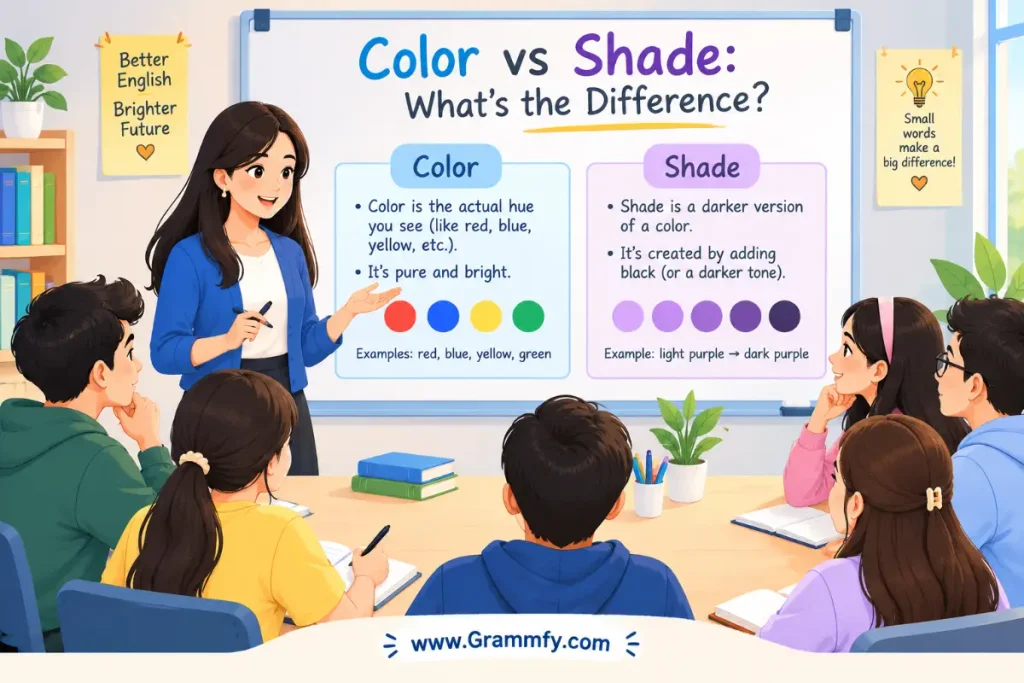
A shade is a variation of a color, often a darker version.
For example:
Blue is a color.
Navy is a shade of blue.
The word shade is useful when you want to identify a particular variation.
Compare:
I like this color.
I like this shade of blue.
The second sentence gives more specific information.
Color vs tint: what’s the difference?
A tint is generally a lighter version of a color.
For example:
Pink can be viewed as a tint of red.
In art and design, the distinction between tint, shade, and tone can be important.
A simple way to remember them is:
- Tint → lighter
- Shade → darker
- Tone → modified or softened
These terms can have more technical definitions in different fields, so don’t treat the shortcut as a complete color-theory rule.
Color vs tone: what’s the difference?
Tone can refer to a modified version of a color, but it also has many unrelated meanings.
For example:
The designer chose a warm gray tone.
But:
Her voice had a serious tone.
Here, tone means attitude or quality of sound, not a visual color.
This is a good example of why context matters when choosing synonyms.
Color vs palette: what’s the difference?
A palette is a collection or range of colors selected for a particular design, painting, brand, or project.
For example:
The website uses a blue and green color palette.
You wouldn’t normally replace color with palette in a basic sentence.
Incorrect:
What palette is your shirt?
Better:
What color is your shirt?
The word palette is most useful when you’re discussing a group of selected colors.
What are 15+ original example sentences with color and colour?
- Blue is my favorite color.
- The designer chose a soft color palette for the website.
- Which color would look best on this wall?
- The painting uses bright colors to create energy.
- She added a splash of red color to the design.
- The team wears blue and white as its official colors.
- This photograph has a warm color tone.
- Children used crayons to color the picture.
- The store lets customers choose the color of the product.
- A British reader may expect the spelling colour.
- The room has a calm colour scheme.
- Which colour do you prefer for the logo?
- The artist used several shades of green in the colour palette.
- The autumn leaves changed colour during the season.
- She used bright colours to decorate the classroom.
- The designer adjusted the colour balance in the photograph.
- The flag contains three main colours.
- His jacket was a deep colour that stood out in the crowd.
- The website uses a simple colour scheme.
- American writers generally spell the word color.
How do you remember the American spelling?
A simple memory trick is:
Color = US English
You can connect the shorter spelling with the United States.
Another way is to remember the larger pattern:
- US: color
- UK: colour
Then apply the same idea to related words:
- US: colorful
- UK: colourful
If you’re writing for an American audience, the missing u is expected.
How do you remember the British spelling?
Think:
Colour has the extra “u.”
British English keeps the traditional-looking -our ending in many words.
Examples:
- colour
- honour
- favour
- labour
- neighbour
- humour
This doesn’t mean every British spelling differs from American spelling. Many words are identical. The difference appears in certain groups of words.
What other words follow the same color/colour pattern?
The spelling difference belongs to a larger group.
| American | British |
|---|---|
| color | colour |
| colorful | colourful |
| colored | coloured |
| coloring | colouring |
| honor | honour |
| honorable | honourable |
| favor | favour |
| favorite | favourite |
| labor | labour |
| neighbor | neighbour |
| humor | humour |
| behavior | behaviour |
Learning the pattern can help you recognize regional spelling choices in other words.
How does the spelling affect SEO?
For SEO, both versions can matter if people search for both spellings.
A website targeting US readers will usually use color as its main spelling. A website targeting UK readers may prefer colour.
Search engines are generally able to understand that the two forms refer to the same concept. You don’t need to awkwardly repeat both forms in every paragraph.
Instead, write naturally for your target audience.
For example, a US-focused article can use:
Color theory helps designers choose effective combinations.
A UK-focused article can use:
Colour theory helps designers choose effective combinations.
If your website serves an international audience, you can mention the regional difference naturally once or twice.
Should you use color or colour on a US website?
Use color if your website primarily targets American readers.
Other American spellings should generally follow the same style.
For example:
favorite color
is consistent American English.
A mixed phrase such as:
favourite color
combines British spelling for favourite with American spelling for color.
That isn’t always confusing, but it may look inconsistent in a polished article.
Should you use color or colour on a UK website?
Use colour if your website primarily targets British readers.
For example:
favourite colour
matches common British spelling.
The same principle applies to related words:
colourful
rather than:
colorful
When writing for an international audience, consider which regional style best matches your site’s main readers.
What should international writers do?
International writers don’t need to worry about choosing the “more correct” spelling. There isn’t a universal winner.
Instead, identify your audience.
If your audience is mainly American
Choose:
- color
- favorite
- center
- organize
If your audience is mainly British
Choose:
- colour
- favourite
- centre
- organise
If your audience is mixed
Pick a consistent editorial style and use it throughout the document.
The most professional-looking writing is usually consistent writing.
Quick tips for choosing the right spelling
Use these simple rules:
- Writing for the US? Use “color.”
- Writing for the UK? Use “colour.”
- Writing for Australia or New Zealand? British-style “colour” is generally standard.
- Follow your school’s required style.
- Follow your employer’s style guide.
- Don’t switch between spellings randomly.
- Remember that the meaning is the same.
- Use “hue” for a more specific color term when appropriate.
- Use “shade” for a particular variation of a color.
- Use “palette” for a selected group of colors.
A quick decision chart for color and colour
| Your situation | Best choice |
|---|---|
| US school assignment | color |
| US resume | color |
| US business email | color |
| US website | color |
| UK school assignment | colour |
| UK resume | colour |
| UK business email | colour |
| UK website | colour |
| Casual US text | color |
| Casual UK text | colour |
| Spoken English | Same pronunciation; spelling isn’t heard |
Which word is best by context?
For a resume
Use color for US English and colour for UK English.
Designed a modern color palette for company branding.
For an essay
Follow the English variety required by your school or teacher.
The author uses color to represent different emotions.
For texting
Use whichever regional spelling you normally use.
What color should we choose?
For an email
Match the spelling to the recipient or organization.
Please let me know which color you prefer.
For speaking
The spelling doesn’t matter because you’re saying the word aloud.
What color is the new logo?
Why consistency matters more than the spelling choice
A reader usually won’t misunderstand color because they use colour, or vice versa. The words are closely related and widely recognized.
However, inconsistent spelling can make formal writing look careless.
Imagine a report that uses:
color, favourite, centre, and organize
A reader may notice that the writer is switching between different spelling systems.
A consistent version looks cleaner:
color, favorite, center, and organize
or:
colour, favourite, centre, and organise
The goal isn’t to prove that one variety is better. The goal is to use the style that fits your audience.
Conclusion
Choosing between Color or Colour is mostly a matter of regional English, not grammar. American English uses color, while British English uses colour. Other varieties, including Australian and New Zealand English, commonly follow the British spelling. The meaning stays the same, so the real goal is consistency.
Use color for US-focused resumes, essays, websites, and professional documents. Choose colour when you’re following British spelling conventions. When you’re writing for an international audience, select one style based on your main readers and stick with it.
You can also choose more precise words such as hue, shade, tint, or palette when the context calls for them. Once you connect the spelling to the English variety you’re using, this small spelling difference becomes easy to handle.
Frequently Asked Questions
Is color or colour the correct spelling?
Both spellings are correct. Color is standard American English, while colour is standard British English and is also common in several other varieties.
What is the difference between color and colour?
The difference is mainly regional spelling, not meaning. American English uses color, while British English uses colour.
Is “colour” wrong in American English?
No, it isn’t a meaningless or incorrect word, but it is not the standard American spelling. US writing normally uses color.
Is “color” wrong in British English?
No, British readers understand color, but standard British spelling normally uses colour. Formal British writing should generally follow the local convention.
What’s another way to say color?
Common alternatives include hue, shade, tint, tone, pigmentation, tinge, palette, and pigment. The best choice depends on the exact meaning.
Which spelling should I use in a US resume?
Use color in a US resume. Keeping related American spellings consistent can make the document look more polished.
Why does British English spell colour with a u?
The spelling developed through the history of English and French influence, while American English later favored shorter spellings in several -our words. Both forms have the same basic meaning.

1 thought on “Color or Colour: Best Guide to the Spelling Difference”