
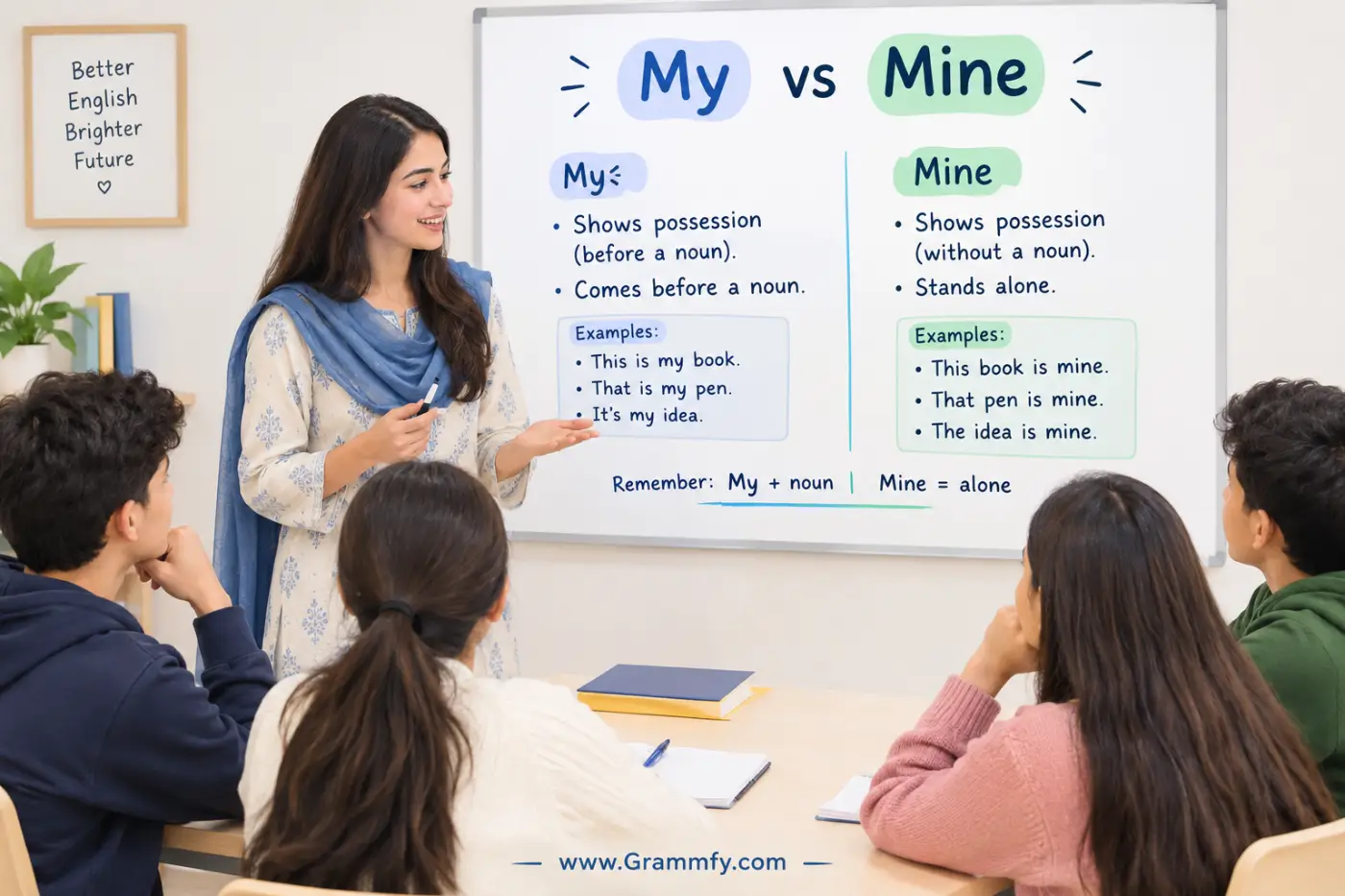
You’re writing a text, email, essay, or school assignment when you stop at a simple sentence: “This is ___ book.” Should you write my vs mine? The answer is easy once you know what comes after the word. These two forms both show possession, but they have different grammatical jobs.
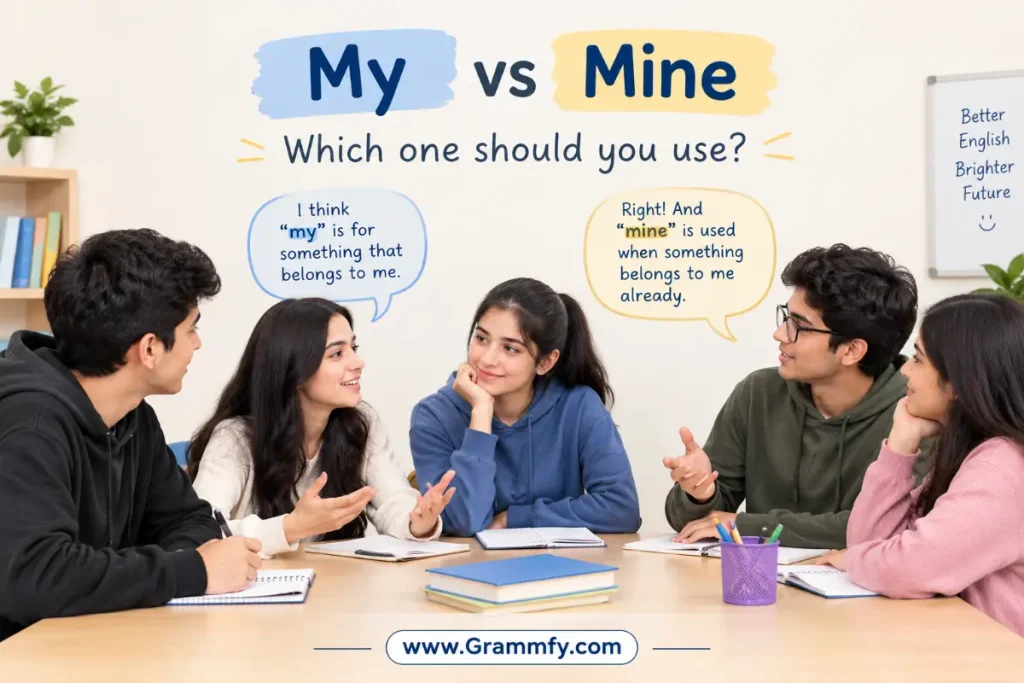
My comes before a noun, while mine usually stands alone and replaces a noun phrase. You can say “This is my book,” but you should say “This book is mine.” The meaning is similar, but the sentence structure is different.
Answer box: Use my before a noun: “my phone.” Use mine when the noun is already understood: “The phone is mine.”
Learning My vs Mine can also help you understand other possessive pairs, such as your/yours, our/ours, and their/theirs. This guide explains the difference, word history, grammar rules, common mistakes, real-life examples, formal and casual use, and easy ways to remember the correct form.
You may also want to learn the difference between [Fair vs Fare].
What is the difference between My vs Mine?
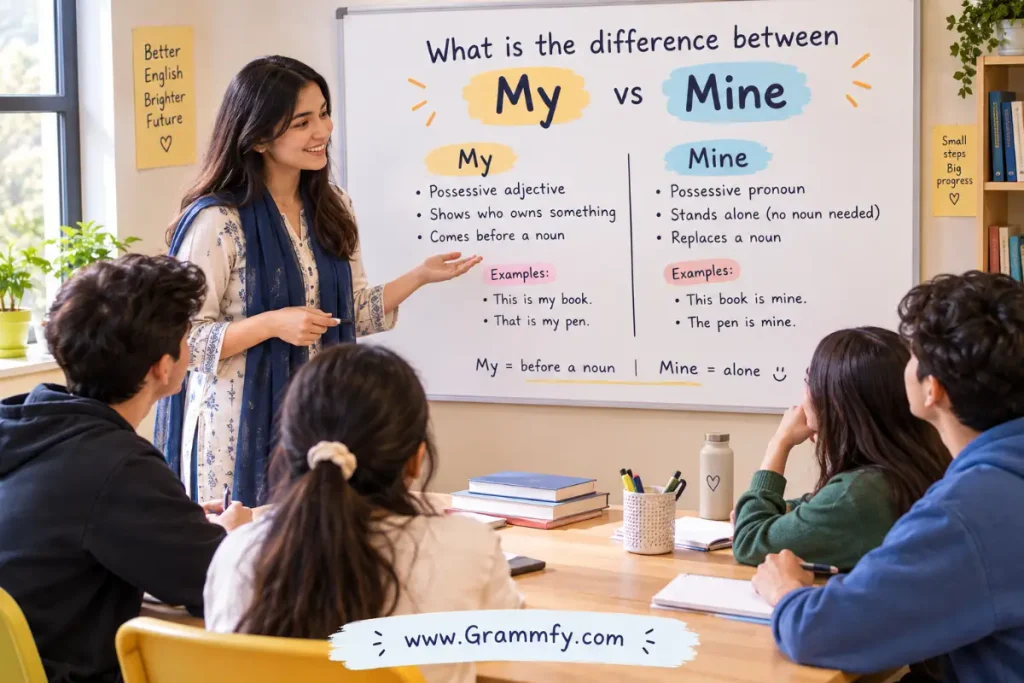
The main difference is their position in a sentence.
My is a possessive determiner. It comes before a noun and tells us that the noun belongs to or is connected with the speaker.
Examples:
my phone
my house
my friend
my idea
my car
Mine is a possessive pronoun. It usually stands alone and takes the place of a noun phrase.
Examples:
The phone is mine.
The house is mine.
She is a friend of mine.
The idea was mine.
That car is mine.
The easiest rule is:
my + noun
noun + mine
Consider these two sentences:
This is my jacket.
This jacket is mine.
Both sentences tell us that the jacket belongs to the speaker. The difference is that my is attached to the noun, while mine replaces the complete phrase “my jacket.”
| Word | Grammar role | How it works | Example |
|---|---|---|---|
| My | Possessive determiner | Comes before a noun | My bag is new. |
| Mine | Possessive pronoun | Stands in place of a noun phrase | The bag is mine. |
This distinction is the key to using both forms correctly.
What does my mean in simple English?
My shows that something belongs to, comes from, relates to, or is connected with the person speaking.
The word doesn’t always mean physical ownership.
For example:
My brother lives in Texas.
Your brother isn’t your property. Here, my shows a family relationship.
You can also say:
My teacher explained the lesson.
The teacher isn’t owned by you. The word identifies your relationship with that person.
Other examples include:
my opinion
my responsibility
my experience
my decision
my mistake
These expressions show a connection rather than physical ownership.
The basic pattern remains the same. My appears before the noun or noun phrase.
How is My used before a noun?
The simplest structure is:
my + noun
Examples include:
my book
my computer
my sister
my job
my school
my question
Adjectives can come between my and the noun.
For example:
my new computer
my favorite book
my old friend
my first job
The rule doesn’t change:
my + adjective + noun
A sentence might say:
I brought my new laptop to class.
Here, my tells us whose laptop it is.
What does mine mean in simple English?
Mine also shows possession or connection, but it normally replaces the noun phrase.
Consider:
This is my jacket.
You can avoid repeating the noun by saying:
This jacket is mine.
The word mine represents the meaning of my jacket.
More examples include:
This seat is mine.
That phone is mine.
The blue bag is mine.
Those books are mine.
The final decision was mine.
In each sentence, the noun is either already mentioned or clearly understood.
Why does mine stand alone?
Possessive pronouns are useful because English speakers don’t need to repeat a noun when everyone already knows what they’re discussing.
Imagine someone asks:
Which laptop is yours?
You can answer:
The black one is mine.
You don’t need to say:
The black one is my laptop.
The shorter answer sounds natural because the word laptop is already understood.
This is one of the main jobs of mine.
Where did My vs Mine come from?
The modern words my and mine developed from older English possessive forms connected with the first-person pronoun I.
English has changed greatly over many centuries. Old English used several forms to express relationships such as possession. As the language developed, those forms changed in spelling, pronunciation, and grammatical use.
Modern English eventually settled on my as the usual form before nouns and mine as the independent possessive form.
This pattern is still visible in other possessive pairs:
| Before a noun | Independent form |
|---|---|
| my | mine |
| your | yours |
| her | hers |
| our | ours |
| their | theirs |
Some forms, such as his, remain the same in both positions:
his car
The car is his.
The difference between my and mine is therefore part of a larger English pronoun system.
Why does mine have an “n”?
The form mine comes from an older possessive form. Historical sound and grammar changes eventually gave English the short form my before nouns and the independent form mine.
You don’t need to memorize the history to use the words correctly. Still, knowing that the forms have different grammatical roles helps explain why English doesn’t normally allow “mine car” in modern standard usage.
Is my a possessive adjective or possessive determiner?
You may see my described in two different ways.
Traditional grammar books often call my a possessive adjective.
Modern grammar commonly calls it a possessive determiner.
Both labels may appear in English-learning materials, but possessive determiner is more precise in modern grammatical descriptions.
For everyday learning, the label isn’t the most important part. The useful rule is:
My comes before a noun.
Examples:
my phone
my mother
my idea
my responsibility
my favorite song
If you’re learning English, focus first on the sentence pattern. The grammar label can come later.
Is mine a possessive pronoun?
Yes. Mine is a possessive pronoun because it can replace a noun phrase that expresses possession.
Compare:
This is my phone.
This phone is mine.
The first sentence contains the noun phone after my.
The second sentence uses mine instead of repeating my phone.
Another example:
Your answer is correct, but my answer is different.
You can avoid repeating the noun:
Your answer is correct, but mine is different.
Here, mine means my answer.
That ability to replace a noun phrase is what makes mine a possessive pronoun.
What is the easiest rule for My vs Mine?
Use this simple test whenever you’re unsure.
If a noun comes after the word, use my
Correct:
my car
my room
my sister
my question
my shoes
my project
If the noun is already understood, use mine
Correct:
The car is mine.
The room is mine.
The shoes are mine.
The project is mine.
That question is mine.
A short memory trick is:
MY needs a noun.
MINE replaces a noun.
This isn’t a rule without exceptions in historical or poetic English, but it’s the right rule for normal modern English.
Can you say “mine book”?
No, not in normal modern English.
You should say:
my book
Not:
mine book
Other incorrect examples include:
mine car
mine phone
mine house
mine friend
The standard forms are:
my car
my phone
my house
my friend
The word mine normally comes after the noun or stands independently.
For example:
This car is mine.
That phone is mine.
The house is mine.
He is a friend of mine.
What about the old phrase “mine eyes”?
You may see mine before a noun in older writing, poetry, religious texts, or deliberately old-fashioned language.
Examples such as “mine eyes” reflect older English usage, especially before vowel sounds.
Modern everyday English normally uses:
my eyes
my idea
my answer
my apartment
So, if you’re writing a school assignment, email, article, or everyday message, use my before a noun.
Can you say “this is my”?
Usually, no, if you are trying to end the sentence with a possessive.
For example:
This is my.
sounds incomplete.
The natural alternatives are:
This is my book.
or:
This book is mine.
The first sentence gives the noun after my.
The second sentence uses mine because the noun has already been identified.
A similar mistake appears in comparisons:
Her car is faster than my.
This should be:
Her car is faster than mine.
The word mine replaces my car.
Can you say “mine is”?
Yes, when the noun is understood.
For example:
My car is outside, but mine is cleaner.
Here, mine means my car.
Another example:
Your computer is on the desk. Mine is in the bag.
The listener knows that mine means my computer.
This structure is especially common when comparing two or more things.
Your house is larger than mine.
Her phone is newer than mine.
Their team is stronger than mine.
The noun doesn’t need to be repeated because the context makes it clear.
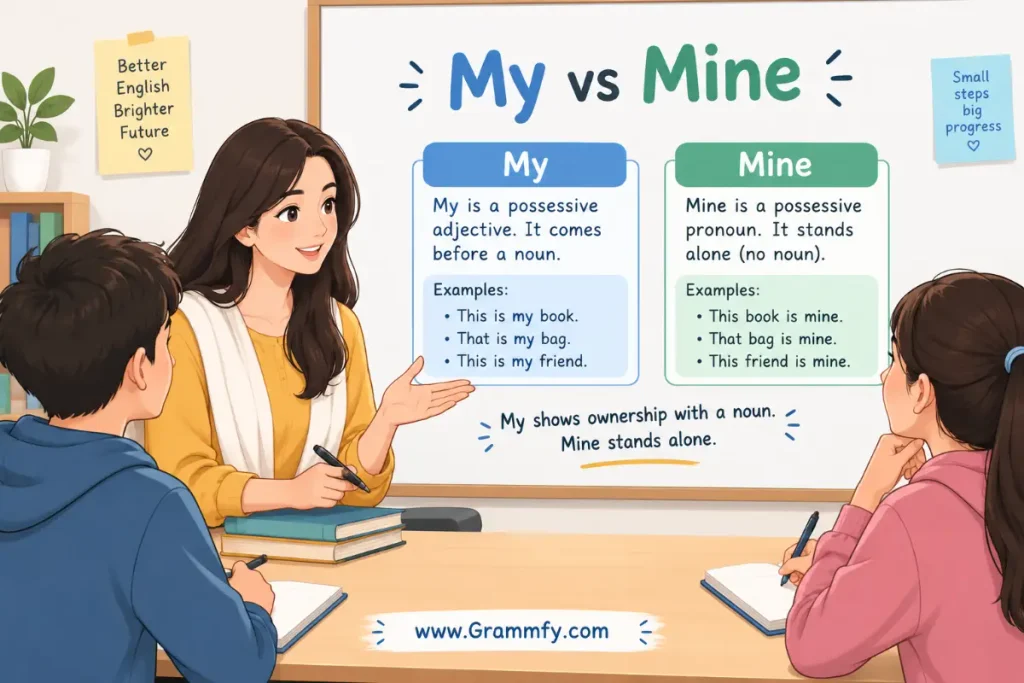
What are the basic examples of my?
Here are real-life examples using my.
- My phone is on the table.
- I forgot my wallet at home.
- My brother starts college this fall.
- She borrowed my jacket.
- We discussed my project yesterday.
- My teacher gave us extra practice.
- I need to finish my homework.
- My parents are visiting this weekend.
- He asked for my opinion.
- My favorite restaurant is nearby.
- I can’t find my keys.
- My computer needs an update.
- She read my email.
- My manager approved the request.
- I changed my answer.
- My dog is sleeping outside.
- We missed my usual bus.
- My room needs cleaning.
- I called my friend after work.
- My decision surprised everyone.
Notice that each example uses my before a noun or noun phrase.
What are the basic examples of mine?
Now look at sentences using mine.
- That phone is mine.
- The black jacket is mine.
- This seat is mine.
- Those books are mine.
- The blue car is mine.
- The final decision was mine.
- This notebook is mine.
- That desk is mine.
- The mistake was mine.
- Those headphones are mine.
- This idea is mine.
- The red umbrella is mine.
- That computer isn’t mine.
- The responsibility is mine.
- The small room is mine.
- These keys are mine.
- The final choice was mine.
- This opinion is mine.
- The old bicycle is mine.
- The black suitcase is mine.
The word mine stands independently rather than directly modifying the following noun.
How do My vs Mine work with singular nouns?
With singular nouns, the pattern is easy to see.
my book
becomes:
The book is mine.
Likewise:
my car
becomes:
The car is mine.
And:
my jacket
becomes:
The jacket is mine.
The noun follows my, but mine can replace the entire phrase.
| With my | With mine |
|---|---|
| My phone is new. | The phone is mine. |
| My house is large. | The house is mine. |
| My bag is black. | The bag is mine. |
| My seat is comfortable. | The seat is mine. |
This transformation is one of the best ways to practice the difference.
How do My vs Mine work with plural nouns?
The same rule applies to plural nouns.
Use my before the plural noun:
my books
my shoes
my friends
my ideas
Use mine when the noun phrase is replaced:
The books are mine.
The shoes are mine.
Those friends are mine.
The ideas are mine.
Notice something important: mine doesn’t change between singular and plural.
You can say:
The book is mine.
and:
The books are mine.
The possessive pronoun remains mine.
Can My vs Mine be used with abstract nouns?
Yes. Possession can describe ideas, feelings, decisions, duties, and experiences.
Examples include:
my opinion
my decision
my responsibility
my experience
my goal
my mistake
You can transform these into possessive-pronoun structures:
The decision was mine.
The responsibility was mine.
The mistake was mine.
The idea was mine.
Here, ownership is often figurative. The word describes who made, holds, or is responsible for something.
What is the difference between “my friend” and “a friend of mine”?
Both expressions are correct, but they can have a slightly different emphasis.
My friend often identifies a particular person.
My friend Sarah lives nearby.
A friend of mine means one person among the speaker’s friends.
A friend of mine recommended this book.
The second structure uses mine after of.
This pattern is completely natural:
a friend of mine
a colleague of mine
a neighbor of mine
an old teacher of mine
an idea of mine
You should not say:
a friend of my
The correct expression is:
a friend of mine
Why do we say “a friend of mine”?
The construction a friend of mine means one of my friends.
It is a common English structure.
Compare:
My friend called me yesterday.
A friend of mine called me yesterday.
The first sentence can point to a particular friend.
The second introduces the person as one member of the speaker’s group of friends.
Both are correct. The choice depends on what you want to emphasize.
This pattern also works with people who aren’t necessarily friends:
A colleague of mine works in Boston.
A neighbor of mine has a new puppy.
An old classmate of mine sent me a message.
How do My vs Mine work in questions?
The same grammatical rule applies to questions.
Use my before a noun:
Where is my phone?
Did you see my bag?
Is this my seat?
What happened to my order?
Use mine when the noun is already understood:
Is this phone mine?
Which bag is mine?
Is that seat mine?
Which one is mine?
For example, imagine several jackets are hanging by a door.
Someone asks:
Which jacket is yours?
You can answer:
The green one is mine.
There is no need to repeat the word jacket.
How do My vs Mine work in negative sentences?
Both forms can be used in negative sentences.
With my:
This isn’t my book.
That isn’t my phone.
These aren’t my shoes.
With mine:
This book isn’t mine.
That phone isn’t mine.
These shoes aren’t mine.
The negative word not doesn’t change the possessive rule.
If a noun comes directly after the possessive, use my.
If the noun is represented by the possessive pronoun, use mine.
How do My vs Mine work in comparisons?
Possessive pronouns are especially useful in comparisons.
Consider:
Your car is newer than my car.
The sentence is grammatically correct, but repeating car sounds unnecessary.
A smoother version is:
Your car is newer than mine.
Here, mine means my car.
More examples:
Her house is bigger than mine.
Your phone is more expensive than mine.
Their team is stronger than mine.
His answer was clearer than mine.
Your handwriting is neater than mine.
This is one of the most useful everyday uses of mine.
Is “mine” more formal than “my”?
No. The difference is grammatical rather than formal.
Both words are normal in casual speech, professional emails, academic writing, and everyday conversation.
For example:
My report is ready.
The report is mine.
Both are perfectly normal.
You don’t choose mine because you want to sound more formal. You choose it because the sentence requires an independent possessive.
Is my more common in everyday English?
You may see my frequently because people often introduce nouns.
For example:
my car
my house
my family
my job
my school
Mine becomes common when the noun is already known.
Examples:
That’s mine.
Which one is mine?
Yours is bigger than mine.
The frequency of each form depends on the sentence structure and situation.
How should you use My vs Mine in an email?
Professional emails often use my because writers discuss their work, questions, files, and responsibilities.
Examples:
I attached my report.
Please review my proposal.
My question concerns the second paragraph.
I have included my contact information.
Mine can also be useful:
The blue folder is mine.
The final draft is mine.
That responsibility is mine.
Neither word is too casual or too formal for professional communication.
How should you use My vs Mine in a resume?
A resume often avoids unnecessary first-person language, but my can still appear in some sentences.
For example:
Managed my team’s weekly schedule.
A more concise resume style might say:
Managed the team’s weekly schedule.
Mine is less common in standard resume bullet points because resumes usually focus on actions, skills, and achievements.
It could appear in a personal statement or explanation:
The project was mine from the original concept through completion.
The best choice depends on the sentence, not on the fact that the writing is a resume.
How should you use My vs Mine in an essay?
Both forms are grammatically correct in essays.
Examples:
My experience changed the way I viewed the problem.
The final conclusion was mine.
My research supports this argument.
The responsibility for the decision was mine.
Academic style guides or instructors may limit first-person language in some types of essays. That’s a style requirement, not a rule against my or mine.
If first-person writing is allowed, both forms are standard English.
How should you use My vs Mine in texting?
Texting doesn’t change the grammar.
You might write:
Where’s my phone?
Is this mine?
That’s my seat.
Which one is mine?
Don’t take my charger!
Short messages often depend heavily on context. That makes mine particularly useful because the speaker can leave out a noun that everyone already understands.
How should you use My vs Mine when speaking?
Both words are very common in spoken English.
Imagine two coworkers looking at identical notebooks.
One asks:
Is this your notebook?
The other replies:
No, mine is on the desk.
The noun notebook doesn’t need to be repeated.
Another conversation might sound like this:
Is this my seat?
No, that’s mine.
The surrounding situation makes the meaning obvious.
Natural conversation often uses possessive pronouns because repeating the same noun can sound awkward.
What is the difference between my, mine, and me?
These three words have different grammatical functions.
| Word | Function | Example |
|---|---|---|
| I | Subject | I wrote the email. |
| My | Possessive determiner | My email is ready. |
| Mine | Possessive pronoun | The email is mine. |
| Me | Object pronoun | She sent the email to me. |
Consider the complete pattern:
I wrote my report.
The report is mine.
My manager reviewed it.
She sent the comments to me.
Each word performs a different job.
Confusing these forms can create sentences that sound unnatural or incorrect, so learning them together is useful.
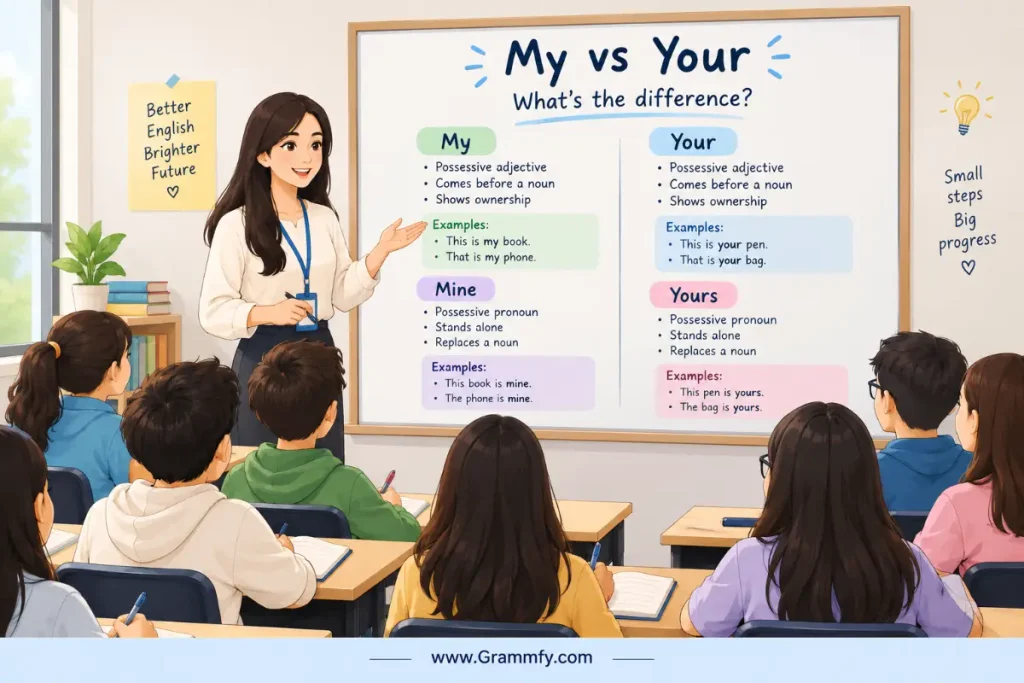
What are the difference between My and Your?
My shows possession by the speaker.
Your shows possession by the person being spoken to.
Examples:
This is my book.
This is your book.
Independent forms work the same way:
The book is mine.
The book is yours.
The pattern is:
my → mine
your → yours
This makes my/mine part of a larger possessive system.
What are the other possessive pairs?
English has several related forms.
| Person | Before noun | Independent |
|---|---|---|
| Speaker | my | mine |
| Person spoken to | your | yours |
| Male person | his | his |
| Female person | her | hers |
| Group including speaker | our | ours |
| Group of other people | their | theirs |
Examples:
My car is fast. The car is mine.
Your car is fast. The car is yours.
Her car is fast. The car is hers.
Our car is fast. The car is ours.
Their car is fast. The car is theirs.
This comparison can make the rule easier to remember.
Why doesn’t English use “mines” for plural possessions?
The possessive pronoun mine doesn’t take a plural -s.
Correct:
Those books are mine.
Incorrect:
Those books are mines.
The word mine works with both singular and plural nouns.
The book is mine.
The books are mine.
Don’t confuse this with the noun mine, which can mean a place where minerals are extracted.
For example:
The workers entered the gold mine.
That noun has a completely different meaning.
Can mine refer to people?
Yes, when it describes a relationship or association.
For example:
She’s a friend of mine.
He’s a colleague of mine.
They’re old classmates of mine.
The meaning isn’t that people are possessions. The construction expresses a personal relationship.
You can also use my:
She’s my friend.
He’s my colleague.
They’re my classmates.
Both structures are grammatically correct.
Can my refer to abstract ideas?
Yes.
Examples include:
my belief
my opinion
my plan
my goal
my responsibility
my decision
These expressions are very common in formal and informal English.
The corresponding mine structures include:
The decision was mine.
The responsibility is mine.
The idea was mine.
The final choice was mine.
This shows that possession in grammar can mean much more than physical ownership.
What are the most common mistakes with My vs Mine?
Using mine before a noun
Incorrect:
Mine phone is broken.
Correct:
My phone is broken.
Using my by itself
Incorrect:
The phone is my.
Correct:
The phone is mine.
Using my after “than”
Incorrect:
Your answer is better than my.
Correct:
Your answer is better than mine.
Using “mine” in front of a modern noun
Incorrect:
Mine house is large.
Correct:
My house is large.
Forgetting the “of mine” structure
Incorrect:
She is a friend of my.
Correct:
She is a friend of mine.
Confusing my with me
Incorrect:
Me phone is ringing.
Correct:
My phone is ringing.
Confusing mine with me
Incorrect:
This belongs to mine.
Correct:
This belongs to me.
Here, me is the object of the preposition to. The possessive pronoun mine isn’t used in that structure.
When should you not use mine?
Don’t use mine when you still need to name the noun immediately afterward.
For example:
I forgot my passport.
Not:
I forgot mine passport.
Use mine when the noun is already understood:
I forgot my passport, but the blue one isn’t mine.
Here, mine works because passport is already clear.
You also shouldn’t replace my with mine just because both words indicate possession. Their grammatical positions matter.
When should you not use my?
Don’t use my alone when you need an independent possessive.
For example:
This laptop is mine.
Not:
This laptop is my.
Likewise:
Your answer is better than mine.
Not:
Your answer is better than my.
If the noun is omitted, mine is usually the correct choice.
What are alternatives to My vs Mine?
There aren’t exact one-word synonyms for my or mine in every situation because they are grammatical possessive forms.
Depending on the sentence, you can use longer expressions such as:
- belonging to me
- owned by me
- associated with me
- connected with me
- in my possession
- personally owned
- created by me
- made by me
- written by me
- from my perspective
- under my responsibility
For example:
The car is mine.
can become:
The car belongs to me.
Another example:
My decision was final.
can become:
The decision I made was final.
These alternatives can be useful when you want to avoid repetition, clarify meaning, or change the sentence structure.
What are antonyms of My vs Mine?
The opposite of my or mine depends on who or what has the connection.
Possible contrasting possessive forms include:
- your
- his
- her
- our
- their
- someone else’s
- nobody’s
For example:
This is my bag.
could contrast with:
This is your bag.
Or:
The bag is mine.
could contrast with:
The bag is hers.
There isn’t one universal antonym because possession can belong to different people.
How can you choose the right word in seconds?
Try these five quick steps.
1. Find the noun
Look at the word after the possessive.
___ phone
Because phone is a noun, choose:
my phone
2. Ask whether the noun is already known
If everyone knows you’re talking about a phone, you can say:
The phone is mine.
3. Try replacing mine with “my + noun”
If this works:
Mine is broken.
→ My phone is broken.
then mine is acting as a possessive pronoun.
4. Avoid “mine + noun”
For standard modern English, don’t write:
mine car
Use:
my car
5. Memorize the short rule
My + noun.
Noun + mine.
This simple formula will solve most everyday questions.
How can you practice the difference?
Sentence transformation is a useful method.
Start with:
This is my phone.
Transform it into:
This phone is mine.
Try these pairs:
This is my bag.
This bag is mine.
That is my jacket.
That jacket is mine.
These are my books.
These books are mine.
This is my computer.
This computer is mine.
That is my seat.
That seat is mine.
The exercise makes the grammatical difference visible.
What are some tricky practice examples?
Choose my or mine.
- This is ___ notebook.
- The notebook is ___.
- Where is ___ jacket?
- The blue jacket is ___.
- Your answer is different from ___.
- I can’t find ___ keys.
- Those keys are ___.
- She is a friend of ___.
- ___ computer is on the desk.
- The computer on the desk is ___.
The answers are:
- my
- mine
- my
- mine
- mine
- my
- mine
- mine
- my
- mine
The reason stays the same throughout the exercise.
How does My vs Mine change across real situations?
In school
I forgot my textbook.
The textbook on the desk is mine.
At work
My manager approved the report.
The final report is mine.
At home
My keys are on the counter.
The keys near the door are mine.
In a store
I found my size.
The blue shirt is mine.
At an airport
Where is my suitcase?
The black suitcase is mine.
In a restaurant
My order hasn’t arrived.
That drink is mine.
During a group project
My section is finished.
The final presentation is mine to complete.
While traveling
My passport is in my bag.
The passport on the table is mine.
These situations show why the two words are useful in everyday communication.
What does “a responsibility of mine” mean?
The phrase a responsibility of mine means something that the speaker is responsible for.
For example:
Keeping the records updated is a responsibility of mine.
This is similar to:
Keeping the records updated is one of my responsibilities.
The phrase doesn’t mean responsibility is a physical possession. It describes a connection between the speaker and a duty.
Similar expressions include:
a goal of mine
an idea of mine
a habit of mine
a concern of mine
a project of mine
These constructions are natural in English.
What does “an idea of mine” mean?
An idea of mine means an idea that belongs to or was created by the speaker.
For example:
An idea of mine helped solve the problem.
This means:
One of my ideas helped solve the problem.
The expression is common because it avoids making the sentence sound too repetitive.
Compare:
One of my ideas helped solve the problem.
An idea of mine helped solve the problem.
Both are natural.
What does “the choice is mine” mean?
The choice is mine means that the speaker has the right or responsibility to decide.
For example:
You can give me advice, but the final choice is mine.
Here, mine refers to my choice.
The sentence isn’t about physical ownership. It expresses control or responsibility.
Other examples include:
The decision is mine.
The responsibility is mine.
The final call is mine.
These expressions are common in both conversation and writing.
What does “not mine” mean?
Not mine means something does not belong to the speaker or isn’t associated with them.
Examples:
That bag isn’t mine.
This phone is not mine.
Those keys aren’t mine.
The mistake wasn’t mine.
The meaning depends on the noun and context.
For physical objects, it usually refers to ownership.
For abstract ideas or actions, it can refer to responsibility or authorship.
My vs Mine: Which one should you use?
Choose my when you want to introduce or identify a noun.
my house
my idea
my friend
my responsibility
Choose mine when the noun is already understood and you don’t want to repeat it.
The house is mine.
The idea is mine.
She is a friend of mine.
The responsibility is mine.
The words are closely related, but they aren’t interchangeable.
A good way to remember the difference is to imagine that my points forward to a noun, while mine carries the noun’s meaning by itself.
Conclusion
Choosing between my and mine becomes simple when you focus on sentence structure. My comes before a noun or noun phrase, while mine stands alone when the noun is already understood. Say “my laptop” when you name the object, but say “The laptop is mine” when you replace the repeated noun. The same pattern works with singular and plural nouns, comparisons, questions, negative sentences, and expressions such as “a friend of mine.” Neither word is more formal or more correct in general. Each one has a specific grammatical role. When you’re unsure, look at the next word. If a noun follows, use my. If the noun has already been mentioned or can be understood from context, mine is usually the right choice. A little practice with sentence pairs will make the distinction feel natural.
Frequently Asked Questions
What is the difference between my and mine?
My comes before a noun, while mine normally replaces a noun phrase. For example, “my book” becomes “The book is mine.”
Is it my book or mine book?
The correct phrase is my book. In modern standard English, mine doesn’t normally come directly before a noun.
Is it correct to say this book is mine?
Yes, “This book is mine” is completely correct. Here, mine means “my book.”
What’s another way to say mine?
You can use phrases such as “belonging to me” or “owned by me,” depending on the context. In everyday English, mine is usually the simplest and most natural choice.
Can I say a friend of mine?
Yes, “a friend of mine” is a standard English expression. It means one person among your friends.
Which is correct: your answer is better than my or mine?
The correct sentence is “Your answer is better than mine.” The word mine replaces “my answer.”
Can mine be used before a noun?
Not normally in modern English. Use my before a noun, as in “my car,” and use mine independently, as in “The car is mine.”
