
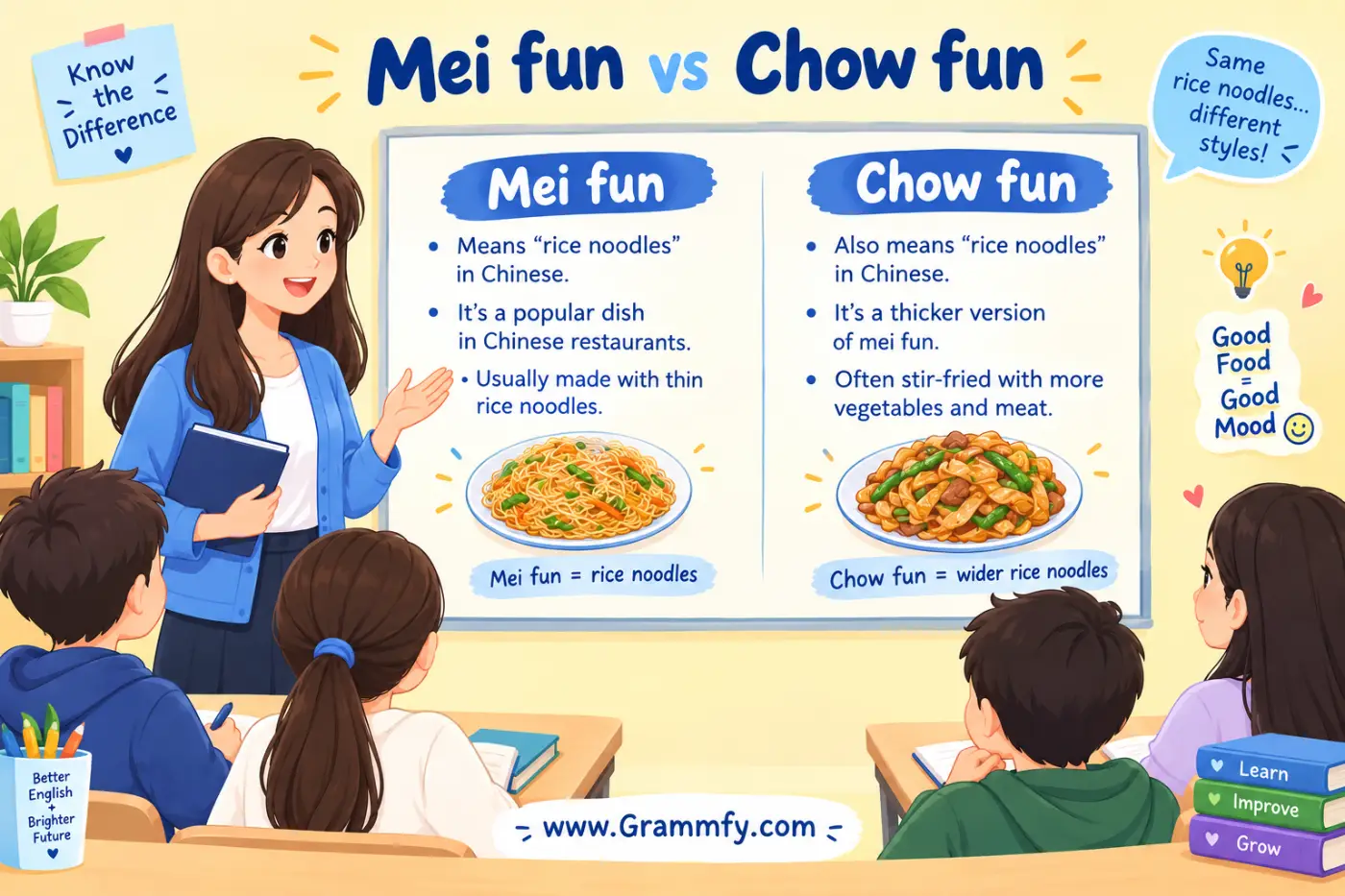
Have you ever looked at a Chinese takeout menu and wondered about Mei fun vs Chow fun? The names sound similar, but the noodles are quite different. One is usually thin and delicate, while the other is wide, flat, and chewy.
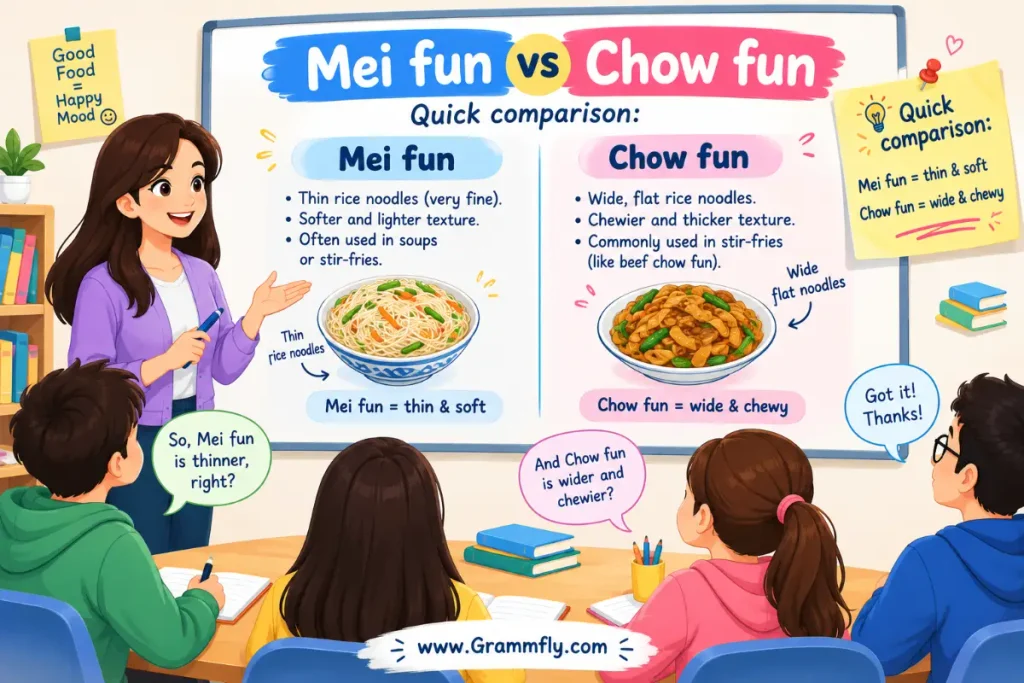
Mei fun is generally made with thin rice noodles. Chow fun usually uses wide, flat rice noodles. Their texture, cooking method, sauces, and common ingredients can also differ.
Answer box: Mei fun uses thin rice noodles, while chow fun uses wide, flat rice noodles. Mei fun is often lighter and finer, whereas chow fun has a soft, chewy texture and is commonly stir-fried.
The two dishes can both include vegetables, meat, seafood, eggs, and savory sauces. Still, the noodle shape creates a major difference in how each dish feels and cooks. This guide compares their origins, ingredients, texture, nutrition, cooking methods, regional names, restaurant terminology, and the best choice for different meals.
Want to avoid similar spelling mistakes? See [potatoes or potatos].
What is the difference between Mei fun vs Chow fun?
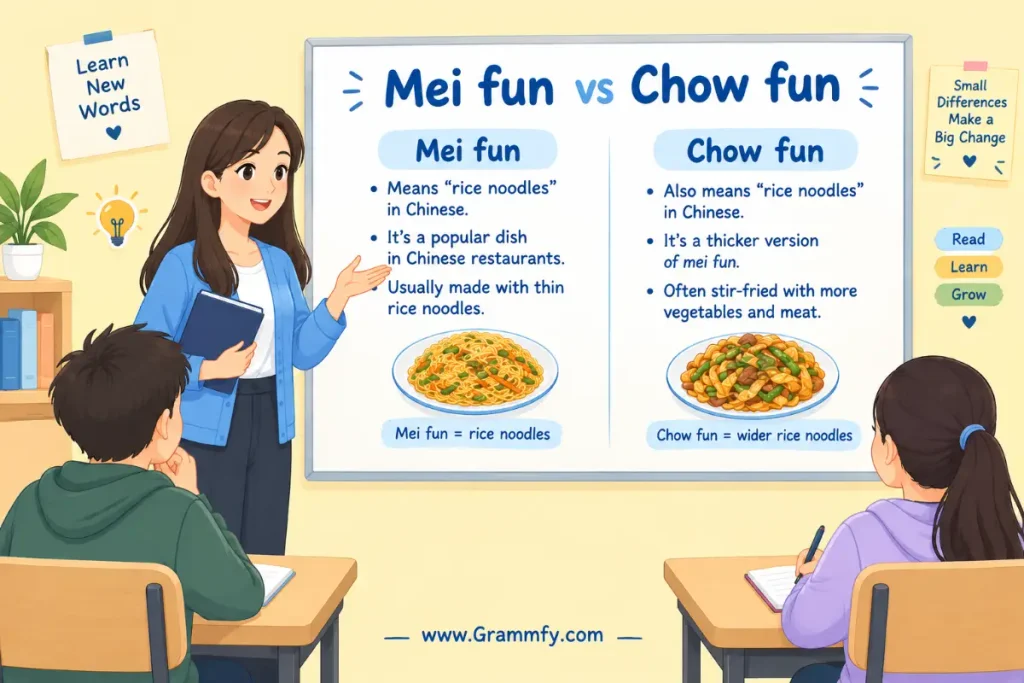
The biggest difference is the shape and texture of the rice noodles.
Mei fun is typically prepared with very thin rice vermicelli. These noodles are delicate and narrow, so they cook quickly and can absorb sauce easily.
Chow fun is usually made with broad, flat rice noodles. The noodles are thicker and wider, giving the dish a soft, slippery, and chewy texture.
| Feature | Mei fun | Chow fun |
|---|---|---|
| Main noodle | Thin rice vermicelli | Wide, flat rice noodle |
| Width | Very thin | Broad and flat |
| Texture | Fine and delicate | Soft, chewy, silky |
| Common cooking method | Stir-fried, sometimes soupy | Usually stir-fried |
| Typical dish | Singapore mei fun | Beef chow fun |
| Sauce | Often light to moderate | Often savory and rich |
| Eating experience | Light and separated | Soft and substantial |
| Common proteins | Chicken, shrimp, pork | Beef, chicken, shrimp |
| Common vegetables | Cabbage, carrots, onions, peppers | Bean sprouts, scallions, onions |
| Best known for | Thin noodles and mixed ingredients | Wide noodles and wok-fried flavor |
Neither dish is automatically better. Your choice depends on whether you prefer thin, light noodles or broad, chewy noodles.
What does Mei fun mean?
Mei fun is a common English spelling for a type of Chinese rice noodle. The term can also appear as mai fun, rice vermicelli, or rice noodles, depending on the restaurant and region.
The noodles are made primarily from rice flour and water. Their thin shape makes them very different from broad rice noodles used for chow fun.
In Chinese food culture, mei fun can refer to the noodles themselves or dishes prepared with those noodles.
A typical stir-fried mei fun may contain:
- Rice vermicelli
- Eggs
- Shrimp
- Chicken
- Pork
- Cabbage
- Carrots
- Onions
- Bean sprouts
- Peppers
- Soy sauce
- Sesame oil
- Other seasonings
The exact ingredients depend on the recipe.
What does Chow fun mean?
Chow fun generally refers to dishes made with broad, flat rice noodles. The name is commonly associated with Cantonese-style cooking.
The noodles are soft, wide, and slightly chewy. They’re often stir-fried in a very hot wok with meat, vegetables, and sauce.
One famous version is beef chow fun, often made with:
- Wide rice noodles
- Sliced beef
- Bean sprouts
- Green onions
- Soy sauce
- Oil
- Ginger
- Other seasonings
The high heat can give the noodles a lightly smoky, toasted flavor known as wok hei.
Where did Mei fun originate?
Rice noodles have a long history in Chinese cuisine, and thin rice noodles are used in many regional dishes across China and beyond.
The exact history of the English menu term mei fun is complicated because different Chinese dialects and transliteration systems produce different spellings.
You may see:
- Mei fun
- Mai fun
- Mai fan
- Rice vermicelli
- Rice noodles
- Rice sticks
Different restaurants may use these labels for similar noodles.
Thin rice noodles also became popular in Southeast Asian cuisines, where they appear in dishes influenced by Chinese migration and local cooking traditions.
Singapore-style rice noodles are one of the best-known restaurant preparations in the United States.
Where did Chow fun originate?
Chow fun is strongly associated with Cantonese cuisine, especially southern China and the Pearl River Delta region.
The dish is closely connected with the cooking traditions of Guangdong and Hong Kong.
Wide rice noodles are especially suited to high-heat wok cooking. Their broad surfaces can pick up sauce and smoky flavors while remaining soft and chewy.
Cantonese restaurants often prepare chow fun with beef, bean sprouts, onions, and scallions. Other versions use chicken, shrimp, pork, or vegetables.
The dish has also spread internationally through Chinese restaurants.
Why are the noodles shaped differently?
Noodle shape changes both cooking behavior and texture.
Thin rice vermicelli has a large surface area compared with its volume. That means sauce and seasonings can coat the noodles quickly.
Wide rice noodles behave differently. Their flat surface makes them excellent for absorbing savory sauces while maintaining a soft, substantial bite.
The difference is easy to picture:
Mei fun: thin, narrow strands.
Chow fun: wide, flat ribbons.
That visual difference is one of the easiest ways to remember which is which.
How do Mei fun vs Chow fun taste different?
The noodles themselves have a fairly mild flavor. Much of the taste comes from the ingredients and cooking method.
Mei fun often tastes:
- Light
- Savory
- Slightly salty
- Aromatic
- Mildly smoky when stir-fried
Because the noodles are thin, seasonings can spread quickly across the entire dish.
Chow fun can taste:
- Richer
- Savory
- Smoky
- Slightly sweet
- Salty
- Wok-seared
The wide noodles can hold more sauce on their surface. When cooked correctly in a hot wok, they can also develop browned edges and wok hei.
Which has a chewier texture?
Chow fun usually has the chewier and more substantial texture.
Its broad rice noodles are soft but pleasantly elastic. A well-prepared dish should feel silky rather than mushy.
Mei fun is usually more delicate. The thin noodles can feel tender and slightly springy, but they don’t have the same broad, chewy bite.
If texture is your main concern, think of the choice this way:
- Want delicate noodles? Choose mei fun.
- Want wide, chewy noodles? Choose chow fun.
Which noodle is thinner?
Mei fun is thinner.
The noodles are typically rice vermicelli, meaning they’re narrow strands that resemble very thin threads.
Chow fun noodles are much wider and flatter.
A simple visual comparison:
| Noodle | Appearance |
|---|---|
| Mei fun | Thin strands |
| Chow fun | Flat ribbons |
| Udon | Thick round noodles |
| Lo mein | Usually thicker wheat noodles |
| Rice vermicelli | Very thin rice noodles |
This distinction can help when ordering from a menu with limited descriptions.
What ingredients are common in Mei fun?
Mei fun can be prepared in many ways.
Common ingredients include:
Protein
- Shrimp
- Chicken
- Pork
- Beef
- Chinese barbecue pork
- Tofu
- Eggs
Vegetables
- Cabbage
- Carrots
- Onions
- Bell peppers
- Bean sprouts
- Green onions
- Snow peas
- Mushrooms
Seasonings
- Soy sauce
- Sesame oil
- White pepper
- Garlic
- Ginger
- Oyster sauce
- Chili sauce
- Curry powder in some regional versions
Singapore-style mei fun often has a yellow color because curry powder is used in the seasoning.
Not every restaurant uses curry powder, though. Recipes vary significantly.
What ingredients are common in Chow fun?
Chow fun is also flexible, but some combinations are especially common.
Protein
- Beef
- Chicken
- Shrimp
- Pork
- Tofu
Vegetables
- Bean sprouts
- Green onions
- Onions
- Chives
- Chinese broccoli
- Mushrooms
- Peppers
Sauces and seasonings
- Light soy sauce
- Dark soy sauce
- Oyster sauce
- Sesame oil
- Garlic
- Ginger
- White pepper
Beef chow fun is particularly famous because the tender beef works well with the soft noodles and crunchy bean sprouts.
What is Singapore mei fun?
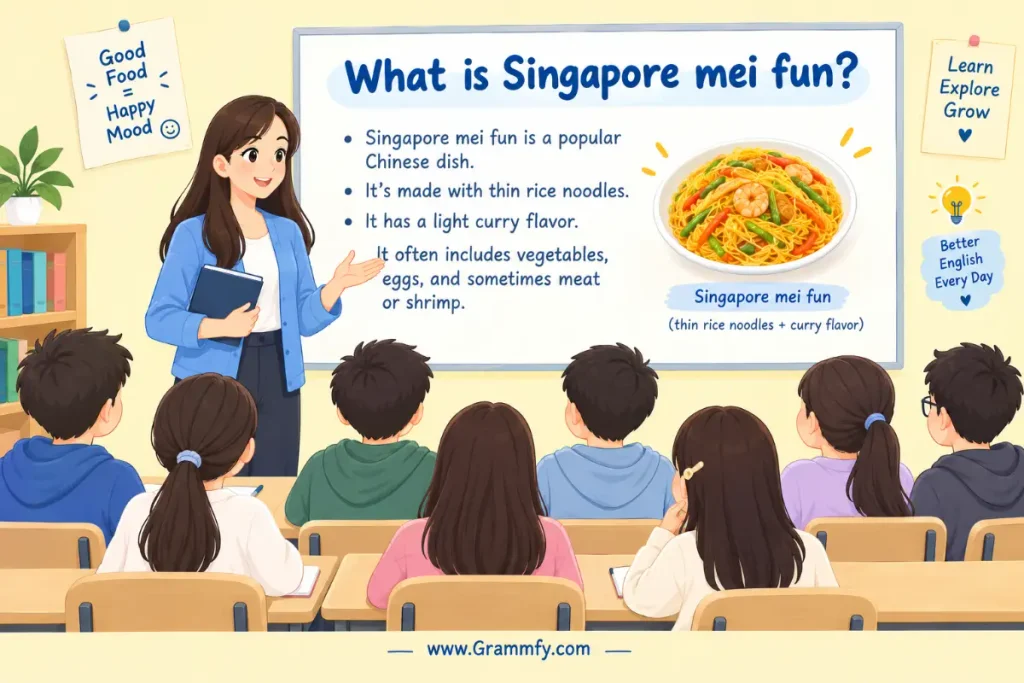
Singapore mei fun is a popular Chinese-American takeout dish made with thin rice vermicelli.
Despite its name, the dish isn’t necessarily a traditional dish from Singapore in the same way a local Singaporean dish would be. The restaurant version commonly found in the United States developed within Chinese restaurant traditions and is often associated with Cantonese-style American Chinese cuisine.
A typical version may contain:
- Thin rice noodles
- Shrimp
- Pork
- Eggs
- Cabbage
- Carrots
- Onions
- Curry powder
- Soy sauce
The curry seasoning gives the noodles a recognizable yellow appearance.
The flavor is usually savory with a mild curry aroma rather than tasting like a heavy curry dish.
What is beef chow fun?
Beef chow fun is one of the most famous preparations of broad rice noodles.
It commonly combines:
- Wide rice noodles
- Thinly sliced beef
- Bean sprouts
- Green onions
- Soy sauce
- Oil
- Ginger
The dish is traditionally cooked over high heat.
A skilled cook moves the ingredients quickly through the wok. That keeps the noodles from becoming overly soft while allowing the beef and noodles to develop a smoky aroma.
The best versions balance several textures:
- Soft noodles
- Tender beef
- Crisp bean sprouts
- Fresh green onions
Why is wok hei important for Chow fun?
Wok hei is a Cantonese expression often translated as “breath of the wok.”
It describes the distinctive aroma and flavor that can develop when food is cooked rapidly at very high heat.
Chow fun is particularly well suited to this technique because the broad noodles can come into direct contact with the hot wok.
The result may include:
- Toasted aromas
- Slight caramelization
- Smoky notes
- Light browning
- A deeper savory taste
Home cooks can struggle to reproduce restaurant-style wok hei because household burners often don’t reach the same heat as commercial wok burners.
Does Mei fun have wok hei too?
It can.
Stir-fried mei fun may develop toasted and smoky flavors when cooked at high heat. However, its thin noodles behave differently from broad chow fun noodles.
Because mei fun is delicate, overheating or excessive stirring can break the strands.
The cooking goal is often to keep the noodles separate and tender while distributing the sauce and other ingredients evenly.
Which one is easier to cook at home?
Mei fun can be easier in some ways because thin rice noodles cook quickly.
However, they’re also easy to overcook.
Chow fun presents a different challenge. The wide noodles can stick together or tear when handled too aggressively.
Tips for cooking mei fun
- Don’t over-soak the noodles.
- Drain them thoroughly.
- Prepare all ingredients before cooking.
- Use medium-high or high heat.
- Avoid adding too much liquid.
- Toss gently.
- Cook only until the noodles are tender.
Tips for cooking chow fun
- Keep the noodles dry enough to stir-fry.
- Use a hot wok or wide skillet.
- Avoid overcrowding the pan.
- Add sauce carefully.
- Toss gently to prevent tearing.
- Cook quickly.
- Let some noodles contact the hot pan.
Preparation makes a major difference with both styles.
How should Mei fun be prepared?
A common stir-fry method starts by soaking the rice vermicelli until tender but not mushy.
While the noodles soften, the cook prepares the vegetables and protein.
The usual sequence is:
- Prepare the noodles.
- Slice the protein.
- Chop the vegetables.
- Heat the wok.
- Cook the protein.
- Add vegetables.
- Add the noodles.
- Add seasonings.
- Toss everything together.
- Remove from heat when the noodles are tender.
Thin noodles don’t need much cooking time.
Too much liquid can make them soft and clumpy.
How should Chow fun be prepared?
Chow fun requires careful handling because the wide noodles can break.
A common approach is:
- Prepare the beef or other protein.
- Prepare the wide rice noodles.
- Heat the wok until very hot.
- Sear the protein.
- Cook the aromatics.
- Add the noodles.
- Add sauce.
- Toss gently.
- Add bean sprouts and green onions.
- Finish quickly.
The cooking time is often short because the goal is to preserve the noodle texture.
Which one absorbs sauce better?
Both absorb sauce, but they do so differently.
Mei fun’s thin strands become coated quickly. The seasoning can spread across many small surfaces.
Chow fun has broad surfaces that can carry sauce across each ribbon. The noodles may also develop browned areas when stir-fried.
If you like every bite to have seasoning throughout the noodles, mei fun can be appealing.
If you enjoy sauce coating broad, silky noodles, chow fun may be the better choice.
Which one is lighter?
Mei fun often feels lighter because the noodles are thin and delicate.
That doesn’t automatically mean a mei fun dish has fewer calories. The total nutritional value depends on:
- Portion size
- Amount of oil
- Protein
- Sauce
- Added sugar
- Vegetables
- Cooking method
A vegetable-heavy mei fun dish can be relatively light, while a restaurant portion cooked with generous oil can be much more substantial.
Chow fun can also be prepared with plenty of vegetables and lean protein.
The noodle type alone doesn’t determine whether a meal is healthy.
Which one has more calories?
There is no universal answer.
Restaurant recipes vary widely, so two plates of the same dish can have very different calorie counts.
Factors include:
- Amount of noodles
- Cooking oil
- Sauce
- Meat
- Egg
- Sugar
- Portion size
A heavily oiled vegetable chow fun could contain more calories than a lightly cooked chicken mei fun.
Likewise, a large serving of mei fun with pork and oil could be very filling.
If you’re watching calories, ask about portion size and oil rather than judging only by the noodle name.
Which one is healthier?
Neither is automatically healthier.
Both dishes can fit into a balanced meal.
For a lighter option, look for:
- More vegetables
- Lean protein
- Less oil
- Less sugary sauce
- A moderate noodle portion
A vegetable-heavy stir-fry with lean chicken or tofu can be a reasonable choice.
People with specific dietary needs should also check sauces and restaurant preparation methods because ingredients can vary.
Are Mei fun and Chow fun gluten-free?
The noodles themselves are traditionally rice-based, so they don’t naturally contain wheat gluten.
However, the finished restaurant dish isn’t automatically gluten-free.
Soy sauce commonly contains wheat. Oyster sauce and other prepared sauces may also contain ingredients that matter to people avoiding gluten.
Cross-contact can happen in restaurant kitchens as well.
If you need a strictly gluten-free meal, ask the restaurant about:
- The noodles
- Soy sauce
- Oyster sauce
- Marinades
- Shared cooking equipment
- Cross-contact
A rice noodle does not guarantee that the entire dish is gluten-free.
Are Mei fun and Chow fun vegan?
The noodles can be suitable for a vegan diet when made only from rice and water.
The complete dish may contain:
- Eggs
- Oyster sauce
- Fish sauce
- Meat
- Shrimp
- Chicken broth
- Other animal-derived ingredients
A vegetable version can often be made vegan, but you should confirm the sauce ingredients with the restaurant.
Ask for:
Rice noodles with vegetables and no meat, egg, fish sauce, or oyster sauce.
Restaurants use different recipes, so confirmation is important.
What are the closest related noodle terms?
There aren’t true synonyms for these dish names because they identify specific noodle styles. However, several related terms can help you understand a menu.
| Term | Meaning | Typical use | Example |
|---|---|---|---|
| Rice vermicelli | Very thin rice noodles | Mei fun dishes | Shrimp rice vermicelli |
| Rice noodles | General term for noodles made from rice | Many dishes | Stir-fried rice noodles |
| Rice sticks | Thin dried rice noodles | Asian cooking | Rice stick stir-fry |
| Flat rice noodles | Broad rice noodles | Chow fun | Beef flat rice noodles |
| Wide rice noodles | Broad noodle strips | Chow fun | Wide rice noodle stir-fry |
| Stir-fried noodles | Noodles cooked in a wok | General | Stir-fried rice noodles |
| Vermicelli | Thin noodle style | Many cuisines | Rice vermicelli |
| Beef chow fun | Beef with wide rice noodles | Cantonese cuisine | Beef chow fun |
| Singapore mei fun | Curried rice vermicelli dish | Chinese-American menus | Singapore mei fun |
| Ho fun | Cantonese name related to flat rice noodles | Cantonese dishes | Beef ho fun |
| Shahe fen | Traditional term for broad rice noodles | Chinese cuisine | Stir-fried shahe fen |
| Chow ho fun | Stir-fried flat rice noodles | Cantonese cuisine | Beef chow ho fun |
These aren’t interchangeable in every situation, but they can help decode restaurant menus.
What are the mild-to-strong flavor differences?
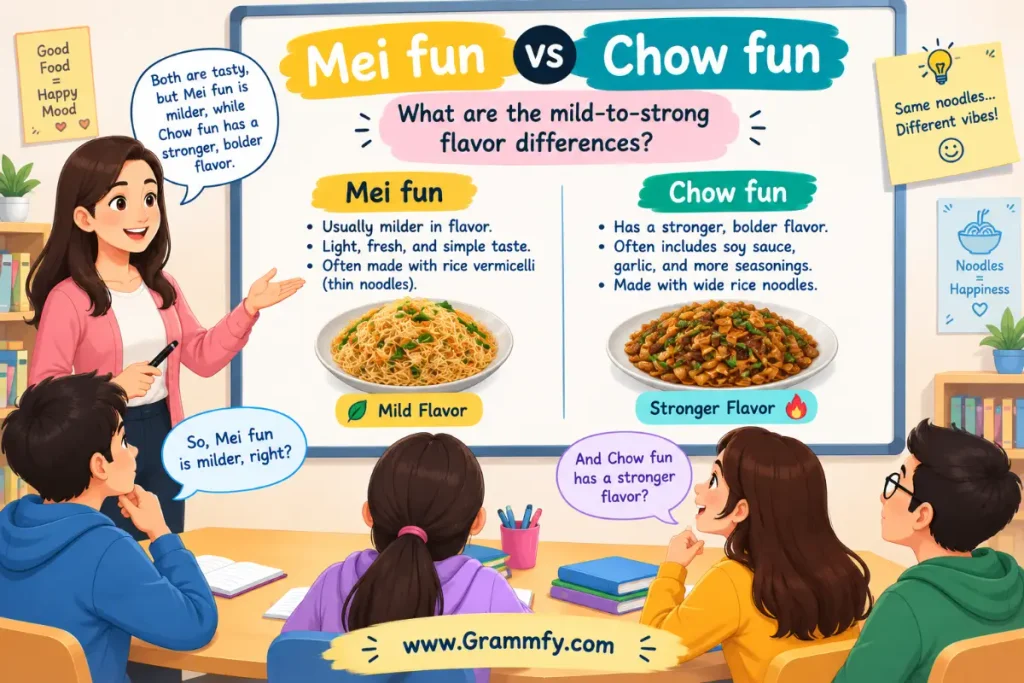
The noodle itself has a mild flavor, so the cooking method creates much of the difference.
Mild flavor profile
A lightly seasoned mei fun may taste:
- Clean
- Soft
- Mildly salty
- Rice-like
Medium flavor profile
A typical stir-fried version can have:
- Soy sauce
- Garlic
- Sesame oil
- Pepper
- Vegetable aromas
Stronger flavor profile
A richly seasoned chow fun may include:
- Dark soy sauce
- Oyster sauce
- Beef juices
- Wok hei
- Caramelized ingredients
These descriptions aren’t fixed rules. Restaurants can make either dish mild or strongly seasoned.
What are the differences by cooking style?
Stir-fried Mei fun
This is perhaps the most familiar restaurant version.
The thin noodles are tossed with vegetables, protein, egg, and seasonings.
Soup Mei fun
Thin rice noodles can also appear in soups.
The noodles are cooked in broth with meat, vegetables, seafood, or herbs.
Stir-fried Chow fun
This is the classic broad-noodle preparation.
The noodles are cooked quickly over high heat.
Dry-fried Chow fun
Dry-fried chow fun is a famous Cantonese style. The dish typically uses less sauce and relies heavily on wok technique.
Beef dry-fried chow fun is especially well known.
What does “dry-fried” mean?
“Dry-fried” doesn’t mean the noodles are literally dry.
It generally means the dish is stir-fried with relatively little liquid sauce.
The cook relies on:
- High heat
- Oil
- Wok technique
- Seasonings
- Caramelization
- Ingredient juices
The result can have a deeper roasted flavor than a heavily sauced noodle dish.
What does “wet-fried” mean?
Wet-fried chow fun usually involves more sauce or gravy.
The noodles may be served with a savory mixture containing meat, vegetables, and a thicker sauce.
The texture and presentation differ from dry-fried versions.
A dry-fried dish tends to have more direct wok flavor.
A wet-fried dish tends to be saucier and softer.
Which is better for beef?
Chow fun is a particularly strong choice for beef.
The broad noodles pair naturally with thinly sliced beef, bean sprouts, and green onions.
The noodles also provide a large surface for savory sauce and wok flavor.
A classic combination is:
Beef + wide rice noodles + bean sprouts + scallions.
Mei fun can absolutely be prepared with beef, but beef chow fun is one of the most recognizable combinations.
Which is better for shrimp?
Both work well with shrimp.
Mei fun provides a lighter noodle base that lets shrimp and vegetables stand out.
Chow fun creates a richer, more substantial dish.
Choose mei fun if you prefer thin noodles.
Pick chow fun if you want a broad, chewy noodle texture.
Which is better for vegetables?
Either can work.
Mei fun is especially good with finely sliced vegetables because the thin noodles blend easily with small pieces.
Chow fun works well with larger ingredients such as:
- Bean sprouts
- Chinese broccoli
- Scallions
- Mushrooms
- Onions
The choice comes down more to texture than nutrition.
Which is better for a quick meal?
Mei fun can be convenient because thin rice noodles cook quickly.
Chow fun can also be fast once the noodles are prepared.
For home cooking, preparation is often more important than the final stir-frying time.
Cutting vegetables, marinating meat, and preparing noodles can take longer than cooking the dish itself.
What should you order if you dislike thick noodles?
Choose mei fun.
Its thin rice vermicelli has a completely different mouthfeel from chow fun.
People who prefer:
- Angel-hair-like noodles
- Fine strands
- Light textures
- Small noodle pieces
often enjoy mei fun more.
What should you order if you like chewy noodles?
Choose chow fun.
The wide, soft noodles provide a more substantial bite.
People who enjoy:
- Udon
- Thick rice noodles
- Soft flat noodles
- Chewy textures
may prefer chow fun.
The exact texture still depends on how the restaurant cooks the noodles.
Which one works better for a large group?
Either dish can work well for sharing.
Mei fun is easy to divide because the thin noodles mix evenly with vegetables and protein.
Chow fun can be especially satisfying as a shared main dish because the wide noodles feel substantial.
For a group meal, consider ordering both.
One plate provides thin, delicate noodles.
The other offers wide, chewy noodles.
That gives everyone a chance to compare the two styles.
How do restaurant names vary?
Chinese food terminology can change based on:
- Region
- Chinese dialect
- Transliteration system
- Restaurant tradition
- English menu conventions
You may see mei fun, mai fun, or rice vermicelli for thin rice noodles.
For broad rice noodles, you may see:
- Chow fun
- Chow ho fun
- Ho fun
- Beef ho fun
- Flat rice noodles
- Wide rice noodles
These names can overlap, but restaurants don’t always use them consistently.
When in doubt, look at the description or ask what type of noodle is used.
US vs UK terminology: what should you know?
American Chinese restaurant menus commonly use terms such as mei fun, mai fun, chow fun, and rice noodles.
British menus may use different descriptions depending on the restaurant and regional influences.
The dishes themselves aren’t necessarily different simply because the English-speaking country changes.
Restaurant terminology is more important than the country label.
One restaurant may call a dish rice vermicelli, while another calls a similar dish mei fun.
Likewise, a broad noodle may be listed as chow fun or ho fun.
Always check the menu description if you’re unsure.
What are common mistakes when comparing these dishes?
Mistake 1: Thinking both noodles are the same
They are both commonly rice-based, but their shapes are very different.
Mistake 2: Assuming “fun” means a type of meat
It doesn’t.
In Cantonese food terminology, fun is connected with rice noodles.
Mistake 3: Assuming Singapore mei fun is simply Singaporean chow fun
The noodles and cooking style are different.
Singapore-style mei fun typically uses thin rice vermicelli.
Chow fun uses broad flat rice noodles.
Mistake 4: Assuming every mei fun contains curry
Singapore-style versions often do, but not every mei fun dish does.
Mistake 5: Assuming chow fun is always made with beef
Beef chow fun is famous, but chicken, shrimp, pork, seafood, and vegetarian versions also exist.
Mistake 6: Assuming rice noodles are always gluten-free
The noodles may be gluten-free, but sauces and kitchen practices can introduce gluten.
Mistake 7: Judging healthiness by noodle type alone
Oil, sauce, protein, vegetables, and serving size matter too.
What are the best choices for different situations?
| Situation | Better choice | Why |
|---|---|---|
| You like thin noodles | Mei fun | Fine rice vermicelli |
| You like chewy noodles | Chow fun | Wide, soft texture |
| You want beef | Chow fun | Classic pairing |
| You want a lighter-feeling dish | Mei fun | Thin noodle texture |
| You want strong wok flavor | Chow fun | Broad noodles suit wok cooking |
| You like curry-seasoned noodles | Singapore mei fun | Often includes curry powder |
| You want seafood | Either | Both pair well with shrimp |
| You dislike wide noodles | Mei fun | Thin strands |
| You like flat noodles | Chow fun | Wide ribbons |
| You want a soupy noodle | Mei fun | Commonly used in noodle soups |
| You want dry-fried noodles | Chow fun | Classic preparation |
| You want lots of mixed vegetables | Either | Both work well |
What should you choose for a first-time order?
If you’re trying Chinese rice noodles for the first time, your preference for texture can guide you.
Choose mei fun if you want:
- Thin noodles
- A lighter mouthfeel
- Lots of mixed vegetables
- Shrimp or chicken
- A dish that resembles rice vermicelli
Choose chow fun if you want:
- Wide noodles
- A chewy bite
- Savory wok flavor
- Beef
- Bean sprouts
- A more substantial noodle dish
If you’re still unsure, beef chow fun and Singapore-style mei fun offer two very different experiences.
Quick comparison: Mei fun vs Chow fun
| Category | Mei fun | Chow fun |
|---|---|---|
| Noodle shape | Thin strands | Wide ribbons |
| Base | Rice | Rice |
| Texture | Delicate | Soft and chewy |
| Typical cuisine | Chinese and Chinese-American | Cantonese |
| Famous version | Singapore mei fun | Beef chow fun |
| Curry common? | In some versions | Usually not |
| Beef common? | Sometimes | Very common |
| Shrimp common? | Yes | Yes |
| Soup possible? | Yes | Less typical |
| Wok cooking | Common | Essential to many versions |
| Wok hei | Possible | Especially important |
| Sauce | Light to moderate | Light to rich |
| Best for | Fine noodle lovers | Flat noodle lovers |
How can you remember the difference?
Use a simple visual trick.
Mei fun = fine.
The “M” in mei can remind you of many thin strands.
Chow fun = wide.
Think of chow fun as broad noodle ribbons moving around a hot wok.
Another easy memory:
Mei fun is vermicelli. Chow fun is flat.
Once you’ve seen both dishes side by side, the difference becomes much easier to remember.
Quick tips for choosing between the two
- Check the noodle shape first.
- Pick mei fun for thin rice vermicelli.
- Pick chow fun for wide flat noodles.
- Choose chow fun for a classic beef-and-bean-sprout combination.
- Try Singapore mei fun if you enjoy curry-seasoned dishes.
- Ask about sauces if you have dietary restrictions.
- Don’t assume every restaurant uses the same terminology.
- Consider texture as much as flavor.
- Look for dry-fried chow fun if you enjoy smoky wok flavor.
- Choose a vegetable-heavy version if you want more produce.
- Ask for less oil if that’s important to you.
- Check the portion size before ordering a large plate.
- Try both if you’re curious about the difference.
Conclusion
The key difference between Mei fun vs Chow fun comes down to the noodles. Mei fun uses thin rice vermicelli, creating a delicate texture that works especially well with vegetables, shrimp, chicken, and curry-seasoned preparations. Chow fun uses wide, flat rice noodles with a soft, chewy bite and is strongly associated with Cantonese wok cooking. Beef chow fun is one of its best-known versions, especially when cooked with bean sprouts and scallions. Neither dish is automatically healthier or better because recipes, sauces, oil, and portions vary from restaurant to restaurant. For thin noodles, choose mei fun. For broad noodles and a stronger wok-style experience, choose chow fun. Once you know the shape, ordering becomes much easier.
Frequently Asked Questions
Is Mei fun the same as Chow fun?
No. Mei fun usually uses thin rice vermicelli, while chow fun uses wide, flat rice noodles. Their textures and common cooking styles are different.
Which is healthier, Mei fun or Chow fun?
Neither is automatically healthier. The nutrition depends on portion size, oil, sauce, protein, and vegetables used in the recipe.
What’s the difference between Mei fun and Chow fun?
The main difference is the noodle shape. Mei fun uses thin rice noodles, while chow fun uses broad, flat rice noodles.
Is Chow fun always made with beef?
No. Beef chow fun is a classic version, but restaurants may also prepare chow fun with chicken, shrimp, pork, tofu, or vegetables.
Does Mei fun contain curry?
Some versions do, especially Singapore-style mei fun, which often uses curry powder. Other mei fun dishes may contain no curry at all.
Are Mei fun and Chow fun gluten-free?
The rice noodles themselves may be gluten-free, but sauces such as soy sauce can contain wheat. Check the complete recipe and restaurant preparation if you need to avoid gluten.
Which one should I order if I like chewy noodles?
Chow fun is usually the better choice because its wide, flat rice noodles have a soft and chewy texture. Mei fun is thinner and more delicate.
