
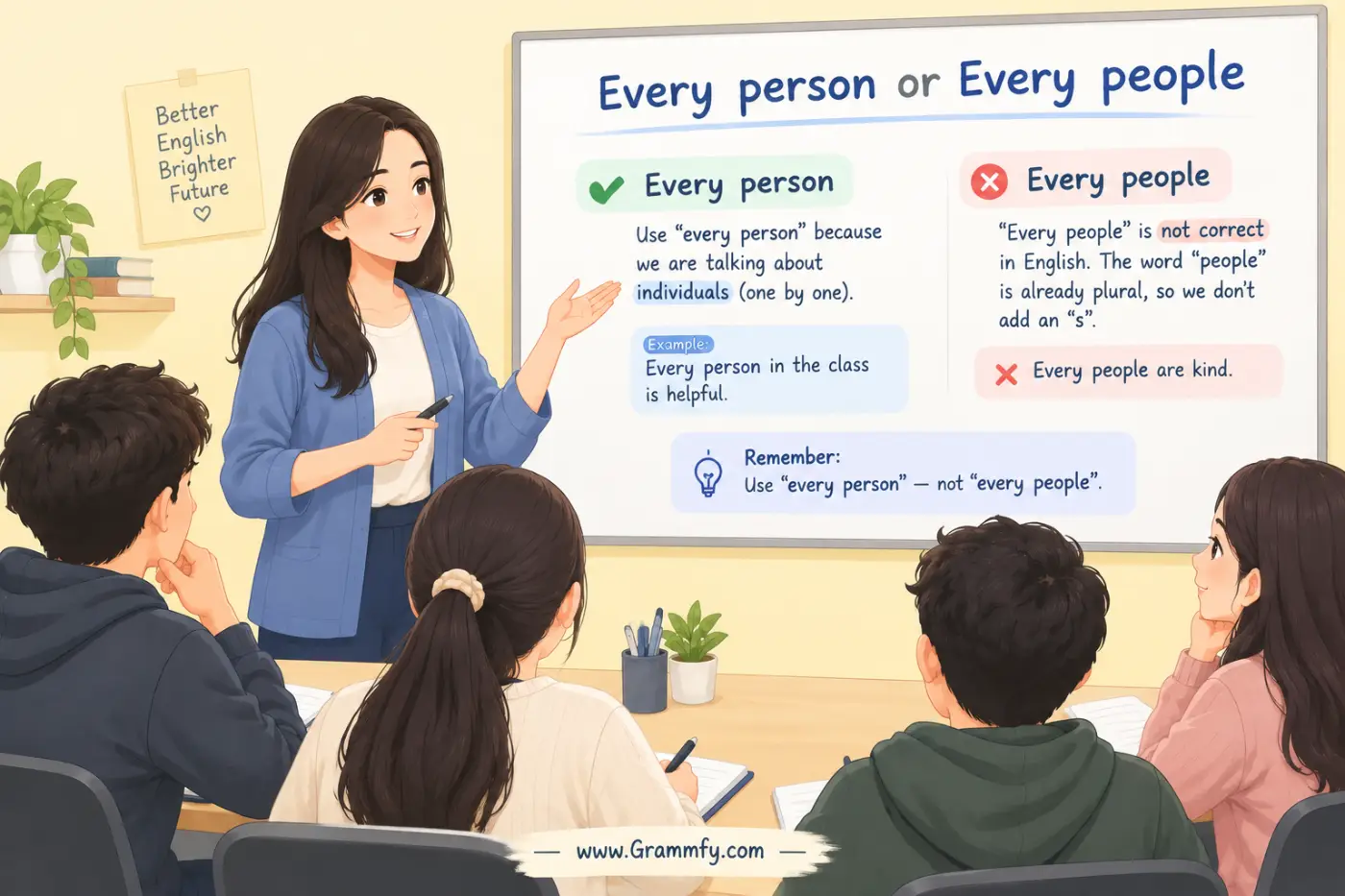
Have you ever been writing an email, essay, resume, or text and paused over a sentence like, “Every people deserves respect”? If so, you’re not alone. Every person or Every people can be confusing because both words relate to humans, but they don’t work the same way in English grammar.
The standard choice is every person when you mean each individual human. The phrase every people is uncommon and has a special use in academic or historical writing when people refers to a distinct ethnic, cultural, or national group.
Answer box: Use “every person” when you mean each individual human. Use “all people” when you mean people as a group. “Every people” is possible only in a specialized sense where people means a distinct population or nation.
Knowing this small grammar rule can help you avoid awkward sentences in schoolwork, professional writing, conversations, and online posts. It also helps you choose better alternatives such as everyone, each person, every individual, or all people.
This guide covers the meaning, word origins, grammar rules, synonyms, examples, regional differences, common mistakes, and the best choice for resumes, essays, emails, texts, and everyday speech.
If you’re working on choosing the right word, explore [accurate or correct].
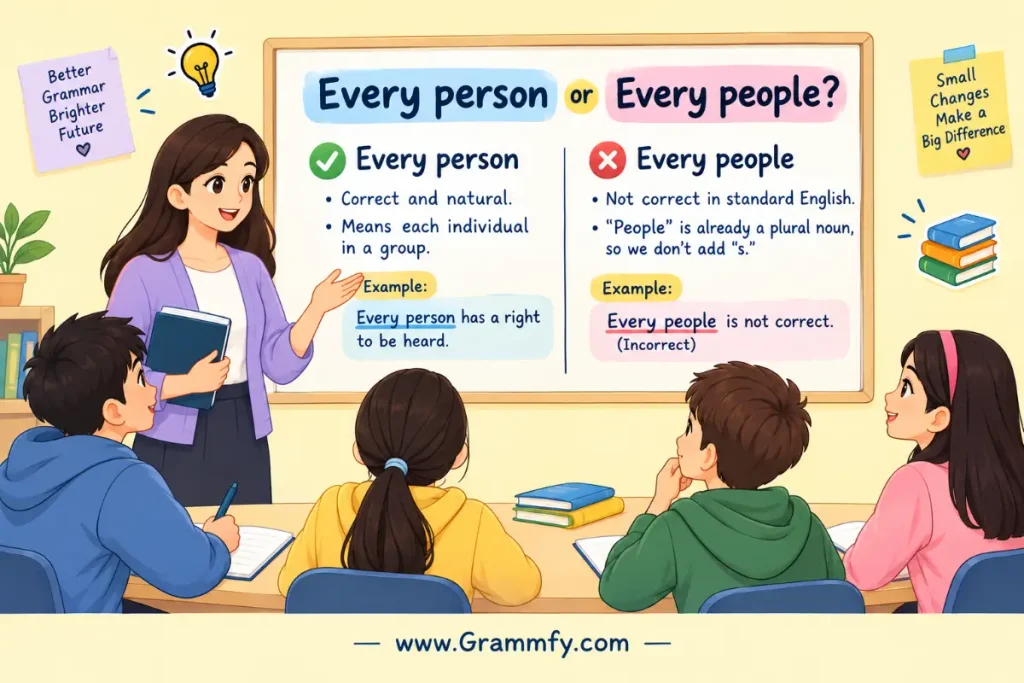
What is the difference between Every person or Every people?
The main difference is simple: every person normally means each individual human, while every people is a rare construction in which people means a distinct cultural, ethnic, or national group.
Consider these examples:
Every person deserves respect.
Here, person means one individual at a time.
Now compare:
All people deserve respect.
In this sentence, people is plural and refers to humans collectively.
The phrase every people has a different possible meaning:
Every people has its own traditions.
In this specialized sentence, people means a distinct population or cultural group. The wording is grammatical in some formal contexts, but it isn’t the normal choice for everyday American English.
| Expression | Meaning | Commonness |
|---|---|---|
| Every person | Each individual human | Very common |
| All people | Humans as a group | Very common |
| Everyone | All individual people | Very common |
| Each person | Each individual separately | Common |
| Every individual | Each separate person | Common/formal |
| Every people | Each distinct people/group | Rare/specialized |
| All persons | All individuals | Formal/legal |
For most everyday sentences, every person, everyone, each person, or all people will be the better choice.
Why is “every person” grammatically correct?
The key is the word every.
In standard English, every normally comes before a singular countable noun.
That gives us this pattern:
every + singular noun
Examples include:
- every person
- every student
- every teacher
- every customer
- every employee
- every child
- every book
- every house
Even though every can refer to a whole group, the noun immediately following it stays singular.
That’s why we say:
Every person is responsible.
Not:
Every person are responsible.
The same rule appears in other sentences:
Every student has a notebook.
Every employee needs training.
Every customer receives a receipt.
Every child deserves care.
The idea may involve hundreds or thousands of people, but grammar considers the members individually.
Why does “every people” sound wrong?
The usual meaning of people is plural.
We normally use:
- one person
- two people
- many people
- several people
- some people
- all people
The word every, however, normally requires a singular noun.
That’s why these combinations are standard:
Every person ✅
Every student ✅
Every customer ✅
But these are normally incorrect when referring to individual humans:
Every people ❌
Every students ❌
Every customers ❌
Every employees ❌
If you want to use a plural noun after a determiner, all is often the right choice:
All people deserve opportunities.
All students must attend.
All customers received receipts.
Can “every people” ever be correct?
Yes, but this is where context matters.
The noun people can have a special singular meaning. Instead of referring to individual human beings, it can describe a distinct group, nation, tribe, or cultural population.
For example:
Every people has its own historical traditions.
Here, people refers to a distinct cultural or national group.
This usage is much less common than ordinary people = human beings. You’ll most likely encounter it in academic, historical, anthropological, religious, political, or literary writing.
For a general audience, a clearer sentence might be:
Every culture has its own historical traditions.
Or:
Every ethnic group has its own historical traditions.
Or:
Every nation has its own historical traditions.
These versions remove the ambiguity.
What does “every person” mean in plain English?
Every person means each individual person in a particular group, place, situation, or general statement.
For example:
Every person in the room received a badge.
This means each individual in the room received one.
Another example:
Every person deserves a fair opportunity.
The sentence makes a general statement about individuals.
The phrase doesn’t necessarily mean every human being on Earth. The exact scope comes from context.
Compare:
Every person in this class must submit the assignment.
The scope is one class.
Every person in our company needs an ID.
The scope is the company.
Every person deserves basic respect.
The statement is much broader.
What is the origin of “every”?
The modern word every developed from Old English expressions connected with the idea of each or every single one.
Its basic meaning has stayed remarkably consistent. It identifies members of a group individually while referring to the group as a whole.
Think of a classroom with 20 students.
If you say:
Every student received a pencil.
You’re talking about all 20 students, but grammatically you’re considering them one at a time.
That’s the central idea behind every.
Where does “person” come from?
Person entered English through Old French and ultimately comes from Latin persona.
The Latin word could refer to a person, character, or role. Over centuries, the English meaning developed into the familiar noun for an individual human being.
That’s why the modern distinction is easy to remember:
person = one human
people = more than one human
There are historical exceptions and specialized meanings, but this basic distinction works for ordinary English.
Where does “people” come from?
The modern English word people came through Old French and is related to Latin populus, meaning a population or people.
Today, its most common meaning is a group of human beings.
For example:
People enjoy different kinds of music.
Many people work from home.
Some people prefer tea.
Because people normally functions as a plural noun, it doesn’t normally follow every when you’re talking about individual humans.
What are the best synonyms for “every person”?
There are many useful alternatives, but each has a slightly different tone or meaning. Choosing the right one can make your writing clearer and less repetitive.
Simple synonyms
| Word | Meaning | Tone | Example |
|---|---|---|---|
| Everyone | All people | Neutral | Everyone is welcome. |
| Each person | Each individual | Clear | Each person gets a ticket. |
| Each individual | Each separate person | Neutral | Each individual has a role. |
| Every individual | Each person separately | Neutral | Every individual matters. |
| All people | People as a group | Neutral | All people need water. |
| Everybody | All people | Casual | Everybody enjoyed the event. |
| Anyone | Any person | General | Anyone can participate. |
| Anybody | Any person | General | Anybody can ask a question. |
Everyday synonyms
| Word | Meaning | Tone | Example |
|---|---|---|---|
| Everyone | All people in a group | Everyday | Everyone agreed. |
| Everybody | All people | Friendly | Everybody had fun. |
| Each one | Each individual member | Casual | Each one received a card. |
| All of us | Everyone including the speaker | Personal | All of us can improve. |
| All of you | Everyone being addressed | Conversational | All of you did well. |
| All of them | Everyone in another group | Conversational | All of them arrived early. |
| Folks | People | Friendly | Folks can sit over here. |
| You all | The people being addressed | Informal | You all did a great job. |
Formal synonyms and related expressions
| Word | Meaning | Tone | Example |
|---|---|---|---|
| Every individual | Each separate person | Formal | Every individual has rights. |
| Each individual | Each person | Formal | Each individual must respond. |
| All persons | All people | Legal/formal | All persons must register. |
| Every member | Each member of a group | Formal | Every member must attend. |
| Each participant | Each person taking part | Formal | Each participant received a certificate. |
| Every citizen | Each citizen | Civic/formal | Every citizen has responsibilities. |
| Each applicant | Each person applying | Professional | Each applicant must submit a form. |
| Every employee | Each worker | Professional | Every employee needs training. |
| Each customer | Each buyer/client | Professional | Each customer receives support. |
Informal and regional alternatives
| Word | Meaning | Tone | Example |
|---|---|---|---|
| Everybody | All people | Informal | Everybody is ready. |
| Folks | People | Friendly | Folks can ask questions. |
| You all | A group being addressed | Informal | You all can join us. |
| Y’all | You all | Informal/regional US | Y’all are welcome. |
| Guys | A group of people | Casual | You guys can sit here. |
| The whole group | Everyone in a group | Casual | The whole group agreed. |
Some alternatives aren’t exact replacements in every sentence. Anyone, for instance, means any individual person rather than all individuals. Always check the intended meaning before swapping words.
Which synonyms are mild, neutral, or emphatic?
Different expressions can change the strength or focus of a sentence.
Mild and neutral
These are useful in most situations:
- everyone
- every person
- each person
- all people
- every individual
Example:
Everyone deserves a chance to learn.
The sentence is direct without sounding dramatic.
More specific
A specific noun can be better when you know exactly who you’re discussing.
Instead of:
Every person at the company must complete the form.
Use:
Every employee at the company must complete the form.
Instead of:
Every person applying for the position needs experience.
Use:
Every applicant needs experience.
Specific wording usually makes professional and academic writing stronger.
More emphatic
Each and every person adds emphasis.
We appreciate each and every person who helped us.
This can sound warm, sincere, or emotional.
Another example:
Each and every individual deserves to be heard.
The wording is stronger than:
Everyone deserves to be heard.
Use emphatic phrases when you have a reason to stress the idea. In ordinary sentences, shorter wording is often better.
What part of speech is “every person”?
Every is a determiner, and person is a singular countable noun.
Together, every person forms a noun phrase.
For example:
Every person has a story.
Here:
- every = determiner
- person = noun
- has = singular verb
The phrase can appear in different parts of a sentence:
Subject:
Every person deserves respect.
Object:
The program supports every person in the community.
After a preposition:
The rule applies to every person.
This is another reason it’s useful to understand the grammar rather than simply memorizing one phrase.
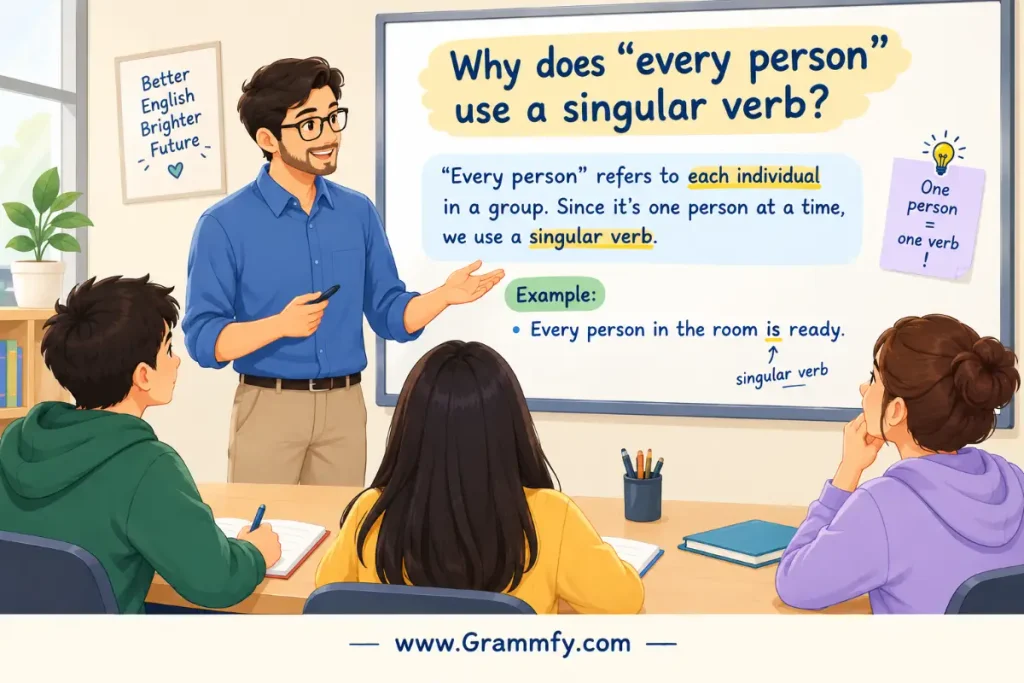
Why does “every person” use a singular verb?
Because person is singular.
The rule is:
every + singular noun + singular verb
Examples:
Every person is welcome.
Every person has a voice.
Every person needs support.
Every person deserves respect.
This can feel strange because the sentence may refer to a large group.
Don’t let the meaning of the whole group change the grammatical number of the noun after every.
What pronoun should follow “every person”?
Traditional grammar sometimes used he or his:
Every person should bring his book.
Modern English often avoids this wording because it assumes a male pronoun for a person whose gender isn’t known.
Singular they is a natural modern alternative:
Every person should bring their book.
This is widely used in contemporary English.
You can also avoid the issue by changing the sentence:
Everyone should bring a book.
Or:
All students should bring their books.
The best option depends on the context and your preferred style.
Is “everyone” singular or plural?
Everyone refers to multiple people but takes a singular verb in standard English.
For example:
Everyone is ready.
Everyone has a ticket.
Not:
Everyone are ready. ❌
The same principle applies to every person.
Compare:
Every person is ready.
Everyone is ready.
Both use singular verbs.
This is a common point of confusion because both expressions can refer to many people.
Every person vs everyone: what is the difference?
The meanings are very close.
| Every person | Everyone |
|---|---|
| Noun phrase | Pronoun |
| Two words | One word |
| Highlights individual people | More compact |
| Can be followed by a defining phrase | Also works with defining phrases |
| Neutral | Neutral and very common |
Examples:
Every person in the office attended.
Everyone in the office attended.
Both are correct.
Everyone often sounds smoother in conversation. Every person can give more emphasis to individual members.
Compare:
Everyone has a different opinion.
Every person in the panel gave a different opinion.
The second sentence makes the individual members more noticeable.
Every person vs each person: what is the difference?
These expressions are almost interchangeable in many sentences.
Every person received a number.
Each person received a number.
Both are correct.
There can be a slight difference in focus.
Every often makes a broad statement about a complete group:
Every person needs food and water.
Each can emphasize individuals separately:
Each person received a different assignment.
This distinction isn’t absolute. In many everyday sentences, either word works naturally.
Every person vs all people: what is the difference?
The main distinction is singular versus plural structure.
Every person focuses on individual members:
Every person must sign the form.
All people treats humans collectively:
All people need access to clean water.
Notice the grammar:
every + singular noun
all + plural noun
That gives you a useful shortcut:
Every person ✅
All people ✅
Every people ❌ for the normal meaning of individual humans
Every person vs everybody: which sounds more natural?
Both are correct, but everybody is often more conversational.
Compare:
Every person in the room should listen.
Everybody in the room should listen.
The second sounds more natural in casual speech.
A professional email might say:
Everyone should submit the report by Friday.
An academic paper might say:
Every individual in the sample was assessed.
Choose based on audience, purpose, and tone.
What should you use on a resume?
A resume usually benefits from specific nouns rather than broad phrases.
If you’re describing work with customers, write:
Assisted every customer with account questions.
Even better, if accurate:
Assisted more than 40 customers daily with account questions.
If you’re describing a team:
Supported every team member during the transition.
A more concise version could be:
Supported team members during the transition.
Avoid vague claims that don’t add useful information.
Resume examples
Instead of:
Helped every person with problems.
Try:
Assisted customers with technical issues.
Instead of:
Talked to every person who visited the store.
Try:
Assisted customers throughout the sales process.
Instead of:
Trained every person on the team.
Try:
Trained new employees on company procedures.
Specific job-related nouns make your writing more professional.
What should you use in an essay?
For an essay, every person can be useful when making a general claim about individuals.
Example:
Every person has experiences that influence how they see the world.
You can vary the wording with:
- everyone
- every individual
- each person
- all people
- members of society
- individuals
For example:
Every person deserves access to education. Individuals also need opportunities to develop their skills.
Changing the noun phrase keeps the paragraph from sounding repetitive.
Essay example
Weak:
Every person has different experiences. Every person has different goals. Every person has different challenges.
Improved:
Every person has different experiences, goals, and challenges. These differences can shape how individuals respond to opportunities and setbacks.
The second version is more natural and efficient.
What should you use in a text message?
Texting usually favors short and familiar expressions.
Use:
Everyone is coming tonight.
instead of:
Every person is coming tonight.
The second sentence is grammatical but sounds unnecessarily formal.
Other casual options include:
Everybody’s coming tonight.
You all should come.
Everyone’s invited.
The best choice depends on who you’re texting.
What should you use in an email?
For most emails, everyone is an excellent choice.
Example:
I hope everyone can attend Friday’s meeting.
You could also write:
I hope every team member can attend Friday’s meeting.
The second version is more specific.
For formal notices:
Each participant must complete the registration form.
For legal or official language:
All persons entering the facility must present identification.
The key is to match the expression to the audience.
What should you use when speaking?
In normal conversation, everyone and everybody are especially common.
For example:
Everyone had a great time.
Everybody knows the answer.
Every person is still natural when you want to stress individuals.
Every person at the table had a different opinion.
That wording draws attention to the separate people rather than the group as a whole.
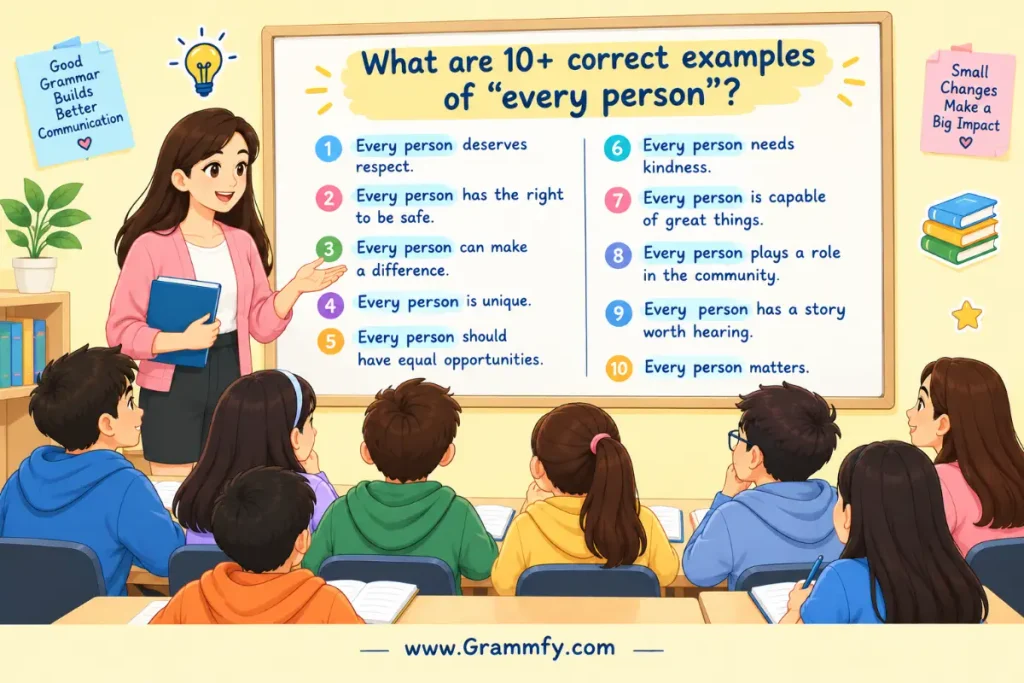
What are 10+ correct examples of “every person”?
Here are original examples from different real-life situations.
- Every person in the classroom received a worksheet.
- Every person deserves to be treated with dignity.
- Every person on the team has a specific responsibility.
- Every person entering the building must show an ID.
- Every person makes mistakes while learning something new.
- Every person in the survey answered the same question.
- Every person at the conference received a name badge.
- Every person should have enough time to make an informed choice.
- Every person applying for the position must complete an online form.
- Every person on the bus was asked to remain seated.
- Every person in the group brought a different idea to the discussion.
- Every person has strengths that can be developed with practice.
- Every person who registered received a confirmation message.
- Every person involved in the project contributed valuable feedback.
- Every person deserves a chance to explain their side of the story.
Notice that the verbs remain singular:
- every person received
- every person deserves
- every person has
- every person makes
- every person should
What are examples using “all people”?
All people is useful when you’re making a broad statement about humans collectively.
Examples:
- All people need clean water.
- All people make mistakes.
- All people deserve basic respect.
- All people have different experiences.
- All people can benefit from clear communication.
- All people should have access to essential information.
The plural noun people works naturally after all.
Compare:
Every person needs water.
All people need water.
Both are grammatical. The first highlights individuals; the second describes humanity collectively.
What are examples of the special use of “every people”?
This special construction is much less common.
Examples may appear in historical or cultural writing:
Every people develops traditions that reflect its history.
Every people has stories that pass from one generation to another.
Every people has a distinct cultural identity.
In these sentences, people refers to a distinct population rather than individual humans.
For general readers, clearer alternatives may be:
Every culture develops traditions that reflect its history.
Every nation has stories that pass from one generation to another.
Every ethnic group has a distinct cultural identity.
Use the specialized construction only when its meaning is clear and necessary.
What are the most common mistakes?
Mistake 1: Saying “every people” when you mean every human
Incorrect:
Every people should have access to education.
Better:
Every person should have access to education.
Or:
Everyone should have access to education.
Mistake 2: Using a plural noun after “every”
Incorrect:
Every students needs a notebook.
Correct:
Every student needs a notebook.
The same pattern applies to:
Every employee ✅
Every customer ✅
Every applicant ✅
Every member ✅
Mistake 3: Using a plural verb
Incorrect:
Every person are invited.
Correct:
Every person is invited.
Mistake 4: Confusing “every” and “all”
Incorrect:
Every people need support.
Correct:
All people need support.
Or:
Every person needs support.
Mistake 5: Assuming “people” always means individuals
Usually, people means multiple human beings. However, specialized writing can use people for a distinct cultural or national population.
Always check the intended meaning.
Mistake 6: Repeating the same expression too often
Even correct grammar can produce weak style when repeated.
For example:
Every person has a story. Every person has a background. Every person has goals. Every person has challenges.
Try:
Everyone has a story, a background, goals, and challenges. Those experiences help shape how individuals see the world.
The revised version is smoother without changing the central idea.
When should you avoid “every person”?
There are several situations where another expression may sound more natural.
When “everyone” is shorter
Instead of:
Every person should bring their own lunch.
You can write:
Everyone should bring their own lunch.
When a specific noun is available
Instead of:
Every person working here must attend.
Use:
Every employee must attend.
When you mean people collectively
Instead of:
Every person needs clean air.
You can say:
All people need clean air.
When you’re writing a casual message
Instead of:
Every person is invited to the party.
A text might simply say:
Everyone’s invited!
Good writing isn’t about choosing the longest or most formal expression. It’s about choosing the clearest one.
What are the antonyms of “every person”?
There isn’t one exact opposite in every context, but several expressions can contrast with the idea.
| Expression | Meaning | Example |
|---|---|---|
| No person | Not one individual | No person was injured. |
| No one | Nobody | No one complained. |
| Nobody | No person | Nobody answered. |
| Some people | Part of a group | Some people disagreed. |
| Few people | A small number | Few people noticed. |
| Not everyone | Less than the entire group | Not everyone agreed. |
| Certain people | Particular individuals | Certain people prefer privacy. |
Not everyone is especially useful because it doesn’t mean nobody.
Compare:
Everyone agreed.
Not everyone agreed.
Nobody agreed.
These three sentences communicate very different ideas.
What are the best word choices by situation?
For a resume: use “every employee” or “each customer”
Professional writing benefits from precision.
Every employee completed the training.
Each customer received personalized assistance.
These phrases identify the group clearly.
For an essay: use “every individual” or “every person”
Formal essays can use either.
Every individual has a unique perspective.
Every person deserves equal consideration.
Both are clear and appropriate.
For texting: use “everyone” or “everybody”
Shorter wording sounds more natural.
Everyone’s coming at 8.
Everybody knows the plan.
For an email: use “everyone”
This is often the safest neutral choice.
I hope everyone can join the meeting.
For speaking: use “everyone” or “everybody”
These are common in everyday American English.
Everyone is ready.
Everybody had a good time.
For legal writing: use “all persons” when appropriate
Official documents often use formal wording.
All persons entering the property must follow the posted rules.
However, don’t use legal-sounding language simply to make ordinary writing seem more professional.
What are the US and UK differences?
The basic grammar rule is the same in American and British English.
Both varieties commonly use:
Every person is responsible.
Everyone is welcome.
All people deserve respect.
The specialized use of every people is also possible in formal contexts in both varieties, but it isn’t a normal everyday expression.
American English often favors everyone and everybody in casual speech.
British English also commonly uses those forms.
Regional vocabulary can vary, but the central rule remains:
every + singular countable noun
Therefore:
every person ✅
not:
every people ❌
when you’re talking about individual humans.
How do you choose between “everyone” and “everybody”?
The difference is mostly style.
Everyone tends to sound slightly more neutral.
Everybody can sound slightly more conversational.
Compare:
Everyone is invited to the meeting.
Everybody is invited to the party.
Both are correct.
In professional writing, everyone is often the safer choice.
In casual speech, either works naturally.
How do you choose between “each” and “every”?
Use each when individual members deserve extra attention.
Each person received a different number.
Use every for a general statement covering all members.
Every person needs enough sleep.
The distinction is often subtle.
You can say:
Each person has a responsibility.
or:
Every person has a responsibility.
Both are grammatical.
When the sentence emphasizes separate actions, each can feel more natural.
Quick tips for choosing the right phrase
Use these rules as a fast reference.
- Use “every person” for each individual human.
- Use “everyone” for a natural, compact pronoun.
- Use “everybody” for a friendly, conversational tone.
- Use “each person” when individual members are important.
- Use “every individual” for a more formal tone.
- Use “all people” when discussing humans collectively.
- Use “all persons” in formal or legal contexts when appropriate.
- Use “every employee” when talking specifically about workers.
- Use “every customer” when discussing customers.
- Use “every applicant” when discussing people applying for something.
- Use “every participant” when discussing people taking part.
- Use “every people” only when people has the specialized meaning of a distinct population or cultural group.
A useful final test is to ask:
Am I talking about individual humans or groups of humans?
If you’re talking about individuals, every person is usually the safe answer.
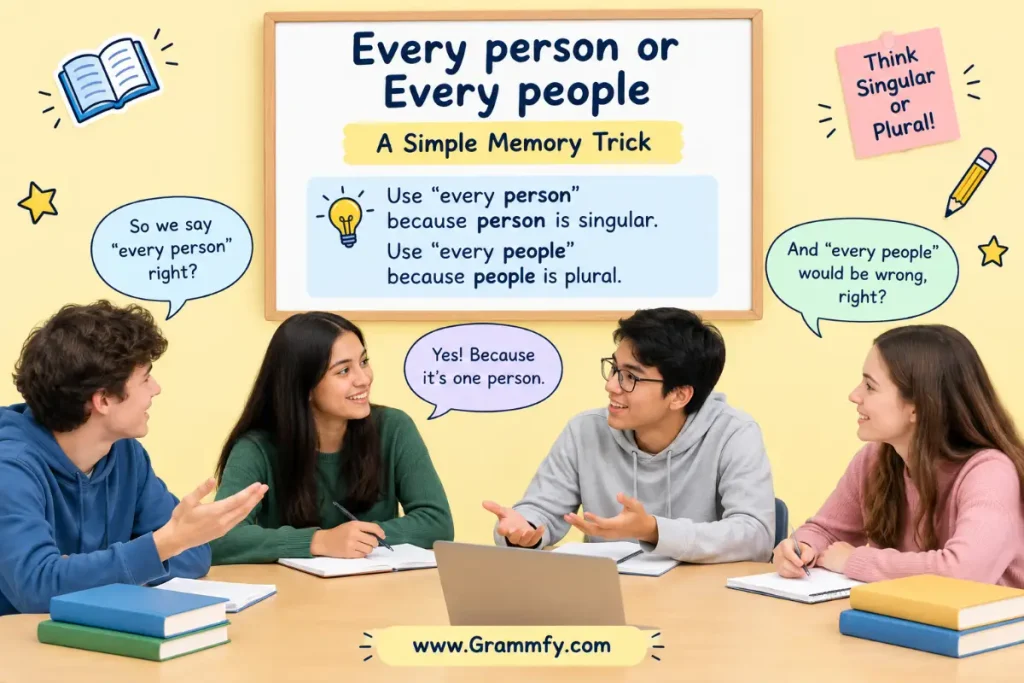
A simple memory trick for “every person or every people”
Remember this formula:
Every + one singular thing
Examples:
- every person
- every student
- every teacher
- every customer
- every book
Then remember:
All + plural things
Examples:
- all people
- all students
- all teachers
- all customers
- all books
So:
Every person is welcome. ✅
All people are welcome. ✅
Every people are welcome. ❌
This shortcut will solve most everyday grammar questions involving these words.
Conclusion
Choosing the right phrase depends on whether you’re talking about individuals or groups. For normal English, every person is the standard choice when you mean each individual human. Everyone and each person are useful alternatives, while all people works well when you want to describe people collectively. The expression every people has a narrow meaning and may appear in specialized writing about nations, cultures, or distinct populations. Remember the core grammar pattern: every normally takes a singular countable noun, so we say “every person is,” not “every people are.” Once you understand that pattern, similar expressions become much easier to handle. Choose the shortest clear phrase for your audience, and don’t be afraid to replace repeated wording with a precise synonym.
Frequently Asked Questions
Is “every person” grammatically correct?
Yes, every person is grammatically correct and means each individual human. The noun after every is singular, so the phrase normally takes a singular verb.
Is “every people” correct in English?
Every people is usually incorrect when you mean individual humans. It can be grammatical in specialized writing when people refers to a distinct ethnic, cultural, or national group.
Which is correct: every person is or every person are?
Every person is is correct because person is singular after every. For example, “Every person is welcome.”
What’s another way to say “every person”?
Common alternatives include everyone, everybody, each person, every individual, and all people. The best option depends on the sentence and tone.
Is “every person or every people” the same as “everyone”?
Not exactly, although everyone often has the same basic meaning as every person. Every people has a rare specialized meaning that everyone does not normally have.
Should I use “every person” or “everyone” in an essay?
Both are correct. Every person can emphasize individuals, while everyone is shorter and often sounds more natural; using both can also prevent repetition.
Can I use “every people” in formal writing?
You can use it when people means separate cultural, ethnic, or national groups. For general readers, however, every culture, every nation, or every ethnic group is often clearer.
