
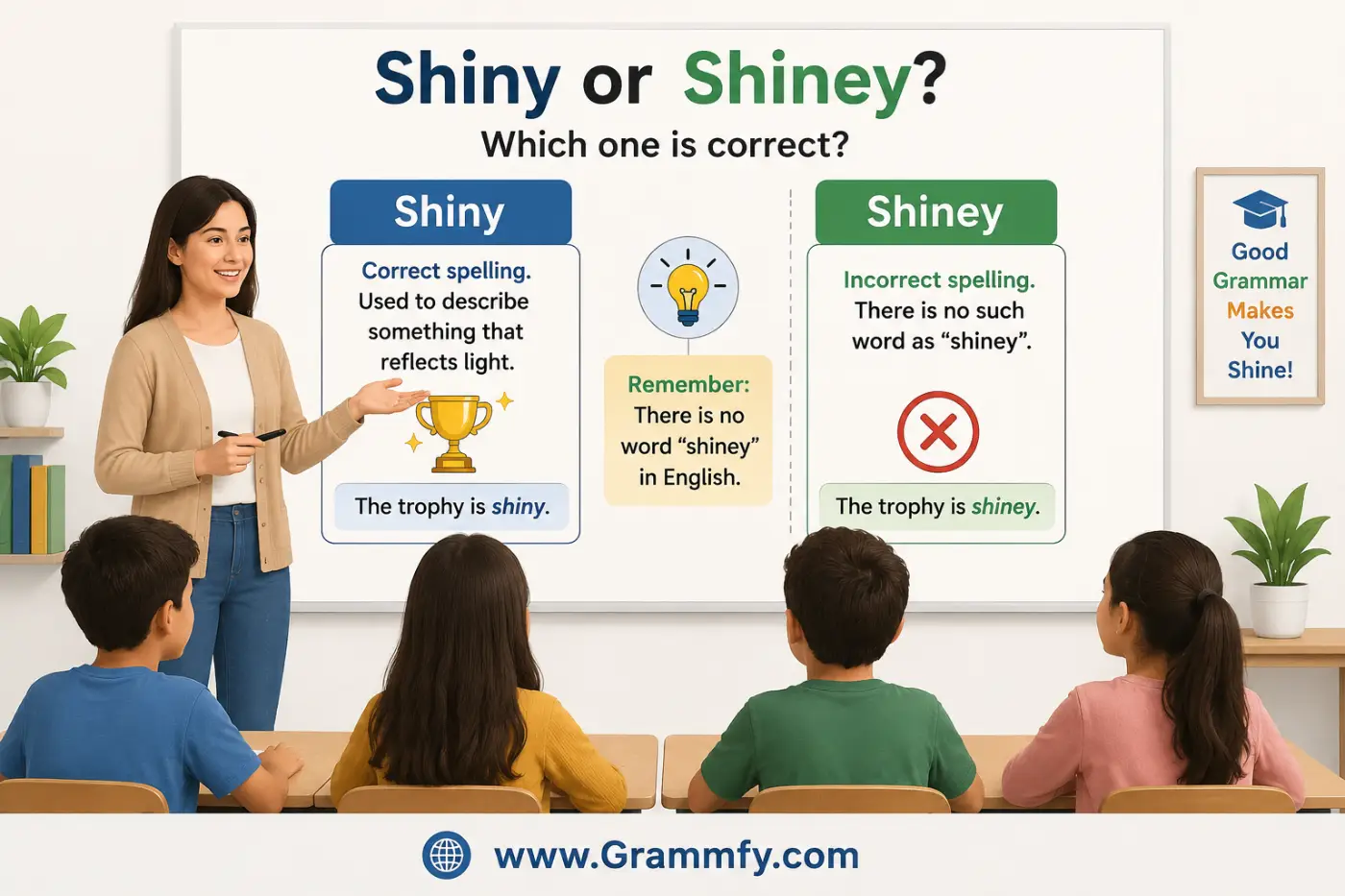
You’re writing an email, essay, resume, or text when you stop at one small question: should you write shiny or shiney? Both versions may look familiar, but only one is the standard spelling in English.
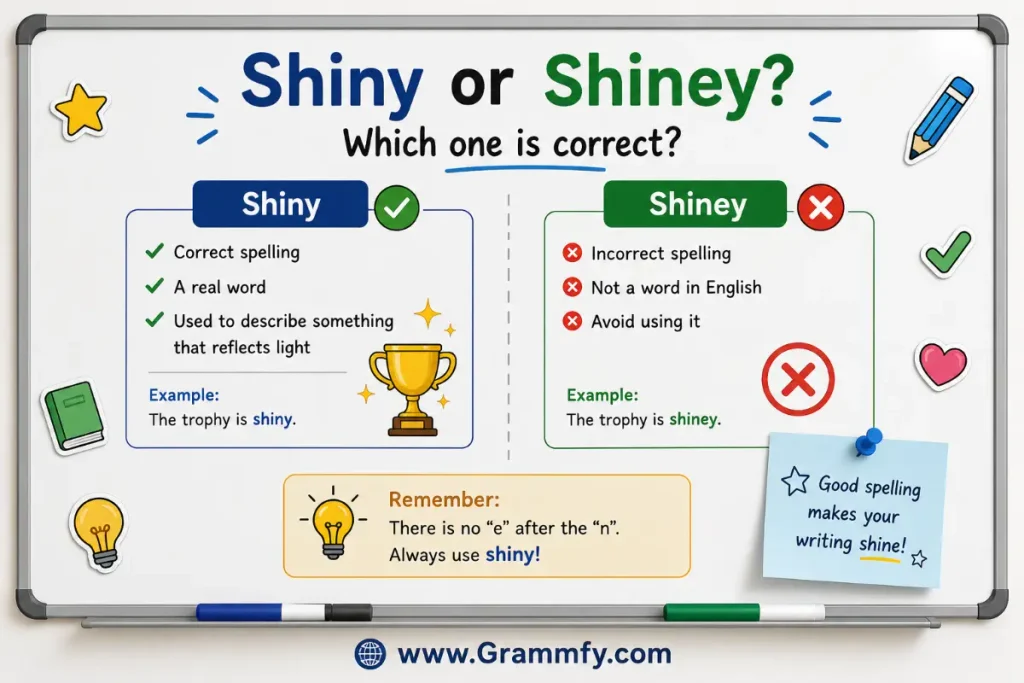
Answer: Shiny is the correct standard spelling. Shiney is a common misspelling and should generally be avoided in formal and everyday writing.
The word shiny describes something that reflects light, looks bright, or has a smooth, polished surface. You can use it for objects such as shoes, jewelry, cars, floors, hair, and metal. It can also describe something that looks new or attractive.
This guide explains the meaning and origin of the word, why the spelling can be confusing, useful synonyms, examples, context-based choices, common mistakes, and quick ways to remember the correct form.
Build stronger spelling skills with our guide to [shiny vs shiney].
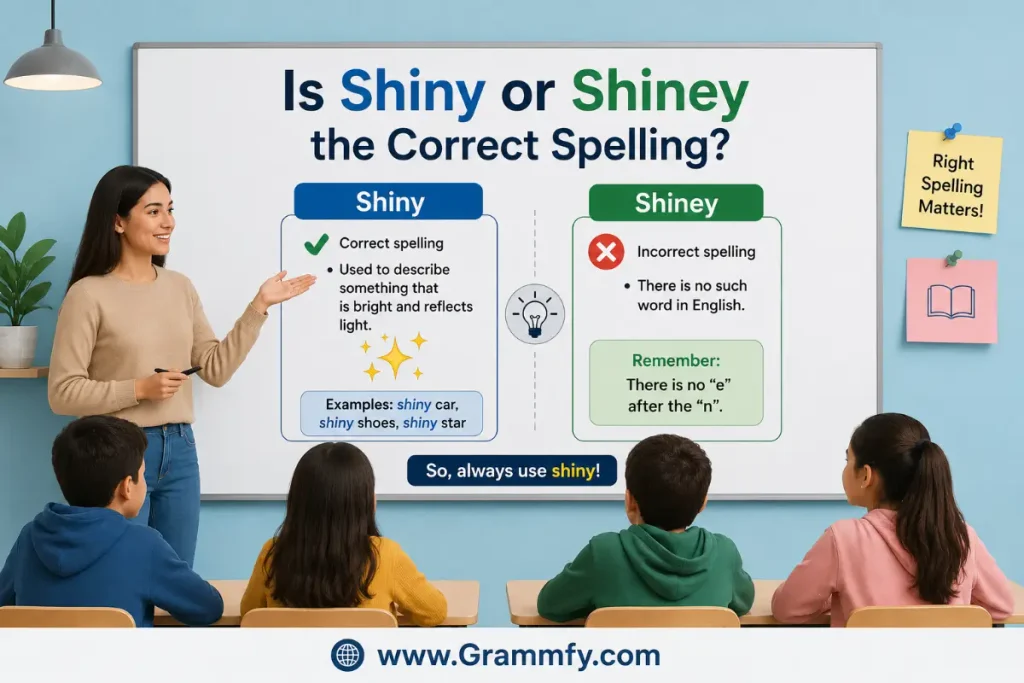
Is Shiny or Shiney the Correct Spelling?
Shiny is the correct spelling in standard English.
The spelling follows a common English pattern. The base word is shine, but when the suffix -y is added, the final silent e is usually removed:
- shine + y → shiny
- noise + y → noisy
- ice + y → icy
- spice + y → spicy
- haze + y → hazy
The form shiney may seem logical because the word comes from shine, but standard English does not normally keep the final e before -y in this type of word.
Why does “shiney” look correct to some people?
The confusion comes from pronunciation and spelling.
When you see shine, you can easily think that adding -y should produce shiney. English spelling, however, does not always work by simply attaching letters to the original word.
Compare:
- shine → shiny
- dine → dinky? No. This shows why spelling patterns must be learned word by word.
- haze → hazy
- noise → noisy
- taste → tasty
The important point is that shiny is the established standard form.
What Does Shiny Mean?
Shiny is an adjective. It usually describes something that reflects a noticeable amount of light.
For example:
- The new shoes are shiny.
- She wore a shiny necklace.
- The floor looked shiny after cleaning.
- His car has a shiny black finish.
The word can describe both physical appearance and, in some cases, a new or attractive quality.
Simple definition of shiny
Shiny means reflecting light because something is smooth, polished, bright, or naturally reflective.
A shiny object may have a glossy, polished, or bright surface.
Examples of shiny things
Many everyday objects can be described as shiny:
- polished shoes
- clean windows
- silver jewelry
- chrome car parts
- polished wood
- wet pavement
- glossy paper
- fresh paint
- clean metal
- bright decorations
- smooth plastic
- polished floors
The exact meaning depends on the object and situation.
Where Did the Word Shiny Come From?
The word shiny comes from the verb shine.
The English word shine has a very old history. It developed from Germanic language roots related to brightness, light, and shining. Over time, English speakers formed related words from shine, including shiny.
The suffix -y is often used to create adjectives that mean “having,” “showing,” or “characterized by” something.
For example:
| Base word | Adjective | Basic idea |
|---|---|---|
| shine | shiny | showing or reflecting light |
| cloud | cloudy | full of clouds |
| rain | rainy | having rain |
| dirt | dirty | covered with dirt |
| sun | sunny | full of sunshine |
| wind | windy | having a lot of wind |
| mud | muddy | covered with mud |
| salt | salty | containing or tasting of salt |
So shiny can be understood as something that has the quality of shining.
What Is the Difference Between Shiny or Shiney?
Shine and shiny are related, but they have different grammatical jobs.
Shine can be a verb or a noun.
- The stars shine at night.
- Give the shoes a good shine.
Shiny is an adjective.
- The shoes look shiny.
- She bought a shiny bracelet.
A simple trick is to ask what role the word has in the sentence.
If you’re describing a noun, shiny is often the right choice.
The shiny car was parked outside.
If you’re talking about the action of producing or reflecting light, shine may be the better choice.
The sun began to shine.
Why Is Shiney a Common Misspelling?
There are several reasons people write shiney.
First, English has many words in which the original spelling appears to remain when a suffix is added. Second, the pronunciation can make the extra e feel natural. Finally, English spelling contains many exceptions, so writers may hesitate when they encounter an unfamiliar form.
The easiest solution is to remember this pair:
shine → shiny
Not:
shine → shiney
You can also connect it with similar words:
- noise → noisy
- spice → spicy
- haze → hazy
- taste → tasty
Once you recognize the pattern, the spelling becomes easier.
25 Useful Synonyms for Shiny
The best synonym depends on what you mean. A word that works for polished metal may not sound natural for someone’s hair or a new product.
| Word | Meaning | Tone | Example |
|---|---|---|---|
| Glossy | Smooth and reflecting light | Everyday | The magazine has a glossy cover. |
| Bright | Giving off or reflecting a lot of light | Simple | She wore a bright dress. |
| Gleaming | Shining strongly or cleanly | Everyday/Formal | The windows were gleaming. |
| Polished | Smooth and carefully finished | Formal/Everyday | He wore polished shoes. |
| Lustrous | Shining beautifully | Formal | She had lustrous hair. |
| Sparkling | Reflecting light in small flashes | Everyday | The water was sparkling. |
| Radiant | Very bright or attractive | Formal | She looked radiant. |
| Gloss | A smooth, shiny finish | Everyday | The paint has a high gloss. |
| Sleek | Smooth and stylish | Everyday | The phone has a sleek design. |
| Sheen | A soft surface shine | Formal/Descriptive | The fabric had a gentle sheen. |
| Shimmering | Giving off a soft, moving light | Descriptive | The lake was shimmering. |
| Twinkling | Shining with quick flashes | Descriptive | The lights were twinkling. |
| Dazzling | Extremely bright or impressive | Strong | The diamond was dazzling. |
| Glittery | Covered with glitter or sparkling | Casual | She chose a glittery card. |
| Metallic | Having the appearance of metal | Technical | The wall has a metallic finish. |
| Polished-looking | Appearing smooth and finished | Everyday | The presentation looked polished. |
| Sparkly | Shining with small flashes | Casual | She bought a sparkly dress. |
| Brilliantly lit | Strongly illuminated | Formal | The stage was brilliantly lit. |
| Radiating | Sending light or energy outward | Formal | The lamp was radiating light. |
| Silvery | Looking like silver | Descriptive | The moon had a silvery glow. |
| Gloss-finished | Having a smooth reflective surface | Technical | The cabinet has a gloss-finished door. |
Synonyms by Intensity: From Mild to Strong
Not every word for brightness has the same strength.
Mild shine
Use these when something has a small or soft amount of light:
- glossy
- polished
- lustrous
- sheen
- silvery
- reflective
Example:
The table had a soft, polished appearance.
Medium shine
These words suggest a noticeable amount of brightness:
- shiny
- gleaming
- glowing
- sparkling
- shimmering
- glossy
Example:
The clean windows were gleaming in the morning light.
Strong shine
These words suggest powerful or eye-catching brightness:
- dazzling
- brilliant
- radiant
- glittering
Example:
The diamond looked dazzling under the spotlight.
Choosing the intensity carefully makes your writing more precise.
Synonyms by Part of Speech
Because shiny is an adjective, its closest replacements are usually adjectives. However, related words can appear as nouns and verbs.
Adjectives
- shiny
- glossy
- bright
- polished
- gleaming
- glowing
- radiant
- lustrous
- sparkling
- glittering
- reflective
- dazzling
Nouns
- shine
- gloss
- sheen
- sparkle
- glitter
- glow
- brilliance
- radiance
Examples:
The floor has a shine.
The floor is shiny.
The fabric has a soft sheen.
Verbs
- shine
- gleam
- glow
- sparkle
- glitter
- shimmer
- reflect
Examples:
The metal gleamed in the sunlight.
The water sparkled in the afternoon.
The stars shimmered above the lake.
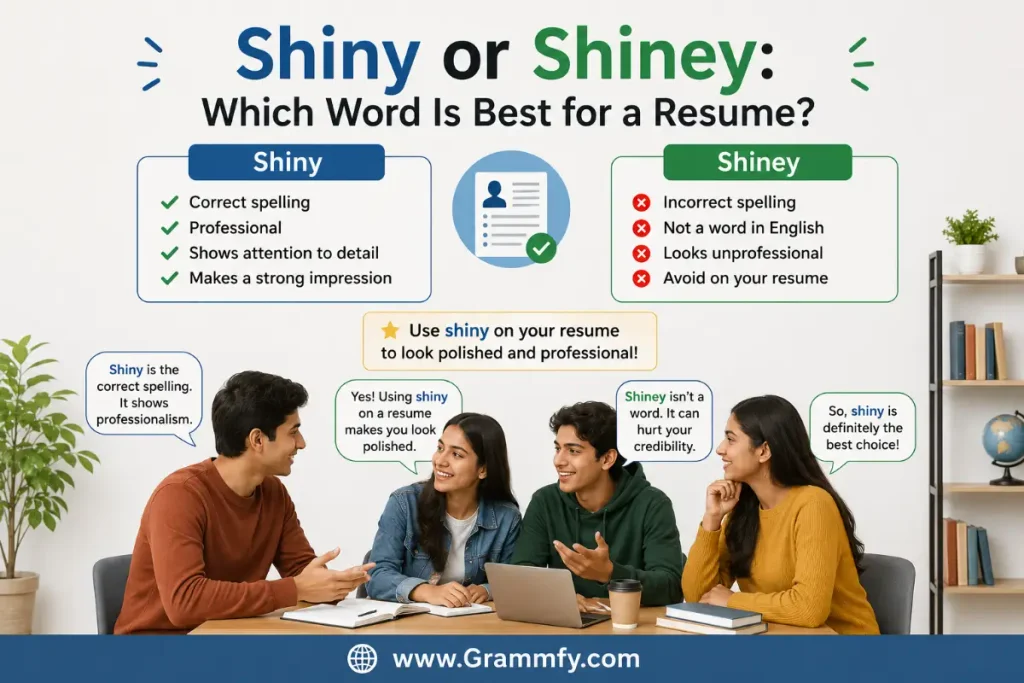
Which Word Is Best for a Resume?
For a resume, avoid using shiny unless you’re describing a physical product, material, or specific visual feature.
Professional writing usually benefits from more precise words such as:
- polished
- professional
- refined
- sleek
- high-quality
- well-presented
For example:
Less precise:
I created a shiny new presentation.
Better:
I created a polished presentation for the sales team.
Here, polished doesn’t mean physically reflective. It means refined, professional, and carefully prepared.
That distinction matters. Words can develop figurative meanings based on context.
When shiny works on a resume
If your job involves physical products, materials, design, or photography, shiny may be appropriate.
Designed packaging with a shiny metallic finish.
In this sentence, the word describes an actual visual property.
Which Word Is Best for an Essay Shiny or Shiney?
In an essay, shiny is perfectly acceptable when you need a simple, direct description.
For example:
The shiny surface of the building reflected the afternoon sun.
However, academic writing may sometimes benefit from a more specific term.
Instead of:
The object had a shiny surface.
You might write:
The object had a highly reflective surface.
The second sentence sounds more technical because reflective explains what the surface actually does.
For creative essays, descriptive alternatives can create a stronger image:
The lake was shimmering beneath the morning sun.
Choose the word based on the purpose of the sentence rather than trying to use the fanciest synonym.
Which Word Is Best for Texting Shiny or Shiney?
For texting, simple words usually sound the most natural.
Shiny works well in casual messages:
Look at my new shiny shoes 😂
That car is so shiny!
You can also use casual alternatives:
- sparkly
- glossy
- glittery
- bright
- sleek
For example:
This phone case is so sparkly!
The choice depends on the object and your tone.
Which Word Is Best for an Email Shiny or Shiney?
In a normal email, shiny is acceptable when you’re talking about appearance.
The new samples have a shiny finish.
If you’re writing to a client or coworker, a more precise term may sound better:
The new samples have a polished finish.
For technical or business communication, words such as glossy, reflective, polished, or metallic may give the reader more information.
Which Word Is Best When Speaking Shiny or Shiney?
In conversation, shiny is natural and easy to understand.
Your shoes are really shiny.
The new floor looks shiny.
You don’t need a formal synonym unless the situation calls for one.
In everyday speech, simple vocabulary often sounds more natural than words such as lustrous or radiant.
What Are the Best Words for Shiny Hair?
Hair can be described with several related words, but each creates a slightly different image.
Shiny hair
Focuses on visible light reflection.
Her hair looked shiny after she washed it.
Glossy hair
Suggests a smooth, healthy-looking surface.
She has long, glossy hair.
Lustrous hair
Sounds more elegant and formal.
The model had thick, lustrous hair.
Silky hair
Focuses more on texture than light.
Her hair felt soft and silky.
Glossy vs shiny hair
Glossy often sounds more polished and beauty-focused, while shiny is simpler and more general.
What Are the Best Words for a Shiny Car?
Several options work well when describing a vehicle.
- shiny car
- polished car
- glossy car
- gleaming car
- sleek car
- sparkling car
Compare these examples:
He washed his shiny car.
Simple and general.
He washed his polished car.
Focuses on the finish or careful cleaning.
He drove a sleek car.
Focuses on stylish shape and design rather than brightness alone.
The gleaming car stood in the driveway.
Creates a stronger visual image.
What Are the Best Words for Shiny Metal?
For metal, polished, gleaming, reflective, and lustrous can all work.
The polished metal reflected the lights.
The stainless-steel surface was gleaming.
The reflective metal made the room brighter.
The best choice depends on whether you’re describing appearance, surface quality, or the way light behaves.
What Are the Best Words for a Shiny Surface?
Use glossy, reflective, polished, or smooth depending on the exact meaning.
| Word | Best when you mean |
|---|---|
| Shiny | Reflects noticeable light |
| Glossy | Has a smooth, polished-looking finish |
| Reflective | Sends light back clearly |
| Polished | Has been made smooth or bright |
| Smooth | Has an even surface, not necessarily bright |
| Lustrous | Has an attractive, rich shine |
For technical writing, reflective may be more accurate than shiny.
Shiny vs Glossy — What’s the Difference?
Shiny and glossy are close, but they aren’t always interchangeable.
| Shiny | Glossy |
|---|---|
| General word for reflecting light | Often describes a smooth, polished finish |
| Common in everyday speech | Common in product, design, and beauty language |
| Works for many objects | Often used for surfaces, paper, hair, and finishes |
| Simple and broad | More specific in some contexts |
Examples:
The clean spoon was shiny.
The magazine had a glossy cover.
You could use shiny for the magazine too, but glossy sounds more natural because magazines often have a specific glossy finish.
Shiny vs Sparkly — What’s the Difference?
These words describe different types of visual effects.
Shiny usually means light is reflected from a smooth surface.
Sparkly suggests many small points or flashes of light.
Compare:
The new shoes are shiny.
This suggests a smooth reflective surface.
The new shoes are sparkly.
This suggests glitter, crystals, sequins, or many tiny points of light.
A polished black shoe can be shiny without being sparkly.
A glitter-covered shoe can be sparkly without having a smooth polished surface.
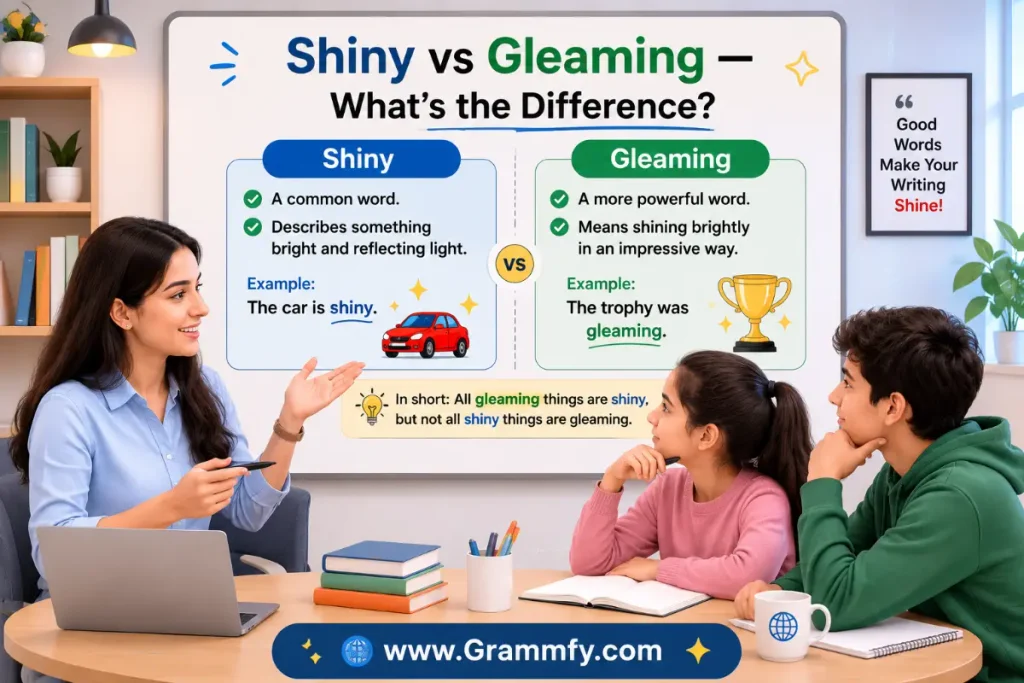
Shiny vs Gleaming — What’s the Difference?
Both words describe brightness, but gleaming can sound stronger and more vivid.
The clean floor was shiny.
The clean floor was gleaming.
The first is simple and neutral. The second creates a stronger impression of brightness and cleanliness.
Gleaming is especially useful in descriptive writing.
Shiny vs Polished — What’s the Difference?
These words overlap, but polished can describe both physical and figurative qualities.
Physical:
She wore polished shoes.
Figurative:
He gave a polished presentation.
You cannot always replace polished with shiny.
He gave a shiny presentation.
This sounds strange because the sentence is using a physical appearance word where a figurative meaning is expected.
15+ Real-Life Example Sentences
Here are examples showing how the word works in different situations.
- The children admired the shiny coins.
- Her new shoes looked shiny after she cleaned them.
- Sunlight reflected from the shiny surface of the lake.
- He bought a shiny silver watch.
- The kitchen floor looked shiny after it was washed.
- The car had a shiny black finish.
- She wrapped the gift in shiny paper.
- The shiny buttons stood out against the dark jacket.
- The freshly polished table looked shiny under the lamp.
- The rain left the streets wet and shiny.
- The artist used shiny paint to create a metallic effect.
- His shoes were still shiny after the long walk.
- The store displayed shiny decorations near the entrance.
- The new phone has a smooth, shiny back.
- The coins became shiny after they were cleaned.
- The shiny surface reflected her face.
- A shiny ribbon was tied around the box.
- The wet leaves looked shiny in the sunlight.
These examples show that the word works naturally in casual, descriptive, and practical writing.
How to Use Shiny in Different Situations
The word can describe more than physical objects.
Physical appearance
The floor has a shiny finish.
This is the most common use.
New or attractive things
Sometimes people use shiny informally to suggest that something looks new, appealing, or exciting.
He bought a shiny new laptop.
Here, shiny may refer to the object’s appearance, but it can also add a playful sense of excitement.
Figurative use
The phrase shiny new can describe something new and attractive even when physical shine isn’t important.
The company introduced a shiny new app.
This can sound playful or slightly humorous.
In formal writing, you may prefer:
The company introduced a new app.
When Should You Not Use Shiny?
There are situations where another word is more precise.
Don’t use shiny when you mean clean
These aren’t always the same.
The floor is shiny.
means the floor reflects light.
The floor is clean.
means the floor has no noticeable dirt.
A clean floor can be dull, and a shiny floor can still have dirt on it.
Don’t use shiny when you mean smooth
A surface can be smooth without reflecting much light.
The stone feels smooth.
is different from:
The stone looks shiny.
Don’t use shiny when you mean new
A new product might be shiny, but the two words aren’t synonyms.
I bought a new phone.
doesn’t necessarily mean:
I bought a shiny phone.
Don’t use shiny when you mean professional
For business writing, polished may be more appropriate.
She gave a polished presentation.
This means the presentation was well prepared, not physically reflective.
Common Spelling Mistakes
The most common problem is adding the e from shine before the -y ending.
Incorrect:
shiney
Correct:
shiny
Other related forms can also cause confusion.
Shine
Verb or noun.
The sun will shine tomorrow.
Shining
Present participle or adjective.
The sun is shining.
Shiny
Adjective.
The surface is shiny.
Shined and shone
These forms can be more complicated because English uses both shined and shone in different contexts.
For example:
He shined his shoes.
The sun shone brightly.
The spelling of shiny is much simpler: remove the final e and add -y.
Is Shiney Ever Correct?
In standard modern English, shiney is generally treated as a misspelling of shiny.
You may occasionally see it in usernames, brand names, fictional names, informal online writing, or other situations where someone intentionally uses a nonstandard spelling.
That doesn’t make it the standard spelling.
If you’re writing an essay, email, resume, school assignment, article, or professional document, use shiny.
What Is the Opposite of Shiny?
Common antonyms include:
- dull
- matte
- flat
- cloudy
- rough
- faded
- lackluster
- nonreflective
- unpolished
The best antonym depends on what you’re describing.
Shiny vs dull
The old metal was dull, but the new metal was shiny.
Shiny vs matte
The camera comes with either a shiny or matte finish.
Matte is especially useful when talking about surfaces designed not to reflect much light.
Shiny vs rough
These describe different qualities.
The stone was rough but shiny.
A surface can actually be both rough and shiny, so they aren’t true opposites in every situation.
What Does Matte Mean Compared With Shiny?
Matte describes a surface with little or no strong reflection.
For example:
- matte paint
- matte paper
- matte screen
- matte makeup
A shiny surface reflects more light, while a matte surface usually produces a softer, less reflective appearance.
This distinction is especially useful when discussing photography, printing, makeup, furniture, electronics, and product design.
Quick Tips for Choosing the Right Word Shiny or Shiney
Use these tips when you’re unsure which description sounds best.
1. Use shiny for general brightness
The shoes are shiny.
It’s simple and natural.
2. Use glossy for a smooth polished finish
The brochure has a glossy cover.
3. Use gleaming for a strong clean shine
The kitchen was gleaming after the cleaning.
4. Use sparkling for small flashes of light
The water was sparkling in the sun.
5. Use glittering for many bright points
The decorations were glittering.
6. Use polished for a carefully finished surface
The table has a polished surface.
7. Use reflective when light is bounced back
The jacket has reflective strips.
8. Use lustrous for elegant or rich shine
The fabric had a lustrous appearance.
9. Use sleek for stylish smoothness
The phone has a sleek design.
10. Choose precision over fancy vocabulary
Don’t replace a simple word just to sound more advanced.
If shiny says exactly what you mean, use it.
A Simple Memory Trick to Remember “Shiny or Shiney”
Here’s an easy way to remember the spelling:
Shine loses its final e before -y.
Think:
shine → shiny
You can also remember the phrase:
“The E shines away.”
The final e disappears when -y is added.
Another useful comparison is:
- noise → noisy
- spice → spicy
- haze → hazy
- shine → shiny
Seeing the pattern several times makes the spelling easier to recall.
Shiny in Common Phrases
Here are some common combinations you may see:
- shiny shoes
- shiny hair
- shiny surface
- shiny object
- shiny floor
- shiny metal
- shiny car
- shiny paper
- shiny finish
- shiny new toy
- shiny new phone
- shiny decoration
- shiny material
- shiny fabric
- shiny jewelry
The phrase shiny new is especially common.
She bought a shiny new bicycle.
It can describe both the literal appearance and the excitement of having something new.
Why Word Choice Matters
Choosing the right adjective helps readers form a clearer picture.
Consider these sentences:
The car looked nice.
This is understandable but vague.
The car looked shiny.
Now we know something about its surface.
The car had a glossy black finish.
This gives even more detail.
The car had a sleek, polished black finish.
Now the reader gets information about both appearance and style.
Good word choice isn’t about using complicated vocabulary. It’s about giving the reader the exact information they need.
A Quick Context Guide about “Shiny or Shiney”
| Situation | Best choice | Example |
|---|---|---|
| General appearance | Shiny | The shoes are shiny. |
| Magazine or paper | Glossy | The magazine has a glossy cover. |
| Clean metal | Gleaming | The metal was gleaming. |
| Hair | Glossy | Her hair looked glossy. |
| Many tiny flashes | Sparkling | The water was sparkling. |
| Glitter-covered object | Glittery | She wore a glittery dress. |
| Smooth finish | Polished | The table has a polished finish. |
| Light reflection | Reflective | The material is reflective. |
| Stylish design | Sleek | The phone has a sleek design. |
| Elegant shine | Lustrous | The fabric looked lustrous. |
| Very bright | Dazzling | The diamond was dazzling. |
| Soft light | Glowing | The lamp was glowing. |
What Should You Remember?
If you only remember a few points, remember these:
- Shiny is the standard spelling.
- Shiney is generally a misspelling.
- Shiny is an adjective.
- It describes something that reflects light or has a bright, polished appearance.
- The word comes from shine.
- The final e is removed before -y.
- Glossy, gleaming, polished, and sparkling can be useful alternatives.
- Pick a synonym based on the exact type and strength of the shine.
- Don’t use shiny when you really mean clean, smooth, new, or professional.
- In formal writing, precision is more important than using the longest synonym.
Conclusion
When you’re deciding between Shiny or Shiney, the answer is simple: use shiny in standard English. It is the correct adjective for something that reflects light or has a bright, polished appearance. The spelling comes from shine plus -y, with the final e removed.
Remember the basic pattern: shine → shiny. If you need a more specific description, choose a related word such as glossy, gleaming, polished, sparkling, or reflective. The best choice depends on what kind of brightness or surface you want to describe. Once you learn the spelling and notice these differences, you’ll be able to choose the right word confidently in schoolwork, emails, conversations, and professional writing.
Frequently Asked Questions
Is shiny the correct spelling?
Yes, shiny is the correct standard spelling, while shiney is generally considered a misspelling.
Why is shiny spelled without an e?
The final e in shine is removed before the -y ending, producing shiny.
What’s another way to say shiny?
You can say glossy, gleaming, polished, sparkling, lustrous, reflective, or bright, depending on the context.
Is shiny a noun or an adjective?
Shiny is an adjective because it describes a person, place, thing, or surface.
Can I use shiny in formal writing?
Yes, you can use shiny in formal writing when it accurately describes something’s appearance. For technical writing, a more precise word such as reflective or glossy may sometimes be better.
Is shiney ever an acceptable spelling?
Shiney is not the standard spelling. It may appear as an intentional name, username, or brand-style spelling, but standard English uses shiny.
What’s the difference between shiny and glossy?
Shiny is a broad term for reflecting light, while glossy often describes a smooth, polished finish, especially on paper, surfaces, hair, or products.
