
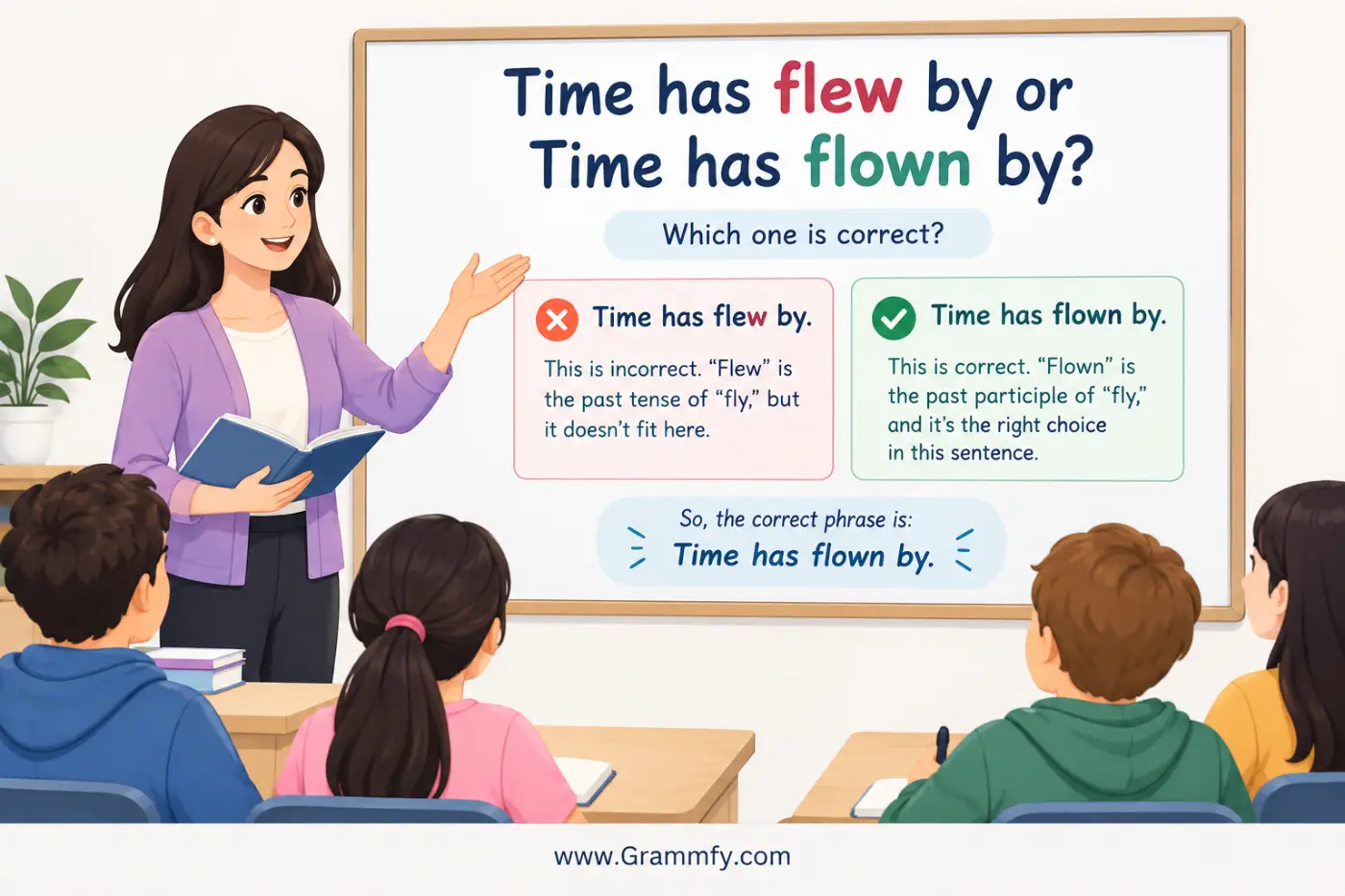
Have you ever finished writing an email, text, or essay and suddenly wondered whether you should write “time has flew by” or “time has flown by”? This is a common grammar question because flew and flown both come from the verb fly, but they do not work in the same grammatical patterns.
The correct form is Time has flown by. The word has is a helping verb, so it needs the past participle flown, not the simple past form flew.
Answer: “Time has flown by” is correct because has must be followed by the past participle flown. “Time has flew by” is incorrect in standard English.
This guide explains why the correct phrase works, where flew and flown come from, and which alternatives sound natural in texts, emails, essays, resumes, and everyday speech. You’ll also find examples, synonym choices, common mistakes, and quick rules that make this distinction easy to remember.
You can learn more about related grammar rules in [felt or feel].
Why is “Time has flown by” correct?
The key is the verb fly and its three main forms:
| Verb form | Word | Example |
|---|---|---|
| Base form | fly | Time can fly by. |
| Simple past | flew | Time flew by. |
| Past participle | flown | Time has flown by. |
The sentence Time flew by uses the simple past tense. It describes something that happened in the past.
The sentence Time has flown by uses the present perfect tense. The helping verb has combines with the past participle flown.
That gives us this basic rule:
has/have/had + past participle
So:
- Time has flown by. ✓
- The years have flown by. ✓
- The summer had flown by. ✓
- Time has flew by. ✗
The problem with “time has flew” is not the word time. The problem is the verb form after has.
What is the difference between flew and flown?
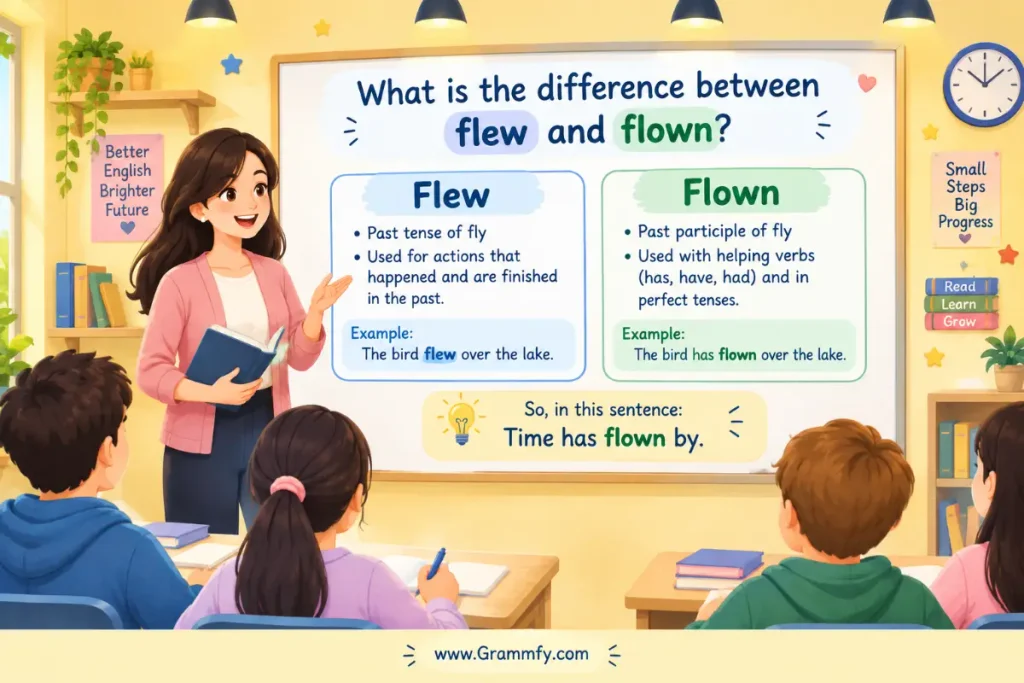
Flew is the simple past form of fly. Flown is the past participle.
You can use flew by itself as a past-tense verb:
- The bird flew over the house.
- We flew to Chicago last summer.
- The hours flew by.
- Time flew by during the vacation.
You use flown with a helping verb such as has, have, or had:
- The bird has flown away.
- We have flown to Chicago before.
- The years have flown by.
- Time has flown by.
A useful pattern is:
Past simple: subject + flew
Present perfect: subject + has/have + flown
Past perfect: subject + had + flown
Once you see that pattern, the difference becomes much easier.
What does “time has flown by” mean?
“Time has flown by” means that time seems to have passed very quickly.
It often expresses surprise because a period feels shorter than expected. You may use it when talking about a birthday, vacation, school year, relationship, job, or any other period of time.
For example:
- Time has flown by since we started college.
- I can’t believe how quickly this year has passed.
- Time has flown by since my first day at work.
- The vacation seemed to end almost immediately.
The expression doesn’t mean that time literally moves through the air. It is an idiomatic expression. The word flown creates the idea of something moving quickly.
Where did flew and flown come from?
The words flew and flown are different forms of the irregular verb fly.
English has many irregular verbs that don’t form the past tense by simply adding -ed. Instead, their forms change.
For example:
| Base | Past | Past participle |
|---|---|---|
| fly | flew | flown |
| go | went | gone |
| see | saw | seen |
| write | wrote | written |
| take | took | taken |
| speak | spoke | spoken |
Because fly is irregular, you cannot treat flew and flown as interchangeable.
The older meaning of fly relates to moving through the air. Over time, English speakers began using fly in figurative expressions involving speed. That’s why we can say that time flies or that the hours flew by.
The expression time flies is especially common in English. It describes how quickly time seems to pass.
Is “time flew by” also correct?
Yes. Time flew by is completely correct.
The difference comes from the tense.
Use time flew by when you are describing a completed past period:
- Time flew by during our trip.
- Time flew by when I was in college.
- The afternoon flew by while we talked.
- The weekend flew by.
Use time has flown by when you connect the past with the present:
- Time has flown by since we moved here.
- Time has flown by since I started this job.
- The year has flown by.
- Time has flown by so quickly.
So both Time flew by and Time has flown by can be correct. The incorrect form is Time has flew by.
Time has flew by or Time has flown by: which one should you use?
When choosing between these two forms, look at the word before the main verb.
If you use has, choose flown.
Correct: Time has flown by.
If there is no helping verb and you are talking about the past, flew can work.
Correct: Time flew by.
This simple comparison can help:
| Sentence | Correct? | Reason |
|---|---|---|
| Time flew by. | ✓ | Flew is the simple past. |
| Time has flown by. | ✓ | Flown is the past participle after has. |
| Time had flown by. | ✓ | Flown follows had. |
| Time has flew by. | ✗ | Has requires the past participle. |
| Time have flown by. | ✗ | Time is singular, so use has. |
What is the best way to remember flew vs flown?
Use this quick memory trick:
Flew goes alone. Flown needs a helper.
For example:
- Time flew by.
- Time has flown by.
- Time had flown by.
- Time will have flown by.
The word flew can act as the main past-tense verb without a helping verb.
The word flown normally appears with a helping verb in perfect constructions.
This is similar to other irregular verbs:
- I saw the movie.
- I have seen the movie.
- She wrote the letter.
- She has written the letter.
- They took the train.
- They have taken the train.
The same grammar pattern applies to fly.
What are synonyms for “time has flown by”?
English gives you many ways to express the idea that time passed quickly. The best choice depends on your audience and tone.
Simple alternatives
| Word or phrase | Meaning | Tone | Example |
|---|---|---|---|
| passed quickly | Time moved quickly | Simple | The week passed quickly. |
| went quickly | A period ended quickly | Very simple | The afternoon went quickly. |
| went by quickly | Time passed faster than expected | Everyday | The summer went by quickly. |
| passed fast | Time passed at a fast rate | Casual | The day passed fast. |
| moved quickly | A period seemed short | Neutral | The morning moved quickly. |
| didn’t last long | The period felt short | Simple | The vacation didn’t last long. |
Everyday alternatives
| Word or phrase | Meaning | Tone | Example |
|---|---|---|---|
| flew by | Passed very quickly | Everyday | The weekend flew by. |
| went by in a flash | Passed extremely quickly | Casual | The holiday went by in a flash. |
| slipped away | Time disappeared gradually | Reflective | The afternoon slipped away. |
| passed in no time | Ended surprisingly quickly | Casual | The meeting passed in no time. |
| went by so fast | Passed much faster than expected | Conversational | This year went by so fast. |
| disappeared quickly | Seemed to vanish | Neutral | The free time disappeared quickly. |
| rushed past | Seemed to move very fast | Informal | The last few months rushed past. |
Formal alternatives
| Word or phrase | Meaning | Tone | Example |
|---|---|---|---|
| passed rapidly | Time moved quickly | Formal | The months passed rapidly. |
| passed swiftly | Time moved at a fast pace | Formal | The years passed swiftly. |
| elapsed quickly | A period ended quickly | Formal | Several hours elapsed quickly. |
| passed in a short time | A period ended sooner than expected | Formal | The project passed in a short time. |
| progressed rapidly | A period moved forward quickly | Formal | The year progressed rapidly. |
| went by rapidly | Time passed at a high speed | Formal | The months went by rapidly. |
| elapsed swiftly | Time passed quickly | Formal | The remaining hours elapsed swiftly. |
Slang and casual expressions
| Word or phrase | Meaning | Tone | Example |
|---|---|---|---|
| time zoomed by | Time seemed extremely fast | Casual | Time zoomed by today. |
| time flew | Time passed quickly | Casual | Time flew during the trip. |
| it went by crazy fast | It passed extremely quickly | Slangy | The weekend went by crazy fast. |
| it was over in a second | Something seemed extremely short | Very casual | The vacation was over in a second. |
| it was gone before I knew it | Time disappeared unexpectedly | Conversational | The summer was gone before I knew it. |
| it went by in a heartbeat | Time passed very quickly | Casual | The evening went by in a heartbeat. |
Which expressions show different levels of speed?
Not every synonym has the same strength.
Mild: time passed quickly
These expressions suggest that time moved faster than expected, but they don’t sound dramatic:
- passed quickly
- went by quickly
- moved quickly
- passed swiftly
- went by fast
Example:
The school day went by quickly.
This sounds normal and neutral.
Medium: time seemed to disappear
These expressions create a stronger feeling:
- flew by
- slipped away
- passed in no time
- went by in a flash
- went by in a heartbeat
Example:
The weekend flew by.
The speaker feels that the weekend ended surprisingly quickly.
Strong: time disappeared extremely fast
These expressions are more emotional or dramatic:
- vanished in an instant
- was over before I knew it
- went by in a heartbeat
- was gone in no time
- seemed to disappear
Example:
The entire summer was over before I knew it.
This suggests strong surprise about how quickly the period ended.
What part of speech is “flown”?
Flown is the past participle form of the verb fly.
It is not normally used as a regular standalone past-tense verb.
Compare:
- The plane flew over the city.
- The plane has flown over the city.
- The plane had flown over the city.
In these sentences, flew carries the simple past tense, while flown works with the helping verbs has and had.
The phrase has flown by is therefore a verb phrase.
- has = helping verb
- flown = past participle
- by = particle/preposition-like element forming the phrasal expression
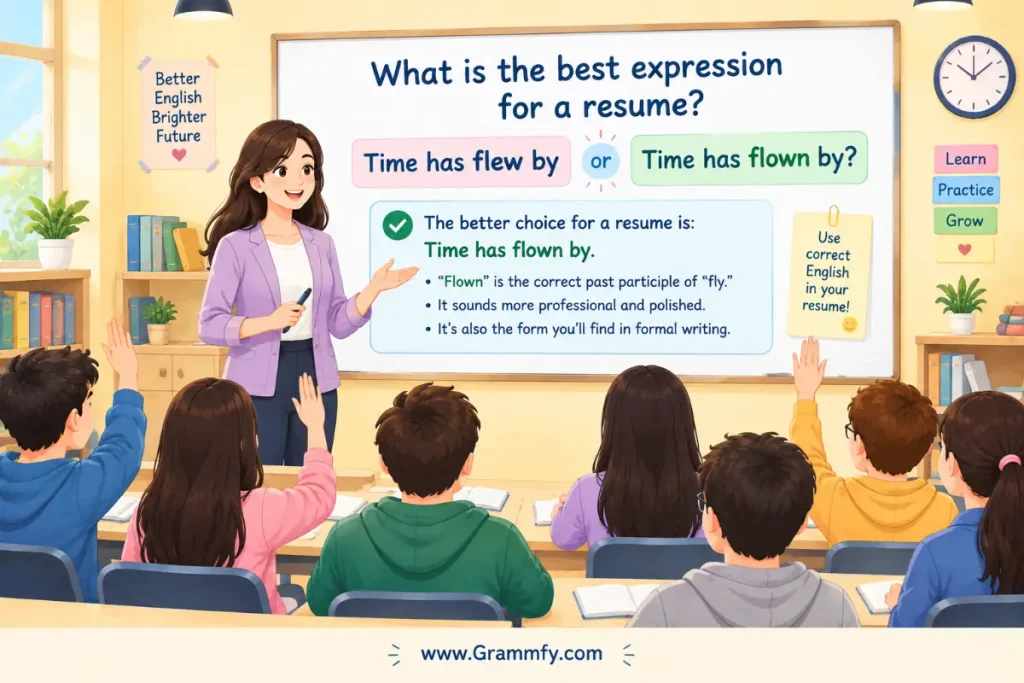
What is the best expression for a resume Time has flew by or Time has flown by?
A resume usually needs precise and professional language. Time has flown by is grammatical, but it usually doesn’t belong in a resume because resumes focus on skills, achievements, responsibilities, and results.
Instead of saying:
Time has flown by since I joined the company.
A professional resume might say:
Over the past three years, I have developed strong project-management skills.
Or:
During my three years with the company, I have led several successful projects.
The point isn’t to replace the grammar with another phrase. It’s to choose language that fits the purpose of a resume.
What is the best expression for an essay Time has flew by or Time has flown by?
For an essay, choose based on the subject and tone.
Time has flown by works well in a personal essay:
Time has flown by since my first day at college.
For a more formal academic essay, a phrase such as the years have passed quickly may sound more measured:
The years have passed quickly since the policy was introduced.
If you’re writing creatively, the years slipped away can add a reflective feeling:
As the years slipped away, the town slowly changed.
The best option depends on whether you want a neutral, personal, or literary voice.
What is the best expression for texting Time has flew by or Time has flown by?
Text messages are informal, so natural conversational phrases work best.
You could write:
Wow, time has flown by!
instead of:
This year went by so fast!
instead of:
Can’t believe how fast the week went by.
Or simply:
Time flies!
For casual texting, time flew by and time has flown by both sound natural when used with the right tense.
What is the best expression for an email Time has flew by or Time has flown by?
In a friendly email, time has flown by sounds warm and natural:
I can’t believe how much time has flown by since we last spoke.
You could also write:
It’s hard to believe how quickly the year has passed.
For a professional email, the second option may sound slightly more neutral.
Example:
It’s hard to believe how quickly the past year has passed. I appreciate everything we’ve accomplished together.
The choice depends on your relationship with the recipient.
What is the best expression in everyday speaking Time has flew by or Time has flown by?
In conversation, people often say:
- Time flies!
- Time flew by!
- Time has flown by!
- The day went by so fast.
- The weekend went by in a flash.
- I can’t believe how quickly the year passed.
If you’re reacting to the present moment, Time flies! is especially common.
If you’re looking back on a completed period, Time flew by works well.
If you’re looking back from the present and connecting that past period to now, Time has flown by is a strong choice.
What are some real-life examples of “time has flown by”?
Here are examples from different situations:
- School:
Time has flown by since my first day of high school. - Work:
Time has flown by since I started my new job. - Travel:
Our vacation is almost over. Time has flown by! - Family:
Time has flown by, and the kids are already in college. - Friendship:
I can’t believe how much time has flown by since we met. - Birthday:
Another year has passed, and time has flown by. - College:
Time has flown by since freshman year. - A project:
We started this project six months ago. Time has flown by. - A relationship:
Time has flown by since our first date. - A holiday:
Time has flown by during this holiday. - A conversation:
We talked for three hours, but time has flown by. - A year:
It’s hard to believe how quickly the year has gone. Time has flown by.
These examples show that the expression works in personal, professional, and casual contexts.
Time flew by vs Time has flown by — what’s different?
The main difference is tense.
| Time flew by | Time has flown by |
|---|---|
| Simple past | Present perfect |
| Focuses on a completed past situation | Connects a past period to the present |
| No helping verb needed | Uses has + flown |
| “The weekend flew by.” | “The year has flown by.” |
| Common for finished events | Common when the result or feeling continues now |
Compare these sentences:
The weekend flew by while we were at the beach.
The speaker is talking about a finished weekend.
The summer has flown by, and now school is starting.
The summer is connected to the current situation.
The difference can be small in casual conversation, but the grammar remains important.
Time has flown by vs time has passed — what’s different?
Both expressions can describe time moving quickly, but they create different feelings.
Time has passed is neutral. It simply says that time has gone by.
Ten years have passed since we graduated.
Time has flown by adds the idea that the period seemed unusually short.
Ten years have flown by since we graduated.
The second sentence sounds more emotional or surprised.
Use passed when you want a straightforward statement. Use flown by when you want to emphasize how quickly the time seemed to move.
Time flew by vs time slipped away — what’s different?
Both expressions suggest that time moved quickly, but slipped away often has a more reflective or slightly regretful tone.
The afternoon flew by while we talked.
This simply means the afternoon seemed short.
The afternoon slipped away while I was working.
This can suggest that the speaker didn’t notice the time passing or wishes they had used the time differently.
Flew by focuses mainly on speed. Slipped away can focus on the feeling of losing time.
Can you say “time has flew by” in informal English?
You may hear or see time has flew by, especially in casual speech, social media, or writing from someone who is still learning English. However, it is not the standard grammatical form.
In edited English, use:
Time has flown by.
If you want the simple past, use:
Time flew by.
Informal language can bend grammar, but that doesn’t make every form standard English.
For school assignments, professional emails, published articles, resumes, and other edited writing, choose the standard form.

Common mistakes with flew and flown
Mistake 1: Using flew after has
Incorrect:
Time has flew by.
Correct:
Time has flown by.
Remember: has + past participle.
Mistake 2: Using flown without a helping verb
Incorrect:
Yesterday, time flown by.
Correct:
Yesterday, time flew by.
Or:
Time has flown by.
The word flown normally needs a helping verb in this type of construction.
Mistake 3: Using have with singular time
Incorrect:
Time have flown by.
Correct:
Time has flown by.
The noun time is singular in this sentence, so use has.
Mistake 4: Mixing the forms
Incorrect:
Time has flew by so fast.
Correct:
Time has flown by so fast.
The issue remains the same even when words such as so fast appear after the verb.
Mistake 5: Assuming flew and flown are interchangeable
They aren’t.
The bird flew away.
But:
The bird has flown away.
The same distinction applies when talking about time.
When should you NOT use “time has flown by”?
The phrase is grammatically correct, but it isn’t the best choice for every situation.
Avoid it when you need highly precise or formal language.
For example, a scientific report might simply state:
Three hours elapsed during the experiment.
Instead of:
Three hours have flown by during the experiment.
The second sentence is grammatical but more conversational.
Likewise, in a business report, the project period ended or six months have passed may communicate the information more directly.
Good writing isn’t only about grammar. It’s also about matching the expression to the situation.
What are the antonyms of “time has flown by”?
There isn’t one exact opposite phrase, but several expressions can describe time moving slowly.
| Expression | Meaning |
|---|---|
| Time dragged on | Time seemed painfully slow |
| Time passed slowly | Time moved at a slow pace |
| The hours crawled by | The period felt very long |
| Time seemed to stand still | It felt as if time wasn’t moving |
| The day felt endless | The day seemed unusually long |
| Every minute felt long | Each moment seemed slow |
| The afternoon dragged | The afternoon seemed to last too long |
Compare:
The weekend flew by.
with:
The workday dragged on.
The first suggests that time passed quickly. The second suggests that time passed slowly.
How do you choose the right expression “Time has flew by or Time has flown by”?
Use the situation and tone as your guide.
- Choose “time has flown by” when:
- You’re looking back on a period connected to the present.
- You want to express surprise.
- You want a natural conversational tone.
- You’re writing a personal message.
- You’re talking about a year, month, vacation, relationship, or life stage.
- Choose “time flew by” when:
- You’re describing a completed past event.
- You want the simple past tense.
- You’re telling a story about something that happened.
- Choose “time has passed” when:
- You want a neutral statement.
- You don’t need to emphasize speed.
- You’re writing in a formal context.
- Choose “time slipped away” when:
- You want a reflective tone.
- You want to suggest that time disappeared unnoticed.
- You are writing creatively or personally.
- Choose “time dragged on” when:
- Time felt slow.
- You want to express boredom, frustration, or impatience.
Quick tips for remembering the correct form
Keep these five rules in mind:
- Flew = simple past.
Say: “Time flew by.” - Flown = past participle.
Say: “Time has flown by.” - Has + flown.
Never use has + flew in standard English. - Time is singular.
Say: “Time has,” not “time have.” - Choose the phrase based on tone.
Passed sounds neutral, flew by sounds conversational, and slipped away sounds more reflective.
A short memory trick is enough for most situations:
Flew for the past. Flown after has, have, or had.
A quick grammar test
Try filling in the blank:
Time has ___ by since we graduated.
The correct answer is flown.
Why?
Because has requires the past participle.
Now try:
Time ___ by during our vacation.
The correct answer is flew.
Why?
Because there is no helping verb, and the sentence uses the simple past.
One more:
Time had ___ by before we noticed.
The correct answer is flown because had + past participle forms the past perfect.
This three-question test covers the main difference.
Final rule: flew or flown?
If you’re unsure, look for a helping verb.
No helping verb + past event → flew
Time flew by.
Has/have + → flown
Time has flown by.
Had + → flown
Time had flown by.
Will have + → flown
By next year, ten years will have flown by.
The pattern stays consistent even when the sentence becomes longer.
Once you learn this pattern, similar irregular-verb questions become much easier. Pay attention to the helping verb, and you’ll usually know which form to choose.

Conclusion
The correct choice depends on the verb form and the tense you need. Time has flown by uses the present perfect structure has + past participle, so flown is the correct form. Time flew by uses the simple past, so flew works without a helping verb.
The easiest rule is to remember that flew is the simple past form, while flown is the past participle. When you see has, have, or had, choose flown. When you’re simply describing something that happened in the past, flew may be the right choice.
Once you learn this pattern, similar irregular-verb questions become much easier. Pay attention to the helping verb, and you’ll usually know which form to choose.
Frequently Asked Questions
Is “Time has flew by” grammatically correct?
No. The standard form is Time has flown by because has must be followed by the past participle flown.
Is “Time has flown by” correct English?
Yes, Time has flown by is grammatically correct and means that time has seemed to pass very quickly.
Is it “time flew by” or “time flown by”?
Use time flew by for the simple past and time has flown by when you need the present perfect. Flown usually requires a helping verb in this construction.
What’s another way to say “time has flown by”?
You can say time has passed quickly, time has gone by so fast, the years have slipped away, or the time has passed in a flash, depending on the tone.
Why do we say “flew” but “has flown”?
Because fly is an irregular verb. Its simple past is flew, while its past participle is flown.
Can I use “time flew by” in an essay?
Yes. Time flew by is grammatically correct and can work especially well in a personal or narrative essay. For a formal academic essay, a more neutral phrase such as time passed quickly may fit better.
Which sounds more natural: “time flew by” or “time has flown by”?
Both sound natural, but they use different tenses. Time flew by refers to a past situation, while time has flown by connects the passing period with the present.
