
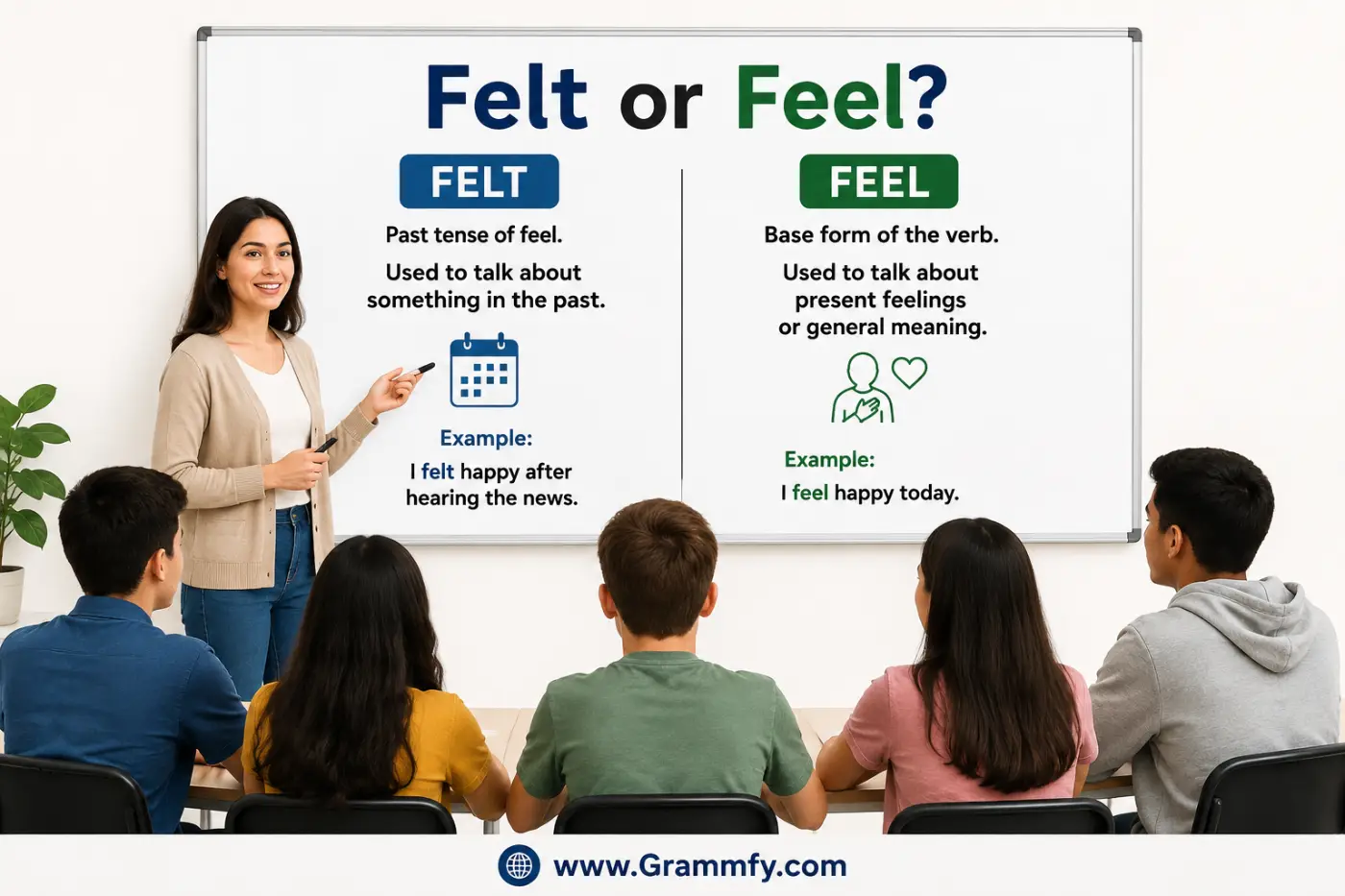
When you’re writing an email, text, essay, or personal message, you may pause over felt or feel. Both words are correct, but they don’t usually work in the same situations. The main difference is time: feel commonly talks about the present, while felt is the past form of feel.
Answer box: Feel is usually used for the present, while felt is the past tense and past participle of feel. Choose the form that matches when the feeling or experience happened.
For example, you might say, “I feel tired today” when the feeling is happening now. If you are talking about yesterday, you would say, “I felt tired yesterday.” The same pattern applies to emotions, physical sensations, opinions, and reactions.
This guide explains the difference between the two forms, their origins, meanings, synonyms, grammar rules, examples, common mistakes, and the best choice for emails, essays, resumes, texting, and conversation. You’ll also learn quick ways to decide which form belongs in your sentence.
You may also want to learn the difference between [ axle or axel ].
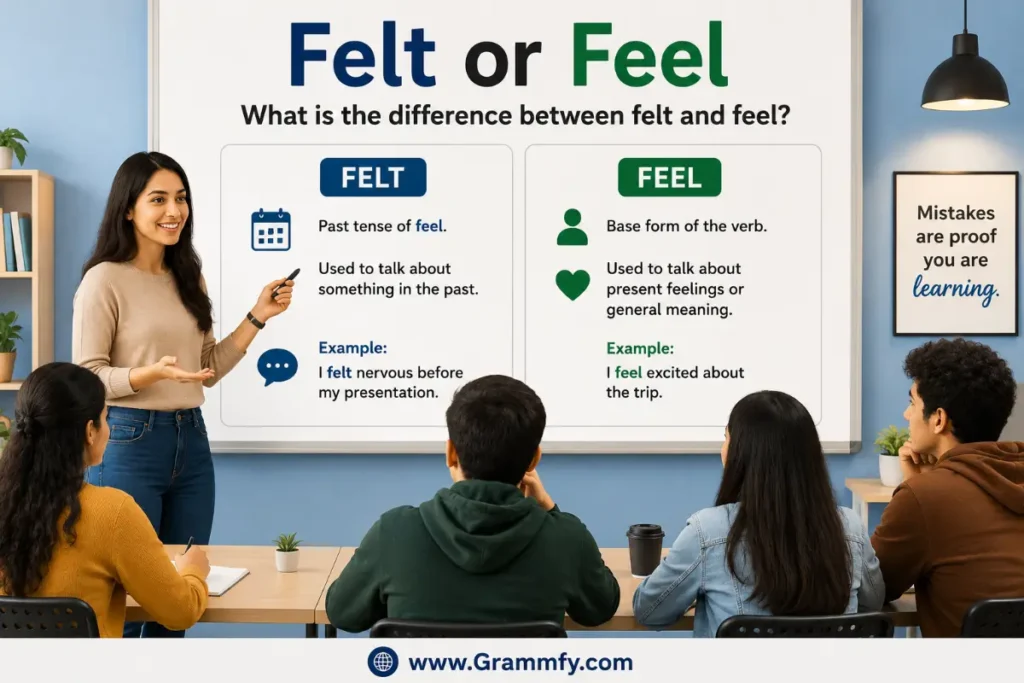
What is the difference between felt and feel?
The basic difference is verb tense.
Feel is the present form of the verb. It can describe something happening now, something that happens regularly, or something that someone believes or senses.
Felt is the past tense and past participle of feel. It normally describes an experience that happened in the past.
| Word | Verb form | Main use | Example |
|---|---|---|---|
| feel | Present | Something happening now or generally | I feel happy today. |
| felt | Past | Something experienced in the past | I felt happy yesterday. |
Compare these sentences:
I feel nervous before exams.
This describes a current or repeated experience.
I felt nervous before my exam yesterday.
This describes a past experience.
The choice depends mainly on when the experience happened.
How do you use feel in a sentence?
Feel is commonly used for present emotions, physical sensations, opinions, and perceptions.
Examples:
- I feel happy.
- I feel tired.
- I feel cold.
- I feel nervous.
- I feel confident.
- I feel that this is the right decision.
- The fabric feels soft.
- This room feels comfortable.
The word can describe both direct physical sensations and emotional experiences.
For example:
I feel sick.
This can describe a physical condition.
I feel worried.
This describes an emotional state.
I feel that we should wait.
Here, feel expresses an opinion or judgment.
How do you use felt in a sentence?
Felt is the past form of feel.
Use it when the experience happened before the current moment.
Examples:
- I felt tired yesterday.
- She felt nervous before the interview.
- He felt cold after leaving the building.
- They felt excited about the trip.
- We felt confident after practicing.
- I felt that something was wrong.
- The fabric felt soft.
Notice that the surrounding sentence often gives a past-time clue:
- yesterday
- last night
- earlier
- before
- when I was younger
- during the meeting
- after the event
- at that time
For example:
She felt nervous before the presentation.
The nervousness happened before the presentation, so the past form fits naturally.
What is the word origin of feel?
The English verb feel has very old Germanic roots. It is related to words in other Germanic languages that refer to sensing, touching, or experiencing.
Over time, English developed several meanings for the word. It can refer to physical touch, emotional experience, personal opinion, and the way something seems.
That explains why feel appears in many different kinds of sentences.
For example:
I feel the wall.
It refers to physical touch.
I feel happy.
This refers to emotion.
I feel that you’re right.
This refers to an opinion or judgment.
The room feels warm.
This describes a perceived quality of the environment.
The past form felt developed as the irregular past form of feel. It doesn’t become “feeled.”
Correct:
I felt nervous.
Incorrect:
I feeled nervous.
Because feel is an irregular verb, its past form must be memorized.
What does feel mean in plain English?
In simple English, feel can mean several things.
Feel can mean experience an emotion.
I feel happy.
She feels worried.
They feel excited.
The word can describe a physical sensation.
I feel cold.
He feels sick.
My hands feel warm.
Feel can mean touch something
Feel the surface of this table.
Feel can mean have an opinion
I feel that we should leave early.
The word feel can describe how something seems.
This room feels peaceful.
Because the word has several meanings, context matters.
What does felt mean in plain English?
Felt expresses the same basic meanings as feel, but it places the experience in the past.
For example:
I felt happy.
means that happiness was experienced earlier.
She felt the wall.
means she touched the wall at an earlier time.
The room felt cold.
This means the room seemed cold or felt cold at an earlier time.
The meaning doesn’t necessarily change. The time changes.
What are the different forms of feel?
The verb feel has several important forms.
| Form | Word | Example |
|---|---|---|
| Base form | feel | I feel better. |
| Present third person | feels | She feels better. |
| Past | felt | She felt better yesterday. |
| Past participle | felt | She has felt better recently. |
| Present participle | feeling | She is feeling better. |
This pattern is important because feel is irregular.
You don’t write:
She feeled better.
You write:
She felt better.
And with has, have, or had, you still use felt:
I have felt this way before.
She had felt nervous earlier.
Is felt past tense or present tense?
Felt is past tense and also the past participle of feel.
For simple past:
I felt tired.
In the present perfect:
I have felt tired lately.
For past perfect:
I had felt tired before the meeting.
The surrounding helping verb tells you how the past participle is functioning.
By contrast, feel is the base form:
I feel tired.
It can also appear after modal verbs:
I might feel better later.
I should feel better tomorrow.
I could feel the vibration.

Master synonym list for feel and felt
The best synonym depends on whether you’re describing an emotion, physical sensation, opinion, perception, or informal reaction.
| Word | Meaning | Tone | Example |
|---|---|---|---|
| sense | Notice or perceive something | Neutral | I sense a problem. |
| experience | Go through something | Neutral | She experienced strong emotions. |
| notice | Become aware of something | Everyday | I noticed the change. |
| think | Have an opinion | Everyday | I think it’s a good idea. |
| believe | Accept something as true | Neutral | I believe you’re right. |
| consider | Form an opinion | Formal | I consider it important. |
| recognize | Identify or understand | Neutral | She recognized the problem. |
| undergo | Go through an event or process | Formal | She underwent a difficult period. |
| endure | Experience something difficult | Strong | He endured severe pressure. |
| enjoy | Experience pleasure | Positive | They enjoyed the event. |
| dislike | Have a negative reaction | Neutral | I dislike the smell. |
| appreciate | Recognize value or importance | Positive/Formal | We appreciate your help. |
| suspect | Think something may be true | Neutral | I suspect something is wrong. |
| imagine | Form a mental impression | Neutral | I imagine it was difficult. |
| suppose | Have an assumption or belief | Everyday | I suppose you’re right. |
| reckon | Think or believe | Regional/Informal | I reckon it’ll work. |
| figure | Think or conclude | Informal | I figure we’ll arrive soon. |
| get | Understand or emotionally grasp | Informal | I get what you mean. |
| vibe | Experience or sense an atmosphere | Slang | I vibe with this place. |
| react | Respond emotionally or physically | Neutral | She reacted calmly. |
| respond | Answer or react | Neutral/Formal | He responded positively. |
| connect | Relate emotionally | Everyday | I connect with the story. |
| empathize | Understand another person’s feelings | Formal | She empathized with him. |
| relate | Understand through similar experience | Everyday | I can relate to that. |
These words overlap with feel, but they aren’t interchangeable in every sentence. A synonym should preserve both the meaning and the tone of the original sentence.
Simple synonyms for feel and felt
For basic English, these words are often useful:
- sense
- think
- notice
- experience
- understand
- like
- enjoy
- believe
Examples:
I sense something unusual.
I think this is a good idea.
I notice a difference.
I understand your concern.
These choices can make your writing more precise.
Everyday synonyms for feel and felt
In normal conversation, people often use:
- think
- believe
- sense
- notice
- experience
- relate
- get
- figure
- connect
For example:
I get what you’re saying.
This is much more casual than:
I understand your perspective.
Both can communicate a similar idea, but the tone is different.
Formal synonyms for feel and felt
In academic or professional writing, consider:
- perceive
- experience
- consider
- believe
- recognize
- detect
- empathize
- undergo
- appreciate
For example:
The participants perceived a significant change.
This sounds more formal than:
The participants felt a big change.
The formal choice is especially useful when you need precision.
Slang and informal alternatives
Casual English has several expressions related to feel.
Examples include:
- get it
- vibe with
- be into
- relate to
- figure
- reckon
- sense something is off
For example:
I really vibe with this song.
Or:
I totally get how you feel.
These expressions are suitable for informal conversations but may not fit a school essay or formal business document.
Synonyms by intensity: mild to strong
Different words can express different levels of emotional or physical experience.
Mild
- notice
- sense
- think
- consider
- experience
Example:
I noticed a little tension in the room.
Moderate
- feel
- perceive
- recognize
- react
- experience
Example:
She felt nervous before the meeting.
Strong
- suffer
- endure
- experience deeply
- struggle with
- be overwhelmed by
Example:
He struggled with intense anxiety before the performance.
Be careful with strong words. They can change the meaning of a sentence.
For example, experience is neutral, while suffer suggests something painful or harmful.
Synonyms by meaning
Because feel has several meanings, organizing synonyms by meaning is more useful than memorizing one long list.
When feel means “have an emotion”
Use:
- experience
- undergo
- react
- be affected by
- experience emotionally
Example:
She experienced a strong sense of relief.
When feel means “have an opinion”
Use:
- think
- believe
- consider
- suppose
- suspect
Example:
I believe this plan will work.
When feel means “sense something”
Use:
- sense
- perceive
- detect
- notice
- recognize
Example:
He detected a slight change in the machine.
When feel means “touch”
Use:
- touch
- handle
- examine
- test
Example:
She touched the fabric to check its texture.
When feel means “seem”
Use:
- seem
- appear
- come across as
- give the impression
Example:
The room seemed warmer than before.
Feel vs sense: what’s different?
Feel is broader than sense.
You can feel an emotion, physical sensation, texture, or opinion.
You can sense something by noticing or perceiving it, often without direct physical contact.
Compare:
| Feel | Sense |
|---|---|
| Broad meaning | Focuses on perception |
| Can describe emotions | Often describes awareness |
| Can describe physical sensations | Can describe subtle impressions |
Examples:
I feel nervous.
I sense that something is wrong.
The first describes an emotion. The second describes an impression or awareness.
Feel vs think: what’s different?
When feel expresses an opinion, it can be close to think, but the two words often carry different shades of meaning.
Think often focuses on reasoning or judgment.
Feel can suggest a personal reaction, intuition, or emotional opinion.
Compare:
I think we should leave.
This may sound like a reasoned judgment.
I feel we should leave.
This can sound more personal or intuitive.
Neither is automatically better. The right choice depends on what you want to communicate.
Feel vs believe: what’s different?
Believe usually expresses a stronger conviction that something is true.
I believe he is honest.
Feel can sound more personal or subjective.
I feel that he is being honest.
The first sounds like a belief. The second highlights personal judgment or impression.
Felt vs experienced: what’s different?
Felt is broader and more natural in everyday speech.
I felt nervous before the test.
Experienced sounds more formal and can emphasize going through an event or condition.
I experienced significant stress before the test.
The second sentence may fit a report or formal discussion better.
What is the best word for a resume?
A resume usually benefits from specific action verbs rather than vague emotional language.
If you’re describing an achievement, avoid:
I felt that I improved the team’s performance.
Instead, write:
Improved team performance by 15%.
If you are describing an observation:
Identified customer concerns and recommended solutions.
Instead of:
I felt that customers had concerns.
A resume should show what you did, not only what you felt.
Useful alternatives include:
- identified
- recognized
- assessed
- evaluated
- improved
- managed
- developed
- resolved
- achieved
- analyzed
Resume example
Weak:
I felt the department needed a better filing system.
Stronger:
Identified weaknesses in the filing system and introduced a more efficient process.
The second version gives the employer useful information.
What is the best word for an essay?
In an academic essay, feel and felt can be useful when discussing characters, authors, historical figures, or personal experiences.
For literary analysis:
The character felt isolated after leaving home.
This is appropriate because you’re describing the character’s emotional state.
For an academic argument, however, believe, argue, suggest, or demonstrate may be more precise.
Instead of:
I feel the author wants readers to question authority.
Try:
The author suggests that readers should question authority.
The second sentence sounds more analytical.
What is the best word for texting?
For texting, feel is extremely natural.
Examples:
How do you feel about it?
I feel like we should go.
I don’t feel well today.
I felt terrible yesterday.
Casual texting may also use:
- think
- get
- vibe
- relate
- like
For example:
I really relate to that.
Or:
I don’t vibe with this idea.
These choices are more conversational.

What is the best word for an email?
In a professional email, feel can be useful when expressing an opinion politely.
For example:
I feel that we should review the proposal again.
However, depending on the situation, believe or recommend may sound clearer.
Instead of:
I feel that we need more time.
You could write:
I believe we need more time.
Or:
I recommend allowing more time for review.
The final version is especially direct and professional.
Email example
After reviewing the report, I feel that we should discuss the results before making a final decision.
This is polite and reasonable for many workplace situations.
What is the best word for speaking?
In conversation, feel is one of the most natural choices.
Examples:
How do you feel about the new plan?
I feel much better now.
I feel like we should wait.
I felt nervous when I first started.
People use feel constantly in spoken English because it works for emotions, physical sensations, and opinions.
15+ original example sentences across real situations
School
I feel confident about tomorrow’s exam.
She felt nervous before giving her presentation.
The students felt proud after completing the project.
Work
I feel that the team needs more time.
He felt relieved after finishing the report.
The manager felt confident about the new plan.
Family
I feel happy when everyone is together.
She felt worried when her brother didn’t call.
We felt grateful for their support.
Health and physical sensations
I feel tired after a long day.
He felt cold while waiting outside.
She felt better after getting some rest.
Travel
We feel excited about our upcoming trip.
They felt exhausted after the long flight.
I felt comfortable in the new hotel.
Technology
I feel that this app is easier to use.
He felt frustrated when the computer stopped working.
The screen feels warm after several hours of use.
Daily life
I feel ready to start.
She felt proud of herself.
They felt lucky to find a parking space.
These examples show why tense matters. If the experience is current, the present form often works. If the experience happened earlier, the past form is usually needed.
Common mistakes with feel and felt
Mistake 1: Using felt for a current feeling
Incorrect:
I felt tired right now.
Better:
I feel tired right now.
The phrase right now signals the present.
Mistake 2: Using feel for a completed past experience
Incorrect:
Yesterday, I feel sick.
Better:
Yesterday, I felt sick.
The word yesterday clearly places the experience in the past.
Mistake 3: Writing feeled
Incorrect:
I feeled nervous.
Correct:
I felt nervous.
Feel is an irregular verb. Its past form is felt, not feeled.
Mistake 4: Mixing tenses without a reason
Incorrect:
Yesterday, I felt tired and I feel sick.
This can be correct only if the meaning is that the past tiredness is over but the sickness is happening now. If both experiences happened yesterday, write:
Yesterday, I felt tired and sick.
Always check whether the tense matches the intended time.
Mistake 5: Confusing feel and felt with feeling
These forms have different uses.
I feel happy.
I felt happy.
I am feeling happy.
All three can be grammatical, but they express different tense or aspect choices.
When should you not use feel or felt?
Sometimes a more precise verb is better.
Instead of:
I felt the problem.
Use:
I noticed the problem.
If you mean that you became aware of it, noticed is clearer.
Instead of:
I felt that the machine was making a strange noise.
Use:
I noticed that the machine was making a strange noise.
Instead of:
She felt that the data was incorrect.
Use:
She suspected that the data was incorrect.
The best word depends on what actually happened.
Antonyms of feel and felt
There isn’t one universal antonym because feel has several meanings.
Depending on context, possible opposites include:
- ignore
- overlook
- remain unaware
- misunderstand
- reject
- dismiss
- numb
- become insensitive
For emotions, feel may contrast with feel nothing or be emotionally numb.
For perception, notice can contrast with overlook:
She noticed the error.
She overlooked the error.
Opinions can also be expressed with support or oppose, depending on the context.
How do you choose between feel and felt?
Use a simple time check.
Ask: Is it happening now?
Use feel.
I feel nervous.
Ask: Did it happen before now?
Use felt.
I felt nervous yesterday.
Ask: Is it a repeated or general experience?
Usually use feel.
I feel tired after long meetings.
Ask: Are you describing a completed past experience?
Use felt.
I felt tired after yesterday’s meeting.
This four-question test handles many everyday situations.
Quick tense chart for feel and felt
| Time or structure | Correct form | Example |
|---|---|---|
| Present | feel | I feel happy. |
| Present with he/she/it | feels | She feels happy. |
| Simple past | felt | She felt happy. |
| Present perfect | have/has felt | I have felt this before. |
| Past perfect | had felt | She had felt nervous earlier. |
| Future | will feel | You will feel better soon. |
| Modal | might/could/should feel | You should feel better soon. |
| Continuous | am/is/are feeling | I am feeling better. |
| Past continuous | was/were feeling | I was feeling tired. |
This chart shows why feel and felt can’t always be swapped.
Feel in common expressions
The word appears in many common English phrases.
Feel like
I feel like going home.
This can mean having a desire or impression.
Feel better
I hope you feel better soon.
This is common when talking about health or emotions.
Feel free
Feel free to ask questions.
This means someone is welcome or permitted to do something.
Feel sorry
I feel sorry for him.
This expresses sympathy.
Feel proud
She feels proud of her work.
This expresses positive emotion.
Feel confident
He feels confident about the interview.
This describes a sense of confidence.
Feel comfortable
I feel comfortable speaking in front of the group.
This describes a sense of ease.
Felt in common expressions
The past form appears in many of the same expressions.
I felt like going home.
She felt better after resting.
He felt sorry for his friend.
We felt proud of the team.
They felt confident about the decision.
The main difference is the time reference.
Feel vs felt in questions
Questions can also change depending on time.
Present:
How do you feel about the plan?
Past:
How did you feel about the plan?
The first asks about the person’s current opinion or reaction.
The second asks about a reaction at a particular earlier time.
For example:
How do you feel about your new job?
This asks about the person’s current feelings.
How did you feel about your old job?
This asks about a past experience.
Feel vs felt in negative sentences
The same tense rule applies to negative statements.
Present:
I don’t feel well.
Past:
I didn’t feel well yesterday.
Notice that after didn’t, we use the base form feel, not felt.
Correct:
I didn’t feel well.
Incorrect:
I didn’t felt well.
This is an important grammar rule.
The helping verb did already carries the past tense, so the main verb returns to its base form.
The same pattern appears in questions:
Did you feel nervous?
Not:
Did you felt nervous?
Feel vs felt with have and has
After have or has, use the past participle felt.
Correct:
I have felt this way before.
She has felt better recently.
Incorrect:
I have feel this way before.
The present perfect structure is:
have/has + felt
For past perfect:
had + felt
Example:
He had felt nervous before the interview started.
Feel vs felt with will
After will, use the base form feel.
Correct:
You will feel better tomorrow.
Incorrect:
You will felt better tomorrow.
This happens because modal and auxiliary verbs can control the form of the main verb.
Other examples:
You might feel tired.
She should feel better soon.
They could feel the vibration.
Regional notes: US vs UK English
There is no major spelling difference between American and British English for feel or felt.
Both varieties use:
- feel
- feels
- felt
- feeling
The grammar is also broadly the same.
Some surrounding vocabulary may vary by region, but the core distinction between present feel and past felt remains consistent.
Why context matters more than the word itself
A sentence may not tell you which form to use until you understand the time being discussed.
Compare:
I feel nervous.
I felt nervous.
Neither sentence is automatically better.
The first means the nervousness is current or presented as a present state.
The second means the nervousness belonged to an earlier time.
Add a time phrase:
I feel nervous today.
I felt nervous yesterday.
The choice becomes obvious.
This is why checking the whole sentence is more reliable than memorizing a single rule.
Quick tips for choosing the right word
Use these simple reminders:
- Now = feel
- Before now = felt
- Yesterday = felt
- Right now = feel
- Did = feel
- Have/has = felt
- Had = felt
- Will = feel
- Can/could/might/should = feel
- He/she/it in the present = feels
Also remember:
feel → felt → felt
Not:
feel → feeled
If you’re unsure, identify the helping verb and the time of the action. Those two clues solve most problems.
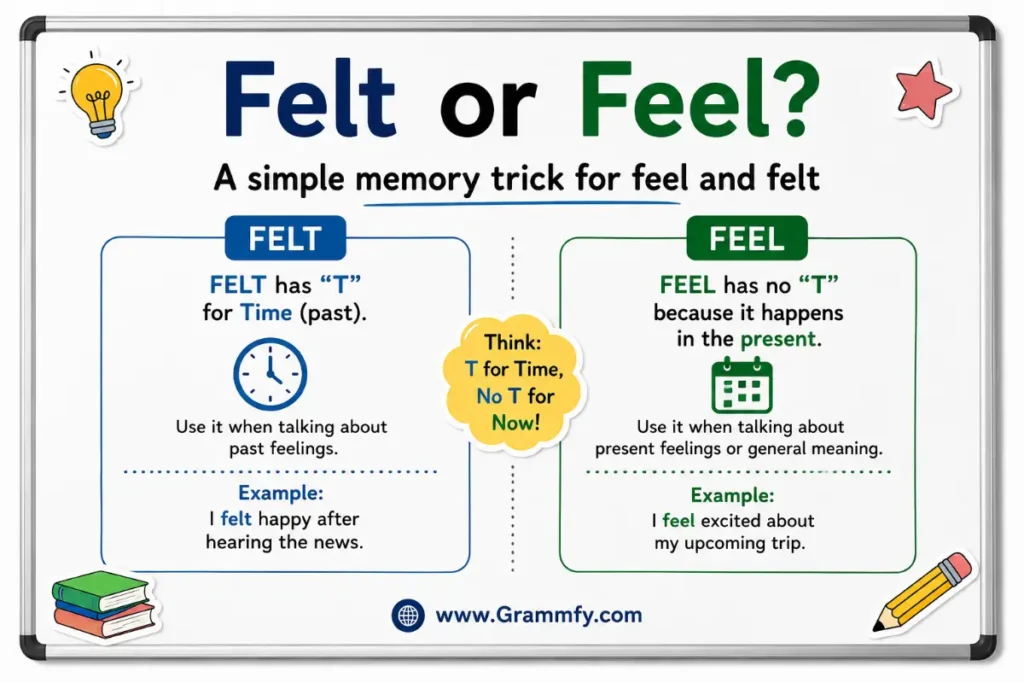
A simple memory trick for feel and felt
Think of a timeline:
NOW → FEEL
PAST → FELT
For example:
Today: I feel tired.
Yesterday: I felt tired.
Then remember the special grammar patterns:
Did + feel
Have + felt
Will + feel
These three patterns are especially useful when proofreading.
Conclusion
The choice between felt or feel comes down mainly to time and grammar. Use feel when you are talking about a current emotion, sensation, opinion, or general experience. Use felt when that experience belongs to the past. The same distinction appears in questions, negative sentences, and sentences with helping verbs.
Remember the basic pattern: feel → felt → felt. After did, return to feel, while have, has, and had are followed by felt. Once you identify the time of the experience and check the helping verb, the correct form becomes much easier to choose.
Keep your sentence simple, check the tense, and choose the word that matches the meaning you want to express.
Frequently Asked Questions
Is felt or feel correct?
Both felt and feel are correct, but they serve different grammatical purposes. Feel usually refers to the present, while felt is the past form.
When should I use feel instead of felt?
Use feel for a current feeling, physical sensation, opinion, or general experience. For example, “I feel confident about the test.”
When should I use felt instead of feel?
Use felt when the experience happened in the past. For example, “I felt nervous before the interview.”
What’s another way to say feel or felt?
Depending on the meaning, you can use sense, experience, think, believe, notice, perceive, react, relate, or understand.
Is felt the past tense of feel?
Yes. Felt is the simple past tense and past participle of feel. The verb is irregular, so the past form isn’t “feeled.”
Why do we say “I didn’t feel” and not “I didn’t felt”?
After did or didn’t, use the base form of the verb. Therefore, “I didn’t feel well” is correct.
Can feel and felt be used for opinions?
Yes. Feel can express a current opinion, while felt can describe an opinion held in the past. For example, “I feel this is right” and “I felt this was right.”
