
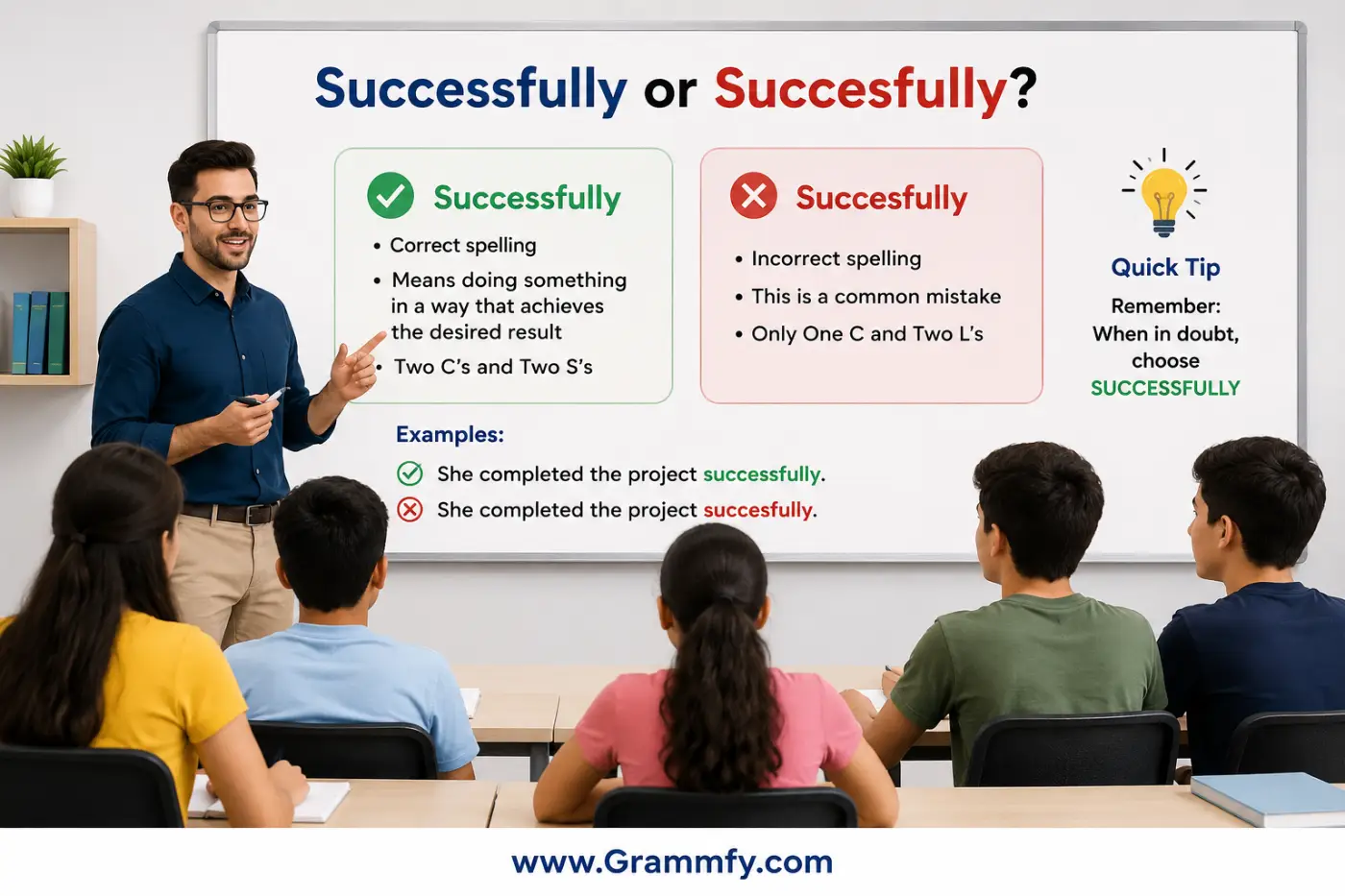
When you’re writing an email, essay, resume, or text, you may stop and wonder: Is it successfully or succesfully? The two forms look almost identical, but only one is correct in standard English. The extra s is easy to miss, especially when you’re typing quickly.
Answer box: Successfully is the correct spelling. Succesfully is a misspelling because the word needs two s’s before -fully.
The correct word is successfully, which means doing something in a successful way or achieving a desired result. For example, “She successfully completed the project.” The incorrect spelling succesfully should not be used in formal or standard English writing.
This guide explains the spelling, meaning, word origin, synonyms, common mistakes, examples, and best word choices for different situations. You’ll also learn a simple trick that makes the correct spelling easier to remember.
For a closer look at another tricky spelling pattern, read [anual or annual].
What is the correct spelling: Successfully or Succesfully?
The correct spelling is successfully.
The spelling succesfully is incorrect. It leaves out one s from the middle of the word.
| Spelling | Correct? | Example |
|---|---|---|
| successfully | Yes | She successfully passed the exam. |
| succesfully | No | This spelling is incorrect. |
The word successfully contains the sequence success:
success + ful + ly = successfully
Look closely at the middle:
s-u-c-c-e-s-s-f-u-l-l-y
A useful way to remember it is to keep the noun success visible inside the word:
SUCCESS + FULLY = SUCCESSFULLY
The incorrect form succesfully loses one of the two s’s in success.
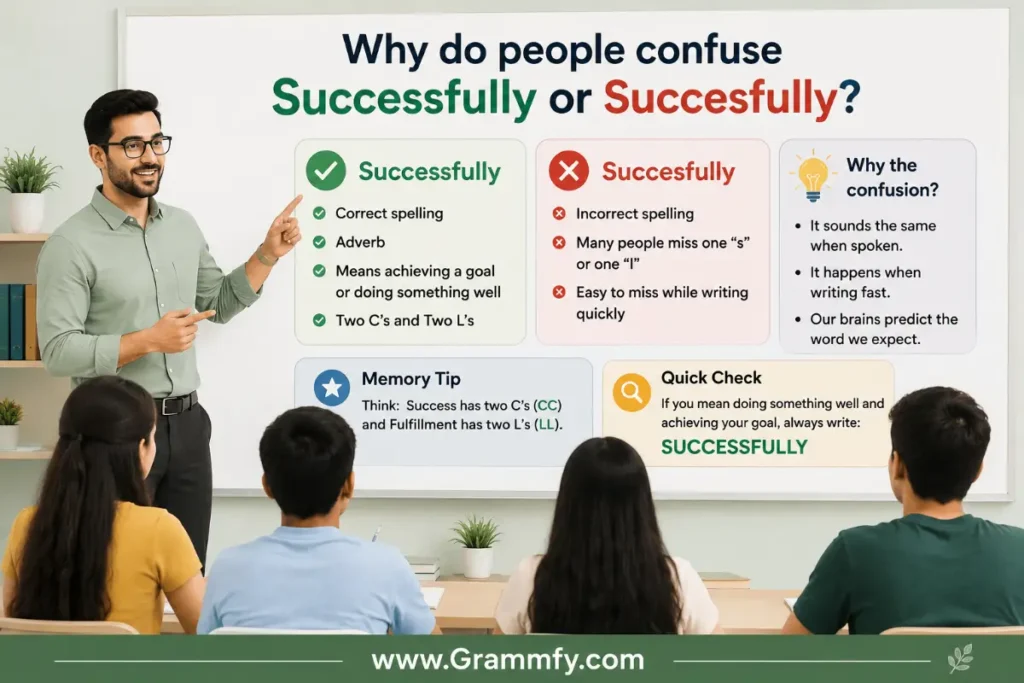
Why do people confuse Successfully or Succesfully?
The confusion usually comes from pronunciation and fast typing.
When people say successfully, the middle sounds can run together. This can make the spelling feel less obvious than it actually is. The word is also fairly long, so writers may accidentally remove a letter while typing.
Another reason is the suffix -ful. Many English words use -ful, such as:
- helpful
- useful
- careful
- hopeful
- successful
Because successful ends in -ful, some writers remember the ending but forget the spelling of the root word.
The safest approach is to start with success and build the word:
success → successful → successfully
This keeps the two s’s in the root.
What does successfully mean?
Successfully is an adverb. It describes an action that is completed with success or produces the desired result.
For example:
- The team successfully finished the project.
- He successfully repaired the computer.
- She successfully completed the interview.
- They successfully solved the problem.
In each sentence, successfully tells us how the action happened.
Compare these forms:
| Word | Part of speech | Meaning | Example |
|---|---|---|---|
| success | Noun | A good result or achievement | Her success was impressive. |
| succeed | Verb | To achieve a desired result | She worked hard to succeed. |
| successful | Adjective | Having a good result | It was a successful project. |
| successfully | Adverb | In a successful way | She completed it successfully. |
This word family is useful because the same root appears in each form.
Where does the word successfully come from?
The history of successfully begins with the word success.
The English noun success came through Old French from Latin successus, meaning a favorable outcome or result. It is related to the Latin verb succedere, meaning “to come after,” “follow,” or “happen.”
English later developed related forms such as:
- succeed
- success
- successful
- successfully
The suffix -ful turns success into the adjective successful, meaning “having success” or “producing a good result.”
Then the suffix -ly turns the adjective into the adverb successfully.
So the word can be understood as:
success → successful → successfully
This word-building pattern also explains why keeping the original success spelling is important.
How do you spell successfully correctly?
Break the word into smaller parts:
SUCCESS + FULLY
Then write:
SUCCESSFULLY
A letter-by-letter version is:
S – U – C – C – E – S – S – F – U – L – L – Y
There are two important areas to watch:
- success has two c’s
- success has two s’s
The beginning is:
succ…
The middle is:
…ess…
The complete base word is:
success
Then add fully:
success + fully = successfully
A simple memory trick
Think:
Success has two S’s, so successfully keeps those two S’s.
You can also remember:
SUCCESS + FULLY
If you’re unsure while writing, type success first and then continue with fully.
Is successfully one word?
Yes. Successfully is normally written as one word.
Correct:
She successfully completed the task.
Incorrect:
She success fully completed the task.
The suffixes -ful and -ly are part of the same word.
You should not normally separate them.
Master synonym list for successfully
There are many ways to express the idea of completing something with a good result. The best alternative depends on the situation, tone, and strength of the statement.
| Word | Meaning | Tone | Example |
|---|---|---|---|
| well | In a good way | Simple | She performed well. |
| effectively | In a way that produces the desired result | Everyday/Formal | The team worked effectively. |
| properly | In the correct way | Everyday | The machine was properly installed. |
| correctly | Without an error | Neutral | He correctly answered the question. |
| efficiently | With little wasted time or effort | Professional | She efficiently handled the task. |
| smoothly | Without problems | Everyday | The event went smoothly. |
| accurately | Without mistakes | Formal | The data was accurately recorded. |
| competently | With enough skill | Formal | He completed the work competently. |
| skillfully | With strong ability | Positive | She skillfully handled the negotiation. |
| expertly | With expert-level skill | Strong/Formal | The technician expertly repaired it. |
| satisfactorily | In an acceptable way | Formal | The issue was satisfactorily resolved. |
| favorably | With a positive result | Formal | The proposal was favorably received. |
| productively | In a useful or effective way | Professional | The team worked productively. |
| efficiently | With good use of time and resources | Professional | They efficiently completed the work. |
| capably | With ability and confidence | Formal | She capably led the group. |
| triumphantly | In a victorious way | Strong | The team returned triumphantly. |
| victoriously | In a winning way | Strong | They finished the competition victoriously. |
| flawlessly | Without mistakes or problems | Strong | The system performed flawlessly. |
| impressively | In a way that creates admiration | Positive | She presented the idea impressively. |
| completely | Fully or entirely | Neutral | The work was completely finished. |
| masterfully | With exceptional skill | Strong | She masterfully solved the puzzle. |
| smoothly | Without interruption or difficulty | Everyday | The launch went smoothly. |
Some of these alternatives are not perfect replacements in every sentence. For example, correctly means “without error,” while successfully focuses more on achieving a desired result.
What are synonyms for successfully from mild to strong?
Not every synonym has the same level of praise. Some simply say that something worked. Others suggest excellent skill.
Mild or neutral
These words work when you don’t want to sound overly positive:
- adequately
- properly
- correctly
- well
- satisfactorily
Example:
The issue was satisfactorily resolved.
This says the result was acceptable, but it doesn’t suggest extraordinary performance.
Medium strength
These words suggest that the action produced a good result:
- effectively
- efficiently
- competently
- smoothly
- accurately
- capably
Example:
The manager effectively organized the meeting.
This gives a stronger impression than simply saying the meeting happened.
Strong
These words suggest exceptional performance:
- expertly
- skillfully
- flawlessly
- brilliantly
- impressively
- masterfully
- triumphantly
Example:
The surgeon skillfully completed the difficult procedure.
These choices should be used carefully because they make a stronger claim about the quality of the action.
What part of speech is successfully?
Successfully is an adverb.
An adverb can describe a verb, adjective, or another adverb, but in this case successfully most often describes a verb.
For example:
They successfully completed the assignment.
The verb is completed. The adverb tells us how the assignment was completed.
Compare:
- Success — noun
- Succeed — verb
- Successful — adjective
- Successfully — adverb
Success
Her success surprised everyone.
Succeed
She hopes to succeed.
Successful
She had a successful career.
Successfully
She successfully completed the training.
Understanding these forms makes spelling and word choice easier.

Successfully vs effectively: what’s different?
Successfully emphasizes achieving the desired result. Effectively emphasizes that something works well or produces the intended effect.
| Successfully | Effectively |
|---|---|
| Focuses on the result | Focuses on how well something works |
| Often suggests completion or achievement | Often suggests useful performance |
| “The plan worked.” | “The plan worked well.” |
Examples:
The team successfully completed the project.
This means the team achieved the goal.
The team effectively communicated with customers.
This means the communication worked well.
The two words can overlap:
The company successfully launched the product.
The company effectively promoted the product.
The first focuses on the successful launch. The second focuses on the quality of the promotion.
Successfully vs correctly: what’s different?
Successfully means achieving a desired result. Correctly means doing something without an error.
For example:
Maria successfully completed the test.
She achieved the goal of completing it.
Maria correctly answered all the questions.
Her answers contained no mistakes.
A person can do something successfully without doing every part perfectly.
For example, someone might successfully repair a bicycle while making a small mistake during the process. The important point is that the repair worked.
Successfully vs smoothly: what’s different?
Successfully focuses on the final result. Smoothly focuses on the process.
Compare:
The conference was successfully completed.
The conference achieved its goal.
The conference ran smoothly.
The conference happened without major problems.
You can use both:
The conference ran smoothly and was successfully completed.
The first describes the experience. The second describes the outcome.
What is the best word for a resume Successfully or Succesfully?
For a resume, successfully can be useful, but stronger and more specific verbs are often better.
Instead of:
Successfully managed a team of employees.
You could write:
Managed a team of 12 employees.
Or:
Led a team of 12 employees to complete projects on schedule.
Specific action verbs give the reader more information.
Useful resume alternatives include:
- achieved
- completed
- delivered
- improved
- increased
- reduced
- led
- developed
- implemented
- resolved
- coordinated
- exceeded
Resume example
Weak:
Successfully worked on customer service projects.
Stronger:
Resolved customer issues and improved response times.
The second version shows what you actually did.
What is the best word for an essay Successfully or Succesfully?
In an essay, successfully is appropriate when you’re explaining an achievement, outcome, or process.
Example:
The campaign successfully raised awareness about recycling.
However, avoid repeating the word in every paragraph. You can vary your language with terms such as:
- effectively
- accurately
- clearly
- efficiently
- appropriately
- convincingly
Essay example
The author successfully uses symbolism to show the character’s changing attitude.
This sentence is useful in literary analysis because it explains that the author’s technique achieved its purpose.
What is the best word for an email Successfully or Succesfully?
Successfully works well in professional emails when you need to report an outcome.
Examples:
We successfully completed the installation.
Your application was successfully submitted.
The payment was successfully processed.
We successfully resolved the issue.
In a casual email, simpler language may sound more natural:
The meeting went well.
Instead of:
The meeting was successfully completed.
The first sentence is shorter and more conversational.
What is the best word for texting Successfully or Succesfully?
In texting, successfully is correct, but it may sound formal depending on the situation.
For example:
I successfully finished my homework.
This is grammatically correct.
But a friend might naturally say:
I finally finished my homework!
Or:
I got it done!
Texting usually favors shorter, more relaxed expressions.
Possible alternatives include:
- done
- finished
- got it done
- made it
- pulled it off
- nailed it
The right choice depends on how casual the conversation is.
What is the best word for speaking Successfully or Succesfully?
In everyday speech, successfully is completely natural, especially in professional or educational situations.
Examples:
We successfully completed the training.
She successfully passed the driving test.
The doctor successfully treated the patient.
In casual conversation, shorter expressions can sound more natural:
We got it done.
She passed the test.
Everything went well.
Good communication isn’t only about choosing a correct word. It’s also about matching the word to the situation.
15 original examples of successfully in real situations
Here are examples from school, work, technology, travel, business, and daily life.
- She successfully completed her final exam.
- The students successfully finished the science project.
- We successfully installed the new software.
- He successfully repaired the broken bicycle.
- The company successfully launched its new service.
- They successfully reached the mountain before sunset.
- The teacher successfully explained the difficult grammar rule.
- I successfully submitted my application before the deadline.
- The team successfully solved the technical problem.
- She successfully negotiated a better price.
- The restaurant successfully reopened after renovations.
- He successfully transferred all his files to the new computer.
- The volunteers successfully collected enough supplies for the event.
- The pilot successfully landed the aircraft despite the difficult weather.
- The researchers successfully completed the first stage of the study.
Notice that successfully works across many kinds of sentences because it describes the way an action achieved its intended outcome.

Examples of the incorrect spelling
The incorrect spelling succesfully is common, but it should be corrected.
Incorrect:
She succesfully completed the course.
Correct:
She successfully completed the course.
Incorrect:
We succesfully solved the problem.
Correct:
We successfully solved the problem.
Incorrect:
The payment was succesfully processed.
Correct:
The payment was successfully processed.
Incorrect:
He succesfully applied for the position.
Correct:
He successfully applied for the position.
The key difference is the extra s:
succesfully ❌
successfully ✅
Common mistakes with successfully
Mistake 1: Removing one s
This is the most common error.
succesfully ❌
successfully ✅
Remember that the base word is success, which already contains two s’s at the end.
Mistake 2: Writing success fully as two words
success fully ❌
successfully ✅
The adverb is one word.
Mistake 3: Confusing successful and successfully
These words are related but have different grammatical jobs.
She had a successful interview.
Here, successful describes the noun interview.
She successfully completed the interview.
Here, successfully describes the verb completed.
Mistake 4: Using successfully when a specific verb is stronger
Consider:
She successfully helped the company.
This is vague.
A stronger sentence might be:
She increased the company’s online sales by 25%.
The second sentence gives measurable information.
When should you NOT use successfully?
Successfully is correct, but it isn’t always the best choice.
Don’t use it when the result is already obvious
Instead of:
He successfully arrived at school.
You would normally say:
He arrived at school.
The word adds little information.
Don’t use it when a more precise verb is available
Instead of:
She successfully made the team better.
Try:
She improved the team’s performance.
The second sentence explains what she actually did.
Don’t overuse it in formal writing
Repeating the same adverb can make your writing sound dull.
For example:
She successfully completed the task. She successfully solved the problem. She successfully presented the report.
A better version varies the verbs:
She completed the task, solved the problem, and presented the report.
Specific verbs often make writing more powerful than repeated adverbs.
Antonyms of successfully
The opposite of successfully depends on the context.
Common antonyms include:
- unsuccessfully
- poorly
- ineffectively
- unsuccessfully
- badly
- incorrectly
- inadequately
- unsuccessfully completed
The most direct antonym is unsuccessfully.
Compare:
The team successfully completed the project.
The team unsuccessfully attempted to complete the project.
However, incorrectly is not always the exact opposite. Something can be completed successfully even if a small part was incorrect.
What is the difference between Successfully or Succesfully?
Successful is an adjective. Successfully is an adverb.
Use successful before or after a noun when describing it:
It was a successful event.
Use successfully to describe an action:
They successfully organized the event.
A simple test is to look at the word being described.
If you’re describing a person, thing, event, project, or result, successful may be appropriate.
If you’re describing how an action happened, successfully is often the right choice.
What is the difference between success and successfully?
Success is a noun. It names the positive result itself.
Her success inspired the team.
Successfully is an adverb. It explains that an action was completed with a good result.
She successfully completed the project.
Think of it this way:
success = the achievement
successfully = the way an action achieved its goal
US vs. UK spelling: is successfully different?
There is no major US-versus-UK spelling difference for successfully.
Both American English and British English use:
successfully
The same is true for:
- success
- successful
- succeed
So you don’t need a different spelling based on whether you’re writing for a US or UK audience.
The main issue is simply avoiding the misspelling succesfully.
Is succesfully ever correct?
No. In standard English, succesfully is considered a misspelling of successfully.
If you see it in an informal message, social media post, draft, or website, it is usually just a typing or spelling mistake.
For professional writing, academic work, resumes, websites, and published content, use:
successfully
Quick tips for choosing the right word Successfully or Succesfully
Use these quick checks before you finish your sentence.
- Check the root: Start with success.
- Remember the double s: The word contains ss before fully.
- Think about grammar: Successfully is an adverb.
- Ask what you’re describing: If you’re describing an action, an adverb may be needed.
- Consider precision: A specific action verb may be stronger.
- Match the tone: Formal writing can use successfully, while casual speech may prefer “well” or “got it done.”
- Don’t split the word: Write it as one word.
- Proofread long words: Long adverbs are easy to mistype.
A final spelling checklist for Successfully or Succesfully
Before submitting your writing, ask:
- Is the word spelled successfully?
- Did I keep the two s’s from success?
- Did I write the word as one word?
- Am I using an adverb to describe an action?
- Could a more specific verb make the sentence stronger?
- Does the word fit the tone of my writing?
- Have I accidentally typed succesfully?
- Have I repeated the word too many times?
If the answer to these questions looks good, your sentence is likely ready.
How can you remember the spelling successfully?
The easiest memory method is to focus on the word success.
Say:
SUCCESS
Then add:
FULLY
Together:
SUCCESS + FULLY = SUCCESSFULLY
Another helpful visual is:
success → successful → successfully
Each word keeps the spelling of success.
Don’t memorize the whole long word as one difficult string of letters. Break it into familiar pieces.
SUCCESS + FULLY
This method can also help with proofreading. If you see succesfully, stop and look at the root. The word should still contain success.
Why correct spelling matters
A spelling mistake may seem small, but repeated errors can affect how readers view your writing.
In a school essay, spelling errors can reduce clarity and distract from your ideas.
On a resume, a misspelled word can make a document look less polished.
In a business email, correct spelling helps create a professional impression.
On a website, spelling mistakes can also affect reader trust.
That doesn’t mean every mistake is serious. Everyone makes typing errors. The goal is to recognize common problem words and build reliable habits.
Successfully is a good example because the incorrect form looks very close to the correct one.
How to use successfully naturally
The word usually appears before a main verb or after an auxiliary verb.
Examples:
She successfully completed the assignment.
They successfully solved the puzzle.
The software was successfully installed.
The company has successfully expanded into new markets.
It can also appear later in a sentence:
The project was completed successfully.
Both positions are grammatical.
Compare:
She successfully finished the project.
She finished the project successfully.
The first version puts more focus on the successful action. The second places the adverb later.
Successfully in professional writing
Professional writing often uses successfully to report completed tasks or positive outcomes.
Examples include:
The payment was successfully processed.
The update was successfully installed.
The customer successfully completed the verification process.
The team successfully met the deadline.
These sentences are clear because the word connects the action with its result.
Still, professional writers should avoid using successfully simply to make every sentence sound impressive. Facts, numbers, and specific verbs are often more useful.
Instead of:
We successfully improved customer satisfaction.
Try:
We increased customer satisfaction scores by 18%.
The second sentence provides evidence.
Successfully in academic writing
Academic writing can use successfully when discussing research, methods, experiments, or arguments.
Examples:
The experiment successfully demonstrated the effect of temperature.
The researchers successfully tested the new method.
The author successfully supports the argument with historical evidence.
However, academic writing should avoid unsupported claims. If you say something was successful, explain what result shows that.
For example:
The study successfully identified three factors that influenced student performance.
This is stronger when the following sentences explain those three factors.
Successfully in everyday English
In everyday English, the word is useful but not always necessary.
Formal:
I successfully completed the registration process.
Casual:
I finished the registration.
Formal:
We successfully resolved the issue.
Casual:
We fixed the problem.
Formal:
She successfully passed the driving test.
Casual:
She passed her driving test.
The choice depends on what you want to emphasize. If the successful outcome matters, successfully can be useful. If the result is already clear, you can often leave it out.
What should you use instead of successfully?
There isn’t one perfect replacement.
Choose based on your meaning:
| If you mean… | Consider using… |
|---|---|
| Without mistakes | correctly, accurately |
| With good results | successfully, effectively |
| With little waste | efficiently |
| Without problems | smoothly |
| With strong skill | skillfully, expertly |
| In an impressive way | brilliantly, impressively |
| In an acceptable way | adequately, satisfactorily |
| With no defects | flawlessly |
| In a winning way | victoriously, triumphantly |
This distinction matters because synonyms often overlap without being identical.

Conclusion
Choosing successfully or succesfully is easy once you remember the root word success. The correct form is successfully, with the two s’s preserved from the original word. The misspelling succesfully drops one of those letters.
The word is an adverb that describes an action completed with a desired or positive result. It works in school writing, professional emails, resumes, reports, and everyday conversation. Still, don’t use it when a more precise verb can communicate your meaning better.
The simplest spelling trick is SUCCESS + FULLY = SUCCESSFULLY. If you keep that pattern in mind, you’ll be much less likely to make this common spelling mistake. With a quick proofread, you can use the correct form confidently in your writing.
Frequently Asked Questions
Is successfully or succesfully correct?
Successfully is correct. Succesfully is a misspelling that leaves out one s.
How do you spell successfully correctly?
Spell it s-u-c-c-e-s-s-f-u-l-l-y. A useful memory trick is success + fully = successfully.
Why is succesfully wrong?
Succesfully is wrong because the base word success contains two s’s at the end. The correct spelling keeps both of them.
What’s another way to say successfully?
You can use effectively, well, efficiently, smoothly, skillfully, correctly, or expertly, depending on the meaning and tone.
Is successfully an adjective or an adverb?
Successfully is an adverb. It usually describes how an action is completed or performed.
Can I use successfully in a resume?
Yes, but use it carefully. Specific action verbs such as led, achieved, increased, developed, completed, or implemented can make resume statements more informative.
Is successfully spelled the same in American and British English?
Yes. Successfully has the same standard spelling in both American and British English.
