
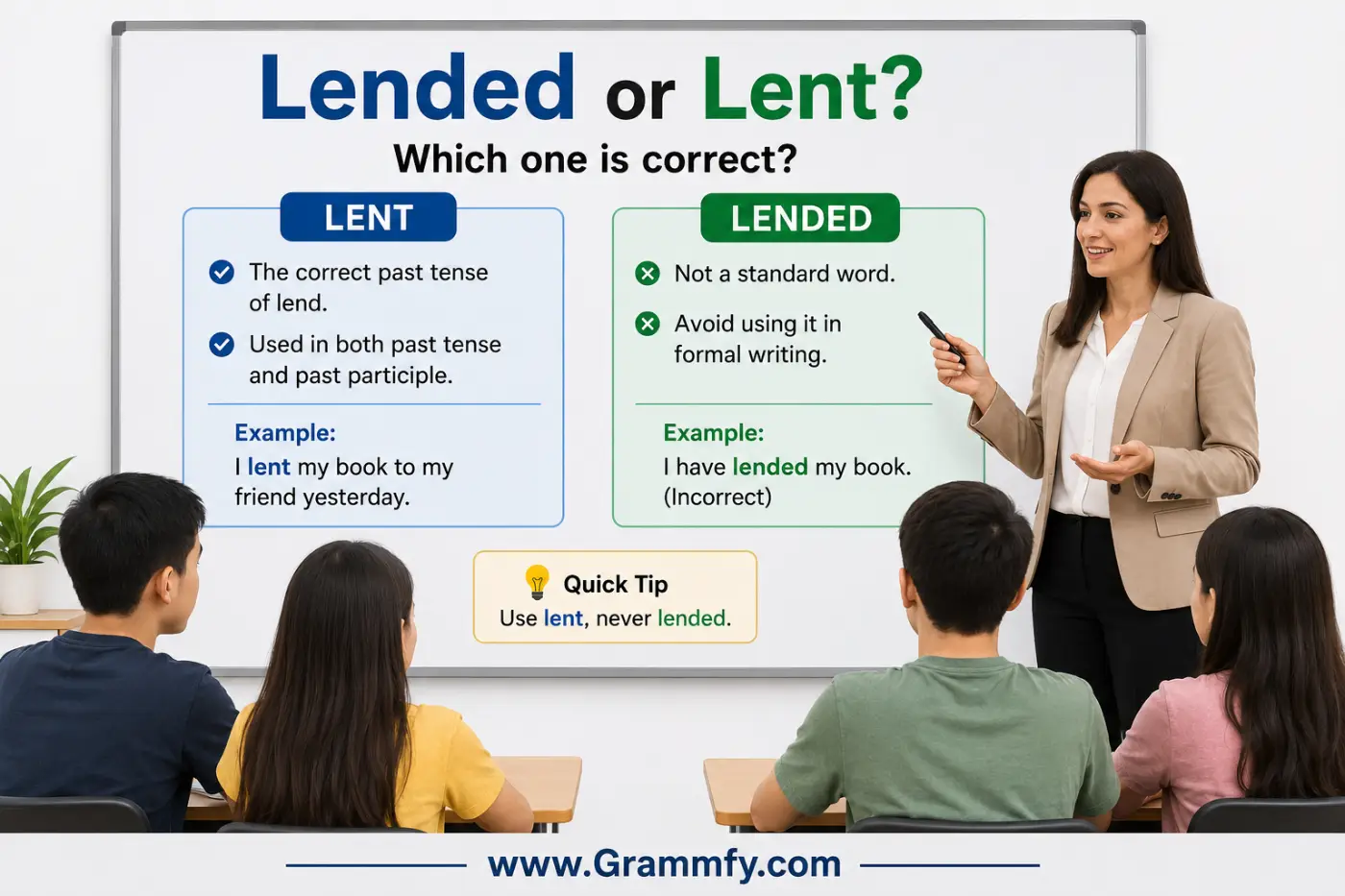
Writing a message about money, books, tools, or personal belongings can create a quick grammar question: should you write lended or lent? The two forms may seem possible because many English verbs form their past tense with -ed. However, lend is an irregular verb, so its past tense does not follow that pattern.
Answer Box: Lent is the correct past tense and past participle of lend. Lended is not standard English.
For example, you can say, “I lent my friend some money,” or “She has lent me her notes.” You should not write, “I lended my friend some money.”
This guide explains why lent is correct, how the verb changes across different tenses, and how to use it naturally. You’ll also see examples for emails, essays, resumes, texting, and everyday speech.
Build stronger spelling skills with our guide to [successfully or succesfully].

What is the difference between Lended or Lent?
The key difference is simple: lent is correct, while lended is incorrect in standard modern English.
The verb lend is irregular. Its main forms are:
| Verb form | Correct form | Example |
|---|---|---|
| Base form | lend | I lend books to my friends. |
| Past tense | lent | I lent him my book. |
| Past participle | lent | I have lent her my notes. |
| Present participle | lending | I am lending him my car. |
| Third-person singular | lends | She lends books to students. |
So the basic pattern is:
lend → lent → lent
Not:
lend → lended → lended ❌
Why is lent correct?
Lend belongs to a group of irregular English verbs. These verbs don’t form their past tense simply by adding -ed.
For example:
- send → sent
- spend → spent
- build → built
- keep → kept
- feel → felt
- leave → left
- lend → lent
Because lend is irregular, its past form is lent.
What does lend mean in plain English?
Lend means to give someone something temporarily, with the expectation that it will be returned.
For example:
Can you lend me your pen?
You give the pen to someone for a while, and they are expected to give it back.
You can lend:
- money
- books
- pens
- clothes
- tools
- equipment
- cars
- notes
- devices
- other belongings
The important idea is temporary use.
Compare:
I lent Sarah my book.
Sarah received the book temporarily and is expected to return it.
This is different from give, which doesn’t necessarily suggest that the person must return the item.
What does lent mean?
Lent is the past tense and past participle of lend.
Use lent when the lending happened in the past.
For example:
I lent him $20 yesterday.
The lending happened yesterday, so lent is correct.
You can also use lent with helping verbs:
I have lent him my laptop before.
Here, lent is the past participle.
Simple tense comparison
| Tense | Example |
|---|---|
| Present | I lend her books. |
| Past | I lent her a book. |
| Present perfect | I have lent her three books. |
| Future | I will lend her another book. |
| Present continuous | I am lending her my notes. |
This pattern is worth remembering:
lend → lent → lent
Why do people say lended?
People sometimes add -ed because many English verbs form their past tense that way.
For example:
walk → walked
talk → talked
clean → cleaned
open → opened
So a learner may naturally assume:
lend → lended
But English has many irregular verbs that don’t follow the regular -ed pattern.
For example:
go → went
buy → bought
teach → taught
catch → caught
lend → lent
The mistake is understandable, but lended isn’t the standard past form of lend.
Where does the word lend come from?
Lend is an old English word with Germanic roots. Its history is connected to the idea of allowing someone to use something temporarily.
The word has been used in English for centuries. Its irregular past form, lent, also has a long history.
This is one reason you can’t simply predict its past tense from modern spelling rules.
Many common English verbs inherited older irregular patterns. Because these verbs are used so often, their unusual forms became firmly established.
That’s why native speakers naturally say:
I lent him my book.
rather than:
I lended him my book.
What is the difference between lend and borrow?
This is one of the most important distinctions to understand.
Lend means give something temporarily to someone.
Borrow means receive something temporarily from someone.
Compare:
I lent Maria my book.
Maria borrowed my book.
The same situation is described from two different viewpoints.
| Verb | Who acts? | Example |
|---|---|---|
| Lend | The person giving | I lent him my car. |
| Borrow | The person receiving | He borrowed my car. |
Easy memory trick
Think:
Lend = give temporarily
Borrow = receive temporarily
For example:
Can you lend me your pen?
You are asking the other person to give you the pen temporarily.
You could also say:
Can I borrow your pen?
Now you’re focusing on yourself as the person receiving it.
What is the difference between lent and borrowed?
Lent describes the action of the person who gives something.
Borrowed describes the action of the person who receives something.
Example:
James lent me his laptop.
I borrowed James’s laptop.
Both sentences describe the same exchange.
The difference is perspective.
| Person | Verb | Example |
|---|---|---|
| Giver | Lent | James lent me his laptop. |
| Receiver | Borrowed | I borrowed James’s laptop. |
This distinction is especially useful when writing emails or explaining transactions.

What are synonyms for lend?
There are many words and phrases related to lend, but they aren’t all exact replacements. The best choice depends on the situation.
Simple synonyms and related expressions
| Word/Phrase | Meaning | Tone | Example |
|---|---|---|---|
| Give temporarily | Allow temporary use | Simple | She gave me the book temporarily. |
| Loan | Give something for temporary use | Everyday/Formal | He loaned me his car. |
| Let someone use | Allow temporary use | Simple | She let me use her laptop. |
| Share | Allow another person to use something | Everyday | He shared his notes with me. |
| Provide temporarily | Give for temporary use | Formal | The company provided equipment temporarily. |
| Advance | Give money before it is due | Formal | The bank advanced the funds. |
| Front | Provide money in advance | Casual | I can front you the money. |
Some of these are context-specific. Loan, for example, is especially common when talking about money or valuable items.
Formal alternatives
| Word/Phrase | Meaning | Tone | Example |
|---|---|---|---|
| Loan | Give temporarily | Formal | The bank loaned the company money. |
| Advance | Give money ahead of time | Formal | The employer advanced his salary. |
| Provide | Supply something | Formal | The organization provided equipment. |
| Extend credit | Allow someone to use money with repayment expected | Financial | The bank extended credit. |
| Finance | Provide money for a purchase or project | Financial | The company financed the project. |
| Allocate temporarily | Assign for temporary use | Formal | The equipment was allocated temporarily. |
Everyday alternatives
| Word/Phrase | Meaning | Tone | Example |
|---|---|---|---|
| Loan | Give temporarily | Everyday | Can you loan me your charger? |
| Let me use | Allow temporary use | Everyday | Can you let me use your phone? |
| Share | Allow someone to use something | Everyday | Can you share your notes? |
| Help out with | Provide something temporarily | Casual | Can you help me out with some cash? |
| Give me a hand | Help someone | Casual | Can you give me a hand? |
Casual expressions
| Expression | Meaning | Tone | Example |
|---|---|---|---|
| Front me | Give me money temporarily | Casual | Can you front me $20? |
| Spot me | Give someone money temporarily | Casual | Can you spot me $10? |
| Let me use it | Allow temporary use | Casual | Can you let me use your bike? |
| Help me out | Provide temporary help | Casual | Can you help me out with the cost? |
These casual expressions are not always direct synonyms for lend. Use them only when their specific meaning fits the situation.
What are synonyms by intensity?
The verb lend doesn’t have a strict intensity scale. However, different expressions can suggest different levels of formality, commitment, or financial involvement.
Mild or simple
- let someone use
- share
- give temporarily
- help with
Example:
She let me use her charger.
Neutral
- lend
- loan
- provide temporarily
Example:
He lent me his car.
More formal or financial
- advance
- extend credit
- finance
- provide funds
Example:
The company advanced the employee some money.
The best word depends on what you’re actually giving and why.
What part of speech is lend?
Lend is primarily a verb.
Examples:
I lend books to my friends.
She lent me her notes.
They will lend us the equipment.
It can be used in different verb forms:
- lend
- lends
- lent
- lending
The noun connected with the action is often loan.
For example:
The bank gave him a loan.
Notice the difference:
I lend money.
I gave him a loan.
Is loan a verb or a noun?
Loan can be both a noun and a verb.
As a noun:
I took out a loan.
As a verb:
The bank loaned him the money.
In American English, loan is widely accepted as a verb.
You may also hear:
She lent me her car.
or:
She loaned me her car.
Both can be correct, although style and regional preferences can influence which form sounds more natural.
What is the difference between lend and loan?
Lend and loan can both describe giving something temporarily.
However, lend is the traditional and very common verb.
I lent him my book.
Loan is also commonly used as a verb, especially in American English.
I loaned him my book.
With money, loan is especially common:
The bank loaned me $5,000.
For general English writing, lend is a safe and natural choice.
US vs. UK usage: is loan used differently?
Both American and British English use lend.
For example:
Can you lend me your pen?
is natural in both varieties.
The verb loan is also used, but American English commonly uses loan as a verb in financial and everyday contexts.
In British English, lend is often preferred in ordinary situations.
For a broad international audience, lend is a clear and widely understood choice.
How do you use lend in a resume?
You don’t usually need lend on a resume unless your work involved lending, financial services, libraries, or equipment management.
Examples:
Managed customer lending accounts.
Processed lending applications.
Assisted clients with loan documentation.
Managed lending records and repayment schedules.
For a resume, use the specific professional term that describes your job.
If you’re talking about a personal action, lend may not be especially useful.
How do you use lent in an essay?
Lent works well in essays when describing something that happened in the past.
Examples:
The library lent students books for the semester.
The museum lent several paintings to the exhibition.
The organization lent equipment to local schools.
Because lent is the past tense, it works naturally when your essay describes completed actions.
How do you use lend in an email?
In a professional email, lend can be useful when asking someone for temporary use of an item.
For example:
Could you lend me the projector for tomorrow’s presentation?
Or:
Would you be able to lend us some additional equipment?
For a polite request, could you or would you be able to can make the sentence sound professional.
How do you use lent in texting?
Texting is usually more casual, but the grammar doesn’t change.
You can write:
I lent him my charger yesterday.
She lent me her jacket.
I already lent it to Sam.
Avoid:
I lended him my charger. ❌
Even in informal writing, lent is the standard past form.
How do you use lend in everyday speaking?
In conversation, lend is very common.
Examples:
Can you lend me five dollars?
Can you lend me your phone?
Could you lend me a pen?
I’ll lend you my notes.
These sentences are simple and natural.
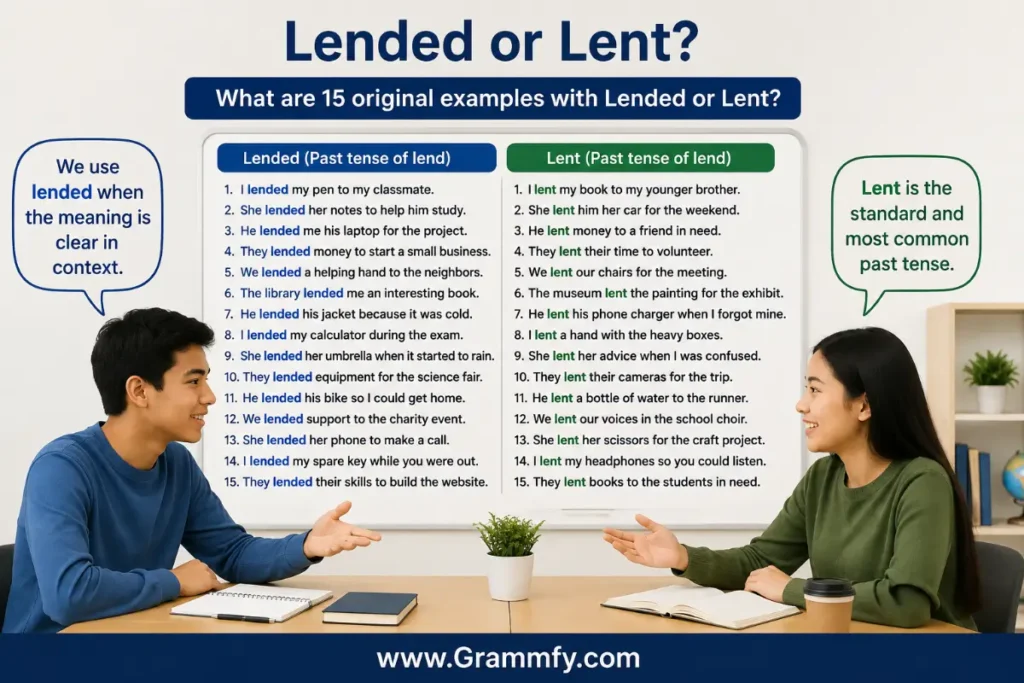
What are 15 original examples with Lended or Lent?
Here are examples from different real-life situations.
Money
My brother lent me $50 when I needed it.
School
I lent my classmate a pencil.
Work
The office lent us a projector for the meeting.
Travel
My friend lent me a suitcase.
Technology
Can you lend me your charger?
Books
She lent me her favorite novel.
Clothing
He lent me his jacket because it was cold.
Tools
Our neighbor lent us a ladder.
Cars
My uncle lent me his car for the weekend.
Notes
I lent my notes to a classmate.
Equipment
The school lent students laptops for the project.
Business
The bank lent the company money.
Family
My sister lent me her camera.
Present request
Could you lend me your umbrella?
Future
I’ll lend you my book tomorrow.
These examples show how the verb changes depending on the tense.
What are the main forms of lend?
Memorizing the complete verb pattern is one of the easiest ways to avoid mistakes.
Present simple
I lend
You lend
We lend
They lend
He lends
She lends
Example:
She lends books to her students.
Past simple
The past form is lent for every subject.
I lent
You lent
He lent
She lent
We lent
They lent
Example:
They lent us some equipment.
Present perfect
Use have/has + lent.
I have lent
She has lent
They have lent
Example:
She has lent me her notes.
Past perfect
Use had + lent.
I had lent
He had lent
Example:
I had lent him the book before he moved.
Future
Use will + lend.
I will lend
She will lend
They will lend
Example:
I’ll lend you my car tomorrow.
Continuous form
Use lending.
I am lending
She is lending
They are lending
Example:
She is lending her equipment to the school.
What are common mistakes with lend?
Mistake 1: Using lended
Incorrect:
I lended him my book. ❌
Correct:
I lent him my book. ✅
Mistake 2: Confusing lend and borrow
Incorrect:
Can you borrow me your pen? ❌
Correct:
Can you lend me your pen? ✅
Or:
Can I borrow your pen? ✅
Mistake 3: Using lent for the present
Incorrect:
I lent books to students every day. ❌
If you’re describing a regular present action, use:
I lend books to students every day. ✅
Mistake 4: Using lend for a completed action
Incorrect:
Yesterday, I lend him my laptop. ❌
Correct:
Yesterday, I lent him my laptop. ✅
The word yesterday tells you that the action happened in the past.
When should you not use lend?
Don’t use lend when you mean permanently giving something away.
For example:
I gave him my old phone.
This may mean the phone is now his.
But:
I lent him my phone.
means you expect him to return it.
The difference is important.
Lend vs give
| Lend | Give |
|---|---|
| Usually temporary | May be permanent |
| Usually expects return | Doesn’t necessarily expect return |
| “I lent him my car.” | “I gave him my old car.” |
If ownership has permanently changed, give is usually better.
What are the antonyms of lend?
There isn’t one perfect direct antonym for lend in every situation.
Depending on context, possible opposites or contrasting actions include:
- keep
- withhold
- take back
- refuse
- reclaim
- retain
For example:
She refused to lend me her car.
The opposite idea here is refusing to provide temporary use.
In a different context:
He took back the book he had lent me.
Here, take back describes the return of the item.
What is the difference between lend and give?
This is another useful close-synonym comparison.
| Lend | Give |
|---|---|
| Temporary transfer | May be permanent |
| Usually expects return | Usually no return expected |
| “I lent him my bike.” | “I gave him my bike.” |
Consider this situation:
I lent my friend my bicycle.
Your friend should return it.
But:
I gave my friend my bicycle.
This normally means your friend now owns it.
The context matters.
What is the difference between lend and provide?
Lend means to allow temporary use.
Provide is broader. It means to supply or make something available.
For example:
The library lent me a book.
This suggests I need to return it.
The library provided me with information.
This doesn’t necessarily mean I need to return anything.
So provide can sometimes replace lend only when the idea of temporary return isn’t important.
What is the difference between lend and rent?
Both can involve temporary use, but the arrangement is different.
Lend normally involves giving something temporarily without charging a rental fee.
My friend lent me his bike.
Rent usually involves payment.
I rented a bike from a shop.
This distinction is important in business and everyday conversation.
What is the difference between lend and lease?
A lease is usually a formal agreement allowing someone to use property for a specific period, often in exchange for payment.
The company leased office space.
Lend is broader and often informal.
My friend lent me his laptop.
A lease can last months or years, while a loan can be very short.
What should you remember about lended or lent?
The easiest rule is:
Lend is the present form. Lent is the past form.
Remember:
lend → lent → lent
Examples:
I lend him books.
I lent him a book yesterday.
I have lent him several books.
Never change lend to lended in standard English.
Quick tips for choosing the right form Lended or Lent
- Use lend for the present.
- Use lent for the past.
- Use lent after have, has, or had.
- Use lending for continuous forms.
- Remember that lended is not the standard past form.
- Don’t confuse lend with borrow.
- Use give when something is permanently transferred.
- Use loan when it fits the financial or temporary-use context.
- Check whether the item is expected to be returned.
- Remember the simple pattern: lend → lent → lent.
A quick grammar chart for Lended or Lent
| Situation | Correct form | Example |
|---|---|---|
| Present | Lend | I lend books to friends. |
| Present, he/she/it | Lends | She lends books to students. |
| Past | Lent | She lent me a book. |
| Present perfect | Have/has lent | I have lent him money. |
| Past perfect | Had lent | I had lent her my notes. |
| Future | Will lend | I will lend you my car. |
| Continuous | Lending | I am lending him my laptop. |
This chart covers most everyday uses.

Conclusion
The correct choice between lended or lent is clear once you remember that lend is an irregular verb. Its past tense and past participle are both lent, not lended. Use lend for present actions, lent for completed past actions, and lending for continuous forms. It is also important to separate lend from borrow: the person who gives something temporarily lends it, while the person who receives it borrows it. If something is permanently transferred, give may be the better word. For most everyday and professional writing, the safest pattern to remember is simple: lend → lent → lent. Once you memorize that pattern, this common grammar mistake becomes easy to avoid.
Frequently Asked Questions
Is lended or lent correct?
Lent is correct. Lended is not the standard past tense or past participle of lend.
What is the past tense of lend?
The past tense of lend is lent. For example, “I lent my friend a book yesterday.”
Is lent the past participle of lend?
Yes, lent is both the past tense and past participle of lend. For example, “I have lent her my notes.”
What’s another way to say lent?
Depending on the context, you can use loaned, gave temporarily, or allowed someone to use. However, lent is the standard past form of lend.
Why can’t I say lended?
Because lend is an irregular verb. Its established past form is lent, just like send becomes sent.
Is lend the same as borrow?
No, lend means to give something temporarily, while borrow means to receive something temporarily. The giver lends, and the receiver borrows.
Can loan be used as a verb?
Yes, loan can be used as a verb, especially in American English. For example, “The bank loaned him the money.”
