
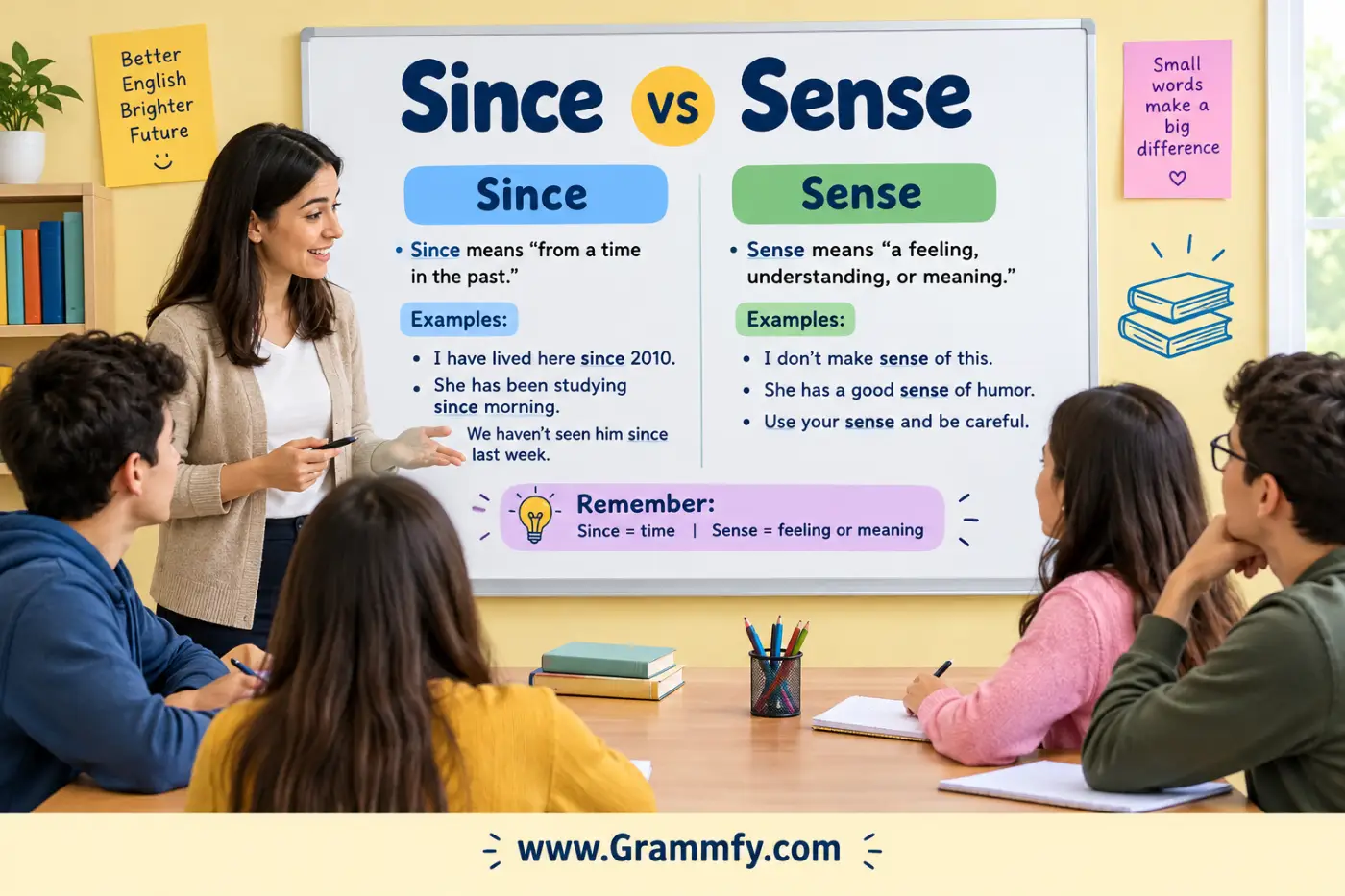
Have you ever been writing an email, text, or school essay and stopped at a sentence like, “I haven’t seen her ___ Monday”? You may know exactly what you want to say, but two similar-looking words can make you pause: since vs sense?
These words sound different and have completely different jobs. Since usually relates to time or gives a reason. Sense is usually a noun or verb connected with meaning, understanding, feeling, or one of the five senses.
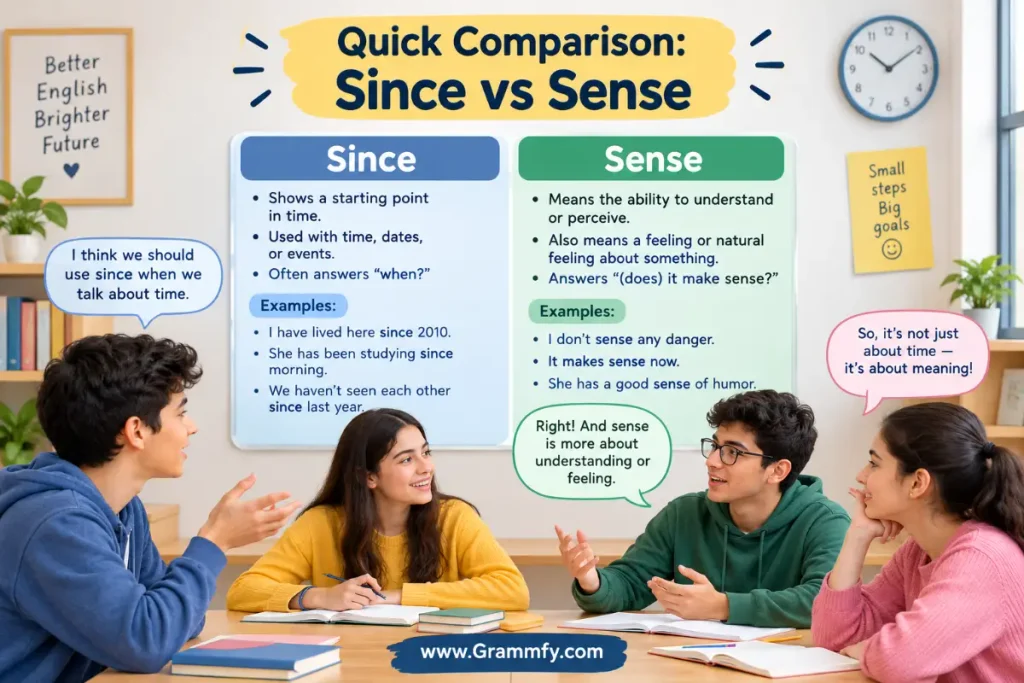
- Answer box: Since is used mainly for a starting point in time or a reason, while sense refers to meaning, understanding, awareness, or a physical ability such as sight or hearing.
This guide explains their meanings, origins, grammar, synonyms, common mistakes, and the best choice for emails, essays, resumes, texting, and everyday speech. You’ll also see plenty of examples that make the difference easy to remember.
These words are easy to mix up, so read our guide to the difference between Sweet vs Sweat to see their meanings and examples side by side.
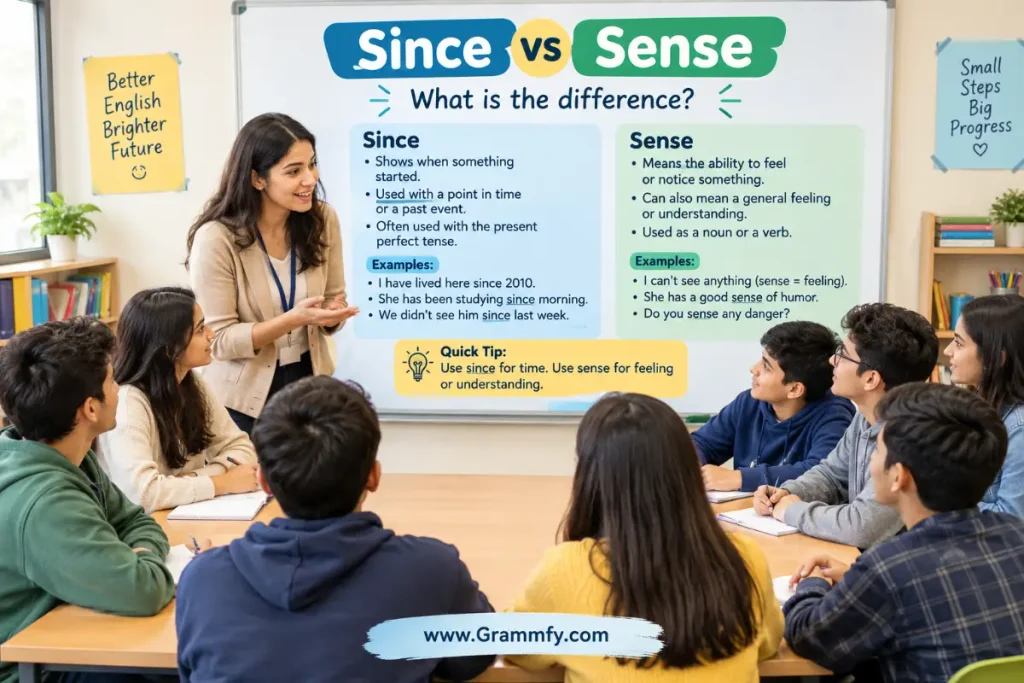
What is the difference between Since vs Sense?
The simplest difference is grammatical and meaningful:
| Word | Main role | Basic meaning | Example |
|---|---|---|---|
| Since | Preposition, conjunction, adverb | From a past time until now; because | I’ve lived here since 2020. |
| Sense | Noun, verb | Meaning, understanding, feeling, or ability to perceive | That doesn’t make sense. |
The two words are not interchangeable.
Use since when you are talking about when something started or why something happened.
- I’ve known her since college.
- He hasn’t called since Monday.
- Since it was raining, we stayed inside.
Use sense when you are talking about meaning, judgment, awareness, or perception.
- This sentence doesn’t make sense.
- She has a good sense of humor.
- I could sense that something was wrong.
- Humans have five basic senses.
A useful memory trick is:
Since = starting time or reason.
Sense = meaning, feeling, or perception.
What does since mean?
Since has three important uses. Learning all three helps prevent mistakes.
Since for a starting point in time
The most common use of since is to show when an action or situation began.
It normally introduces a specific point in the past.
Examples:
- I have worked here since 2022.
- She has been sick since Tuesday.
- We’ve been friends since high school.
- He hasn’t eaten since breakfast.
- They have lived in Texas since June.
Notice that since points to a starting moment.
You can think of the pattern like this:
Since + starting point
Common starting points include:
- since Monday
- since January
- since 2019
- since last summer
- since yesterday
- since breakfast
- since childhood
- since I was a child
- since we met
Since with the present perfect
Since often appears with the present perfect because the action began in the past and continues into the present.
For example:
- I have known him since 2018.
- She has lived here since she graduated.
- We have used this system since last year.
The basic structure is:
have/has + past participle + since + starting point
Compare:
- I have worked here since 2021.
- She has studied English since childhood.
The starting point is in the past, but the situation continues or has relevance now.
Since meaning “because”
Since can also introduce a reason. In this use, it means something close to because.
Examples:
- Since you’re here, we can start the meeting.
- Since it was late, I went home.
- Since she had already eaten, she skipped dinner.
- Since you asked, I’ll explain it.
- Since the store was closed, we came back later.
Here, since has nothing to do with time.
For example:
- Since it was raining, we stayed home.
This means:
- Because it was raining, we stayed home.
The surrounding sentence usually makes the intended meaning clear.
Since as an adverb
Since can sometimes stand alone as an adverb, especially when the starting time has already been mentioned.
Example:
- I met him in college and haven’t seen him since.
- She moved away years ago, but we’ve spoken several times since.
In these sentences, since means “from that time until now” or “after that time.”
What does sense mean?
Sense has several meanings, but they all connect to the ideas of meaning, awareness, judgment, or perception.
Sense meaning “meaning”
When something “makes sense,” it is logical, understandable, or reasonable.
Examples:
- Your explanation makes sense.
- That sentence doesn’t make sense.
- His decision makes perfect sense.
- Does this plan make sense?
- I finally understand what you mean.
This is one of the most common uses of sense.
The phrase make sense is especially important in everyday English.
You can say:
- That makes sense.
- It doesn’t make sense.
- Does that make sense?
- Now it makes sense.
- Your argument makes a lot of sense.
Sense meaning a physical ability
A sense is also a physical ability that allows you to receive information from your surroundings.
The traditional five senses are:
- Sight
- Hearing
- Smell
- Taste
- Touch
Examples:
- Dogs have an excellent sense of smell.
- Her sense of hearing is very sharp.
- The cold affected my sense of touch.
- Our eyes help us use the sense of sight.
The word can also refer to perception more generally.
Sense meaning awareness or intuition
Sense can describe an awareness that something is happening.
For example:
- I had a sense that something was wrong.
- She sensed danger nearby.
- He had a strange sense of being watched.
The verb sense means to notice or feel something without necessarily being told directly.
Example:
- I could sense that my friend was upset.
You may not have seen your friend’s emotions directly, but you noticed signs that suggested something was wrong.
Sense meaning good judgment
Sense can also mean practical judgment or wisdom.
Examples:
- Use your common sense.
- She has good financial sense.
- He showed a lot of sense by checking the contract first.
- It would be senseless to spend all your money at once.
The expression common sense means basic practical judgment.
Where did since come from?
Since has a long history in English. It developed from older English expressions connected with the idea of “after that” or “from that time.”
Over time, its meaning developed into the uses we know today.
Modern English uses since mainly in two important ways:
- to connect something with a point in past time
- to introduce a reason
The time meaning is especially important in expressions such as:
- since Monday
- since 2015
- since then
- ever since
- since I arrived
The word has remained common because English speakers frequently need to connect present situations with past events.
Where did sense come from?
Sense also has an old history. It entered English through French from Latin sensus, connected with perception, feeling, understanding, and meaning.
That history explains why modern English uses sense for several related ideas.
Think about these meanings:
- physical perception
- emotional awareness
- understanding
- judgment
- meaning
They may seem different, but they all involve the ability to perceive or understand something.
For example:
- Your eyes give you a sense of sight.
- Your mind can understand the sense of an argument.
- Your intuition can give you a sense that something is wrong.
- Your judgment gives you common sense.
So although sense has several meanings, they are connected by the idea of perception and understanding.
What are the main synonyms for Since vs Sense?
Because these words have multiple meanings, their synonyms depend on the context. You should never replace one automatically without checking the sentence.
Here is a broad synonym guide.
| Word | Meaning | Tone | Example |
|---|---|---|---|
| because | Gives a reason | Everyday | I left because I was tired. |
| as | Gives a reason | Neutral | As it was late, we left. |
| given that | Considering a fact | Formal | Given that it was raining, we stayed in. |
| seeing that | Because | Everyday | Seeing that you’re busy, I’ll go. |
| from | Starting at a time/place | Everyday | We worked from Monday. |
| after | Following a time/event | Everyday | After lunch, we left. |
| ever since | Continuously from then | Everyday | I’ve loved music ever since. |
| from then on | Starting at that point | Neutral | From then on, things changed. |
| meaning | What something represents | Everyday | What’s the meaning of this word? |
| significance | Importance or meaning | Formal | The event has historical significance. |
| sense | Meaning or understanding | Neutral | That doesn’t make sense. |
| signification | Meaning | Formal | The signification is unclear. |
| reason | Explanation or cause | Neutral | What’s the reason? |
| logic | Sound reasoning | Neutral | I understand the logic. |
| understanding | Knowledge of meaning | Neutral | Her understanding is strong. |
| awareness | Knowledge of something | Neutral | He had awareness of the problem. |
| perception | Way of noticing or interpreting | Formal | Perception can differ. |
| intuition | Immediate feeling or knowledge | Neutral | My intuition told me to wait. |
| feeling | Emotional or physical awareness | Everyday | I had a strange feeling. |
| impression | An idea or feeling | Neutral | I got the impression he was tired. |
| judgment | Ability to make sensible decisions | Neutral | She showed good judgment. |
| wisdom | Good practical understanding | Positive/Formal | His wisdom helped us. |
| awareness | Recognition of something | Neutral | She had an awareness of the risks. |
| understanding | Ability to understand | Neutral | His understanding improved. |
| meaning | Intended idea | Neutral | I know the meaning now. |
| sign | Something that indicates another thing | Everyday | That was a sign of trouble. |
| clue | Information that helps you understand | Everyday | The note gave us a clue. |
| feeling | An instinctive impression | Everyday | I had a feeling about it. |
| intuition | Instinctive understanding | Neutral | Her intuition was right. |
| common sense | Practical judgment | Everyday | Use common sense. |
Simple synonyms
For basic English, these are the easiest alternatives:
- since → because, from, ever since
- sense → meaning, feeling, understanding, reason
Examples:
- Since it was cold, we stayed inside.
- Because it was cold, we stayed inside.
And:
- This doesn’t make sense.
- This doesn’t seem logical.
Everyday synonyms
In normal conversation, you may hear:
- because
- as
- from then on
- ever since
- meaning
- feeling
- idea
- understanding
- common sense
- judgment
These sound natural in texts, conversations, and casual emails.
Formal synonyms
In academic or professional writing, context may call for:
- given that
- considering that
- due to the fact that
- significance
- perception
- awareness
- judgment
- interpretation
Be careful with very formal alternatives. A simple word is often clearer.
For example, instead of: “Due to the fact that the meeting was canceled, we left”.
You can simply write: “Since the meeting was canceled, we left”.
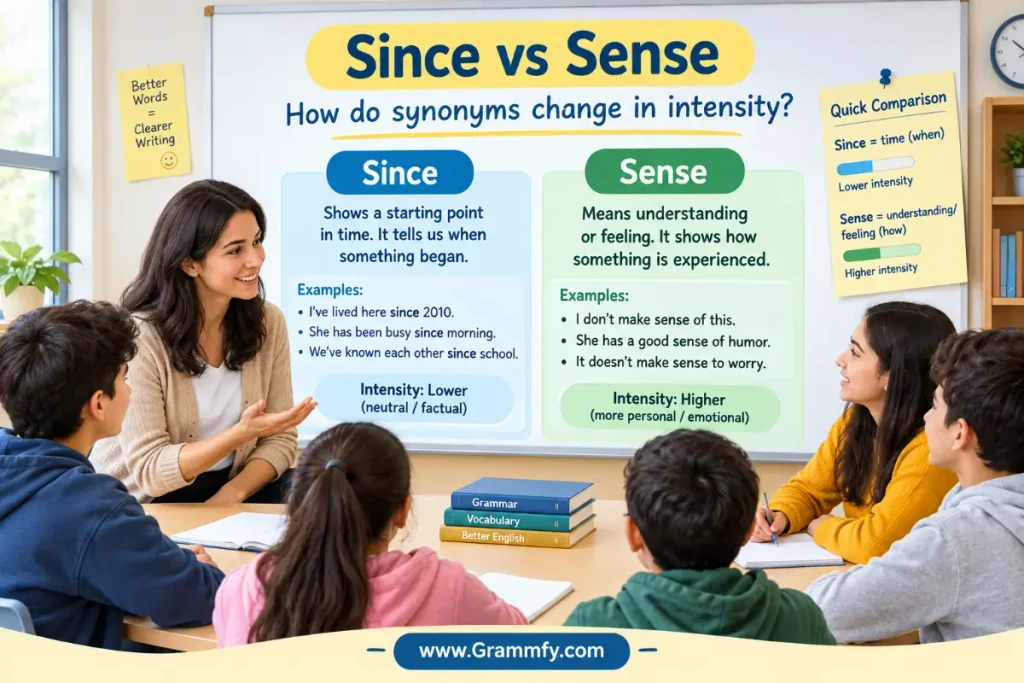
How do synonyms change in intensity?
Not every synonym has the same strength.
Mild awareness
These suggest a small or uncertain impression:
- feeling
- impression
- hint
- suspicion
- idea
Example:
I had a feeling that he would call.
Medium awareness
These suggest stronger recognition:
- awareness
- perception
- understanding
- realization
Example:
She had an awareness of the risks.
Strong awareness
These can suggest a strong inner judgment:
- certainty
- conviction
- knowledge
- intuition
Example:
His intuition told him not to continue.
The same idea can therefore sound weaker or stronger depending on the word you choose.
How are sense-related words used as different parts of speech?
This is important because sense can work as both a noun and a verb.
Sense as a noun
Examples:
- That makes sense.
- I have a sense of humor.
- Sight is one of the five senses.
- She has good business sense.
Sense as a verb
Examples:
- I could sense trouble.
- She sensed that he was nervous.
- The dog sensed danger.
- He sensed a change in the room.
Since as a conjunction
Example:
Since you finished early, you can leave.
Here it introduces a reason.
Since as a preposition
Example:
I’ve lived here since 2020.
Here it introduces a starting point in time.
Since as an adverb
Example:
I haven’t seen him since.
Here it stands alone and refers to a previously mentioned time.
Since vs sense in resumes: which word should you use?
In a resume, both words can appear, but they serve completely different purposes.
Use since when describing experience over time.
Examples:
- Worked as a sales assistant since 2022.
- Managed the team since January 2024.
- Have used Excel since college.
Use sense when describing skills, judgment, or perception.
Examples:
- Strong business sense.
- Excellent financial sense.
- Strong sense of responsibility.
- Good sense of customer needs.
A resume sentence like this is correct:
I have managed customer accounts since 2022.
But this is different:
I have a strong sense of customer needs.
The first sentence describes time. The second describes awareness or understanding.
Since vs sense in essays: which word sounds right?
Essays often use since to explain causes or establish time.
Examples:
Since the Industrial Revolution, technology has changed daily life.
Or:
Since the evidence was incomplete, researchers continued the study.
Use sense when discussing meaning, interpretation, or judgment.
Examples:
- The author creates a strong sense of tension.
- The final paragraph gives the story a deeper sense of meaning.
A useful test is to replace since with because.
If the sentence still makes sense, since is probably being used as a reason.
Example:
Since the evidence was weak, the claim was rejected.
Replace it:
Because the evidence was weak, the claim was rejected.
The meaning remains clear.
Since vs sense in texting: which one should you type?
Texting often makes mistakes more noticeable because people type quickly.
- Use since for time:
I haven’t talked to him since Monday.
- Use since for a reason:
Since you’re already there, can you grab coffee?
- Use sense for meaning:
That doesn’t make sense.
- Use sense for feelings or awareness:
I sense something weird is going on.
Common texting mistakes include:
❌ That doesn’t make since.
Correct:
✅ That doesn’t make sense.
And:
❌ I haven’t seen her sense Friday.
Correct:
✅ I haven’t seen her since Friday.
Since vs sense in emails: which is correct?
Professional emails often use since to describe dates and reasons.
Examples:
- I have been working on this project since March.
- Since the deadline has changed, I have updated the schedule.
Use sense when discussing clarity or meaning.
Examples:
- Does this proposal make sense?
- I want to make sure the instructions make sense to everyone.
A simple rule works well:
Time or reason → since.
Meaning or understanding → sense.
Since vs sense in speaking: how can you hear the difference?
These words are usually pronounced differently.
Since has a short vowel sound, while sense has a similar but not identical vowel quality depending on accent. In standard American English, they are clearly distinguishable in normal speech.
The final sounds are also different:
- since ends with a /s/ sound
- sense also ends with a /s/ sound
The main difference is the vowel.
If you’re learning English, listen carefully to the middle sound rather than focusing only on the spelling.
However, spelling is often the safer way to distinguish them when writing.
What are 10 real-life examples of Since vs Sense?
Here are examples from different situations.
1. Talking about work
I’ve worked at this company since 2021.
The word identifies the starting year.
2. Giving a reason
Since you already finished the report, you can send it to the manager.
Here, since means “because.”
3. Talking about meaning
Your explanation makes sense now.
The word refers to understanding.
4. Talking about intuition
I could sense that she was uncomfortable.
Here, sense is a verb meaning “notice or feel.”
5. Talking about time
We haven’t visited them since last summer.
The word identifies the starting point.
6. Talking about logic
It doesn’t make sense to spend money on something you don’t need.
Here, sense means logical or reasonable.
7. Talking about perception
Dogs have a powerful sense of smell.
Here, sense refers to a physical ability.
8. Talking about a past event
I haven’t eaten anything since breakfast.
Breakfast is the starting point.
9. Talking about awareness
She had a sense that someone was watching her.
Here, sense means an intuitive feeling.
10. Explaining a decision
Since the road was closed, we took another route.
Here, since means “because.”
11. Talking about humor
He has a great sense of humor.
The word describes a quality or ability to appreciate humor.
12. Talking about a continuing situation
I’ve been interested in grammar since high school.
The interest began in high school and continues.
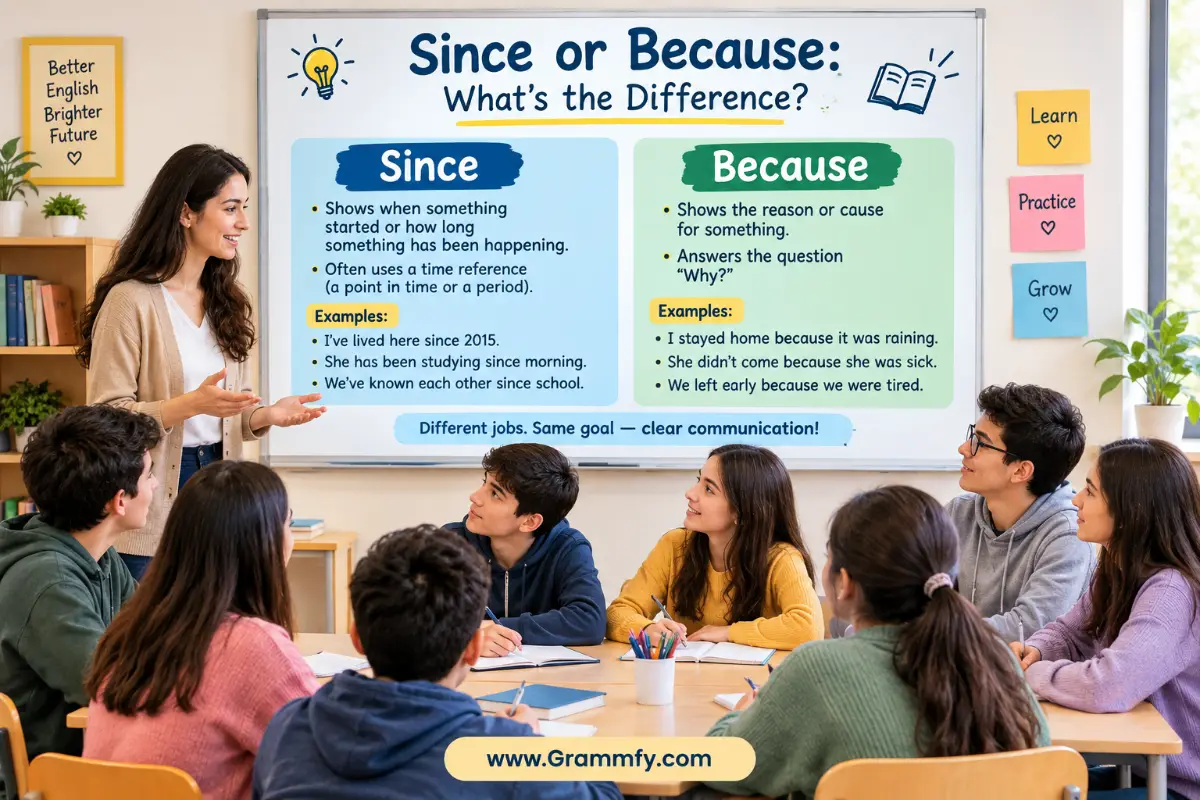
Since or because: what’s the difference?
Since and because can both introduce reasons, but they don’t always sound exactly the same.
Because is usually more direct.
- I stayed home because I was sick.
Since can sound slightly less direct or can place more attention on a fact that the listener already knows.
- Since I was sick, I stayed home.
In many sentences, either is grammatically correct.
For clear formal writing, because is sometimes better when the reason is especially important or could be misunderstood.
Compare:
Since the files were missing, we delayed the report.
Because the files were missing, we delayed the report.
Both are correct.
Sense vs meaning: what’s the difference?
Sense and meaning are often interchangeable, but not always.
Meaning usually refers directly to what a word, phrase, statement, or action represents.
What is the meaning of this word?
Sense can refer to meaning, but it often adds an idea of logic, interpretation, or understanding.
I don’t see the sense in doing that.
Here, sense means something closer to “reason” or “logic.”
Compare:
| Sense | Meaning |
|---|---|
| Often suggests logic or understanding | Directly describes what something represents |
| That makes sense. | What does this word mean? |
| I don’t see the sense in it. | I don’t understand the meaning. |
| Can describe perception | Usually focuses on interpretation |
Sense vs feeling: what’s the difference?
These words overlap when talking about intuition.
A feeling is a general emotional or intuitive experience.
I had a feeling that she was upset.
A sense can also describe an intuitive awareness.
I had a sense that something was wrong.
The difference is subtle.
Feeling is more common and conversational. Sense can sound slightly more neutral or descriptive.
Compare:
I had a feeling that he was lying.
I had a sense that he was hiding something.
Both are natural.
What are the most common mistakes with “Since vs Sense”?
These words are easy to confuse because they look and sound somewhat similar.
Mistake 1: “That makes since”
Incorrect:
❌ That makes since.
Correct:
✅ That makes sense.
The expression is always make sense.
Mistake 2: “I’ve lived here sense 2020”
Incorrect:
❌ I’ve lived here sense 2020.
Correct:
✅ I’ve lived here since 2020.
The word introduces the starting point.
Mistake 3: “Since of humor”
Incorrect:
❌ She has a great since of humor.
Correct:
✅ She has a great sense of humor.
Mistake 4: “I can since something is wrong”
Incorrect:
❌ I can since something is wrong.
Correct:
✅ I can sense something is wrong.
Here, sense is a verb.
Mistake 5: Confusing time with meaning
Incorrect:
❌ I haven’t seen him sense Friday.
Correct:
✅ I haven’t seen him since Friday.
Ask yourself whether you are talking about when something began.
If yes, use since.
When should you NOT use since?
Don’t use since when you mean meaning, understanding, or perception.
For example:
❌ That doesn’t make since.
Use:
✅ That doesn’t make sense.
Don’t use since for the five physical senses.
❌ Sight is one of the five since.
Use:
✅ Sight is one of the five senses.
Don’t use since as a verb for perception.
❌ I since that he is worried.
Use:
✅ I sense that he is worried.
When should you NOT use sense?
Don’t use sense when you need to identify a starting point in time.
Incorrect:
❌ I’ve lived here sense 2019.
Correct:
✅ I’ve lived here since 2019.
Don’t use sense to introduce a reason.
Incorrect:
❌ Sense it was raining, we stayed home.
Correct:
✅ Since it was raining, we stayed home.
Don’t use sense to replace because.
What are the antonyms of since and sense?
There is no single direct antonym for either word in every context because both words have multiple meanings.
For since in its time-related use, possible contrasts include:
- before
- until
- prior to
Example:
I’ve lived here since 2020.
A contrasting idea might be:
I lived there before 2020.
For sense, possible opposites depend on the meaning.
If sense means understanding:
- confusion
- misunderstanding
- nonsense
When it means good judgment:
- foolishness
- poor judgment
- irrationality
If it means awareness:
- unawareness
- ignorance
The correct opposite depends on the sentence.
How can you quickly choose the right word “Since vs Sense”?
Use these simple questions.
Ask: “Am I talking about a starting time?”
If yes, choose since.
I’ve known her since 2015.
Ask: “Am I giving a reason?”
If yes, choose since.
Since it was late, we left.
Ask: “Am I talking about meaning or logic?”
If yes, choose sense.
That doesn’t make sense.
Ask: “Am I talking about perception or awareness?”
If yes, choose sense.
I could sense danger.
Ask: “Can I replace it with because?”
If yes, since may be correct.
Since he was tired, he went home.
→ Because he was tired, he went home.
Ask: “Can I replace it with meaning?”
If yes, sense may be correct.
I understand the sense of the sentence.
→ I understand the meaning of the sentence.
What are easy memory tricks for “Since vs Sense”?
Try these shortcuts.
Memory trick 1: Since = start
Both since and start connect with time.
Think:
Since → Starting point
since Monday
since 2020
since breakfast
Memory trick 2: Sense = meaning
The word sense often answers questions such as:
Does it make sense?
What does it mean?
If you’re talking about understanding, choose sense.
Memory trick 3: Sense has “senses”
Think of:
- sight
- sound
- smell
- taste
- touch
These are your senses.
Memory trick 4: “Make sense” is a fixed phrase
Whenever you mean “be logical” or “be understandable,” use:
make sense
Never write:
❌ make since
Write:
✅ make sense
Why do since vs sense get confused?
There are several reasons.
First, both words begin with sen/sin-like sounds and contain similar letters. Second, English spelling is not always predictable from pronunciation. Third, fast typing can cause people to choose the wrong word without checking its meaning.
Another reason is that both words appear frequently in everyday English.
For example, these sentences are common:
I’ve been here since Monday.
That makes sense.
Because both expressions are familiar, writers may type the wrong spelling automatically.
The solution isn’t memorizing dozens of rules. It is learning the job of each word.
Since connects an event with a time or reason.
Sense connects with meaning, perception, awareness, or judgment.
Quick comparison: since vs sense
| Feature | Since | Sense |
|---|---|---|
| Talks about time | Yes | No |
| Gives a reason | Yes | No |
| Means meaning | No | Yes |
| Relates to perception | No | Yes |
| Can be a verb | No | Yes |
| Can be a noun | No | Yes |
| Common phrase | since then | make sense |
| Example | since Monday | common sense |
The easiest distinction is:
Since tells you when or why. Sense tells you what something means or how something is perceived.
Practice: choose since vs sense
Try filling in each blank before checking the answers.
- I haven’t called her ___ Tuesday.
- That explanation doesn’t make ___.
- ___ you’re already here, let’s begin.
- He has a strong ___ of responsibility.
- I could ___ that she was worried.
- We’ve known each other ___ childhood.
- Does this plan make ___?
- ___ the store was closed, we went home.
- Dogs have an excellent ___ of smell.
- I haven’t eaten ___ breakfast.
Answers
- since
- sense
- Since
- sense
- sense
- since
- sense
- Since
- sense
- since
Notice the pattern. Time and reasons take since. Meaning, awareness, judgment, and perception take sense.
A final checklist for choosing the right word Since vs Sense
Before you submit an email, essay, post, or message, check the sentence.
- Is it about a starting point in time? → since
- Does it mean “because”? → since
- Does it mean “meaning”? → sense
- Does it describe a physical ability? → sense
- Does it describe awareness or intuition? → sense
- Does it describe practical judgment? → sense
- Is the phrase “make ___”? → Usually sense
- Is the phrase “___ Monday”? → since
- Is the phrase “___ 2020”? → since
- Is the phrase “common ___”? → sense
- Is the phrase “___ of humor”? → sense
These quick checks can prevent most errors.
Conclusion
The easiest way to remember Since vs Sense is to focus on meaning instead of spelling. Use since when you point to a starting time, such as “since Monday,” or when you give a reason, such as “since it was raining.” Use sense when you talk about meaning, logic, awareness, judgment, or perception. The fixed phrase make sense is one of the most common examples.
When you’re unsure, ask yourself one quick question: Am I talking about when or why, or am I talking about meaning or perception? If it’s when or why, choose since. If it’s meaning or perception, choose sense. With a little practice, this commonly confused pair becomes easy to handle in writing and conversation.
Frequently Asked Questions
What is the difference between since and sense?
Since usually refers to a starting point in time or gives a reason, while sense refers to meaning, perception, awareness, or judgment. They are different parts of English grammar and cannot normally replace each other.
Is it “make sense” or “make since”?
The correct phrase is make sense. Use it when you mean that something is logical, understandable, or reasonable.
Is it since Monday or sense Monday?
The correct phrase is since Monday. Since introduces the starting point of an action or situation.
What’s another way to say sense?
Another way to say sense depends on its meaning; possible alternatives include meaning, understanding, feeling, awareness, perception, intuition, and judgment. Choose the synonym that matches the exact context.
Is since the same as because?
Since can mean because when it introduces a reason. For example, “Since it was raining, we stayed home” means “Because it was raining, we stayed home.”
Can sense be a verb?
Yes, sense can be a verb meaning to notice, perceive, or become aware of something. For example, “She could sense that something was wrong.”
How can I remember the difference between since and sense?
Think of since as connecting to a starting point or reason, while sense connects to meaning, perception, or understanding. The phrase make sense is a useful clue because it always uses sense.

1 thought on “Since vs Sense: The Ultimate Guide to Using Them Correctly”